
D
Oct 17, 2025 at 10:12 AM
Latin America's Alibaba Mercado: Alibaba's 'face', Amazon's 'core'?
 I'm LongbridgeAI, I can summarize articles.
In the previous first and second parts of Dolphin Research's coverage on $Mercadolibre(MELI.US)—one of the largest integrated internet giants in Latin America—we explored and analyzed the industry environment, market competition landscape, and business models of the company's two major pillars: e-commerce and financial credit business. In this concluding part, Dolphin will focus on recent company and industry dynamics, the outlook for the company's future performance, and finally, our judgment on the company's valuation and investment value.
Detailed Analysis:
I. E-commerce Segment
1. E-commerce in Latin America is still in its early stages despite improved fulfillment efficiency
1) The potential of Latin American e-commerce is being released slowly, with economic instability and logistics bottlenecks as major issues
As mentioned in the first part, we can make two qualitative summaries about the Latin American e-commerce market where Meli operates:
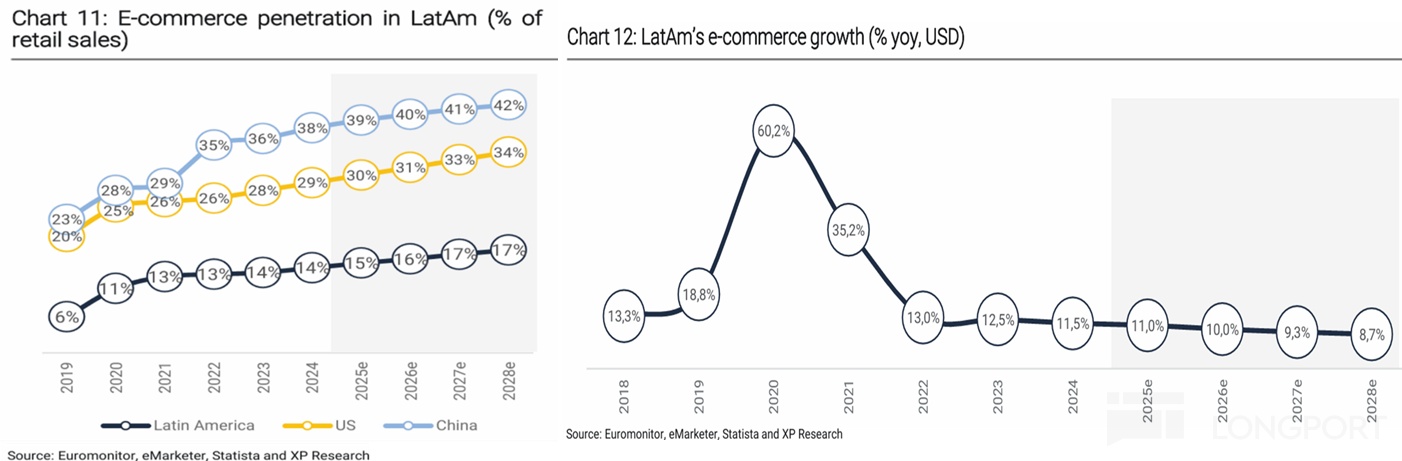
a. The Latin American e-commerce market is still in the early to mid-development stage. By 2024, the online shopping penetration rate in Latin America (excluding categories like automobiles, oil, and gas) is only around 14%, compared to 30%~40% in mature markets like China and the US, indicating significant room for improvement in the long term.
b. However, historically, even with a low penetration rate base, the growth of the Latin American e-commerce industry has not been rapid except during the pandemic boom. As shown in the chart below, growth was less than 20% between 2018 and 2019 before the boom, and after 2022, the industry's growth rate quickly declined as the pandemic ended, failing to sustain high growth.
Based on the analysis in the first part, the main constraints on the historically slow growth of the e-commerce industry in Latin America include:
a. Political instability and slow macroeconomic growth in the region (with a 10-year GDP compound growth rate of only 1.5% for the major five Latin American countries in USD terms). With a weak underlying economic growth, the e-commerce industry naturally struggles to achieve high growth.
b. Due to geographical constraints and poor logistics infrastructure in Latin America, the fulfillment and delivery experience, a crucial part of e-commerce, is poor (with long delivery times and frequent package losses), which is another major factor limiting the growth of e-commerce in the region.
2) Giants leading logistics infrastructure will eventually boost online penetration
Regarding the first point—whether the political environment and economic growth in Latin American countries will improve significantly in the future—Dolphin has no intention or ability to predict. However, regarding the second point—the constraints on logistics fulfillment—Meli has led the way in building its logistics capabilities, significantly improving the delivery timeliness and experience of e-commerce packages (according to the company, about 52% of Meli's packages were delivered on the same day or the next day in 2Q25). This has also prompted other e-commerce platforms, including Shopee, to focus more on logistics fulfillment and build their fulfillment capabilities.
Dolphin believes that with the upgrade driven by upstream demand, the construction of logistics fulfillment facilities and capabilities in Latin America will continue to improve. The improvement in fulfillment capabilities will also boost the penetration rate of the upstream e-commerce industry, aligning with mature markets like China and the US.
Looking more closely at the Brazilian market, in 2023, the product categories with higher online penetration include toys, video games, digital products, and furniture. These four categories are typical "e-commerce advantage categories," and their penetration rates in Brazil are not too far behind those in mature markets like China and the US. However, in other "e-commerce advantage categories" such as footwear, beauty products, and traditional "e-commerce disadvantage categories" like food and beverages and various daily necessities, the penetration rate gap between Brazil and mature markets is very significant.
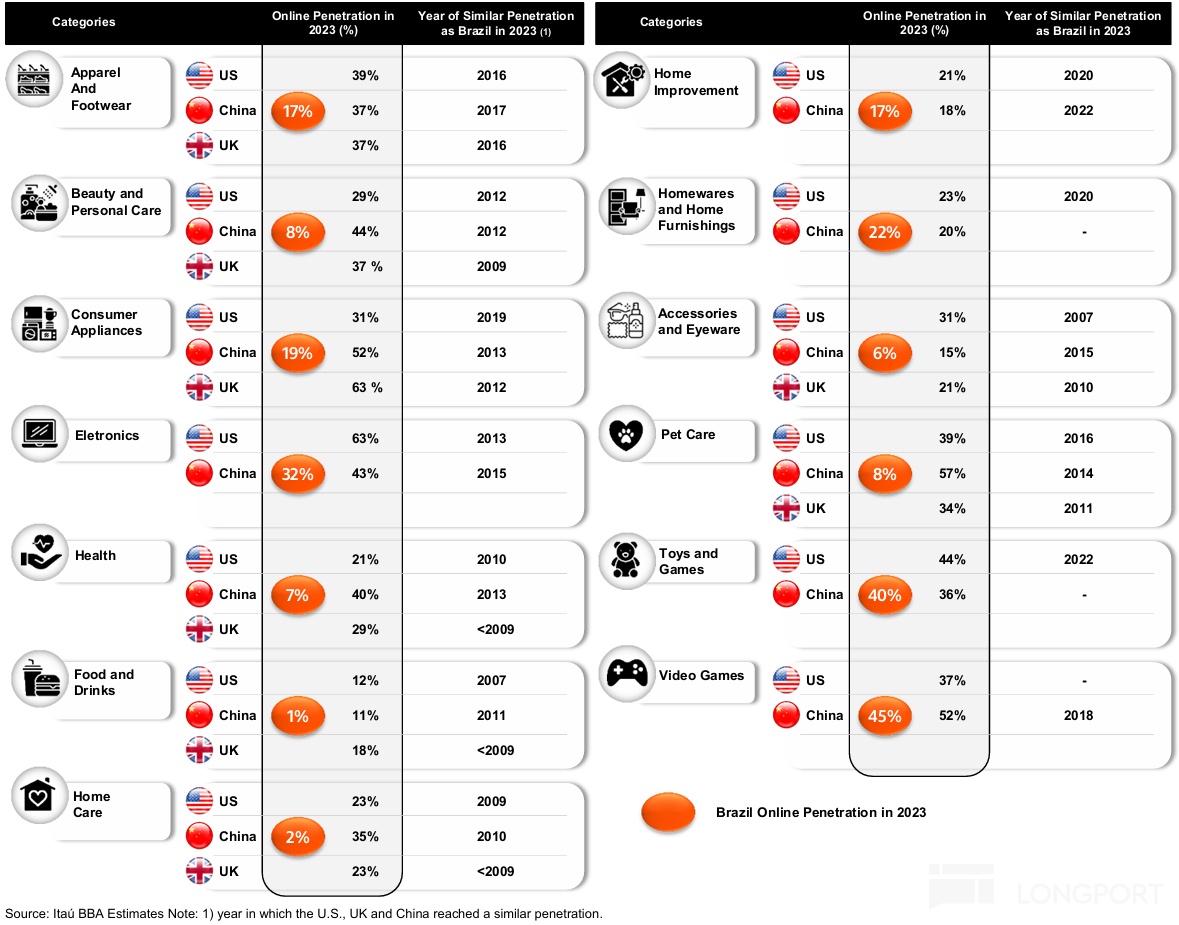
Dolphin believes that one important factor causing the penetration rate differences between different categories in Brazil is the ratio of fulfillment cost to product price. After all, if the proportion of fulfillment cost to the product's own value is too high, online purchases are not "economical." (Other factors include differences between standardized and non-standardized products, etc.). Currently, in Brazil, the product categories with higher penetration rates are either those that do not require fulfillment (digital games) or those with high unit prices that can fully cover fulfillment costs (digital products and large furniture).
Therefore, Dolphin believes that with the improvement in logistics efficiency and the reduction in average fulfillment costs, the online penetration of categories such as apparel, beauty products, daily necessities, and food, which have relatively low unit prices or high fulfillment requirements, is expected to increase significantly.
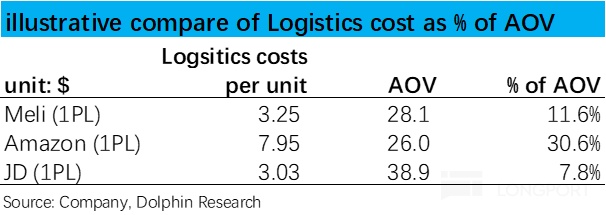
According to Dolphin's estimates, Meli's current average fulfillment cost accounts for about 11%~12% of the unit price, compared to about 7%~8% for JD.com (first-party warehousing model) in China, indicating a significant efficiency gap. This confirms that for Latin American residents, whose per capita consumption capacity is still weaker than that of China, the current fulfillment cost of Latin American e-commerce is indeed high, with much room for improvement.
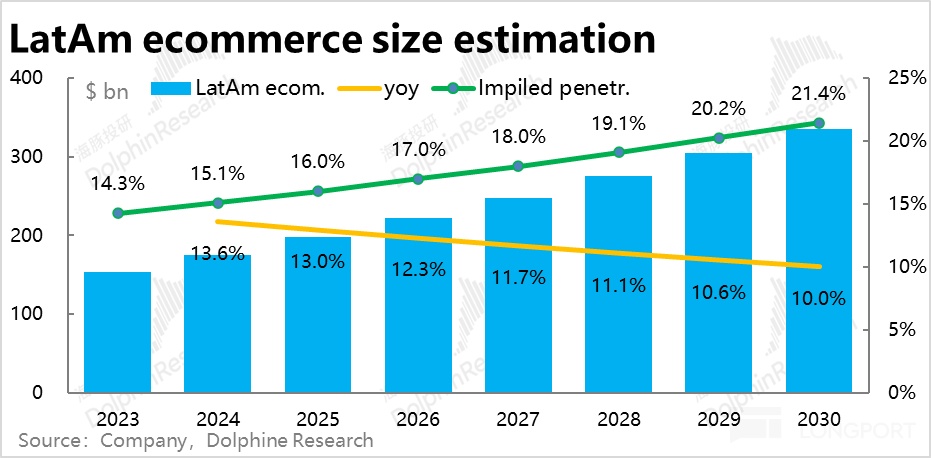
In summary, Dolphin's view on the future growth potential of the Latin American e-commerce market is that, driven by improved fulfillment capabilities, there is a definite potential for significant growth in the penetration rate and scale of the e-commerce industry in Latin America in the long term. According to a forecast by a foreign investment bank, the online penetration rate in the Brazilian market is expected to increase by about 10 percentage points from 2023 to 2030.
However, based on historical experience, the increase in e-commerce penetration and scale in Latin America is likely to be a slow process (for example, it may take a 10-year cycle), and it is not realistic to expect explosive growth in the Latin American e-commerce market in the next 3~5 years in the medium term.
Therefore, out of caution, Dolphin conservatively expects the compound growth rate of the overall Latin American e-commerce market to be about 11% during the 5 years from 2025 to 2030. The market size is expected to grow by about 70% from 2025 to 2030, reaching $335 billion. However, it should be emphasized that it is difficult to accurately predict when the explosive improvement in fulfillment efficiency and online penetration rate will occur. The risk of actual performance deviating upwards is likely higher than the risk of deviating downwards.
2. Can Meli maintain its market share leadership?
Having established that the long-term potential of the Latin American e-commerce industry is significant and that medium-term growth is stable, the next major factor and question affecting the growth of Meli's e-commerce segment is how its market share will change in the current competitive environment, given that Meli is currently the market leader.
Based on the analysis in the first part, two qualitative judgments can also be made: First, although Meli is the clear market share leader in Latin America, it faces multiple strong competitors in its main markets of Brazil and Mexico, except in Argentina where it can be considered a monopoly (as shown in the pie chart below);
Second, although Meli is already the largest player (or one of the largest) in the major Latin American markets, the market share in these markets is still quite fragmented, and not fully consolidated. In the three major markets of Brazil, Mexico, and Argentina, about 40% of the market share is still held by numerous "unknown" small players.
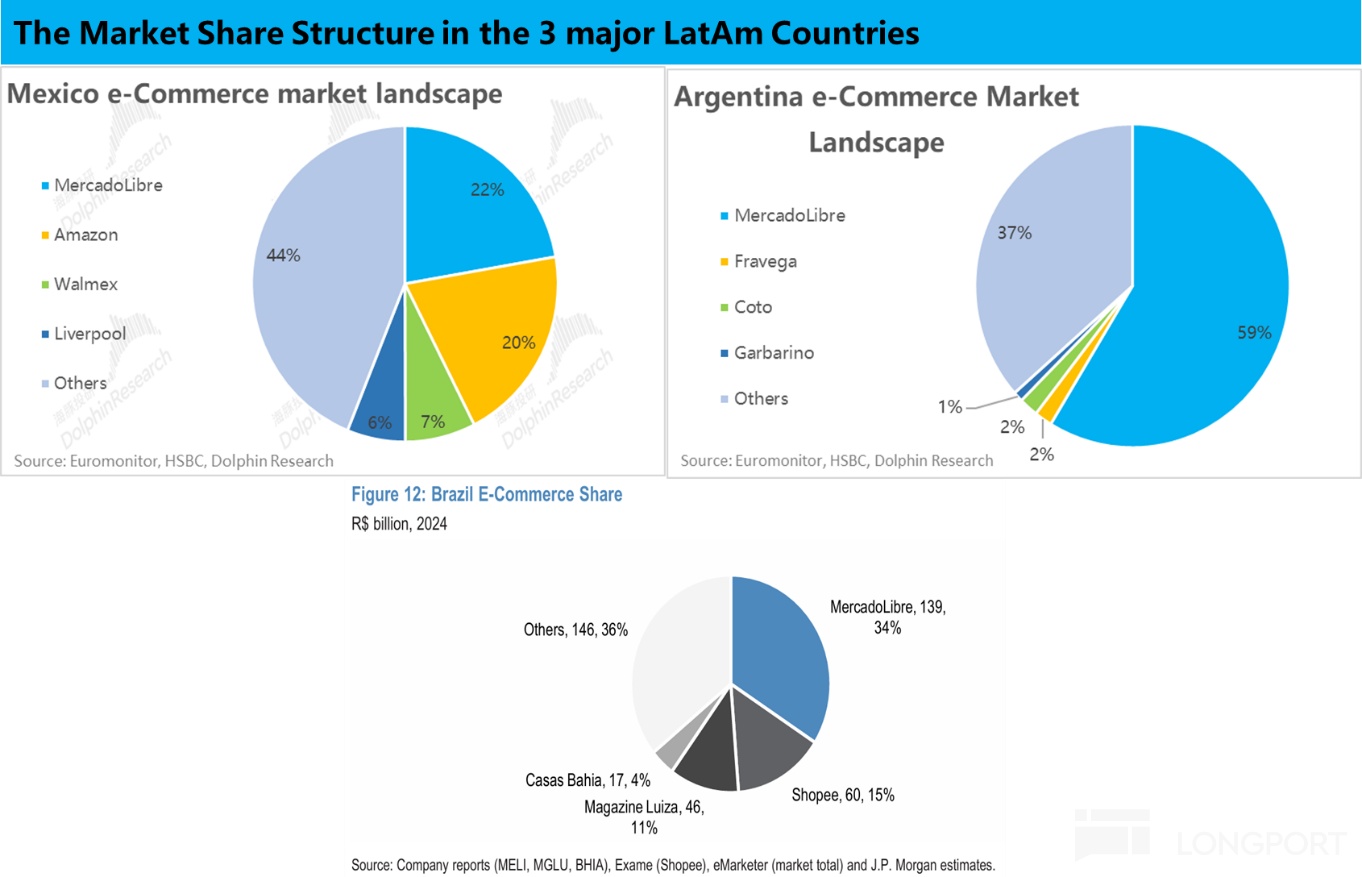
Combining the above two points, two opposing driving forces can be summarized: a. As the market consolidates, market share will further concentrate from "unknown small players" to leading giants; b. Strong competitors like the second and third largest players will significantly capture market share from Meli. Therefore, the question is, which of these two factors, one positive and one negative, is more likely to occur, or which will dominate if both occur simultaneously?
1) Using the mature experiences of China and the US as references
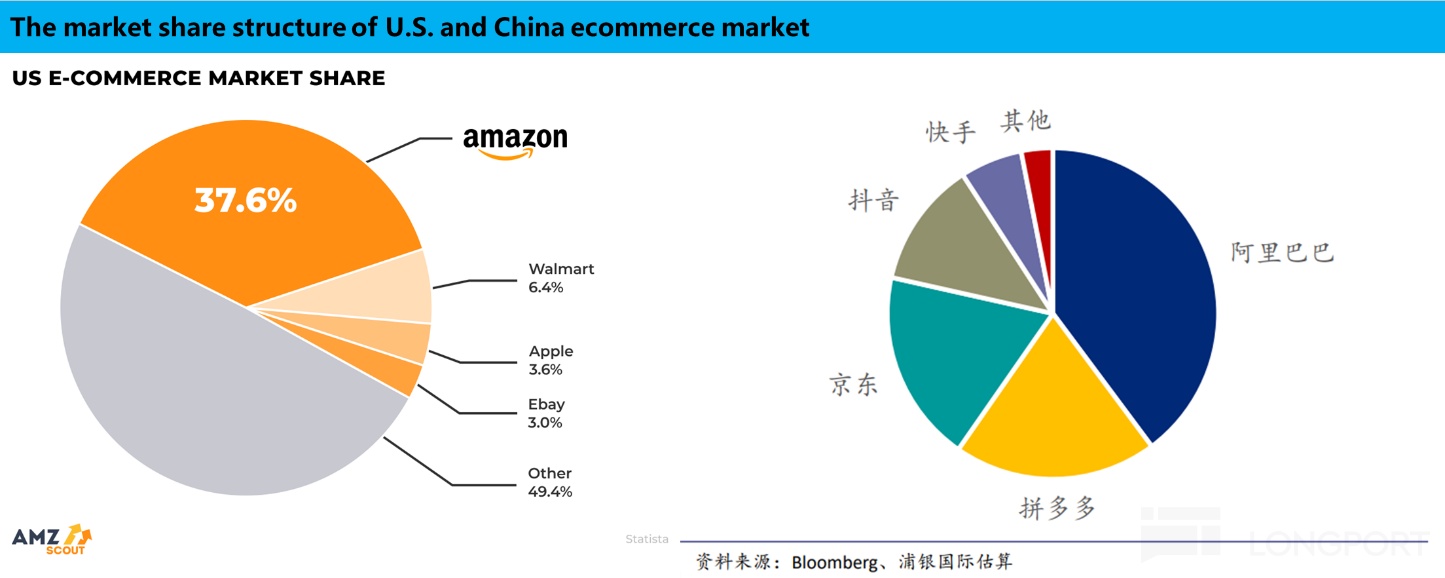
First, regarding whether the market share of the Latin American e-commerce industry will further concentrate, we can refer to the current situations in China and the US, the two most mature markets, to see which is more likely to be the direction of future development in Latin America. It can be seen that the market structures in China and the US are quite different:
a. The US market is also very fragmented, with nearly half of the market share held by "unknown" small and medium players. In contrast, China's market share is highly concentrated, with the top five players occupying about 95% of the national market share; b. Besides Amazon, the main players in the US e-commerce market are independent sites operated by numerous brand owners and vertical channel operators. In contrast, the Chinese market is almost entirely occupied by comprehensive platform-based e-commerce.
The factors that have led to these two most mature e-commerce markets evolving into completely different market structures are enough to warrant a separate discussion. Dolphin summarizes what it believes are the two main reasons for this stark difference:
a. Brand loyalty: Perhaps due to the stronger per capita consumption capacity of US residents or differences in consumer culture, US consumers have a significantly stronger recognition of brands or channels, and are more willing to shop from brands or channel operators they recognize or are familiar with. Even though independent sites logically have disadvantages in terms of operation and scale effects compared to larger comprehensive platforms, they have not been replaced by the latter.
b. Whether fulfillment logistics is "shared": Specifically, during the early stages of the development of the e-commerce industry in both countries, the leading e-commerce company in the US—Amazon—chose to build an in-house warehousing and fulfillment system, while the leading company in China—Alibaba—chose to establish an external fulfillment system with Tongda Express.
Amazon's exclusive and proprietary logistics capabilities have blocked or at least increased the difficulty for later platform-based e-commerce companies to develop. In contrast, Alibaba's cultivation of a highly efficient but shared Tongda Express system provided later entrants with ready-made and homogeneous delivery capabilities, which instead helped new platform-based e-commerce companies to also develop rapidly.
Dolphin believes that this is another main reason why there is only one "seedling" in the US—Amazon—while multiple platform-based e-commerce companies have grown in the Chinese market, sharing the market.
2) The Latin American market is more like the Chinese market, but with differences
Based on the experiences of the Chinese and US markets, let's look at the situation in Latin America:
a. The Latin American e-commerce market is more likely to concentrate than to remain fragmented: Dolphin believes that in terms of consumption capacity, consumption habits, and the development level of brand commerce, Latin American consumers should be more similar to Chinese consumers. Logically, the Latin American market should not be able to support a large number of small and medium-sized brand independent sites with efficiency disadvantages for long-term survival. And unlike the US, which has only Amazon, Latin America is more like China, with multiple leading e-commerce platforms already existing, so it is unlikely to have a situation where one company dominates.
In other words, the Latin American e-commerce market is more likely to be similar to the Chinese market, with market share further concentrating, rather than maintaining a fragmented state like the US.
b. Following a different path, multiple platforms are building their own logistics fulfillment capabilities: In terms of fulfillment, Latin America has taken a path different from both China and the US. Meli, as the leader in Latin America, is building its own logistics, so it will not allow later entrants to "hitch a ride," and can have relatively stronger competitive barriers.
However, unlike Amazon's situation, its scale and market share in the US are overwhelmingly leading, and after establishing huge first-mover and scale barriers, it is basically impossible for later entrants to have the ability and willingness to invest hundreds of billions of dollars to rebuild similar logistics capabilities to compete with Amazon.
But Meli has competitors in the Brazilian and Mexican markets with not-so-large gaps (Shopee, Magazine, and Temu in Brazil, and Amazon in Mexico), and both Shopee and Magazine are also building their own logistics capabilities. Latin America has taken another path where leading e-commerce platforms are building their own logistics fulfillment capabilities.
According to news reports, Shopee and Magazine both started building their own logistics and warehousing centers in the second half of 2024, providing warehousing and fulfillment services. The table below summarizes the logistics fulfillment facilities that Meli, Shopee, and Magazine have already built or plan to build around 2025, according to media reports. It can be seen that Meli currently has several times more warehousing and fulfillment centers in Brazil compared to its competitors, but the latter two have also established a certain scale and systematic delivery network.
Therefore, Dolphin believes that better logistics fulfillment capabilities will still be Meli's competitive advantage, but it will not be an exclusive and overwhelmingly leading advantage like Amazon's.

From another perspective, is it possible for competitors like Shopee and Temu to significantly capture Meli's market share in Brazil, or even take Meli's current market share leadership position? Dolphin believes that the probability is not high at present.
Similarly, referring to the experience in China, although the competition in the domestic e-commerce industry is extremely fierce, Alibaba's market share has indeed declined year by year under intense competition, but it still maintains a huge advantage over the second place (36% vs. 21%).
From the domestic experience, it is difficult to say that there are absolute barriers or advantages and disadvantages in the e-commerce industry. More often, different platforms have their own suitable markets and user groups under different brand, price, and other positioning. Dolphin believes that one of the main reasons why Alibaba can still maintain its market share leadership in China is its scale advantage and its advantages in "multiple" dimensions.
According to the analysis in the first part, Meli, like Alibaba, is also the best platform in Latin America in terms of "multiple" dimensions, or "universal" dimensions. Therefore, even if Shopee and Temu can outperform Meli in their respective suitable customer groups (currently mainly cost-effective customer groups), Meli is likely to maintain its first-place market share.
In summary, from a qualitative perspective, Dolphin believes that the more likely situation in the Latin American market is that, on the one hand, as the market consolidates, market share will further concentrate on leading platforms. However, the competitive environment among leading platforms will be more similar to the Chinese market— that is, there will be continuous competition among multiple platforms.
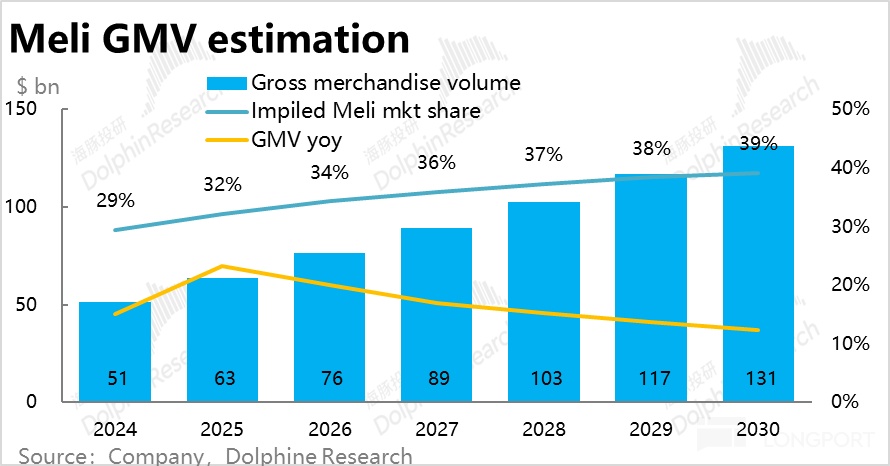
Therefore, in quantitative predictions, Dolphin expects that in the next 5 years, Meli's market share in Latin America will steadily increase from 29% to about 39%, continuing to rise but not dominating the market. The corresponding GMV's 5-year compound growth rate is 15.7%, with the scale growing from $63.4 billion in 2025 to about $131 billion in 2030.
3. Advertising is the main direction for monetization rate improvement
Above, Dolphin discussed the growth prospects of Mercado's e-commerce GMV. Next is the judgment on the company's monetization space and future revenue in the e-commerce business.
According to disclosures, by 2Q25, the overall monetization rate of Meli's e-commerce business (excluding the self-operated part) for the 3P platform business was 21%. Compared to the generally 3%~5% monetization rate of domestic e-commerce, this is exaggeratedly high, but it is not uncommon in overseas markets.
Breaking down the monetization rate into three main parts: commission, fulfillment-related fees, and advertising monetization, and using Amazon and Shopee as reference objects. It can be seen that Meli's monetization level is between Amazon (comprehensive over 40%) and Shopee (just over 11%).
According to Dolphin's calculations, breaking down the monetization rate into commission-based monetization, fulfillment-based monetization, and advertising-based monetization, specifically:
1) Commission monetization is relatively saturated
Among them, Meli's commission-based monetization is about 13%, even slightly higher than Amazon's. Part of this is because Meli's commission-based monetization also includes the payment service fees of Mercado Pago, as well as the service fees for merchants providing installment payment functions to consumers. After excluding the payment-related part, Meli's pure commission-based monetization level should be around 8%~10%, higher than Shopee and slightly lower than Amazon.
Therefore, Dolphin believes that in terms of commission monetization, Meli has currently reached a relatively balanced position, and there is unlikely to be a significant jump in the future, with more likely small increases.
2) Advertising monetization still has considerable space
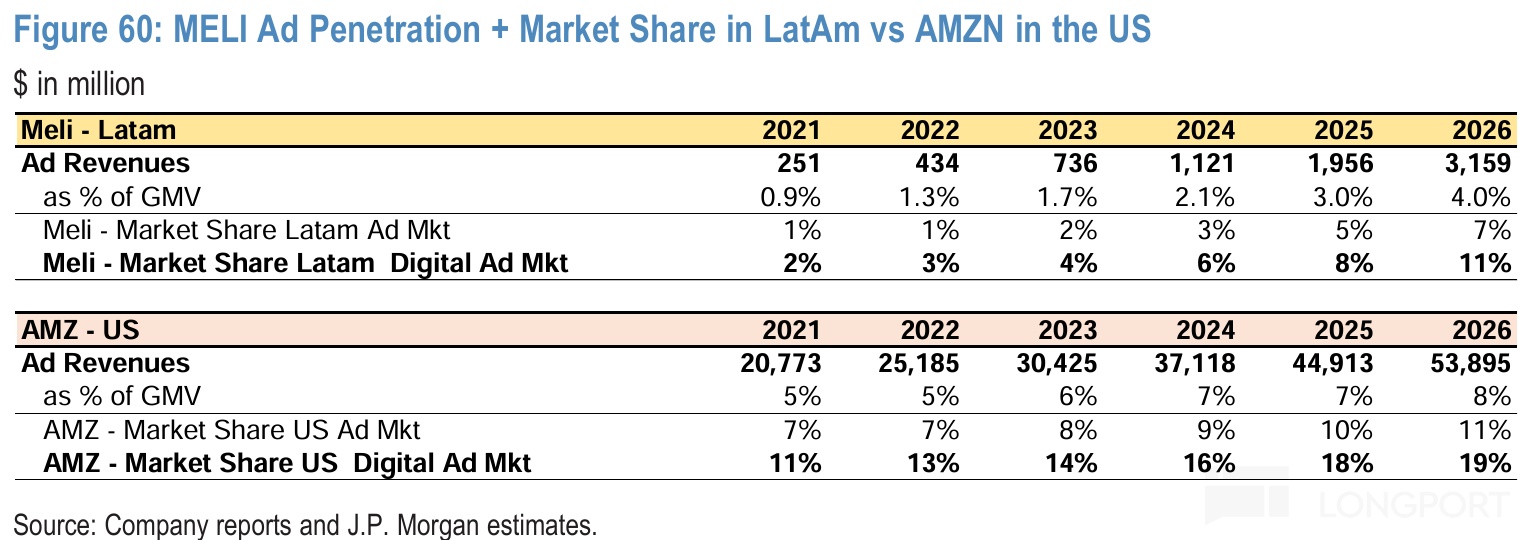
In terms of advertising monetization, according to the company's official disclosure, by 4Q24, Meli's advertising monetization rate had reached 2.1% of GMV. According to Dolphin's forecast, it may increase to 2.4% or higher by 2025. Similarly, in horizontal comparison, Meli's advertising monetization level is currently roughly equivalent to Shopee, but there is still a significant gap compared to Amazon's monetization level of about 7%~8%.
Therefore, the market generally believes that the main direction for Meli's future monetization improvement is in advertising.
As for the improvement space, referring to JPM's analysis using Amazon as a reference. Amazon, with a market share of about 30%~40% in the US e-commerce market, has achieved about 10% of the overall US advertising market share, and an advertising monetization rate of about 7% based on GMV.
Currently, Meli, with an overall market share slightly below 30% in the Latin American market, has achieved about 5% of the overall Latin American advertising market share and nearly 3% monetization rate by 2025. In other words, if Meli's market share in the Latin American e-commerce market steadily increases to about 40% in the future, then Meli's advertising share and monetization rate should also have the opportunity to double to Amazon's level.
3) Logistics is likely to remain loss-making, with no significant improvement space in the medium term
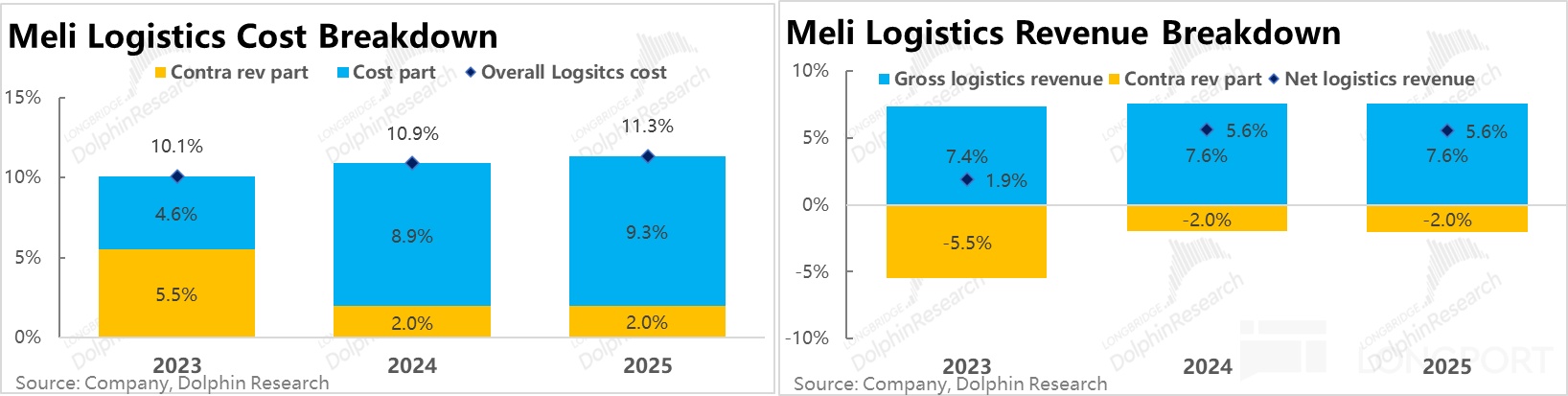
As can be seen from the table above, Meli's current net monetization rate reflected in revenue is about 5.6%, slightly higher than Shopee's 2.5%, but far lower than Amazon's (over 20%).
However, Meli's recognition of fulfillment costs is divided into two parts: recognized as a deduction from fulfillment revenue and as a cost. According to the company's disclosure, Meli's gross monetization rate for fulfillment (adding back revenue deductions) has fluctuated slightly around 7.5% over the past three years, while the total fulfillment cost has risen from about 10% (as a percentage of GMV) in 2023 to about 11% in 2025. In other words, Meli's fulfillment monetization rate has remained largely unchanged over the past three years, but fulfillment costs have risen year by year, with the company's fulfillment gross margin remaining negative, widening from -2.7% (as a percentage of GMV) in 2023 to -3.7% in 2025.
Dolphin believes that, on the one hand, the increase in fulfillment investment and the improvement in delivery timeliness, resulting in higher average delivery costs, is reasonable; on the other hand, due to competitors also building their own logistics capabilities, Meli is unlikely to significantly improve logistics monetization in the short term. In fact, the opposite is true, as both Meli and Shopee have recently lowered the free shipping threshold in the Brazilian market.
Looking ahead, Dolphin believes that in the 5-year period we forecast, Meli's fulfillment costs are likely to continue to rise slightly year by year, and only after the fulfillment system matures will they slowly decline. At the same time, due to the long-term competition in the Latin American e-commerce market, especially in Brazil, we do not expect Meli's fulfillment monetization to rise significantly within 5 years.
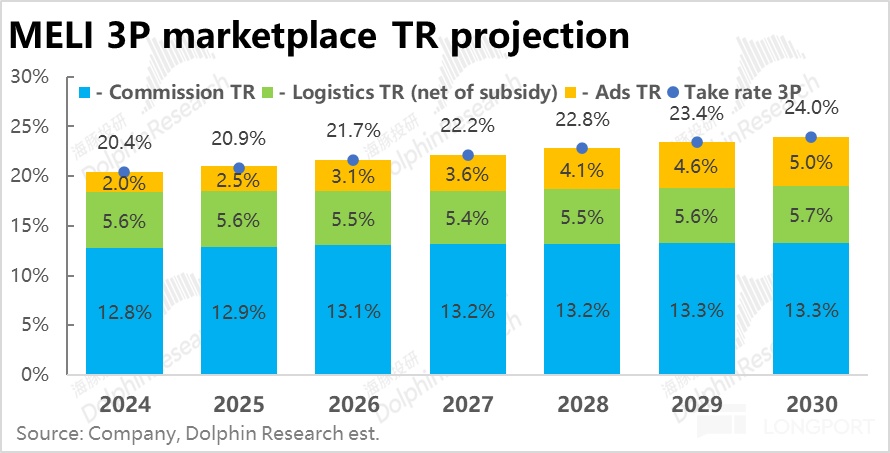
Based on the above judgment, for Meli's platform e-commerce business monetization rate, besides expecting the advertising monetization rate to increase significantly from about 2% in 2024 to 5% by 2030 (still some distance from Amazon's 7%~8%), other commission and fulfillment monetization are only expected to fluctuate or slightly increase. The monetization rate of the 3P platform business will increase from 20.4% to about 24%.
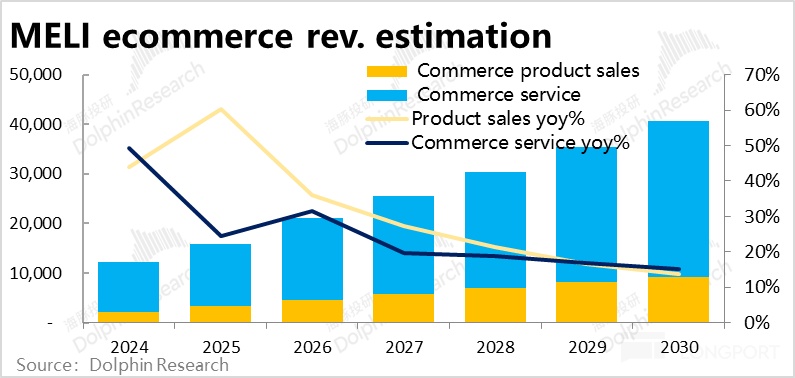
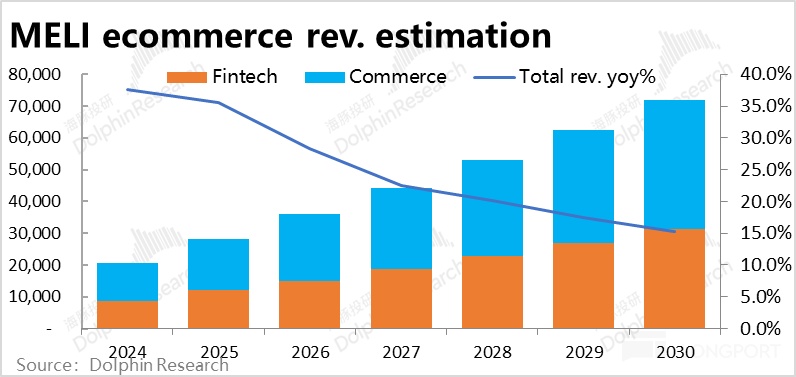
In addition to the company's self-operated e-commerce business, Dolphin expects the overall revenue of the e-commerce business to have a compound growth rate of about 21% over the next 5 years, growing by about 1.5 times from 2025 to nearly $41 billion.
II. Financial Business
After discussing the e-commerce segment, the following is a discussion of Meli's other pillar—financial payment and credit business. First, Dolphin wants to remind that, unlike Meli's relatively mature and market-leading position in the e-commerce segment, Meli's financial business, especially the credit business, is still in the early stage of rapid growth, with a very low market share. Even in the largest Brazilian market, Meli's payment business market share is only about 5%, and the credit business market share is only about 1%~2%.
Therefore, at the current scale, analyzing the future growth of Meli's financial segment from the perspective of industry growth or market share competition is not very meaningful. After all, even if the business scale grows several times compared to the current level, it will not be significantly limited by industry space and market share.
Therefore, Dolphin's focus will be more on the qualitative development dynamics of these two businesses, and how the profit structure will change as the company's financial business grows and its structure changes.
1. Payment business main theme: volume growth but declining monetization
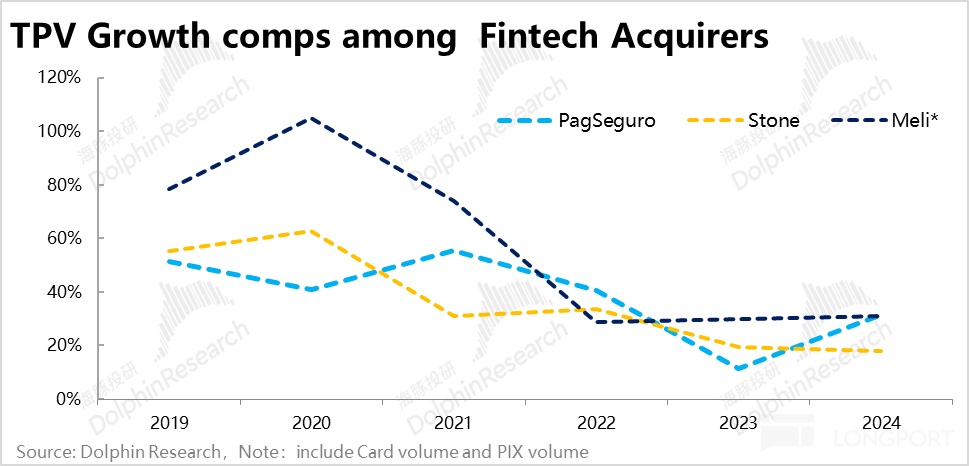
Based on the analysis in Dolphin's second part, the current situation of Meli's acquiring payment business (P2B payment) is roughly: a. Its payment penetration rate within the system has reached 100%, so the TPV within the system grows in proportion to GMV, with little change.
b. The main variable depends on the growth of TPV for payments outside the system. However, due to the highly homogeneous nature of payment functions, the payment experience of Mercado Pago is not significantly different from similar Fintech payment companies, and it has not significantly outperformed these peers, which is the background.
Notably, an important change in the Brazilian payment market is the PIX instant payment system. In summary, this system was promoted by the Central Bank of Brazil starting in 2020, aiming to simplify domestic payment/transfer processes, improve payment timeliness, and reduce payment handling fees.
In this system, users can open electronic accounts at any participating service provider (any financial institution with more than 500,000 accounts must participate in the PIX system). Subsequently, they can directly perform various operations such as P2P, P2B payments, or transfers through the PIX electronic account without any card or other medium. The system's backend clearing is directly handled by the Central Bank of Brazil, capable of completing payment clearing within 10 seconds, 24/7.
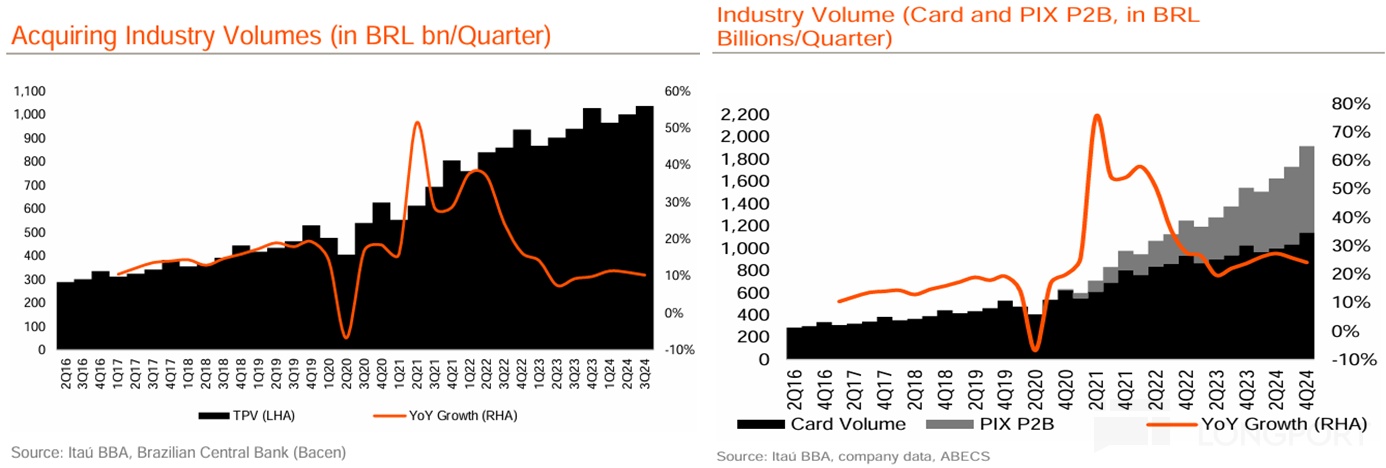
After the launch of PIX, due to its excellent convenience, it quickly became one of the main payment methods in Brazil. As shown in the chart below, by 4Q24, the payment amount completed through PIX in P2B payments had exceeded 60% of card payments (including credit and debit cards). Moreover, the growth rate of PIX P2B payments is still significantly outperforming card payments (as shown in the chart below, the growth rate of pure card payments is only about 10%, while the growth rate including PIX is about 25%).
In other words, the share of PIX payments will continue to increase, and it has become the main engine driving the overall payment amount growth.
So, what impact does the gradual mainstreaming of the PIX payment system have on payment providers like Mercado Pago? Looking at it from two directions:
a. First, from the competition perspective, the PIX system does not appear to significantly benefit Fintech payment providers like Pago. On the one hand, the PIX system has accelerated the acceptance of electronic payments by Brazilian residents; on the other hand, because PIX is mandatory for all institutions to connect, it relatively erases the advantage of Fintech payment institutions being more flexible, convenient, and relatively low-cost compared to traditional payment institutions.
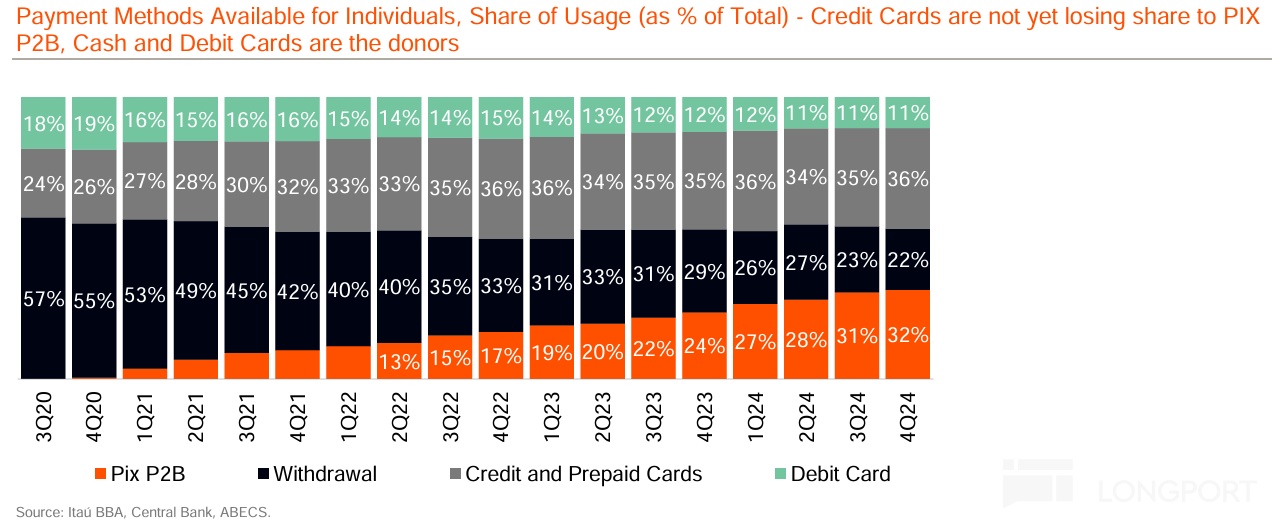
b. Impact on payment company revenue: On the one hand, the PIX system has accelerated the replacement of cash payments, helping to increase the monetizable payment amount scale (for payment providers, cash payments are worthless). As shown in the chart below, among all payment methods, PIX mainly replaced cash payments, with a small impact on debit cards. The proportion of credit card payments even slightly increased.
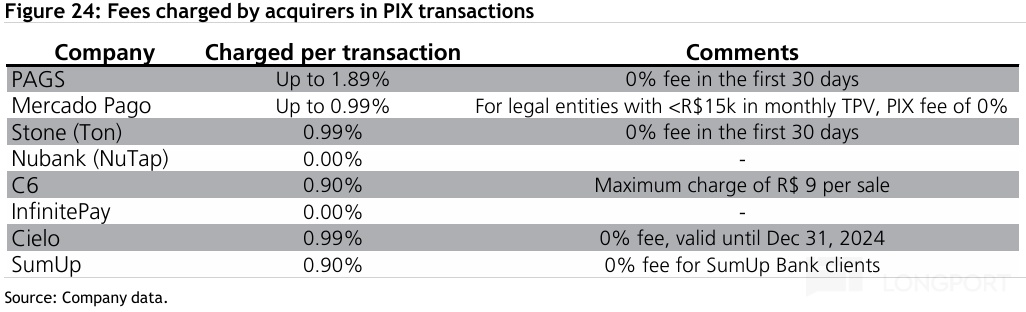
However, on the other hand, due to the low fee rate characteristic of PIX, it will significantly drag down the average payment fee rate of payment companies. As shown in the table below, most payment acquirers charge a fee rate of only 0.99% for PIX, and for specific user groups or within a limited time, it can even be as low as 0%. In contrast, the fee rate for debit and credit card payments can reach about 1.5%~5%.
Although the above impact is currently limited to the Brazilian market, since Brazil alone contributes more than 40% of the company's overall payment amount, the impact on the group as a whole is still quite significant. Therefore, Dolphin expects that while the company's acquiring payment business will maintain good TPV growth, the payment fee rate will show a more obvious downward trend.
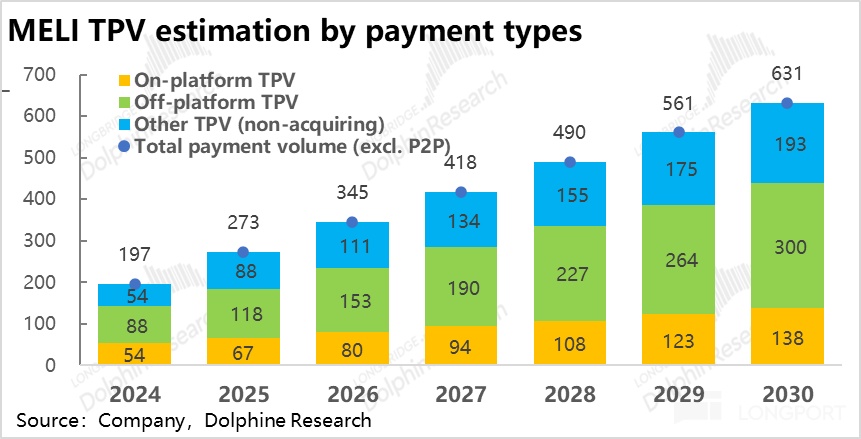
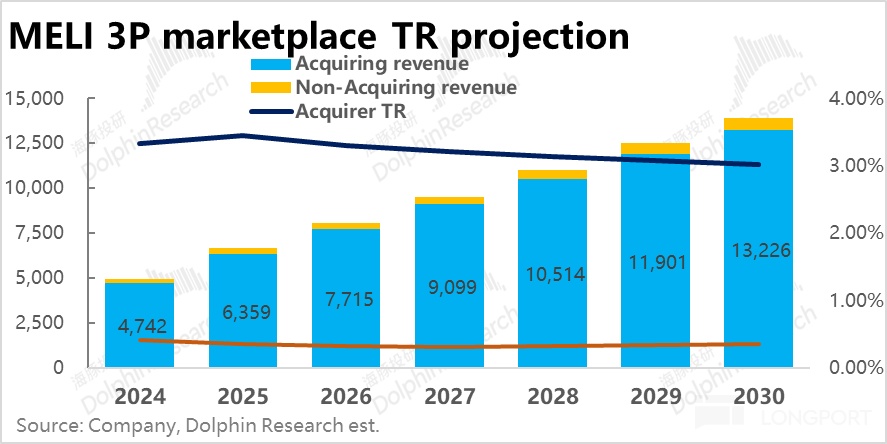
Summarizing acquiring payments outside the system, acquiring payments within the system, and non-acquiring payments, Dolphin expects Meli's total TPV to have a compound growth rate of about 18% over the next 5 years. That is, it will grow by about 1.3 times from 2025 to 2030.
However, since we assume that the fee rate for acquiring payments will decrease from 3.4% in 2025 to about 3% in 2030, and the fee rate for non-acquiring payments will remain roughly stable at about 0.35%. The revenue contributed by the payment business will grow from $6.7 billion in 2025 to about $13.9 billion.
2. Loan Business
1) Credit cards are the main driver of loan growth
Similar to the situation in the payment business but more so, Meli's credit business is at an even earlier stage, with an even smaller market share. Therefore, it is also difficult to use a top-down approach to predict the future growth space of the company's credit business. Quantitative predictions of the company's loan business balance are more dependent on the company's past performance patterns.
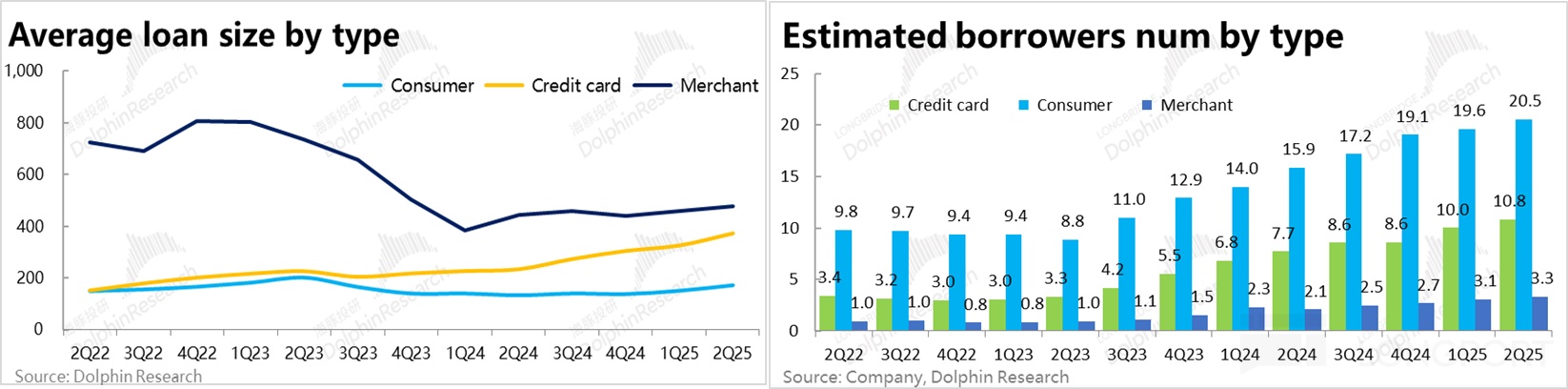
According to our second part coverage, a noteworthy point in the company's credit business is that the latest launched credit card loans have become the largest and fastest-growing sub-segment, with a year-on-year growth rate of about 100% expected in 2025, significantly higher than the approximately 50% growth rate of consumer loans and merchant loans.
Another point is that historically, the average loan size of merchant loans and consumer loans has not shown a continuous upward trend, with loan growth mainly driven by an increase in the number of users. In contrast, credit card loans are the only sub-segment with both user growth and an increase in average loan size.
Therefore, in predicting the company's future loan scale, we continue the logic of the company's current performance:
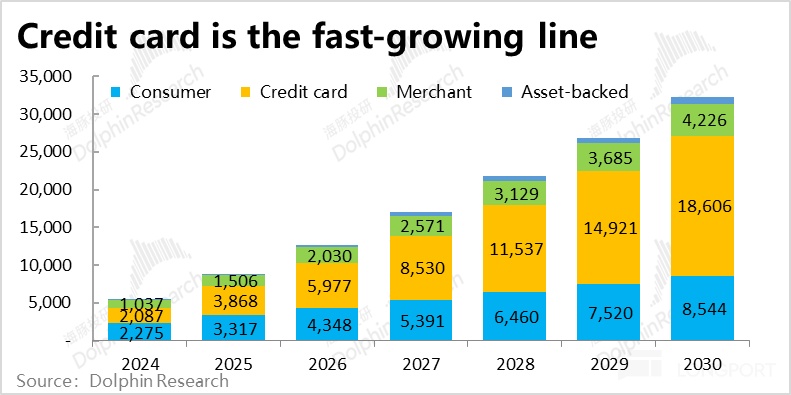
a. Growth is mainly driven by an increase in the number of loan users, with the penetration rate of loan users (including consumer, merchant, and credit card loans) in the company's disclosed total Fintech monthly active users expected to increase slightly from about 51% in 2025 to 59% over 5 years.
b. The average loan size of the credit card business is expected to increase by about 14% annually over the next 5 years, while the other two sub-items are expected to have a compound growth rate of only about 5%.
Based on the above logic, Dolphin assumes that by 2030, the company's average loan business balance (average of the beginning and end of the year) will grow to about $32 billion. The overall compound growth rate is nearly 30%, with the credit card business having a compound growth rate of 37%.
2) Short-term profit decline is the growing pain of loan structure changes
Objectively speaking, the above prediction of loan volume has a large elasticity space. Therefore, the main focus is more on the structural change of "the proportion of credit card business continues to rise," which will have what impact on key indicators such as NIMAL and its components (including gross interest rate, funding cost, and bad debt loss) of the loan business.
First, credit card loans differ from other types of loans in a key way—credit cards have an interest-free period. Interest is only generated for the portion that remains unpaid after the interest-free period or is chosen to be paid in installments.
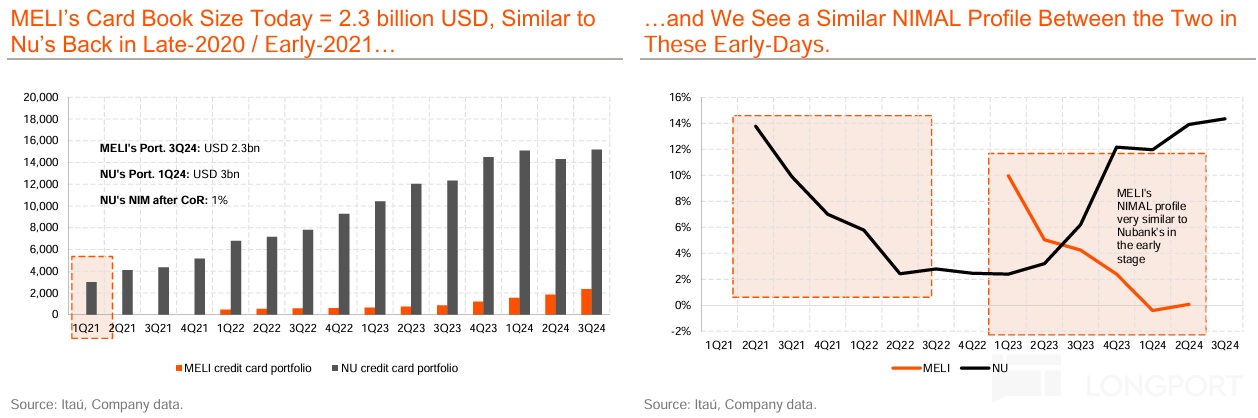
Generally, new users are not likely to trigger overdue or installment payments, and it is more likely to occur as users' usage duration and usage amount gradually increase. Therefore, credit card loans generally generate negative NIMAL during the high-growth stage, dragging down the overall profitability of the company's credit business. This also explains why after the explosive growth of credit card loan volume began in 2023, the disclosed NIMAL of the company gradually declined from nearly 40% to slightly above 20%.
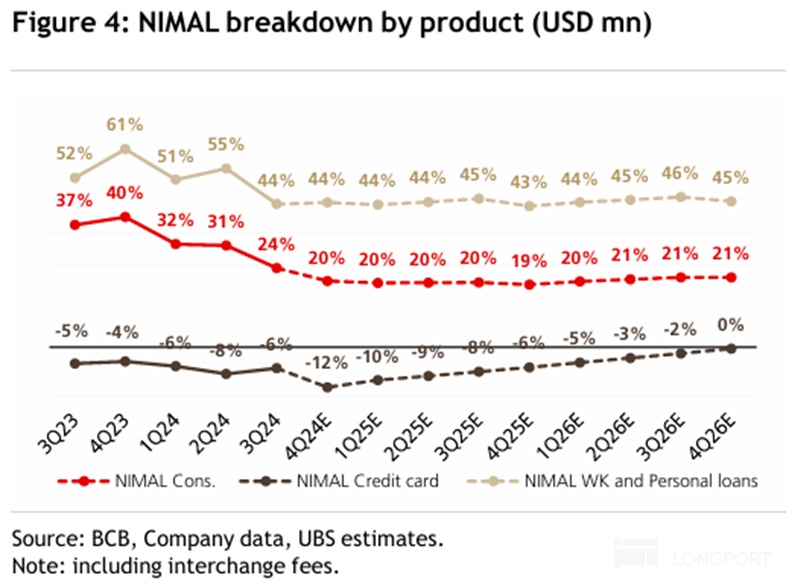
However, referring to the experience of an industry peer—Nu Bank. It can be seen that historically, during the period from 1Q21 to 2Q22, Nu Bank also experienced a rapid decline in NIMAL from about 14% to about 2% during the rapid growth of credit card loan volume. Subsequently, as the growth rate of Nu Bank's credit card loan volume slowed (from several tens of percent to below 50%), by 4Q23, Nu Bank's credit card business NIMAL quickly returned to the original level of about 14%.
It can be seen that it took Nu Bank about 3 years to return to the high point of NIMAL. Currently, Meli's credit card loan balance (only in the Brazilian market) is just close to Nu Bank's scale in 1Q21. Therefore, Meli is also likely to replicate Nu Bank's experience, with the NIMAL of the credit card business gradually returning to a normal level of about 10% within the next 2~3 years as the credit card business matures.
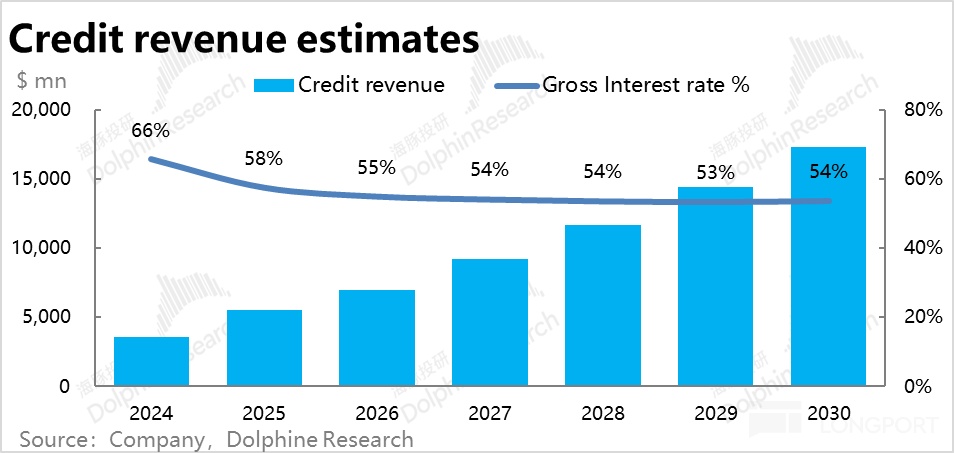
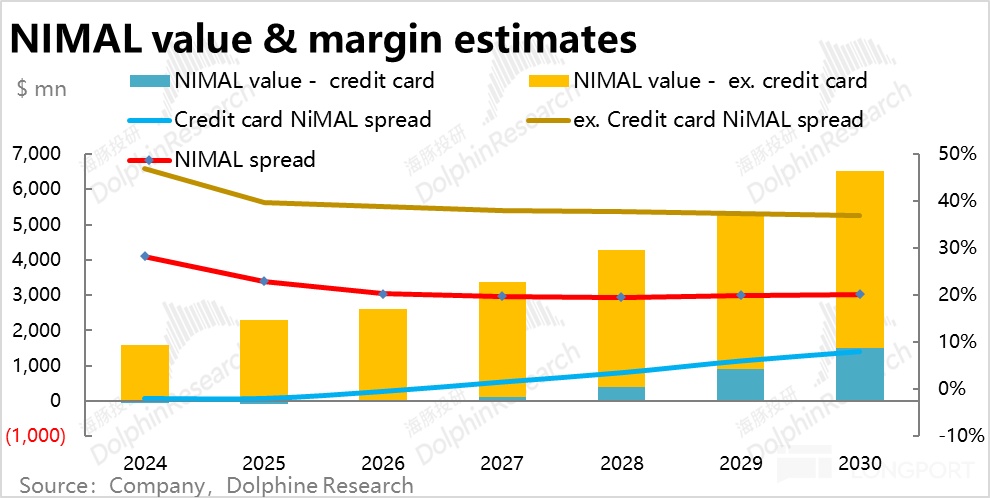
Based on the above judgment, and the expectation that non-credit card loans will gradually penetrate into users with higher credit as they grow, with the gross interest rate and NIMAL likely to gradually decline, Dolphin expects the overall revenue of the company's credit business to grow from about $5.5 billion in 2025 to about $19 billion in 2030, a growth of 2.4 times. At the same time, the NIMAL of the company's credit business is expected to gradually decline from about 23% in 2025 to about 20%. The NIMAL profit contributed by the credit business will reach about $6.5 billion by 2030.
III. Valuation - Is Meli's current valuation fair?
1. Cost and Profit Analysis
Summarizing our revenue forecasts for e-commerce, payment, and credit businesses, we expect Meli's total revenue to grow from about $28 billion in 2025 to $72 billion in 2030, with a compound growth rate of about 21%.
In addition to revenue, Dolphin also combined the company's disclosures and external forecasts to break down the company's costs. Specifically, they are divided into two main categories: a. Directly related to total revenue, including sales taxes, platform support costs, and other costs; b. The other major category of costs is directly related to matching businesses, including funding costs matching the credit business, fulfillment costs matching e-commerce logistics, payment costs matching the payment business, and product sales costs matching self-operated e-commerce and POS sales revenue.
According to the specific forecast logic shown in the chart and table below, Dolphin calculates that the company's gross profit margin will steadily increase from 44% in 2025 to 50% in 2030.
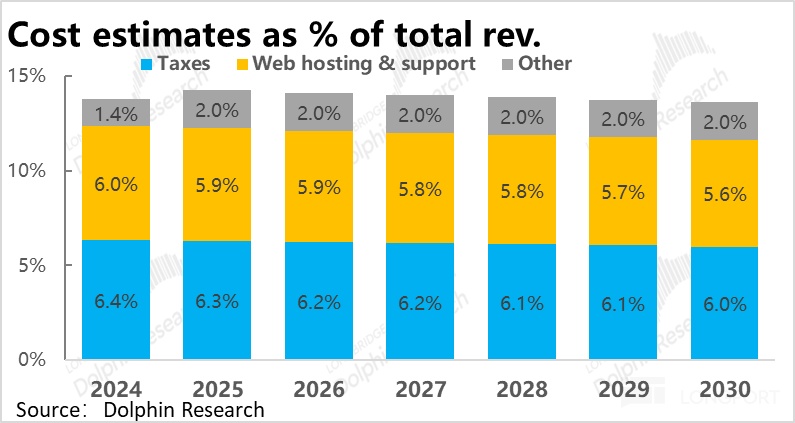

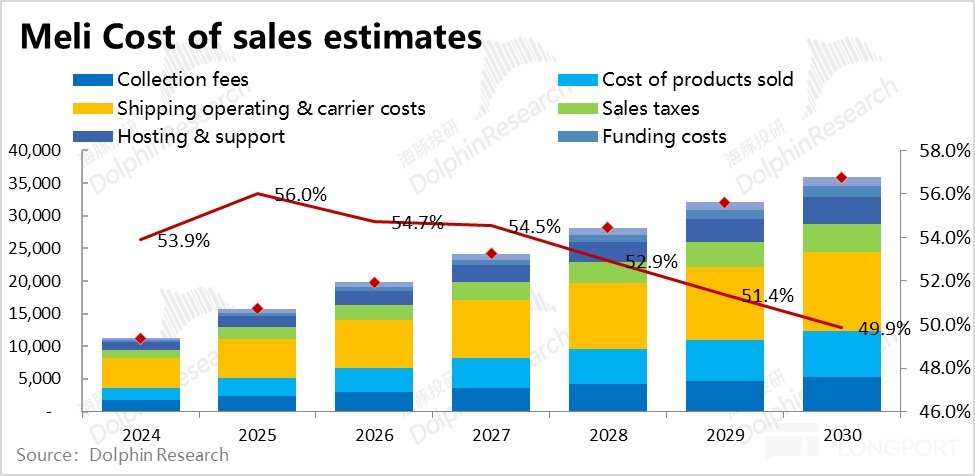
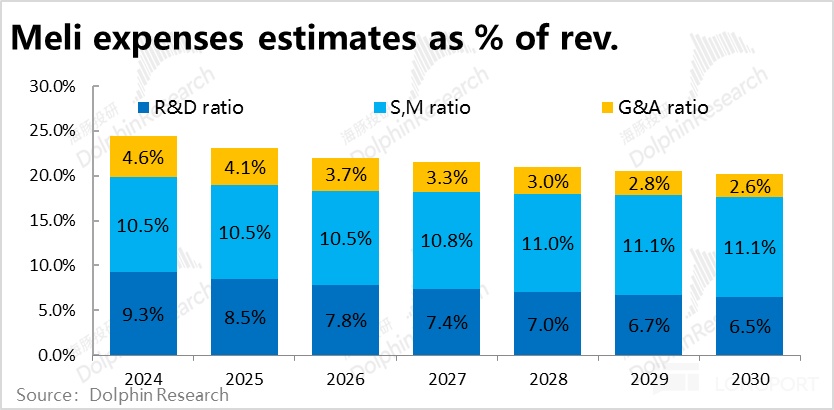
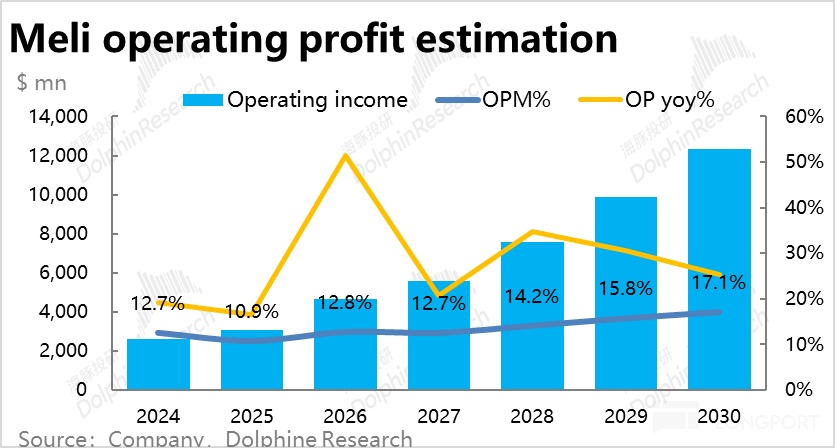
In operating expenses, bad debt losses have been separately predicted when calculating NIMAL. In addition, with R&D and management costs growing slower than revenue, they are passively diluted; while the marketing expense rate is expected to rise first and then slightly decline due to financial customer acquisition and e-commerce competition. We estimate that the company's total operating profit will be $12.3 billion by 2030, about 9% higher than Bloomberg's consensus estimate.
2. Valuation Analysis
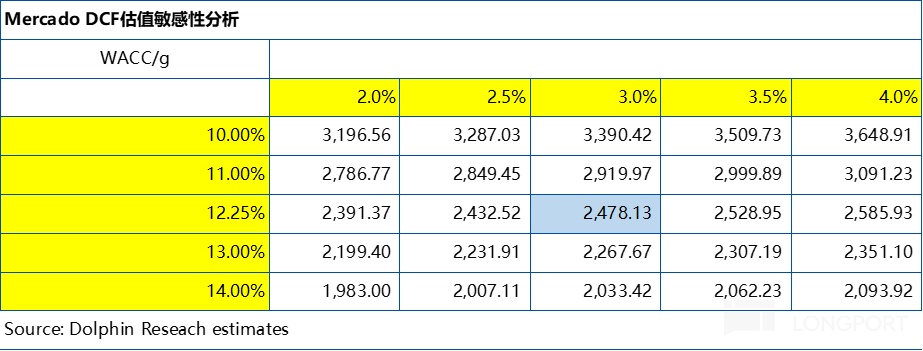
Based on the above forecasts, we use a perpetual growth rate of 2.5% and a discount rate of about 12.2% (considering the higher risk of the market Meli is in). This translates to a reasonable valuation of about $124.7 billion, about 20% higher than the current price, corresponding to a per-share price of $2460, roughly equivalent to the price when the company was trading sideways for several months before the recent pullback.
Using the PE valuation method, we use the after-tax net profit of about $9.28 billion in 2030, matching the net profit growth rate of about 23% that year, giving a 20x PE, and discounting it back at 12.2%, resulting in a market value of $104.3 billion, which is basically consistent with the current price. This also aligns with the general situation where DCF valuation is slightly higher than PE valuation.
Therefore, in summary, we believe that the market's valuation of Meli is relatively fair. Excluding the recent stock price pullback caused by US policy turmoil and tariff issues, the market's pricing is basically completely consistent with Dolphin's expectations.
Finally, Dolphin wants to remind that our expectations for the company's e-commerce business are relatively conservative, not fully reflecting the possibility of explosive growth in the e-commerce market due to logistics improvements, or the potential for the company's market share to exceed expectations.
As for the credit business, Dolphin's current forecast is mainly based on the currently visible development trends, with relatively conservative expectations for the decline in payment business fee rates and a slight decline in the NIMAL of the credit business.
In reality, even though we currently predict that the credit business scale will grow by about 230% over the next 5 years, the corresponding market share will still only be about 2%~3%. The actual performance's upward and downward elasticity will be relatively large.
<End of Text>
Past [Mercado Libre] Research by Dolphin Research:
Earnings Tracking:
August 5, 2025, Earnings Commentary "Mercado (Minutes): Uncertain about lowering free shipping thresholds in other markets"
August 5, 2025, Earnings Commentary "Growth or Profit? The Choice of 'Latin American Alibaba' Mercado"
In-depth Research:
July 10, 2025, "Mercado: The Billion-Dollar Market Cap Journey of Latin America's 'Alibaba' with Slow Efforts"
Risk Disclosure and Statement of This Article: Dolphin Research Disclaimer and General Disclosure











The copyright of this article belongs to the original author/organization.
The views expressed herein are solely those of the author and do not reflect the stance of the platform. The content is intended for investment reference purposes only and shall not be considered as investment advice. Please contact us if you have any questions or suggestions regarding the content services provided by the platform.