

 Rate Of Return
Locking funds for a year + asset tokenization: What market trend is Dexiang Real Estate brewing?

On November 24, $Deson Property hk00199$ announced two major developments after resuming trading following a suspension: first, a private placement of approximately 10% new shares to Reynold Lemkins of Rui Kai Group under a general mandate, with a voluntary 12-month lock-up period; second, a clear intention to allocate part of the raised funds to Web3.0, blockchain infrastructure, and RWA-related new businesses.
The news sent the stock soaring by over 70% intraday, closing nearly 55% higher, with signs of stabilization today pending further strategic updates from the company.
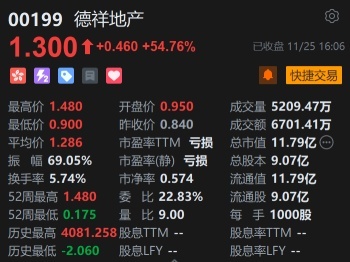
Looking at the capital relationships and industry trends behind this, it’s a classic "valuation inflection point" event, with mid-term implications for the stock price far beyond a one-time stimulus.
1. One-Year Lock-Up + Board Participation: A Long-Term Active Investment
The key takeaway from this placement isn’t the amount but "who’s buying, how they’re buying, and the lock-up period." Deson didn’t opt for a typical "syndicated placement" but introduced Rui Kai as the sole subscriber. It also avoided short-term "pump-and-dump" capital, instead accepting an investor willing to take a 10% stake and lock it up for a full year. For institutions focused on capital efficiency, a one-year lock-up almost entirely eliminates short-term arbitrage opportunities, signaling a clear alignment—not with short-term price swings but with the potential upward shift in the company’s value curve over time.
First, Rui Kai isn’t a traditional real estate player but an institution with "family capital + think tank + cross-border financial hub" attributes: frequently seen at forums like Greenwich Economic Forum and Hong Kong’s Asian Financial Forum, deeply involved in Hong Kong’s Asian Family Heritage Foundation and Middle East/Southeast Asia family office circles, and closely tied to groups like CCG. Such capital typically avoids "hit-and-run" short-term trades, focusing not on the yield of existing projects but on "how much asset weight this listed platform can carry and how big a story it can tell in the future."
Second, there’s a governance shift. Per the announcement, this placement isn’t just "cash for shares"—Rui Kai will join Deson’s board, exerting substantive influence on mid-to-long-term strategy. In other words, it’s not a passive "take shares and do nothing" investor but a co-architect of the future strategic roadmap.
From a secondary market perspective, this "equity + lock-up + board participation" combo sends a strong mid-term signal: an institution capable of mobilizing cross-border long-term capital is willing to bet real money at current prices and share at least a year of time cost with the company, indicating strong confidence in future operational and valuation upside.
2. "Shell King" Chan Kwok-keung’s Final Shell: A "Rebirth"
To gauge the mid-term impact, we must look beyond the present. Deson’s current major shareholder, Chan Kwok-keung (dubbed "Shell King"), has a consistent playbook: acquire platforms at cyclical lows, clean up asset burdens, then introduce new narratives and capital during upswings for revaluation or exit. This logic is highly evident in Deson, his last listed vehicle.
In April 2025, Deson sold its London office project to JD.com, followed by disposals of Hong Kong’s To Kwa Wan site and Mid-Levels luxury projects, recouping nearly HK$800 million. This "asset-light" restructuring left Deson with a cleaner balance sheet—lower leverage, higher cash, and a streamlined core property portfolio.
Today, Deson presents a relatively clean, low-debt, orderly platform—Chan’s preferred "operational state." If he merely wanted to "weather" the real estate winter, traditional financing (bank credit, project loans, or debt restructuring) would suffice. Instead, post-restructuring, he’s pivoting to Web3.0 and RWA with capital and advisors fluent in new financial and tech logic—a move resembling a veteran player’s bid for a "rebirth" of his final listed platform before retirement.
RWA’s potential impact lies in granting Deson an "offensive option." Traditional real estate profits and valuations, constrained by cycles and rates, face limited elasticity. But digitizing properties into compliant on-chain asset products for global sale via Rui Kai’s family office network could upgrade Deson from a "develop + collect rent" firm to a "hold + digitize + manage + match" platform. The valuation multiples for these models differ vastly.
Crucially, Deson’s current P/B as a property stock is low, with prices largely reflecting real estate pessimism, providing a "safety net." Layering an RWA narrative with policy support, tech trends, and capital backing adds a "free upside option": downside cushioned by physical assets and low valuation, upside hinging on new-track execution. For mid-term holders, this "asset floor + growth potential" structure offers high cost-performance.
3. Revaluation Logic: Long-Term Capital Lock-Up, Narrative Shift, and Expectation Gap
The post-announcement surge reflects a reaction to the event itself, but mid-to-long-term performance hinges on three factors: who’s buying, the platform’s potential, and consensus evolution.
First, Rui Kai’s one-year lock-up at current prices is itself a strong signal. A family-capital-backed, globally active institution’s willingness to buy and hold Deson shares for a year suggests acceptable, even attractive risk-reward. This "vote with cash" carries more weight than bullish rhetoric, prompting institutional reevaluations of undervaluation.
Second, the platform is shifting from pure real estate to a "real-world asset digitization hub". Hong Kong’s regulatory clarity on virtual assets, stablecoins, tokenized bonds, and RWAs is growing, enabling compliant on-chain transfers of real estate, debt, and fund shares. If Deson can turn prime properties into benchmark RWA products, it could boost liquidity, lower financing costs, and add fee-based revenue. Valuation tools may then shift from "real estate NAV discount" to "real estate base + platform premium," lifting the valuation framework—a key driver for stock prices.
Third, an expectation gap persists. Many investors still view Deson as a "niche property stock," with limited attention to its "RWA + Web3.0 platform potential." The initial spike priced in the event and short-term sentiment, but systematic research and institutional positioning are nascent—the real "main wave" hasn’t started. Thus, if Deson delivers on three fronts—launching substantive RWA products, adding partners/assets, or disclosing progress—the stock could see a "step-by-step" revaluation rally, not just a one-day spike.
$ITC PROPERTIES(00199.HK) $Hang Seng Index(00HSI.HK)
The copyright of this article belongs to the original author/organization.
The views expressed herein are solely those of the author and do not reflect the stance of the platform. The content is intended for investment reference purposes only and shall not be considered as investment advice. Please contact us if you have any questions or suggestions regarding the content services provided by the platform.
