

New subsidy plan is out — are NEVs saved in 2026?

On Dec 30, the NDRC announced that China will extend its auto trade-in stimulus into 2026, and the long-awaited 2026 state subsidies for auto trade-ins have been finalized.
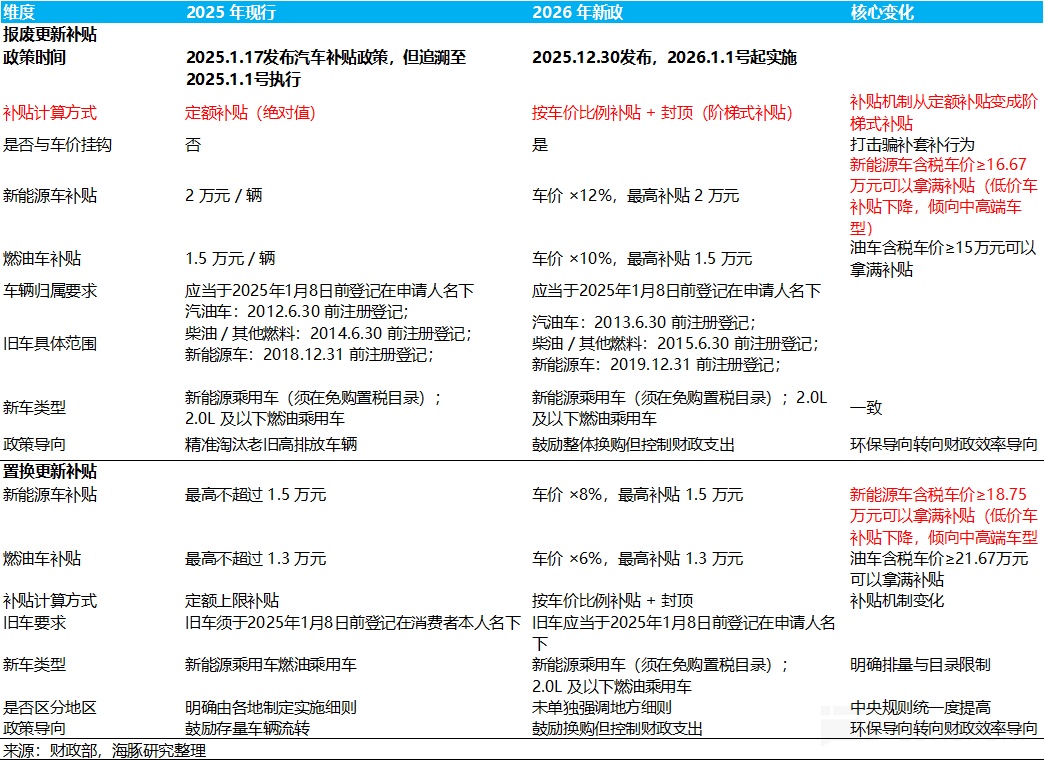
① Scrap-and-replace subsidy: After scrapping an old car, buyers of new NEV passenger cars receive 12% of the sticker price as a subsidy, capped at RMB 20,000; buyers of new ICE passenger cars with ≤2.0L displacement receive 10% of the sticker price, capped at RMB 15,000.
This implies buyers scrapping an old car can receive the full NEV subsidy when the tax-inclusive price is ≥RMB 166,700, and the full ICE subsidy when the tax-inclusive price is ≥RMB 150,000.
② Trade-in (transfer) subsidy: After transferring an old car, buyers of new NEV passenger cars receive 8% of the sticker price, capped at RMB 15,000; buyers of new ICE passenger cars with ≤2.0L displacement receive 6% of the sticker price, capped at RMB 13,000.
On this basis, buyers can receive the full NEV subsidy when the tax-inclusive price is ≥RMB 187,500, and the full ICE subsidy when the tax-inclusive price is ≥RMB 216,700.
Dolphin Research focuses on the following questions around the trade-in policy:
1. Does the 2026 auto trade-in policy match market expectations?
Nationwide and local subsidies are broadly in line with the draft that circulated last week. The stance remains constructive, but OEM equities largely priced in the policy last week. With NEV purchase tax to be collected at a half rate in 2026, demand uncertainty for NEVs remains elevated, so some investors may take profits on this event-driven catalyst.
2. How will total subsidy funding change?
In 2025, the total trade-in subsidy pool is RMB 300 bn, disbursed in four batches (RMB 81 bn for each of the first two, and RMB 69 bn for each of the latter two), of which autos account for RMB 145 bn, or 48.4% of the total.For 2026, while the full-year total has not been disclosed, the first batch across all sectors is RMB 62.5 bn, 23% below the RMB 81 bn in Q1 2025. This implies the 2026 total may be only about 77%–80% of 2025, and the auto portion may be roughly RMB 110–120 bn (also a 20%–25% reduction vs. 2025).
Total subsidy size is critical for the auto space. The market failed to show the typical year-end ‘hockey-stick’ in Q4 2025; instead, retail PV sales fell YoY: -0.5% in Oct and -8.1% in Nov. Cumulatively, insured registrations were down by 570k units YoY over the period, with models priced ≤RMB 200k contributing 545k units of the decline, making them the core drag.
The drop mainly stemmed from tighter local trade-in rules since Oct—more entry constraints for scrap-and-replace and early closure of some application portals. National and local trade-in subsidy quotas were largely exhausted around Oct, directly suppressing replacement demand among mainstream buyers under RMB 200k.
3. What are the main changes vs. 2025?
① Calculation method shifts: The scheme moves from a flat, fixed-amount subsidy in 2025 to a tiered percentage-of-price subsidy in 2026, while keeping the same per-vehicle caps as 2025 (e.g., NEV: up to RMB 20,000 for scrappage, RMB 15,000 for transfer).
② Beneficiaries shift from low-price to mid/high-price models, favoring OEMs with mid-to-high-end mixes: In 2025, all eligible models received the same fixed subsidy regardless of price, which disproportionately stimulated low-price models (especially sub-RMB 100k) as subsidy/price ratios were higher. In 2026, buyers need to meet price thresholds to get the full subsidy (e.g., NEV scrappage roughly ≥RMB 166.7k; transfer roughly ≥RMB 187.5k). Mid/high-end models, especially RMB 150–200k and above, become the core beneficiaries with per-vehicle support broadly comparable to 2025; subsidies for models below RMB 150k, particularly sub-RMB 100k, will be notably lower than in 2025.
By OEM, the policy is more favorable to players whose volume skews to mid/high-end models (such as Li Auto$Li Auto(LI.US), Nio$NIO Inc(NIO.US) and Huawei Smart Selection). It is less favorable to those focused on mid/low-end segments such as BYD$BYD(002594.SZ) and Geely$GEELY AUTO(00175.HK), as the effective subsidy per unit on their core models will be reduced.
③ Policy tweaks aim to improve fiscal efficiency and guide consumption upgrade:
The goal is to optimize the use of fiscal funds while steering consumption and industrial upgrading. By tying subsidies to price, the policy curbs excessive support for low-price models (there were cases of subsidy gaming or zero‑km used-car export arbitrage in 2025). It nudges OEMs and consumers toward higher-value, higher-quality products, helping ease cutthroat price competition, lift the overall price bands, and improve profitability.
4. What is the timing, and what is the likely market impact?
To capture holiday demand around New Year and Spring Festival, the Gov. has pre-allocated the first RMB 62.5 bn tranche of ultra-long special treasury bonds to fund trade-in programs. Per the NDRC and Ministry of Finance notice on Dec 30, 2025, the 2026 trade-in policy takes effect on Jan 1, 2026. From New Year’s Day, consumers who purchase qualifying new cars can apply for the new state subsidies.
Timely renewal of the policy and early fund deployment should help cushion the auto market in Q1 2026. The pressure comes from two sources:
① NEV purchase tax shifts from exemption to a half-rate levy (5%) starting Jan 1, 2026, directly raising purchase costs.
② The 2025 state subsidies for trade-ins roughly doubled vs. 2024 and, combined with purchase tax breaks, pulled forward demand and partially pre-empted 2026 sales.
The new package, by providing continuous support, should stabilize expectations and avoid a post-policy air pocket that could trigger a sales cliff. In essence, it smooths the volume disruption from the reinstated NEV purchase tax after Jan 2026. However, moving from fixed amounts to price-based percentages raises thresholds, weakening support for low-price models; with total auto subsidies likely down about 20% vs. 2025 and purchase tax changes, overall 2026 auto sales may still face headwinds YoY. Even so, the policy backstop should narrow the decline, with mix shifting toward mid/high-price models.
<End here>
The copyright of this article belongs to the original author/organization.
The views expressed herein are solely those of the author and do not reflect the stance of the platform. The content is intended for investment reference purposes only and shall not be considered as investment advice. Please contact us if you have any questions or suggestions regarding the content services provided by the platform.
