
D
Jan 2 at 05:24 AM
Kunlun Chip IPO fast-tracks: Is BIDU's Google moment here?
 I'm LongbridgeAI, I can summarize articles.
The long-rumored spin-off and listing of Kunlun Chip has finally been formally announced by $Baidu(BIDU.US). On Jan 2, BIDU proposed to spin off Kunlun Chip Technology for an independent listing on the HKEX Main Board, while retaining control (59.45% stake). BIDU has confidentially filed, but the full prospectus is not yet public. Based on currently available information, Dolphin Research highlights a few core questions for a quick take:
1. Kunlun Chip’s origin and trajectory
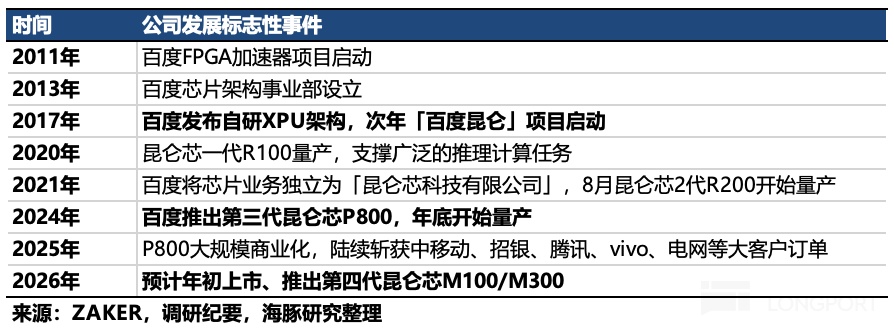
Kunlun traces back to BIDU’s FPGA accelerator project started in 2011, followed by the creation of a chip architecture dept. in 2013. In 2017 it unveiled its in-house application-specific architecture, XPU.The team now exceeds 500 people. Core staff turnover is low, underpinning steady technical iteration.
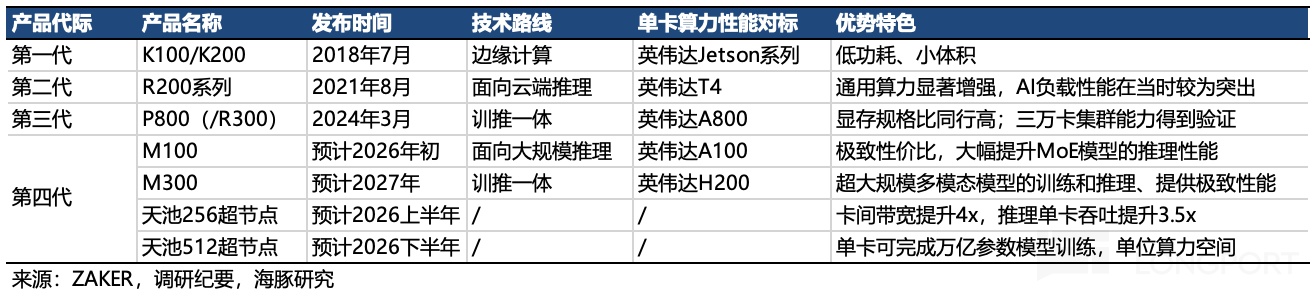
To date, it has released three generations of products (K100/K200, R200 series, P800). It also plans to launch M100 in 2026 and M300 in 2027 (roadmap published in Nov 2025).
Kunlun’s core compute architecture and logic are developed in-house, with SerDes licensed from Broadcom and some backend design/packaging support. Fabrication uses Samsung’s 7nm process.Gen-1/2 have been discontinued. In 2025, deliveries will be centered on the P800 launched in Mar 2024, with cadence constrained by Samsung capacity; the P800 targets NVDA’s A800 and is among the most advanced domestic iterations.
2. What gives Kunlun a competitive edge?
To assess Kunlun’s edge, we first look at the strengths of domestic compute. This sets the context.
On paper specs, domestic chips still lag overseas peers by a wide margin. Even first-tier leaders’ newest parts (including unreleased chips) generally track several generations behind NVDA/AMD in performance.
Domestic chips, however, win on cost and compliance. Despite recent signs of de-escalation between major powers, including chatter about GPU export loosening, on-the-ground execution still faces many constraints. With 2026 technical iteration and a stronger price-performance profile, substitution for the ‘loosened’ H20 should improve materially.
As AI applications inflect in 2026, industry-wide demand for domestic chips, especially for inference, could accelerate. Internet majors such as ByteDance, Alibaba, and Tencent have already earmarked meaningful budgets for domestic chips.Domestic share should rise further in 2026; at least half of local budgets may go to domestic chips to meet Agent-driven inference demand.
So where exactly does Kunlun stand out?
(1) Technology
Unlike BIDU’s oft-criticized search biz., P800 has earned relatively strong technical reviews across three areas. First, it offers higher memory specs than peers and a NV-like hardware architecture, which helps with CUDA compatibility, albeit not fully.Second, on supernodes — i.e., very large-scale cluster deployments — P800 has powered China’s first fully self-developed 30k-card cluster, addressing stability at the 10k-card scale. Kunlun plans to roll out 256- and 512-card supernodes in 1H and 2H next year, respectively.
In addition, Kunlun delivers a hardware-software integrated offering with deep ties to the PaddlePaddle framework and ERNIE. Performance has measurable validation points, and the deployed 10k+ card clusters demonstrate real-world deployability, giving end customers a relatively stable compute solution.
(2) Ecosystem
A strong ecosystem helps chip vendors reach customers quickly and secure upstream capacity. Huawei’s Ascend reportedly captured about 40% market share in 2024 in no small part due to its ecosystem position.
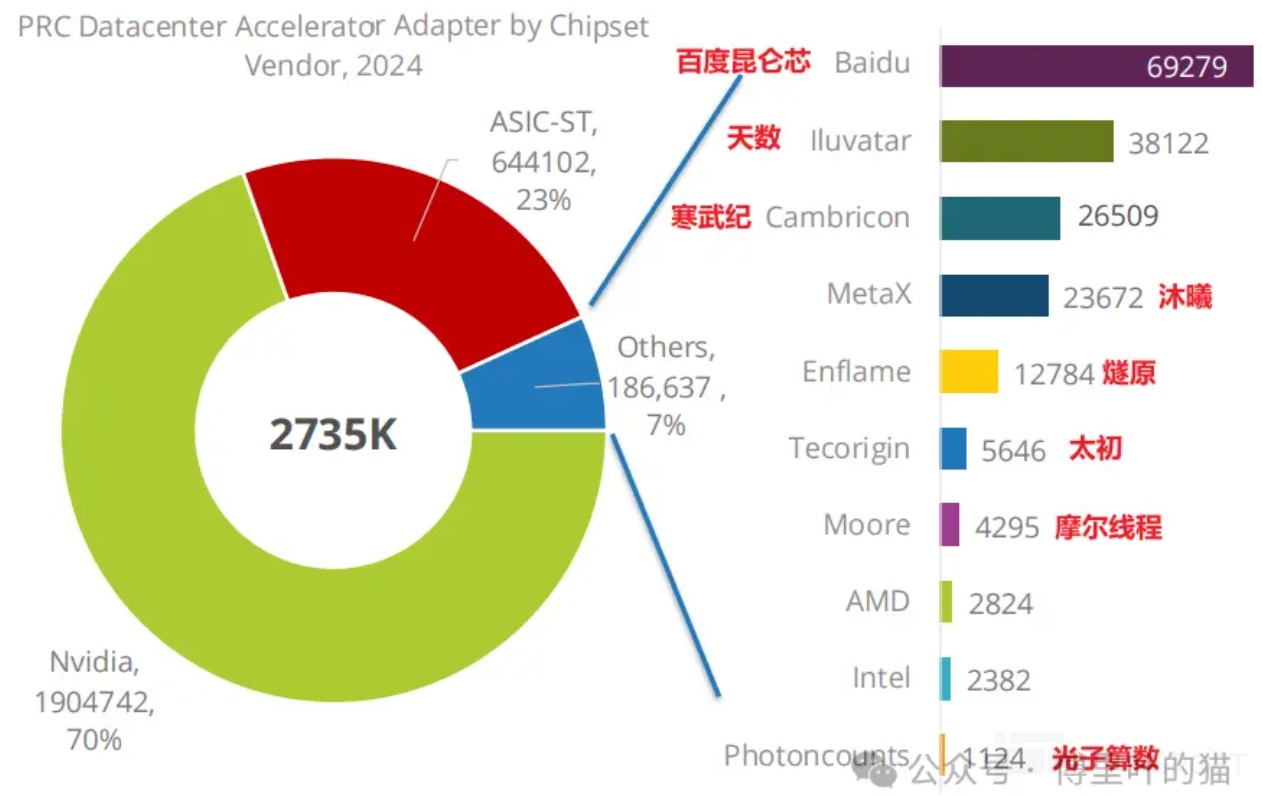
Beyond Huawei’s foothold in gov./enterprise, Cambricon’s deep link with ByteDance, and T-Head’s alignment with Alibaba, Kunlun can likewise leverage BIDU’s long-built ToB ecosystem to reach users faster than independent domestic peers. IDC estimates Kunlun shipped 69k units in 2024, or 2.5% of global shipments, and over 8% share in China alone.
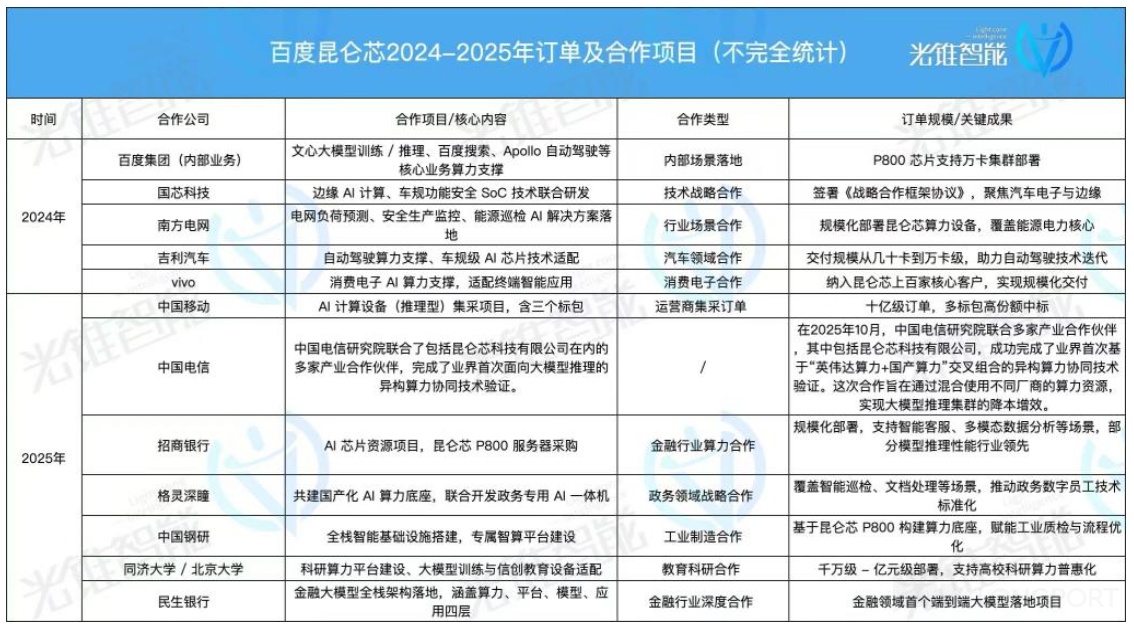
Current customers include BIDU itself; large clients such as Tencent and vivo (with JD, Meituan, and ByteDance in testing); telcos such as China Mobile; and many gov./enterprise clients including State Grid and China Merchants Bank. The roster continues to expand alongside production ramp.
2. What does BIDU gain from Kunlun’s IPO?
How much could BIDU benefit from Kunlun’s listing? We will revisit detailed operations and valuation once the prospectus is out; for now, a quick run-through.
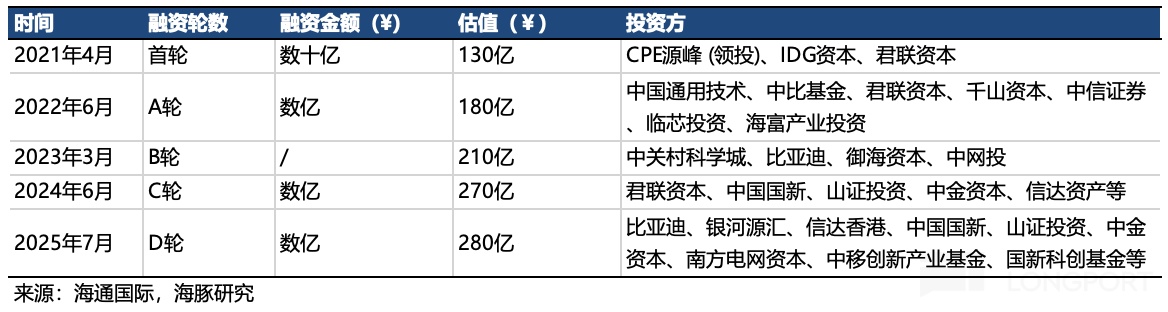
Since 2021, Kunlun has completed five funding rounds, most recently six months ago at a RMB 28 bn valuation. Channel checks suggest 2024 revenue of RMB 1–2 bn and 2025E revenue of RMB 3.5 bn (source: Hong Kong Economic Times), implying 100–200% YoY growth and 18x/8x PS, respectively.
Industry research puts P800’s retail price at RMB 84k, with an ASP of RMB 60k. That implies roughly 60k units delivered in 2025.Combining several large clients, total orders (including BIDU) exceed 200k units, leaving at least 140k units slated for delivery next year. Kunlun is currently supply-constrained; revenue growth is mainly capped by Samsung capacity, slowing deliveries to some major clients.
Assuming no new orders (in reality, next year’s M100 should drive incremental demand) and sufficient capacity to fulfill, that would point to at least RMB 8.4 bn in revenue at a RMB 60k ASP per card. If production keeps up, top-line could scale accordingly (+140% YoY).
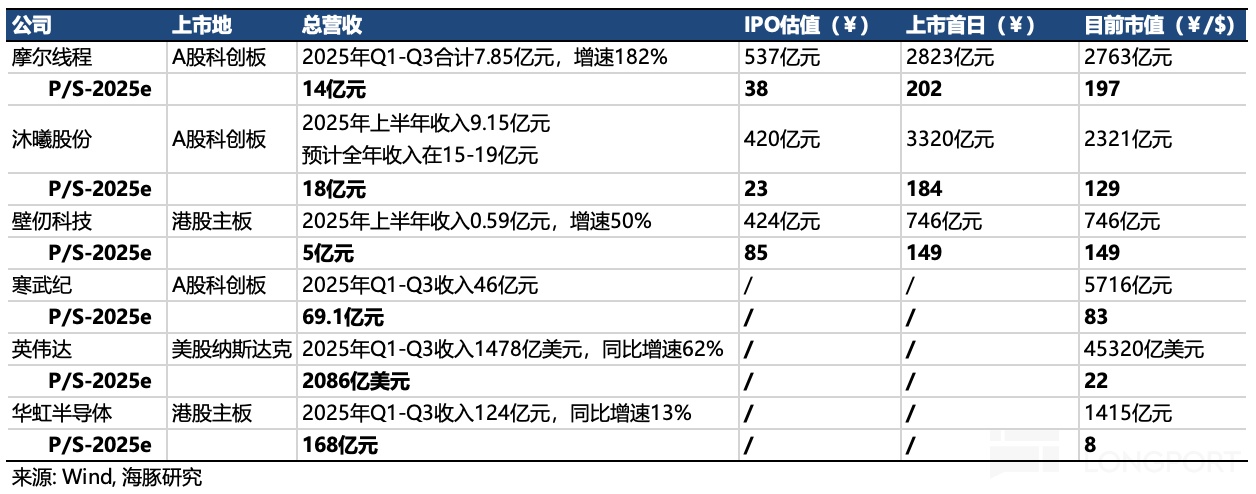
Recent AI chip IPOs such as Moore Threads, Muxi, and Biren Tech priced richly and popped on debut across A/H markets. Beyond sentiment premium, investors are also paying for growth and scarcity.However, near-term IPO fever is extreme. While industry tailwinds persist, both growth and scarcity premiums should fade as competition intensifies and more names list.
Among already-listed AI chipmakers, Cambricon still trades at 80x+ PS on overwhelming demand. By contrast, NVDA in the US and mature HK semiconductor names trade on more normalized multiples.
Given different investor bases by venue (HK skews to foreign capital, typically less enthusiastic about domestic chip stories than onshore funds), Dolphin Research expects that, after IPO hype cools, Kunlun’s current competitive standing — despite lower GPM than mature peers — could warrant a 10–15x PS range in 2026 (midpoint of Hua Hong and NVDA). That implies a RMB 84–126 bn valuation ($12–18 bn), offering at least a 5x return even for last-round investors.
At a 59.45% stake, BIDU’s holding would be worth $7.1–10.7 bn post spin pricing. Previously, Dolphin valued BIDU Cloud at $13.9 bn (4x PS).Recomputing, BIDU Cloud plus Kunlun totals $18.3–21.9 bn, up by $4.4–8.0 bn. Versus our prior neutral valuation of $38.3 bn (=$13.4 bn Ads + $13.9 bn Cloud + 50% of net cash $7.6 bn), that is an 11–21% uplift.
Risk disclosure and statement:Dolphin Research Disclaimer and General Disclosures






The copyright of this article belongs to the original author/organization.
The views expressed herein are solely those of the author and do not reflect the stance of the platform. The content is intended for investment reference purposes only and shall not be considered as investment advice. Please contact us if you have any questions or suggestions regarding the content services provided by the platform.