
D
Jan 12 at 05:50 AM
From Cars to Dreams: Is AI TSLA at RMB 1.5tn overvalued?
 I'm LongbridgeAI, I can summarize articles.
Following the prior piece 'Robotaxi: A Ride-Hailing Empire That Could Recreate Tesla?', Dolphin Research analyzed how Robotaxis could change the unit economics of ride-hailing and expand the market. In this Tesla-focused note, we address three questions:
1. What is the current competitive landscape for Robotaxis in the U.S.? How could Robotaxis reshape UE allocation and the structure of competition?
2. How much incremental market cap could the Robotaxi biz. add to Tesla?
3. The ultimate question: Is a $1.5tn Tesla pulling forward future value, or is the market underpricing the AI golden stock?
I. What does U.S. Robotaxi competition look like now? What is the likely endgame?
1) Market shakeout: Smaller players exit; three blocs emerge
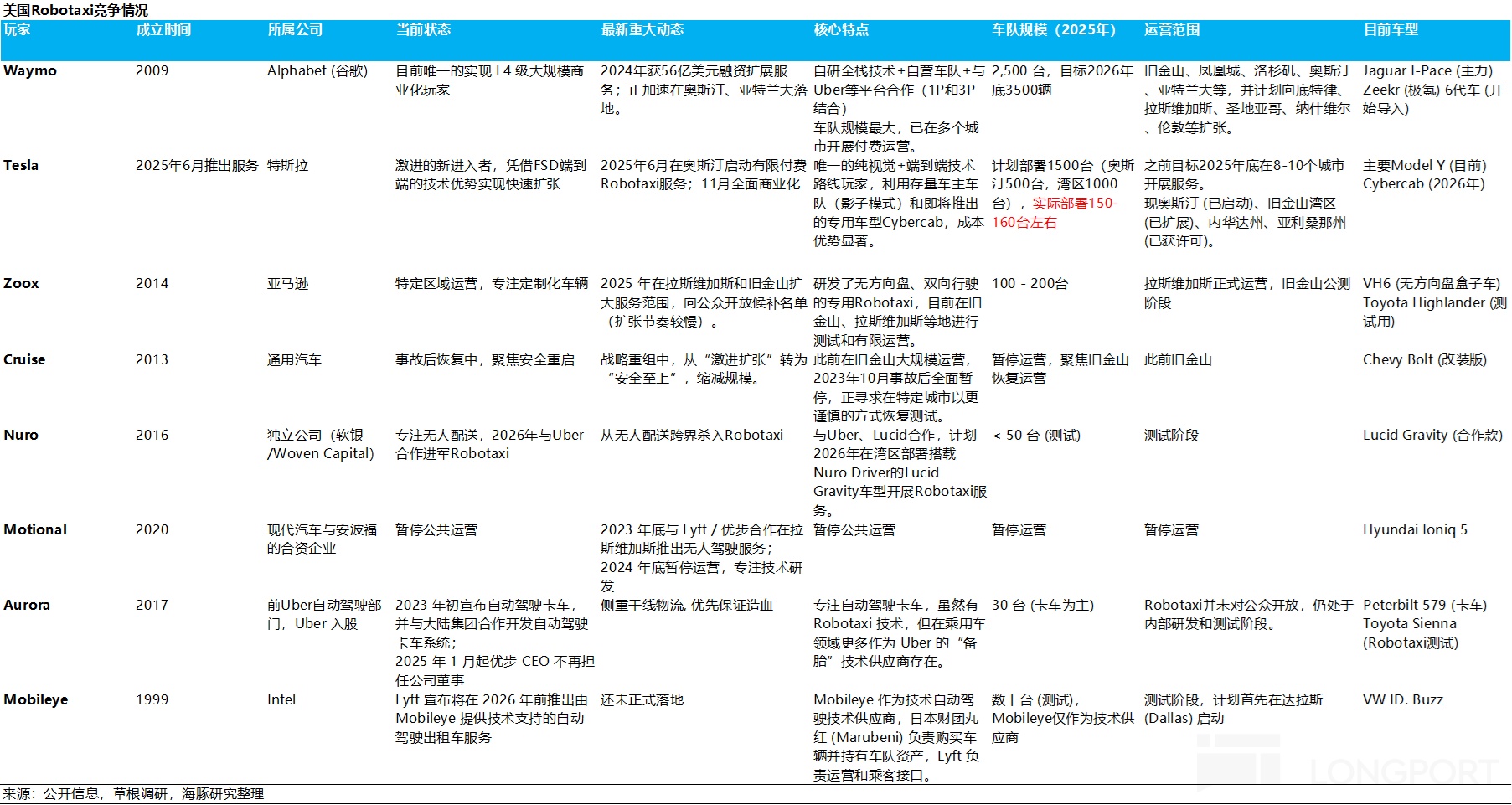
Today the U.S. Robotaxi market is clearly in a bifurcation and reshuffle phase. Cruise, Motional, and Zoox are either severely impaired or progressing slowly, leaving a three-bloc contest:
a) Incumbent Waymo leads for now on first-mover scale and a more mature commercial footprint (2,500+ vehicles).
b) Aggressive challenger Tesla$Tesla(TSLA.US) is catching up fast with end-to-end tech and a structural cost edge.
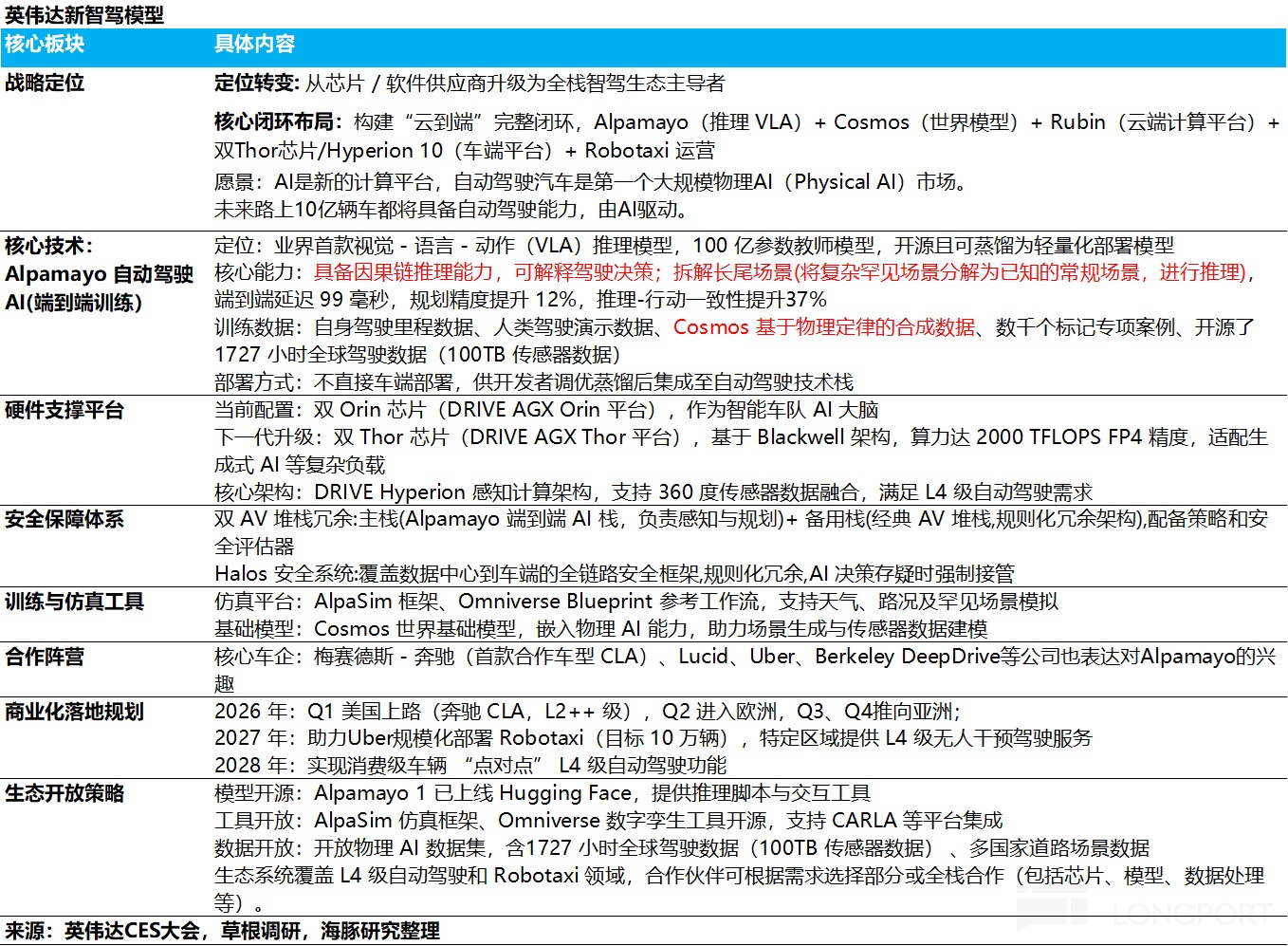
c) Ecosystem enabler NVIDIA has just announced an 'open alliance' with OEMs and ride-hailing platforms (Uber), a potential swing factor that could change the game.
2) Operations: Waymo's first-mover vs. Tesla's price aggression
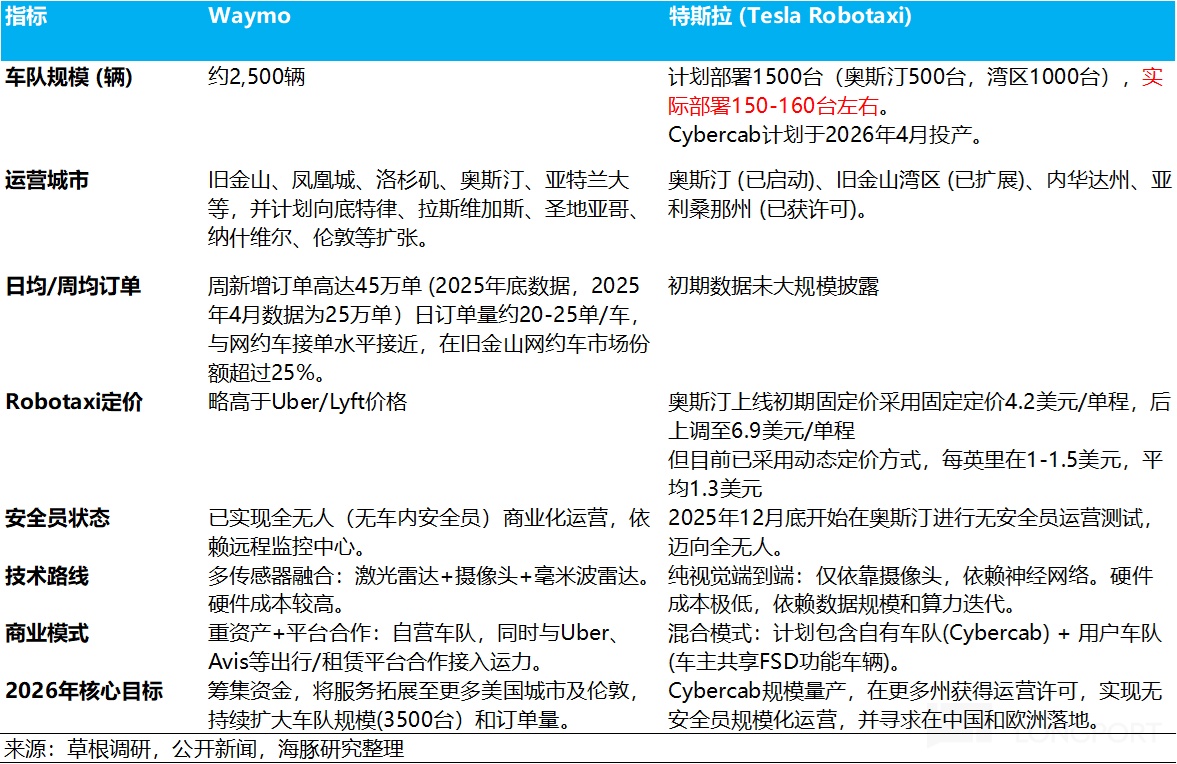
a) Fleet scale and service footprint (Waymo still ahead): By end-2025, Waymo had ~2,500 vehicles deployed in core cities. Tesla removed safety drivers in certain Austin tests, but public rides still use them, and regulatory/tech constraints keep actual Robotaxi deployment at ~150–160 units.
Note: Tesla plans to start Cybercab production in Apr 2026. Robotaxi is expected to have a meaningful P&L impact in 2H26.
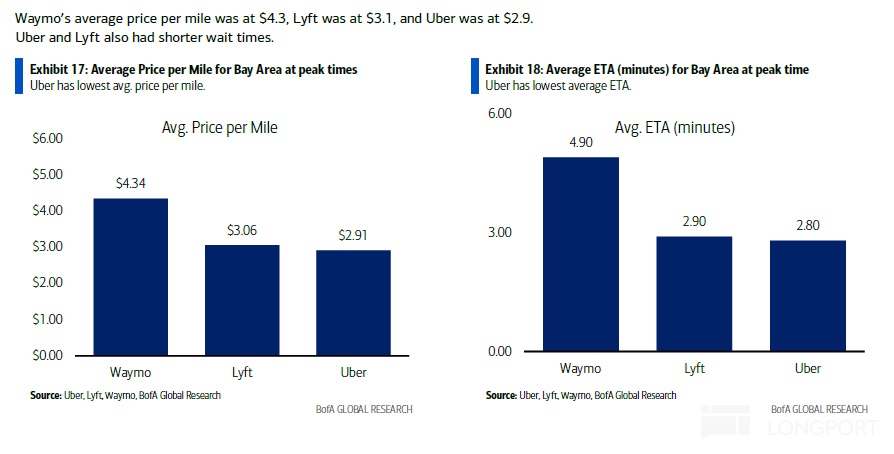
b) Pricing (Tesla as price slasher): Tesla uses dynamic pricing at approx. $1.3/mile (targeting <$1/mile). Waymo, constrained by higher hardware costs, averages >$2/mile and struggles to join a price war.
c) Biz. model: Vertical integration vs. hybrid
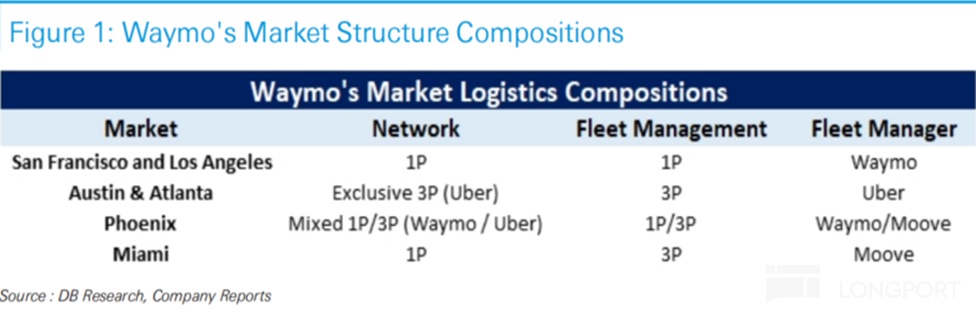
Tesla (vertical): Owns tech stack (software + on-vehicle compute), vehicle, and platform. It plans a light-asset model that onboards millions of owner vehicles to the network and charges a take rate, enabling easy capacity scaling at very low marginal cost.
Waymo (hybrid): Controls autonomy software and the platform, but vehicles are sourced from OEM partners (ZEEKR, Hyundai). The platform mixes self-operated fleets with aggregation (including $Uber Tech(UBER.US)), which remains asset-heavy today.
3) Robotaxi endgame: Tech path, cost curve, and ecosystem
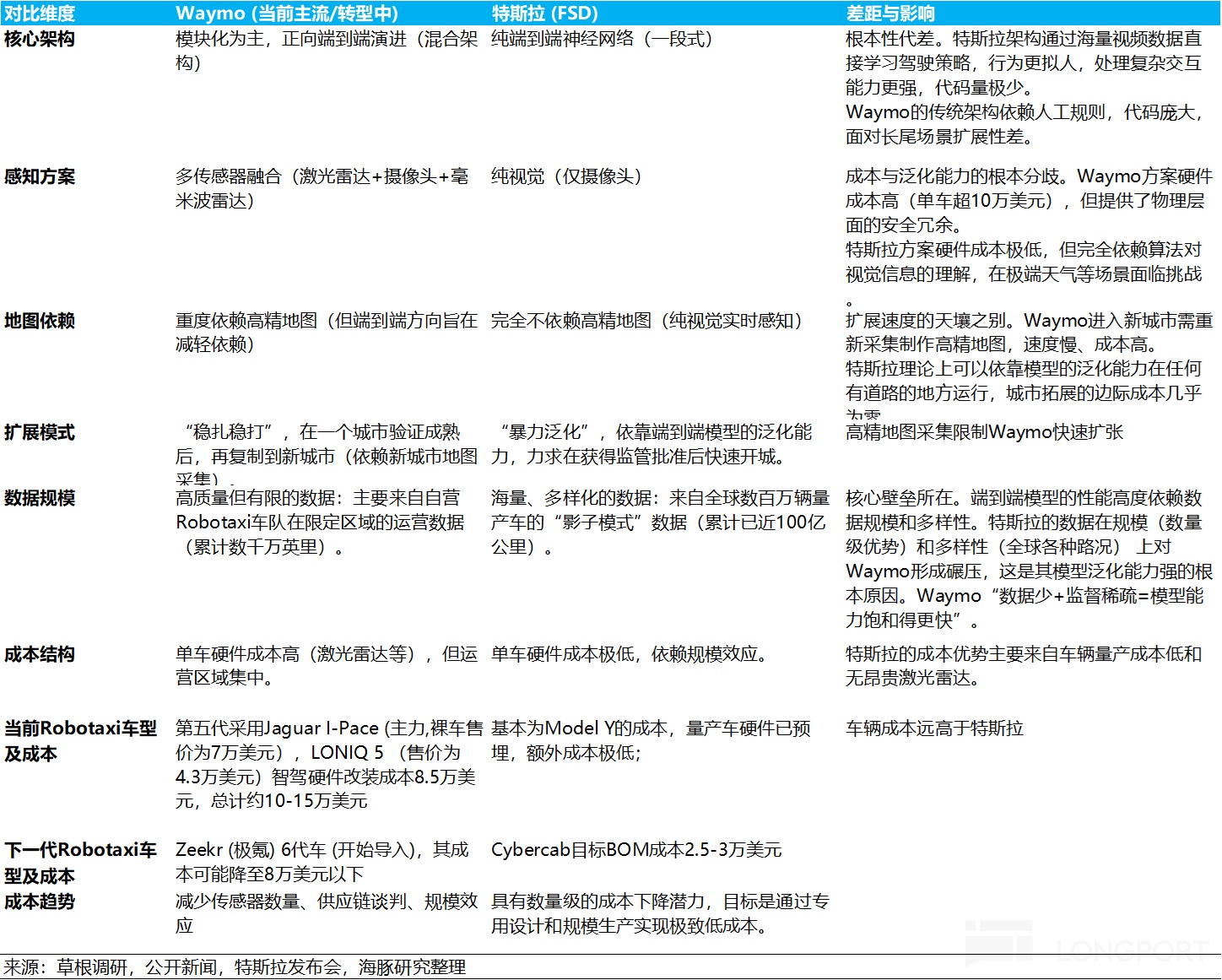
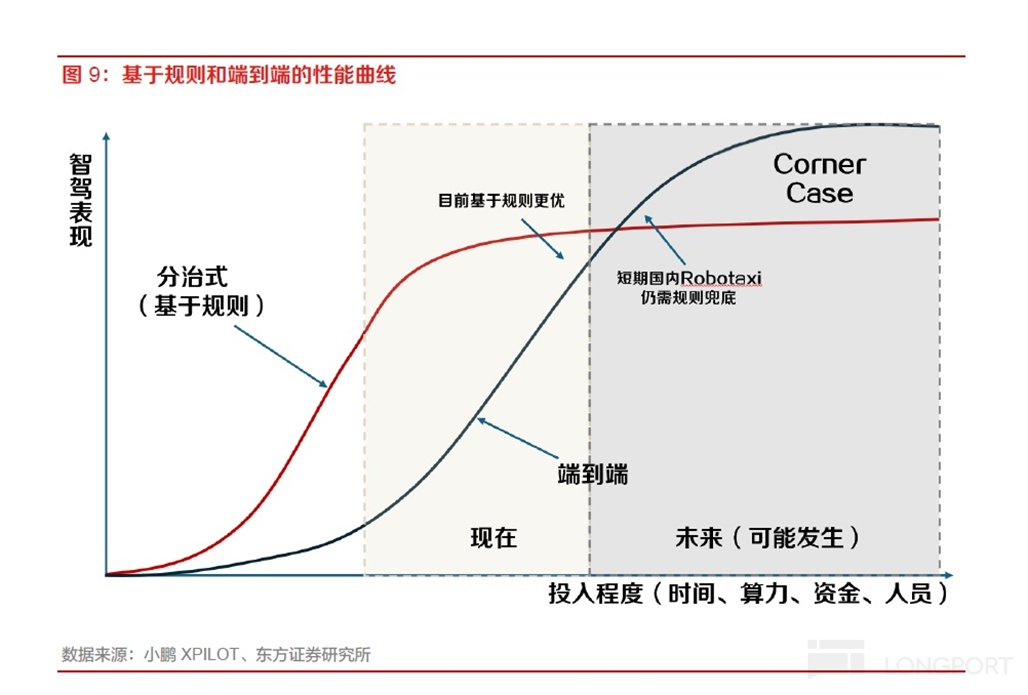
a) Tech roadmap: End-to-end is consensus; data defines the ceiling
End-to-end (E2E) is now the consensus direction, but the three paths differ materially.
Tesla: Pure vision + E2E, powered by massive real-world data from millions of cars, with FSD V14 showing human-like decision-making. Elon Musk has said the last 1% long-tail will need 10bn training miles; Tesla is uniquely close to that order of magnitude with millions of cars pre-installed with high-grade autonomy hardware.
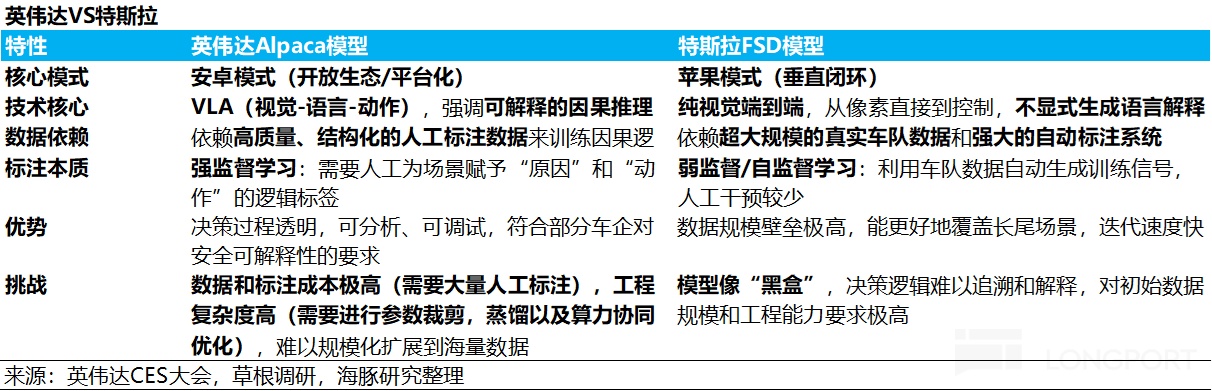
NVIDIA: Its Alpamayo is also E2E but emphasizes chain-of-thought style interpretability. Real-world road-test data is limited; training leans on Cosmos synthetic data, and the interpretable architecture needs extensive, high-quality structured hand-labels, driving up labeling cost. Experts suggest current capability is around FSD V12, with 7–8 months needed to catch V13.
Waymo: Moving toward E2E but still retains heavy multi-sensor fusion and rules-based code. With data from only a few thousand cars, model iteration hits bottlenecks and struggles with long-tail scenarios.
b) Cost: Tesla’s downshifted attack
Even with sharp LiDAR price drops in China (e.g., Hesai), geopolitics and tariffs keep Waymo’s cost-down path uncertain. Its Gen-6 ZEEKR-based units aim for sub-$80k cost, but Tesla’s 2026 Cybercab at $25k–30k is multiples cheaper. Pure vision plus vertical manufacturing creates a formidable cost moat.
Even if hardware cost gaps narrow between pure vision and multi-sensor, Tesla’s deep vertical stack should preserve systemwide cost leadership across vehicle mfg. and Robotaxi ops. NVIDIA’s alliance could trim BOM via DRIVE AGX Hyperion by reducing LiDAR/camera counts, but a licensing + OEM production model still bears supply-chain premiums and cannot match Tesla’s end-to-end cost compression.
c) Model: Closed-loop monopoly vs. open alliance
Tesla as the 'Apple model': Vertically integrated vehicle (in-house) + autonomy (FSD software + hardware) + platform (owned). Starting with self-owned fleets, it plans to open the network to millions of owner vehicles, shifting to a light-asset platform with easy capacity scaling and minimal marginal cost.
NVIDIA + Uber + OEMs as an 'open alliance': NVIDIA supplies the tech base, Uber the demand-side gateway, and OEMs the vehicles. The alliance targets scaled rollout (Uber plans to onboard 100k Robotaxis in 2027) to counter Tesla’s lead.
4) How Robotaxis could reshape UE and the competitive order
Pricing and profit split will not be static. They hinge on the endgame: does Tesla hold decisive pricing power or not?
① Red ocean melee (many strong players; Uber benefits most):
If no one wins absolute tech dominance, NVIDIA Alpamayo and Waymo narrow the gap with Tesla FSD using synthetic/sim data. Waymo, Tesla, Zoox, and the NVIDIA alliance split the market with no clear safety/UX differentiation.
Pricing power (with consumers): Prices converge toward industry average marginal cost as players turn labor cost savings into rider subsidies to gain share. This mirrors ride-hailing today, where OPM stays under 10%.
Tesla’s share and margin: Tesla still has BOM cost advantages from pure vision and in-house vehicles, but if Waymo/the NVIDIA alliance narrow total cost gaps to 20–30% (via China supply chains), Tesla cannot sweep the market on cost alone. Tesla’s share could be capped below 50% (around 30%), with excess profits competed away and industry net margins reverting to manufacturing levels (10–20%).
Biggest winner: Uber gains the most in this setup. With multiple homogeneous supply providers (Robotaxis as 'never-resting drivers'), Uber can pivot to an aggregator + value-add model, pooling capacity across Waymo, the NVIDIA alliance, and mid-tier players to lift utilization via its demand funnel.
② Duopoly (Apple vs. Android-like)
Neither a cutthroat red ocean nor a Tesla monopoly emerges. A vertically integrated Tesla coexists with a horizontally assembled NVIDIA alliance, resembling smartphones’ Apple vs. Android dynamic.
Tesla’s FSD reaches L5 first and builds a cost moat via pure vision + vertical mfg. The NVIDIA alliance scales with turnkey solutions plus Uber’s traffic gateway, easing legacy OEMs’ existential anxiety with safety-compliant deployments despite higher cost.
Pricing power (with Tesla): Tesla uses its cost edge to anchor prices near the alliance’s cost line, forcing thin-margin operations and limiting the alliance’s ability to undercut for core users. Share and profit split: Tesla secures 55–65% share (base case ~60%) and, with no middleman, can still earn 30%+ net margin at a $0.6/mile price point.
The NVIDIA alliance holds 30–40% share. NVIDIA captures most profits as the 'picks-and-shovels' vendor via chips and high-GPM software licensing; Uber’s net margin stays at a typical ride-hail 5–10%; OEMs like Toyota, Hyundai, and Mercedes devolve into contract manufacturers with <5% net margin and little influence.
③ Dominant winner (Tesla’s tech + cost monopoly):
Tesla reaches scaled L4/L5 first, propelled by its data flywheel and a superior cost base, creating a triple moat of data dominance, tech ceiling, and cost floor. Waymo/the alliance, unable to fix cost or scalability, retreat or confine operations to narrow zones (e.g., airport campuses), and Tesla could take 70–80%+ share.
Pricing power (with Tesla): Tesla sets prices by balancing TAM vs. unit margin to maximize the opportunity. Lower pricing broadens substitution of private cars and expands TAM; higher pricing lifts margins but narrows the audience.
Musk noted at the 'We, Robot' event that Cybercab’s target opex is $0.20/mile, implying an all-in price (after taxes/fees) of $0.30–0.40/mile. That equates to 33.3–50% GP margin; netting ~10% OpEx suggests a 23–40% net margin target, with ~30% as the midpoint.
In this setup, Uber and others cannot secure Tesla capacity (Tesla runs its own platform) and risk being relegated to pure traffic brokers or even displaced.
II. How much market cap upside could Robotaxis add to Tesla?
If, as Musk argues, Robotaxi opex falls to $0.2–0.3/mile and Tesla achieves global dominance via the cost floor + tech ceiling, market cap upside becomes non-linear. Still, for a pragmatic reference, we model 2035 under different endgames to estimate Robotaxi’s contribution.
a) Bear case: A red-ocean player, adding ~$80bn
By 2035, if Tesla’s unit cost only falls to ~$0.8/mile, it prices at ~$1.2/mile, implying a smaller ~$200bn Robotaxi market. In a commoditized melee vs. Waymo, Zoox, and the NVIDIA alliance, Tesla gets 30% share, elevated OpEx of ~12%, and net margin ~20%, yielding ~$12bn net income.
At 17x PE (cf. a mature, cautious Uber multiple) and discounted, that implies ~$80bn to 2026 market cap, roughly half an Uber today.
b) Base case: Duopoly, adding ~$440–550bn
Most likely, in our view: unit cost at $0.5–0.6/mile, pricing at $0.75–1.00/mile, unlocking a $320–360bn private-car substitution market. Tesla takes 60% share on cost leadership.
Scale lowers OpEx ratio to ~10% and nets ~30% margin, implying ~$58–65bn net income in 2035. At 20–22x PE and discounted, that adds ~$440–550bn to 2026 market cap.
c) Bull case: A new mobility empire, adding ~$0.9–1.0tn
With unit cost at ~$0.4/mile and pricing at ~$0.65/mile, Tesla undercuts private-car economics and reshapes a $420bn+ mobility market. It holds 80% share with extreme operating efficiency, OpEx at ~8%, and a stable 30% net margin.
Robotaxi net income surpasses ~$102.2bn by 2035. At 23–25x PE and discounted, that implies ~$0.9–1.0tn added market cap.
III. The ultimate question: Is a $1.5tn Tesla priced ahead of itself, or is AI underappreciated?
① Auto biz.: Through the cycle, toward a 'new Toyota'
As of early 2026, Tesla’s auto biz. may be at a pre-dawn trough. Aging Model 3/Y cycles and China’s price war have diluted the impact of price cuts, leading to two years of YoY volume declines; 2025 deliveries were 1.64mn, down 8.6% YoY.
Dolphin Research sees this not as terminal decline, but as a deliberate strategic lull to pursue disruption. Musk shelved the low-cost Model 2.5 (without full autonomy architecture) to focus resources on the Apr 2026 Cybercab launch.
Designed for FSD, Cybercab drops legacy driving hardware and targets sub-$30k ASP with a differentiated autonomy UX. That underpins a 2026–2028 rebound: 2.5mn annualized units in 2026, 4.0mn in 2027, and 5.0mn+ in 2028.
Tesla’s near-term annual output target for Cybercab is 2–3mn units, with a longer-term goal of 4–5mn units per year.
On this ramp path, we revalue the auto biz. from a 2035 steady-state lens:
Share: Assume 80mn global auto units in 2035 (vs. 74.6mn passenger cars in 2024). On mature FSD moats, Tesla surpasses Toyota as the top seller with 14% share (in line with Toyota’s 2024 level).
Revenue: ASP dips to ~$35k (with sub-$30k Cybercab as the share driver). At 11.2mn units, 2035 auto revenue is ~$392bn.
Margins: Hardware GPM at 25% (slightly above Toyota), and scale drives OpEx ratio down to ~7%. NOPAT (post-tax OP) is about $55.7bn.
Valuation: Using 20x PE (cf. Apple/Toyota), discounted to today, implies ~$420–430bn for the auto biz., above Toyota’s ~$380bn historical peak.

② Energy storage: ~+$80bn
As EVs reset, Tesla Energy continues to scale. In 2024, shipments reached 31GWh (+113% YoY); 2025 grew ~47% to >47GWh, with ~15.3% global share.
Near term, storage is Tesla’s fastest-growing, most visible segment. Longer term, surging data center capex makes power supply the key AI bottleneck, and 'solar + storage' becomes the fastest bridge to close that gap.
Dolphin Research projects global storage shipments to grow at ~30% CAGR over five years to ~1,150GWh by 2030, driven by AI data center demand.
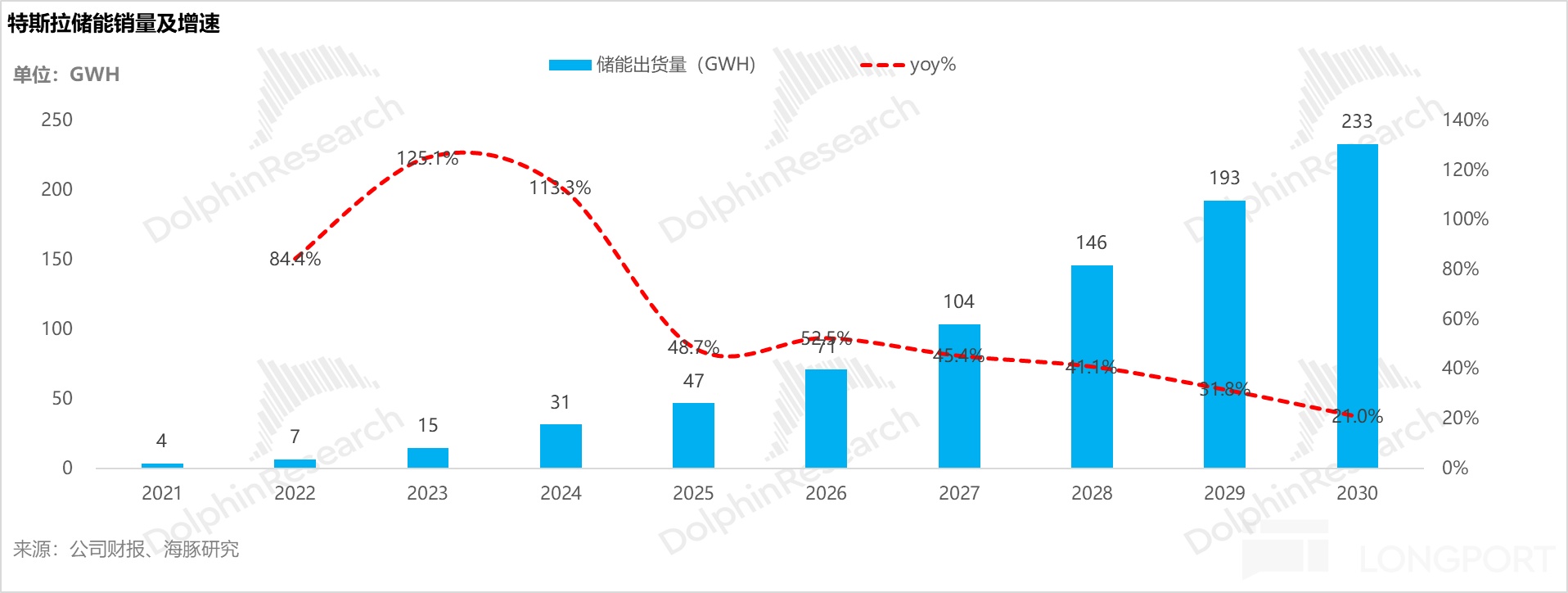
We see two key advantages that could lift Tesla Energy’s share from ~15% in 2025 to ~20% by 2030:
a) Mfg. scale: The Shanghai Megapack plant leverages China’s low-cost battery chain and is ramping from 20GWh toward 40GWh annual capacity, unlocking continued cost-down.
b) AIDC customization: Tesla’s low-voltage DC storage, with high energy density, ms-level response, and co-optimization algorithms for data center loads, is emerging as a new AIDC power standard.
As scale expands and cost structure improves, storage GPM rose from ~7% in 2022 to ~30% in 2025. By 2030, despite ~10% annual ASP declines, GPM is stable at ~30% and OpEx ratio trends down to ~8%, implying ~$6.9bn NOPAT. At 25x PE and discounted, that is ~$106.2bn today.
③ FSD valuation: SaaS-like subscription optionality
FSD V14 in N. America marks a shift from 'usable' to 'good' autonomy. Still on HW4.0, its parameter count is ~10x V13 with much stronger generalization.
FSD Tracker shows V14.1 at 4,000+ miles per intervention in complex urban scenarios vs. ~200 miles on V13, a step-change. Musk guides that V14.3 in 1–2 months will unlock 'hands-off' driving and raise system safety.
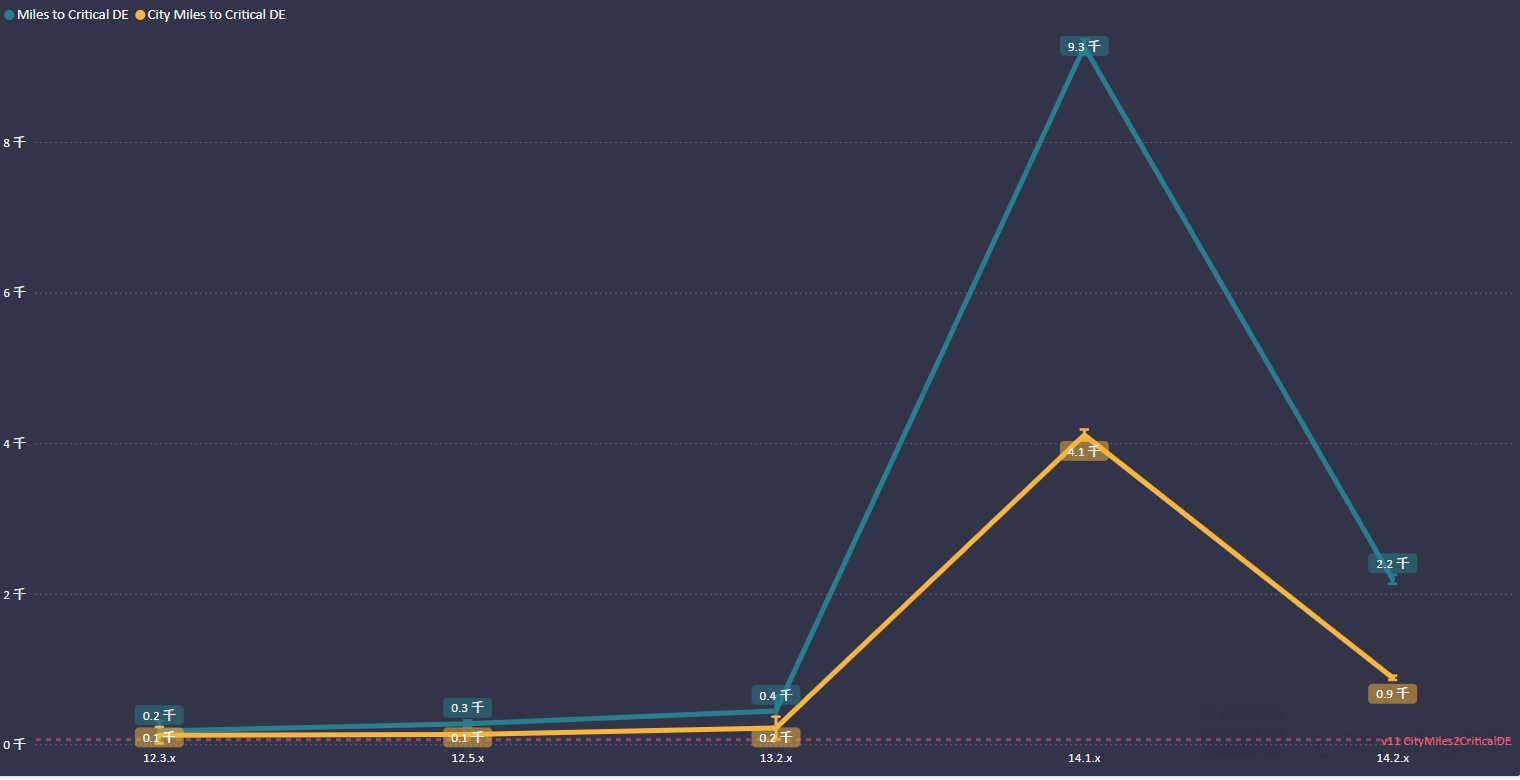
Source: Tesla FSD Tracker
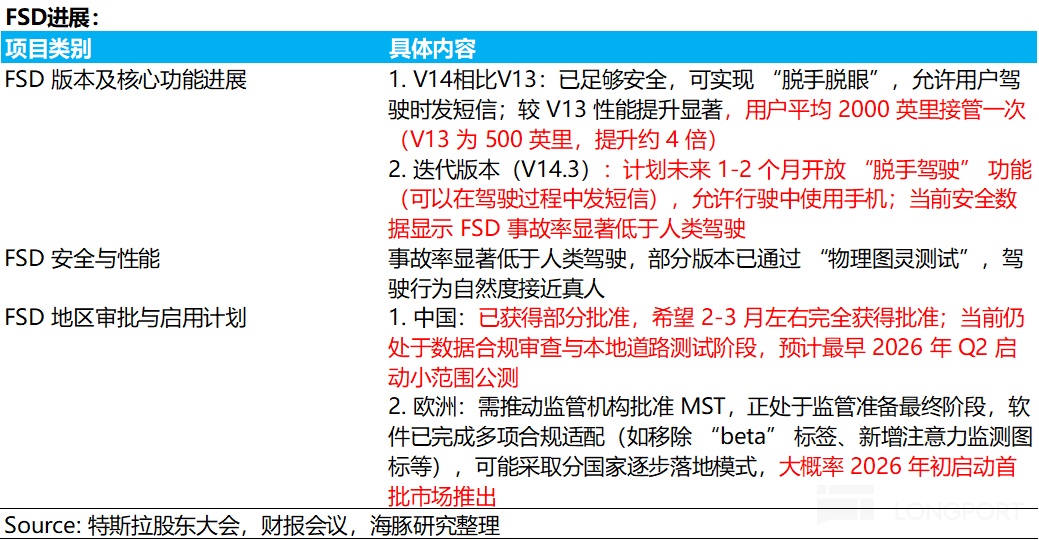
Over time, software forces hardware upgrades: Tesla plans AI 5 chips with 2,000–2,500 TOPS for mass production in late-2026 to 2027, 4–5x HW4.0 compute, enabling larger models and a shift from ADAS to driverless.
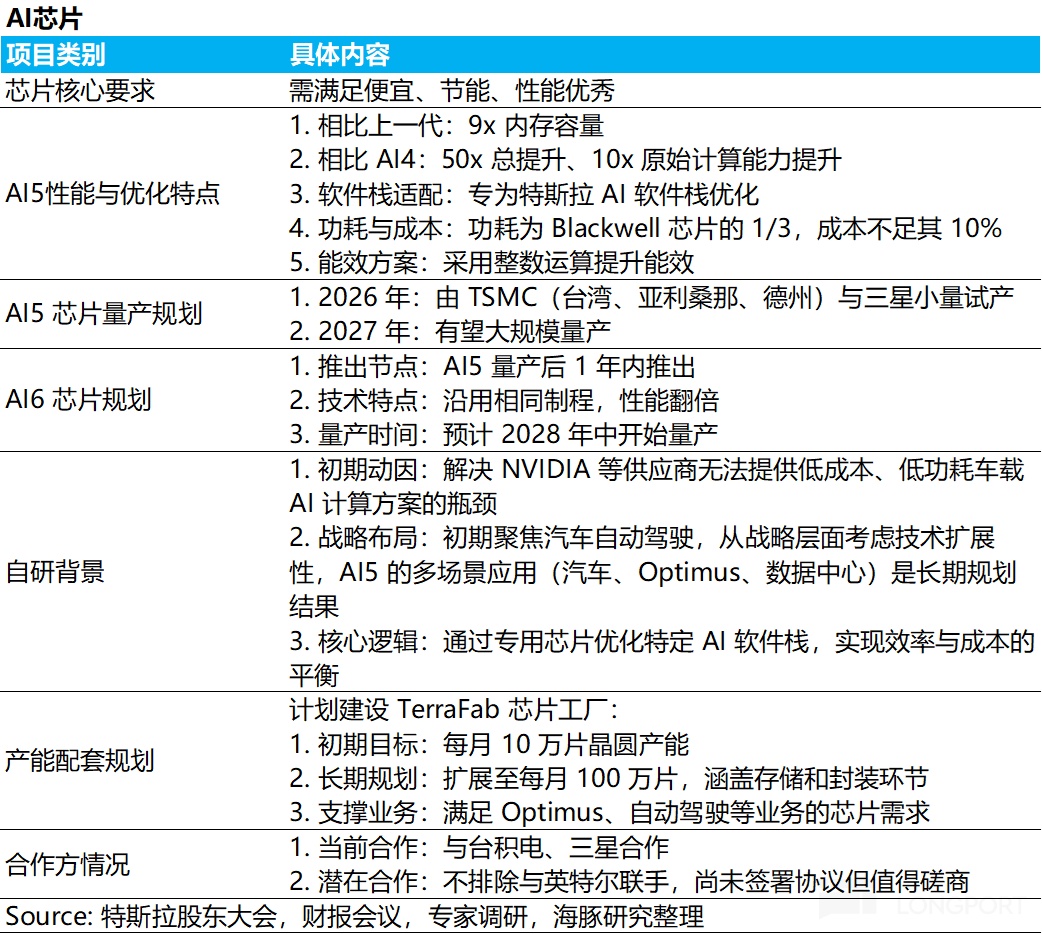
As of Q3 2025, paid FSD penetration is ~12% of the installed fleet, constrained by maturity. With AI 5 ramp and V15 software, improving tech should lift take-rates.
From a 2035 end-state lens, we assume Tesla rebuilds FSD into a global SaaS platform with owned subscriptions plus 3rd-party licensing:
a) Base case:
Tesla fleet subscriptions: 48.41mn vehicles in 2035, at $60/month (down from today’s $99), with ~60% paid penetration (~28.74mn users). Annual revenue contribution: ~$20.8bn.
3rd-party licensing: With global NEV penetration at ~60% (~420mn vehicles), assume FSD reaches ~8% of this 3P pool (~33mn vehicles). At the same $60/month and a 40% platform take, that is ~29mn paid 3P users and ~$8.4bn annual revenue.
Valuation: Nearly 58mn paid FSD users globally by 2035 (vs. Microsoft 365’s ~400mn users at ~$10/month, still room). Total FSD revenue of ~$29.1bn. At 15x P/S and discounted, the FSD biz. is worth ~$165.5bn today.
b) Bull case:
~84mn paid FSD users (70% Tesla-fleet penetration; 2035 NEV penetration at 80%/~500mn stock; 10% 3P paid). Total revenue of ~$41.8bn. At 20x P/S and discounted, worth ~$320bn today.
c) Bear case:
~33mn paid users (30% Tesla-fleet; 5% 3P paid). Total revenue of ~$17.0bn. At 10x P/S and discounted, worth ~$65bn today.
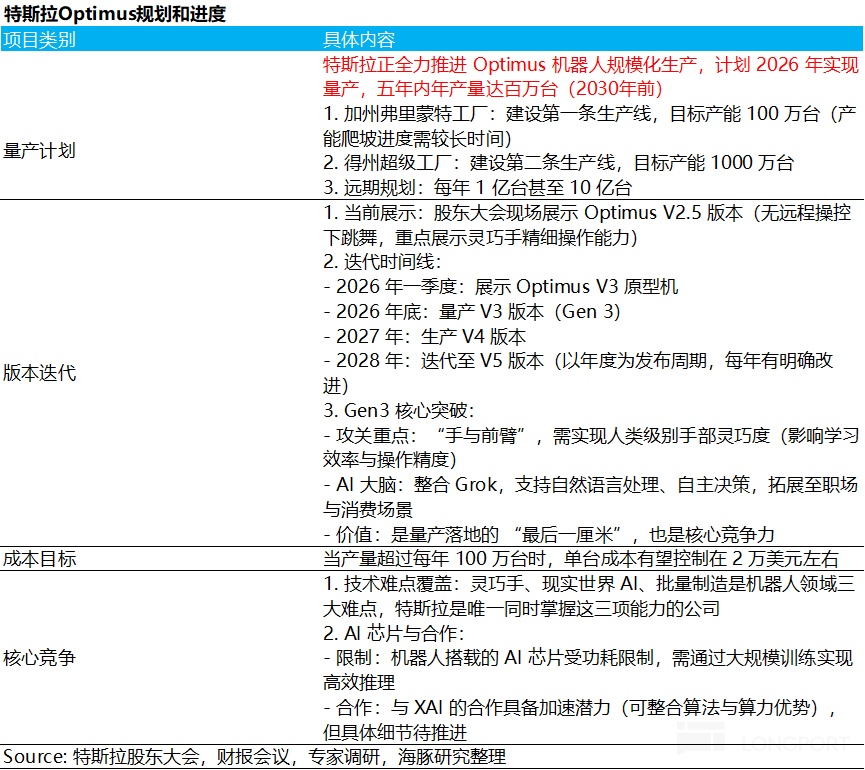
④ Optimus: 'Starry ocean' vs. a cold start
Optimus is the most imaginative AI option for Tesla and the biggest long-dated call option. Musk has said it could be 80% of Tesla’s value long term, capped only by the labor market it replaces.
But robots vs. FSD differ fundamentally in commercialization:
Smart EVs: The car remains a functional tool even without AI and can still collect driving data before autonomy matures, enabling the data–train–iterate flywheel. Humanoid robots: Shipments depend on an AI brain; without it, they are expensive shells, stuck in a loop of no AI, no shipments, no data, and no cost-down. The training bar is much higher and the data loop far harder.
We therefore expect Optimus to scale materially later than Robotaxi.
Progress: Musk plans to demo Optimus V3 in Q1 2026, start mass production by end-2026, and first deploy in Tesla’s gigafactories. Annual iterations follow, with a 2030 target of 1mn units at ~$20k cost (below Model 3).
In a base case, with 1mn units in 2030 at ~$30k ASP and ~20% net margin, Optimus earns ~$6bn net income. At 30x PE and discounted, that is ~$110bn today; in a bull case, given larger TAM, 50x PE implies ~$185bn today.
Tesla’s market cap: Auto company or AI company?
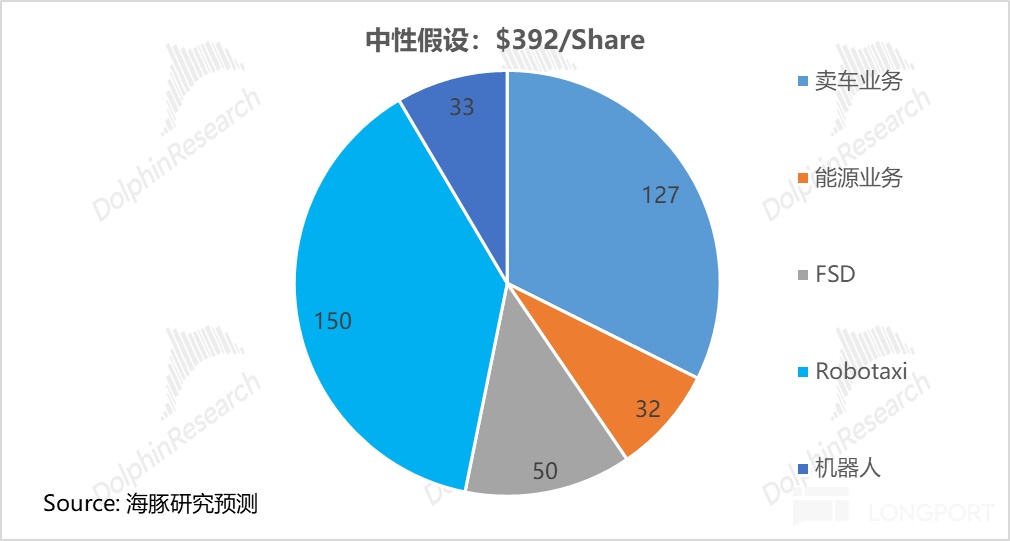
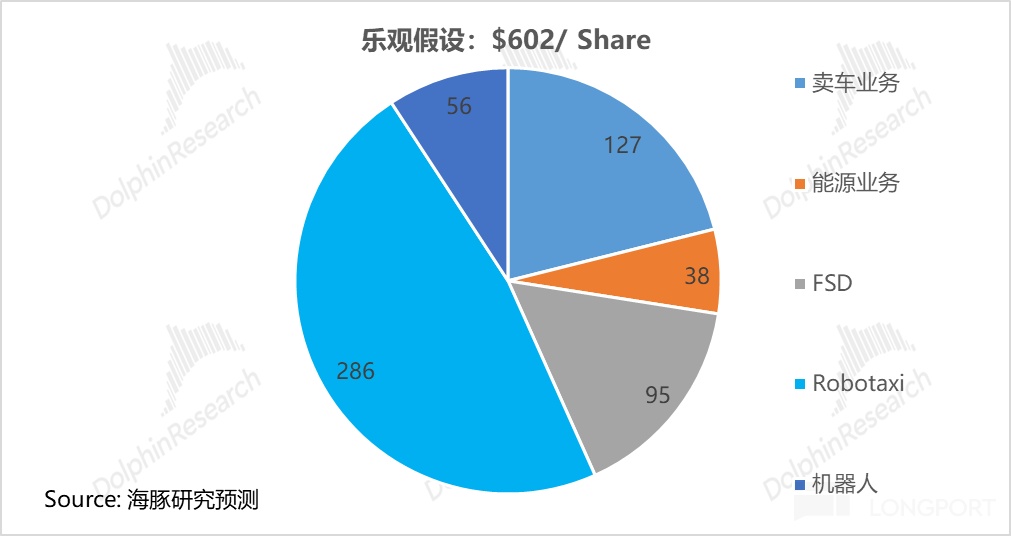
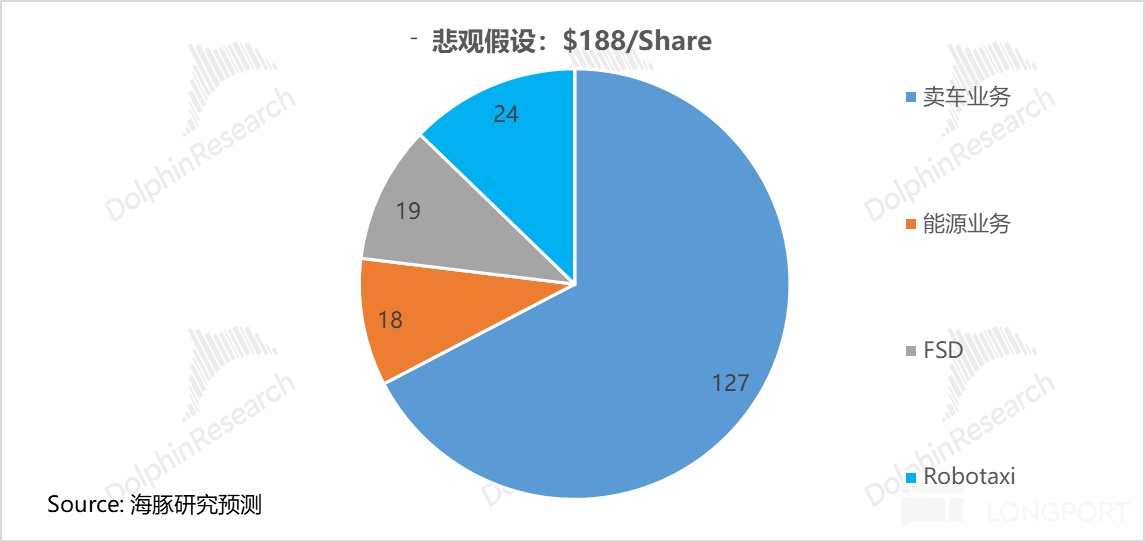
On SOTP, we split Tesla into the 'hardware foundation' (Autos + Energy) and 'AI growth premium' (FSD + Robotaxi + Optimus).
Base case: AI starts to dominate valuation
Dolphin Research’s target is ~$1.3tn (implied price $392). Autos + Energy contribute ~$520bn (~40%), while AI contributes ~$776.4bn (~60%). AI accounts for the majority of Tesla’s value.
Bull case: Tesla begins its transformation into an AI-era hegemon
If AI execution is strong, we see a ~$2.0tn target (implied $602). Autos + Energy contribute ~$550bn, with AI at ~$1.45tn (~73%). In this scenario, Robotaxi expectations, SaaS FSD revenue, and Optimus scaling drive the story, and Tesla effectively shifts from auto to AI.
Bear case: Valuation reverts to manufacturing
If AI progress notably disappoints (delayed breakthroughs, regulatory holdups, production setbacks), commercialization takes longer and the AI narrative cools. We see a ~$630bn target (implied $188), led by Autos + Energy at ~$480bn (~77%) and AI at ~$145bn (~23%).
In that case, the stock has a larger margin of safety, and AI becomes a heavily discounted call option.
Bottom line:
Despite repeated delays in Tesla’s AI roadmap (Robotaxi/Optimus), the opportunity remains in a 'huge TAM, hard to disprove near term' sweet spot.
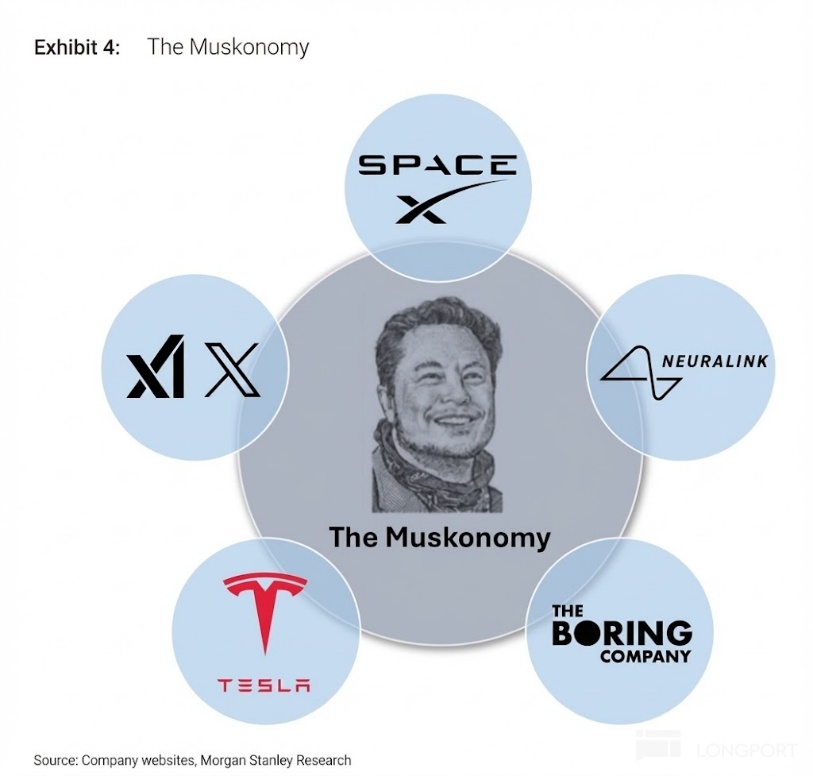
2026 should be the year when Musk’s empire starts to show synergy at scale, and when the AI story shifts from concept to profit delivery. Tesla guides that Robotaxi will begin to impact reported results meaningfully in 2H26.
Therefore, Dolphin Research’s take:
If weak Q4 2025 prints or Q1 2026 seasonality drags the stock below the base case ($392), it could be a reasonable entry.
If Optimus or Robotaxi execution surprises to the upside (e.g., regulatory approval, orders and mass production), the market’s anchor should rotate faster from 'auto mfg.' to 'AI growth', driving toward the bull-case target ($602).
<End here>




The copyright of this article belongs to the original author/organization.
The views expressed herein are solely those of the author and do not reflect the stance of the platform. The content is intended for investment reference purposes only and shall not be considered as investment advice. Please contact us if you have any questions or suggestions regarding the content services provided by the platform.