
D
Jan 14 at 05:11 AM
99% compute idle? In the inference era, storage beats compute!
 I'm LongbridgeAI, I can summarize articles.
Jensen Huang’s CES 2026 keynote again reignited enthusiasm for memory. In particular, Rubin’s architecture calls for more DDR and NAND vs. Blackwell, lifting memory stocks. With focus broadening from HBM to DDR and NAND, tightening supply-demand is pushing up pricing across the board.
The prior piece scoped out storage roles in AI servers and the HBM market. In this article, Dolphin Research turns to DDR, NAND, and HDD, highlighting incremental opportunities in AI data centers and estimating supply-demand by category.
Key takeaways from Dolphin Research: We summarize the core views below.
a) Tightness extends into 2027: From 2026–2027, demand growth for DRAM (HBM + DDR), NAND (SSDs), and HDDs will outpace supply growth. Memory markets should stay tight.
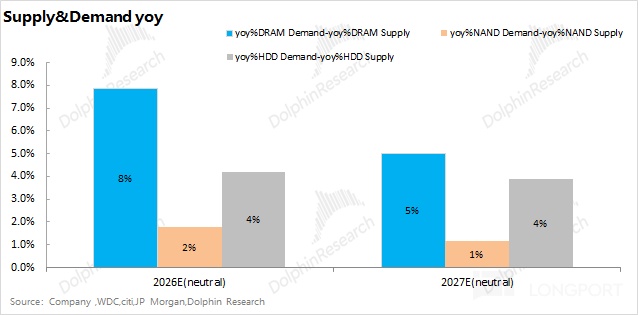
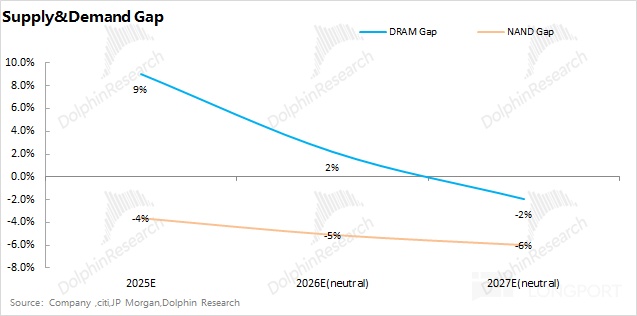
b) Core categories: DRAM and NAND remain short. As CPU-side DDR content rises in AI servers, DRAM’s supply-demand gap should widen meaningfully in 2027. NAND’s deficit likely holds at about 5–6% in 2026–2027.
The reason: expansion difficulty varies across memory types, which sets the pace of supply growth. DRAM expansion typically requires new lines, so capex at major vendors is skewing to DRAM (incl. HBM). This constrains legacy DDR supply.
By contrast, NAND and HDD have lower expansion hurdles. AI demand is lifting both, but NAND can scale via layer count and HDD via more platters/heads. Vendors can add output without building greenfield fabs.
Also, NAND and HDD are more cyclical, so vendors prefer a tight balance to maximize returns. They avoid overbuilding during up-cycles, which would trigger fresh losses and a downturn. Maintaining discipline is key.
Given current capacity plans, DRAM tightness looks most certain (with SK hynix, Samsung, and $Micron Tech(MU.US) holding ~90% share). In NAND and HDD, today’s price-over-volume discipline should prolong this up-cycle and maximize industry profits. If vendors step up expansions later, NAND/HDD tightness could ease more quickly.
Below we detail how AI reshapes the memory cycle. We focus on traditional memory in AI data centers and the evolving supply-demand.
I. DRAM: AI demand creates a structural gap We explain the mechanisms and timing.
HBM is packaged on AI accelerators and is essential, but HBM alone is not enough. Speed matters, yet capacity is critical in inference. Long-context and multimodal workloads require both bandwidth and capacity.
This explains why the market’s attention moved beyond HBM. In 2025 (the inference phase), demand for legacy DDR within DRAM visibly inflected.
DDR serves two main roles in AI servers: Both are becoming more important as inference scales.
① CPU-side system memory for data pre-processing, model orchestration, and parameter distribution. This lifts CPU-attached DDR content.
② A potential expanded memory pool via CXL acting as an external store. With HBM’s limited capacity, DDR over CXL can feed the GPU with data support.
Price momentum in legacy DRAM aligns with this shift. The sharp DDR price upturn began in 2H25.
For DDR5 (16Gb (2Gx8), 4800/5600 Mbps), spot prices have climbed from about $6 in early Sep 2025 to ~$31 now. That is a 5x+ surge.
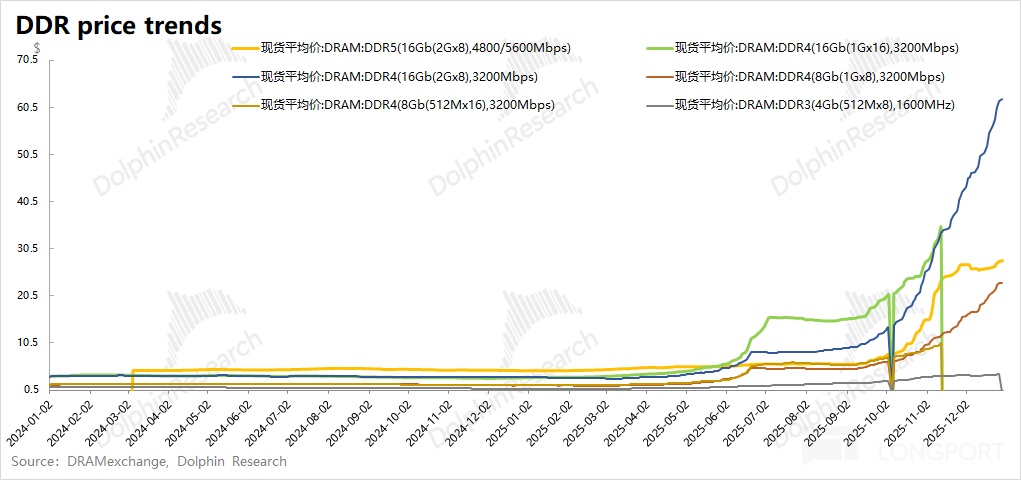
What is driving the jump in legacy DRAM pricing? Two forces are at work on supply and demand.
a) Supply: the big three (SK hynix, Samsung, Micron) have redirected more DRAM capacity to HBM. That crowds out legacy DDR supply and tightens availability.
b) Demand: as focus shifts from training to inference, CPU-side and CXL-based external memory needs rise. Given higher DDR ASPs in servers, vendors prioritize AI server orders.
Combining both sides, DRAM exited its prior balance in 2H25. The market flipped toward tightness as AI demand scaled.
So where does DRAM supply-demand stand now? Dolphin Research assesses it via capex, supply, and demand.
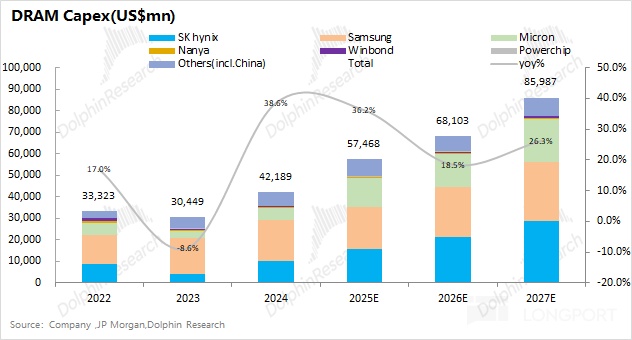
1.1 DRAM capex After cuts in 2023, AI/HBM demand drove a return to double-digit DRAM capex growth from 2024. The majors are leading that push.
The big three (SK hynix, Samsung, Micron) are the largest spenders, consistent with their leading market shares in DRAM. Their allocations align with strategy.
While everyone is investing more in DRAM, the big three are prioritizing HBM over legacy DDR. This skews capacity away from DDR supply.
1.2 DRAM supply: from capacity to output We derive output from wafer capacity, given concentration among the top three.
Since SK hynix, Samsung, and Micron ship over 90% of DRAM, we anchor on their footprints. Their combined monthly capacity has trended up to roughly 1.6mn wafers.
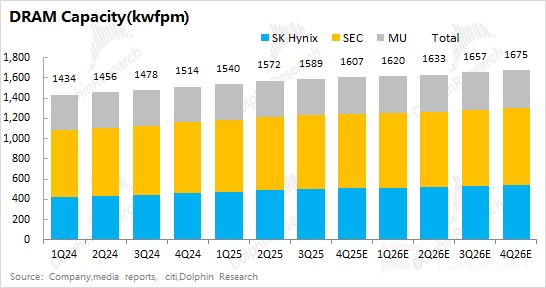
With continued DRAM investment, monthly capacity could reach ~1.675mn wafers by Q4 2026. On a full-year basis, 2026 capacity could total about 19.65mn wafers.
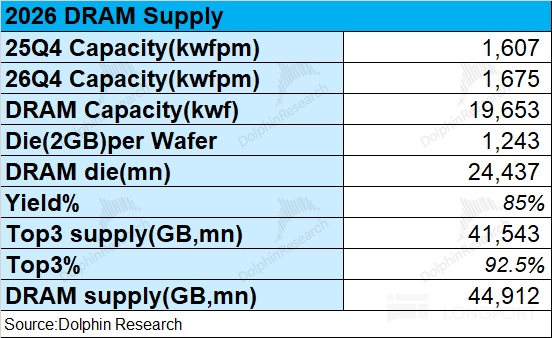
Output then depends on die-per-wafer and conversions. We also consider scrap and cut loss.
Assuming 12-inch wafers yield about 1,200–1,250 DDR dies each (die size ~50–70 mm²). At 19.65mn wafers, that implies ~24.4bn DRAM dies (each equivalent to 2 GB).
Assuming ~85% overall yield and ~92.5% share for the top three, global DRAM supply in 2026 would be near 449bn GB. This frames the base case.
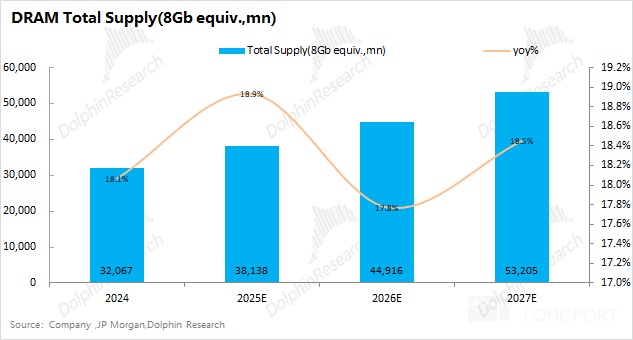
Using this approach and market expectations, total DRAM supply grows at ~18% CAGR from 2024. By 2027, it could top 53bn GB.
1.3 DRAM demand: 25%+ growth We separate AI servers from traditional end-markets.
Traditional demand from PCs, smartphones, and industrial is mature. The real swing factor this cycle is AI servers.
Within AI servers, DRAM splits into HBM and DDR. HBM pairs with the GPU/AI accelerator, while the bigger DRAM dislocation comes from server DDR.
For DDR, the traditional role is CPU-attached memory, and the new role is CXL DRAM as external memory for model offload and KV cache. This eases pressure on HBM’s limited capacity.
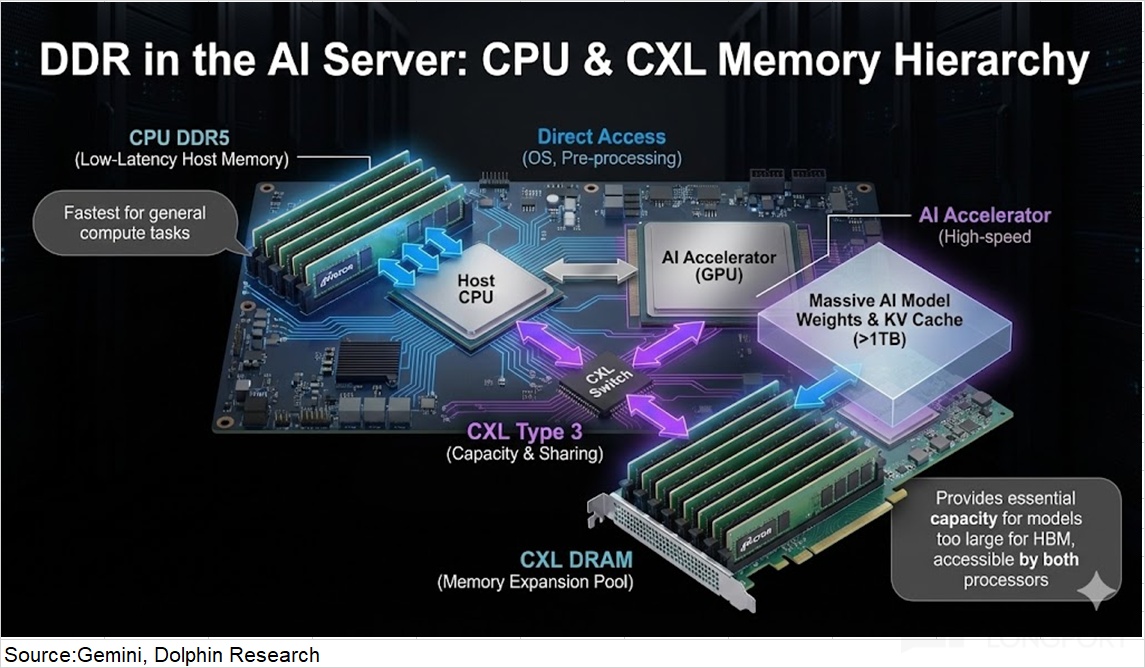
At CES 2026, Jensen Huang noted that in NVL72, DDR per CPU could rise from 500 GB on Blackwell to 1.5 TB on Rubin. That is a 3x jump.
Market estimates suggest a roughly 1:1 CoWoS split between Blackwell and Rubin. Thus, NVIDIA’s avg. DDR per CPU in 2026 would be ~1 TB, rising to ~1.5 TB as 2027 shipments skew to Rubin.
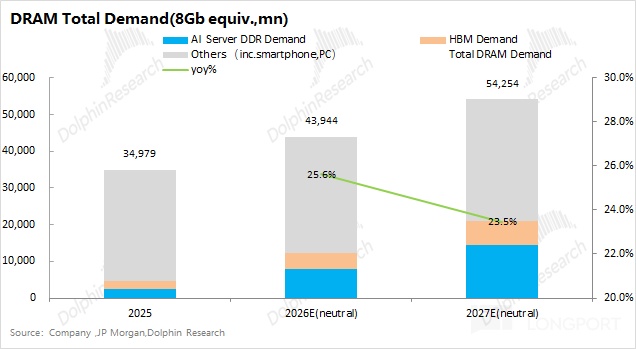
Assuming CoWoS shipments expand to about 1.9mn in 2027, and applying NVL72 DDR content, AI server DDR demand could reach ~8bn GB in 2026 and ~14.4bn GB in 2027. That implies +222% and +80% YoY.
We model total DRAM demand as HBM for AI + DDR for AI + traditional segments. This aggregates the moving pieces.
After sizing AI demand for HBM and DDR, we add traditional end-markets. Rising DDR prices strain smartphones and PCs.
Although per-device memory content is still rising, unit shipments of smartphones and PCs are expected to fall. We assume other segments (phones, PCs, industrial) grow ~5% YoY in both 2026 and 2027 (neutral case).
Under these assumptions and AI adds, total DRAM demand would be ~43.9bn GB in 2026 and ~54.2bn GB in 2027. That is +25% and +23% YoY.
1.4 DRAM balance: tight through 2027 Relative growth points to ongoing tightness.
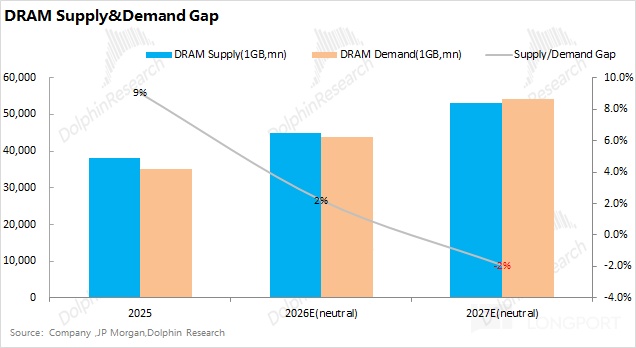
Many brokers frame it in relative terms: (i) 2026 demand +25% vs. supply +18%; (ii) 2027 demand +23% vs. supply +18.5%. This implies a persistent gap and continued pricing power.
In absolute terms, tightness should intensify across 2026–2027. Inventory buffers fall below normal.
With supply growing at ~18% CAGR, the gap is not obvious in 2026 (supply adequacy already below normal). In 2027 the shortfall could widen to ~2%.
Hence the big three (Samsung, SK hynix, Micron) continue to lift DRAM capex. The bias remains toward HBM.
II. NAND: can layer scaling keep up with demand? We assess the bridge between DRAM and HDD.
NAND is the hot data store in AI servers, the fast persistent layer between DRAM and HDD. It is a core enabler of low-latency inference.
Legacy DRAM is not the only product rallying. NAND has nearly doubled YTD, with 32Gb (4Gx8 MLC) moving from ~$2.3 at the start of 2025 to ~$4.27 now (+85%).
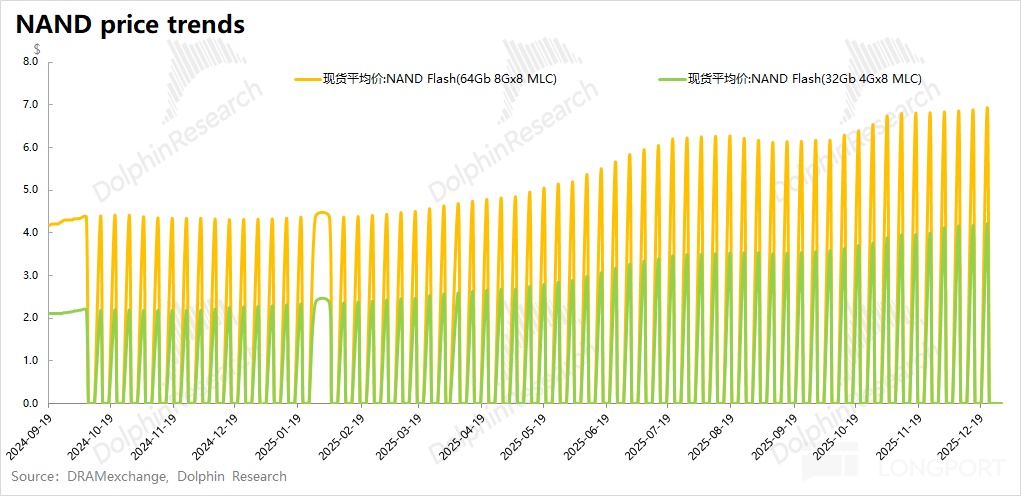
Since early 2025, NAND’s rebound unfolded in two phases. The drivers shifted from supply discipline to AI-led demand.
Phase 1 (1H): supply cuts stopped the bleeding and lifted prices. Samsung, SK hynix, and others reduced output to stabilize the market. At the same time, demand was stimulated by China’s state subsidies, further tightening the balance.
Phase 2 (2H): AI demand created a fresh imbalance and drove another leg up, as AI capex surged and SSD attach per AI chip rose. That pushed AI server SSD demand sharply higher and left NAND short.
Where SSD sees incremental AI opportunity: Two main vectors are at play.
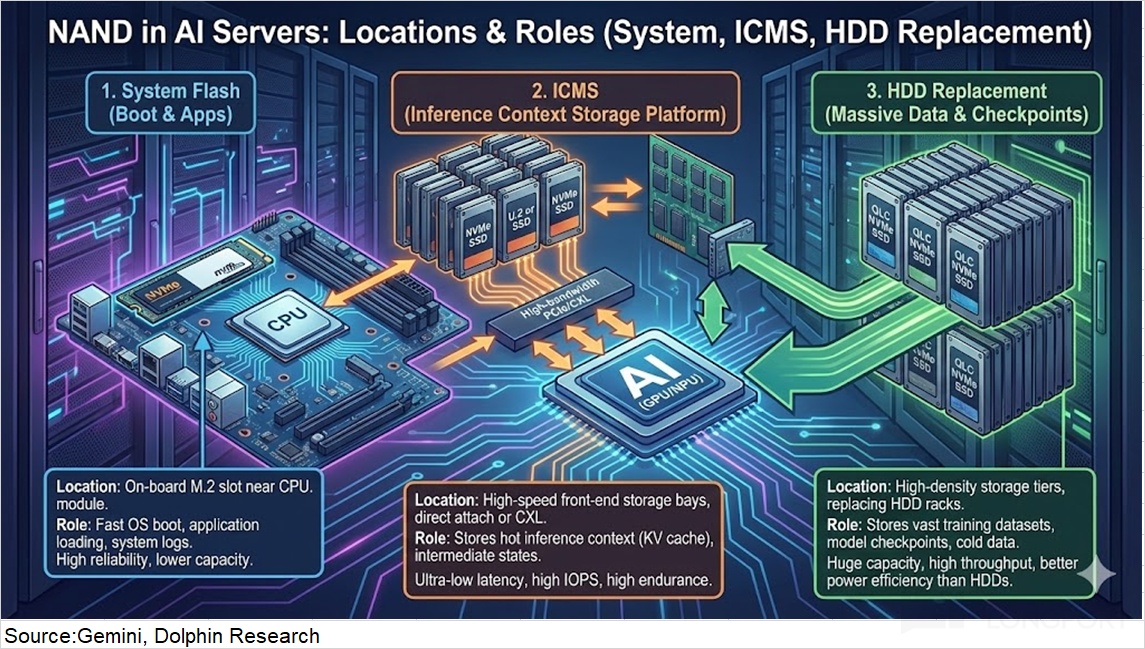
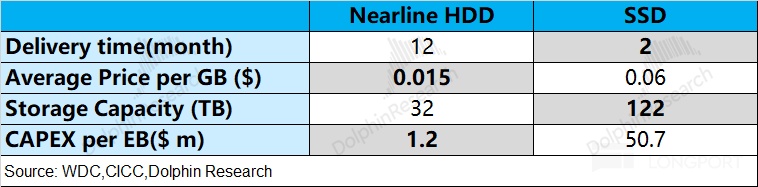
① Substitution for HDD in some deployments, as HDD lead times stretch to 1+ years. Although SSD costs 4–6x per GB vs. HDD, it has become a practical alternative for some buyers.
② Rubin adds NAND via an ICMS layer: per CES 2026, NVIDIA’s Rubin introduces an Inference Context Memory System (ICMS) with up to 16 TB NAND per GPU. This unlocks new SSD demand adjacent to accelerators.
[The ICMS is dedicated to context storage, moving KV cache from HBM to more cost-effective NAND. This reserves HBM for compute and lowers inference cost. It is a classic tiering optimization.]
As potential NAND use cases expand in AI servers, supply-demand tightens further. We evaluate tightness through capex, supply, and demand lenses.
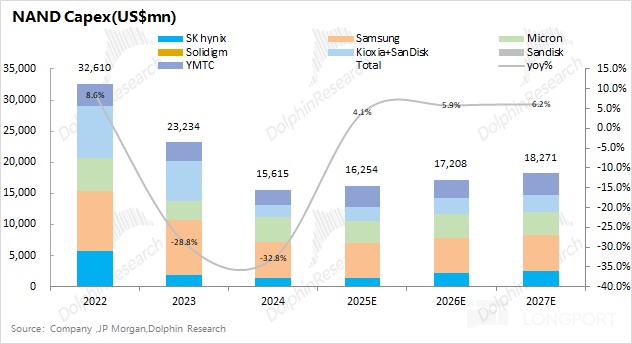
2.1 NAND capex: layer-driven scaling keeps capex modest AI has lifted demand, but global NAND capex remains cautious. With pricing recovering, 2025 capex also bounced.
Even so, spend is skewed to DRAM rather than NAND. Based on company plans and industry checks, global NAND capex could reach ~$18.3bn by 2027, a two-year CAGR of only ~6%.
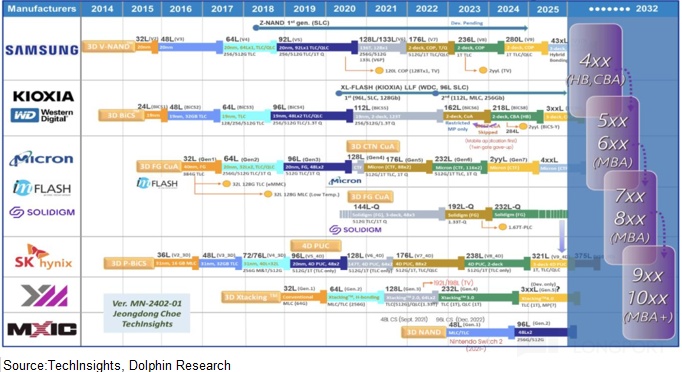
The key is that 3D NAND scales capacity by adding layers, not wafers. In 2D NAND, +20% capacity required +20% wafer starts. In 3D, layer count delivers most of the growth.
Practically, vendors do not need new lines. They upgrade etch/deposition on existing tools, and more layers yield more bits per wafer. Capex per bit stays contained.
2.2 NAND supply: from capacity to output We start from wafer capacity and translate to EB.
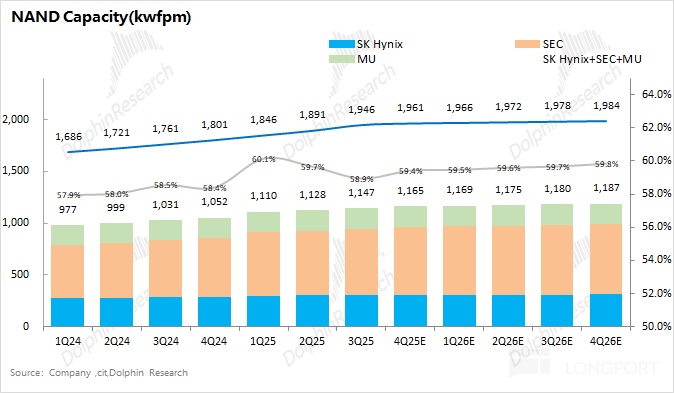
Total industry capacity is about 1.96mn wpm, with Samsung, SK hynix, and Micron at roughly 60% share. The rest is split among Kioxia, SanDisk, and others.
Unlike DRAM’s >90% concentration, NAND is more fragmented and competitive. This is another reason majors prioritize DRAM capex.
Given the cautious stance, NAND capacity likely inches to ~1.98mn wpm by end-2026. There is no aggressive greenfield build.
Accounting for ramp cadence, 2026 NAND capacity could total ~23.66mn wafers, about +4% YoY. This is a modest increase.
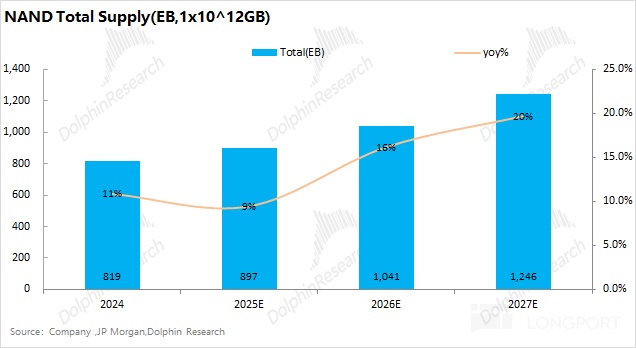
Translating wafers to bits, we assume ~44 TB per wafer on avg. in 2025. With the push toward 300+ layers, bits-per-wafer could grow ~12% CAGR in 2026–2027.
On this basis, NAND supply could reach ~1,041 EB in 2026 and ~1,246 EB in 2027 (~1×10^12 GB). That is roughly ~18% CAGR.
2.3 NAND demand: AI servers + smartphones/PCs We break down by segment and rebuild the totals.
a) Data centers and servers: Rubin boosts NAND Traditional server demand is steady, while AI servers are the pricing driver.
Incremental demand per server comes from Rubin’s ICMS layer and partial HDD substitution. Dolphin Research splits AI demand into Rubin adds and other AI server growth.
① Rubin incremental: with ~350k CoWoS units and +16 TB NAND per GPU, Rubin could add ~78 EB of NAND demand in 2026. This is a new layer of SSD attach.
② Other AI servers: B300 (e.g., NVL72) typically carries 500 GB–1.2 TB of NAND; we use 850 GB mid-point. Assuming +30% NAND per server in 2026, other AI server demand could exceed ~180 EB.
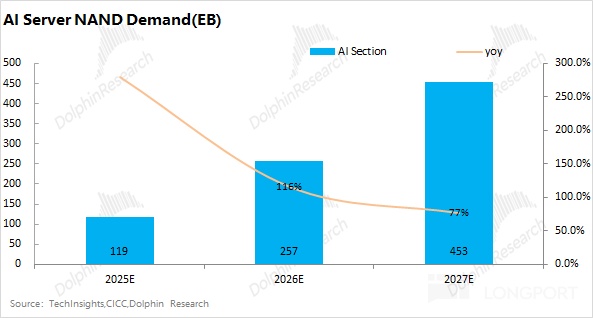
Applying the same framework to 2027, AI server NAND demand could reach ~258 EB in 2026 and ~453 EB in 2027, +116% and +77% YoY. This is the primary growth engine.
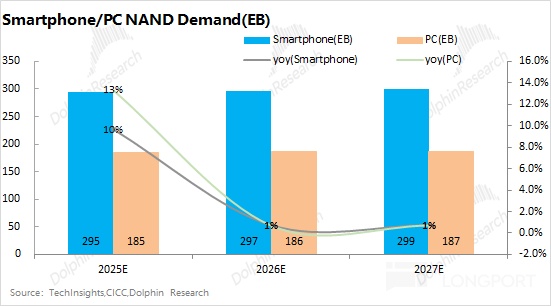
b) Smartphones/PCs: facing price pressure Video-heavy use keeps pushing up per-device NAND content. But rising prices pressure OEMs and could curb stocking and shipments.
Dolphin Research assumes per-unit content rises while device shipments slip. Phone and PC NAND demand is roughly ~298 EB and ~187 EB in 2026–2027, with only slight YoY growth over two years.
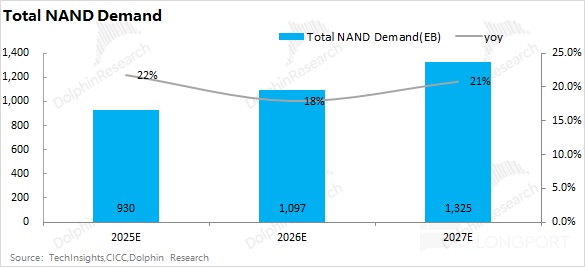
c) Total NAND demand combines data centers, phones, PCs, and other industrial uses. Assumptions: traditional servers +10% and other industrial +5% CAGR under higher prices.
On this basis, total NAND demand would be ~1,094 EB in 2026 and ~1,325 EB in 2027 (~20% CAGR). By 2027, AI servers become the largest end-market for NAND.
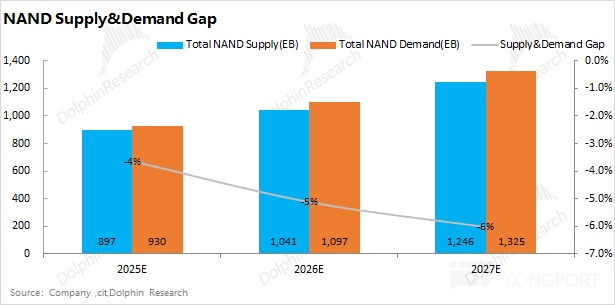
2.4 NAND balance On a relative growth view: (i) 2026 demand +18% vs. supply +16%; (ii) 2027 demand +21% vs. supply +20%. The gap and pricing power likely persist.
In absolute terms, tightness endures in 2026–2027. Since layering boosts bits without new fabs, vendors keep NAND capex restrained.
Assuming supply grows ~18% CAGR, the NAND deficit likely holds at ~5–6% in 2026–2027. That supports further price discipline.
III. HDD: cheapest at scale, still the cold-storage default We separate compute nodes from storage nodes.
Inside AI servers, HDDs are not essential; interest rose only as AI storage needs ballooned. We split the discussion into compute nodes vs. storage nodes in AI data centers.
a) AI servers (compute nodes): HDD latency is ~100x SSD and the mechanics suffer from vibration from high-power fans. As a result, servers rarely ship with HDDs.
b) AI data centers (storage nodes): ① Raw data storage for massive video/image/text cleaning pre-training, where HDD TCO per TB is ~1/4–1/5 of SSD. ② Logs and archives including inference logs, user interactions, and RAG indices typically sit on large-capacity HDD clusters.
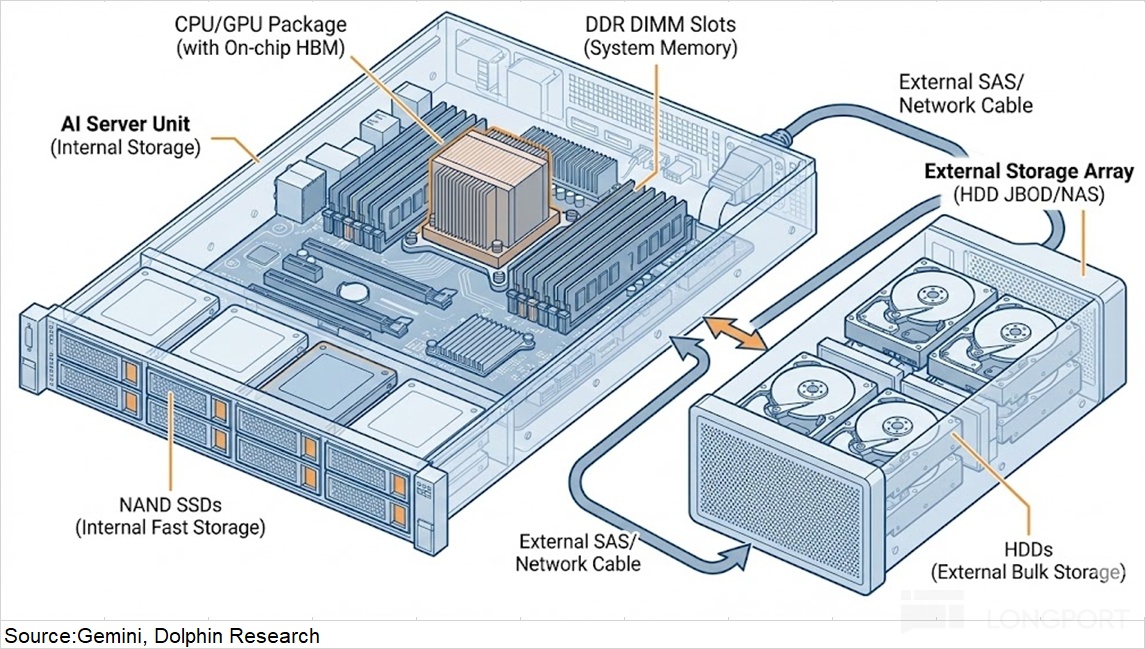
3.1 SSD vs. HDD Some argue SSDs will replace HDDs, but near term HDDs keep their cold-storage role. SSDs are a stopgap where HDD lead times are too long.
HDDs lag SSDs in speed and latency, making them unsuitable inside AI servers. But for massive cold storage, HDDs retain a strong cost advantage.
HDD unit storage cost and capex per EB are roughly 1/4 and ~1/50 of SSD, respectively. With ~1-year HDD lead times (materials ~3 months + build/test ~6 months), some buyers are forced into SSDs with ~2-month cycles despite higher cost.
3.2 HDD balance Even with AI-driven demand, core vendors ($Western Digital(WDC.US), $Seagate Tech(STX.US), Toshiba) remain restrained on large expansions. Discipline is deliberate.
Vendors aim to control supply to sustain margins, and HDD capacity can be added without new lines by increasing platters and heads. The preferred state is a tight balance.
Nearline HDDs (NL HDD) account for 80%+ of shipments and dominate cold-storage demand in AI data centers. We focus on NL HDD supply-demand.
1) Supply: with cautious expansions, NL HDD supply does not surge. Dolphin Research estimates +29% in 2026 and +19% in 2027.
2) Demand: based on WDC commentary, NL HDD demand growth could be +33% in 2026 and +23% in 2027. AI storage is the key driver.
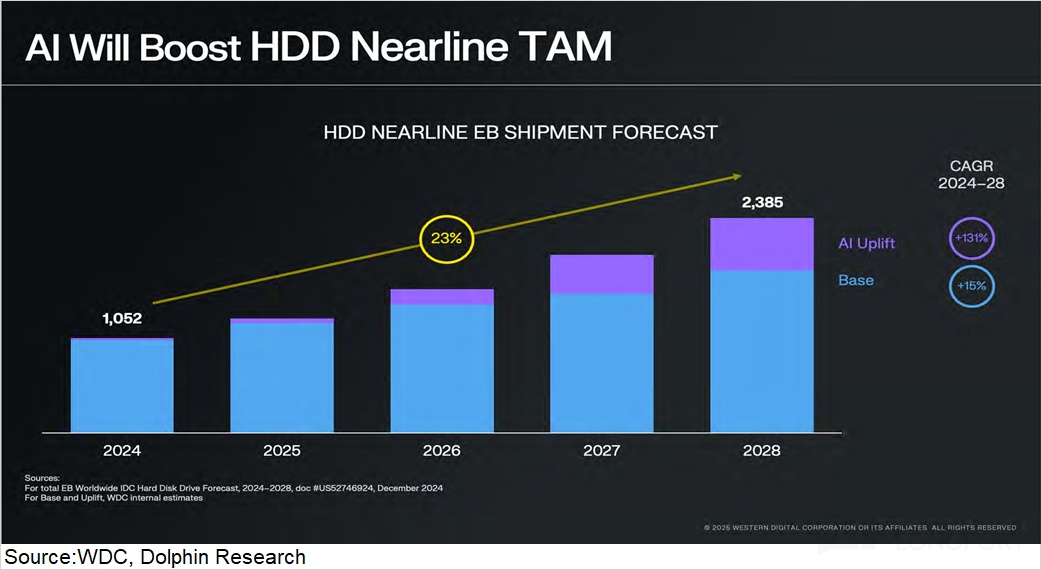
In sum, HDDs also trend tighter: (i) 2026 demand +33% vs. supply +29%; (ii) 2027 demand +23% vs. supply +19%. Compared with DRAM, HDD tightness is more about deliberate price-over-volume strategy.
As SSDs improve and costs fall, they can replace some near-server storage. At hyperscale cold storage, HDDs remain the cheapest and most scalable choice.
<End>
Recent Dolphin Research pieces on memory and NVIDIA: See related links below. All links remain unchanged.
Jan 6, 2026 AI storage hot topic: 存储猛拉,AI 存力超级周期到底有多神?
Dec 18, 2025 Micron analyst call Trans: 美光(分析师小会):现金优先用于扩大生产,HBM4 良率爬坡更快
Dec 18, 2025 Micron call Trans: 美光(纪要):毛利率继续提升,幅度会放缓
Dec 18, 2025 Micron earnings First Take: 美光 MU:AI 点燃存力,存储大周期启幕?
Risk disclosures and statements: Dolphin Research disclaimer and general disclosures



The copyright of this article belongs to the original author/organization.
The views expressed herein are solely those of the author and do not reflect the stance of the platform. The content is intended for investment reference purposes only and shall not be considered as investment advice. Please contact us if you have any questions or suggestions regarding the content services provided by the platform.