
D
Jan 16 at 06:24 AM
Qwen: Can BABA stage a comeback in the AI internet era?
 I'm LongbridgeAI, I can summarize articles.
Among open-source models globally, Qwen punches above its weight. Backed by Alibaba Cloud’s distribution, Alibaba’s models have also seen solid adoption on the enterprise side in China.
By contrast, Alibaba’s AI-to-C push has looked muted. From the early Tongyi Qwen app bundled with model R&D to the indecisive stance on Quark, progress has lagged ByteDance’s early bet on Doubao and Tencent’s heavy push behind Yuanbao.
By late 2025 and early 2026, Dolphin Research finally began to see some overdue moves. The following stood out.
1) Around mid-2025, Alibaba created an Intelligent Information Biz. Group and by year-end reorganized it into the Qwen-to-C Biz. Group. It consolidated Qwen App, Quark, AI hardware, UC and Shuqi, among others.
2) In late 2025, the Qwen group unveiled Quark AI Glasses, signaling its entry into AI hardware. This was a fast, high-profile launch.
3) In mid-Nov 2025, Alibaba re-packaged and re-launched the Qwen app. It has shown clear early traction, and was recently announced to have surpassed 100mn MAUs across all channels (App, Web and PC).
As noted in Dolphin Research’s recent analysis of China’s AI internet, 2026 is likely the year AI finally lands at scale on the consumer side. The battle for the AI entry point among Big Tech is imminent. With Qwen App now marketed aggressively in China, one key question is front and center.
1) After multiple rounds of consumer education by Doubao, DeepSeek and Yuanbao, what sets Qwen apart?
2) How is Qwen positioned within the Group?
3) Will AI apps become the primary traffic gateway in the AI era?
4) Qwen App vs. Taobao Flash Sales: will Qwen become another cash burner?
Invited to Alibaba’s Jan 15 Qwen launch themed 'From Question To Action', Dolphin Research attended with these questions in mind. Below are our takeaways following Qwen’s most consequential launch since its relaunch.
Details below:
I. What did Qwen announce this time?
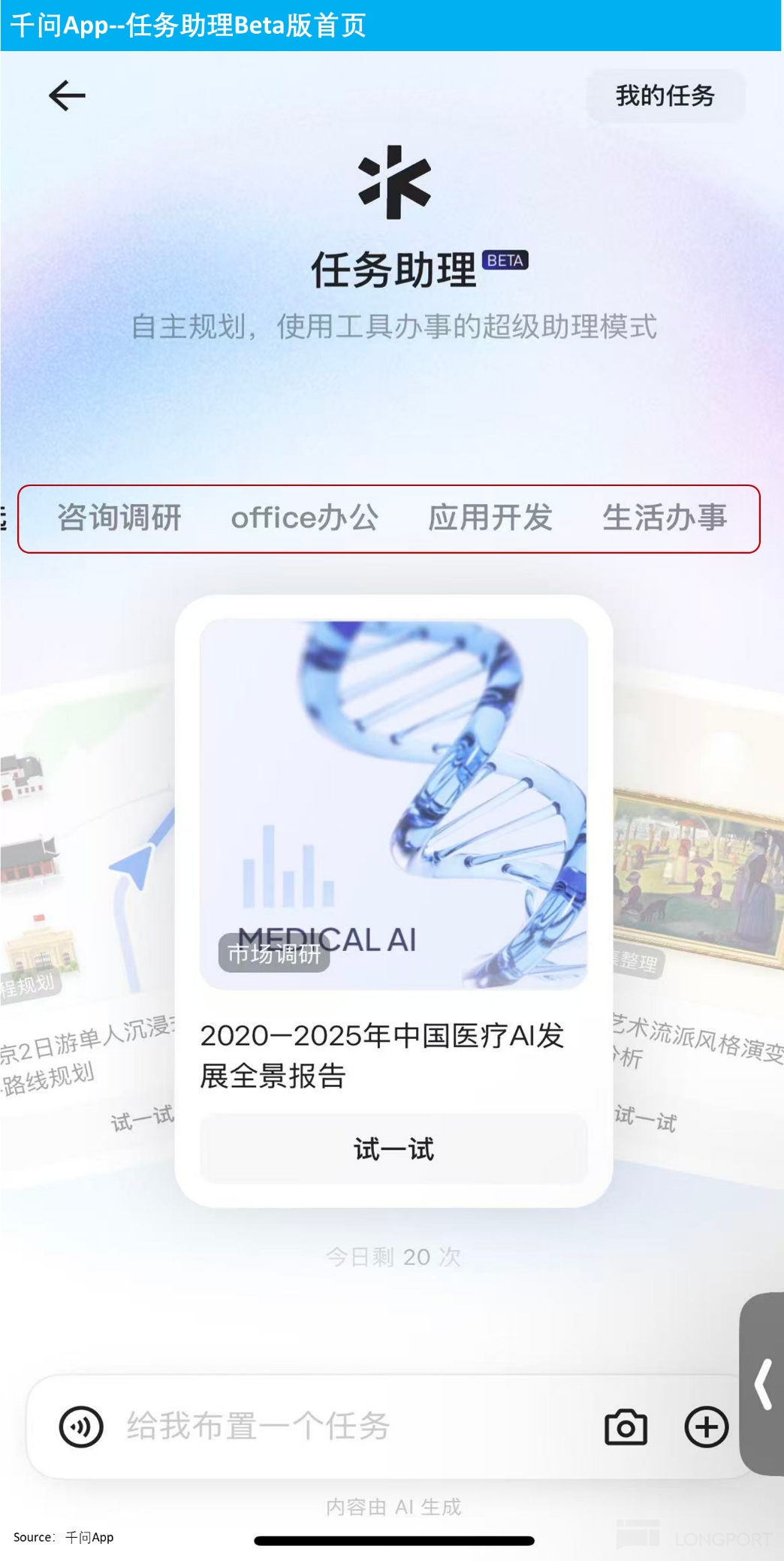
The theme 'From Question To Action' speaks for itself: Qwen is evolving from a chat-first chatbot into an agent that can get things done, bringing its Qwen Agent capabilities online. These span two tracks: 1) a Task Assistant for the virtual/digital world, focused on office workflows, and 2) a Life Assistant that interacts with the real world to help with shopping, travel and errands.
1) Task Assistant
Qwen’s Task Assistant, or office-centric assistant, is the most common and mainstream path for AI agents today. There are many similar offerings at home and abroad, such as Microsoft Copilot and Manus, that assist with Office productivity, project planning, coding and guided learning.
Dolphin Research believes deep differentiation here is hard unless there is clear technical outperformance. Most products will sit in a 70–90 score band, so we will not dwell on Task Assistant.
2) Life Assistant – the real highlight
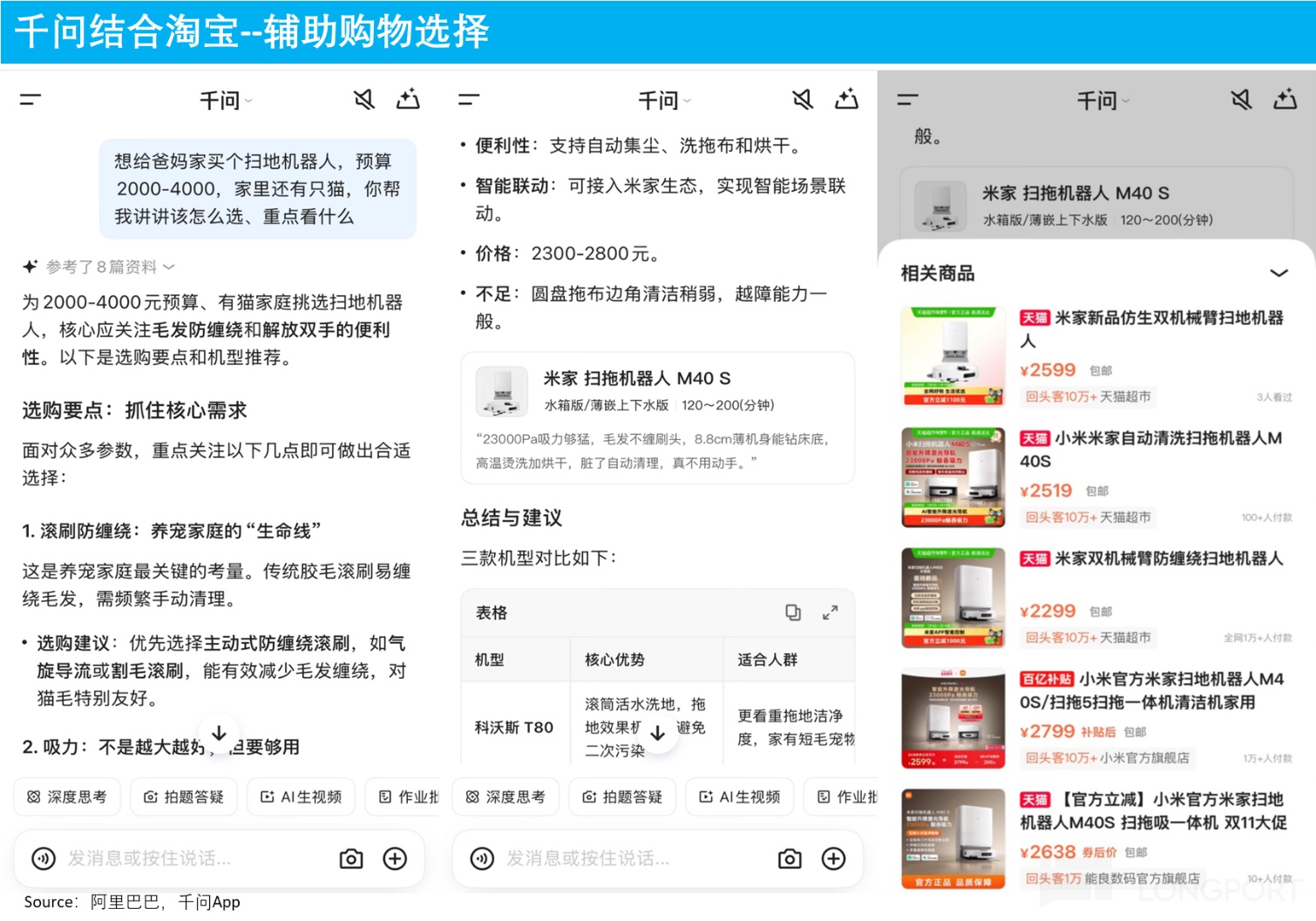
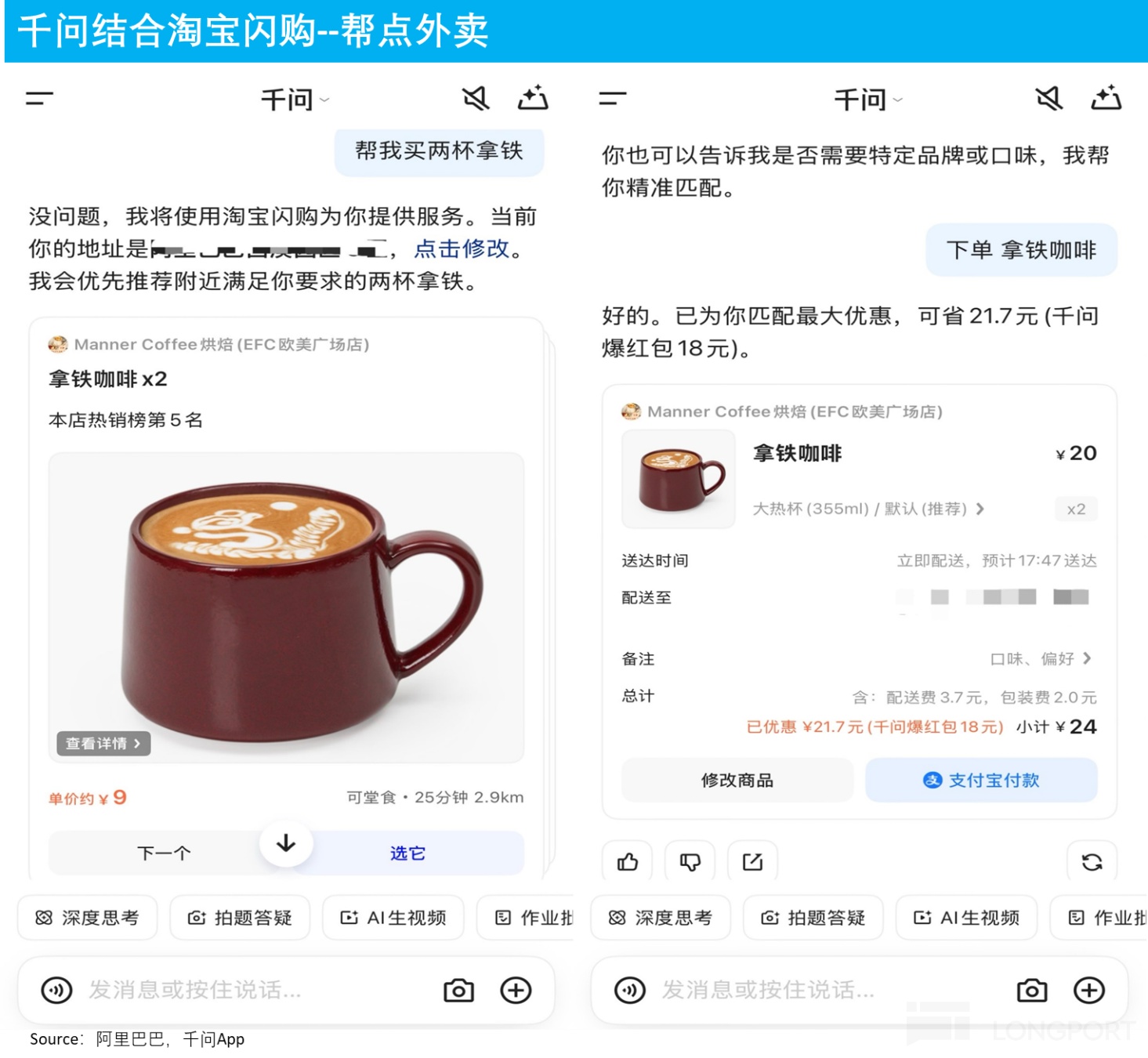
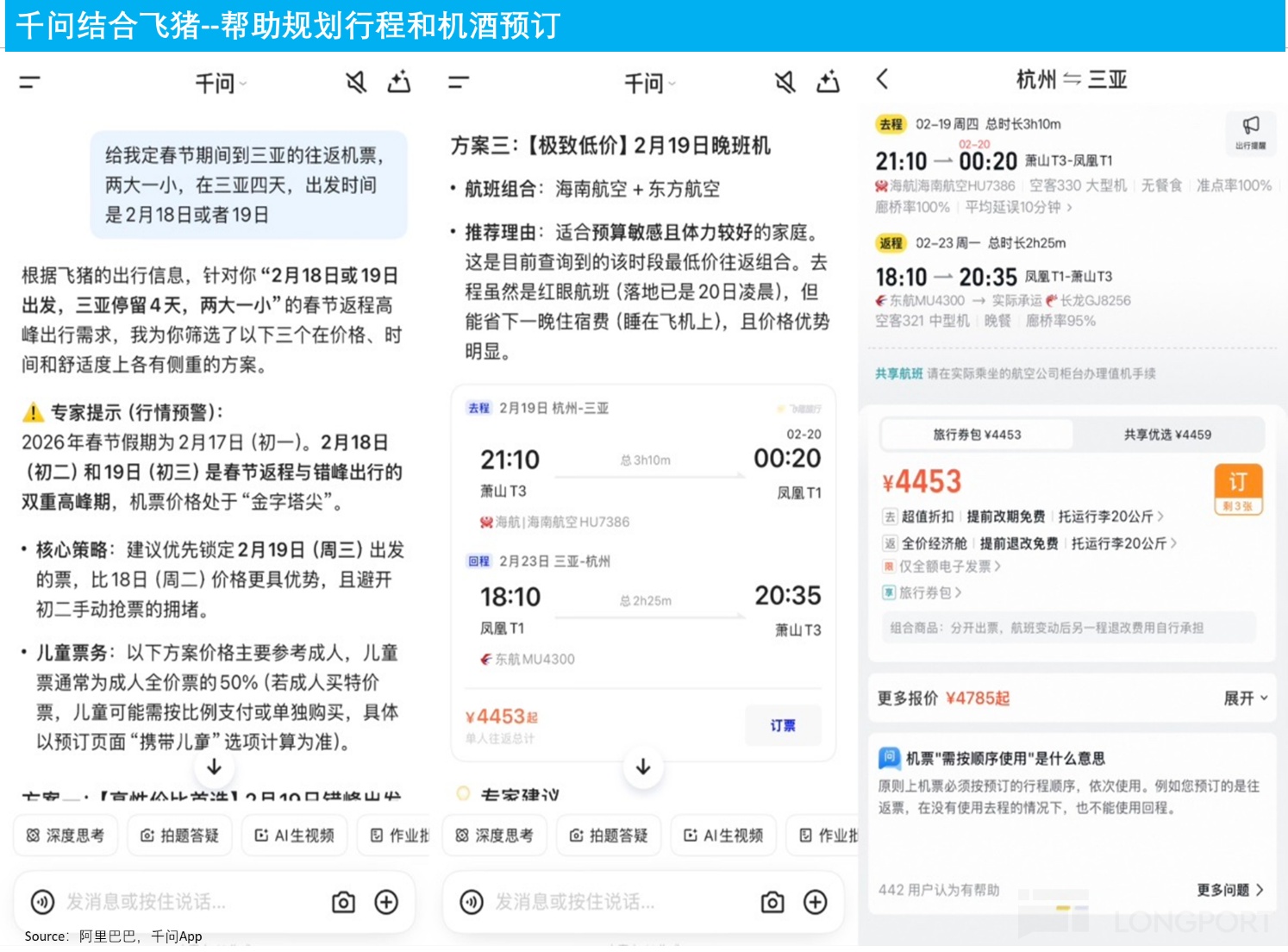
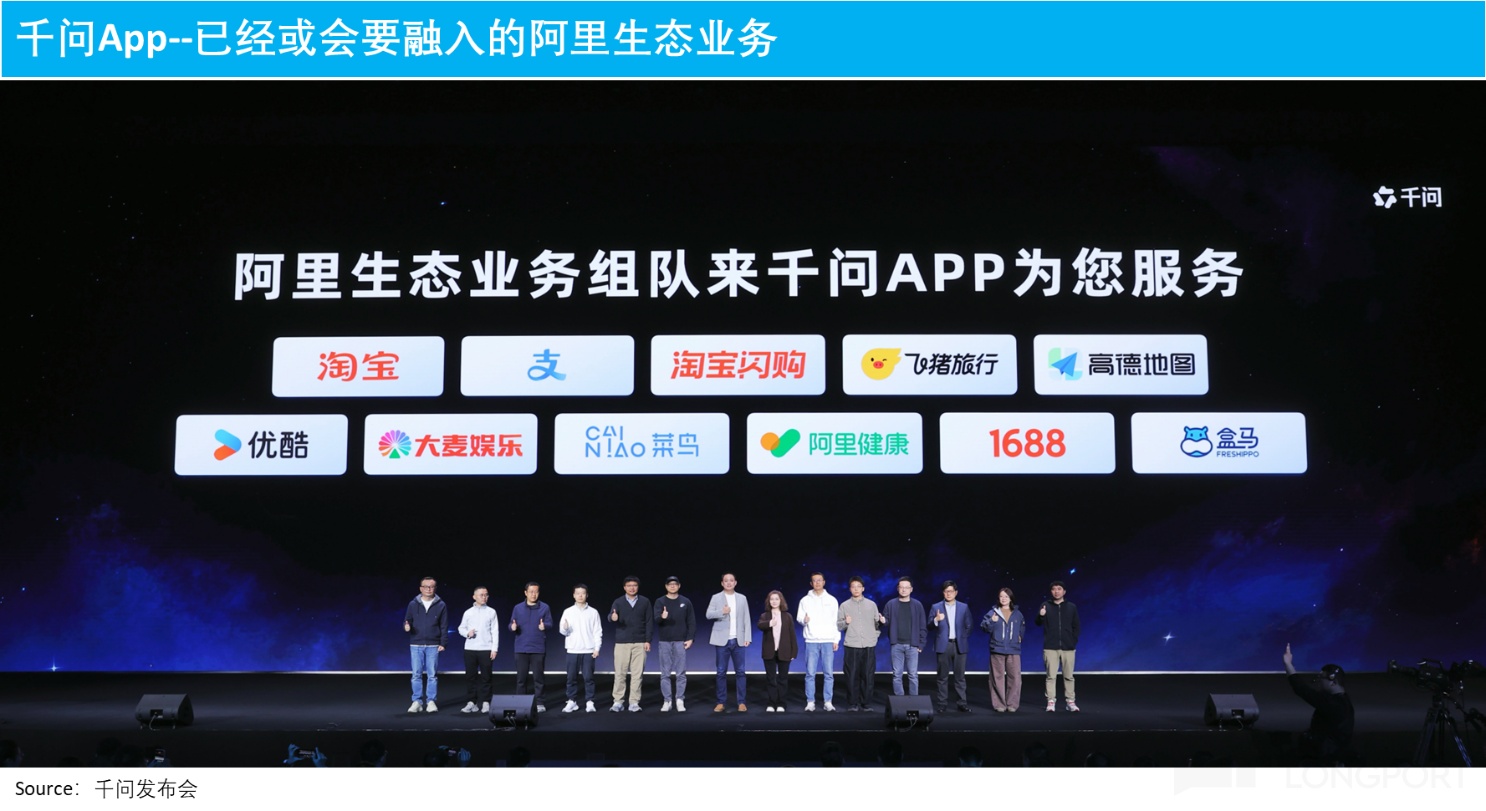
The real breakthrough is bridging the virtual and real worlds while fusing Alibaba’s major consumer businesses into one Life Assistant. The demo showed Qwen Life Assistant can: a) help users shop via Taobao, b) order food delivery or restaurants via Flash Sales, c) plan trips and book flights/hotels via Fliggy, and d) handle government and daily services via Alipay.
Beyond these, features like ride-hailing via Amap and ticketing via Damai should roll out over time. In short, Qwen App should progressively integrate all C-end ecosystem services. For actual functionality, we recommend trying it firsthand or watching the demo for clarity.
We also note the Agent features were built under tight timelines. For now, only Flash Sales supports a full in-app flow from selection to payment without switching apps in Qwen. Other services like Taobao e-commerce and Fliggy flights/hotels render as cards within Qwen and still require deep links to their native apps to complete transactions.
Over time, more functions should become fully in-app without redirects in Qwen. The constraint is simply short dev cycles and immature features at this early stage.
II. Versus Doubao, DeepSeek and Yuanbao, what is Qwen’s differentiation?
In short, Doubao leans on Douyin’s strengths in chat and entertainment scenarios, while Yuanbao leverages WeChat for high-quality information distribution. Qwen’s edge is Alibaba’s uniquely broad consumer footprint among Chinese internet platforms, enabling what is arguably the first life assistant globally that can transact end-to-end.
Horizontally, Qwen Life Assistant already resembles an early all-in-one gateway or a comprehensive AI assistant, similar in spirit to the Doubao phone. The overlap is meaningful at the functional and positioning level.
Where they are similar, both Qwen Assistant and the Doubao phone act as a ‘butler’ AI that orchestrates other apps/services to complete tasks. That includes digital tasks like docs and image editing, and real-world tasks like ordering food or hailing rides.
The more important contrast is in implementation paths. The key differences are: a) Qwen App is a software entry point vs. the Doubao phone is a hardware entry point, and b) Qwen relies on Alibaba’s closed internal ecosystem vs. the Doubao phone tapping an open external ecosystem.
a) Software vs. hardware: As a hardware device, the Doubao phone sits a layer closer to the user and, in principle, can claim the highest permissions. Software stacks ultimately run on hardware, though in practice this depends on whether app owners will cooperate, which is a negotiation in itself.
b) Closed vs. open ecosystem: Qwen’s Life Assistant is powered by Alibaba’s own businesses. Today the Doubao phone mostly invokes external apps (e.g., Meituan for delivery, Didi for rides), enabled by its top-level hardware assistant permissions.
Intuitively, a closed internal ecosystem can integrate faster and cleaner, with fewer conflicts of interest or disputes such as cross-app redirects. This accelerates a seamless in-app experience.
An open ecosystem has a higher theoretical ceiling, with assistant capabilities expandable without hard limits. In reality, it requires strong partnerships or overwhelming bargaining power to onboard third parties, and a fully open model looks unlikely near term.
c) Qwen’s edge: Alibaba arguably has the most complete C-end consumer portfolio in China’s internet space. From e-commerce and flash sales to travel, navigation/ride-hailing, grocery and ticketing, it covers the breadth in-house.
Combining a strong model stack with the richest C-end businesses gives Qwen a late-mover advantage to launch a transaction-capable life assistant first. This integration is the core differentiation.
If Qwen App ultimately scales to hundreds of millions of DAUs, it could serve as Alibaba’s primary traffic gateway or a powerful supplemental funnel. Either way, it would help address Alibaba’s lack of a Douyin- or WeChat-like traffic entry.
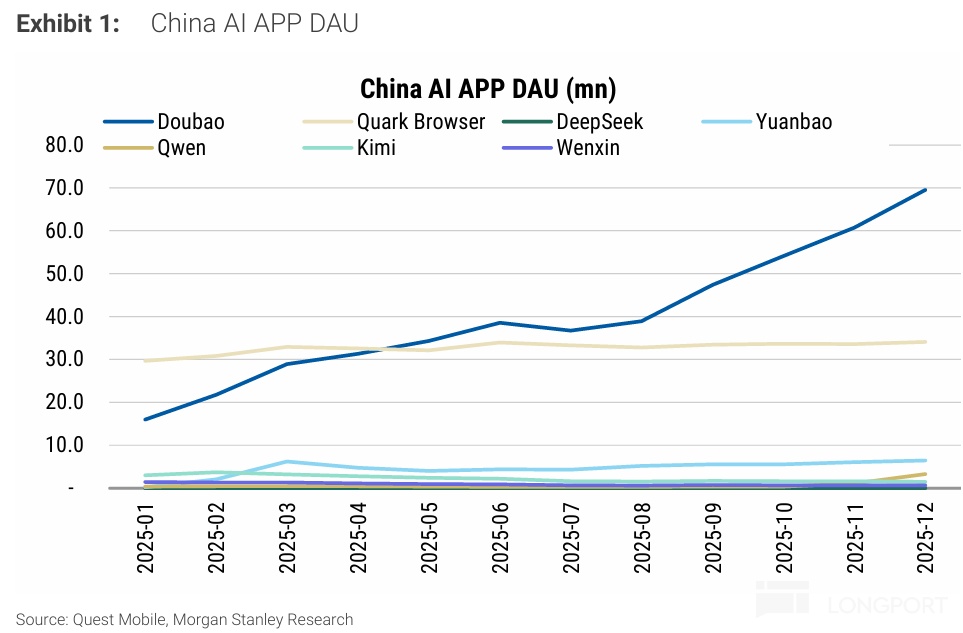
d) Early days, and the gap is real: Although Alibaba announced that Qwen’s C-end MAUs have exceeded 100mn across App, mobile Web and PC, its high-frequency users remain much smaller than peers. Recently, Doubao’s all-channel DAUs reportedly topped 100mn, while Qwen’s DAUs are still in the single millions.
QuestMobile data show that by Dec, App-only DAUs were ~70mn for Doubao vs. sub-5mn for Qwen. The gap is massive given Qwen has been live for only ~3 months. Whether the Life Assistant’s reliability and usability can drive mass adoption will take time to prove.
III. How is Qwen positioned within the Group?
The revamped Qwen App clarifies Alibaba’s C-end AI carrier, replacing Quark as the primary C-end AI focus. This should enable more concentrated resource allocation.
We view Qwen’s organizational standing within Alibaba as very high, approaching the level of Flash Sales. The Group has restructured around Qwen and mobilized nearly all C-end biz. groups to push the project jointly.
IV. What is the endgame for AI apps? A new entry-class app?
a) Mid-to-long term positioning is still evolving: A key question across the industry is whether a comprehensive AI assistant becomes the next universal entry point, replacing current gateways like search, social and shopping. Or will it coexist as a new entry, inevitably siphoning some traffic from incumbents?
For Qwen App, Dolphin Research believes the long-term target is still being explored rather than fixed. Even for Alibaba, deciding whether Qwen should replace Taobao or Alipay as the top gateway would have far-reaching implications not solvable in the short term.
b) Monetization is not yet clear for C-end AI apps: While China’s C-end AI apps are entering a hyper-growth phase, monetization is still early. Unlike overseas, consumer subscriptions are unlikely to be the main path domestically, removing the simplest revenue model.
Even if Qwen later facilitates a wide range of transactions, whether it stays a pure acquisition/funnel tool or also carries commission or ad KPIs will involve internal profit-sharing. That makes it a non-trivial decision.
c) Hardware vs. software entry is undecided: Today’s split—Qwen’s software + closed ecosystem vs. the Doubao phone’s hardware + open ecosystem—may not be the end state. Each side will likely test the other path.
ByteDance also has meaningful consumer businesses and could try a closed, in-house support model. Conversely, if needed, Alibaba could move up to a hardware-level entry as well.
V. Qwen App vs. Taobao Flash Sales: will Qwen be another cash burner?
For investors, another key question is how Alibaba balances C-end AI investment on top of two group-level priorities already in motion: the Flash Sales battle and elevated Alibaba Cloud Capex. Budget discipline matters.
The short answer: we do not expect Qwen to spend like Flash Sales, at least not before a clear, proven path emerges. It will likely stay measured in the near term.
First, Alibaba is pursuing a differentiated stance vs. Doubao, not a head-on subsidy war like Flash Sales. Doubao’s strengths are chat and entertainment, while Qwen is focusing on office and life assistants. Without a clear long-term target, a blank-check spend is unlikely.
Second, funding is a constraint. Since the Jun-2025 quarter, Alibaba’s FCF after Capex has turned negative, Flash Sales still lost over RMB 20bn in the latest quarter even after narrowing losses, and recent Capex has run above RMB 30bn per quarter. Against Taotian’s adj. EBITA of ~RMB 50bn per quarter, the Group is roughly at a tight balance.
Moreover, per company guidance, the 'All others' segment, which includes Qwen, lost about RMB 10bn in the Dec quarter, widening by ~RMB 6.6bn QoQ. As Dec is a peak spend quarter, we roughly estimate incremental losses attributable to Qwen at around RMB 5bn.
Given the new Qwen app launched in mid-Nov, total quarterly user acquisition spend likely did not exceed RMB 10bn by a wide margin. Overall, Qwen should be a cost center near term, contributing little revenue, and losses should be far smaller than Flash Sales.
VI. Postscript
This year is likely the first true battleground year for C-end AI in China. With rapid iteration over the past three months and this Qwen Assistant launch, Alibaba has secured a core ticket to the main arena.
Others are also moving: Doubao has reportedly committed a large partnership with the Spring Festival Gala, and Tencent is expected to roll out new C-end AI moves via Yuanbao. Competitive intensity is set to rise.
In our view, because everyone is still exploring and pursuing distinct routes, pure homogenous competition like e-commerce or food delivery is unlikely in the early innings. As AI apps advance, cross-over competition is likely in the second half, and a hard-fought battle will be hard to avoid.
<End>
Past Dolphin Research coverage on Alibaba:
Deep Dives:
Dec 28, 2023 ‘Fall of the Internet Gods’: Who sank Alibaba, Meituan, JD and Tencent?
Oct 10, 2023 Into the headwinds: Can Alibaba, JD and Meituan stage a comeback?
Jan 19, 2023 Ant is back onshore, Daniel moves to Cloud: How far is Alibaba from re-rating?
Jan 18, 2023 The endgame of e-commerce: Can Taobao beat Douyin?
Earnings Reviews
Aug 30, 2025 Takeaways Wolf spirit returns: ‘Lost’ Alibaba starts over
Aug 30, 2025 Trans Alibaba (Trans): Shares up 10cm+: What did mgmt. reveal on the call?
May 16, 2025 Takeaways AI needs fresh blood: Can an ‘unwilling’ Alibaba make one more push?
May 16, 2025 Trans Alibaba (Trans): AI is a decade-long opportunity; food-delivery subsidies can substitute for marketing
Risk disclosure and statements: Dolphin Research Disclaimer and General Disclosures








The copyright of this article belongs to the original author/organization.
The views expressed herein are solely those of the author and do not reflect the stance of the platform. The content is intended for investment reference purposes only and shall not be considered as investment advice. Please contact us if you have any questions or suggestions regarding the content services provided by the platform.