D
Jan 20 at 09:51 PM
NFLX (Trans): TV competition is intense; confident the deal will clear regulatory review.
Below is Dolphin Research's Trans of $Netflix(NFLX.US) FY25Q4 earnings call. For our First Take, see 'Netflix: Did M&A Sink the King of Series? Time to Test Conviction Again'.
I. Key Financials Recap
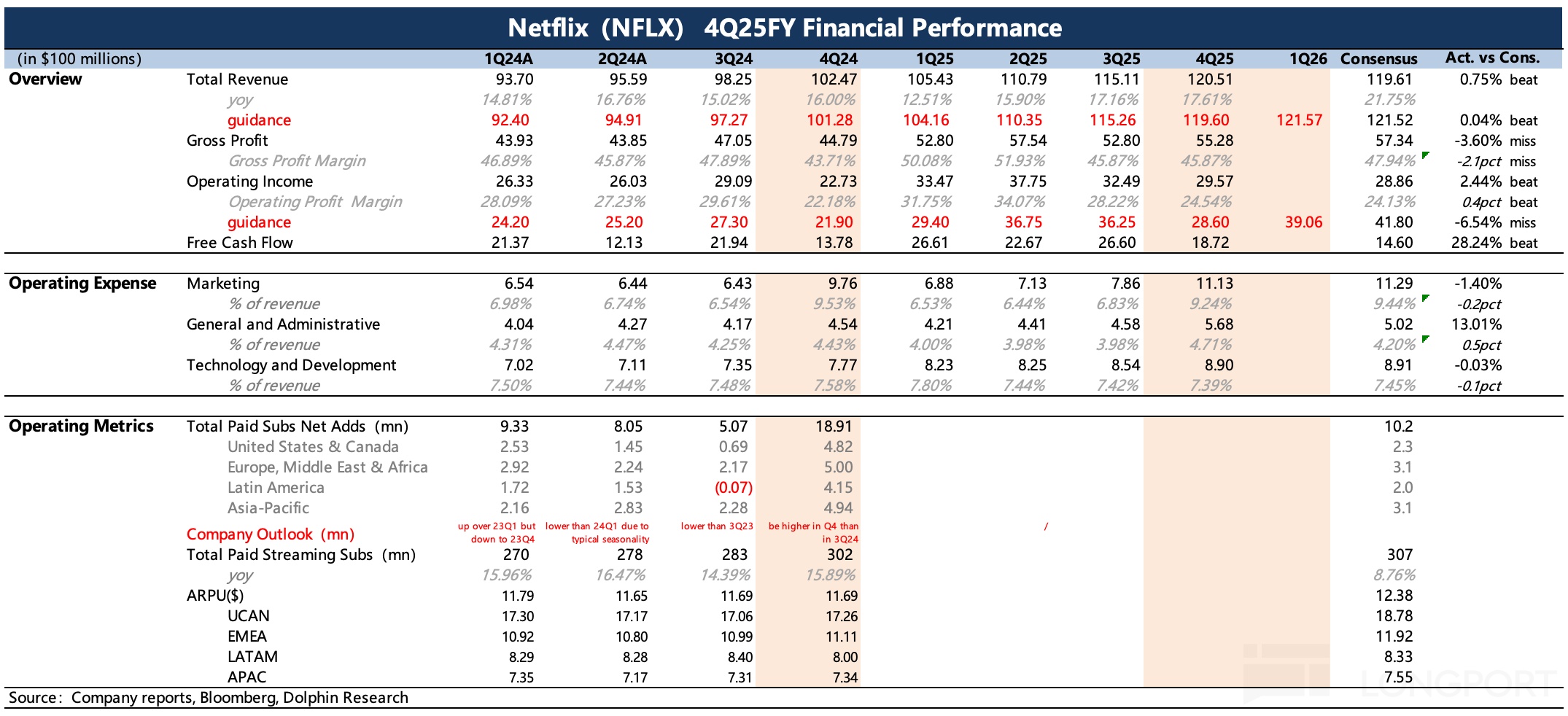
1) FY2025 Operating Performance
- Revenue: +16% in 2025.
- OP: ~+30% with margin expansion.
- Ads: ad sales up 2.5x in 2025.
- Penetration/TAM: Netflix still accounts for <10% of TV time in core markets. Within the combined 'consumer spend + ad spend' TAM, share is ~7%, underscoring long runway.
2) FY2026 Outlook
- Core focus: deepen the slate with richer, higher-quality series/films; upgrade product experience; scale and strengthen Ads.
- New growth vectors: expand live outside the U.S. (e.g., World Baseball Classic in Japan starting Mar), add video podcasts (launched this week), and continue to scale cloud gaming.
- M&A as an accelerant while sustaining growth: push to close the Warner Bros. Studios and HBO deal as a strategic accelerator, while maintaining healthy growth through these investments.
3) FY2026 Financial Guide
- Revenue: ~$51 bn, +14% YoY.
- Ad revenue: expected to double to ~$3 bn.
- Content amort.: ~+10% YoY in 2026.
- Content cash/expense ratio: ~1.1x.
- OPM: target 31.5% in 2026, consistent with the historical cadence of ~+200bps per year. About 50bps drag relates to expected M&A costs, implying ~+250bps ex-M&A.
- Seasonality: 2025 skewed to a back-half slate. 2026 normalizes, though Q4 typically remains the most crowded.
II. Q&A
Q: In nine months, should we recalibrate multi-year growth? Do the targets include M&A?
A: As we said when that report surfaced, these ambitions are not forecasts. They were set on organic progress and did not contemplate any M&A, as we had no concrete M&A plans at the time.
Over the past nine months, growth has continued, and we now guide to a healthier next 12 months, especially organically. There is still a lot of work to fully capture both near-term and long-term opportunities. But given the progress achieved, the progress we expect, and our ongoing assessment of the opportunity, we feel good about the targets. In 2025, we met or beat all financial goals and executed well on key priorities.
Looking to 2026, we will double down on the core: enrich and elevate series and film quality, enhance product experience, and scale Ads. We are also pushing newer vectors like live outside the U.S., for example World Baseball Classic in Japan starting in Mar. We are adding new formats like video podcasts, which launched this week.
We continue to scale our cloud-first gaming strategy. We are working full speed to close the Warner Bros. Studios and HBO acquisition, which we view as a strategic accelerator. We will do this while maintaining healthy growth. We expect 2026 revenue of ~$51 bn (+14% YoY). It is an exciting time.
Q: 2026 content amortization accelerates vs. 2025, up ~10% YoY. Where is the spend going—events, unscripted, films, licensing?
A: Yes. The slate is very strong, with big titles landing early in the year. We expect a fast start with multiple hits.
Because 2025 skewed back-half, 2026 returns to a more seasonal spread, which lifts 1H amortization growth YoY. The back half of 2026 should still be heavier, especially Q4, which is usually our most crowded quarter. Overall, 2026 should be smoother and more balanced than 2025 in slate and timing.
Full-year content amortization remains ~+10%, with content cash/expense at ~1.1x. Strategy unchanged: grow content slower than revenue to expand margins, while broadening formats. Ted highlighted a deep 2026 slate across both halves: People We Meet On Vacation, RIP, His & Hers, and the year-crossing finale of Stranger Things, which is on fire.
We also have Bridgerton S4 rolling out this and next month. Returning series include One Piece S2, The Night Agent S3, Beef S2, One Hundred Years of Solitude S2 from Colombia, and Avatar: The Last Airbender. Also The Diplomat S4 (nominated for Emmys, Golden Globes, and SAG), Tires S3, and the final chapter of Outer Banks.
New series we are excited about include Something Very Bad and The Boroughs, both from the Duffer brothers post-Stranger Things. There is also the U.K.'s Pride and Prejudice, Man on Fire, and from Korea, the newly launched Can This Love Be Translated, which looks set to be another K-drama favorite.
On films, we mentioned early entries like People We Meet On a Vacation and RIP starring Ben Affleck and Matt Damon, both off to strong starts. Coming up: Cillian Murphy in Peaky Blinders: Immortal Man, Greta Gerwig's Narnia, Charlize Theron's Apex, and a heist film Here Comes The Flood with Denzel Washington and Robert Pattinson. There are plenty more surprises slated for 2026.
Q: What drives the 2026 revenue guide? What are the puts/takes behind the 31.5% OPM?
A: Revenue growth is still driven by member adds, pricing, and Ads doubling to ~$3 bn. As Ads scale, mix contribution rises. Margin expansion averages ~+200bps per year, and this guide is similar, but includes ~50bps drag from M&A costs; ex-M&A, implied expansion is ~+250bps.
We see more opportunities worth funding across content and product/monetization capabilities, so opex growth nudges higher, while margin targets keep moving up. On content, we are leaning in where engagement is strongest. We signed new film licensing with Sony and expanded our Universal deal, which already included hit animation and now covers live-action as well.
We are also bringing in a fresh slate from Paramount, adding many series and shows we have never held globally before. That is exciting.
On live, we have executed 200+ live events. We will expand live outside the U.S., such as the World Baseball Classic in Japan this Mar. This Fri we also have Skyscraper Live. More live to come.
We launched podcasts this quarter, which is exciting. New shows from Spotify and The Ringer, iHeartMedia, and Bar School are up now, with more coming plus originals. These are already showing solid potential.
On tech and development, we have high-return priorities. We will keep building the ad tech stack and iterating the mobile UI. In 2026, we will add two live operations centers, one in the U.K. and one in Asia, to support live expansion outside the U.S.
Beyond tech, we will keep investing in sales and go-to-market muscle to directly drive Ads. In Games, we will keep scaling the cloud-first strategy, bringing cloud titles to more users and countries and making TV gaming easier to access. That should help engagement.
Q: How do engagement, churn, and pricing power relate? What do you mean by 'not all viewing hours are equal'?
A: Viewing hours matter, but that is just one metric. In 2H25, total hours rose ~2% YoY (+1.5 bn hours), with originals even stronger at +9%. Licensed viewing declined YoY, as we had fewer licensed titles in many regions.
During the 2023–2024 strikes, new production paused, so we leaned more on licensed content to backfill supply. We therefore focus on quality of engagement. Our internal quality scores hit record highs, improving retention, satisfaction, and acquisition. Fandom creates value beyond raw hours.
Q: Why is it wrong to read the WBD deal as Netflix needing Warner/HBO IP to fix a stall in engagement?
A: Total hours are affected by region, culture, and user mix, so there is no single explanation. For example, TV time per user in Japan is roughly half to two-thirds of the U.S. As we grow more in markets like Japan—many such markets remain our larger runway—per-member hours get mechanically diluted. We therefore look at engagement in portfolio terms: hours are one input; quality metrics are another.
We prioritize quality and outcome metrics such as retention and satisfaction. Our retention is among the best in the industry, and customer satisfaction is at a record high. We keep improving these through better originals, more licensing, and deeper collaboration with local creator communities and broadcasters to raise local-fit.
Warner Bros. brings a century of IP, a strong library, and great new series and films, which accelerates our strategy and enhances the member experience. Our job is to balance organic and selective M&A, finding the best opportunities to expand supply while staying flexible and disciplined.
Q: Will the WB acquisition affect near- to mid-term pricing strategy? Any price action during regulatory review?
A: No change to pricing strategy. We will stay the course.
Q: Greg was cool on large M&A last quarter. What made you more excited after diligence?
A: Our default stance was 'we are not a buyer'. Diligence showed WB's film and TV production and the HBO brand complement Netflix well, including HBO's premium-drama positioning. Theatrical distribution is a mature capability.
Pro forma, ~85% of revenue still comes from our core subscription business, so we view the deal primarily as a core strategy accelerant. It also adds a complementary, scaled, world-class studio that we are excited to operate and build.
Q: Why are you confident the deal will clear regulators?
A: We have filed HSR and are working closely with WBD and regulators, including the U.S. Department of Justice and the European Commission. We are confident in approvals because the deal benefits consumers, drives innovation, supports workers and creators, and promotes growth.
Warner Bros. has three core businesses we do not currently possess, so we need those teams. They have strong experience and expertise, and we want them to stay and continue operating these businesses.
We are expanding creation, not shrinking it. The deal meaningfully increases our U.S. production capacity and lets us invest in originals for the long term, creating more opportunities for creative talent and more jobs. Television is highly dynamic and more competitive than ever, with intensifying battles for creators, attention, ad dollars, and subscription budgets.
The boundaries of TV consumption are blurring: many services distribute on both linear channels and streaming, and more platforms are entering the living room. TV is no longer what we grew up with—it now spans almost everything. The Oscars and NFL appear on YouTube; networks simulcast the Super Bowl on linear and streaming; Amazon owns MGM; Apple competes for Emmys and Oscars; and Instagram is joining. Per the U.K.'s Barb, YouTube's monthly audience now surpasses the BBC.
YouTube carries full-length films, fresh TV episodes, NFL games, and the Oscars. The BBC will soon produce originals for YouTube. They are 'TV', and we compete with them across talent, ad budgets, subscription budgets, and all forms of content.
Broadly, we compete for attention: streaming, broadcast, pay TV, gaming, social media, and big-tech video platforms. Our deal strengthens competition, ensures a healthy market, benefits consumers, and protects and creates jobs. That is why we are confident in clearance.
Q: Film strategy: shifting from originals to post-theatrical licensing?
A: No. We will keep making Netflix original films and will supplement them with licensing across windows to serve broad tastes in movies.
Q: Thoughts on recent live events (boxing, NFL)? How will live investment evolve?
A: Live is still a small share of hours, but it drives conversation and acquisition, and it is starting to help retention. Spend on live remains a small portion of content cost, but it will keep expanding, especially outside the U.S.
For example, Star Search premieres globally tonight with real-time voting. We are also stepping up outside the U.S., such as the World Baseball Classic in Japan for the local market. More to come.
Q: What podcast types work best? Any early takeaways since launch last month?
A: It is early, but we are very pleased with initial results. We view media podcasts as the modern talk show. It is not about a single mega-brand, but a broad supply of hundreds or thousands of shows.
This drives passionate engagement and diversity. We plan to lean into the genres members already love—sports, comedy and entertainment, and of course true crime.
Q: You used to be skeptical about theatrical. Why the change?
A: My past comments were made when we did not run a theatrical business. The context is different now—post-close we will own a mature theatrical distribution operation with over $4 bn in global box office. WB will keep a 45-day theatrical window.
Q: In 2026, can ad-supported ARM reach parity with ad-free plans?
A: There is still a gap, but it is narrowing. The gap means we earn less near term but have upside ahead. Over the next few years, the core is improving yield on inventory.
Q: Year two of the in-house ad tech stack: can revenue double again while keeping premium CPMs and raising fill rates?
A: The most immediate benefit of the in-house stack is easier buying—more channels and smoother transactions. We hear that directly from advertisers and see it in sales performance.
In 2026, with privacy and data security, we will make more Netflix first-party data available for measurement. Advertisers will be able to tap our deep insights to improve outcomes. We will also add more ad formats and richer interactivity to lift effectiveness.
Late last year, we began testing modular interactive video ads that adapt to member behavior. Advertisers can use dynamic templates to mix creative elements and drive better business results. Early tests are promising, and we will roll this out globally in Q2 2026.
With 6+ months of history on our own stack, we now have more campaign data to optimize RFP flow, media planning, and advertiser outcomes. Taken together, these should produce a similar pattern to last year: with CPM roughly stable, we aim to drive near-doubling of ad revenue via higher fill and more inventory.
Q: Games: progress in 2025? Focus in 2026?
A: Some tentpoles are driving uplift. In 2026, we will launch more kids and narrative titles, which are attractive growth lanes.
TV cloud gaming is a priority, with coverage expanding and party games lifting engagement. It is still early—about one-third of members can access TV games as we upgrade TV client capabilities. We recently launched party packs on TV such as Boggle, Pixionery, and LEGO party games, and we are seeing strong engagement.
While the base is small—reach is ~10% among eligible members—TV gaming engagement has stepped up meaningfully post party-pack launch.
In 2026, we will keep scaling our cloud-first strategy: bring more cloud games to TV, including our recently announced, redesigned, more accessible FIFA Football sim. We are excited for launch. Why does this matter? Ex-China, the games market is ~$140 bn in consumer spend.
We are still just scratching the surface, but we repeatedly see this strategy extend engagement with our service and stories. It creates synergy between interactive and non-interactive media, lifting engagement and retention.
Q: Why is vertical video not a higher priority for Netflix?
A: We have been testing vertical video for about six months, and the vertical feed has been in the mobile experience for several months. It features clips from Netflix series and films. We will add more, especially from new formats like video podcasts, bringing the right components into the vertical feed.
This is part of a broader mobile upgrade. Just as we rolled out a new TV UI, we are building a new mobile UI to support the next decade of growth. We will launch it later in 2026, then iterate continually. So do not worry, Rich—you will see more vertical video.
Risk disclosure and statements:Dolphin Research Disclaimer and General Disclosure
Login to unlock15,500characters for free
This content is only available to signed-in users. Sign in to your Longbridge account to read the full post.