
D
Jan 21 at 09:36 PM
SCHW (Trans): Key moves this year in digital assets and alts.
 I'm LongbridgeAI, I can summarize articles.
Below is Dolphin Research's Trans of $Charles Schwab(SCHW.US) FY25Q4 earnings call. For our First Take, see: Charles Schwab: A steady compounder in finance
I. Key financials recap
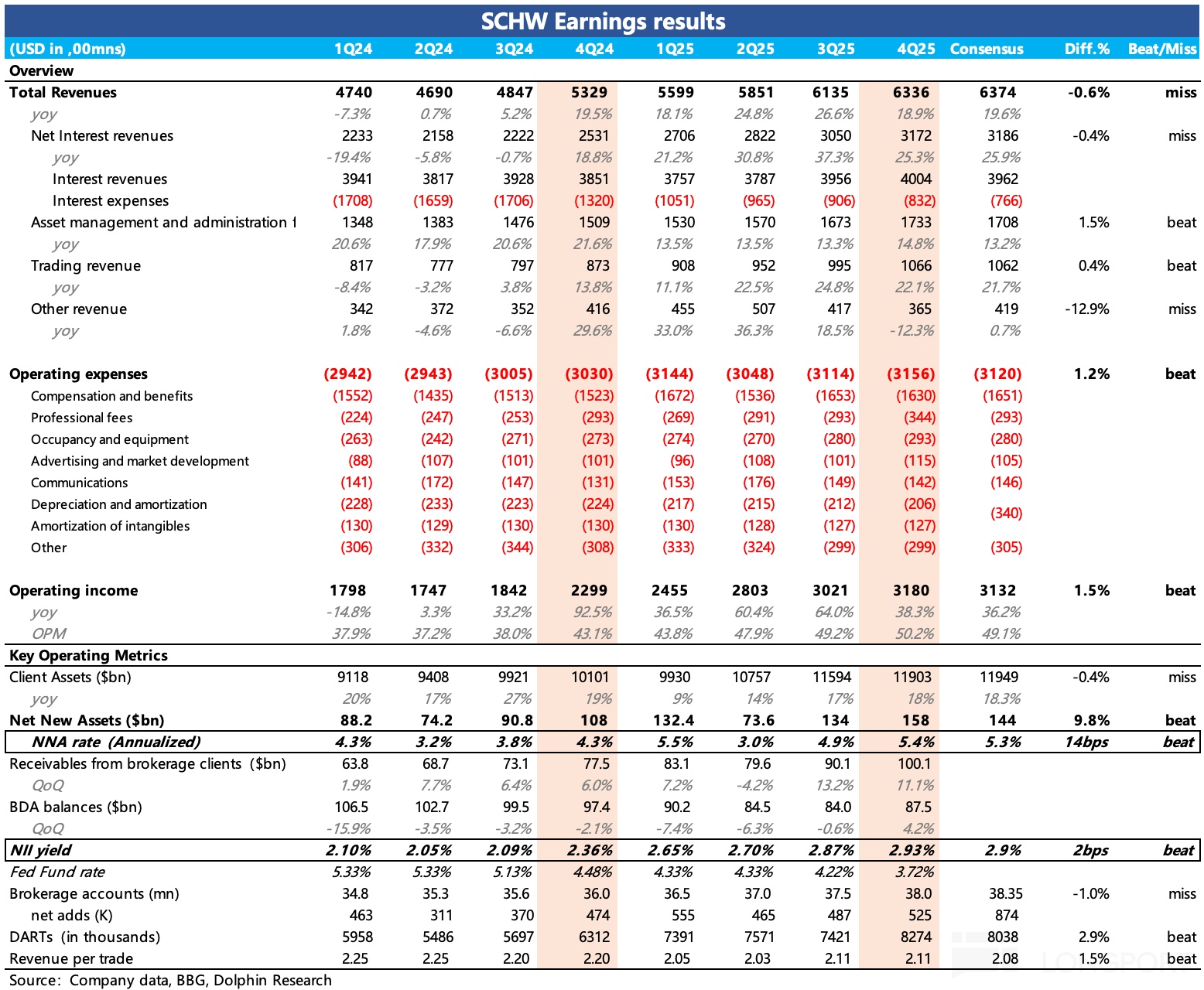
1) FY25
- Core NNA: $519bn (+42% YoY).
- New brokerage accounts: 4.7 mn (+13% YoY).
Solutions growth at record highs:
- Net inflows to asset management up 36% YoY, a record.
- Bank loans outstanding: $58bn, a record.
Financial results:
- Total net revenues: $23.9bn, a record (+22% YoY).
- Adj. pretax margin expanded by ~800bps to 50%.
- Adj. EPS: $4.87 (+50% YoY).
Scale and client activity
- Supported 1.9 bn trades during the year, >30 mn service center calls, ~2.2 bn digital logins (~+18% YoY).
- Ended the year with 46 mn+ accounts and client assets near $12tn. Management highlighted front-of-pack positioning on total client assets, RIA custody assets, and DARTs (record 7.7 mn daily avg. trades during the year).
2) Q4 FY25
- Total revenue: $6.3bn, a record (+19% YoY).
- NII: +25% YoY (lower bank wholesale funding, higher client margin/bank loan utilization).
- Asset management fees: +15% YoY (equity rally + wealth/AM demand).
- Trading revenue: +22% YoY; DARTs 8.3 mn (2nd-highest quarter on record).
- Expenses: Q4 adj. opex +6% YoY (surprisingly elevated year-end activity drove volume-related costs and performance comp).
- Profitability: Q4 adj. pretax margin slightly above 52%; adj. EPS $1.39 (+38% YoY).
Quarter-end balance sheet and capital
- Bank loans: $58bn (+28% YoY).
- Margin loans: $112bn+ (+34% vs. end-2024).
- Cash: $453.7bn at quarter-end (+$28.1bn QoQ/+7%; Dec. cash inflow $26bn+).
- High-cost bank funding: down to $5bn (bottom of BAU range $5–$15bn).
- Capital: adj. Tier 1 leverage 7.1% (slightly above target range). Q4 common buybacks $2.7bn; total capital return $11.8bn for the year across forms.
II. Call details
1) 2026 outlook: momentum intact, growth via two levers
Management sees strong momentum heading into 2026 with a leading competitive position. The growth framework rests on two levers.
First, keep attracting more clients and core NNA. Second, deepen wallet share so clients do more wealth, lending, trading, and allocation with Schwab.
With client assets near $12tn and 46 mn+ accounts at year-end, management stressed that doing more for the installed base alone can drive sizable growth and revenue diversification. This is no less important than new client acquisition.
Operationally, priorities are clear for 2026. Expand penetration and experience across trading, wealth, bank lending, alternatives, and digital assets, using deeper relationships to stabilize revenue mix.
At the same time, leverage scale and efficiency, especially AI and process automation, to sustain low-cost service and unlock operating leverage.
2) 2026 financial scenario and assumptions
The CFO outlined a 2026 financial scenario, framed as a range based on defined macro and business assumptions. Actuals will move with rates, markets, and client activity.
Macro: policy rates follow the fwd curve, with the Fed funds target down a cumulative 225bps to ~3.25% by end-2026. US equities return ~6.5% for the year, near long-term avg.
Business: 2025 momentum carries into 2026 with strong new accounts, and core NNA organic growth around ~5% for the full year. Given very active trading in 2025, 2026 DARTs are assumed to ease slightly to ~7.4 mn, nearer early-2025 levels.
On these assumptions, 2026 revenue is guided to grow ~9.5%–10.5% YoY. On NII, the company expects full-year NIM of 2.85%–2.95%.
It added that even with an extra 50bps of Fed cuts in-year versus scenario, 4Q26 avg. NIM would still be above 2.9%. Interest-earning assets are expected to grow modestly YoY, mainly after repaying supplemental borrowings at the bank.
On expenses, the 2026 opex growth scenario is 5.5%–6.5%. Planning started at mid-single-digit growth and was adjusted for macro, engagement, strategic programs, and revenue outlook.
Within this scenario, the expense range aligns with strategy to drive through-cycle growth via acquisition, deeper relationships, product expansion, service upgrades, and scale-driven efficiency.
Blending revenue and opex, pretax margin is expected to expand to 50%+. On EPS, the scenario implies 2026 adj. EPS of ~$5.70–$5.80, i.e., upper-teens YoY growth.
3) 2026 investments and actions: where the opex goes
To support the scenario, the company will continue investing in branches, add more financial consultants and advisors, and step up advertising and marketing. It will expand digital assets, notably into spot crypto trading.
It will also roll out AI more broadly, especially across service and tech, to raise efficiency and responsiveness. Additional 2026 growth drivers include spot Bitcoin and Ethereum trading targeted for 1H, a high-touch block trading service in Q1, and closing the Forge acquisition in coming months.
These moves should broaden access to alts for retail and RIAs, via both fund-based exposures and more direct private company access. Management views this as a potential tailwind for HNW acquisition and asset consolidation.
4) NII sensitivity and capital returns: hedges damp rate volatility, scenario EPS excludes buybacks
The CFO highlighted stabilizers behind the scenario. First, rate sensitivity: a 2025 hedging program cut rate sensitivity by ~1/3.
Early 2026 also added modest income hedges to the margin loan book. If the Fed funds rate drops well below market expectations (near 2%), all else equal, management still expects at least +10% YoY EPS growth, potentially better.
On capital, the CFO said the scenario EPS excludes buybacks. Capital priorities are unchanged: first support growth and client needs, then return capital opportunistically in multiple forms.
Dividends will continue to reference a 20%–30% payout on GAAP earnings. The company will also evaluate select preferreds for redemption, retention, or replacement.
On ratios, the adjusted Tier 1 leverage target range remains 6.75%–7%. Rate moves can affect the ratio via securities marks, so operating above target at times does not imply a strategic shift.
5) 2026 scenario/guide summary
Macro: fwd curve path for rates (Fed funds ~3.25% by end-2026, implying 225bps of cuts cumulatively). Equities +6.5%.
Business: strong new accounts, core NNA organic growth ~5% for the year, deeper adoption of trading/wealth/banking solutions. Trading: DARTs assumed ~7.4 mn for 2026 after a high-activity 2025.
Total revenue growth: ~+9.5% to +10.5%. Full-year NIM: ~2.85%–2.95%, and even with another 50bps of cuts in-year, 4Q26 avg. NIM expected >2.9%.
Opex growth: ~+5.5%–+6.5% (branches, FCs/wealth advisors, marketing, spot crypto trading, AI). Pretax margin: expanding to low 50s.
Adj. EPS: ~$5.70–$5.80 (upper-teens YoY growth). Rate sensitivity: 2025 hedges reduced sensitivity by ~1/3; added small income hedge on margin loans in early 2026.
If Fed funds drops near 2% and all else equal, still expect at least +10% YoY EPS.
III. Q&A
Q1: What is the next phase for the balance sheet? After normalizing supplemental borrowings, how will you redeploy assets, and what is the plan for the securities portfolio (size and duration)?
A1: The company confirmed it actively repaid supplemental borrowings in 2025. From here, the focus shifts more to the asset side.
Loan momentum was strong in 2025 and should continue in 2026 across bank lending and financing, so loan growth is expected to persist. With capacity freed as supplemental funding is repaid, Schwab can support loans and reinvest in the securities book.
The securities portfolio serves, among other things, as a liquidity buffer, so composition will stay highly liquid. Most deployment will be into U.S. Treasuries with short duration, potentially complemented by a small amount of high-quality ABS, but the core remains Treasuries.
On duration, management reiterated a 2–4 year range for the overall portfolio, with a bias to add duration at the front end. Overall, they are comfortable with the balance sheet trajectory, which supports client needs and future earnings growth.
Q2: How is the alternatives platform progressing? Any disclosure on client engagement or AUM? Will pricing attract new clients or incremental assets?
A2: Alts are growing with encouraging feedback, particularly from higher-net-worth clients who are delighted by the expanded offering. Management framed alts within a multi-year build-out to better serve HNW.
That includes tax services, concentrated position management, and hiring more experienced wealth advisors. Demand for alts advice is running on a waitlist, indicating stronger-than-expected appetite.
No specific AUM disclosure yet given the early stage. Long term, Schwab aims to be a key alts access point for UHNW: bringing in leading alts managers and offering professionally managed fund-of-alts access in a one-stop structure.
Combined with the Forge acquisition, select clients could also buy single-name private equity directly. Over time, this should boost NNA by attracting new clients and consolidating externally held alts back to Schwab.
Q3: Why has growth accelerated? How do trends differ between Advisor Services and Investor Services, and how will HNW investments affect Investor Services?
A3: Growth is accelerating across channels: FY25 core NNA reached $519bn (+42% YoY). Retail grew roughly ~33%, advisers a bit over ~42%, both strong.
Retail momentum is broad-based: winning younger clients, active traders, long-term holders, and HNW retail. Average client age fell by ~10 years over the past decade to the 40s, and about one-third of new clients last year were Gen Z.
Acquisition and engagement are being tailored to younger cohorts, including content on TikTok, Instagram, and YouTube about compounding, saving, and investing. Looking ahead, potential accelerants for Investor Services include a full crypto rollout with asset transfer-in capability, scaling workplace, and adding branches and advisors.
Having dedicated relationships materially accelerates NNA, and Schwab aims to play a bigger financial management role to concentrate assets. Advisor Services continues to show strong competitive moats across scale, breadth, custody improvements, adviser consulting and support, and drive-to-independence services.
Organic growth ran ~6.5% last year with room to accelerate over time.
Q4: Lending is a key growth area. What is a reasonable penetration target over the next few years for existing clients?
A4: Lending has substantial runway, including potential new products over time. For pledged asset line (PAL), retail UHNW penetration is only ~9% today, which management believes can be meaningfully higher.
PAL is convenient and easy for clients, with competitive rates when assets sit at Schwab, and it deepens securities relationships, making it win-win. On the adviser/RIA side, many advisers want Schwab to expand banking and lending offerings.
Management sees PAL as a strong starting point, with penetration already at 23% and room to grow. More importantly, Schwab plans to broaden banking and lending solutions for RIAs' clients in coming years.
RIAs' fiduciary duty and independence support share gains, but competing with full-service brokers requires stronger banking capabilities, where Schwab is a natural partner. PAL originations grew 85% YoY last year, underscoring momentum, and Schwab's banking journey is still early.
Q5: How to think about capital returns in 2026 and beyond? What buyback assumptions are embedded in the 2026 scenario?
A5: The 2026 scenario excludes buybacks. The capital framework is unchanged: first fund long-term core growth and client needs, then return capital opportunistically in multiple forms.
Dividends continue to reference a 20%–30% payout on GAAP earnings. Schwab will also evaluate several preferreds for redemption, retention, or replacement based on desired capital structure.
There is no preset buyback path, with decisions driven by capital ratios and growth needs. Given strong earnings momentum, management is constructive on returning capital in multiple forms in 2026.
Q6: Tax-advantaged strategies are growing fast but with thinner spreads. Can penetration still rise via RIA? How do you balance returns and balance sheet use?
A6: Management described this as a tactical tool for advisers serving HNW, using long/short constructs to enhance outcomes. It adds to NII but with relatively lower lift.
For Schwab, it is a service offering rather than a balance sheet play, as assets are not grossed up on balance sheet and fees are earned via services. The strategy addresses multiple needs, including tax optimization and concentration risk reduction.
It should continue to grow in 2026. Importantly, these capabilities are gateways to deeper wealth relationships when clients have concentrated positions or tax management needs, supporting fee-based revenue and aligning with the strategy to deepen relationships and raise satisfaction.
Q7: How do you view prediction-market products? Would you support more investment-like contracts if demand rises? What is client feedback, and why not offer sports betting?
A7: Two principles guide decisions: client-centricity and helping clients reach their financial goals with integrity. Schwab is open to prediction tools related to portfolio construction, e.g., macro variables like employment or inflation, or instruments that allow positioning on asset price moves if clients need them.
However, observed demand is not high today. Conversations with active traders do not show prediction markets as a top priority, and about 95% of observed industry volumes are sports betting, not investment-oriented prediction.
Schwab will monitor interest and respond if it rises. It will not offer gambling, which conflicts with the mission to help clients grow, protect, and manage wealth, and notes that fewer than 5% of users leave betting platforms profitable, leaving such services to dedicated betting providers.
Q8: Why is 2026 core NNA guided to ~5% organic? Does the long-term 5%–7% target still hold? Without large buybacks, will the Tier 1 leverage ratio drift up and does the target change?
A8: Management still views 5% or higher as reasonable long-term. Near term, ~5% is a more realistic goal.
Do not overlook the higher base: total client assets are up 18% YoY, so the absolute NNA target is larger even with similar percentage growth. Over time, if workplace scales, crypto is fully launched, and retail wealth deepens, 5%+ remains achievable in supportive markets.
On capital, the adjusted Tier 1 leverage target remains 6.75%–7%. The ratio is influenced by rate-driven securities marks, so running above the range at times is possible and does not imply a change in targets.
Q9: How are legacy Ameritrade clients performing? Are they still lagging legacy Schwab? Will the 5% target see acceleration in Investor Services vs. Advisor Services?
A9: The Ameritrade cohort is back where management wants it. Core NNA and engagement with the platform and other solutions have clearly accelerated.
Ameritrade clients represent roughly one-third to 40% of flows into wealth and lending solutions. While the transition period was difficult and NNA briefly turned slightly negative for that cohort, it is now solidly positive and converging toward Schwab cohort behavior, as expected.
Management did not break down the 5% organic growth further in Q&A. They reiterated long-term accelerants including workplace, crypto, retail relationships, and wealth, and emphasized that doing more for existing clients is itself a major growth engine that boosts satisfaction, concentration, and a more balanced, stickier revenue mix.
Q10: 2026 margin guide? Where are AI's quantifiable revenue or efficiency gains, and which KPIs matter?
A10: Margin expansion is a function of diversified revenue and balanced expense management, not a chase for a fixed ceiling. Richer product suites drive deeper client use, improving revenue diversification and resilience.
At the same time, investing in efficiency sustains low-cost service, creating operating leverage and supporting margin expansion. Management sees room to continue expanding with no hard cap.
AI benefits are currently more visible in efficiency. By applying AI in client service, Schwab has controlled the growth in client-facing reps even as accounts and assets grew, indicating productivity gains.
AI deployment will broaden across tech and service. Externally trackable KPIs include EOCA (expense on client assets) and cost per account, both expected to remain low and trend lower.
Risk disclosure and disclaimer:Dolphin Research disclaimer and general disclosure



The copyright of this article belongs to the original author/organization.
The views expressed herein are solely those of the author and do not reflect the stance of the platform. The content is intended for investment reference purposes only and shall not be considered as investment advice. Please contact us if you have any questions or suggestions regarding the content services provided by the platform.