
D
Jan 22 at 12:39 PM
ORCL: Picking up scraps, leaning on deep‑pocketed patrons—fighting to survive?
 I'm LongbridgeAI, I can summarize articles.
Earlier, Dolphin Research covered CoreWeave as a gateway to studying the US IaaS market. This time we turn to a far more pivotal new cloud player — $Oracle(ORCL.US) (Oracle), now one of OpenAI's key partners.
As the first note in our coverage, Dolphin Research will focus on:
1) A high-level review of Oracle's history to understand how a 50+ year-old software incumbent evolved into a rising force in cloud.
2) A clear breakdown of biz. and revenue mix to identify the drivers that matter for results and stock performance.
3) The 'catalyst' — what the $300 bn mega-order really means and where it comes from.
4) Gains and trade-offs after supplanting Microsoft as OpenAI's primary partner. The motives and implications behind this big bet.
Below is the main text:
I. Oracle at 50: Past and Present
1.1 Brief history: Database → Enterprise software → Cloud
As context, we first outline how Oracle evolved from a traditional software vendor into the most consequential AI cloud challenger outside the Big Three. This frames the runway from legacy to new cloud.
a. Database era (1977–1990s): In its early years Oracle's biz. was focused on database management systems, anchored by RDBMS plus SQL. This cemented databases as its core franchise and enabled it to become the US market share leader.
b. Diversification — software first, then hardware (1990s–2009): After solidifying the core database franchise, Oracle in the 1990s expanded into enterprise apps — ERP, CRM, HCM and more. In the early diversification phase through 2000, it relied mainly on internal development, seeding what became Oracle E-Business Suite.
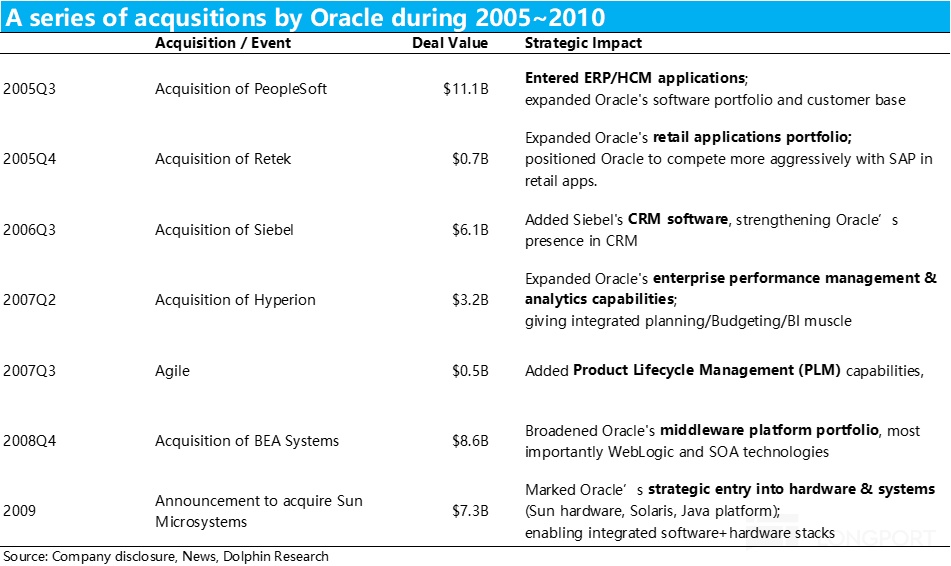
From 2003–2009, post the dot-com bust, it pivoted to targeted M&A — buying leaders across key enterprise software verticals. These deals rapidly scaled tech and revenue in apps, making Oracle No. 2 behind SAP at the time.
The capstone was acquiring Sun Microsystems, which pushed Oracle from software into hardware and operating systems. This set up a broader stack play.
c. Integration era (2010–2015): After closing Sun in 2010, Oracle shifted to integrating legacy and acquired assets. It moved from point products to integrated solutions spanning hardware to applications.
By then, Oracle had largely built a vertically integrated stack from hardware, to foundational software such as databases and OS, to applications. The blueprint was in place.
d. Early cloud pivot underwhelmed (2012–2022): Oracle was initially skeptical of cloud and only pivoted in 2012. Phase one SaaS-ified apps under Oracle Cloud Applications (OCA) and launched a first-gen IaaS offering (Cloud 1.0), which failed to gain traction due to tech gaps.
Phase two began in 2016 with a from-scratch Cloud 2.0 — Oracle Cloud Infrastructure (OCI), adding Bare Metal and bringing the flagship Autonomous Database into OCI. This marked a true entry into IaaS.
Even so, OCI's early progress was modest. By FY22, total cloud revenue (SaaS + IaaS) was only ~25% of total, and narrow-sense cloud OCI was just ~7%. Oracle remained a minor name in cloud.
e. The AI-era new cloud (2023–now): Momentum inflected in late 2022 as AI drove a surge in compute demand, kicking off OCI's real hypergrowth. In Sept 2025, with the OpenAI-led $300 bn order, Oracle became central to the AI + cloud narrative and value chain.
Note that at the start of FY23 Oracle also closed a major deal for Cerner, lifting total revenue by ~14% that year and mechanically accelerating growth. Ex M&A, organic growth that year was still low single-digit.
1.2 IaaS — OCI is both the biggest and the only real swing factor
We reviewed how Oracle pivoted from databases and software to one of the most watched cloud names. As cloud became the key growth engine, Oracle revamped its segment disclosure starting FY26 (Aug 2025 fiscal start).
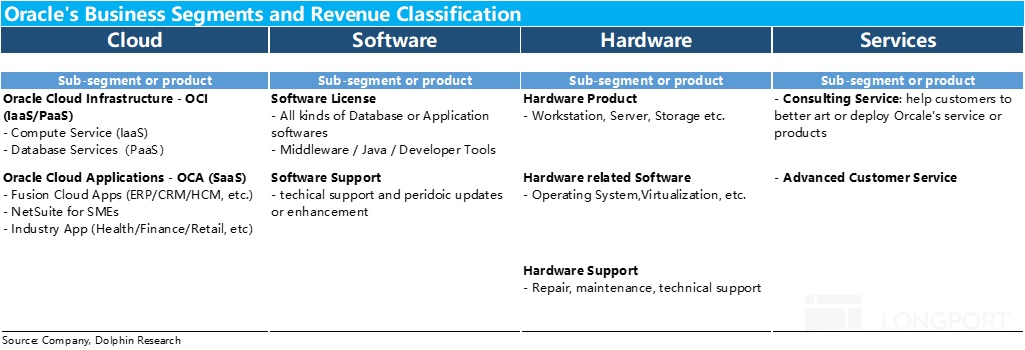
Previously, cloud and software were reported together with overlaps. Now cloud is standalone across four segments — Cloud, Software, Hardware, and Services — to help investors track cloud more clearly.
Based on the new framework, the biz. mix is as follows.
a. Cloud: The most important segment, split into IaaS via OCI and SaaS via OCA. OCA includes SaaS-ified ERP/CRM/HCM and vertical apps, while OCI comprises database services and compute leasing.
Historically OCA dominated cloud at 70–80%. Over the past 1–2 years, OCI's faster growth has pushed its share above OCA. Mix has flipped.
b. Software: Traditional on-prem software that customers deploy and manage themselves. Once the largest segment, it has been surpassed by Cloud, with share down from 60%+ to below 40%.
It includes one-off software licenses and recurring software support. Support revenue is typically 3–4x license sales.
c. Hardware: Similar to software, it includes one-off server and related hardware sales plus support and maintenance. This is the smallest segment, now ~5% of revenue.
d. Services: Other services not bundled with software or hardware, mainly consulting for deployment and optimization plus custom work. Recent years have seen a high single-digit % revenue contribution.
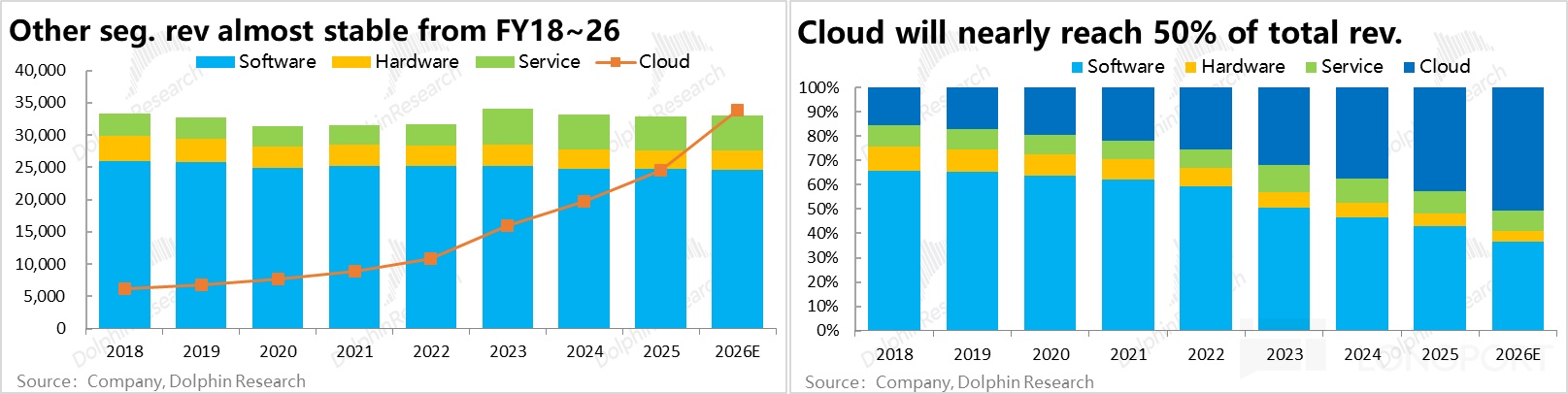
Under the latest FY26 taxonomy, we recast historical revenue. From FY18 to FY26E, segment growth trends are as follows.
a. Since FY18, non-cloud legacy (Software + Hardware + Services) has been flat to negative, even in the AI upcycle. Annual revenue oscillated in the $30–35 bn range over nine years, dragging total growth to single-digit % through FY24 ex Cerner consolidation.
b. Cloud is the only growth driver in recent years. In FY26 it will exceed 50% of total revenue, becoming the largest and fastest-growing core segment.
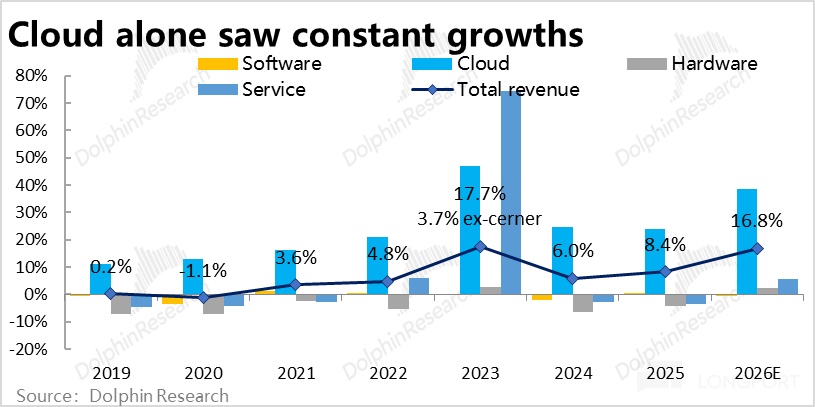
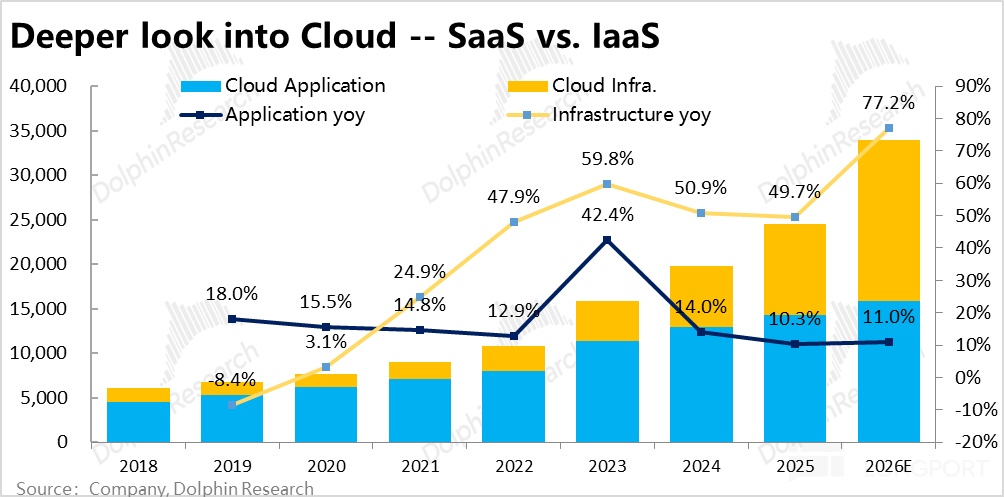
c. Within cloud, OCA's growth since FY18 has been sub-20% and decelerating, excluding the FY23 M&A effect. OCI, by contrast, has driven both cloud and group growth.
As the charts show, OCI revenue growth has run near or above ~50% since FY22. With OCI now larger than OCA, it is lifting cloud and total revenue, and should stay strong with AI demand and the OpenAI partnership.
II. The make-or-break lever — OCI
The review shows Oracle's legacy core — software — has been in multi-year decline, and SaaS growth within cloud is modest. Growth is now almost entirely tied to IaaS via OCI.
Accordingly, the rest of our analysis focuses on cloud, especially OCI, and we will sidestep legacy discussions. That is where the thesis resides.
2.1 The catalyst — a $300 bn surge in new orders
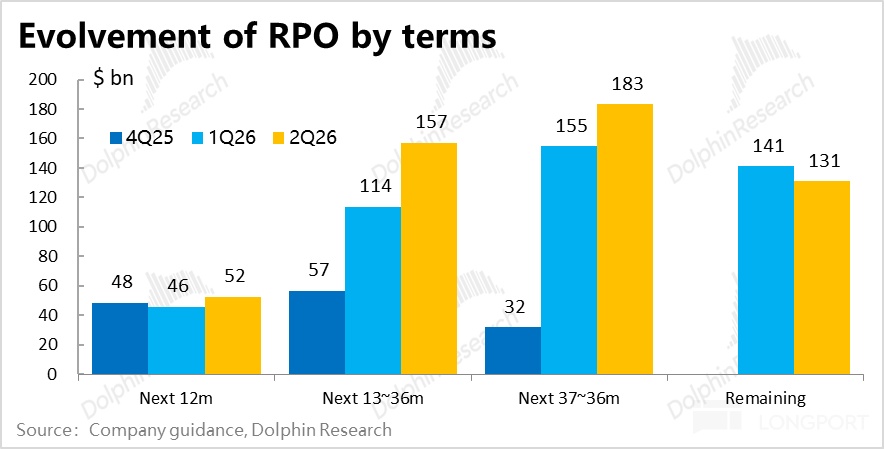
Oracle's F1Q26 call delivered a shock — roughly $300+ bn of new demand contracts signed in the quarter, equal to 5.8x FY25 revenue. It is also nearly 2.4x the F4Q25 RPO of $138 bn.
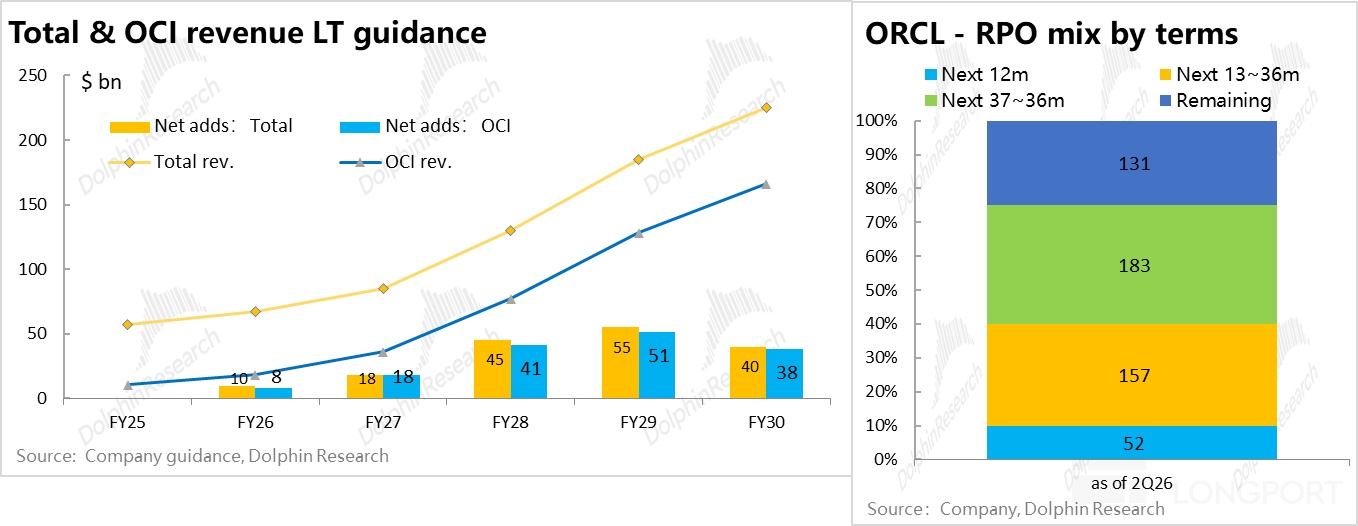
The company also issued multi-year guidance through FY30, later raised at the analyst day. Latest revenue guidance is as follows.
a. Total revenue: From ~$57 bn in FY25 to $225 bn in FY30, a 5-year CAGR of 31%. This implies a step-change in scale.
b. OCI revenue: The core engine rises from ~$10 bn in FY25 to $166 bn in FY30, about 16x in five years. The steepening inflection starts in FY28.
c. All-in on OCI: Combined, the data imply 90–100% of the YoY net revenue adds in FY27–FY30 come from OCI. In short, not just the past but the visible future is almost entirely OCI-led, with SaaS and non-cloud expected to be flat.
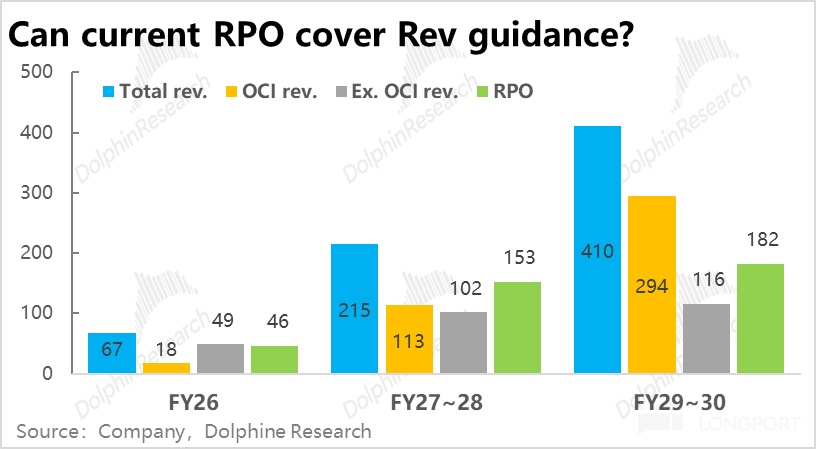
The latest RPO buckets by delivery window roughly map to FY26, FY27–28, and FY29–30 guidance. We observe the following.
a. Management noted Cloud RPO is ~95% of total RPO. Given OCA is guided to be largely flat, RPO beyond 12 months can be viewed as mostly OCI.
b. For FY26–28, expected OCI revenue is fully covered by current RPO, implying high visibility. From FY29 onward, current RPO covers only ~62% of expected OCI, leaving a ~$110 bn 2-year gap that requires additional wins.
2.2 Where does the $300+ bn actually come from
The consensus view is that the vast majority of the mega-order comes from a single customer — OpenAI. Details below.
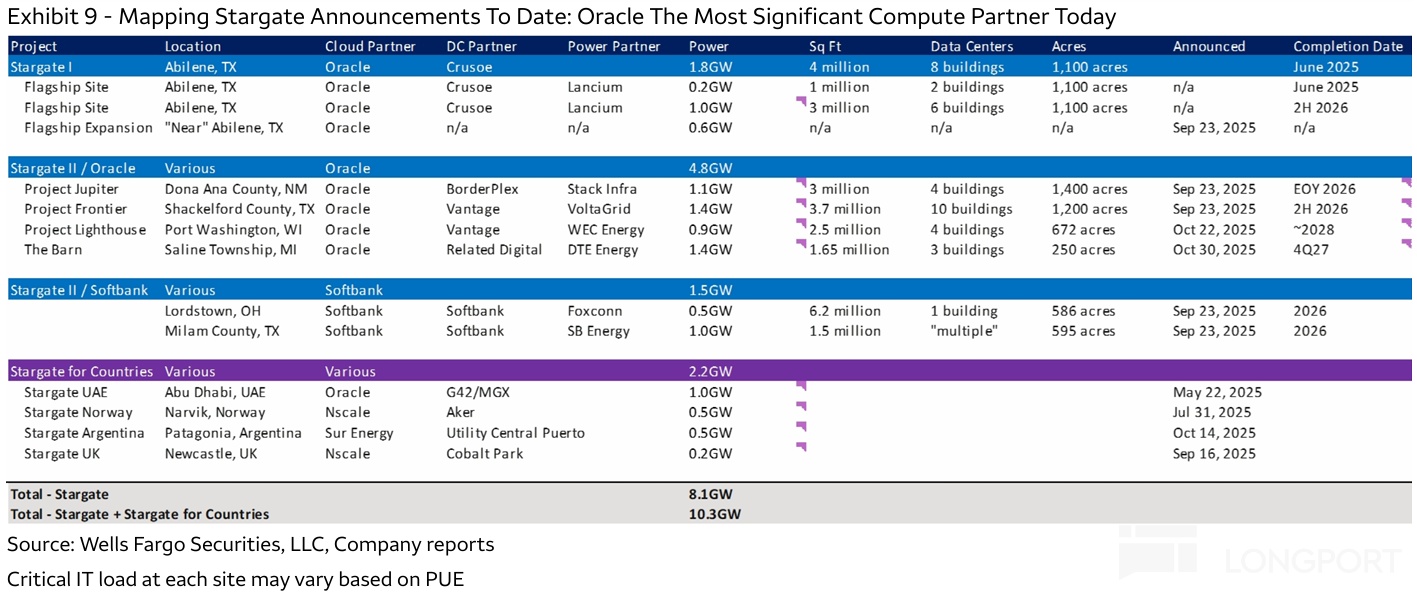
a. A $100 bn-class order was telegraphed: Before the 1Q26 print, Oracle disclosed signing an annual ~$30 bn cloud order with a customer starting FY28, without term or total value. On Jul 22, OpenAI announced, under the Stargate framework, a second batch of ~4.5 GW compute supply deals, i.e., the four projects in Stargate II.
The market thus mapped the $30 bn per year to Stargate II and, assuming a 5-year term, expected ~$150 bn of RPO adds into F1Q26. That was the base case.
b. Actual RPO doubled expectations: Reported RPO additions were $300+ bn, roughly 2x the prior estimate. This raised a new question — where did the extra ~$150 bn come from
Management said the quarter's new orders involved three customers, prompting a search for two other mega buyers beyond OpenAI. No clear candidates emerged.
The working view is that most of the $300+ bn still comes from OpenAI. The difference is that OpenAI's contract is likely ~$60 bn per year over five years starting in 2027.
In short, the RPO add doubling from ~$150 bn to $300+ bn likely reflects OpenAI doubling its order size, not Oracle landing another OpenAI-scale buyer. That is the simplest explanation.
2.3 Both Microsoft's stand-in and a scaled CoreWeave
1) Replacing Microsoft as OpenAI's top partner
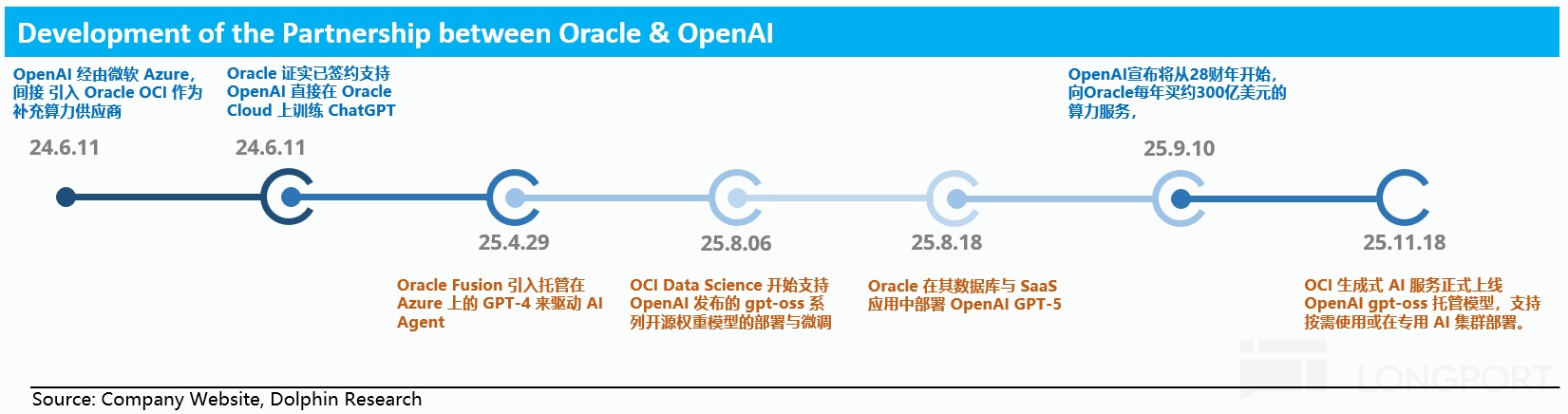
Signals of an Oracle–OpenAI tie-up surfaced as early as Jun 2024, when Microsoft still held exclusive rights to supply compute to OpenAI. Oracle participated as a subcontractor via Microsoft, similar to how CoreWeave previously absorbed overflow demand.
In Jan 2025, Microsoft amended its deal with OpenAI and relinquished exclusivity to avoid concentration and overinvestment risks. Oracle then became one of OpenAI's primary cloud partners.
The relationship mirrors the prior OpenAI–Microsoft model. Oracle not only sells compute to OpenAI for revenue, but also leverages OpenAI's tech to shore up its lack of proprietary frontier models.
Per reports, Oracle has infused OpenAI capabilities into Fusion SaaS and database offerings, and can sell pre-deployed GPT services on OCI. This tightens the integration.
2) Picking what Microsoft did not want Is this a good business
A common take is that Oracle got what Microsoft did not want — lower-value work. The OpenAI partnership brings massive orders and AI capability uplift, but also significant risk.
In this sense Oracle resembles CoreWeave. Key risks include the following.
a. High customer concentration: If OpenAI accounts for $300 bn of Oracle's RPO, that is ~58% of total. This is better than CoreWeave but still concentrated, even with the ~$60 bn of new 2Q26 orders reportedly from Meta and Nvidia.
b. Limited tech leverage: Like CoreWeave, Oracle's software and platform edge is not strong relative to the Big Three clouds. Pricing power is weaker, and it is harder to lift margins with value-add software.
Evidence includes a heavy Bare Metal mix in compute leasing and the underwhelming Cloud 1.0 outcome due to tech gaps. Pre-AI, IaaS growth was tepid, consistent with this read-through.
c. AI cloud margins are modest, albeit better than CoreWeave: It is consensus that AI cloud GPM runs below traditional cloud given expensive GPUs. Oracle's Bare Metal tilt, lower value-add, and OpenAI dependence constrain margin.
The market once thought AI cloud GPM could be sub-20%, assuming 60–90% utilization. At the Oct investor day, management guided AI cloud GPM at 30–40%, which seems plausible vs. CoreWeave's ~25–30%.
Oracle is not stuck at breakeven like CoreWeave might be, but the drop vs. its legacy 70–80% GPM is still steep. Mix will pressure profitability.
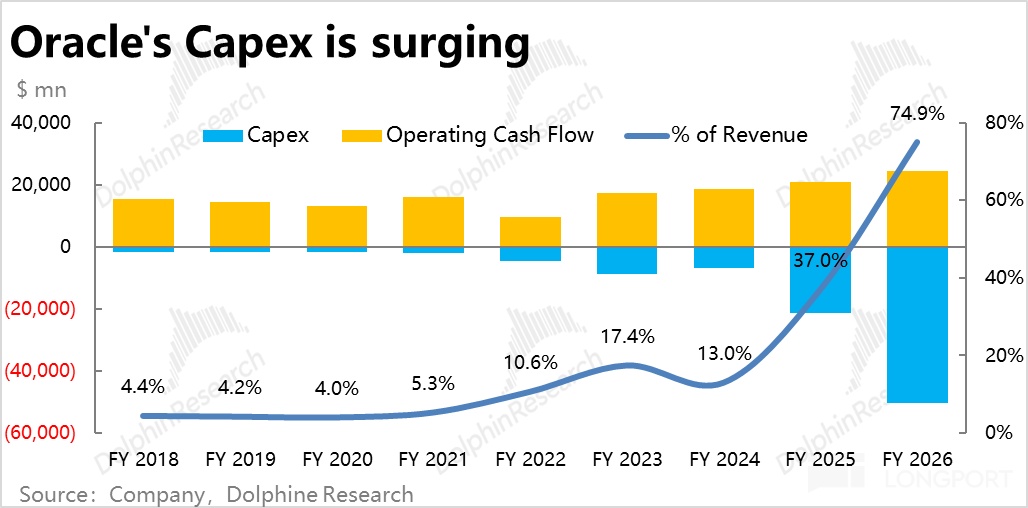
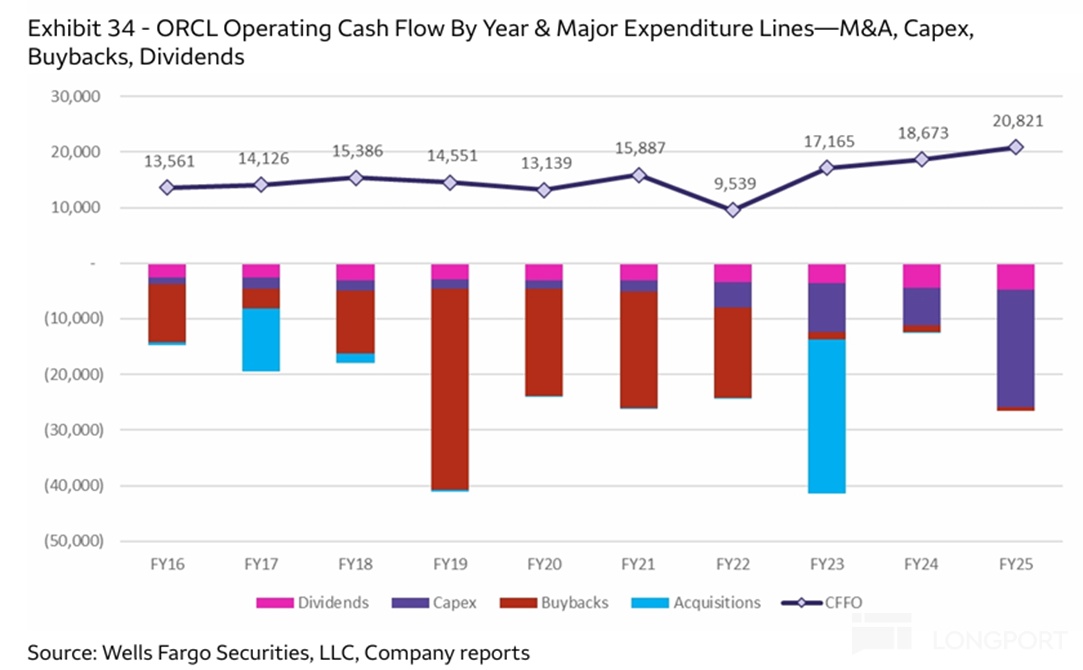
d. Heavy Capex and leverage, with the peak still ahead: Like CoreWeave, massive DC buildouts strain cash flow and the balance sheet. Management guides FY26 Capex to double to ~$50 bn, or ~75% of revenue and more than 2x projected OCF.
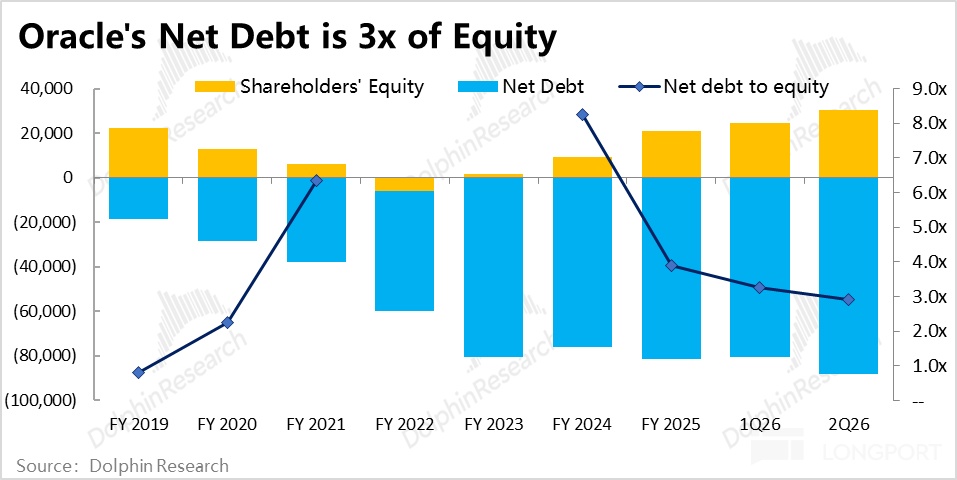
The funding gap must be filled by cash on hand or debt. Cash is limited at sub-$20 bn as of 2Q26, and net debt is nearly 3x shareholders' equity, with the true Capex and issuance peak still ahead.
For over a decade Oracle has run a leveraged model. Since FY16, cash outlays have exceeded OCF almost every year — historically for buybacks and M&A, and ahead for Capex.
As noted, DC build peaks from FY28, so Capex peaks around FY27. The real cash squeeze and leverage stress test are still coming, and the current B/S is not robust.
If a black swan hits, there is a non-trivial risk of balance sheet impairment and equity wipeout. That tail risk exists.
III. Takeaways — outsized upside and risk coexist
Dolphin Research's key views on Oracle are as follows. They reflect both necessity and dependence.
a. Legacy has little appeal, OCI is existential not optional. Both history and guidance show that, outside IaaS/OCI, all other businesses are mature to declining. SaaS may grow modestly, non-cloud has been negative for years.
For Oracle, OCI is not a nice-to-have. Without it, Oracle would be a low-growth, potentially disrupted legacy software name.
That is why Oracle is so aggressive with OpenAI and willing to shoulder the risk of potential AI overbuild. It is a bet-the-company move.
b. A scaled CoreWeave with similar issues. Despite its size, Oracle's role is akin to a supply-chain workhorse tied to OpenAI's ship. Customer concentration, weaker pricing power, and lower tech value-add limit AI margins, while heavy Capex and debt raise solvency risk.
These are the same structural challenges. They need monitoring.
c. As OpenAI's new close ally, both opportunity and risk are significant. Replacing Microsoft as a primary partner opens a vast revenue runway. Even if other segments stagnate, total revenue could still compound at ~31%.
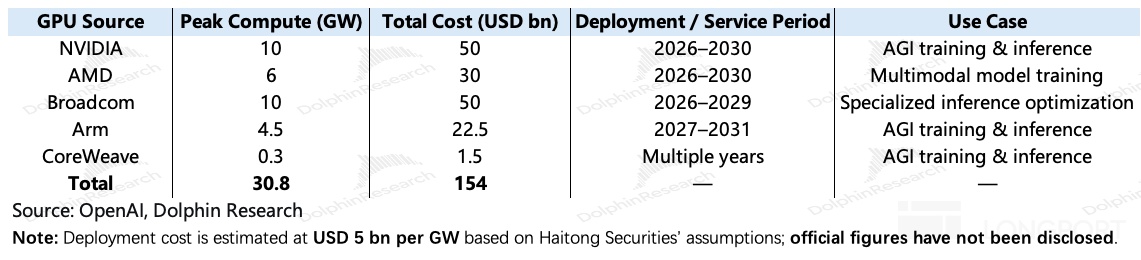
RPO could rise further if Oracle captures part of OpenAI's combined 26 GW intentions with Nvidia, AMD, and Broadcom as a cloud operator. New orders from Meta, xAI and others are also possible.
On the flip side, OpenAI's 30+ GW of compute intents may be deliberately over-reserved. Not all orders may materialize, risking stranded capacity and bad debt.
<End>
Risk Disclosure and Statement:Dolphin Research Disclaimer and General Disclosure


The copyright of this article belongs to the original author/organization.
The views expressed herein are solely those of the author and do not reflect the stance of the platform. The content is intended for investment reference purposes only and shall not be considered as investment advice. Please contact us if you have any questions or suggestions regarding the content services provided by the platform.