D
Jan 28 at 12:33 PM
ASML (Trans): Outlook weighed by customer fab build-outs; most new orders are for 2027 deliveries.
Below is Dolphin Research's compiled transcript of ASML's Q4 2025 earnings call. For our earnings First Take, see ‘ASML:Memory Order Surge Invites Super Litho Cycle'
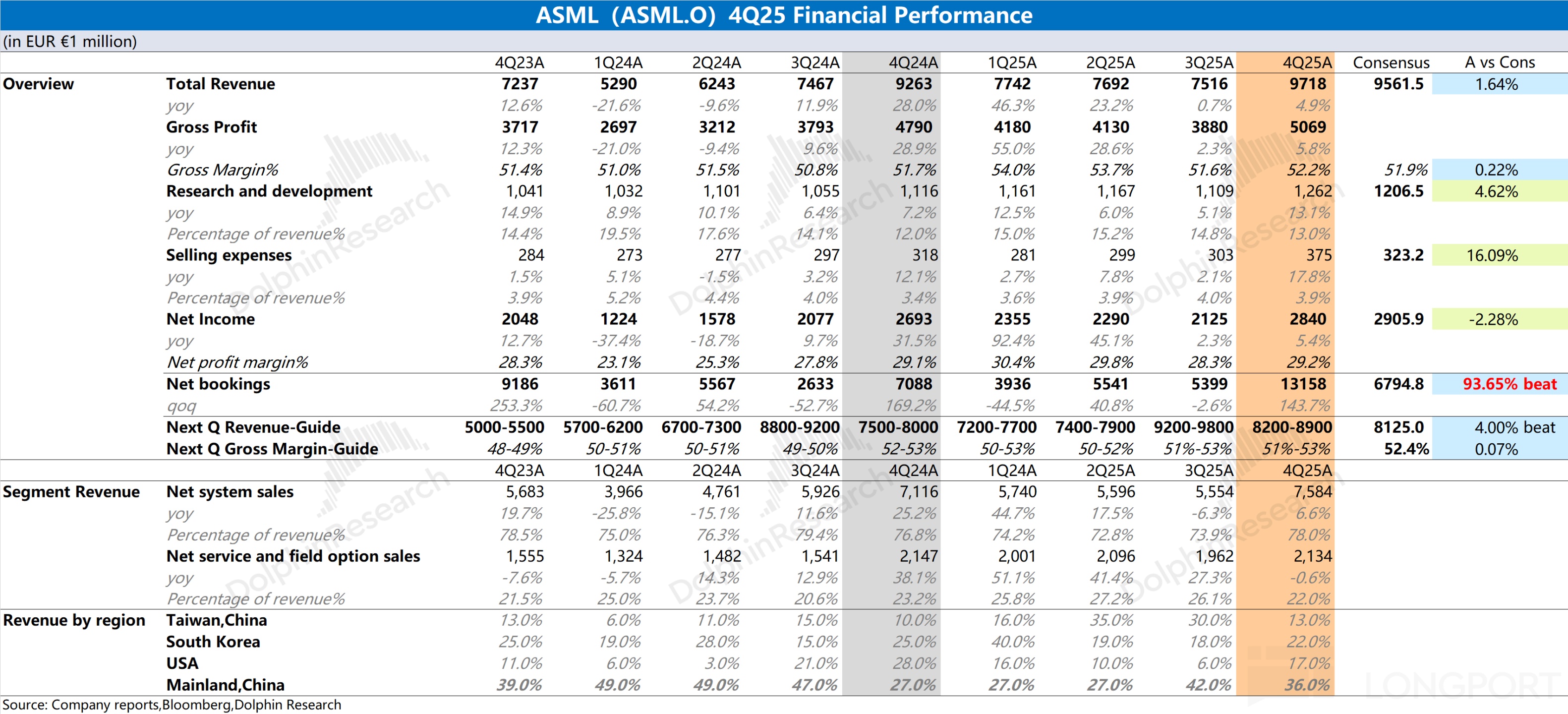
I.$ASML(ASML.US) Key Financials Recap
Q4 2025 results:
Net sales: EUR 9.7bn. In line with guidance.
Net system sales: EUR 7.6bn (EUV EUR 3.6bn, including 2 High-NA systems; non-EUV EUR 4.0bn). Logic accounted for 70%, memory 30%.
Installed base management sales: EUR 2.1bn. GPM: 52.2%, in line with expectations.
Net income: EUR 2.8bn (29.2% of net sales), EPS EUR 7.35.
Net bookings: EUR 13.2bn (EUV EUR 7.4bn; non-EUV EUR 5.8bn). Memory was 56%, logic 44%.
FY2025 results:
Net sales: EUR 32.7bn. GPM: 62.8%.
EUV system sales: EUR 11.6bn (48 systems delivered, incl. High-NA), +39% YoY.
DUV system sales: EUR 12.0bn, -6% YoY.
Metrology & inspection sales: EUR 825mn, +28% YoY.
End-market mix: Logic systems EUR 16.1bn (+22%); memory systems EUR 8.4bn (-2%); installed base management EUR 8.2bn (+26%).
Net income: EUR 9.6bn (29.4% of net sales), EPS EUR 24.73.
FCF: EUR 11.0bn. Backlog: approx. EUR 38.8bn.
Shareholder returns:
Interim DPS for 2025 was EUR 1.60. Planned full-year DPS is EUR 7.50 (+17% vs. 2024).
A proposed final dividend of EUR 2.70 per share.
Q4 share repurchases were approx. EUR 1.7bn. Total 2025 capital return via dividends and buybacks is EUR 8.5bn.
New buyback program announced through end-2028, with an aggregate cap of up to EUR 12.0bn.
II. ASML Earnings Call Details
2.1 Management highlights
Market outlook and demand:
- Outlook has improved materially, driven by ongoing build-out of data centers and AI infrastructure. This is the primary tailwind.
- That demand is translating into additional capacity needs at advanced logic and DRAM customers, lifting demand across the portfolio, especially EUV.
- Most customers have accelerated capacity expansion plans over recent quarters. The pace has clearly picked up.
Business-line updates and outlook:
Advanced logic: Confidence in sustainable long-term demand is rising. AI accelerators are moving from 4nm to 3nm, while customers continue to ramp 2nm for next-gen HPC and mobile.
Memory: Demand for HBM and DDR remains exceptionally strong, with tight supply likely at least through 2026. DRAM customers are adding EUV layers at relevant nodes and migrating multi-patterning DUV to single-exposure EUV, implying higher litho intensity at future nodes.
2026 outlook:
- EUV: Revenue set to grow meaningfully, supported by both advanced logic and DRAM. Momentum is broad-based.
- Non-EUV: Revenue expected to be roughly flat vs. 2025. China is expected to account for a similar share of net sales as its current share of system orders, around 20%.
- Metrology & inspection: Significant growth expected as customers step up process control investments.
- Installed base management: Another year of growth, driven by the expanding EUV install base and performance upgrades to meet capacity needs.
Guidance:
Q1 2026: Net sales of EUR 8.2–8.9bn. Installed base management revenue around EUR 2.4bn.GPM of 51%–53%. R&D approx. EUR 1.2bn; SG&A approx. EUR 300mn.
FY2026: Net sales of EUR 34–39bn. GPM expected at 51%–53%.
Through 2030, revenue is expected at EUR 44–60bn with GPM at 56%–60% (unchanged from the 2024 CMD).
Technology updates:
EUV: Continues to reduce customers technology cost at the leading edge. NXE:3800E is planned into 2025, and its higher productivity enables EUV single exposure to replace complex multiple exposures in DRAM.As customers migrate from 6F² to 4F², both immersion and EUV litho intensities increase.
High-NA EUV: Customer qualification in R&D fabs is progressing well. Intel has announced its EXE:5200B has been qualified and put into use for high-volume manufacturing at leading nodes.More systems are expected to ship in 2026 to prepare customers for volume ramps.
2.2 Q&A
Q: Based on EUV orders, 2026 Low-NA deliveries guided at about 56 tools seem far below the roughly 114 tools in backlog. Is this due to customer cleanroom readiness, Carl Zeiss optics constraints, or longer lead times?
A: Several factors are at play. Customer fab construction progress shapes the cadence of demand release through the year, and we also need to lift quarterly output to meet demand.So the range depends mainly on customer readiness and our quarterly ramp and execution capacity.
Q: On High-NA, has the 2026 revenue view for 4–7 systems changed? More importantly, how do you see adoption timing? Is there scope for additional High-NA orders in 2H? Could DRAM adopt ahead of logic and positively surprise?
A: No major change vs. last quarter. On adoption, both DRAM and logic customers are making good progress, with some already using limited product wafers to test tool performance.We still expect most qualifications and data collection to run through year-end, meaning decisions to adopt will likely fall in 2H this year or in 2027.
As for who adopts first, DRAM vs. logic is highly competitive. Both sides are very active in testing and progressing well.Also, the 114 EUV tools you cite in backlog may be slightly overstated, as the EUR 25.5bn total value also includes High-NA tools.
Q: With 2026 revenue growth guided at 4%–19%, what variables are in ASML's control vs. customers?
A: It largely hinges on customer fab build progress and their ability to take tools, which determines whether demand lands in 2026 or a bit later. Our own execution matters too, but it starts with customers having fabs and cleanrooms ready on time.So it is a combination of both sides.
Q: Can you update Low-NA EUV manufacturing capacity, e.g., targets for tool counts?
A: We have the infrastructure in place to respond within about 12 months, or slightly longer. Long-lead items like cleanrooms and equipment are set.Given stronger demand signals in recent months, we are increasing capacity.
This is a phased process, not a jump from, say, 44 to 80 tools in a single year. We will raise output QoQ through 2026 via hiring, training, and supply-chain alignment.If demand stays strong, capacity will continue to rise beyond 2026.
Q: Customers are lifting mid-term plans, as seen in rev. growth and capex commentary, notably TSMC. Your record orders reflect part, but not all, of that. As you plan to lift output over coming quarters, have customers given more visibility for demand next year and beyond? Any color on how visibility is improving?
A: Customers views on the sustainability of AI-related demand, across advanced logic and memory, are consistent publicly and in our discussions. This is translating into concrete orders or demand indications, especially for 2027.The strong Q4 bookings show those discussions are turning into action.
They are discussing demand beyond this year, and we factored that into our capacity plans. Directional indications align with their public statements and clarify how they see demand developing year by year.
Customers are also more open about capacity plans after extensive talks with their own customers, giving them mid-term demand insight. Over the past three months, we have seen growing alignment on a strong mid-term demand outlook.In recent weeks, we received many confirmations from logic and DRAM customers. The trend has strengthened materially and appears well coordinated across much of the ecosystem.
Q: Does the high end of 2026 guidance assume a sharp decline in China? On long-term capacity, customers seem to plan for more than 80–90 EUV tools. How long would it take to surpass that, and can tool productivity gains via R&D help?
A: On the upper end of guidance, the assumption that China is 20% of sales applies across the range. Key drivers include customers ability to take tools as planned, our execution, and a full contribution from installed base business, which is the fastest path for customers to add capacity.In that model, China can still be around 20% of sales.
On long-term capacity, by 2030 we will supply both Low-NA and a meaningful number of High-NA tools. Low-NA tools will be more productive than today.We will keep pushing the Low-NA roadmap via R&D to raise per-tool productivity.
Combined with the significant incremental output from High-NA, this gives customers capacity well above numbers currently discussed. Our EUV and DUV capacity build over recent years gives us flexibility to support market growth.
Q: Was last quarter's surge in memory orders mainly DUV-driven? For DDR5 at the 1C node, are there 7–8 EUV layers or fewer?
A: Memory orders were strong, but not only from DUV. EUV contributed as well.We expect memory to be a substantial share of 2026 sales, with a more balanced mix between logic and memory vs. 2025. In DRAM, we benefit from both rising capacity needs and more EUV layers.
This trend started in 2025 and continues. The shift from 6F² to 4F² will lift EUV share in DRAM.Based on customer discussions, we see room for further increases in EUV layers and litho intensity in DRAM over the next few years.
Q: Is EUV manufacturing capacity about 70 tools, and could that cap next year's growth? Are capacity limits causing allocation between this year and next, contributing to a wide 2026 revenue range?
A: Capacity is dynamic, and cannot be raised sharply within a single quarter. Low-NA EUV units were 44 last year, and you cannot jump from 44 to 80.We will step up output each quarter and increase capacity. If demand signals stay strong, growth continues into 2027.Seventy tools is not a hard cap in our view. Actual capacity can be higher.
Q: As you add EUV capacity, does that change order behavior? Do customers wait for proof of incremental capacity before committing to orders for 2027 and beyond?
A: Not really. Customers know our plans, and we are very transparent about our ramp.They value the greater flexibility now embedded in our model. In fact, if they sense a tight year, the dynamic is the opposite they will order earlier to secure slots.We have reduced response time by building out long-lead items, and customers appreciate that.
Q: Some orders ship in 2027. What is needed to reach the top end of this year's revenue guide? Is this related to China, given its shorter backlog cycle and potential impact on reaching the high end?
A: The first and most important factor is customer readiness to receive tools, meaning fab completion, foundations prepared, and ability to accept our systems. That is the primary constraint.Second is our execution and supply-chain alignment to match the ramp. On the demand side, upgrades are key.China is modeled at 20% of revenue in our guidance, so it moves in line with the range.
Q: There is a view that the DRAM shift to 4F², say in 2028, could cause an EUV demand cliff from DRAM customers. Is that risk diminishing given AI-driven DRAM expansion?
A: First, 4F² has more complex structures and requires more advanced litho, so both immersion and EUV layers increase. Second, customers dislike demand cliffs because they are operationally disruptive.In our EUV discussions, the transition to 4F² is already factored in, and no one plans to buy many tools and then be stuck.
In DRAM, EUV simplifies process flows, cuts steps, shortens cycle times, and can even add capacity. The more DRAM customers use EUV, the greater the benefits, which argues against a cliff.Many discussions suggest litho intensity in both DUV and EUV will grow under 4F², and EUV adoption will keep broadening before and after that transition.
Q: The 2026 GPM guide may disappoint, with headwinds from High-NA mix, China, upgrades, and some milestone payments. Into 2027, does the EUV mix shift back to 3800E-led, and does 3nm expansion extend into 2027?
A: For EUV mix, 3800E demand is strong in 2025, but in 2026 we still ship some 3600 units with parts already kitted. By 2027, the EUV mix should improve significantly, potentially with a new generation in play, which would be better than 2026.
The next-gen Low-NA EUV tools are key to long-term margin targets. Another mix effect is in DUV, where dry tools will outnumber immersion in 2026 due to immersion supply constraints, which is margin dilutive for DUV mix.Also, installed base management, especially upgrades, will be a major swing factor within the margin range.
Q: Can you specify 2026 High-NA revenue recognition in tool counts?
A: Likely a bit more than this year, but we prefer not to disclose more detail.
Q: Could the rapid capacity build across the industry delay High-NA adoption, as customers focus on expansion and shy away from technology transition risk?
A: High-NA adoption has three phases R&D qualification, limited-layer HVM insertion, and broad deployment, and the plan already leaves room for thorough qualification. The current capacity acceleration mainly targets existing nodes with current technologies like DUV and metrology.High-NA is for the next node, and customers have time to plan and insert it properly. Once they decide to adopt, they commit resources to masks and process qualification, making reversal unlikely.Workstreams are scheduled so they are less sensitive to capacity accelerations or pauses. We do not see a delay risk.
Q: If China is 20% of 2026 revenue and down 20%–25% YoY mostly in DUV, while DUV is guided flat for the year, non-China DUV would need to rise roughly 40% YoY. Non-China DUV did not grow in 2025 alongside EUV. Why expect a strong rebound this year, and does 2026 make up for 2025?
A: It is a key point. Non-China DUV, including dry, was strong in 2024.2025 was indeed disappointing, likely because many customers, like us, prioritized long-lead items such as EUV and kept flexibility in shorter-lead DUV. That said, we saw non-China DUV recover late last year and expect that uptrend to continue through 2026.So there was a disconnect in 2025, but the trend reversed by year-end and should carry into 2026.
Q: On backlog delivery timing, how much is expected to ship in 2026, and are expected delivery times extending vs. recent quarters?
A: We expect 2H to be stronger than 1H, driven by customer fab space availability and our continued QoQ output increases. It is clear many of the large Q4 orders, and a good portion of the backlog, are for 2027.Most of the Q4 orders are for 2027, with only a part for 2026.
Q: What are the pluses and minuses for margins, and what could put full-year GPM at the high vs. low end of guidance?
A: Negatives include 1) fewer immersion tools vs. 2025 due to supply constraints, not demand; 2) more dry tools with lower margins; 3) a higher share of lower-margin EUV variants; and 4) slightly negative mix from more High-NA. Positives include 1) a significant increase in EUV tool volume, which is margin accretive; and 2) strong upgrades in installed base management as an important positive swing factor.
Q: For logic roadmaps A16, A14, A10, do EUV layers rise with each generation? Are some customers trying to limit EUV adds?
A: Mid-term, EUV layers do not change much from 2nm to A16. At A14, we expect EUV layers up by 10%–20%.At A10, structural changes may require more EUV layers. This view is shared in discussions with foundry customers and is key to hitting their future targets.
Q: With 2026 revenue growth guided at 4%–19%, what variables are in ASML's control vs. customers?
A: It largely hinges on customer fab build progress and their ability to take tools, which determines whether demand lands in 2026 or a bit later. Our own execution matters too, but it starts with customers having fabs and cleanrooms ready on time.So it is a combination of both sides.
Risk disclosure and statement: Dolphin Research disclaimer and general disclosure
Login to unlock15,543characters for free
This content is only available to signed-in users. Sign in to your Longbridge account to read the full post.