D
Jan 28 at 11:54 PM
META (Trans): AI Improving Recommendations; FB & IG Engagement to Keep Rising
Below is Dolphin Research's$Meta Platforms(META.US) FY25 Q4 earnings call Trans. For the earnings take, see Meta: Spending $100bn+? As long as growth rips.
I. Key financials
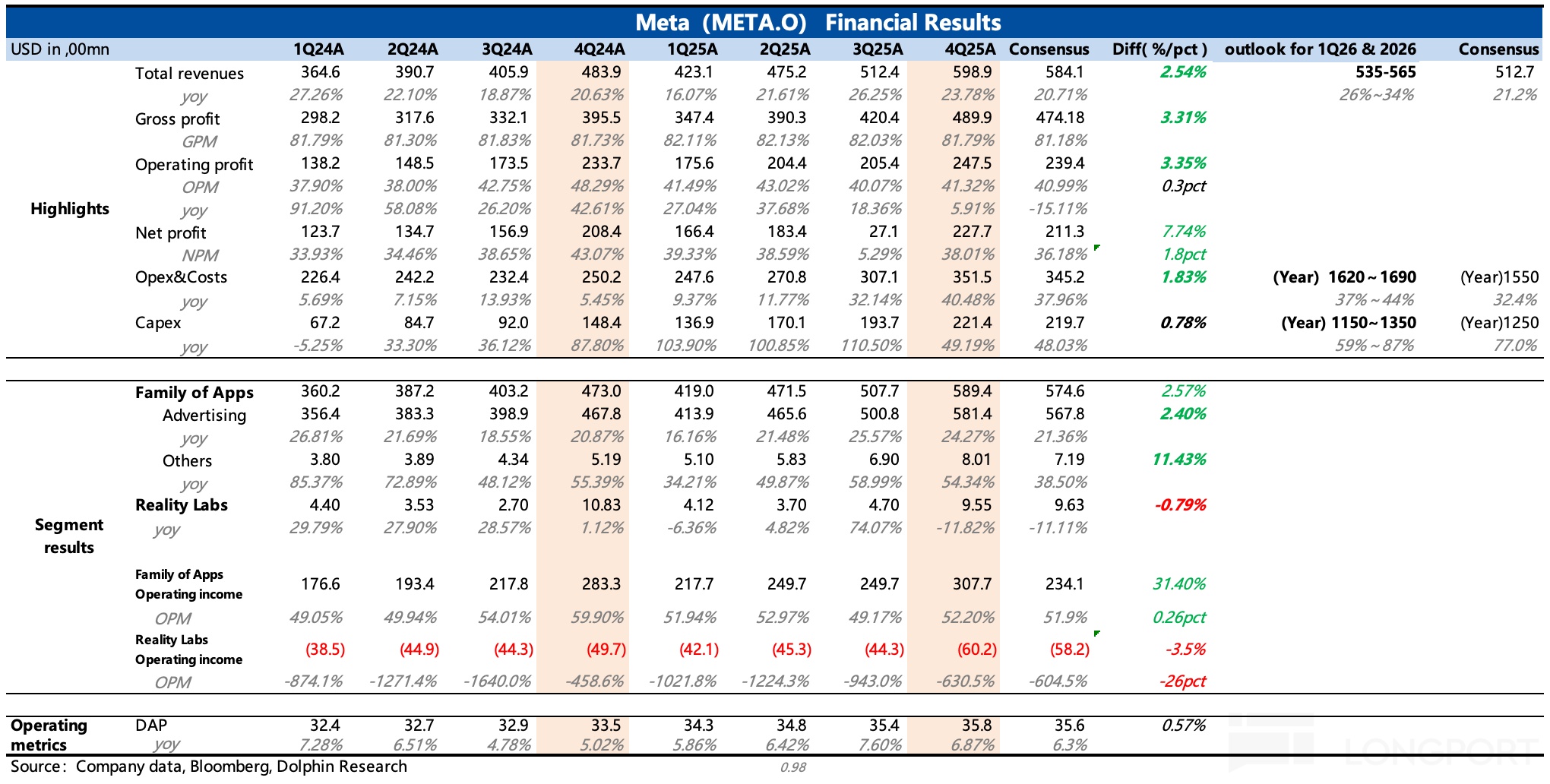
1) Rare, pedal-to-the-metal guide: For a top-scale ad platform to guide to ~30% growth (with ~4ppt FX tailwind) is exceptional. Most warts can be overlooked when you promise that kind of pace.Ads remain a gold mine, and AI is a share-gain weapon for leaders with scale capital and rich data.
2) Solid in-quarter print: In Q4, fundamentals were firm. Revenue rose 24% YoY off a tough comp (+23% on FXN), slightly ahead of consensus.Growth was carried by ads as usual: ad impressions +18% and price +6%.
The primary drivers were Reels and AI. Short video naturally lifts inventory but at lower unit pricing, which dragged blended CPM growth.With AI-improved recommendation, Reels became a runaway engine: deeper immersion boosted engagement and time spent, materially expanding ad inventory and improving conversion.
Beyond that, North America ad demand was healthy in Q4, notably in e-comm, travel and gaming. But with more macro/policy uncertainty this year, advertisers are re-basing expectations and shifting faster to better ROAS performance ads.
This helps Meta near term given its performance-heavy mix, but prolonged uncertainty would still seep into Meta. Versus rising buy-side optimism in recent days, Q4 itself is not the focus.
3) A small scare — investment appetite stays high: Management guided 2026 Opex to $16.2–16.9bn, up 37–44% YoY, above many buy-side views of $15–16bn (slightly above BBG consensus).
Without the robust top-line outlook, this would have been punished.Capex is $11.5–13.5bn for the year, up 59–87% YoY. Buy-side was at $12–13bn, broadly within the range, so not a shock but hardly a positive surprise.
Overall, the budget for investment remains generous. Whether spend can be dialed back later likely hinges on revenue pressure, given Meta's history.With foundation models where Meta still plays catch-up, AI spend is unlikely to see sharp cuts unless stress rises meaningfully; any optimization will skew to legacy ops.
4) Profit pressure persists over the next two years: The production/investment mismatch started to show last quarter. Q4 total operating expenses rose 41%, accelerating vs. Q3, weighing more on margins.Q4 OP was $24.7bn with OPM at 41%, down 7ppt YoY. Given the 2026 Opex/Capex cadence, total revenue needs to grow >21% to keep OP up YoY.
5) Cash use and shareholder returns: Cash plus ST investments was $81.5bn at Q4-end, up $37bn QoQ, mainly due to $30bn in new long-term debt issued in Q4.FCF was $14.1bn and dividends $1.3bn this quarter.
But buybacks paused; even the prolonged Q4 share pullback did not trigger repurchases, likely as heavy investment tightened cash.The once-loud $10bn+ shareholder return package now looks thin. With dividends alone, shareholder yield is minimal and provides negligible support for the stock.
II. Management update (2026 ops & strategy priorities)
1) AI enters an acceleration phase. The product roadmap points to 'personal superintelligence'.Mark expects 2026 to see rapid advances across frontiers, with agents starting to actually work, enabling new product forms and new ways to get work done.
Following 2025's reset of AI foundations, new models and products will roll out over the coming months, showing a 'fast-evolving trajectory'.They will iterate through the year and push the frontier.
2) Infuse LLMs into recommendation and ads to deliver more 'you-aware' distribution.The company is integrating LLMs into the recommendation engines behind Facebook/Instagram/Threads and the ad stack.
The goal moves from 'recommend good content' to understanding personal objectives, turning the feed into AI that helps users improve their lives the way they want, even generating personalized content.This is an upgrade in intent understanding and delivery.
3) Biz. and e-comm: from 'finding the right people' to 'agentic shopping'.Ads today find people likely to be interested; the next-gen shopping agent helps users find the best set of products in a catalog.
The focus is to connect feed and business messaging end-to-end, while steadily enhancing WhatsApp capabilities.That should raise conversion and lower friction.
4) New media forms: more immersive, more interactive formats will emerge.After text → photos → video, AI will catalyze the next wave with richer interaction and immersion.
Feeds will become more interactive. Opening the app should feel like opening an AI that understands you, not just an 'algorithmic feed'.
5) Smart glasses as the key device; Reality Labs to focus on glasses and wearables.Mark called glasses the ultimate device to realize the vision: see what you see, hear what you hear, converse, and overlay information/UI in view.
He noted glasses shipments more than tripled last year and expects mainstream eyewear to trend toward AI glasses over the next few years.Reality Labs will prioritize glasses and wearables, advance Horizon on mobile, and aim to move VR to profitability over the next few years; RL losses this year should be similar to last year, likely near peak, then gradually narrow.
6) 2026 growth levers: engagement uplift + monetization efficiency (Susan's frame).Susan said revenue performance hinges on two things: deliver more compelling experiences and monetize higher engagement more efficiently.
In 2026, Meta will scale training data complexity and size and make systems more responsive to real-time interests.It is investing in next-gen recommendation: rebuilding from scratch on top of LLMs, using their world knowledge and reasoning to infer interests better.
AI product directions (Meta Superintelligence Labs models):
- AI-dubbed/translated video: 9 languages supported; 'hundreds of millions' watch AI-translated videos daily, driving incremental IG usage. More languages will be added this year.
- Media creation: nearly 10% of daily Reels views come from Edits; DAUs for 'generate media' in Meta AI tripled YoY in Q4. 2026 will upgrade base generative media models and ship new features.
- Meta AI personalization: early tests show personalized replies lift engagement. In 2026, personalization will advance materially, blending 'content understanding' so answers include the most relevant content on platform.
(b) Monetization efficiency: drive more conversions at the same ad load and place ads in new surfaces.Ad delivery focuses on 'right time/right place'. More importantly, conversions can rise by detecting moments when users are more willing to see ads without raising total load. In H2 2025, Facebook's ad reallocation lifted revenue by nearly 4x the impact of higher ad load.
New surface ads:
- Threads: expanding ads this month to remaining markets, including the UK, EU and Brazil.
- WhatsApp: plan to roll out Status ads globally this year, keeping load low initially, optimizing formats and performance before expanding inventory.
- Ad system/model iteration, e.g.:
- Doubled GPUs training the GEM ad-ranking model in Q4, introduced a new sequence-learning architecture that handles longer behavior sequences and richer content signals.
These drove +3.5% clicks on Facebook in Q4 and >1% conversion lift on Instagram, with the new architecture more efficient and easier to scale.
- New run-time models on Instagram across Feed/Stories/Reels raised Q4 conversion by 3%.
- Lattice (unified model framework): folded FB Stories and more into the unified model in Q4; along with backend improvements, ad quality rose 12%. 2026 model integrations will exceed the prior two years combined.
- Ad product/creative tools: testing Meta AI business assistant for advertisers, expanding in coming months. It will 'remember' business goals and offer tailored suggestions.
- Video creation tools: combined revenue run-rate hit $10bn in Q4, growing nearly 3x faster QoQ than overall ad revenue.
- Incremental attribution: the latest Q4 model delivered 24% more incremental conversions vs. standard attribution; within 7 months, the product reached a multi-billion-dollar annualized run-rate.
Business messaging:
- Click-to-message ads: US +50% YoY in Q4.
- WhatsApp paid messaging: annualized run-rate topped $2bn in Q4.
- Business AI: early progress in Mexico/Philippines with >1mn weekly human-to-business-AI conversations. In 2026, expand markets and capabilities so agents not only answer but complete tasks within WhatsApp.
7) Org and efficiency: AI coding tools lift engineering output; flatter teams with greater individual contribution.Since early 2025, engineer output per head is up 30%, mostly from agentic coding. Heavy users of AI coding tools are up ~80% YoY; this should accelerate over the next six months.
Mark emphasized AI-native tools, empowering individual contributors and flatter teams. Many initiatives can shift from large teams to a handful of top performers.
8) Infra and chips: Meta Compute, long-term bets on silicon and energy for flexibility and efficiency.Meta Compute centers on long-term investment in chips and energy, with unit GW costs expected to fall markedly via tech and supply-chain optimization.
In Q4, Meta expanded Andromeda (ad retrieval engine) to support NVIDIA/AMD/MTIA, and with model innovation, achieved nearly 3x compute efficiency. In Q1, MTIA will expand to core ranking and recsys training workloads.
It also stressed long-term flexibility: data center siting and development, strategic partnerships, cloud contracts, and new ownership structures for some large data centers.
8) Guidance
1) Q1 2026 revenueTotal revenue: $53.5–56.5bn.
Assumption: at current FX, FX is a ~+4% YoY tailwind to total revenue growth.This is stronger than Q4 2025 FX tailwinds.
2) FY2026 expense guideTotal expenses: $162–169bn.
Key drivers:1. Infra costs (third-party cloud, higher D&A, infra opex) 2. Personnel comp (tech hiring, esp. AI; includes full-year impact of 2025 levels plus 2026 adds)
By segment: expense growth mainly from Family of Apps; Reality Labs OP loss expected similar to 2025.Discipline remains, but investment intensity stays high.
3) FY2026 Capex guideCapex (incl. principal on finance leases): $11.5–13.5bn.
YoY growth reflects larger infra to support Meta Superintelligence Labs and core businesses.Spend ramps with model scale and deployment.
4) Profitability and taxDespite a step-up in infra, 2026 operating profit is expected to exceed 2025.
Assuming no changes in tax policy, FY2026 tax rate: 13–16%.FX and regulatory items may add volatility.
5) Regulatory/legal risks (potential guide impacts) Agreement reached with the European Commission on further adjustments for 'less personalized ads', to roll out this quarter.Monitoring EU and US regulatory/legal headwinds, including multiple US cases this year related to teens and other issues that could result in material losses.
III. Q&A
Q1: Long-term revenue/ROIC from AI investment; and drivers of 2026 revenue acceleration.A: We are ~6 months into rebuilding AI capabilities. Over the next few months, we will ship the first wave of AI models, products and businesses, and share more specifics as they launch; for now, we can only provide a high-level view.
Commercial opportunities include: first, fortifying core products and accelerating existing businesses by deeper fusion of recsys and LLMs, lifting native experience and ad performance. Generative media will raise content quality, compounding with recsys gains.
Second, new monetization around Meta AI. At scale and depth, we expect multiple models including subscriptions and ads.Third, shopping and commerce: as models mature, we will build supporting product suites for enterprise customers on platform and direct-to-consumer models.
We also highlighted enterprise solutions from M&A integration: folding Manus's paid subscription toolset into ads and biz. management gives more integrated solutions to businesses relying on our platform, improving existing products while opening new growth lines.
On 2026 acceleration, Q1 outlook spans scenarios but overall reflects strong growth expectations. Demand strengthened from late Q4 2025 into early 2026; FX adds ~4ppt YoY tailwind, stronger than Q4 2025.
More importantly, advertisers are responding to better performance with stronger conversions. In 2025, we upgraded ranking and delivery, reallocated ad load more efficiently, launched new features/products like Advantage+, and improved measurement, sustaining ad momentum.
Q2: Are we still compute constrained? How does demand vs. roadmap line up? With ads scaling, is there a clear first-order link from more compute to monetization gains?
A: We are still compute constrained. Infra expansion in 2025 was material, but demand is growing even faster. In 2026, cloud resources will add significant capacity, but until new self-build capacity comes online later in the year, most of 2026 may remain constrained.
We are mitigating the impact via efficiency: optimizing workloads, improving utilization, diversifying chip supply, and constant efficiency work in core ranking and recsys R&D.As for compute and monetization, we typically do not run inference with very large models at run time due to cost; instead, large models train and learn, and knowledge is then distilled/transfered into smaller run-time models. Foundational models for ad ranking and recommendations can still benefit from more compute, and as we scale them across stages, we expect corresponding gains.
Q3: If by year-end there is no major progress or adoption in new products, would that be surprising? How to view the timing? With OP guidance, if macro weakens but more AI spend is needed, is there a boundary between high investment and core results?
A: New products will launch throughout the year and are not a single bet. AI will bring multiple new experiences: ongoing recsys upgrades, higher content quality, new formats, better smart glasses, and some efforts beyond extensions of existing businesses.
Products typically need multiple iterations to hit PMF, so it is hard to pin to a specific quarter. The trend is clear, and we expect some wins within the year.
We also believe agent tools will materially raise adopter productivity, widening the gap vs. non-adopters and driving efficiency at industry and possibly macro levels. We aim to use this to raise output velocity.
On OP, the guide emphasizes 2026 OP in absolute dollars above 2025, not necessarily higher YoY growth. Revenue is off to a strong start, but the full year has many variables; we will reinvest strength into AI infra and talent while following our framework of compounding OP over time.
Q4: Progress of the MSL team? Path to frontier models this year? Positive FCF in 2026? How to view JV structures for data centers and compute?
A: For MSL (Meta Superintelligence Labs), details remain limited at this stage. The team has been forming for ~6 months; we are happy with talent density and early signals. This is a long-term program aimed beyond a single model or product; first releases will showcase direction and trajectory.We are optimistic overall but have nothing more specific to disclose now.
On infra and funding, 2026 will see very significant AI infra investment supported by internal cash generation. We are exploring structures to preserve long-term flexibility and option value given uncertain multi-year capacity needs; no new structures to announce yet as we evaluate opportunities across time horizons.
Q5: Beyond ads, how will subscriptions, model licensing, etc., evolve into new growth? Also, ex-FX, ad growth is still accelerating: is e-comm activity picking up across the board, and where is growth strongest?
A: We do see opportunities beyond ads, but at scale, ads will remain the key growth driver for the next few years. Even with fast growth, new lines take time to become meaningful in size, while we ensure AI spend upgrades core apps and ads and keeps creating value for businesses.
On demand mix, in Q4 2025 most verticals grew healthily YoY except politics (high base from the US election). E-comm led growth, followed by professional services and tech.E-comm strength was broad-based across regions and advertiser sizes, from the holiday season through Black Friday and year-end.
Pro services saw strong lead-gen gains following product improvements, including the early-Q4 full rollout of Advantage+ Leads; tech was also robust across regions and sizes.
Q6: Plan to bring Horizon Worlds to mobile? Will AI + Horizon open new gaming or communication formats?
A: People gravitate to richer expression and experiences, evolving from text to photos to video. Video will endure and grow, but it is not the endpoint.More interactive and immersive formats will enter the feed. Users may prompt to generate worlds or games and jump in directly from the feed in 2D or 3D; Horizon aligns especially with immersive 3D.
Investments in VR software and Horizon should be synergistic with AI progress, bringing immersive experiences to hundreds of millions to billions on mobile. Horizon will be a key case to watch.
Q7: On ranking/recs changes, what is the roadmap and stage? Any constraints or need to wait for new models? What are the key directions?
A: On core engagement, we shipped multiple ranking improvements for Facebook and Instagram in Q4, and these drove steady engagement gains. No single update accounted for most of the lift; rather, a set of optimizations helped better predict what is interesting for each person.We see substantial headroom in 2026 to further improve recsys and expect engagement to rise on both apps.
First, we plan to scale up model size and data usage, including lengthening interaction histories, to raise overall recsys quality.As we build a more unified platform for organic and ad recommendations, we will test how ad signals inform organic ranking.
Second, we will enhance real-time adaptivity so systems respond to in-session behaviors, making recommendations more aligned with current interests.Lastly, because LLMs understand content more deeply, we will integrate them further into recsys. This is especially helpful for fresh content that lacks interaction signals.
On ads, as discussed with Andromeda, Lattice and GEM, we expanded GEM to Facebook short video in Q4. It now covers all major FB and IG surfaces.We also doubled the GPU clusters training GEM.
In 2026, we expect to materially scale GEM training with larger clusters, higher model complexity, more training data, and our new sequence-learning architecture rolled out from Q4. We will further improve transferring GEM foundation learning into our run-time models.
We see significant upside across many parts of the stack. This is our first recsys architecture that scales in LLM-like fashion, enabling us to expand model size while maintaining attractive ROI.
Q8: Is leadership in general-purpose models essential, or are best-in-class vertical models enough? Any diminishing returns in ad/engagement model investments, and do you see visibility into opportunities beyond 2026?
A: We operate like a deep tech company. Some view us as just building apps and experiences, but we build and control foundational tech that lets us integrate and design the experiences we want, rather than being limited by what others in the ecosystem provide or permit.Frontier AI will not always be available via open APIs for competitive and safety reasons, among others.
I believe the key is having the capability to create the experiences we want. That matters commercially and also creatively and mission-wise, letting us design what we believe users should have.This is why we are so focused, and why our investment is so concentrated here.
On your second question, a year ago on this call I discussed a set of 2025 investments under our ads performance and organic engagement programs. Those investments, in aggregate, have paid off, supported by rigorous ROI gating and measurement.We have just completed the 2026 budgeting with a similar slate funded, and we expect to sustain strong revenue growth in 2026.
That said, we expect reported and FXN revenue growth for the full year to be below Q1 levels, for several reasons. FX tailwinds should fade later in the year at current rates; comps get tougher as we lap 2025's strong performance and supportive macro; and the revised non-personalized ads service rolling out in the EU from late Q1 may be a modest headwind.
Q9: Meta AI engagement/usage update, and are improvements just starting? Also, no buybacks this quarter — should we expect a pause, and what are capital allocation priorities?
A: Meta AI is now available in 200+ markets. Top DAU markets for Meta AI align with where our apps are most used, though the primary app interface differs by country.In India and Indonesia, most interactions are on WhatsApp; in the US, Facebook is the main driver.
We see a huge opportunity to make everyday tasks easier across what people already do on our services. If we execute well, product usage will keep expanding.We are focused on making Meta AI the most personalized assistant, leveraging the vast information, trends, and content on our platforms to deliver differentiated insights.
We have a strong track record in personalization and are building that into Meta AI to tailor responses to each person's interests and preferences.
On buybacks, sizes adjust from time to time for many reasons, including near-term funding priorities. Right now, our top priority is investing in AI to lead the industry, so that is the first call on capital.We will stay flexible and dynamically balance buybacks against other uses of cash.
Risk disclosure and statement:Dolphin Research Disclaimer and General Disclosure
Login to unlock21,640characters for free
This content is only available to signed-in users. Sign in to your Longbridge account to read the full post.