
D
Jan 29 at 12:28 AM
'Seasoned' MSFT: Deliberate Step back for Bigger Leap?
 I'm LongbridgeAI, I can summarize articles.
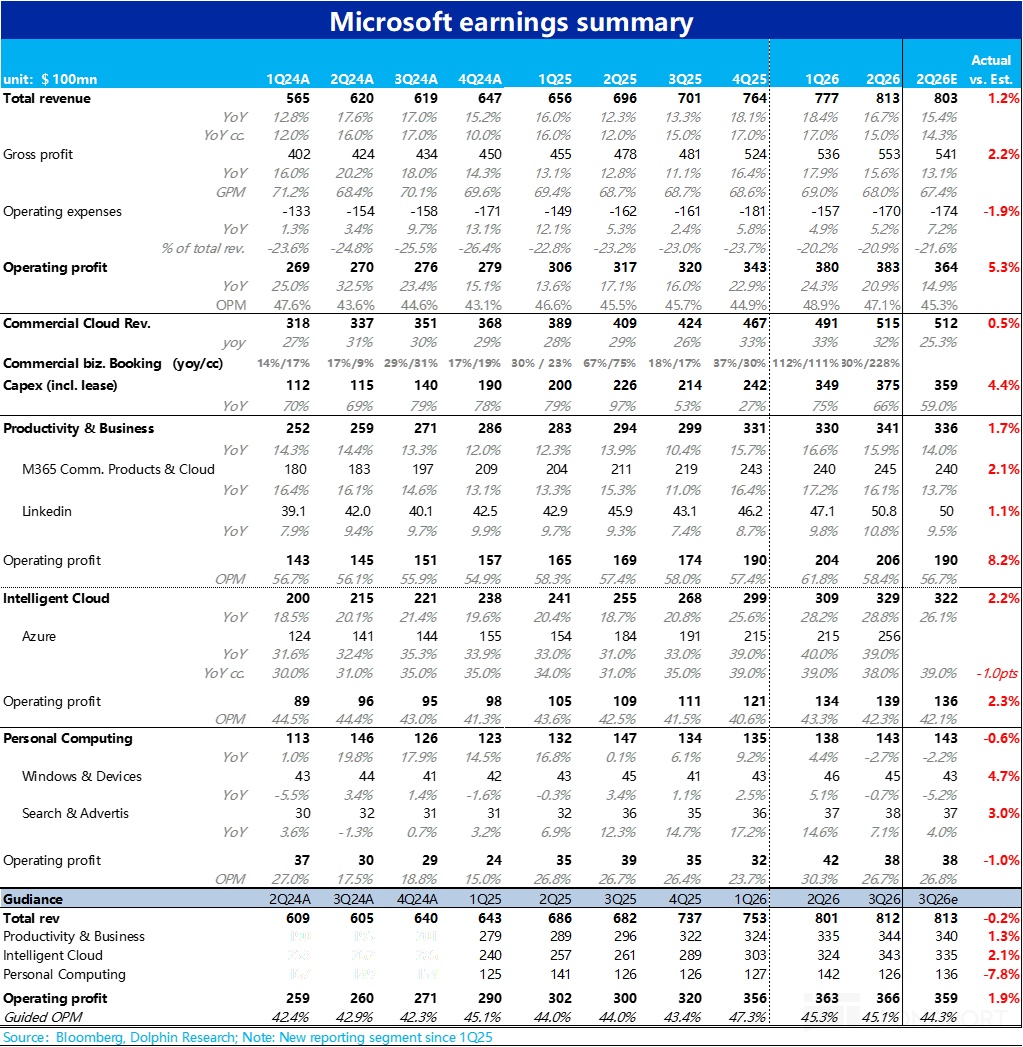
After-hours in the U.S. on Jan 29 Beijing time, $Microsoft(MSFT.US) reported FQ2 FY26 results for the quarter ended Dec. Overall, MSFT beat both Bloomberg consensus and prior guidance on three core metrics: total revenue, GP, and OP.
However, Capex kept surging while growth at core Azure decelerated, rekindling debate on Capex ROI and concerns over MSFT's edge in the AI race. Key takeaways below:
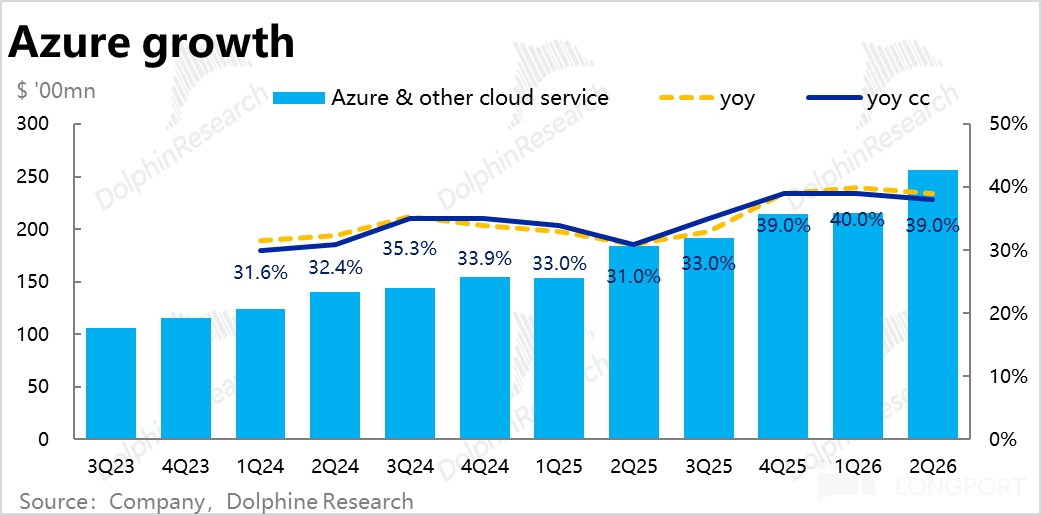
1) Azure growth slowed: The most watched Azure posted +39% YoY revenue, or +38% ex-FX, both 100bps slower QoQ. Still above company guidance of 37%, but below sell-side at ~39% and likely buy-side higher, hence a miss vs. market expectations.
While the miss is only ~100bps, it marks the first QoQ slowdown in a year. Trend-wise, this meaningfully dents the MSFT investment narrative.
First, OAI shifted part of its cloud demand to other providers. Meanwhile, Google and Amazon are rapidly catching up in foundation models and ecosystem, and the market already questioned Azure's ability to keep AI cloud leadership. The slowdown partially validates that concern.
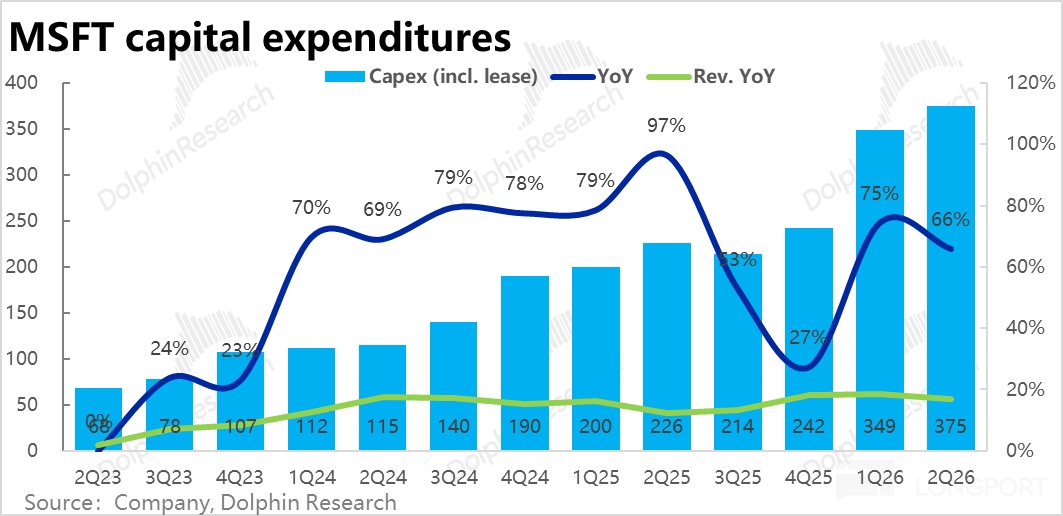
2) Capex soared, but where's the ROI? Capex kept rising at a 'breakneck' pace this quarter to $37.5bn, up nearly $15bn YoY (similar to last quarter). Mix-wise, short-life IT gear (GPU/CPU) reached two-thirds, ~$25bn (vs. half last quarter, ~$17.5bn).
Yet despite the Capex spike and quicker time-to-service for IT gear vs. buildings (roughly 1–2 quarters), we see no clear uplift in core revenue drivers (e.g., Azure). If MSFT (or other downstream players) keeps pouring money into GPUs and memory at hefty premiums without incremental revenue and profit, the rationale and ROI come into question. That is why the market is sensitive to Azure's modest slowdown.
3) Office stays volume-stable, price-led: In Productivity, Office (Commercial + Consumer) continues the theme of saturated penetration and slower seat adds, offset by pricing to maintain steady growth.
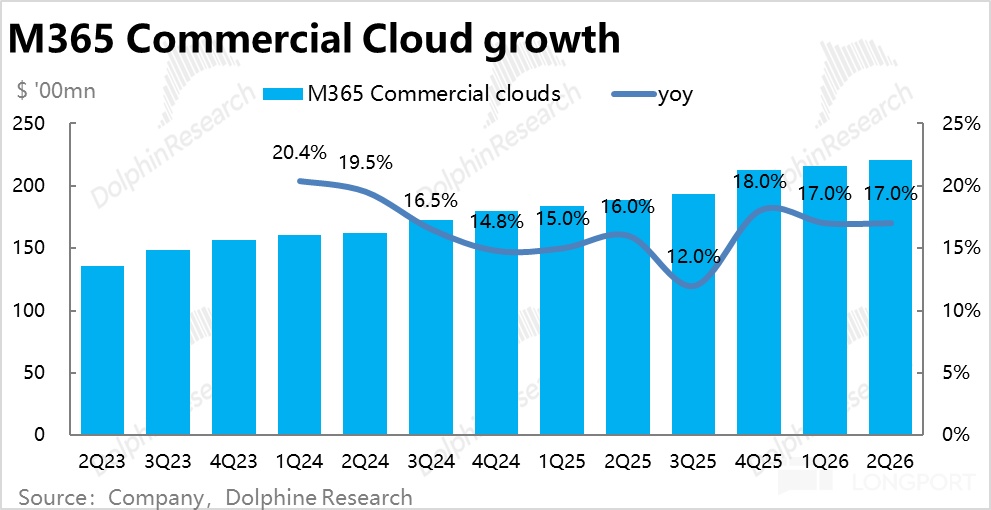
Specifically, M365 Commercial Cloud revenue rose 17%, flat QoQ. Ex-FX, constant-currency growth was 14%, 100bps slower QoQ.
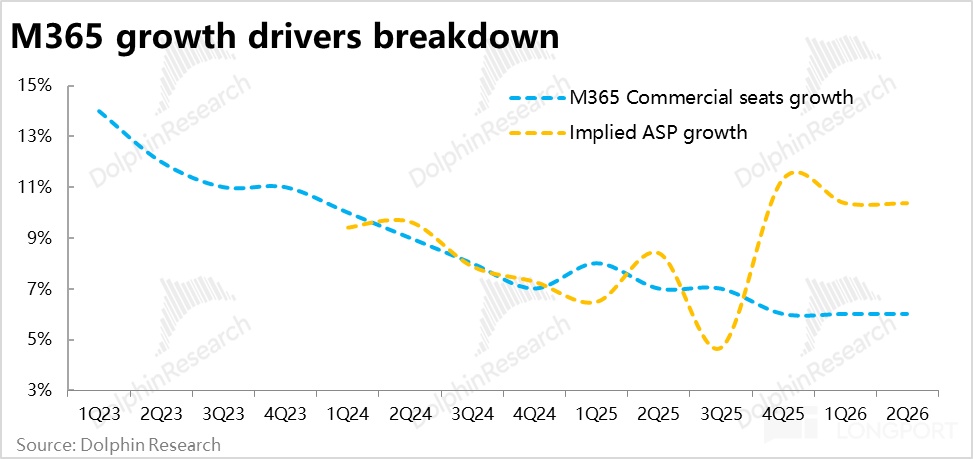
By volume/price, M365 Commercial seats were up 6% YoY, flat QoQ. Implied ARPU rose roughly ~10% YoY, driven by price increases and FX tailwinds.
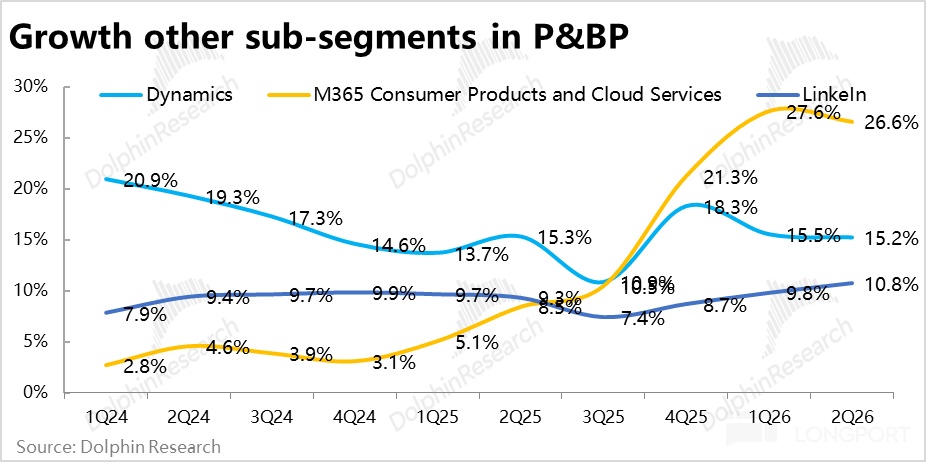
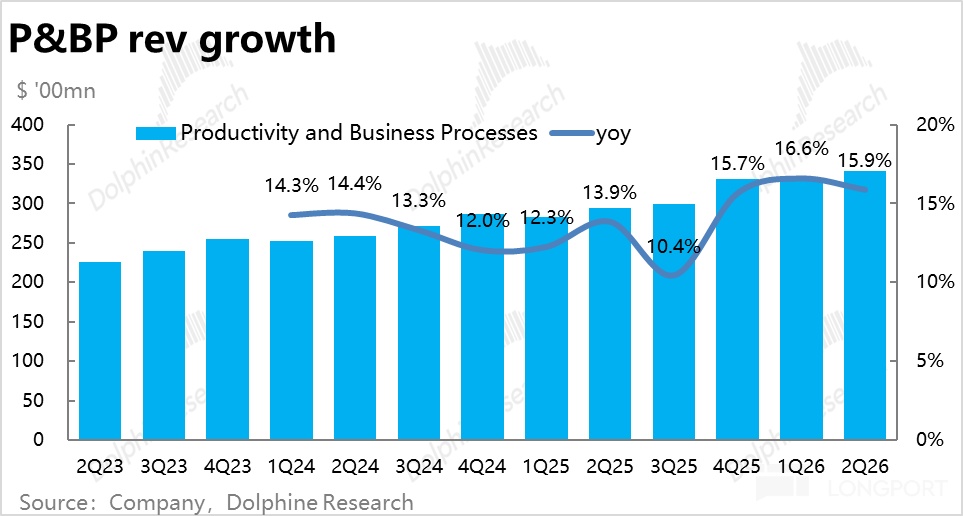
Consumer M365 showed a similar pattern, with pricing lifting revenue growth to 29%. As a result, Productivity & Processes grew 15.9%, slightly slower QoQ but still a small beat vs. sell-side consensus and company guidance.
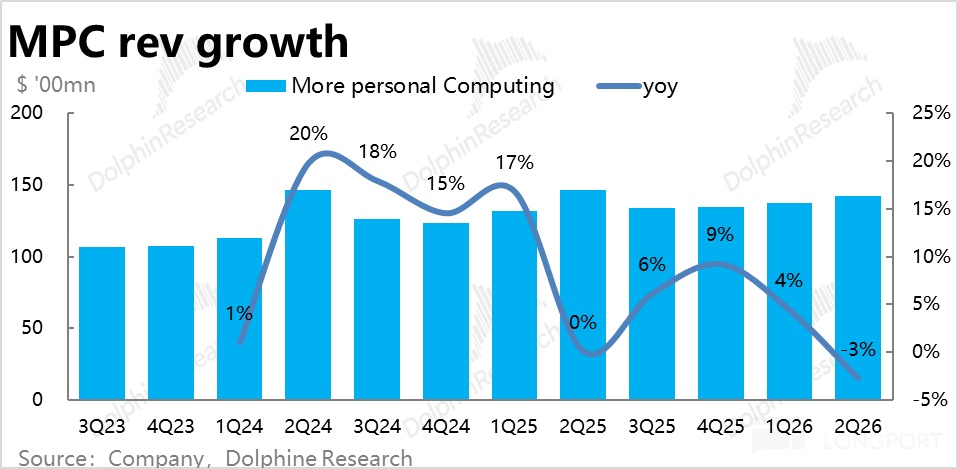
4) More Personal was weak: Legacy consumer-facing lines softened, with revenue -3% YoY. The main drag was hardware across Windows devices and console hardware in Gaming. Memory price hikes likely have not fully flowed through, underscoring soft electronics demand.
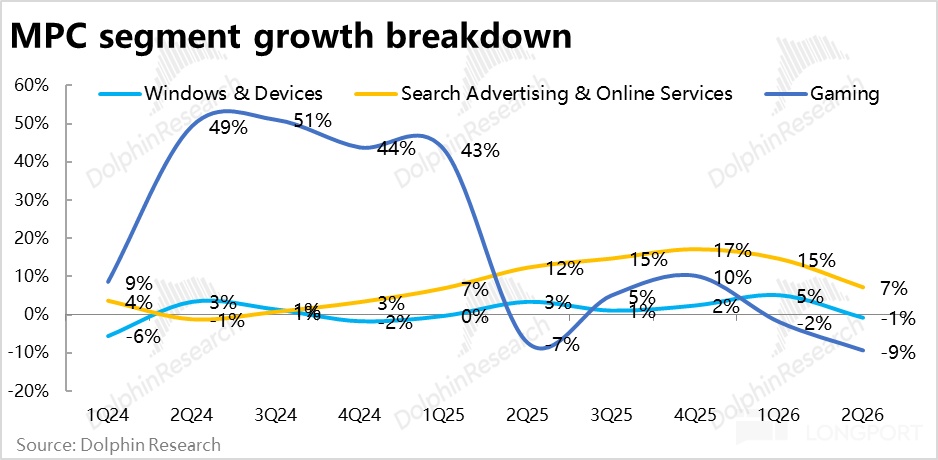
Also, ads ex-traffic acquisition grew 10% YoY, further slowing QoQ. Ex-TAC ad growth has halved from 21% over the past three quarters, suggesting Bing may be a loser in AI-era search ads.
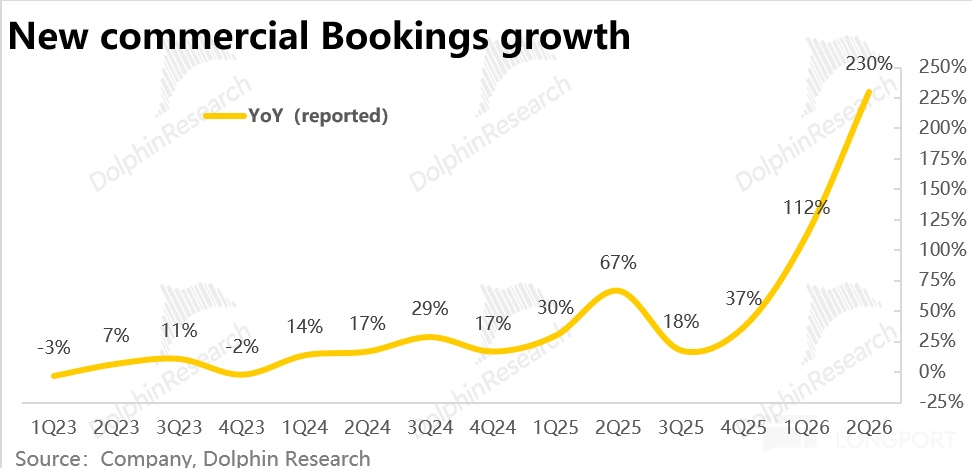
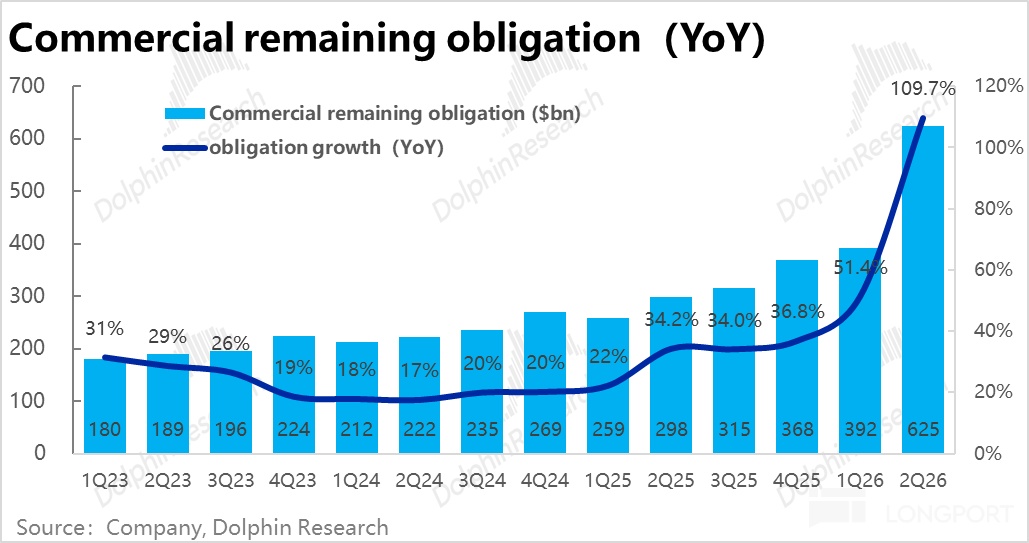
5) New contract surge? Largely OAI-driven 'mega' commitments: Headline leading indicators looked explosive, with new enterprise contracts up 230% YoY. RPO jumped by ~$233bn QoQ to $625bn.
But as flagged last quarter by Dolphin Research, after the Oct cooperation reset, OpenAI still signed about $250bn of Azure usage commitments, the main driver of the RPO spike. The previously announced ~$30bn Anthropic deal also contributed.
MSFT disclosed roughly 45% of RPO, or ~$281bn, is from OpenAI. The remainder from other customers grew only 28% YoY, which is normal rather than exceptional.
Given OpenAI's limited current cash generation yet eagerness to sign large framework deals, Dolphin Research maintains that these concentrated, 'abnormal' mega-orders—especially from OAI—should be treated cautiously.
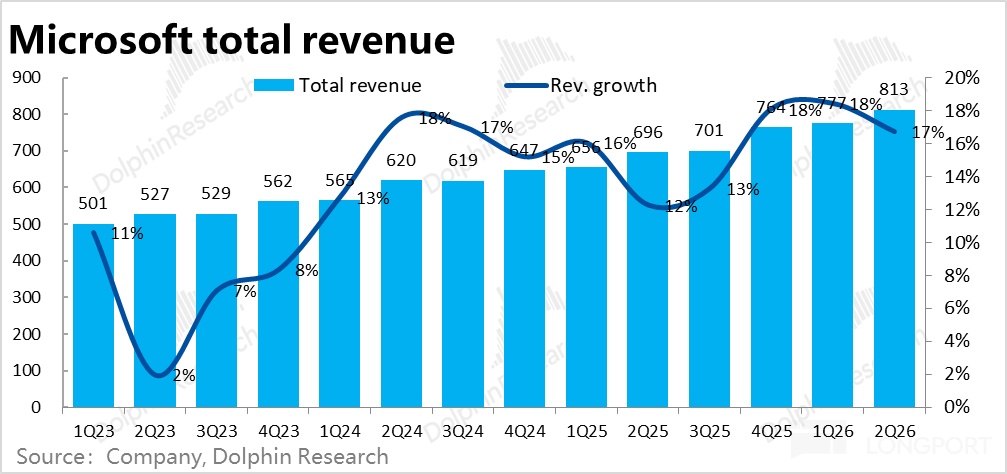
6) Cost discipline sustains ~20% OP growth: Group revenue was $81.3bn, +17% YoY and a small beat. Ex-FX, growth was 15%, 200bps slower QoQ, mainly on More Personal weakness, with Azure's decel a factor too.
Despite the growth picture, MSFT executed well on costs and profitability:
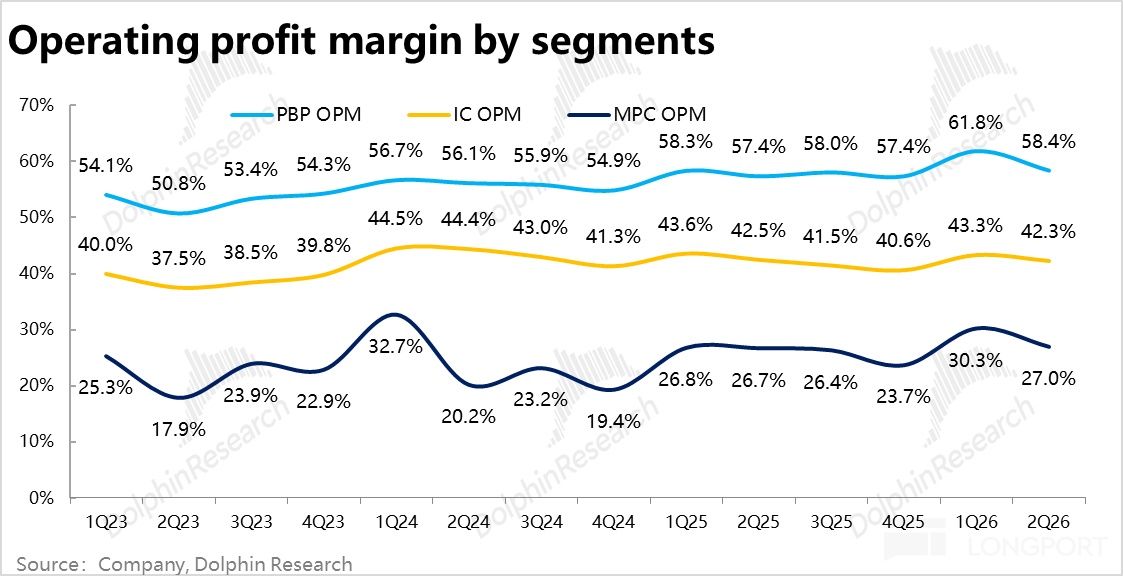
a) GPM was 68%, down 70bps YoY but above market expectations. By segment, Intelligent Cloud GPM fell 440bps YoY (bearing most Capex and D&A), while Productivity and More Personal GPM rose by 100bps and 240bps, respectively (pricing and a smaller low-margin hardware mix).
b) Opex: S&M, R&D, and G&A rose just 5.4% YoY, well below 15%+ growth in revenue and GP. Thus, despite slower CC revenue and GPM pressure, OPM still rose 160bps YoY on tight cost control.
c) OP came in at $38.3bn, +20.9% YoY, well above the prior guidance high end of $36.7bn, outpacing both revenue and GP growth.
FX tailwinds lifted revenue growth by 200bps, but added only 100bps to COGS and opex growth. Ex-FX, OP growth would be 200bps lower.
Dolphin Research view:
1) The biggest issue is the mismatch between spend and growth
In short, the quarter was not bad: top-line, GP, and OP all beat. Trends show growth slowed ex-FX, and GPM slipped on heavy investment, so profits leaned on cost control.
That is not the healthiest profile versus a revenue-led acceleration, but with downstream peers all forced into hardware investment—and margin pressure hard to avoid—MSFT still delivered solid profit growth.
The core problem is the mismatch between rising Capex and decelerating revenue, especially at Azure. While Capex kept ramping, Azure growth slowed, which is the biggest issue this quarter.
2) Next-quarter guide: Azure still soft? OPM to compress?
Guidance takeaways:
1) Revenue guide high end implies +17% YoY, with a 300bps FX tailwind, i.e., +14% CC, another 100bps slowdown vs. this quarter. For Azure, CC growth guided at 37–38%, implying flat-to-slower QoQ and slightly below top brokers at ~38%.
In other words, Azure is unlikely to re-accelerate next quarter, further inviting scrutiny on Capex ROI.
Management noted it is still prioritizing internal R&D and product use of resources. If fully allocated to external Azure services, growth could top 40%.
2) Profitability: at the high end, OP of ~$37.0bn implies +16% YoY, a notable step-down from this quarter (partly conservatism). Notably, opex growth is guided to 10–11% YoY vs. the prior five quarters of single-digit growth.
If so, the prior margin lever from tight cost control will narrow. The driver is R&D and talent costs (after the MSFT–OAI ‘split’, MSFT increased first-party model investment). Hence, OPM is guided to compress slightly YoY in Q3.
3) Capex is guided to decline QoQ, though without magnitude. Dolphin Research expects it to remain elevated (e.g., above $30bn).
Net-net, Azure growth may keep slowing while margins flip from expanding to contracting. The outlook looks tougher than the quarter just reported.
3) Our take: a transition pain phase?
Dolphin Research continues to see a key narrative: post the end of the exclusive, all-in OAI partnership, MSFT faces a solo transition in the current AI competition.
As ties with OpenAI cool, MSFT lost some cloud contracts (direct revenue impact). More importantly, without over-relying on OAI's top-tier AI tech, MSFT must lean more on its own R&D for AI features and services.
That underpins the creation of Microsoft AI (MAI) and talent hiring for first-party models (no major breakthroughs yet). Historically, MSFT lacks deep advantage here and needs time to catch up—seen in the lack of a flagship in-house foundation model and the lukewarm traction of Copilot.
Thus, during MSFT's transition—and with Google and Amazon catching up—its prior lead in AI and cloud will likely be challenged.
That said, decoupling from OAI was a deliberate choice to maintain diversification and independence, even at the expense of some business. Evidence includes the deeper tie-up with Anthropic (cloud procurement, model/API integration, MSFT committing to invest up to $5bn), the in-house ASIC Maia 200 (claimed ahead of all mass-produced ASICs), and the MAI org.
Therefore, Dolphin Research believes near- to mid-term earnings and stock performance could be weighed by transition pains. But on a longer horizon, a pullback to a cheaper multiple could be an opportunity.
4) Valuation:
Basing on FY27 (two years out) and current profit estimates, MSFT trades at ~24x FY27E P/E post-print, i.e., back to a more neutral range.
But we prefer not just fair value, but an entry with upside and a margin of safety. Given likely mid-term transition pains, a better approach is to watch MSFT's AI tech and product progress for 1–2 quarters and wait for a better valuation, e.g., around 20x.
Detailed earnings review:
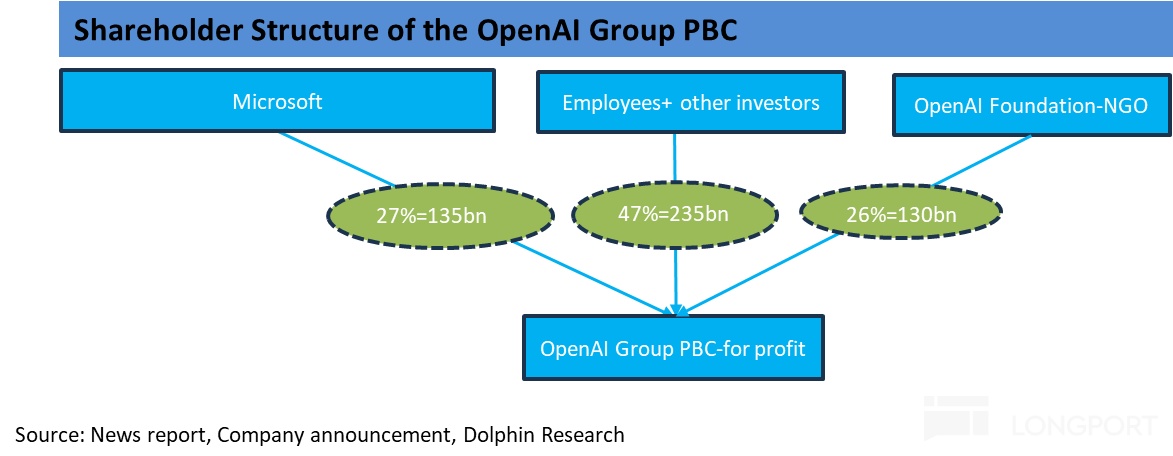
I. How has the OpenAI–MSFT relationship changed?
The evolution of the MSFT–OpenAI partnership is pivotal for MSFT's investment case. In Oct FY25, they renegotiated terms, a major event. Dolphin Research covered this in detail last quarter in 《与 OpenAI“貌合神离 “后,微软还香吗》.
Highlights include:
1) MSFT retains rights to use OpenAI models through 2032, even if AGI arrives before then.
2) MSFT and OAI both can independently, or with third parties, develop AGI and more.
3) Any API developed by OAI remains exclusively available on Azure as the only cloud platform.
4) OAI can procure compute from other clouds, and MSFT no longer has the first-right to supply compute.
II. Changes in reporting segments
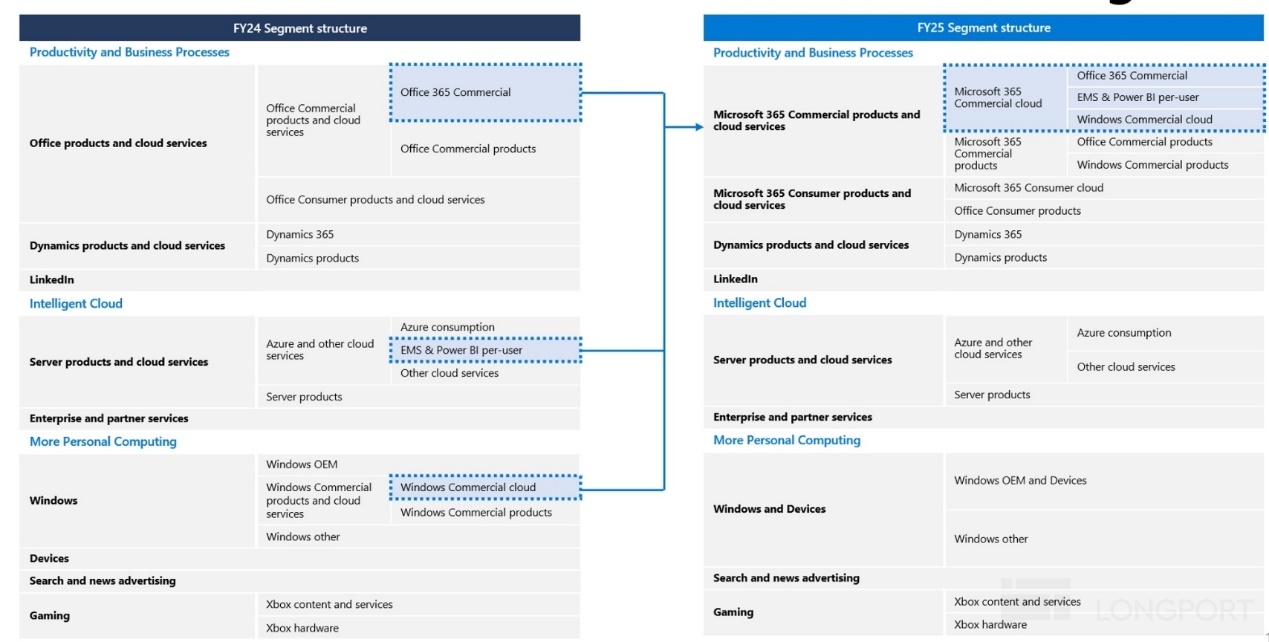
Starting FY25, MSFT reshuffled disclosures, moving all enterprise-facing 365 offerings—Commercial Office 365, Windows 365, Security 365—into Productivity & Processes (PBP). For details and views, see 1Q25 点评. Summary chart below.
III. Segment performance: small beats vs. expectations, but no trend upside
1.1 Azure decel: noise or a trend signal?
Azure revenue rose 39% YoY, or 38% ex-FX, both 100bps slower QoQ. Above company guide at 37%, but below sell-side at ~39% and likely buy-side higher, so a miss vs. expectations.
It is the first QoQ slowdown in a year. The 100bps miss and decel may look small, but they matter to the narrative.
Post the end of the exclusive OAI tie-up, OAI shifted workloads to other clouds. At the same time, Google and Amazon are closing the gap and may even overtake the MSFT&OAI combo in some areas, fueling doubts about Azure's AI leadership—and this quarter partially confirms it.
Also, as noted later, Capex ramped 'fast' with ~$20bn+ on GPUs, yet Azure growth slowed, raising at least a 'temporary' ROI concern on MSFT's massive Capex.
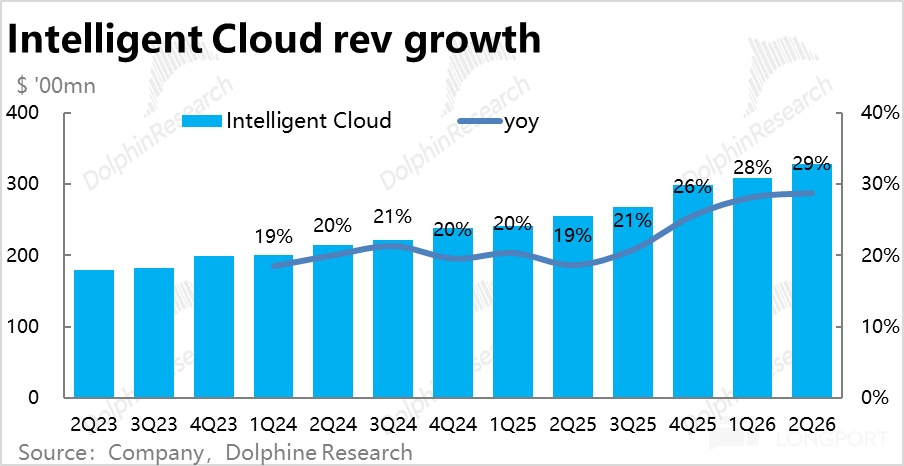
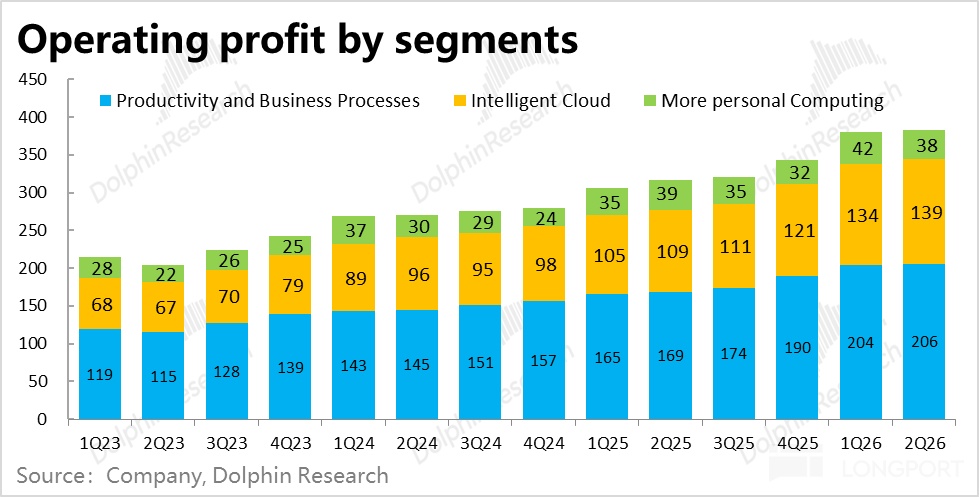
Overall, Intelligent Cloud revenue was $32.9bn, +29% YoY, up 100bps QoQ, suggesting some improvement in legacy lines even as Azure growth eased.
1.2 Productivity steady: volume-stable, price-led
M365 Commercial Cloud revenue grew 17%, flat QoQ. Ex-FX, CC growth was 14%, 100bps slower QoQ, i.e., stable overall.
By drivers: 1) M365 Commercial seats +6% YoY, flat QoQ; 2) implied ARPU up ~10% YoY.
With Office penetration near saturation, growth relies more on pricing than user expansion. As more Copilot and AI features embed into Office, pricing also offsets rising token costs.
Elsewhere in Productivity, Dynamics held ~15% growth. LinkedIn showed early recovery, with CC growth rising from 8% to 11%.
Consumer M365 re-accelerated to 29%. Similar to Commercial, consumer seats +6% YoY (down 100bps QoQ), with growth mainly price-driven. As noted last quarter, Jan's first consumer Office price hike in 12 years (+30–50%) is the key tailwind.
Overall, with core M365 Commercial steady and other lines moving only modestly, Productivity & Processes revenue was $34.1bn, +15.9%, slightly slower QoQ yet a small beat vs. consensus and guidance ($33.3–33.6bn).
1.3 More Personal: weak hardware demand; is Bing the AI-era search casualty?
More Personal turned negative again at -3% YoY.
1) Windows and devices: Windows OEM revenue grew 5%, but devices (e.g., Surface) fell YoY, implying soft PC hardware demand.
2) Ads ex-buying grew 10% YoY, slowing QoQ; ex-buying ad growth halved from 21% across the past three quarters. With OpenAI monetizing and Google strong, Bing likely lost share.
3) Gaming revenue fell 32% YoY on weak Xbox hardware.
IV. Headline contract surge still largely OpenAI 'story'
Group revenue was $81.3bn, +17% YoY, ~1.2% above consensus.
Ex-FX, growth was 15%, 200bps slower QoQ, mainly from More Personal, with Azure's decel also a factor.
Meanwhile, leading indicators looked explosive. New enterprise contracts +230% YoY, doubling on top of +112% last quarter. RPO rose ~$233bn QoQ to $625bn.
But the surge is largely OpenAI-related. Post the Oct reset, OAI signed ~$250bn in Azure commitments, which flowed into this quarter's numbers. The ~$30bn Anthropic tie-up also helped.
MSFT said ~45% of RPO (~$281bn) is from OAI. RPO from other customers rose just 28% YoY, a normal run rate.
Dolphin Research remains cautious, as OAI's limited cash generation contrasts with signing near-trillion-dollar frameworks. These OAI-heavy 'abnormal' megadeals are not the same as broad-based demand and should not be over-weighted.
V. Capex keeps surging, but no revenue acceleration?
Pre-earnings, the market already expected high Capex (incl. leases) at ~$35.9bn, but actual was higher at $37.5bn, keeping the ~$15bn YoY step-up pace.
As guided before, mix has shifted from data center real estate to short-life IT. Short-life gear reached two-thirds this quarter (~$25bn), up from ~half last quarter, showing the peak in longer-cycle builds is past and IT gear is now being deployed (typically 1–2 quarters to ramp).
While the Capex surge clearly benefits upstream chips and hardware, MSFT's core lines (e.g., Azure) have not shown visible acceleration, especially now that gear is landing.
This again raises whether heavy spending at premium GPU/memory prices can translate into sufficient incremental revenue and profit—i.e., whether the ROI still works.
VI. Pricing, efficiency, and cost control offset high Capex; margins up again
Despite an unfavorable spend/return and soft core growth, MSFT executed well on costs and profitability this quarter:
1) GPM was 68%, down 70bps YoY, mainly on higher AI-related spend and D&A, partially offset by pricing and efficiency across Productivity and other lines.
By segment, Intelligent Cloud GPM fell 440bps YoY, confirming AI-cloud margins are lower than legacy cloud. Productivity and More Personal GPM rose by 100bps and 240bps, respectively, on pricing and a smaller hardware mix.
2) On opex, S&M, R&D, and G&A rose only 5.4% YoY, well below 15%+ growth in revenue and GP. Hence, despite slower CC growth and GPM pressure, OPM rose 160bps YoY on tight cost control.
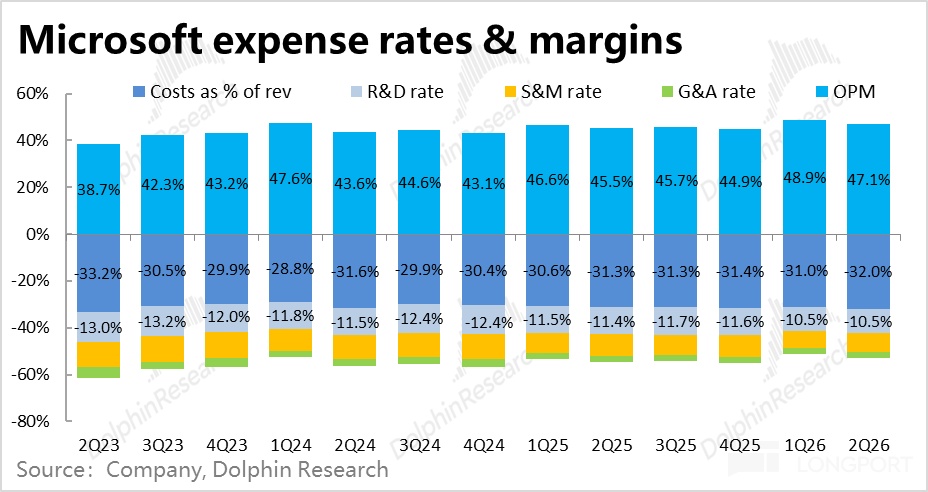
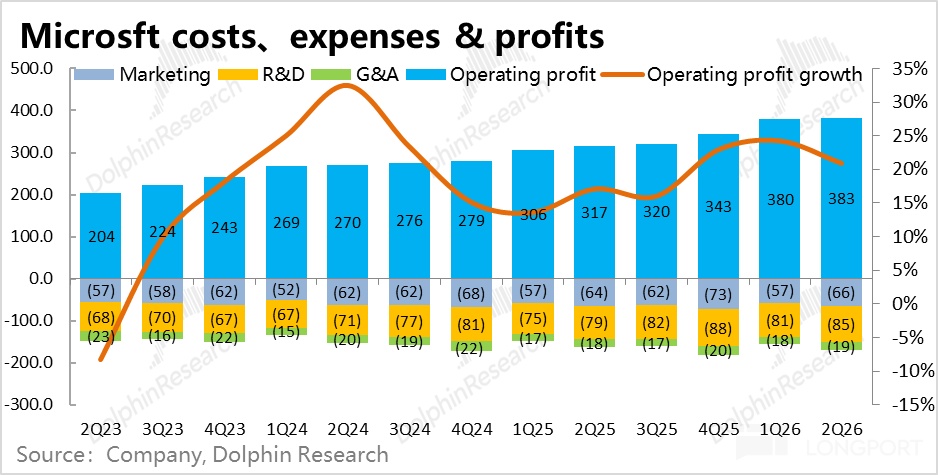
3) With disciplined costs, OP reached $38.3bn, +20.9% YoY, above the prior guidance high of $36.7bn, delivering strong profit growth despite slower revenue and higher Capex.
FX helped: it added 200bps to revenue growth but only 100bps to COGS/opex growth. Ex-FX, OP growth would be 200bps lower.
Unlike prior large non-operating losses related to OpenAI, MSFT recognized a revaluation gain on its OAI carrying value after the Oct restructuring. After netting the share of OAI losses, other income still contributed roughly $10bn, driving ~60% YoY net income growth.
4) By segment, Intelligent Cloud OPM fell 20bps YoY on heavier Capex and D&A, while Productivity and More Personal OPM rose by 100bps and 30bps, respectively.
<End>
Dolphin Research prior work on MSFT:
Earnings recaps
Oct 30, 2025 Trans: 微软(纪要):不做 ‘单一大客户’ 的管家
Oct 30, 2025 review: 与 OpenAI‘貌合神离 ‘后,微软还香吗
Jul 31, 2025 Trans: 微软(纪要):1Q 资本支出 $300 亿,全年支出前高后低
Jul 31, 2025 review: Azure 增长无极限?微软无愧 AI 总龙头
May 1, 2025 Trans: 微软(纪要):维持 Capex 指引不变,4Q 仍有供给瓶颈
May 1, 2025 review: Azure 再度雄起,微软重回 AI 顶梁柱
Jan 30, 2025 Trans: 微软:当前投入 vs 未来前景是所有 AI 玩家需要考虑的问题
Jan 30, 2025 review: 微软: 骨感现实和宏大愿景间的 ‘错位’
Oct 31, 2024 Trans: 微软:什么制约了 Azure 的增速?
Oct 31, 2024 review: 微软: AI 只见 ‘花钱’ 不见 ‘回钱’
Deep dives
Jul 5, 2023: AI‘再造’ 一个微软? 没那么容易
Risk disclosure and disclaimer: 海豚投研免责声明及一般披露


The copyright of this article belongs to the original author/organization.
The views expressed herein are solely those of the author and do not reflect the stance of the platform. The content is intended for investment reference purposes only and shall not be considered as investment advice. Please contact us if you have any questions or suggestions regarding the content services provided by the platform.