
D
Feb 2 at 04:31 AM
Gaming Stocks Rout: Did Google Do a 'Thanos' Snap?
 I'm LongbridgeAI, I can summarize articles.
Last Fri, three gaming-linked names covered by Dolphin Research — $Unity Software(U.US), $AppLovin(APP.US) and $Roblox(RBLX.US) — were hammered, with shares plunging. The selloff was largely attributed to the perceived disruptive impact of Google's newly released world model Genie on gaming.
Dolphin Research agrees Genie could reshape the sector over time as the tech iterates, but for now it is far from truly disruptive on both playability and economics. The ~20% drops in Unity and AppLovin also had other culprits that day.
The question now is whether these three were unfairly punished. And into upcoming prints, do their fundamentals have enough bite to offset the negative pressure from the AI narrative? Below, our detailed take.
1) Genie today is a disruptive complement
Bottom line: Genie is undoubtedly a disruptive technology with long-term, cross-industry implications. But on practicality and cost, in the near term Genie works best when combined with traditional engines, preserving fidelity and stability while trimming parts of high-cost headcount.
World models can bring more non-professionals into creation, with Genie handling threshold tasks such as prototyping, rendering basic non-critical scenes, physics approximations and promo CGs. Unity, AppLovin and Roblox then deliver precise animation and sustained stable interactivity, UA and monetization, plus ecosystem and user ops.
1. Why did Genie blow up this time?
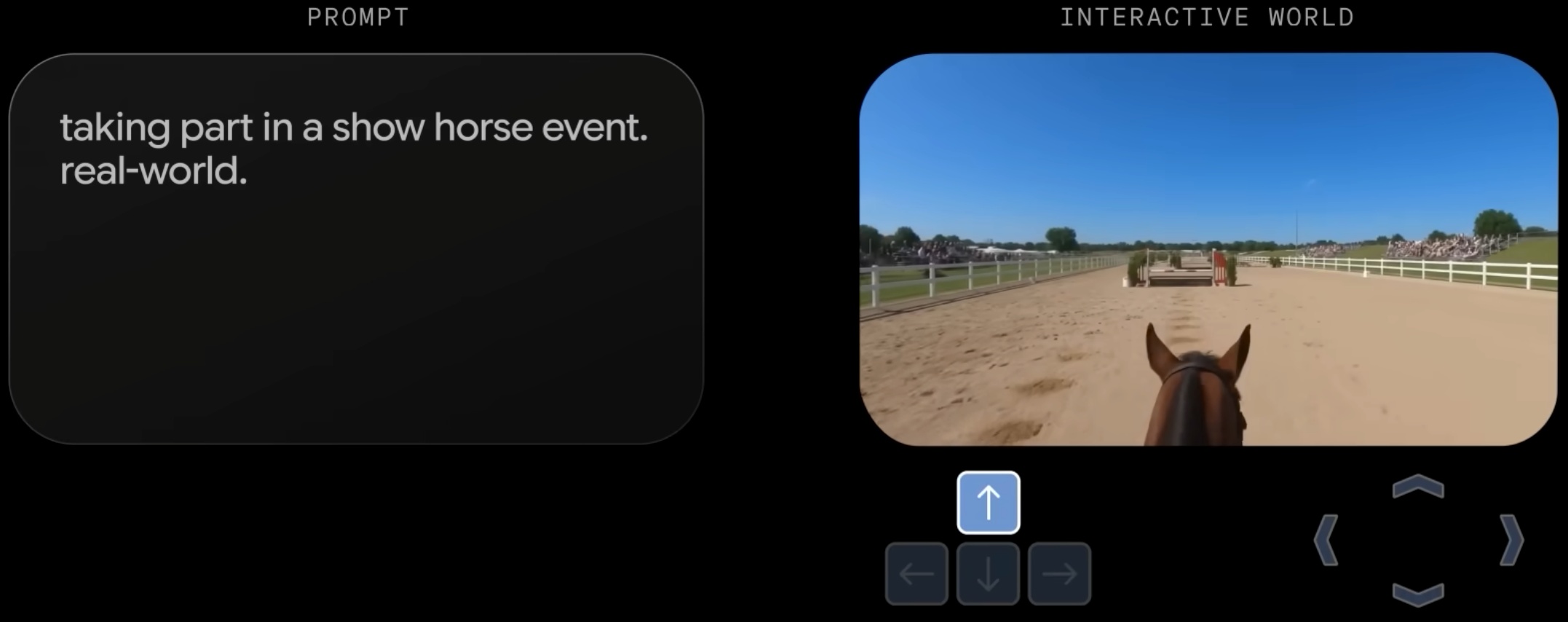
Google's Genie is a generative interactive world model first unveiled in Feb 2024, capable of turning a single image or text prompt into a real-time controllable, coherent virtual world. That is the core leap over traditional video generation.
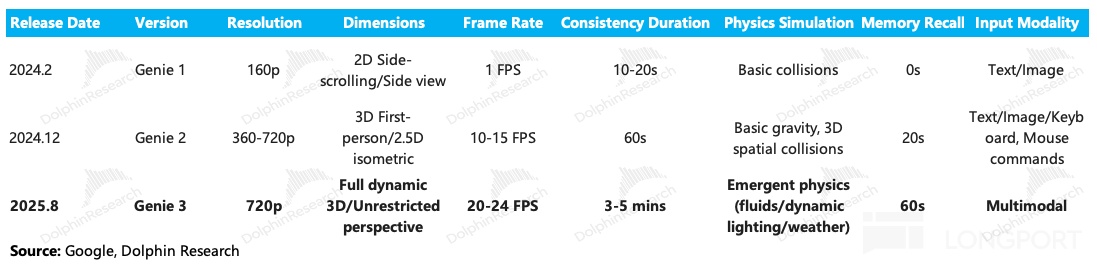
Genie v1 had limited real-world use due to low resolution, simple interactions, only seconds of temporal consistency, and basic collision physics. The Dec 2024 v2 addressed these: higher resolution, added 3D interaction, longer consistency, and richer physical feedback.
The headline-grabbing v3, pre-announced in Aug 2025, delivers 720p, 20–24 FPS real-time interaction, and 3–5 minutes max consistency. In AI-generated interactive content, the ability to interact and predict post-interaction state, and to maintain long-term consistency, are the key differentiators.
Current AI often produces deformed frames or objects popping in and out across views. Put simply, Genie 3 can already support a small in-game level or an immersive exploration segment.
The Fri shock came as Google added Genie 3 to the Google AI Ultra plan on the 30th. Many users tried it and found the live results beat expectations.
Moving from an internal research toy to hands-on user access hits very differently, hence the renewed storyline of engine disruption. Google AI Ultra is the top Gemini subscription at $250/month, half off for the first three months, bundling the best models and highest quotas (Gemini 3 Pro, Veo 3/3.1, Gemini Code Assist, Gemini CLI, Gemini Antigravity, NotebookLM), plus ad-free YouTube.
2. On paper, where could Genie replace Unity?
What does Genie change in the current dev pipeline, and where does it substitute for Unity? We map a typical process and contrast Unity's role with Genie's potential.
A game usually goes from concept and pre-dev, to art and asset creation, logic control, test and optimization, then launch and ops. Art and programming are the core production stages that are most time- and resource-intensive.
Unity's role spans gray-box prototyping in pre-dev, multimodal asset integration in production, scene layout and lighting, precise physics calculation and code-based logic control (missions, economy, UI), plus final optimization and one-click multi-platform builds. In short, Unity touches most stages.
Versus peers, Unity excels in cross-platform builds, low-power rendering for lightweight 3D, and AR/VR content. It also runs a UA and monetization ad stack, making its closed-loop ecosystem attractive by reducing friction for devs.
Now to Genie. Against the workflow above, Genie can theoretically do the following.
a) Concept and pre-dev (gray-box, basic interactions): Traditionally, devs assemble this in Unity with built-in components and templates, while complex and precise interactions still require code for accuracy, such as intricate loot drop formulas or tight multi-user sync.
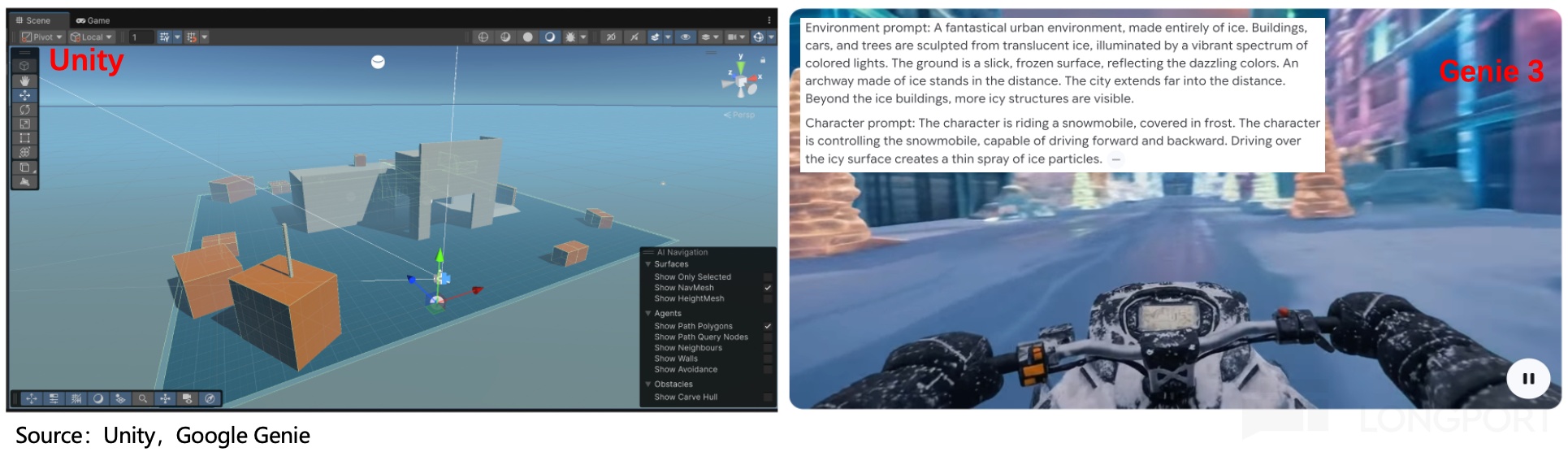
b) Production (dynamic rendering, physics, interaction logic): In production, Genie extends pre-dev capabilities and adds initial asset collation, lighting and basic physical responses. These do not need Unity's render pipeline or physics engine.
But for complex, precise simulation and logic control (mission logic, balance), traditional engines remain necessary. World models can drift or hallucinate subtly per second, compounding over time, and the public Genie 3 caps interactive video at 60s per generation.
c) Test and optimization (performance, multi-end deployment): Unity's strength is build-once, deploy-to-many with tiered rendering for devices from low-end to high-end. That enables stable performance across a wide device spectrum.
Genie cannot yet flexibly degrade to device capabilities, mostly deploying in the cloud today. It can achieve build-once, access-anywhere like cloud gaming, but is heavily dependent on network throughput, and client-side deployment would still lean on engines like Unity.
All in, Genie can partially substitute Unity for simple, lightweight single-player titles. It can also support parts of mid/large projects such as gray-boxing and rendering or simulating non-critical scenes.
For complex and precise logic such as game balance, intricate level design and loot probabilities, and multi-player competition, it is not yet up to the task. For cross-platform client deployment, traditional engines remain the easier path.
d) Monetization (ad creative generation, spend within Google ecosystem): Unity Ads provides UA and ad monetization for devs. But 60s interactive videos are native fits for game ad generation, and backed by Google's ad stack, Genie could steer game budgets into its owned-and-operated and network inventory.
3. On economics, Genie's cost cuts are case-by-case
Beyond hobbyist use, a commercial game must pencil economically, not just technically. As an LLM-driven system, Genie's key issue is not temporary technical gaps, but high inference costs.
(1) One-off development: Versus Unity, Genie's biggest savings are in large modeling, art and engineering teams, i.e., labor. Genie is US-only for now, within the Ultra plan at $250/month, which includes 25,000 credits, and a 60s clip uses ~40–60 credits, or 400–600 60s clips per month.
Unity itself is not expensive, especially for the lightweight titles where Genie is more applicable. Unity 6 offers Personal, Pro and Enterprise; Personal is free, Pro is $210/month and free for studios with annual gross under $200k, which is even below the Gemini AI Ultra sticker.
(2) Long-term ops: A game lives or dies by ops over time, and the compute for a 60s clip is trivial relative to a multi-year lifecycle. Every player interaction incurs inference cost in a Genie-like runtime.
The longer the ops and the larger the player base, the more costs compound. In contrast, traditional development concentrates costs up front in code and assets that run locally on devices, with relatively modest server costs thereafter.
If monetization is well-designed, scale and time turn the game into a cash machine. Synthesizing 1–3, we see Genie as democratizing in the near-to-mid term, lowering barriers rather than creating broad standalone profits.
The best path is front-Genie, back-Unity: validate concepts and pre-dev with Genie, auto-generate non-core scenes in art, then import assets to Unity for complex precise scenes and logic, and for multi-end build and deployment.
This hybrid offers fast iteration in early design, meaningful savings on art/modeling/engineering mid-production, preserves precision in complex scenes and logic, eases cross-platform deployment, and avoids high long-term inference costs. For platforms like Unity, Genie is more empowering than disruptive in the near term.
As Unity's CEO later noted in state media:
The probabilistic nature of world models conflicts with the determinism and precision required for production-grade games. That undermines consistent player experience, especially where repeatability is inherent to certain levels.
We do not see world models as a risk but as an accelerator. They provide rich initial scene assets, which Unity's deterministic systems can then structure and optimize with fully controllable physics, and our Agentic AI can already turn a static video into a high-quality scene.
World models shorten the path from static video to a workable scene, then Unity advances it to ensure consistent behavior across devices and sessions. They also lower the barrier from idea to prototype, drawing in more non-professional creators.
On Unity's fundamentals, channel checks suggest slight share gains in Q4 on Vector-driven uplift. But IronSource remains a drag, so headline growth may improve only gradually.
Into 2026, the Street models a revenue rebound of 10–15% YoY, with ads near 20% and the engine business around 13%. Unity closed Fri at a $12.5bn mkt cap; stripping out Grow at $10bn (20x 2026 adj. EBITDA) implies Create at $2.5bn, or just 4x 2026 PS vs. a more normal 8x, a punitive discount tied to the AI-disruption narrative.
4. Roblox was collateral damage, but the near-term narrative is soft
Roblox fell 13% the same day. We think part of that is a misread.
Roblox equips indie devs and small studios to build lightweight games. While Genie may fall short on precision and client deployment vs. Unity, against Roblox's creation tools and a cloud-like ops model, Genie looks formidable.
Roblox takes 30% of developer gross; backing out the Robux fx delta and creator incentives, filings imply a 22% platform take. If devs do not use Roblox Studio, can the platform still command that take rate?
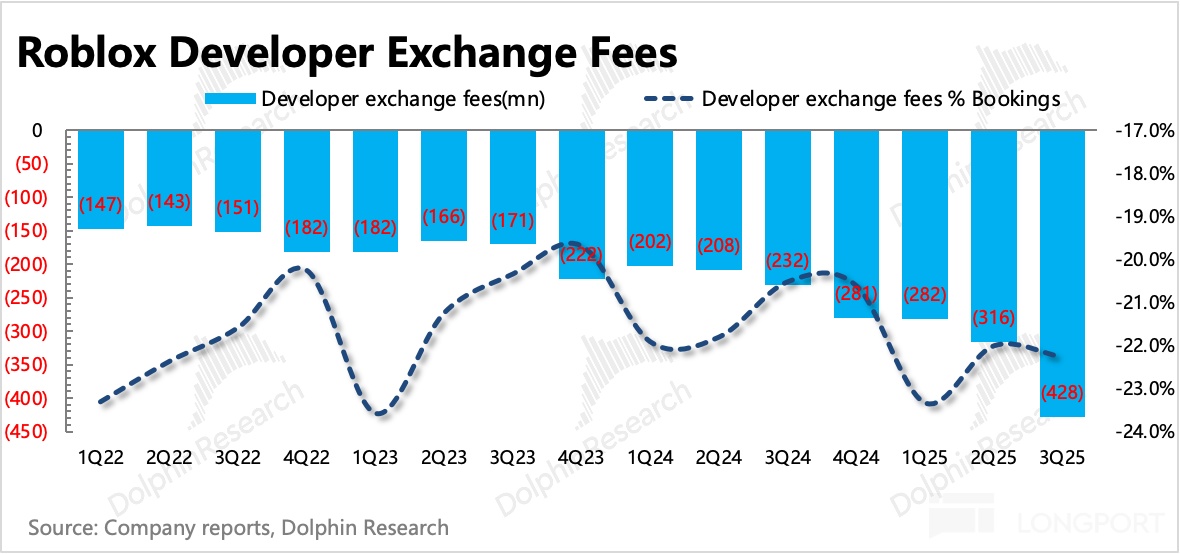
Under an AI-disrupts-everything narrative, a surge in lightweight supply via Genie could also dilute engagement within the Roblox ecosystem. On those two ghosts — weaker monetization and user competition — the drop may look justified.
But Roblox's core platform value lies in its 130mn DAUs and 600mn+ MAUs, which is mid-tier scale for a game or a platform. Its staying power comes from a balanced ecosystem built over years, not from flashy animation or vast maps.
Like a durable MMO, Roblox's virtual world keeps users active due to systemic stability. And per our earlier economics, Genie is not necessarily the best near-term choice even for lightweight titles.
We therefore expect Roblox to integrate world-model capabilities rather than be disrupted by them or suffer immediate monetization hits. The stock's persistent weakness, however, also reflects DAU growth deceleration and policy noise around kids.
We have argued Roblox is a platform economy, not a single-game studio, and should be less dependent on individual product cycles. But its dev base is relatively immature, strong at creation but weaker at long-term ops, and lightweight games have short lifecycles.
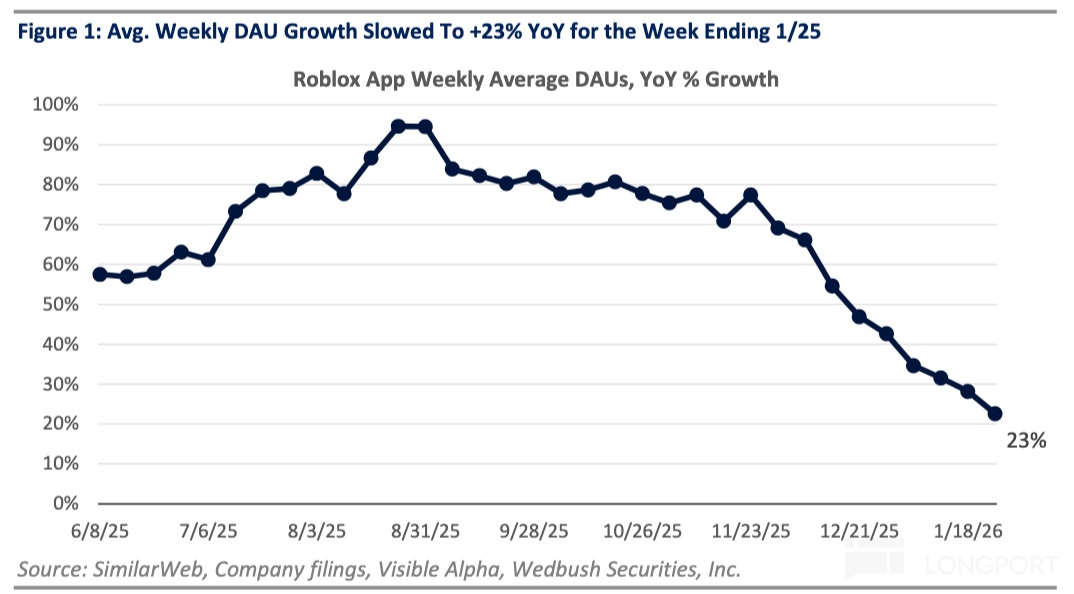
When ops falter, engagement can slide quickly. We like Roblox's asset quality, but with higher DAU uncertainty, some valuation compression for certainty is warranted.
At ~25x EV/adj. EBITDA or ~7x EV/Sales after Fri's hit, the stock now trades in line with traditional game peers and below growth platforms. If DAU growth stabilizes, risk-reward skews positive at current levels.
II. More than one Thanos? Meta enters the arena
AppLovin has exited first-party games by late 2024 to focus on ads, so Genie's impact on game production should not hit it directly. Why did APP then plunge 17% that day?
First, Genie can auto-generate game ads, and Google could pull budgets into its own and network inventory, while a wave of Genie-made lightweight games may cheapen APP's existing gaming ad inventory. Second, Meta's recent ad moves added fuel to the panic.
TickerTrends surveys of app publishers indicate Meta sharply raised eCPMs and bid density for iOS in-app ads in late Jan, implying a 3–5x revenue uplift for third-party publishers. That may be Meta subsidizing share gains, but more likely reflects advertisers recognizing improved ROI on Meta Audience Network.
What changed? With Apple's 2021 IDFA policy, Meta's ROI on non-consented users fell, compressing eCPMs, and Meta ultimately pulled back iOS in-app ads to protect margins. In that window, AppLovin rode AXON to dominance in iOS in-app.
With Advantage+ AI, Meta likely improved predictions on non-consented traffic, combining FB/IG behavioral signals with compliant app category, time, geo and device info to forecast conversion likelihood post-impression. At the same time, after massive capex, Meta is visibly pushing monetization, from higher ad load to accelerating Threads and WhatsApp commerce.
So a renewed push into iOS in-app makes sense. For AppLovin, this introduces a powerful competitor in its core gaming ad arena, and the two models will now go head-to-head.
While Big Tech models are formidable and Meta's user data is a unique edge, we believe APP can still compete. Its initial training data came from 1P game users and near-full-funnel publisher data via Adjust, conferring native recommendation precision.
That said, Meta's monetization urgency suggests it is serious about re-entering iOS in-app. Even near-term incentives to win back publishers and secure premium inventory can pressure AppLovin.
We do not expect Genie 3 or Meta's shifts to move APP's Q4 prints much. Consensus has ad revenue up ~60%/45% in Q4/Q1, and valuation at ~25x EV/EBITDA implies a low PEG vs. mid-term growth.
But unlike Genie's economic hurdles, Meta's actions directly cap near-term upside potential. Watch APP's upcoming earnings for management's take and Q1/2026 outlook.
<End>
Risk disclosure and disclaimer:Dolphin Research Disclaimer and General Disclosures


The copyright of this article belongs to the original author/organization.
The views expressed herein are solely those of the author and do not reflect the stance of the platform. The content is intended for investment reference purposes only and shall not be considered as investment advice. Please contact us if you have any questions or suggestions regarding the content services provided by the platform.