
D
Feb 4 at 08:31 PM
Google (Trans): Expects compute capacity supply to remain constrained for the full year (energy, land, supply chain).
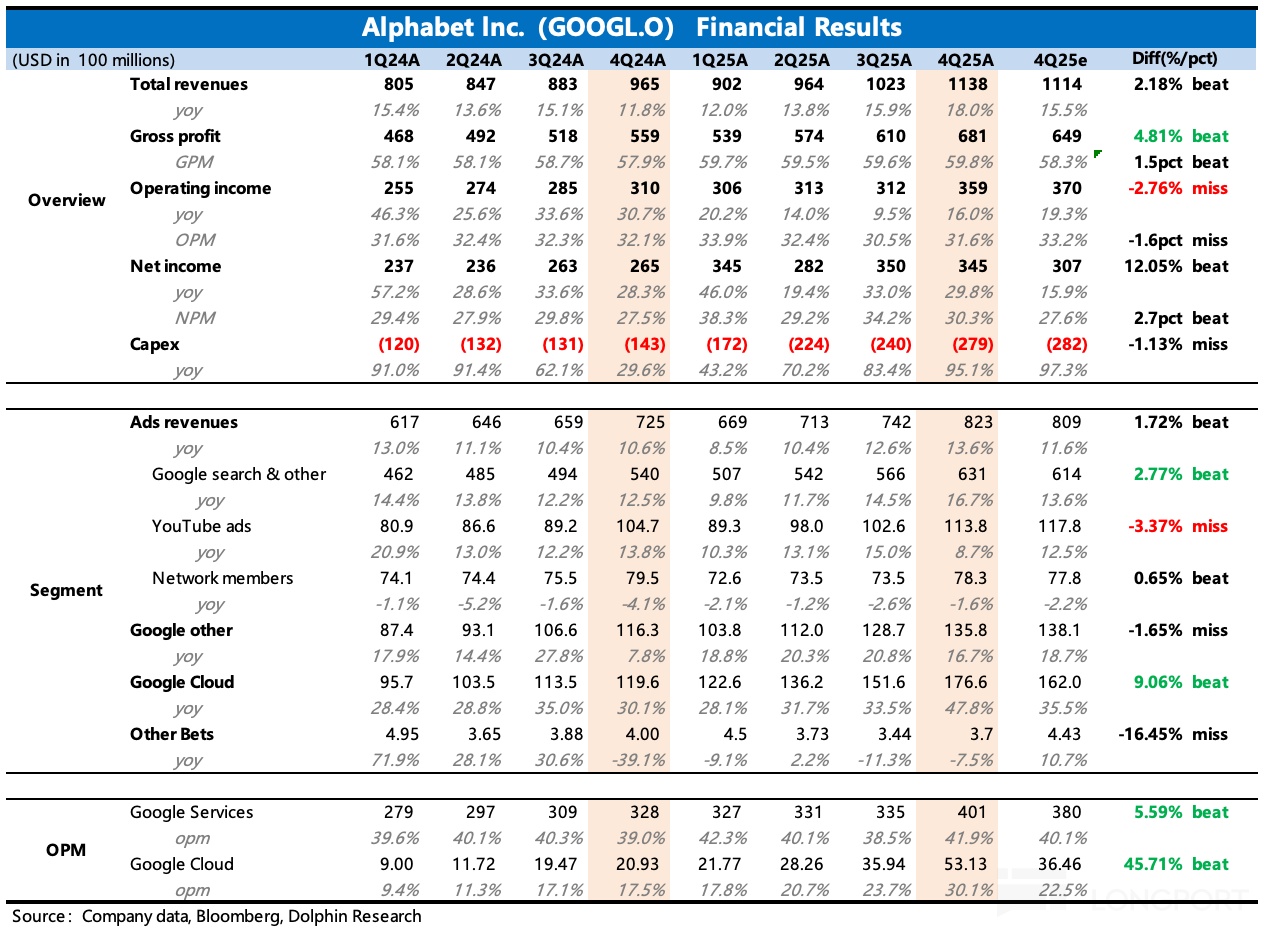
Dolphin Research compiled the following$Alphabet(GOOGL.US) FY25 Q4 earnings call Trans. For our First Take, see《Google: Doubling down on AI》
I. Key takeaways
1) Guidance
a) CapEx: 2026 CapEx guided to surge to $175–185 bn (vs. $91.4 bn in 2025), driven by AI compute, servers and DC buildout. b) Depreciation: With CapEx ramping, 2026 D&A growth will accelerate (2025 D&A rose 38% to $21.1 bn). c) Cost efficiency: Model optimizations cut Gemini inference unit cost by 78% in 2025, with more gains expected.
2) Equity capital actions: Q4 buybacks of $5.5 bn and dividends of $2.5 bn.
II. Call details
2.1 Management highlights
1) Search & Ads: AI mode driving an expansion moment
a) Gemini 3 integration: Management said Search is in an expansion phase. After Gemini 3 powered AI Overviews, query length tripled, and users are more likely to follow up via conversations. b) Habit shift: One-sixth of AI-mode queries are non-text (voice/image), and Circle to Search now covers 580 mn Android devices.
c) Monetization efficiency: Two years of Gemini-led tuning reduced irrelevant ads materially. PMax created nearly 70 mn creative assets for advertisers in Q4, boosting ROI. d) AI-mode monetization: Testing ads below AI responses and launching a Universal Commerce protocol to enable checkout directly in the AI surface.
2) Google Cloud: Twin engines of AI infra and AI software
a) Hypergrowth: Rev. growth accelerated to 48%, with backlog up 55% QoQ to $240 bn. b) Two engines:
- Infrastructure: Demand is extremely strong for TPUs (now Gen 7) and NVIDIA GPUs, with AI customers showing 1.8x higher product usage vs. non-AI customers. - AI software: Gemini Enterprise sold 8 mn seats in four months; GenAI model-related rev. was up nearly 400% YoY in Q4.
c) Flagship partnership: Deepened collaboration with Apple as a preferred cloud provider, co-developing next-gen Apple foundation models on Gemini.
3) YouTube & Subscriptions: Streaming and creator ecosystem
a) Revenue mix: YouTube annual rev. exceeded $60 bn (ads + subs). Premium and Music grew strongly. b) AI for creators: In Dec., over 1 mn channels per day used AI creation tools.
c) Shorts: Daily views topped 200 bn. In several markets including the U.S., Shorts rev./hour has surpassed long-form.
4) Waymo and Other Bets
a) Milestones: In Dec., fully driverless rides surpassed 20 mn, with ~400k weekly rides served. b) Capital moves: Closed a new $16 bn funding round (led by Alphabet), with $2.1 bn SBC amortization this quarter.
5) AI Infra & R&D
a) Compute portfolio: The broadest options in the industry, including in-house Trillium TPU Gen 7 and the first wave of NVIDIA Rubin GPUs. b) Efficiency: Model work cut Gemini inference costs by 78% in 2025. API throughput now exceeds 10 bn tokens per minute.
2.2 Q&A
Q: Looking back at 2025, what core progress did you make on agentic commercial products, and where do you see the most user and advertiser value ahead?
A: In 2025 we focused on foundations and robustness of models for agent use cases. Code generation shows the most visible progress, while on the commercial side we worked with the ecosystem on base-layer protocols for an agentic world. At NRF in Jan., we and launch partners introduced the Universal Commerce protocol, which was very well received. With interoperability as the cornerstone, agentic commerce now has the prerequisites to operate, and we are integrating these experiences into Gemini and other models. 2026 should be the year consumers use these at scale, and we are excited about the monetization runway.
Q: For YouTube, what is Alphabet’s long-term vision for new creator models like Genie, and how will they integrate with the platform?
A: Genie shows strong multimodal world-modeling and high real-world fidelity, with wide applications. Whether Imagen, Veo, Lyria or Genie, our principle is to translate research into products and make them available to cloud customers. YouTube will naturally be where creators use these tools. We will keep integrating them into the platform, and creator adoption is already strong. Our core principle is creator-centricity, ensuring YouTube remains the primary window for creator expression when introducing any AI tools.
Q: With a step-up in 2026 CapEx, how will you close AI compute supply gaps at home and abroad?
A: We remain supply-constrained even as capacity ramps, and this year’s CapEx is forward-leaning given lengthening supply-chain lead times. We plan on a rolling, multi-year basis, and how much of this year’s gap gets filled depends on prior-year investments. Demand is exceptional across core services, Google DeepMind R&D, and Cloud, so we expect to remain supply-constrained for the full year.
Q: Amid rapid model iteration, how does Google leverage data, distribution and product integration to sustain Gemini’s lead?
A: Frontier progress has been remarkable and should continue in 2026. Our path is not only about scale but cross-paradigm gains across pre-training, post-training and inference optimization, with deep integration of multimodality and agentic capabilities—especially fast-advancing code generation. This lead becomes durable via two channels: 1) superior UX across Google’s own products, and 2) powerful APIs for cloud customers. Given our tight, efficient cadence over the past two years, we are confident about leading in model performance and ecosystem in 2026.
Q: Could TPUs be deployed outside Google Cloud into third-party DCs to create new revenue streams?
A: Treat TPUs as a core part of Google Cloud’s differentiation. Customers value Google Cloud because we offer broad, flexible compute choices, and TPUs combined with end-to-end DC efficiency are key to that appeal. Cloud’s momentum remains strong precisely because we meet diverse, high-efficiency compute needs. Given our infra investments, we will continue to amplify TPU value via cloud delivery, driving growth.
Q: YouTube ad rev. grew 9% YoY in Q4. Given strong retail and DR, was this below expectations?
A: In 2025, YouTube’s combined ads and subs surpassed $60 bn. Q4 ads growth faced offsets, mainly a tough comp from the 2024 U.S. election, and a faster mix-shift to Music and Premium, which is a modest headwind to ad rev. but accretive to profit and long-term value. We now have over 325 mn subs. Looking ahead, we see opportunities in brand and CTV. We are rolling out new formats such as the Universal Commerce protocol and Direct Deals to strengthen brand–creator connections. On performance, SMB adoption of Demand Gen and Shorts monetization remain strong, with retail strength unlocking through these formats.
Q: With models like DeepSeek, some fear SaaS vendors may lose pricing power and seat value. As a leader in AI infra and apps, how do you see AI impacting large SaaS customers’ economics?
A: For Gemini’s impact on SaaS, leading SaaS players have not lost competitiveness. Instead, they are embedding Gemini deeply into core workflows to enhance product value and internal efficiency. AI is an enabler, as in Search and YouTube, and those leaning in are seeing major growth opportunities. Data show strong Q4 token consumption growth on Gemini by SaaS partners. For software firms that harness AI for automation and innovation, economics are enhanced via stickier customers and higher operating efficiency. We are bullish on these long-term partnerships.
Q: How do you balance investment scale with core performance? Do you target specific OP or FCF hurdles in approvals?
A: We apply a rigorous framework to weigh internal and external needs. We focus on two dimensions: First, total investment control—set annual CapEx based on near- and long-term growth outlook. Second, resource allocation—dynamically shift funds across businesses as markets and execution evolve.
We care about cash generation and a strong balance sheet to invest prudently, but we prioritize return on investment. AI investments are already showing up in results: Cloud growth is evident, and Search and frontier models are laying the groundwork for company-wide growth. Our aim is to stay financially healthy while funding the flywheel with precision.
Q: What worries or challenges you most at this point?
A: Though we have been AI-first for over a decade and started TPU a decade ago, compute capacity is the core challenge now. This involves highly complex variables, including energy supply, land acquisition and supply-chain constraints. Amid explosive demand, we must ramp fast, invest accurately for the long term, and maintain world-class operational efficiency. Finding the precise path within these constraints is the defining challenge.
Q: What is the logic behind the Universal Commerce protocol? Which pain points does it solve, and what does it mean for discovery and purchase paths?
A: Users engage in commerce across Google surfaces—Search, YouTube, Gemini—while we support a vast retail ecosystem via Cloud and Ads. Improving this flow yields foundational efficiency. The protocol balances user–merchant value: it streamlines the transaction loop for users and provides a standardized framework for merchants to showcase catalogs and run flexible promotions. We are now productizing it, with Gemini’s agentic capabilities advancing quickly in these scenarios. We expect a near-seamless journey from discovery to action, creating an expansion moment for commerce with incremental transactions.
Q: On 2026 CapEx, can you split long-life assets (buildings/infra) vs. short-cycle (tech gear/servers)? How will ML compute be allocated between internal and Cloud?
A: In 2025, ~60% of CapEx went to machines (server-led), with ~40% to DCs and networking, and we expect a similar mix in 2026. Depreciation lives vary, with long-life assets (e.g., buildings) at four years or longer, and other components shorter. On allocation, especially ML compute, we expect more than half of company-wide ML capacity to be allocated to Google Cloud in 2026, reflecting robust external AI demand and our strategy to convert compute into Cloud revenue.
Q: For native Gemini, you added 100 mn MAUs in Q4. Any high-level color on usage and retention, the right metrics vs. peers, or other user groups worth highlighting?
A: Q4 was a breakout quarter for the Gemini app, not just in MAUs but in per-user engagement. Core metrics—activity, intensity, retention—improved meaningfully across iOS, web, Android and regions. Momentum reflects continual UX upgrades, investments in the Nano Banana effort, and the model’s evolution. Many users also experience native AI in Search via AI mode, with Gemini 3 a strong growth driver. We will keep iterating and are excited about the road ahead.
Q: As AI search gets more conversational, with longer sessions and more on-platform results vs. outbound links, how are you adapting monetization? And how do you align incentives with partners like Apple when AI-driven utility decouples from legacy search rev.?
A: Q4 Search acceleration was broad-based, led by retail and most major verticals. We continuously innovate for users and advertisers, shipping hundreds of tweaks each quarter. Features like AI Overviews lift UX and overall query volume, including commercial queries. Gemini’s integration improves understanding of complex intent, enabling precise ads in long-tail, complex searches that were hard to monetize, while auto-generating creative assets for advertisers.
Automation tools are inflecting. Hundreds of thousands of advertisers now use AI MAX and related tools, unlocking billions of net-new queries. SMB budgets are expanding as they leverage Gemini to produce millions of creatives in AI MAX and PMax, improving performance and opening new monetization surface for Search.
Q: Will Gemini app growth cannibalize core Search?
A: We are offering choice: users can access AI Overviews and AI mode in classic Search or use the standalone Gemini app. Taken together, this is an expansion moment that broadens the types and boundaries of queries across Google. We see no evidence of cannibalization of core Search, only incremental growth.
Q: On monetization, will agents and related ad formats become a new rev. driver in coming years?
A: We prioritize great user experience. We are encouraged by ads in AI Overviews and early AI-mode experiments. For the Gemini app, the focus remains on free tiers and subscriptions, which are scaling well.
Historically, when done right, ads can serve as valuable commercial information at massive scale. We will share specific ad plans at the right time, but we will not rush to monetize ads in the Gemini app now.
<End>
Risk disclosure and statements:Dolphin Research disclaimer and general disclosures
Login to unlock12,657characters for free
This content is only available to signed-in users. Sign in to your Longbridge account to read the full post.

