D
Feb 5 at 03:15 AM
ARM (Trans): Handset exposure limited; FY2027 to sustain 20% growth
Below is Dolphin Research's Trans of Arm's FY2026 Q3 earnings call. For our earnings take, see Arm: AI tailwinds intact, but smartphones now a drag?.
Arm call highlights:
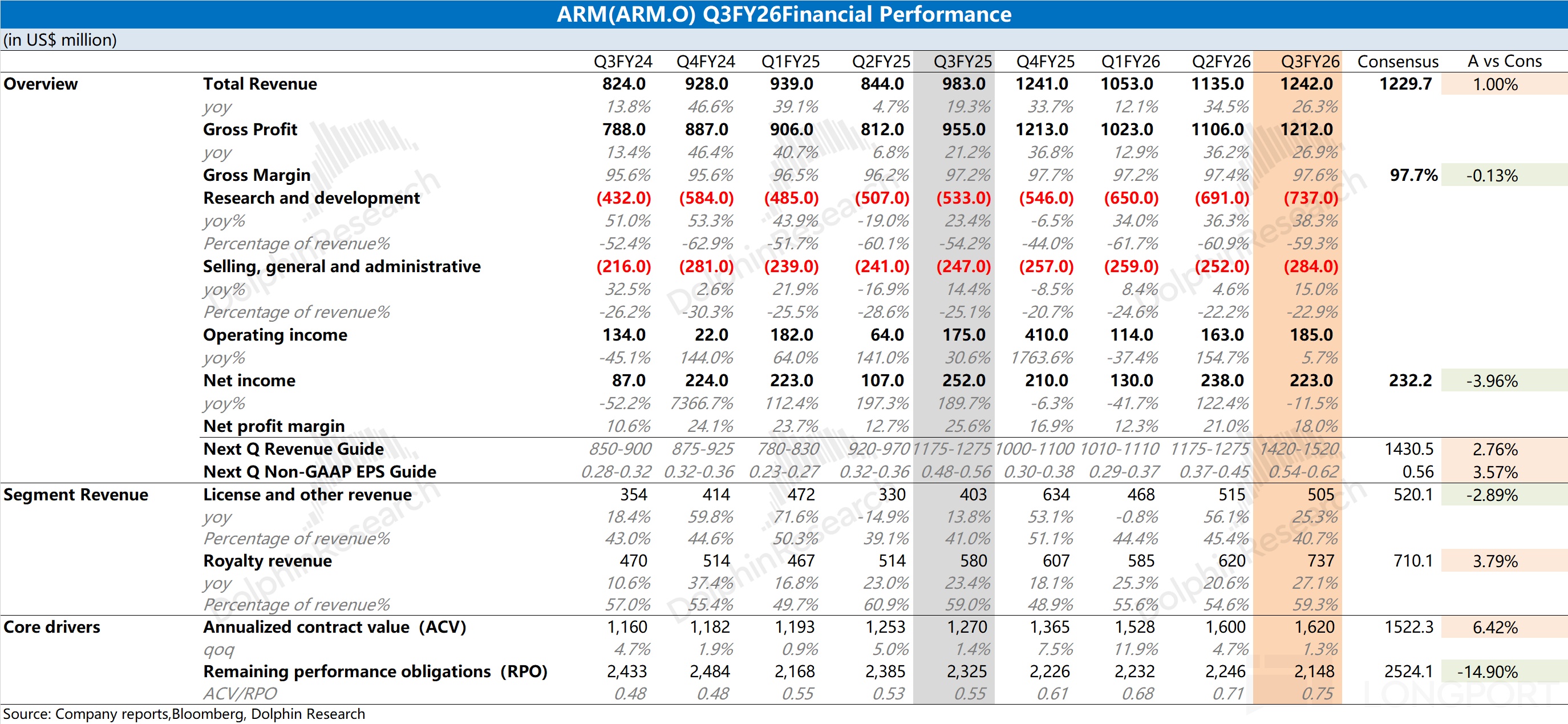
1) Next-quarter guide: revenue of $1.42bn–$1.52bn (midpoint +18% YoY). Licensing is expected to grow in the high-teens (~20%) YoY. Royalties are guided to low-teens (+11–13% YoY). Memory supply is not the main driver; seasonality and a tough base last year are the primary factors.
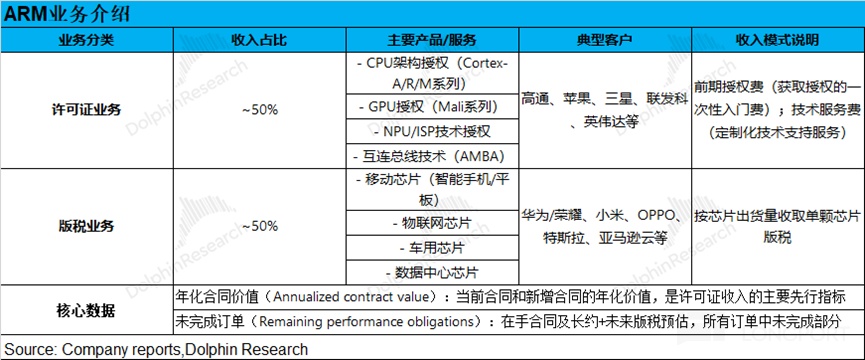
2) Revenue mix: data center now 15%–20% of revenue. Smartphones account for ~40%–45% of total. Over the next 2–3 years, data center should reach or even surpass smartphones.
2) SoftBank partnership: contributed $200mn of licensing revenue this quarter, expected to normalize at that run-rate. SoftBank has zero intention to sell any Arm shares and remains highly constructive on the long-term, planning to hold.
3) Smartphone market: in line with partners such as MediaTek, Arm expects ~15% unit decline next year due to memory supply-chain constraints.
Arm estimates that even if smartphone units fall 20% next year, the impact on smartphone royalties would be only ~2%–4%. For the group, the drag on total royalties would be just ~1%–2%.
4) FY2027 outlook: no formal full-year guide yet. At a macro level, sustaining ~20% growth looks very reasonable.
5) AI substitution risk: as an IP provider to physical chips, AI will not replace chips any time soon. Software ultimately runs on hardware, making the two symbiotic.
Enterprise AI remains very early in deep, internal use cases. Even at Arm, while AI has been introduced into payroll, procurement and SAP, it is far from transformational. The lag reflects the complexity of integrating large systems and changing software workflows.
Overall, the market’s biggest disappointment in this print is the next-quarter royalty guide at low-teens, well below Arm’s long-run ~20% pace. Management attributes it mainly to the high base. With the stock trading near 100x PE, investors expect sustained high growth.
On smartphones, both Qualcomm and Arm see a weak outlook, with Arm flagging a ~15% decline for the full year. Given smartphones are >40% of revenue, the pressure here weighs on growth.
For the next fiscal year, management only pointed to ~20% growth, which reads like a floor. Lacking more upbeat signals, the premium valuation may stay under pressure.
I. $Arm(ARM.US) key financials recap
1. R&D: non-GAAP R&D spend +37% YoY. Arm is expanding engineering to accelerate next-gen architecture, CSS and chiplet development.
2. Outlook (Q4)
a. Revenue: $1.42bn–$1.52bn (midpoint +18% YoY).
b. Royalties: guided to low-teens YoY growth.
c. Licensing: guided to high-teens YoY growth.
d. Profitability: non-GAAP EPS of $0.58 ± $0.04.
3. Licensing: $200mn from SoftBank included this quarter. With SoftBank advancing its AI compute strategy (e.g., Ampere and Graphcore), this contribution is viewed as sustainable.
II. Arm earnings call details
2.1 Key management commentary
1. Cloud AI:
a. This is the strongest growth area. Management expects it to surpass smartphones within a few years.
b. Data center royalties grew over 100% YoY. As AI shifts from training to inference and workloads become more agentic, demand for high-core-count, power-efficient CPUs is surging. Neoverse CPUs now exceed 1bn cores deployed. Arm’s share at hyperscalers is expected to reach 50%.
c. Key products/customers:
- AWS: 5th-gen Graviton (192 cores), doubling core count.
- NVIDIA: next-gen Vera CPU (88 cores), with DPU compute up 6x.
- Microsoft: Cobalt 200 (132 cores) based on CSS V3.
- Google: second Arm-based server CPU, delivering 80% better perf/W vs. x86 peers.
2. Edge AI:
Despite smartphone volatility, Arm is lifting per-chip royalty rates via Arm v9 and CSS. The top four Android OEMs have shipped CSS-based devices. CSS lowers integration risk and time-to-market while materially boosting royalties. Over 22mn developers globally (80%+) build on Arm.
3. Physical AI:
a. Auto: double-digit YoY growth.
- Rivian: third-gen AD computer uses custom Arm chips, the first mass-produced car on Arm v9.
- Tesla: the upcoming Optimus robot is also powered by custom Arm AI silicon.
b. Robotics: NVIDIA Jetson and Qualcomm Snapdragon platforms are scaling fast in autonomous systems.
2.2 Q&A
Q: What role do Arm CPUs play in AI and cloud DCs, and how does that evolve with AI agents?
A: DCs are shifting markedly from training toward inference. Agentic workflows that interact with other agents or orchestrate service tickets suit CPUs, given their power efficiency, always-on nature and low latency.
We see DCs ramping CPU deployments to meet this need. The key is not only CPU performance but core counts. Under tight power budgets, efficiency is critical, which is a tailwind for Arm.
This trend is evident: both hyperscalers and NVIDIA are increasing core counts in their latest chips. We expect this to continue as AI workloads evolve.
Q: On FY27 royalty elasticity and risks from memory-led consumer weakness?
A: Aligned with partners like MediaTek, we expect smartphone units to decline ~15% next year due to memory supply constraints. OEMs will prioritize premium/flagship, where Arm CSS and v9 dominate and royalty rates are higher, which helps us.
Pressure is concentrated in low-end tiers using v8 or older, which contribute minimal royalties. Even with a 20% smartphone unit drop, our smartphone royalties would be hit only ~2%–4%; at the group level, total royalties would see just ~1%–2% impact.
Crucially, cloud AI and infra continue to outperform and can offset mobile and memory risks. We are confident in next year’s royalty mix and not worried about shipment volatility.
Q: Could SoftBank sell Arm shares to fund other investments, and what would that mean for the stock?
A: There is plenty of market chatter, but I can share the outcome of our discussions. Put simply, there is no intention to sell a single Arm share.
It is absolute — not one, two, or three shares. He is very bullish on Arm’s long-term prospects and plans to hold, which aligns with my own view. Despite rumors about SoftBank monetizing, from repeated direct conversations, a sale is not the case.
Q: Why guide royalty growth slower next year — high base or something structural?
A: In absolute dollars, next year’s royalty still looks solid. Memory shortages may trim 1%–2%, but the lower growth rate is mostly base effect. Last quarter we guided ~20% growth but delivered 27% (about $30mn above), and we expect strength again this quarter, lifting the comp.
It is too early to say if this outperformance fully carries into next year. While there is talk of memory and even wafer tightness, the direct impact on Arm is smaller than for pure-play chip designers.
Our guide remains near the absolute levels set early in the year. We will watch if recent momentum persists and update as FY27 unfolds.
Q: SoftBank revenue rose from the expected $180mn to $200mn. Why, and what is the steady-state?
A: Last quarter we recognized $178mn, this quarter about $200mn. This was not a new deal; it reflects a full-quarter impact, whereas last quarter did not cover a full three months.
Going forward, ~$200mn per quarter should be the steady-state contribution. For DC, management highlighted doubling growth, while financially the focus is on mix shift and long-term cash flow stability from the contracts.
Q: Can you quantify data center revenue?
A: We typically disclose detail annually. Early this year, DC was just into double digits as a share. Given growth far outpacing the rest, we believe it is now 15%+ and approaching 20%.
Longer term, as the CEO noted, in 2–3 years DC should reach or exceed smartphones. Smartphones are ~40%–45% of the business today, making DC the key growth engine and revenue pillar.
Q: Can higher v9 royalty per unit offset lower smartphone volume?
A: The core is our CSS strategy. Each smartphone cycle we launch a new CSS, and per-unit royalty rates typically step up with each generation. The market is shifting comprehensively to CSS, giving us annual uplift in pricing power.
Financially, even with a 20% unit decline next year, the hit to smartphone revenue would be at most ~4%–6%, reflecting contracted higher per-unit royalty rates as second-half launches ramp. Price uplift is smoothing volume volatility.
Q: With SoftBank’s AI roadmap and Arm’s ~$200mn per quarter in licensing/NRE, should the market expect custom AI chips from the partnership, and any FY27 impact?
A: We have nothing to disclose at this time. Unfortunately, we cannot provide more detail now.
Q: Arm’s IP penetration in AI DC semis today and over the next 3–5 years?
A: Over the next three years, DC chip design will change fundamentally. The traditional CPU+GPU split is giving way as agentic AI inference shifts more tasks to CPUs, implying more CPU cores and custom CPU-centric silicon.
Also, AI inference comprises prefill and decode, and we expect more targeted innovations there (akin to what Groq is pursuing). Compute demand is also moving from DC to smaller devices, where power limits in Physical AI and edge will favor diverse IP-plus-solution combos.
As AI runs everywhere compute exists, and most global compute platforms are Arm-based, our installed base gives us a major opportunity to shape the future compute landscape.
Q: CSS licensing progress and royalty mix today vs. outlook?
A: CSS momentum is strong, with two new licenses signed this quarter. Five CSS-based chips have already shipped commercially and are paying royalties, moving the financial needle. Customers pay higher license and royalty because CSS can cut design cycles by roughly half, a compelling value prop in the AI race.
Mix-wise, CSS was near 10% of royalty last year and is around 15% this year. Looking out 2–3 years, we expect it to exceed 50%.
A key leading indicator: every CSS customer facing contract expiry or product refresh has renewed or upgraded to the next-gen CSS. This validates the system-level performance and productivity gains, and we expect the trend to accelerate as time-to-market matters more.
Q: You previously pointed to ~20% growth for FY26 and FY27. FY26 is tracking well. Any early read on FY28?
A: For FY2026, as you noted, we initially said at least 20%, and we have lifted the midpoint to 22%, above plan.
For FY2027, while we are not providing a formal guide, ~20% growth remains a very reasonable target, and we are not backing away from it.
For FY2028, no numbers yet. Stay tuned, as we are evaluating potential new products and services and their financial impact, and will update at a future time.
Q: Why is next-quarter royalty only low-teens — already hit by memory? Any pushback on higher-cost CSS and v9 given BOM pressure?
A: We have seen no negative signal on CSS pricing vs. customer BOM. Time-to-market value dwarfs small IP cost moves. As nodes move to 3nm/2nm, design is harder and windows are compressed, making delays profit-destructive.
The low-teens royalty guide is not driven by memory; the impact is minimal. It is mainly seasonality and a tough comp — MediaTek had an atypical launch window in the year-ago quarter, creating an unusually strong base.
Q: Opex and R&D cadence: R&D is growing faster than revenue. Will that continue in FY27, or will R&D growth slow vs. revenue?
A: Too early for full-year detail, but here is what we expect now. From Q4 into next year’s Q1, opex growth should be similar to last year, roughly low-teens QoQ.
After Q1 next year, we expect R&D growth to moderate vs. this year. We had a step-up this year, which should not repeat at the same magnitude. We will share more as the year progresses; at a high level, spending should normalize.
Q: Recent volatility in software stocks — beyond demand pull, how does AI affect Arm internally?
A: Volatility is normal during major tech shifts, as investors grapple with broad impacts. As an IP provider to physical chips, AI will not replace chips in the near term; they are interdependent, and all AI software ultimately needs hardware.
Deep enterprise AI adoption is still early. Even inside Arm, AI has touched payroll, procurement and SAP but is not transformational yet, due to the complexity of large-system integration and workflow changes.
We are at the frontier of this shift. The productivity upside is massive, but adaptation is ongoing. Look at CapEx — for example, Google’s up to $180bn — previously akin to years of fab spend for the entire semi industry. We are in uncharted waters, which explains volatility, but the core is unchanged: demand for compute is enormous, and enabling compute is Arm’s mission, so we focus on the long run.
Q: Impact of edge-side SRAM and new memory on Arm? And power-efficiency advances from v8 to v9?
A: Power efficiency is our 24/7 focus. As devices shrink, battery and thermal constraints bind, and adding AI atop display, app and voice workloads raises the bar. Given Arm is the de facto standard across mobile and edge, we are best placed to solve the compute vs. power budget trade-off and invest heavily here.
On SRAM and emerging memories, CPU and memory co-evolve. We are deeply engaged not only in SRAM but also alternative memories to meet AI’s surging access demands.
More broadly, the worry is not a lack of challenges but a lack of hard problems. Every endpoint is being reshaped by AI, and we believe these workloads will ultimately run on Arm. This extreme demand for compute, efficiency and memory innovation underpins our sustained investment.
<End>
Risk disclosure and statements:Dolphin Research disclaimer and general disclosure
Login to unlock13,563characters for free
This content is only available to signed-in users. Sign in to your Longbridge account to read the full post.