
D
Feb 6 at 03:14 AM
AMZN (Trans): All incremental capacity was absorbed by customers immediately---
Below is Dolphin Research's transcript of the $Amazon(AMZN.US) FY25 Q4 earnings call. For the earnings take, see '$200bn Arms Race! Amazon Pushes AI to New Heights'.
I. Key Financials Recap
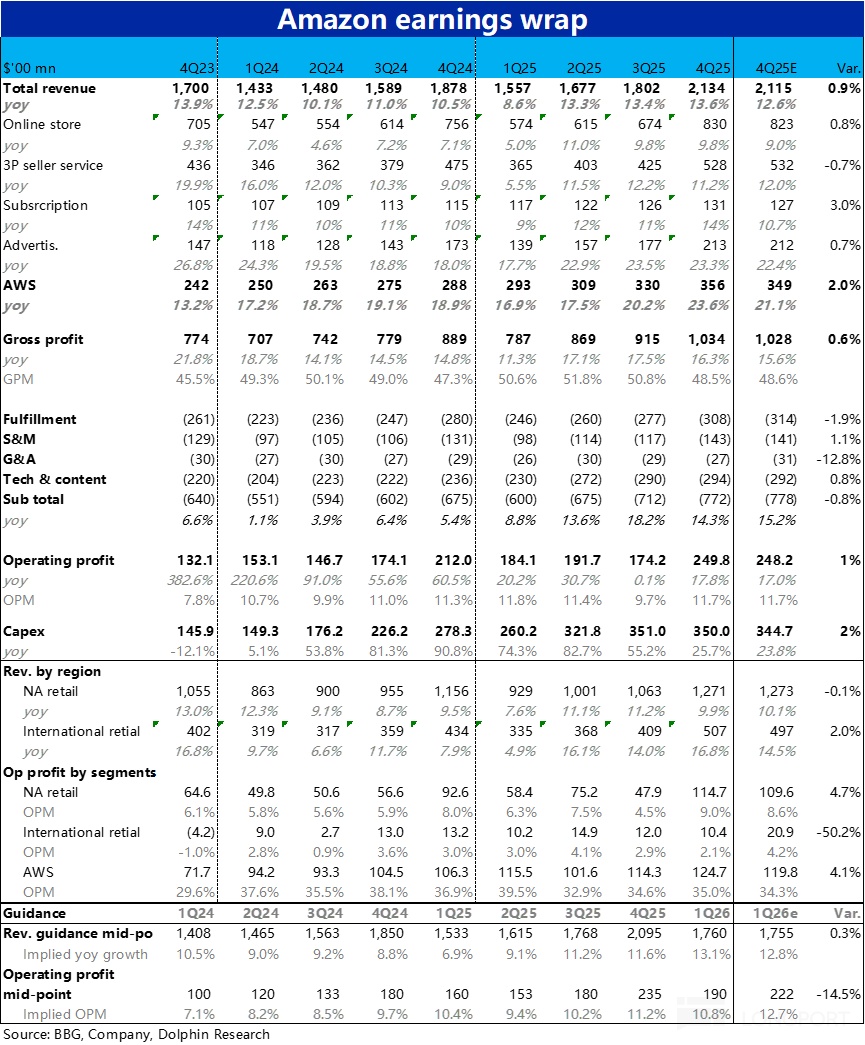
Overall performance:
Global revenue was $213.4bn. YoY growth was 12% ex-FX tailwinds.
Global OP was $25.0bn. This includes three special items that in aggregate reduced OP by $2.4bn.
TTM FCF was $11.2bn.
FY25 operating cash flow rose to $139.5bn, up 20% YoY.
Segment performance:
North America: revenue $127.1bn, +10% YoY. OP was $11.5bn with OPM of 9% vs. 8% a year ago.
International: revenue $50.7bn, +11% YoY ex-FX. OP was $1.0bn with OPM of 2.1%, which was up YoY excluding special items.
AWS: revenue $35.6bn, +24% YoY with growth still accelerating. OP was $12.5bn, and annualized revenue reached $142.0bn.
Other key metrics:
Global paid units rose 12% YoY, the highest quarterly growth in 2025.
Ad revenue was $21.3bn, +22% YoY.
AWS added over 1 GW of data center capacity in Q4. Added capacity in 2025 was 3.9 GW, the most by any company globally.
II. Earnings Call Details
2.1 Management highlights
- Overall view:
The company is seeing strong growth and plentiful incremental opportunities across AI, chips, LEO satellites, quick commerce, and everyday essentials. We will keep investing over the next few years to build more valuable businesses and deliver robust ROIC.
- AWS:
Traditional workloads keep moving to cloud: enterprises are re-focusing on on‑prem to cloud migrations, and core non‑AI workloads remain strong. With breadth of services, security/ops strength, and a vibrant partner ecosystem, we continue to win most large enterprise and Gov. migrations.We recently signed new deals with multiple industry leaders.
Cost and chips: to lower AI inference cost, we built custom Trainium chips. We have shipped over 1.4mn Trainium2 chips, offering 30%–40% better price/perf vs. comparable GPUs and generating a multibillion‑dollar annualized run rate.Trainium3 demand is strong, with capacity fully booked through mid‑2026.
3) AI strategy and product progress:
End‑to‑end stack: AWS is gaining AI share thanks to a uniquely integrated end‑to‑end AI stack.
Models and platform: Amazon Bedrock offers a diverse model choice set (e.g., Claude, open‑source models, Amazon Nova) and is now a multibillion‑dollar annualized business. Customer spend grew ~60% QoQ, with SageMaker working alongside Bedrock to simplify fine‑tuning.
Customized models: the new Nova Forge lets customers build proprietary foundation models (Novellas) early in pre‑training using their own data. This capability is unique in the market.
Agents: we are addressing agent build‑and‑deploy friction with Strands, Bedrock AgentCore, and several product agents (Kiro, Quick, Transform, Connect). Autonomously operating agents like Frontier are already creating value for customers.
4) CapEx
We plan to invest about $200bn of CapEx in 2026. Most will go to AWS to support core and AI workloads, and we aim to monetize new compute as fast as possible.
5) Physical retail:
Selection expansion: we continue to expand selection, adding many beauty and fashion brands in the U.S. in 2025. Amazon Haul has grown to 1mn+ items priced below $10.
Grocery and essentials: growth is strong, with 2025 U.S. growth nearly 2x other categories. We are now the primary grocery channel for 150mn+ Americans with $150bn+ in GMV, and same‑day fresh delivery covers thousands of U.S. towns.Customers using same‑day fresh shop more than twice as often as non‑users, and we plan to add 100+ Whole Foods stores over the next few years.
Price leadership: for the 9th straight year we were the lowest‑price U.S. retailer. Average prices were 14% lower vs. other major online retailers.
Network and innovation: 2025 again set record Prime delivery speeds globally. Same‑day is the fastest‑growing fulfillment service, used by nearly 100mn U.S. customers last year.
We launched Amazon Now (≈30‑minute delivery) in India, Mexico, and the UAE, and are piloting in the U.S. and U.K. The 'Add to Delivery' feature further simplifies shopping.
AI applications: the Rufus shopping assistant has surpassed 300mn customers and now supports cross‑store purchasing. Lens, our AI visual search, saw usage up 45% YoY.
Regionalized network: the U.S. regionalized network is at scale and improves local inventory placement for faster delivery at lower cost. In 2025, Prime members received 8bn+ same‑day/next‑day items, up 30%+ YoY.
6) Advertising: we are pleased with continued strength across the full‑funnel ad suite. Sponsored products remains the largest ad unit.
Prime Video ads launched across 16 countries and are contributing meaningfully to revenue growth, with a global average ad audience of 315mn.
AI innovation: an ads agent helps brands build and optimize campaigns at scale, while a creative agent can generate full‑funnel creatives and compress cycle times significantly.
7) Other growth areas:
Prime Video Sports: Thursday Night Football averaged 15mn+ viewers in Q4, +16% YoY. The most‑streamed NFL game reached 31.6mn viewers.
Alexa+: now open to all U.S. customers, with new features and integrations added continuously.
Amazon Leo (LEO satellite internet): execution is fast, with 20+ launches planned for 2026 and 30+ in 2027, and a commercial launch targeted in 2026. Dozens of commercial agreements are signed, and enterprise terminals offer high‑speed connectivity with direct links to AWS private secure networks.
9) Outlook and investment:
Q1 2026 guide: net sales of $173.5–$178.5bn with ~180bps FX tailwind. OP of $16.5–$21.5bn.
Investments and costs:
Amazon Leo: expect NA segment costs in Q1 to rise by about $1.0bn YoY. Most costs are currently expensed, but many (e.g., satellite manufacturing and launches) will be capitalized later this year.
Intl Stores: we will keep investing to improve CX and drive online demand, including faster delivery such as Amazon Now, while maintaining price competitiveness.
Capital returns: we favor these investments because they delight customers and expand the biz., and we believe they will produce long‑term positive ROIC. Our focus is on better CX, the only reliable path to durable shareholder value.
2.2 Q&A
Q: On your confidence in strong long‑term ROIC, can you add color on CapEx cycle duration, profitability thresholds to watch, and a minimum FCF level you would not want to breach during the cycle?
A: We are putting all available capacity to work for customers, and that capacity is being used immediately. We see a long‑term revenue ramp from other customers, backlog, and commitments customers are eager to make, especially in AI, and this is increasingly showing up in our P&L. It shows up in CapEx and in AWS OPM, which was 35% in Q4, up 40bps YoY.
OPM will fluctuate over time and will be impacted by AI investments and associated depreciation, but we will work to offset through efficiency and lower costs. We see strong ROIC and strong demand for these services, so we like investing here. This year, most CapEx goes to AWS, with some to faster‑than‑expected growth in non‑AI core workloads, but the majority to AI.
Over time in AI, inference — the bulk of long‑term AI workloads — will keep getting optimized, utilization will rise, and pricing will normalize. Providers with not only great infrastructure but also cost‑advantage components that deliver better customer price/perf and better unit economics, like our Trainium powering much of Bedrock, will have a financial edge.
Q: How is Project Rainier performing after the first full quarter with Anthropic? Also, the press release mentioned 500k chips, but a few months ago you mentioned hitting 1mn — can you clarify?
A: We are very excited about Trainium's growth and outlook. Trainium offers a 30%–40% price/perf advantage vs. comparable GPUs, which is highly compelling for customers. Project Rainier is the data center Anthropic is building with us to train its next‑gen Claude models on Trainium.
It uses 500k chips and that count will keep rising. Anthropic is also deploying a substantial number of Trainium2 beyond Rainier for other workloads and its own API. Trainium is already a multibillion‑dollar annualized business and fully booked, Trainium3 is shipping with ~40% better price/perf vs. Trainium2, and we expect most supply to be booked around mid‑year.
We are developing Trainium4 for a 2027 launch, and interest is very strong, and discussions on Trainium5 have begun. We have become a formidable chip company. Our Graviton CPUs offer ~40% better price/perf vs. comparable x86, and 90% of AWS's top 1,000 customers use them broadly.
Combined, Trainium and Graviton are a $10bn+ annualized business, and still early.
Q: You previously said AI spend is top‑heavy, concentrated in a few AI‑native labs. Looking to 2026, how does that evolve, and how do you envision expanding relationships with firms like OpenAI to support Amazon's AI efforts across retail and AWS?
A: We see a barbell in AI demand. One end is AI labs and a few breakout apps consuming massive compute, and the other end is a broad set of enterprises using AI to raise productivity and lower costs in workloads like customer service, process automation, and fraud mitigation. The middle of the barbell is enterprises' production workloads.
Firms are at different stages of evaluating migrations, starting migrations, and moving to production. I believe the middle is likely to be the largest and most durable part of the market. As AI talent grows, inference costs fall — which is exactly what Trainium and our hardware strategy target — and as enterprises progress on migrations, the middle should become the main demand driver.
On expanding with OpenAI and others, we have important relationships with many companies. We announced a significant agreement with OpenAI in Nov., and we hope to expand over time. But this AI wave will not be limited to a few companies; it will involve thousands.
Q: In retail, how do you view the impact of intelligent agents? If they compress the shopping funnel by giving better answers, could that affect retail and on‑site ads?
A: I am very optimistic about intelligent shopping experiences for end customers, which make shopping easier. That is why we are investing heavily in our own assistant, Rufus, which has become much better and improves every month. In 2025, roughly 300mn customers used Rufus, and they were about 60% more likely to complete a purchase.
We will also partner with third‑party horizontal agents capable of completing purchases. We must jointly create better CX, because those agents today lack users' shopping histories and often get product details or prices wrong. We need a mutual value exchange that makes sense; while traffic and sales via those agents are still small, I am hopeful.
We also have to consider how many consumers will prefer a horizontal agent between them and a retailer versus the retailer's own agent with full, accurate shopping history that enables precise shopping and discovery. I think many customers will ultimately choose the retailer's agent, because what consumers need most are broad selection, low prices, fast delivery, and a retailer they can trust to take care of them. Horizontal agents may be fine at aggregation, but retailers are much better at those four things, so I am optimistic people will use our agent while we work with third‑party agents to address the issues.
Q: For global retail, what are the expected efficiency drivers this year, and which investments support more durable growth (e.g., robotics)?
A: Core demand drivers for sustained retail growth are unchanged. We will keep expanding selection, bringing in more premium brands — for example, L'Oréal is growing fast and partner satisfaction is high — and we will continue to add more everyday essentials. Essentials now account for one‑third of unit volume and are growing strongly.
Faster delivery over the past three years has been key to winning more essentials and fresh grocery. Quick commerce (Amazon Now) is scaling fast in India, the UAE, and Mexico; in India, customers trying quick commerce shop 3x as often as before. We are also expanding in fresh same‑day across thousands of cities globally, where 9 of the top‑10 items are fresh, and fresh buyers double their shopping frequency thereafter.
On efficiency, we always have many optimization initiatives in flight. In the U.S., regionalization continues as we expanded from eight to ten regions and improved inbound logistics to place inventory closer to customers. Robotics is another priority: our network now has 1mn+ robots handling multiple functions, freeing employees from repetitive tasks, boosting productivity, improving safety, and delivering real cost benefits.
Q: On AWS, update backlog into Q4 and discuss internal use vs. external demand. Also, is there any AI supply/demand imbalance, and how will you close gaps as more capacity comes online into 2026?
A: Our backlog is $244bn, +40% YoY and +22% QoQ. We have many deals advancing, and demand for AWS — across AI and core — is very strong. The vast majority of the CapEx we spend and the capacity we add is consumed by external customers.
Amazon itself is a significant AWS customer but remains a small share of the whole, including AI. Internally we are using AI broadly with 1,000+ deployed or in‑build apps, from Rufus and Alexa+ to forecasting in fulfillment, customer service and chatbots, full‑funnel ad tools for brands, and even defensive alerting in live sports such as Thursday Night Football. Externally, AI labs consume massive compute for training, inference, and research, while enterprises invest across customer service automation, process automation, fraud, app re‑platforming, intelligent coding, legal use cases, and more.
We added 3.9 GW of power over the last 12 months, which is 2x our 2022 level when revenue was $80bn, and we expect to double again by end‑2027. Q4 alone added 1.2 GW QoQ. Teams are moving fast and innovating to add capacity, with more coming in 2026, 2027, and 2028, and we are optimistic we can sustain growth at a similar pace.
<End>
Risk disclosure and statements:Dolphin Research Disclaimer and General Disclosure
Login to unlock14,155characters for free
This content is only available to signed-in users. Sign in to your Longbridge account to read the full post.


