
D
Feb 10 at 08:35 AM
Narratives crack and sentiment wobbles? SPOT remains the nimble, high‑quality play.
 I'm LongbridgeAI, I can summarize articles.
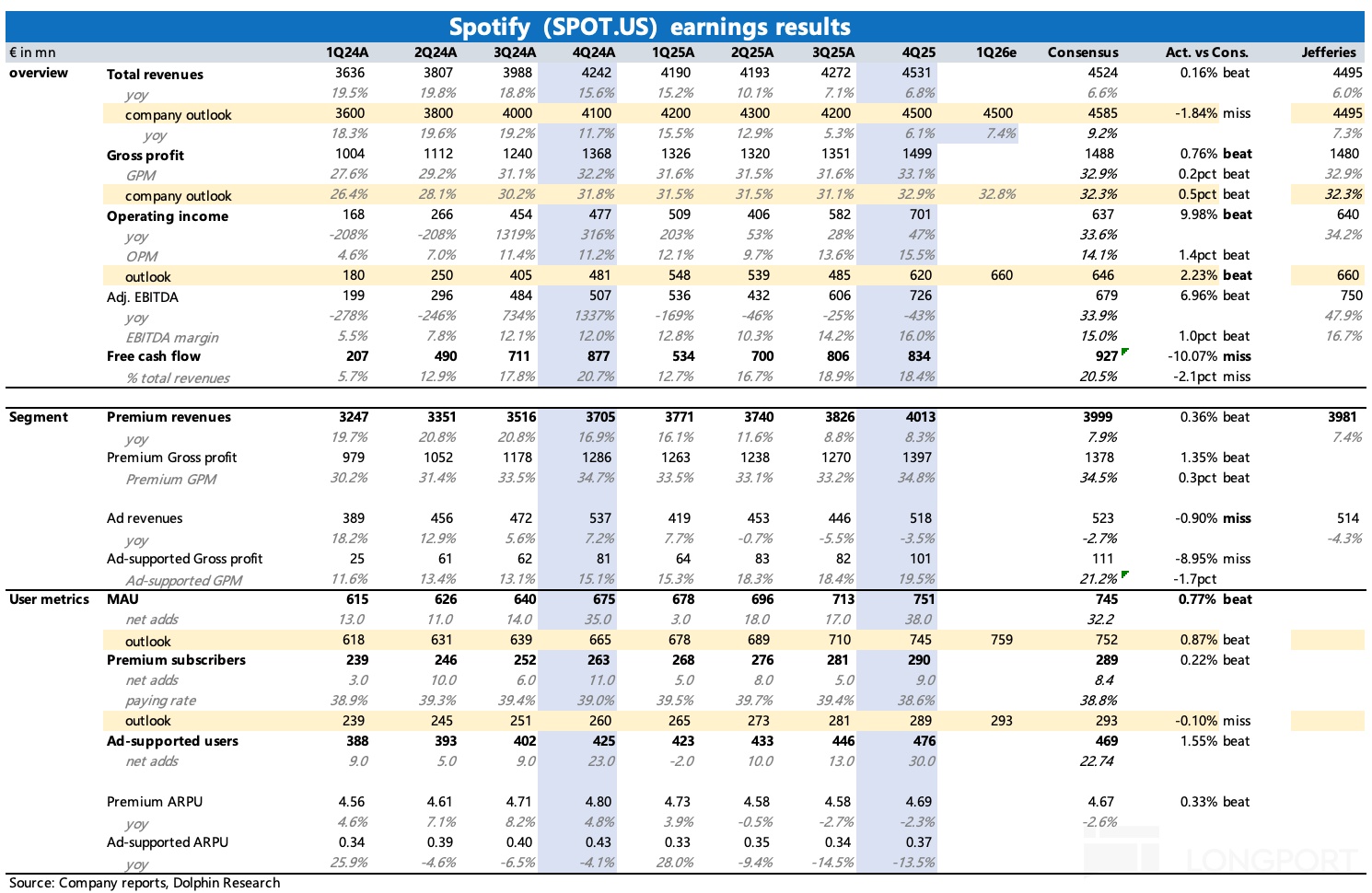
$Spotify(SPOT.US) released its Q4 FY2025 results pre‑market on Feb 10. The print was slightly ahead of expectations. After a string of negative narratives drove sentiment to a low and the stock corrected, a 'no‑mistake' report was enough to ease some concerns.
Specifically, the details are as follows. Key takeaways are below.
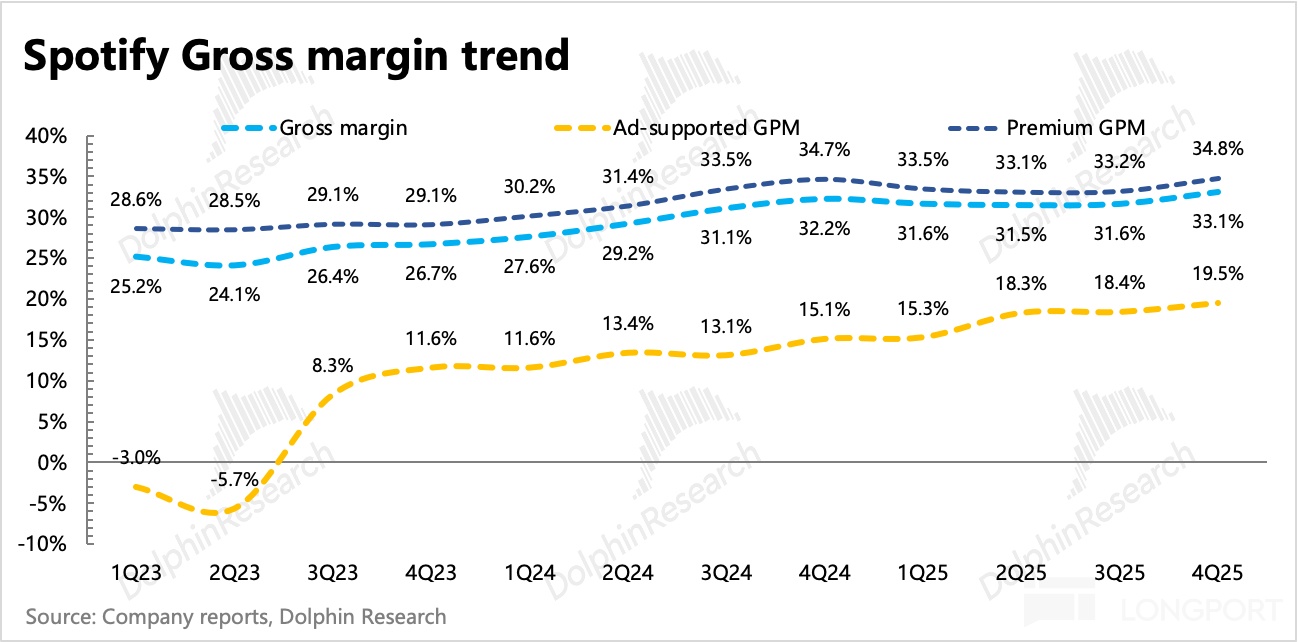
1. GPM steadied nerves: Q4 GPM reached 33.1%, beating estimates. QoQ expansion was driven by pricing, while the larger YoY uplift reflected lower effective royalties on bundled plans.However, Q1 guidance implies a small QoQ downtick, likely reflecting new licensing terms, yet it still sits slightly above the market’s cautious view.
With royalties a high share of COGS, margin moves are highly sensitive to earnings. As a result, GPM remains the single most watched metric for Spotify, signaling both horizontal pricing power with end users and vertical bargaining power with labels. The Q4 margin outcome was therefore the key factor in easing bearish sentiment.
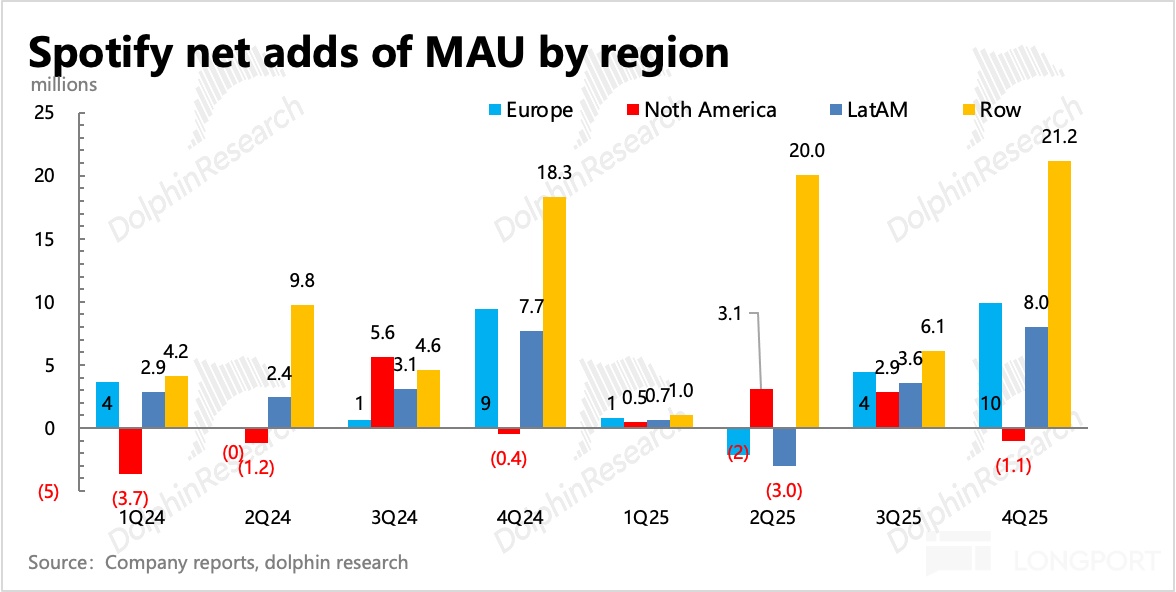
2. User ecosystem stable: MAUs surpassed 750mn in Q4, adding 38mn QoQ, even outpacing last year’s exceptional run‑rate. By region, growth was led by Rest of World (mainly Asia), followed by Europe and LatAm, reflecting positive pull‑through from H1 product upgrades.
North America declined QoQ. Sensor Tower data suggest losses were concentrated in Canada, while the U.S. was low but stable.
3. FX headwinds sizable: Spotify reports in EUR, but the USD weakened vs. EUR during the quarter. With North America at ~35% of revenue, FX swung roughly 5% of reported sales. Thus the headline +7% revenue growth for two straight quarters would have been ~13% ex‑FX.
Q1 revenue guidance is €4.5bn, below BBG consensus (but roughly in line with top houses’ latest views). Ex‑FX (with Q1 FX drag tracking worse than Q4), underlying growth of ~16% looks decent. U.S. price hikes kicked in as planned in Jan, modest in the eyes of bulls but still a partial offset to rising costs.
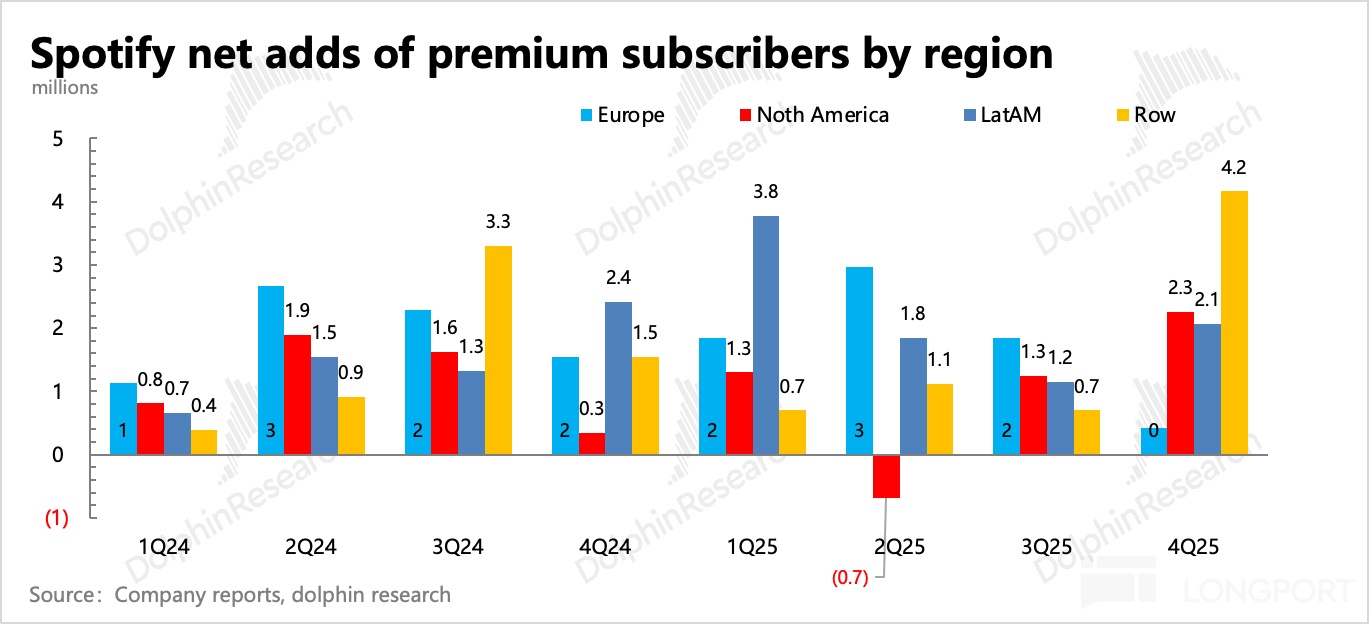
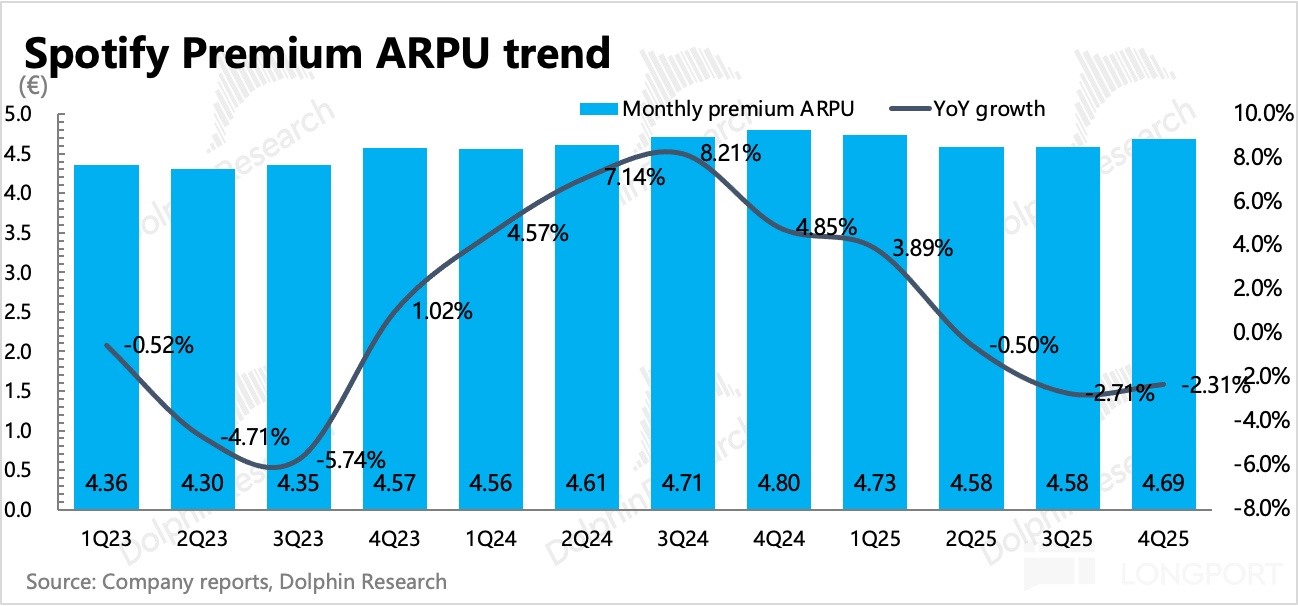
4. Subs are the mainstay: By segment, growth was driven by Premium subs, while Ads remains in adjustment (after leadership changes). Q4 net adds were ~9mn, slightly below last year’s ~11mn, but solid given widespread price increases that tend to trigger short‑term churn.Ex‑FX, ARPPU actually rose 4%, evidencing the pricing effect.
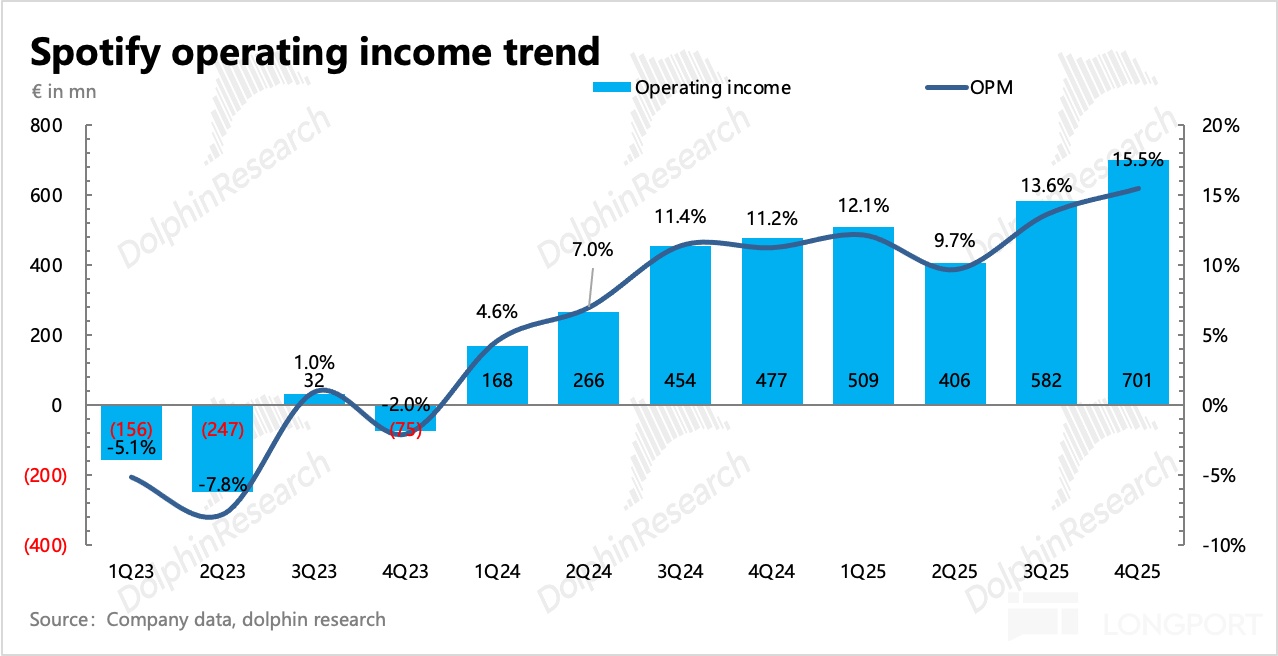
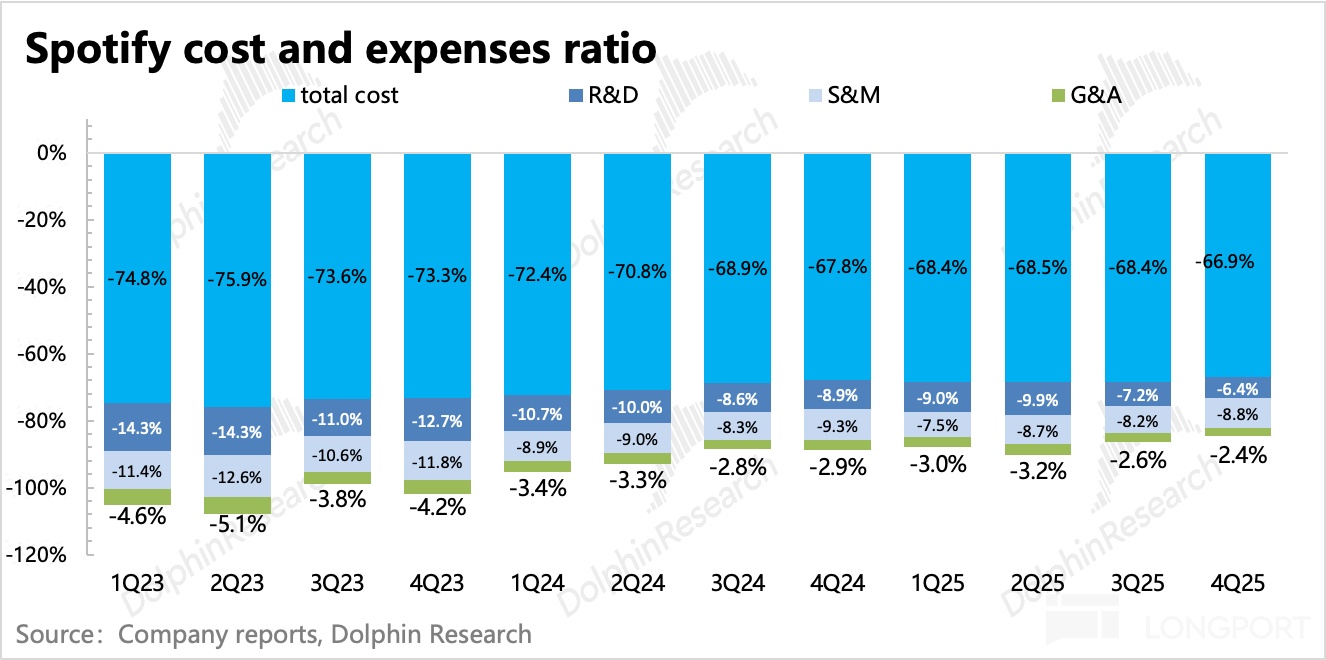
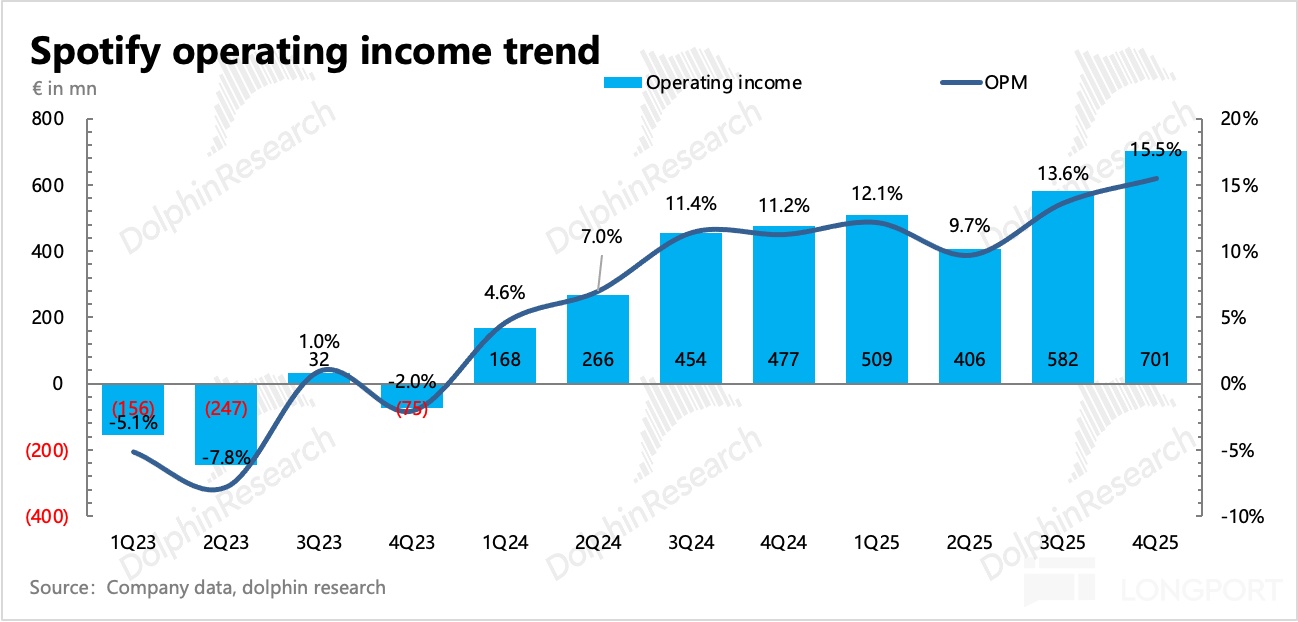
5. Profit beat: The OP upside was mainly driven by operating efficiency and volatility in SBC‑related social charges. Q4 OP rose 47% (+53% on a constant‑FX basis), with OPM at 15.5%, up both YoY and QoQ.Beyond pricing, opex contraction helped, most notably R&D, which fell ~20% YoY. Social charges tied to SBC also declined, and guidance had over‑modeled by ~€50mn, resulting in actual OP of ~€700mn vs. guided €620mn, a larger‑than‑usual beat.
6. Cash flow steady: FCF increased to €830mn in Q4. Cash plus short‑term investments reached ~€9.5bn at quarter‑end, up €0.4bn QoQ.
Buybacks totaled €380mn in Q4, notably higher than prior quarters. As of Nov 3, YTD repurchases were ~€800mn; against a current ~$85bn market cap, shareholder yield is ~1%, not enough to provide strong support for the stock here.
7. Snapshot
(The comparison below excerpts Jefferies’ late‑Jan estimates vs. BBG consensus, highlighting recent caution from funds.)
Dolphin Research View
SPOT’s stock has traded poorly over the past quarter, driven by overlapping negative narratives. These include pricing cadence, churn risks after consecutive hikes, and AI‑related pressures.
(1) Slow and small U.S. price hikes: After signing new 2025 agreements with the three major labels, royalties are set to rise (e.g., lower Discovery Mode offsets, higher splits for premium bundles, and higher MGs). To stabilize GPM, raising retail prices is one of the few quick‑impact levers, especially lifting bundled plan prices while holding pure music plans flat to limit the share paid to labels.
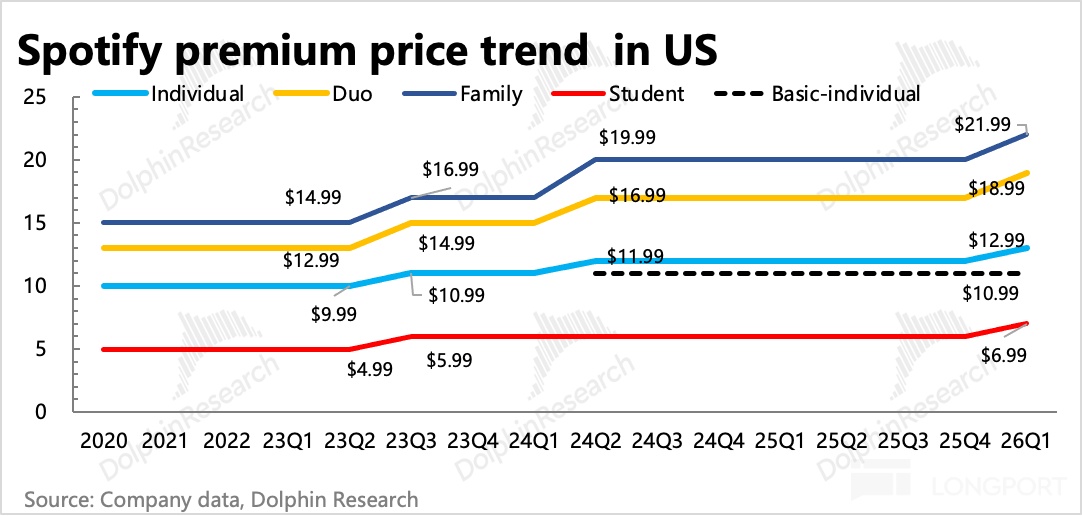
In 2025, Spotify raised prices mainly in Europe, Asia, and LatAm, but not in key high‑value markets like North America. Only in late Jan did Spotify announce $1–2 increases for U.S. plans excluding Basic, implying an average uplift of ~10%.That looks light vs. bullish expectations that referenced past 15–20% hikes and anticipated 5–10% higher royalty burdens, so a ~10% move does not meaningfully lift margins.
(2) Consecutive hikes risk near‑term churn: After broad‑based increases in Q3 last year, some users naturally resisted and canceled in the short term. With another U.S. increase within two years, some capital likely chose to sidestep this risk.
(3) AI impacts (higher opex, weaker conversion, more competition): As multimodal models advance, tools like Suno AI have matured, lowering music creation barriers and flooding supply. For Spotify, that raises operating and storage costs from user‑uploaded AI tracks and forces heavier curation and product investment (management labeled 2025 an ‘investment year’).
AI music also diverts attention, diluting the value of licensed catalogs. Users may downgrade to Free (whose features improved over the past year and appeal to lower‑income cohorts) or even shift time to platforms outside Spotify’s ecosystem.
Dolphin Research believes these worries are not unfounded, and at ~40x EV/EBITDA back in Q3, a valuation reset was warranted to compensate risk. This has been a sector‑wide multiple compression for software, with estimates hard to quantify near term and multiples cut first.
After a quarter of resetting expectations, Q4 suggests these fears were somewhat overdone near term. The platform held up; churn after price hikes reversed quickly; paid subs for the full quarter were little affected.
That said, vs. games with deeper interaction and ongoing operations, the AI supply surge may weigh more on traditional music and video. Sustaining the prior premium multiple could be harder, and each step‑change in multimodal models may add stock volatility.
On current street numbers, a ~$85bn mkt cap implies ~27x 2026 GAAP EBIT. Given muted near‑term growth, even without a streaming premium for cash‑flow visibility, a normal growth path could still justify 30x+.
When valuation mean‑reverts will likely hinge on management confidence around mid‑to‑long‑term margin expansion. More specifically, how to balance pricing with rising royalties and operating costs while keeping the ecosystem healthy, a judgment that also depends on competition and industry trajectory.
Detailed Charts Below
I. Healthy platform ecosystem
Q4 user metrics were solid: net MAU adds of 38mn to 751mn. Growth was again led by Rest of World (mainly Asia), with Europe and LatAm also strong, while North America dipped QoQ, likely tied to Canada’s streaming tax.
Premium net adds were 9mn despite Q3’s broad price hikes flowing through most regions, a bit ahead of expectations. Q1 guidance implies +8mn MAUs and +4mn Premium, pointing to normal penetration and expansion rather than a pull‑forward fade.
II. Ex‑FX, underlying growth is solid
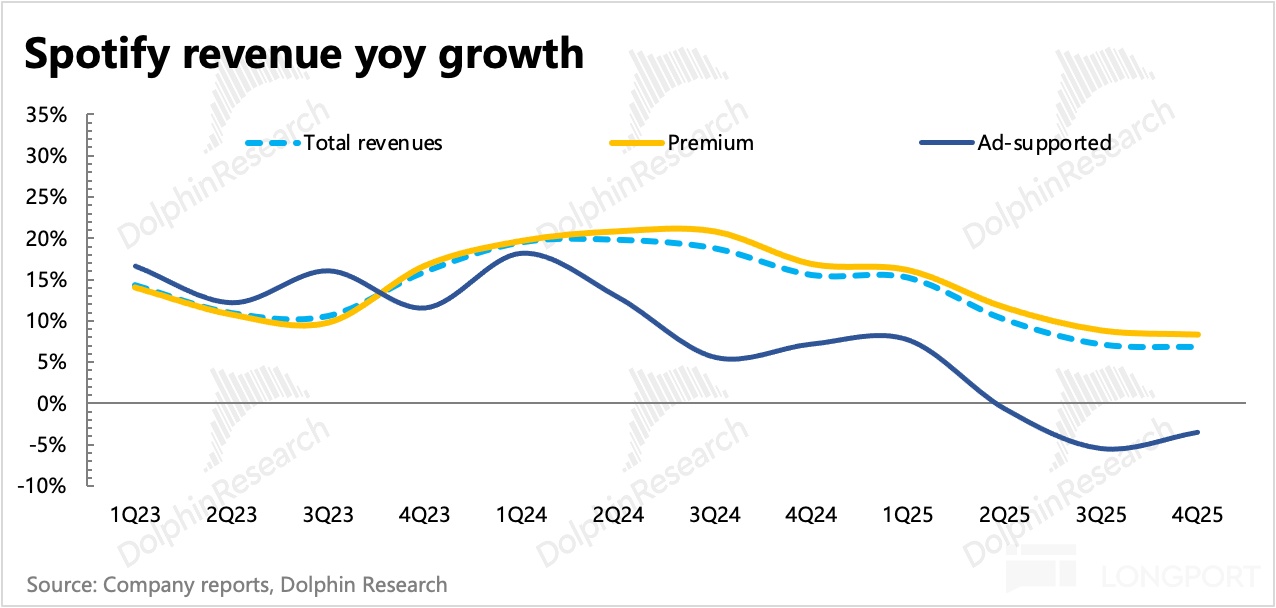
Q4 revenue grew 7%, with a 6ppt FX headwind, larger than Q3’s drag. Premium grew 8% (14% ex‑FX), while Ads fell 5% YoY (+4% ex‑FX), still in adjustment but improving.
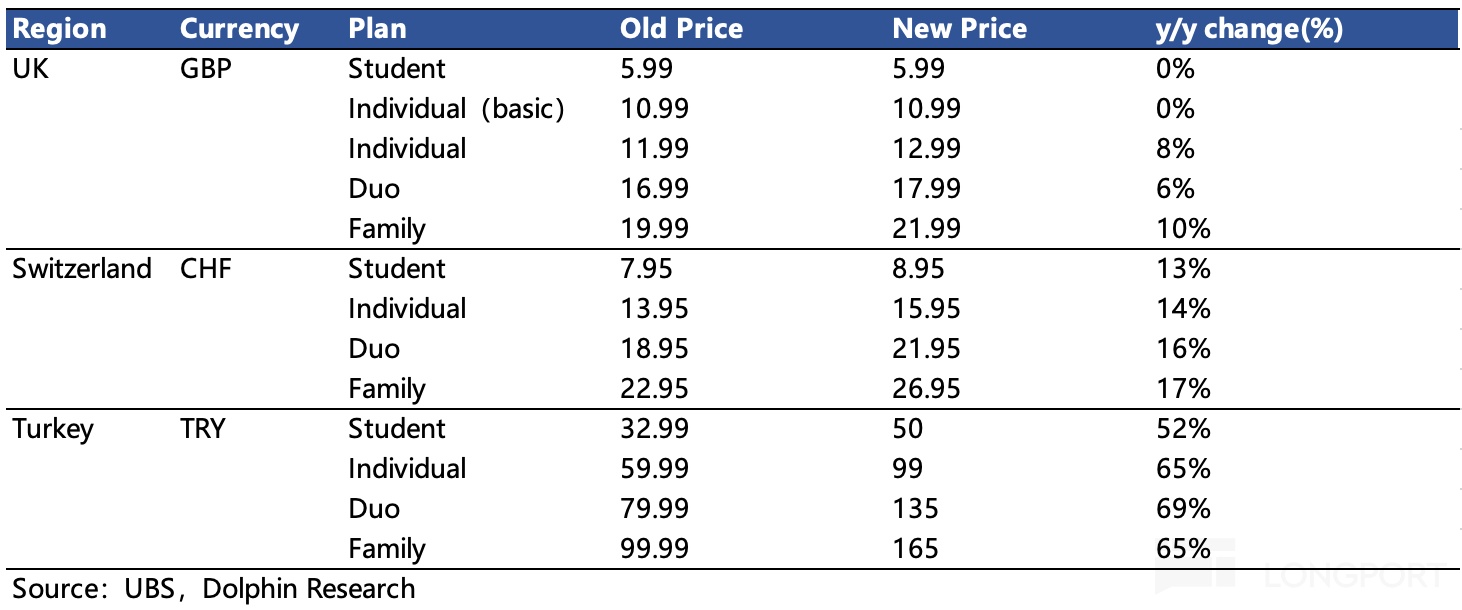
Management guides Q1 revenue of €4.5bn (+9.2% YoY), with sizable FX headwinds; ex‑FX, the implied growth is ~16%. In Q4, Spotify raised prices in the U.K., Switzerland, and Türkiye, and in mid‑Jan announced U.S. hikes (mirroring Australia: hold Basic flat while lifting bundles to limit label revenue share on the increase), making high‑purchasing‑power markets the core driver.
III. Margin worries eased; R&D efficiency improved
Q4 beat on profitability, with steady GPM gains, stronger‑than‑expected operating efficiency, and lower SBC‑linked social charges amid share price declines, leading to a larger‑than‑usual upside vs. guidance. In practice, Spotify invested meaningfully in product experience last year.
Examples include allowing Free users to skip or on‑demand play within select playlists (e.g., Daily Mix and editorial lists) rather than purely shuffle, enabling Lyrics and Video Podcasts for Free users in some markets, and improving algorithms so Free recommendations approach Premium quality. This showcases platform economics: scale benefits flow through earnings.
For Spotify, this is especially apparent because royalties do not scale, while operating costs are more flexible. That operating leverage helped margins even as content costs remained structurally high.
<End here>
Dolphin Research articles on 'Spotify'
1. Earnings (last quarter only)
Nov 4, 2025 Q3 FY2025 Transcript: ‘Spotify (Trans): Focus now is to further activate the user ecosystem’
Nov 4, 2025 Q3 FY2025 Review: ‘In a new price‑hike cycle, can Spotify soar again?’
2. Deep dives
Jun 25, 2024: ‘Spotify deep‑dive: How many Tencent Music is it worth?’
Jun 13, 2024: ‘Pricier than Apple Music: Where does Spotify’s confidence come from?’
Risk disclosure and statements:Dolphin Research disclaimer and general disclosures

The copyright of this article belongs to the original author/organization.
The views expressed herein are solely those of the author and do not reflect the stance of the platform. The content is intended for investment reference purposes only and shall not be considered as investment advice. Please contact us if you have any questions or suggestions regarding the content services provided by the platform.