
D
Feb 11 at 11:14 AM
SHOP: Solid quarter, stock plunges — Are e-com AI agents a boon or a bane? ---
 I'm LongbridgeAI, I can summarize articles.
As one of the most closely watched AI-in-commerce plays, $Shopify (SHOP.US) reported Q4 FY2025 before the U.S. market open on Feb 11. Overall, results were strong, with the quarter and next-quarter guide both ahead of expectations. The biggest issue remains valuation.
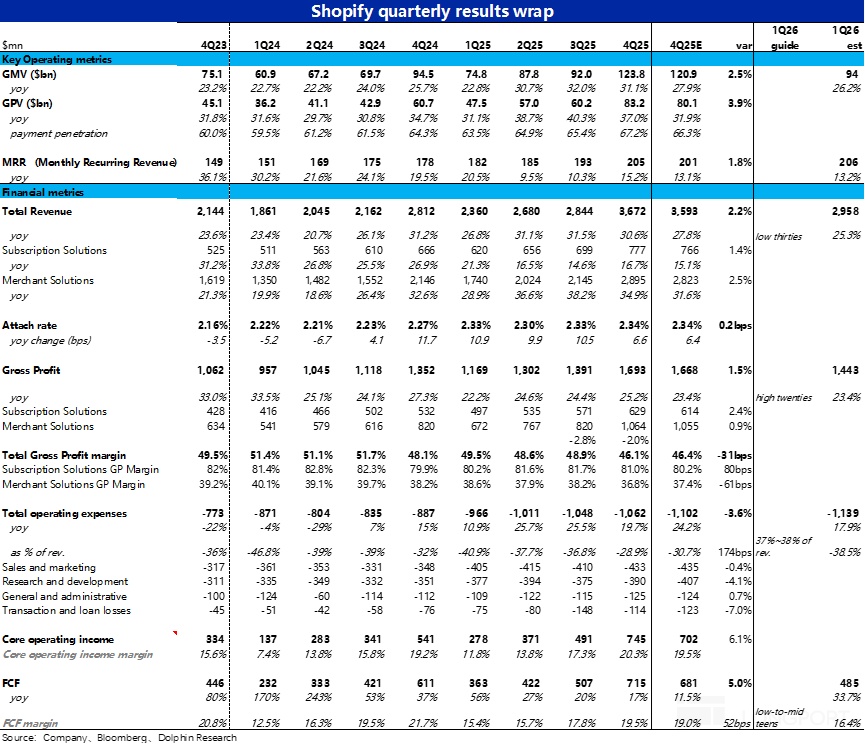
1) Strong GMV growth holding up: Contrary to concerns that Shopify’s GMV growth would fade, GMV rose 31% YoY this quarter, roughly in line with last quarter with no real slowdown. Ex-FX tailwinds, growth was still 29% YoY, easing only ~100bps QoQ.
Based on limited disclosure, Dolphin Research believes the strength still comes mainly from Intl markets and U.S. mid-to-large enterprises.
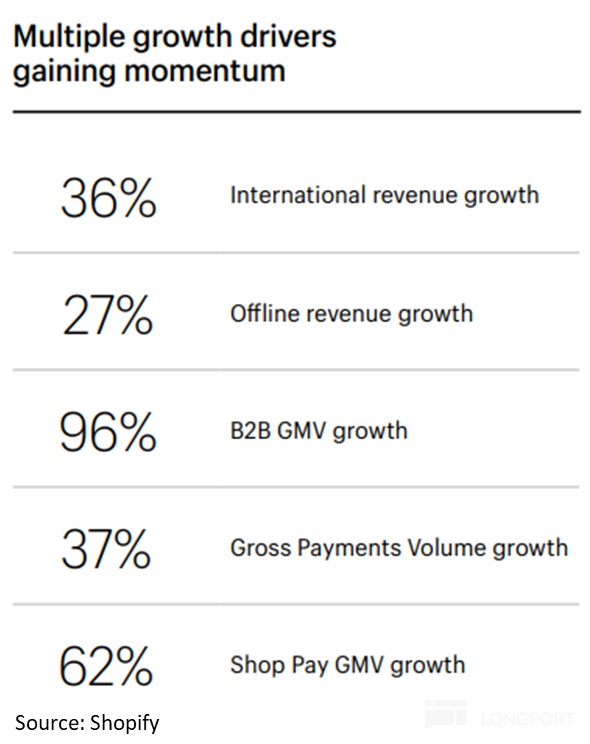
In addition, Shopify Payments penetration within GMV increased another 180bps QoQ, lifting GPV growth to 37%, again outpacing GMV.
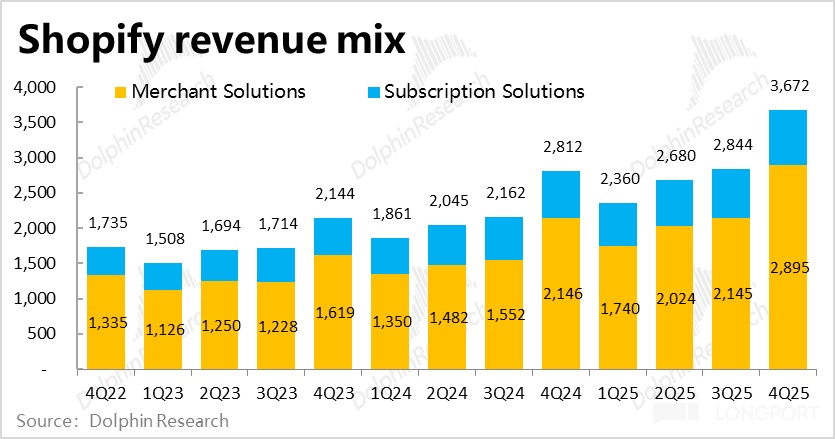
2) Solid top line on the back of strong ops: With robust GMV and GPV, merchant solutions revenue also came in strong, up nearly 35% YoY. By merchant solutions revenue/GMV, take rate improved ~6bps YoY to 2.34%, roughly in line with consensus.
That said, the magnitude of take-rate improvement narrowed vs. the prior ~10bps run-rate. Partly because the prior benefit from PayPal reporting changes has faded, and likely also due to a higher mix of larger enterprises.
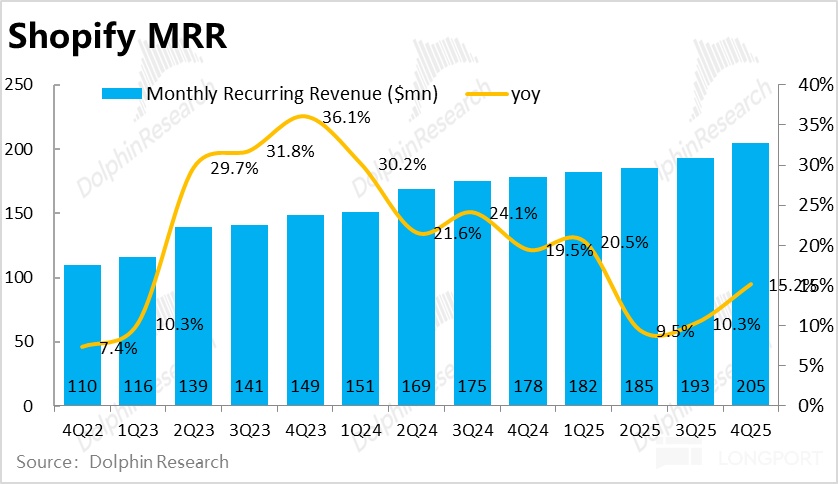
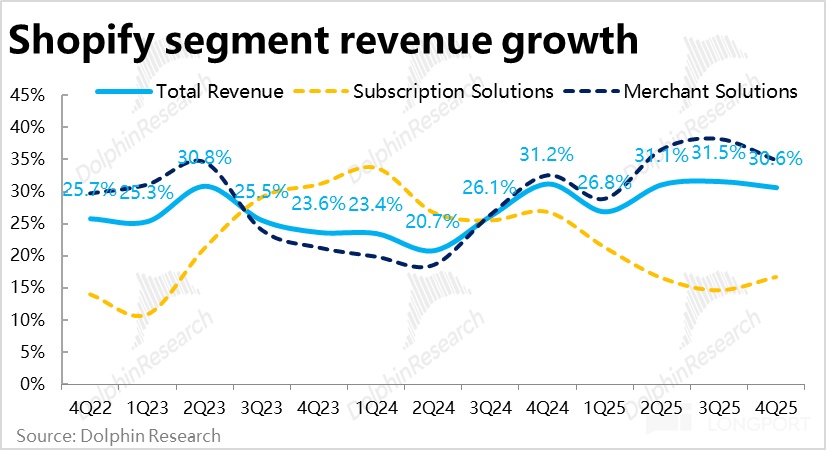
3) Trial drag faded, subscriptions healed: As expected, with the prior free/discounted trials largely rolling off, MRR grew 15% YoY, accelerating by nearly 500bps QoQ, a modest beat. Correspondingly, subscription revenue growth ticked up to 16.7% YoY, topping the 15% consensus.
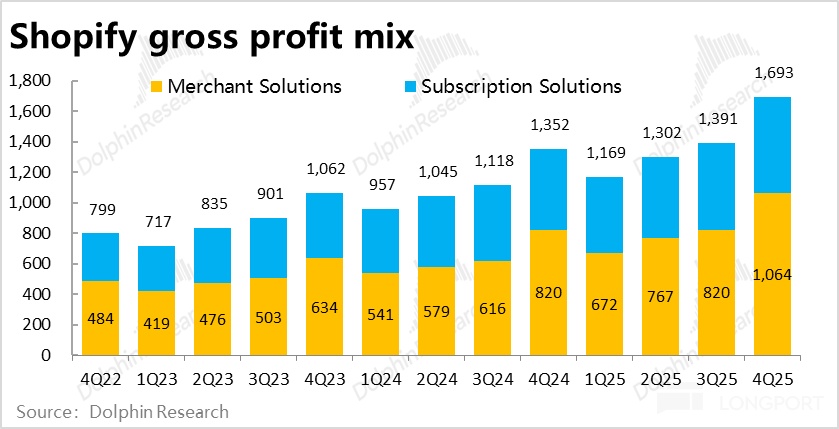
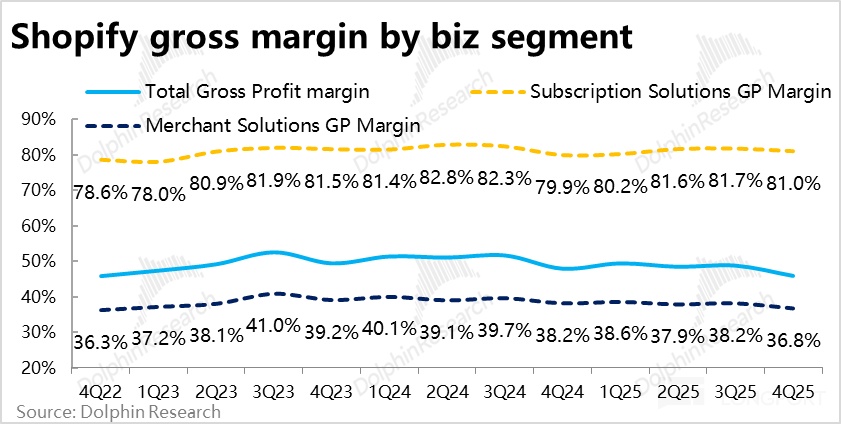
4) GPM under pressure, worse than expected: Despite strong growth, GPM declined as anticipated, with total GPM at 46.1%, down 200bps YoY and 30bps below consensus.
By segment, subscriptions benefited from ASP normalization as trials rolled off, with GPM turning up YoY.
The consolidated margin pressure reflects a higher mix of lower-margin merchant solutions. Separately, merchant solutions GPM fell 160bps YoY, about 60bps below Bloomberg consensus. Dolphin Research suspects a rising mix of mid-to-large customers.
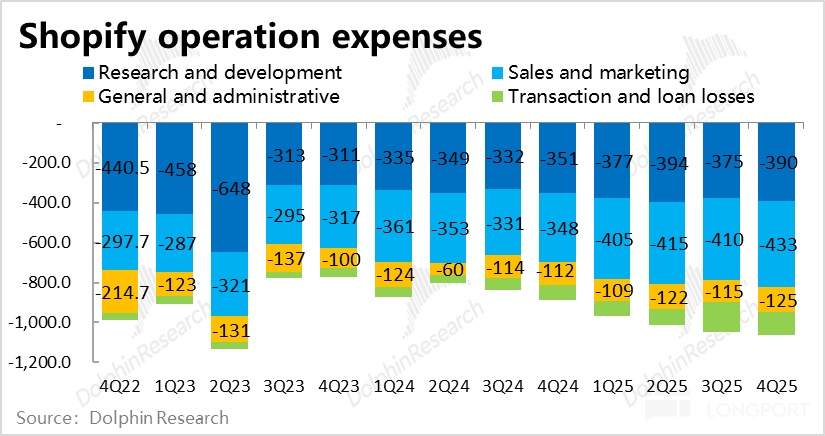
5) Cost control decent, but quality mixed: This quarter, OpEx did not rise as much as expected, with total OpEx up less than 20% YoY, a clear deceleration vs. the 25% of the prior two quarters. Total OpEx was 28.9% of revenue, below the company’s prior 30%–31% guide.
Looking closer, normal run-rate expenses did not fall meaningfully vs. last quarter, with marketing up ~24% and R&D/G&A up ~11%. Transaction losses narrowed from nearly 150mn last quarter to 110mn this quarter, so the OpEx beat carries limited quality.
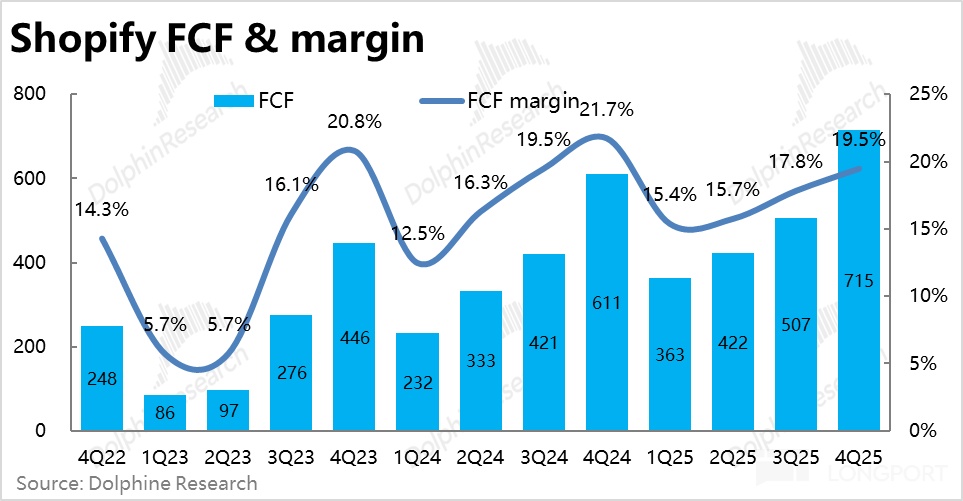
6) Profitability came in fine: Overall, the OpEx ratio was 170bps better than expected while GPM missed by only 31bps, so margins beat. The key focus metric, FCF margin was ~19.5%, about 50bps above expectations, which is solid.
Dolphin Research view:
1) Strong quarter and upbeat next-quarter guide
In short, Shopify delivered a clear beat, with core merchant solutions and operating metrics staying strong or improving. Revenue growth remained robust, and the feared slowdown did not materialize this quarter.
GPM is under pressure from mix shift, as payment-related revenue grows and mid-to-large enterprises typically carry lower net payment take rates. That said, absolute GP dollars continue to rise, which remains accretive.
Meanwhile, concerns that scaling into larger enterprises would require heavier sales headcount, and that AI would require elevated R&D, have not shown a major impact yet. The guide is similarly upbeat, calling for revenue growth roughly in line with this quarter at 30%+, well above the ~25% sell-side view, implying no slowdown.
Management guides GP to grow 25%–29% YoY next quarter, implying continued YoY GPM pressure but well above the 23.4% expected. OpEx as a % of revenue is guided to 37%–38%, a touch below the 38.5% expected, suggesting a slight YoY OpEx ratio decline.
The one negative: FCF margin is expected to be below 1Q25’s 15.4%, and thus below the 16.4% the market models. Since guided GPM and OpEx ratios are not worsening materially, the softer FCF margin is likely driven by working-capital and other BS items.
2) Is agentic commerce an opportunity or a risk?
Beyond the print, the hottest topic is agentic commerce (AI assistants completing shopping, akin to an LLM placing a food order). Theoretically, like the ‘SaaS replaced by AI’ narrative, Shopify’s core—online store building and management tools—also faces AI disruption risk. Web tools peers like Wix and GoDaddy have seen shares halve from their 2025 peaks.
SHOP has held up better not only due to fundamentals, but also because it has embraced the agentic commerce narrative, shifting from a potential AI victim to a prospective AI Agent beneficiary.
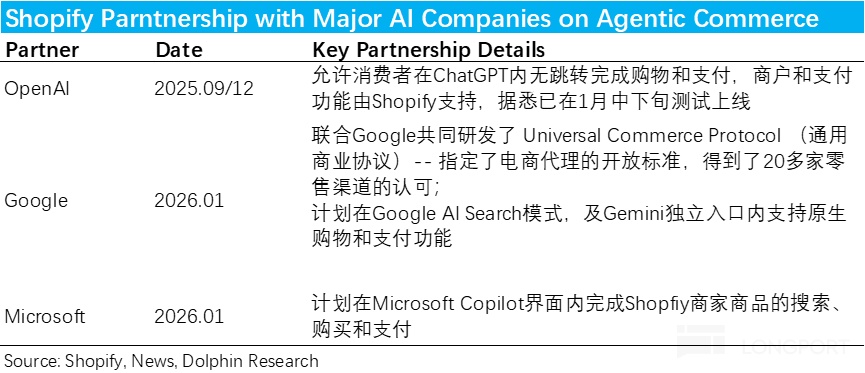
Specifically, Shopify has signed partnerships with OpenAI, Google Gemini, and Microsoft Copilot, enabling fully in-chat shopping and payments powered by Shopify, without redirects, inside each AI chatbot.
Beyond that, Shopify and Google jointly announced the Universal Commerce Protocol, an open agentic-commerce standard, which in theory allows AI entry points beyond Google/Microsoft and merchants outside Shopify to join the ecosystem.
On the flip side, while the story is compelling, its near- to mid-term P&L impact looks limited. Even setting aside how much GMV agents can drive near term, most monetization appears to accrue to the AI agent platforms.
Currently disclosed, ChatGPT plans to charge merchants a 4% take rate, relatively low and with no ads yet given fairness concerns. This commission goes entirely to OpenAI, with no revenue share to Shopify, though Shopify can monetize via payments as one of the processors.
Google and Microsoft Copilot agentic shopping have not announced commissions, implying no incremental revenue for now. Notably, reports indicate Google’s agentic checkout front-end defaults to Google Pay (with Shopify potentially a back-end processor), suggesting payment economics would likely be split between Google and Shopify.
Thus, under the current model, Shopify may not capture much direct incremental revenue from agentic commerce. Extrapolating from Google’s setup, the market also worries about ‘disintermediation’, where AI platforms control traffic and checkout, leaving Shopify as a product catalog and back-end payments provider, potentially reducing its take rate and profit share across the value chain.
Balancing both sides, Dolphin Research still sees agentic commerce as a net positive narrative for Shopify for now, as it is the fastest mover and uniquely partnered with the major AI gateways. As features ship, this should at least be a positive catalyst.
While it may not unlock much new monetization near term, it enhances the Shopify ecosystem’s appeal, attracting more merchants and reinforcing legacy revenue growth.
Management on the call implicitly validated this view: agentic commerce likely won’t create a large new monetization stream for Shopify near term and will still rely on payments, with economics split between the AI front-end and Shopify as back-end processor.
In short, volume could rise while margins stay flat or even compress, which is a negative for the most bullish investors.
On ‘disintermediation’, Dolphin Research views it as a reminder that investors shouldn’t pay a ‘priced-for-perfection’ premium, assuming rapid agentic adoption and a sizable uplift in Shopify’s take rate by absorbing platform-like commissions.
3) Valuation is the biggest problem
Fundamentals are strong, and under the AI narrative Shopify is a beneficiary. The single biggest issue is valuation.
Even after a ~40% pullback from the highs, at a ~$143bn market cap, SHOP trades at ~40x on the street’s FY2027 FCF estimate of ~$3.5bn. On P/S, it is about 8x FY2027 revenue of ~$18bn.
The premium embeds faster share gains from agentic commerce and sustained high GMV growth, plus a shift from ~3% payments monetization with limited margin to higher-value commission-based monetization. In some overseas markets, platform commissions can reach high single digits to 10%+.
But per Dolphin Research’s read (and partial company confirmation), even with decent agentic progress, revenue and profit contributions are unlikely to be material in the near to mid term. For such premium names that require faith capital, Dolphin Research’s stance is consistent: suited for high risk appetite or strong conviction, but not our preferred style.
Detailed review
I. GMV growth intact and strong
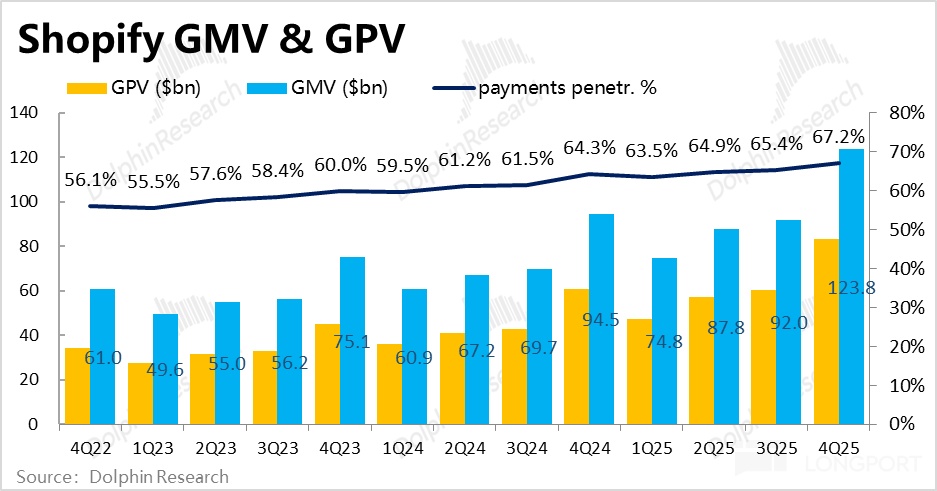
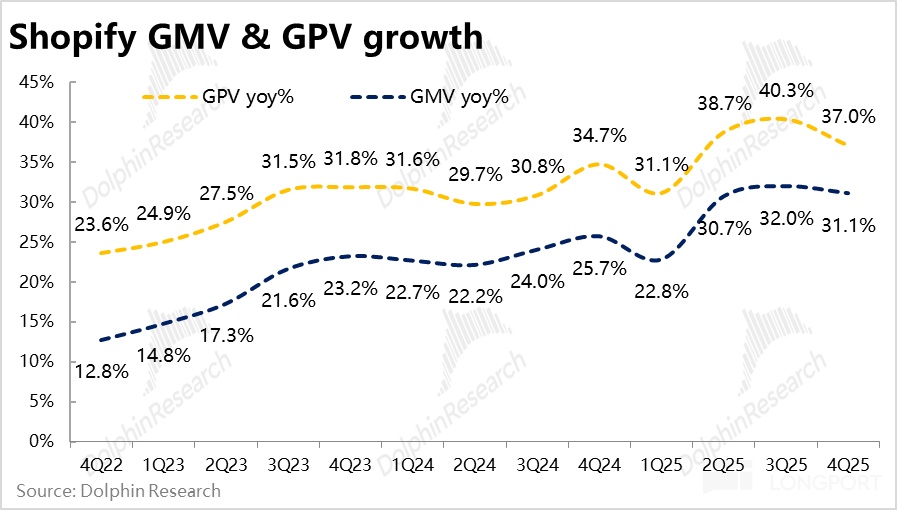
The key growth metric—ecosystem GMV reached 12.38bn this quarter, up 31% YoY, vs. the 28% slowdown feared by the market, effectively maintaining last quarter’s pace. Ex-FX tailwinds, GMV grew 29% YoY, just 100bps slower QoQ.
Based on limited disclosure, Dolphin Research believes growth was driven mainly by Intl markets and U.S. mid-to-large merchants.
Meanwhile, Shopify Payments penetration in GMV rose 180bps QoQ to 67.2%, driving GPV growth to 37%, a bigger beat vs. GMV and consensus.
II. Trial impact behind us, MRR recovers
The subscription core metric, MRR was $205mn this quarter. As the drag from prior free/discounted trials faded, growth began to recover, with MRR up 15% YoY, slightly ahead of Bloomberg consensus.
III. Healthy operating metrics drove solid revenue
On revenue, as MRR recovered, subscription revenue growth accelerated to 16.7% YoY, up more than 200bps QoQ, a modest beat. Meanwhile, with strong GMV/GPV, merchant solutions revenue grew nearly 35% YoY.
By merchant solutions revenue/GMV, take rate improved ~6bps YoY to 2.34%, in line with the street. The take-rate uplift narrowed vs. the prior ~10bps, mainly because the PayPal methodology change tailwind has rolled off, likely alongside a higher large-enterprise mix.
All in, with solid underlying metrics across both segments, total revenue grew 30.6% YoY, above expectations, with FX tailwinds contributing about 200bps.
IV. GPM still pressured, rising enterprise mix?
Despite the growth, company GPM remained under pressure as expected, with total GPM at 46.1%, slightly below the 46.4% Bloomberg consensus and down 200bps YoY.
Specifically, subscription margins improved YoY as trials rolled off and ARPU normalized, beating the street by 80bps.
Overall GPM declined due to a higher mix of lower-margin merchant solutions. In addition, merchant solutions GPM fell 160bps YoY, about 60bps below consensus. While Q4 promo season naturally lifts bandwidth and traffic costs and the street expected some pressure, the magnitude was larger. Dolphin Research suspects a higher mid-to-large customer mix, consistent with strong GMV.
V. OpEx below expectations, margins decent
While GPM was pressured, OpEx did not rise as much as expected. Total OpEx grew less than 20% YoY, a clear deceleration vs. the ~25% in the prior two quarters (and vs. the ~25% expected). Total OpEx was 28.9% of revenue, below the 30%–31% guide.
Drilling down, core OpEx did not ease much vs. last quarter, with marketing +24% and R&D/G&A ~+11%. The main swing came from transaction losses narrowing from nearly 150mn last quarter to 110mn this quarter, so the OpEx beat is of limited quality.
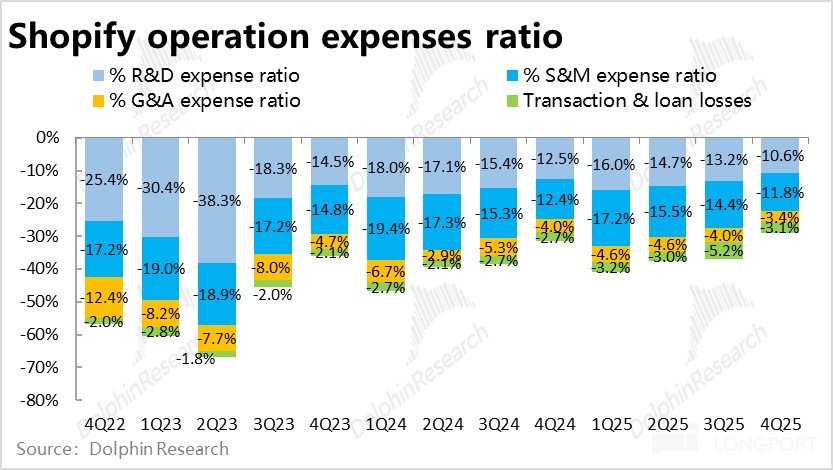
All told, since the OpEx ratio beat (by 170bps) more than offset the 31bps GPM miss, margins came in better than expected. FCF margin was ~19.5%, beating by 50bps. Free cash flow was 71.5bn, up 17% YoY, which is respectable.
<End of text>
Past Dolphin Research on [Shopify]:
Earnings reviews:
Nov 5, 2025 call: 'Shopify (Trans): Bullish on enterprise market + AI in commerce'
Nov 5, 2025 call: 'Shopify: Imperfect means inadequate — the original sin of a high multiple?'
Aug 7, 2025 call: 'Shopify (Trans): Europe and North America drove the GMV beat'
Aug 7, 2025 earnings review: 'Shopify: As long as growth blows out, other issues fade'
May 9, 2025 call: 'Shopify (Trans): No tariff impact seen in May'
May 9, 2025 earnings review: 'Shopify: Tariff sword still hanging — small merchants most exposed?'
Feb 12, 2025 earnings review: 'Shopify: With a rich multiple, good is not good enough'
Feb 12, 2025 call: 'Shopify (Trans): Too many growth avenues, current margins are fine'
Nov 13, 2024 earnings review: 'Up 20% overnight — why is Shopify a bull?'
Deep dives:
Jan 19, 2024 initiation I: 'Shopify: Looks like a marketplace, runs like a payments rail'
May 29, 2024 initiation II: 'Shopify: Marketplace shell, payments core — engines of growth'
Jun 20, 2024 initiation III: 'Payments core, SaaS multiple — is Shopify expensive?'
Risk disclosure & disclaimer: Dolphin Research Disclaimer and General Disclosure


The copyright of this article belongs to the original author/organization.
The views expressed herein are solely those of the author and do not reflect the stance of the platform. The content is intended for investment reference purposes only and shall not be considered as investment advice. Please contact us if you have any questions or suggestions regarding the content services provided by the platform.