
D
Feb 13 at 02:53 AM
ABNB (Trans): Accelerating Boutique Hotel Onboarding & AI Dev.
Curated by Dolphin Research:$Airbnb(ABNB.US) FY25 Q4 earnings call Trans. For the earnings take, see'Airbnb: Solid Print, But Now Cyclical?'
I. Key takeaways
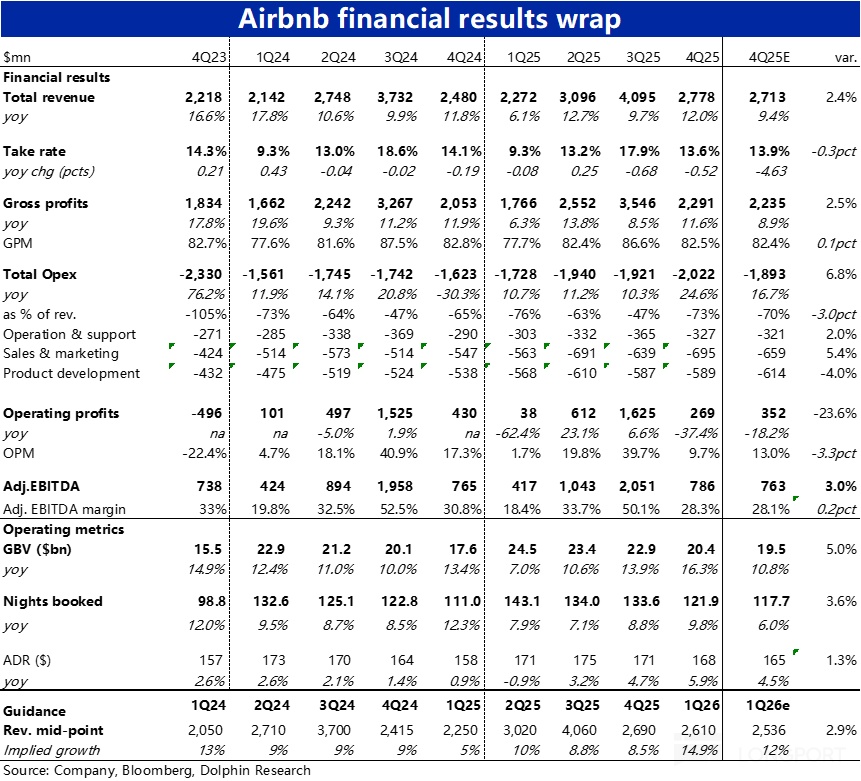
1) Shareholder returns: repurchased $3.8bn for the year, using ~80% of annual FCF, with total shares down 9% since 2022.
2) Q1 2026 guide:
a) Revenue of $2.59bn–$2.63bn (+14%–16% YoY), including ~3% FX tailwind.
b) Nights to grow high single digits, with ADR modestly up on FX.
3) FY2026 outlook:
a) Top line: growth expected to accelerate to low double digits.
b) Profitability: EBITDA margin to remain stable, as efficiency offsets higher spend in marketing and tech.
c) Tax: effective tax rate expected to fall to mid-to-high teens under the new legislation.
II. Call details
2.1 Management remarks
1) Core platform optimization (Project Y)
a) Improved conversion from high-intent users by refining search filters, simplifying checkout, and nudging web users to download the app.
b) Project Y alone added several hundred million dollars of revenue in 2025, with incremental contribution expected again in 2026.
2) Pricing and payments innovation (core growth engine)
a) Price transparency: first in the U.S. to display total price upfront, reducing churn.
b) Reserve Now, Pay Later (RNPL): launched in Q4 in the U.S., it drove outsized gains in larger homes (4+ bedrooms) and longer booking windows. Together with cancellation policy tweaks and migration to a single service fee, it added ~200bps to nights and ~300bps to GBV in Q4, with global and cross-border rollout planned for 2026.
3) Supply management
a) Major events: added 40k listings for the 2024 Paris Olympics, now replicating playbook for the 2026 World Cup across 16 North American cities.
b) Quality over quantity: proactively removed 500k low-quality listings.
c) Guest trust: high-quality supply up ~30% YoY in 2025.
4) Intl markets and new bets
a) Intl breakthrough: Brazil moved from a top-10 to a top-5 market on local installments and Carnival campaigns, becoming the largest new-guest source outside the U.S.
b) Category expansion: Hotels – onboarding boutique and independent hotels to fill use-case gaps. Services – piloting food delivery and airport pickup in Paris and LA, aiming for a one-stop 'Airbnb Trip' app.
5) AI strategy
a) AI agent now resolves about one-third of support tickets, materially improving response times.
b) Hired Meta’s former head of GenAI as CTO to build AI-native experiences, shifting from search-led to concierge-led interactions.
2.2 Q&A
Q: With the pace of AI, why can’t AI platforms (e.g., ChatGPT) directly launch a short-stay marketplace?
A: Airbnb’s moat extends far beyond the front-end app. Over 18 years we’ve built a complex back end with a dedicated Host app, processing over $100bn in annual transactions, and solving the hardest part of travel globally – customer service. This spans multilingual dispute resolution, global insurance coverage, and stringent ID verification. We now hold 200mn verified IDs, exceeding the number of U.S. passports outstanding, and this depth of trust and offline fulfillment is hard for pure AI platforms to match.
On supply, most of our inventory and unique stays are exclusive. Even if AI plans a trip, guests still come to Airbnb to book and message, as 90% of bookings involve real-time host DMs, and those verified hosts and assets are only on our platform.
Q: Will you need to share economics with AI platforms, or can you sustain direct traffic?
A: Think of chatbots like traditional search: great top-of-funnel discovery. Early data shows AI-sourced traffic can convert even better than Google. Foundation models aren’t monopolistic moats; GPTs, Gemini, or Claude are broadly accessible. As every company becomes more AI-native, travel winners will be defined by specialization.
We aim to be AI-native, led by one of Llama’s creators. Using the same base models as AI platforms, we fine-tune with Airbnb’s proprietary, at-scale interaction data. By wiring AI into our CS stack and host network, we can deliver a more precise experience than generic AI platforms. So we see AI platforms as traffic boosters, not substitutes for our closed-loop ecosystem.
Q: APAC grew ~15% this quarter but slowed vs. prior periods. What drove the decel, and what’s the long-term outlook?
A: As a destination, APAC growth was relatively stable in 2025. There’s wide dispersion within the region: Australia is highly penetrated, which drags the aggregate, while India, SE Asia, and Korea are still early.
Our focus markets are showing strong traction. Japan domestic has outperformed since we ramped in Q4 2024, and India was exceptionally strong at +50% last quarter, with further accel expected in 2026. APAC remains core to our Intl expansion, and we’re deploying targeted playbooks to unlock its potential.
Q: Over half of 'Experiences' orders are not tied to a stay. Is this helping new user acquisition and conversion?
A: Roughly 50% of Experiences orders come from visitors without an active stay. They may be hotel guests or locals, which opens an exciting funnel to convert them into lodging users over time.
It also proves new products can drive higher engagement beyond long-haul trips. In Paris, bookings for 'Airbnb Original' local experiences have surged, showing differentiated inventory can attract local traffic into our app.
Strategically, our evolution rhymes with late-90s Amazon. Amazon started with books, but the logic was anything that fits a box; for Airbnb, the logic is travel, very broadly defined. Each new line (e.g., hotels, experiences) should stand alone competitively, yet drive ecosystem synergies. Hotels complement last-minute, business, or 1-night needs, strengthening the platform.
Q: Under RNPL, are cancellation patterns in line with expectations, especially with Q1 weather? How is this embedded in the EBITDA guide?
A: Before the U.S. launch for summer 2025, we ran extensive tests to ensure gross booking uplift exceeds any net increase in cancels. Actual cancellation curves are tracking our models closely, and we are confident in RNPL’s full-year impact and EBITDA support.
RNPL does pull bookings forward and raises cancel rates for that cohort, but the increase has been fully absorbed. Platform-wide, the nominal cancel rate only ticked up about 1ppt (from ~16% to ~17%), which is not material at scale.
RNPL also creates positive competitive effects. It lengthens booking windows and modestly lifts ADR, as guests book higher-quality, higher-priced stays when they don’t face immediate large card charges.
Q: How will AI search reshape sponsored ads and the rollout cadence?
A: ChatGPT signaled the shift from traditional search to conversational AI, so we must design the AI search UX first, then build ad units around that form factor. We’re running rapid iterations, with AI search live to a very small slice of traffic. Rather than a big-bang launch, we’re iterating to make search more conversational and tie it into the end-to-end trip. Once the UX is nailed, sponsored ads will follow naturally. AI search won’t replace ads; it will define next-gen ad entry points.
Q: For 2026 acceleration, which core, expansion, and services drivers matter most? Also, hotels seem to have evolved from a gap-filler to a bigger strategy—why?
A: Our hotels strategy has fundamentally shifted. Previously, hotels filled supply gaps at peak occupancy; now we’re pursuing a broader, more expansionary strategy, because many guests alternate between homes and hotels based on occasion.
We highlight that some trips are better on Airbnb, but last-minute, single-night, business travel, or conferences can favor hotels. We’re prioritizing boutique and independent hotels, which represent a large share of global inventory and align with Airbnb’s brand of distinctive hospitality.
These operators are highly engaged given our lower commission structure, stronger merchandising, and high-quality traveler base. Adding hotels expands the addressable market and reinforces core homes supply, improving the platform’s overall competitiveness.
Q: What halo effects did the Paris Olympics drive for brand and supply, and how will that translate to the North American World Cup?
A: The impact was massive, reaching beyond Paris to all of France and globally. Major events are our best supply-acquisition moments, attracting first-time hosts and unlocking exclusive, non-standard inventory unique to Airbnb.
Airbnb’s origin story is rooted in event housing, and it shows: 40k Olympic-period hosts in Paris stayed on afterward, converting one-off demand into long-term supply. Policymakers also see the value, as hotels can’t absorb sudden surges of millions of visitors.
Italy recognized this during the Milan Winter Olympics, and the upcoming World Cup spans the U.S., Canada, and Mexico across key markets like Toronto and Mexico City. The playbook scales down to local events like Lollapalooza and remains a core engine for supply growth.
Q: With a flat margin guide, you’ll add roughly $800mn of spend this year. Where will it go?
A: In 2026, COGS and Ops support will scale roughly in line with revenue. With margins held steady, incremental investment will focus on two areas: Sales & Marketing, emphasizing go-to-market over programmatic—across Homes, Experiences, and Hotels supply.
Second, continued Product & R&D investment to raise innovation velocity. Our 2026 ambition is to re-accelerate revenue growth, and we’re using margin flexibility to invest ahead for longer-term growth.
Q: After app and supply upgrades, have repeat rates and NPS improved meaningfully?
A: Repeat intent correlates with guest satisfaction, which is driven by listing quality and after-sales service. 'Guest Favorites' now account for about half of bookings, lifting overall trip ratings and repeat propensity, which has been a key driver of the recent re-acceleration.
NPS is at the highest level since the pandemic and still improving. Beyond team execution, this reflects unprecedented ecosystem governance: we quality-screened and dynamically adjusted over 500k listings and infused AI into support, improving both speed and resolution quality. Tighter supply-side quality control is becoming a durable tailwind.
Q: North America nights are back to mid-single-digit growth. What’s your 2026 outlook there?
A: North America was soft in 1H25 with low-single-digit growth, then accelerated in Q3 and sustained in Q4. Macro stabilization helped, but product improvements mattered more. Into 2026, North America remains a key growth engine and underpins the acceleration guide.
Q: When will hotels materially contribute to revenue growth? Is it a driver of 2026 acceleration?
A: As of Q4 2025, hotel nights are still a single-digit share of total bookings, but growth is nearly 2x the platform rate. It will take time to reach scale and move the needle, yet momentum is strong. We plan to expand hotel supply through this year, with a meaningfully higher mix by exit-2026.
Q: Q1 revenue growth steps up vs. Q4, but nights and GBV growth look slightly softer. Any monetization mix effects (FX or seasonality)?
A: 1) FX: roughly a 3ppt tailwind to Q1 revenue, as noted in the shareholder letter. 2) Booking cycle vs. revenue recognition: longer booking windows in Q4 mean many late-2025 bookings stay in Q1 2026 and convert to revenue. 3) Monetization: implied take rate is expected to be slightly higher YoY in Q1 on timing factors. 4) Holidays: Easter falls on Apr 5 this year, muting inter-quarter holiday swings. This should add ~50bps to Q1 revenue and reduce Q2 by ~50bps.
Q: Why not add more branded chains to grow supply faster and attract new users?
A: We’re prioritizing boutique and independent hotels. Independent hotels command a large global share and represent substantial whitespace. They also tend to pay higher commissions to traditional OTAs, making a lower-commission channel like Airbnb especially attractive, with many operators proactively reaching out to partner.
Moreover, boutique hotels align better with our brand DNA. We’re first scaling high-quality, non-standard hotel supply in core global markets. In New York, over 100 hotels with 20k+ rooms are already live on Airbnb. While we won’t rule out other categories later, we’re focused on perfecting the boutique/independent ecosystem to ensure a differentiated UX and brand consistency.
Q: How is the 'all-in' fee structure for PMS-connected hosts performing? Will you migrate all hosts over time?
A: The legacy dual-fee model (3% host fee plus variable guest fee) had drawbacks, especially for multi-platform professional managers, creating pricing friction and mismatches that sometimes made Airbnb appear pricier. We completed the migration in Oct 2025 for all API-connected hosts to a single service fee, with strong results. We emphasized communication so hosts didn’t treat it as a stealth price hike, and many did not raise base rates.
That led to a slight ADR decline on the guest side, improving price competitiveness and elasticity, and directly contributing to Q4 and subsequent growth. We’re piloting broader migration for Individual Hosts in select countries. Wider adoption simplifies host pricing, enhances cross-platform price competitiveness, and lays the infrastructure for more dynamic pricing and fee tools.
Q: Vision for loyalty, and how will it span products? Does Project Y change the twice-yearly launch cadence?
A: We’ll keep the May and Nov moments, but with a new operating model. Instead of holding features for those events, we now ship continuously. Post-Project Y, teams release when ready. In the AI era, rapid iteration beats monolithic launches, so May and Nov will be more about product marketing—telling our story to guests, hosts, and shareholders—than the sole ship dates.
Notably, Airbnb has achieved current growth without a traditional loyalty program or sponsored ads. Once we launch loyalty, it should be a major accelerator.
We’re not building a generic points scheme, but an Airbnb-specific, experience-led program. We’re running intensive tests on benefits and cross-line synergies across Homes and Experiences, and will package and launch once the data proves out.
<End of text>
Risk disclosure and statements:Dolphin Research disclaimer and general disclosure
Login to unlock14,243characters for free
This content is only available to signed-in users. Sign in to your Longbridge account to read the full post.

