
D
Feb 13 at 03:02 AM
RIVN: Post-subsidy era — can R2 lead a turnaround?---
 I'm LongbridgeAI, I can summarize articles.
$Rivian Automotive(RIVN.US) reported Q4 2025 results after the U.S. market close on Feb 12, 2026. Overall, performance was solid, with a clear recovery from the Q2 trough. Key takeaways:
1) Revenue slightly beat: total revenue was $1.29bn, a touch above the $1.26bn consensus despite a weak delivery quarter. Auto revenue (incl. regulatory credits) was $840mn, down 26.5% QoQ, mainly as IRA subsidies faded and deliveries fell 26% QoQ to 9.7k units. ASP also declined as the mix shifted toward lower-priced EDV and promotions stepped up, falling ~$4k QoQ to ~$83k.
Software and services held up well at $450mn, up ~$30mn QoQ. The upside was still driven by high-margin tech licensing linked to the JV with Volkswagen.
2) GPM improved QoQ: notably, gross margin rose another 780bps QoQ to 9.3% even with weak auto sales, far above the 3.4% consensus. Both auto and services margins improved QoQ, with services benefiting from high-margin JV tech licensing.
3) Auto GPM continued to recover: Q4 auto GPM was -7%, up 440bps QoQ, or -11% ex-credits. The improvement came from lower variable cost per vehicle (ongoing cost-downs, easing tariff drag, stronger EDV margin), offsetting lower ASP and higher per-unit overhead absorption.
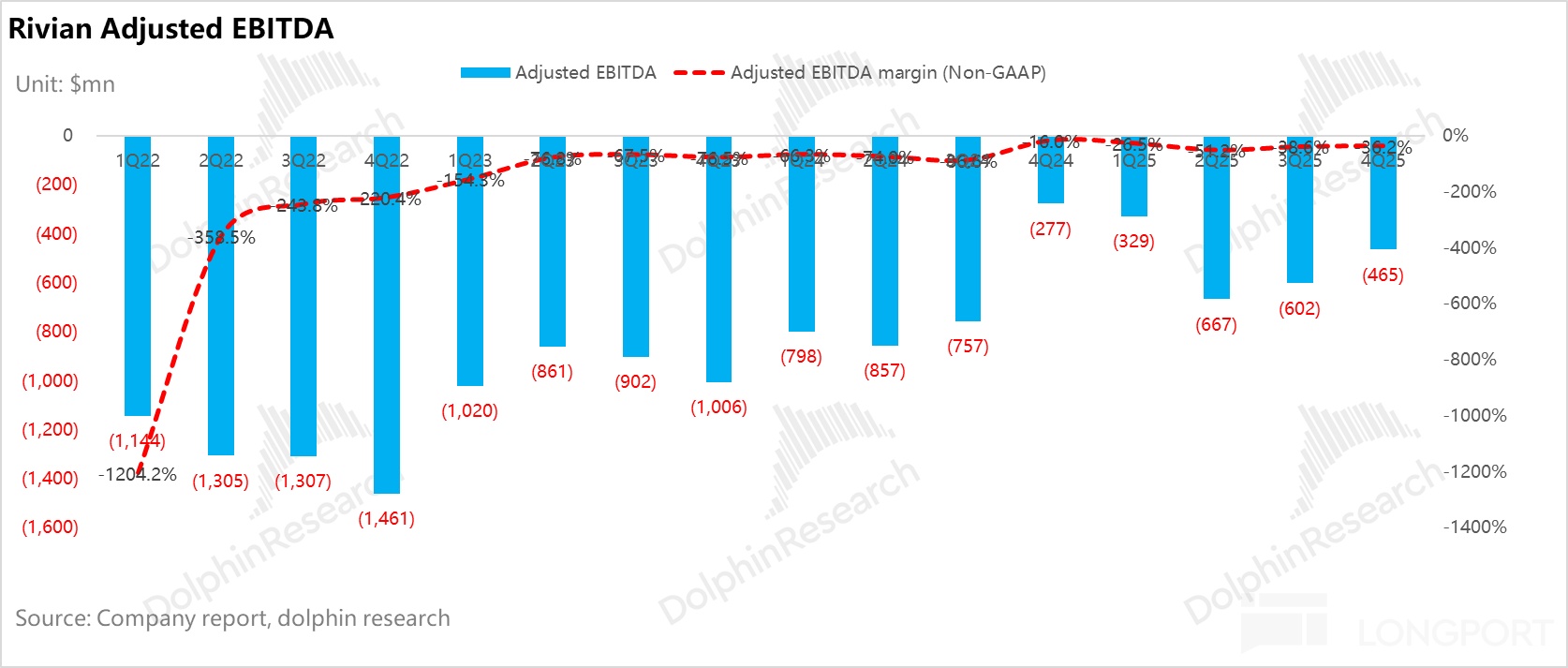
4) Adj. EBITDA and net income beat: with better-than-expected revenue, improving margins, and disciplined opex, both Adj. EBITDA and net profit topped estimates. Adj. EBITDA was -$470mn, improving by ~$140mn QoQ despite lower volumes, and ahead of the -$570mn consensus.
Dolphin Research view:
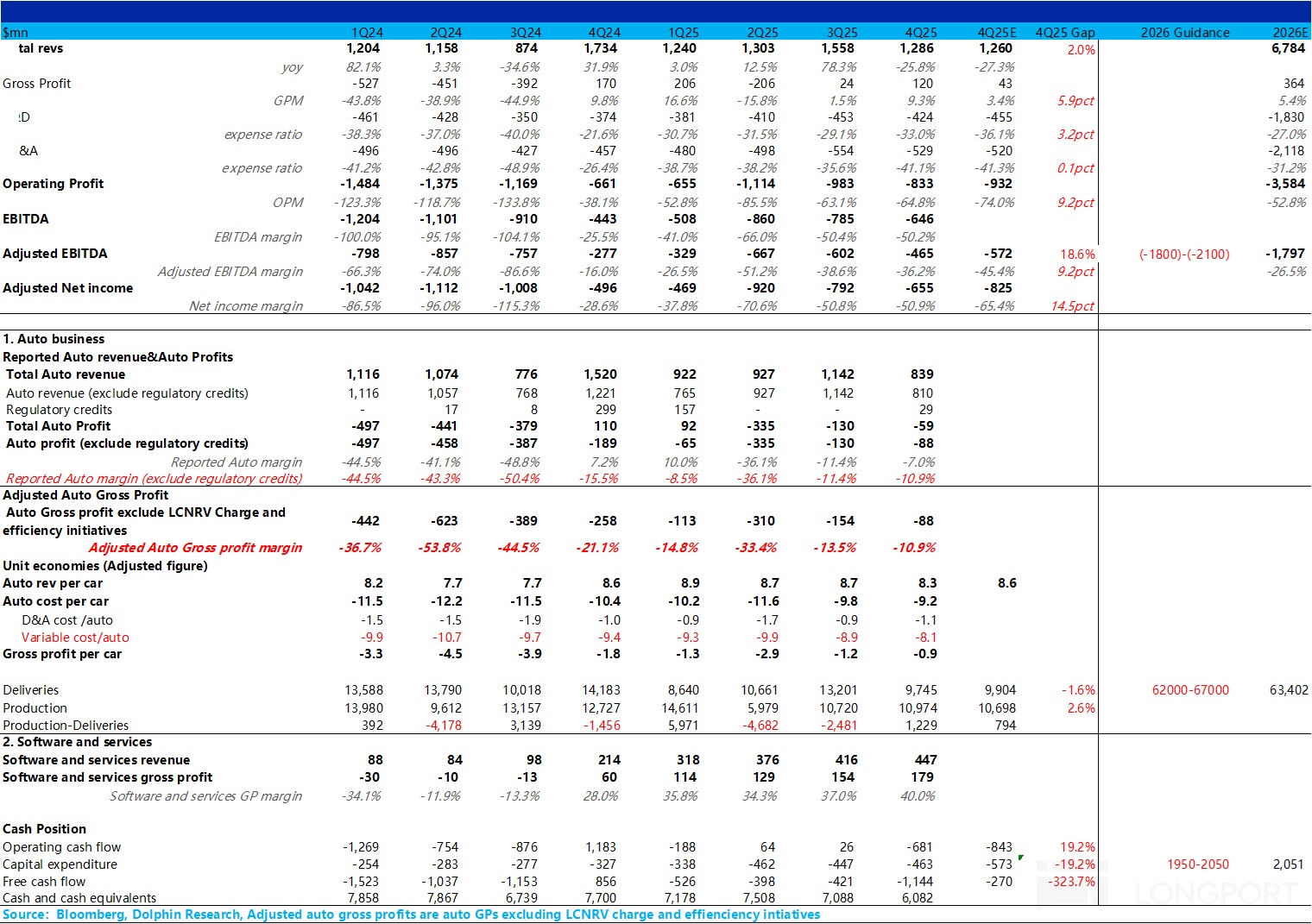
Against a low bar, Rivian delivered a solid print. With IRA rollback weighing on the U.S. market in Q4, industry volumes softened across the board, including Tesla, and Rivian also hit a delivery trough. Even so, revenue and profit both beat expectations, and both GPM and NPM improved QoQ. This underscores decent cost control in a tough backdrop.
Beyond the quarter, the market focus was on 2026 guidance given the lower-priced R2 slated for mass production and launch in 2026:
i) 62k–67k vehicle deliveries: implying +47% to +60% vs. 42k in 2025. The ramp and launch of R2 is the core driver of 2026 volume growth.
Rivian expects 9–11k deliveries per quarter in 1H26. As R2 ramps in 2H26, quarterly deliveries should rise to 22k–23k; the R2 launch edition will start on a single shift and move to double shift by year-end.
On Dolphin Research estimates, assuming R1 declines ~7% YoY on subsidy fade, the guide implies R2 at ~21k–27k units in 2026. That is well above prior Street expectations of ~10k units.
The earlier bearishness stemmed from R2 1H shipments still on Gen-2 hardware, while Gen-3 with the in-house 800 TOPS RAP1 and higher-end sensors (incl. LiDAR) arrives only by year-end. Together with weaker demand after subsidy rollback, the Street had penciled in just 47k–50k total units for 2026.
The above-consensus delivery guide alleviates these concerns to a meaningful extent. It directly challenges the prior cautious view.
ii) Adj. EBITDA guidance of -$1.8bn to -$2.1bn (2025: -$2.06bn): below the -$1.8bn consensus. Most of 2026 will be in R2 ramp mode, and heavier autonomy R&D will dilute the profit uplift from higher volumes.
Management still targets positive R2 GPM by Q4 2026, aided by BOM reductions from joint purchasing with Volkswagen and fixed-cost dilution on higher output. This anchors the margin inflection path.
Rivian expects software and services revenue to grow ~60% YoY to ~$2.5bn in 2026 (about half from the Volkswagen JV). With roughly 35% segment GPM, this will be the key ballast for consolidated margins during the R2 ramp.
iii) Capex guidance of $1.95bn–$2.05bn: above 2025's ~$1.7bn, mainly for the Georgia plant (R2 capacity expansion and R3 production).
iv) Autonomy progress: the in-house RAP1 chip (800 TOPS) has debuted. Point-to-point (P2P) autonomy is slated for 2H26, while hands-off and eyes-off capability is expected in 2027. The AI and autonomy roadmap echoes Tesla's playbook, preserving scarcity value in the U.S. market.
v) Liquidity: cash and equivalents were ~$6.1bn at end-2025. Together with Volkswagen's planned $2.0bn injection in 2026 and $0.5bn in 2027, plus an in-process U.S. DOE loan, liquidity appears sufficient for the next 2–3 years with no near-term funding stress.
The R2 low-price story is on track, and the volume guide well above expectations signals high management confidence. A successful R2 scale-up is central to the equity story.
Valuation-wise, based on guidance, RIVN trades at ~2.3x 2026 P/S, near the low end of its historical 2.3–4.0x range. The caveat is execution: the multiple assumes management delivers. Given past guide-downs and lingering demand uncertainty post-IRA, Dolphin Research remains cautiously optimistic and advises against paying a steep premium for distant promises.
While the guide surprise could lift shares near term, Q1 is seasonally soft and R2 has yet to contribute. If the stock spikes, consider taking profits rather than chasing momentum, and wait for a better entry with a wider margin of safety. Dolphin Research sees ~$16.2bn market cap as a more comfortable floor.
Details:
I. Weak auto, yet QoQ fundamentals improved
1. GPM kept rising QoQ
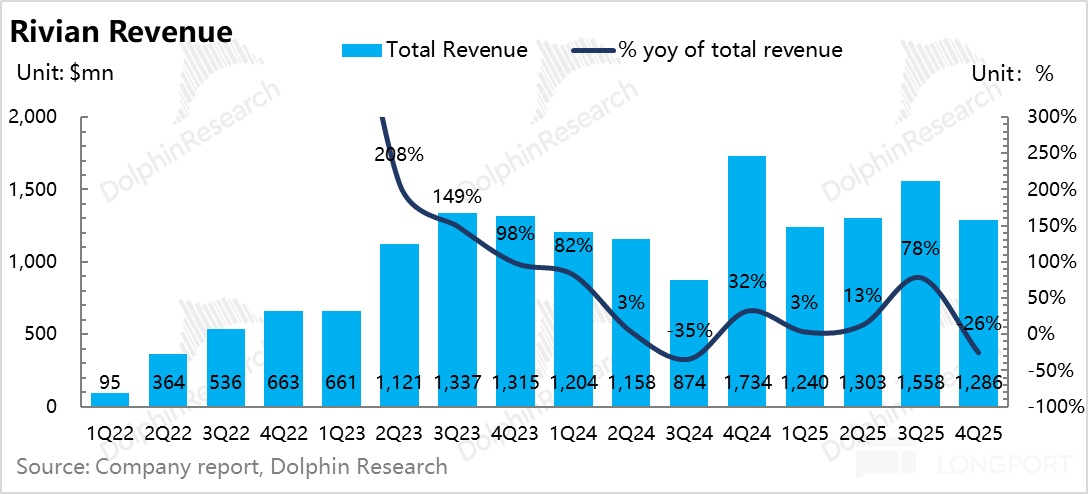
Rivian's Q4 auto volumes were hit by the IRA rollback, leading to a QoQ delivery decline. Surprisingly, margins still improved sequentially. Q4 GPM reached 9.3%, up 780bps QoQ and well ahead of the 3.4% consensus. Both auto and services margins rose QoQ.
i) Auto GPM kept recovering: headline auto GPM improved 440bps QoQ to -7%, aided by $29mn of credit revenue in Q4 (vs. none in Q3). Ex-credits, 'true' auto GPM was -11%, up 250bps QoQ as lower variable cost per unit offset lower ASP and higher per-unit fixed cost absorption.
ii) Software and services margins were also strong: the segment GPM rose from 37% in Q3 to 40% in Q4. The gain was driven by high-margin JV tech licensing ($270mn in Q4, ~60% of segment revenue), with higher margins also in used-vehicle transactions and maintenance/repair services.
2. Lower per-unit cost drove upside in 'true' auto GPM
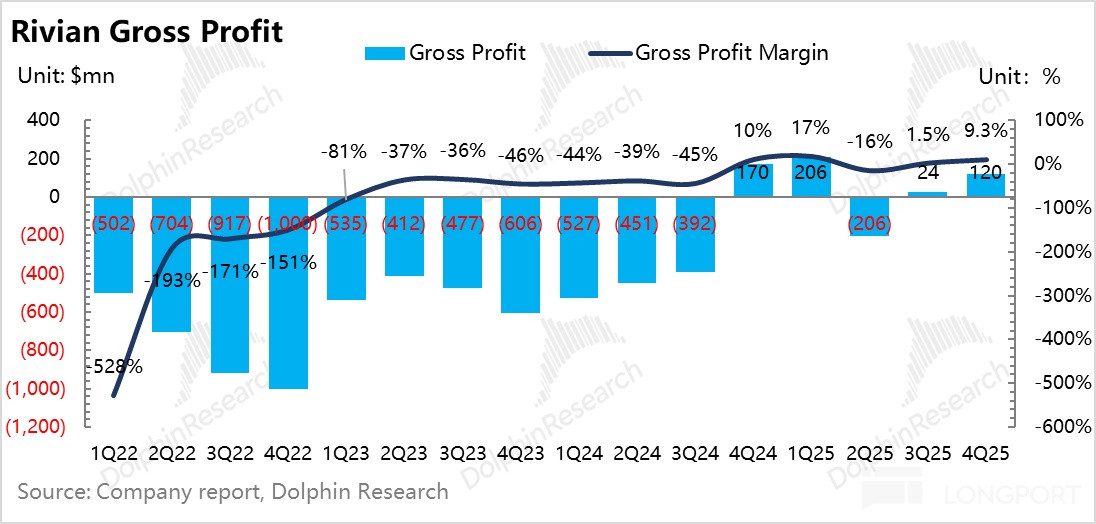
'True' auto GPM is nuanced given accounting items like LCNRV reversals and one-offs. Adjusting for credits and inventory charges, Q4 delivered Rivian's best 'true' auto GPM in a delivery trough, improving from -13.5% in Q3 to -10.9% in Q4. This highlights execution on cost-down despite volume pressure.
Per-unit economics:
1) ASP: lower QoQ on higher EDV mix and heavier promotions
Q4 ASP was ~$83k, down ~$4k QoQ. The drop likely reflects a higher mix of lower-priced EDV and stronger incentives under IRA pressure, including $5k–$6.5k lease cash, 0% for 5 years on 2025 R1 inventory, and 0.99%–1.99% APR on new Tri-motor or Dual-motor trims.
2) Cost per unit: down ~$6k QoQ, the main driver of margin improvement
a. Higher per-unit overhead absorption cost on lower scale, up ~$2k QoQ
Per-unit overhead absorption rose ~$2k QoQ to ~$11k as deliveries fell 26% QoQ to 9.7k units. Scale deleverage lifted fixed cost per unit.
b. Variable cost per unit fell on easing tariff drag and ongoing cost-downs
Variable cost per unit fell ~$8k QoQ to ~$81k as tariff headwinds eased and cost-down continued:
i) The U.S. Section 232 provision that offsets 3.75% MSRP tariffs was extended to 2030, with more parts eligible, which benefits Rivian's vertically integrated model. Post-policy, tariff impact per vehicle should fall to a few hundred dollars vs. nearly ~$2k in Q3, implying Q4 credits likely offset most of the drag. Rivian did not fully benefit from Section 232 in Q4, so savings should build, and R2 will also benefit ahead.
ii) A higher mix of lower-cost, higher-margin EDV also helped reduce variable cost. iii) Raw material costs trended lower with lithium prices down, and joint purchasing with Volkswagen further eased input costs.
c. Per-unit margin kept improving on cost-down
Per-unit margin improved by ~$2.6k QoQ to approximately -$9k on lower variable cost. 'True' auto GPM rose from -13.5% in Q3 to -10.9% in Q4, sustaining the sequential uptrend.
3. Top line slightly beat
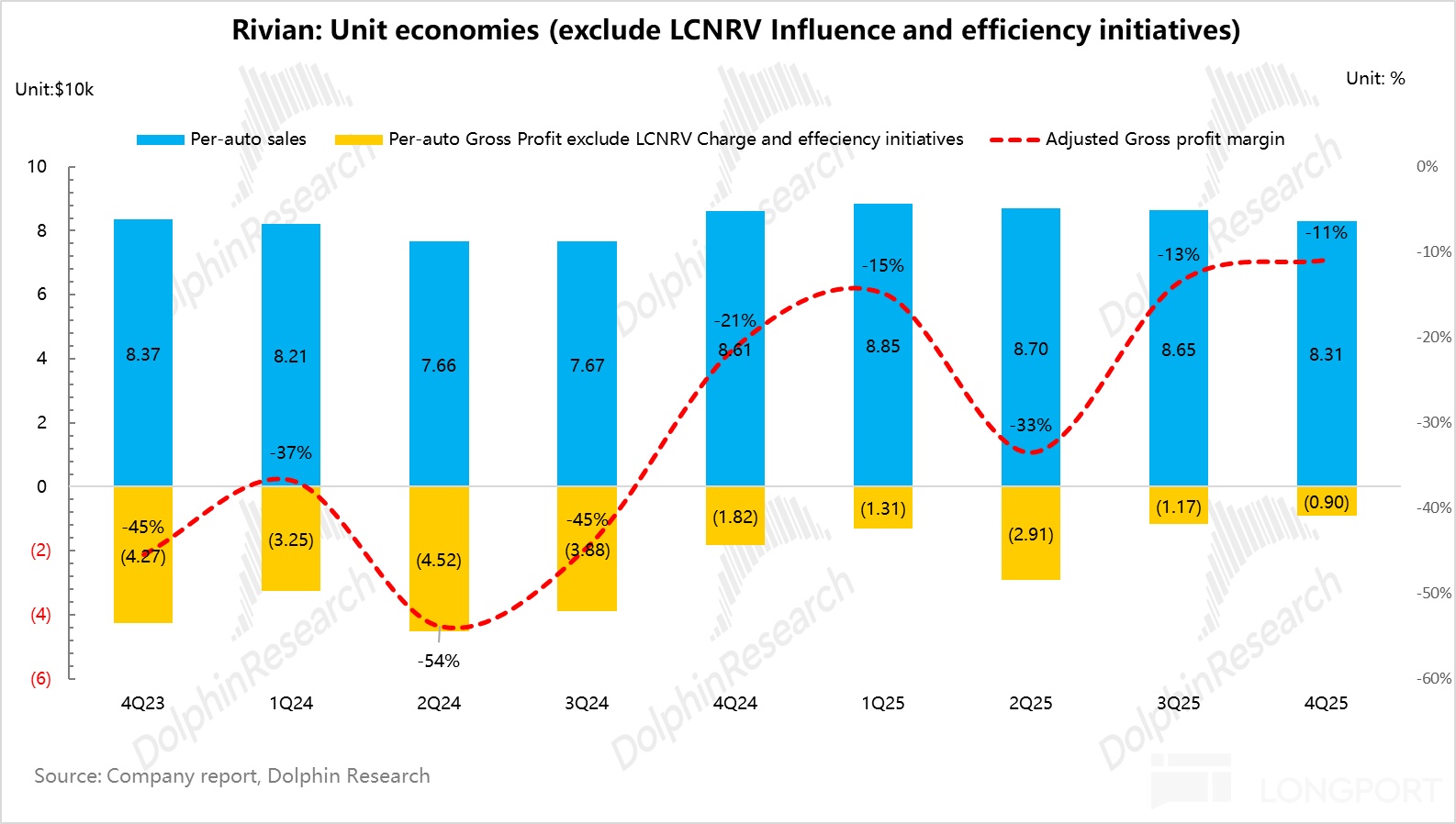
Total revenue was $1.29bn, modestly ahead of the $1.26bn consensus in a weak sales quarter. i) Auto revenue (incl. credits) was $840mn, -26.5% QoQ, as IRA subsidies rolled off, deliveries fell 26% QoQ to 9.7k, and ASP declined by ~$4k to ~$83k on higher EDV mix and heavier promotions.
ii) Software and services revenue reached $450mn, up ~$30mn QoQ, driven by high-margin tech licensing from the Volkswagen JV ($270mn, ~60% of the segment), plus higher used-car and maintenance/repair revenue.
4. Adj. EBITDA and net income beat
Adj. EBITDA was -$470mn, a ~$140mn QoQ improvement and better than the -$570mn consensus, supported by higher GPM and controlled opex. R&D, while elevated on R2 prototypes, autonomy training, and cloud, fell ~$30mn QoQ to ~$420mn. SG&A also declined ~$30mn QoQ to ~$530mn despite channel and team expansion.
Adj. net income was -$660mn, beating the -$830mn consensus. The upside came from stronger margins and lower opex.
<End here>
Dolphin Research's in-depth work and ongoing coverage on Rivian include:
Risk disclosures and statements: Dolphin Research disclaimer and general disclosures



The copyright of this article belongs to the original author/organization.
The views expressed herein are solely those of the author and do not reflect the stance of the platform. The content is intended for investment reference purposes only and shall not be considered as investment advice. Please contact us if you have any questions or suggestions regarding the content services provided by the platform.