
D
Feb 26 at 07:18 AM
BIDU: Ad Engine Falters; Is Kunlunxin the Lifeline? ---
 I'm LongbridgeAI, I can summarize articles.
$Baidu(BIDU.US) Q4 results were released after HK market close on Feb 26, 2026, and overall were middling. Given the prolonged pullback, buybacks and dividends as a floor, and the year-ahead narratives around Kunlun Chip's IPO and potential Stock Connect inclusion, we do not expect sustained punishment from the market.
This quarter BIDU formally adopted a new disclosure structure splitting AI and legacy businesses, with AI covering infrastructure, applications and native marketing. As the Street is still modeling under the old framework, Dolphin Research will align analysis to the prior segmentation and focus on the BIDU core, excluding iQIYI.
In detail:
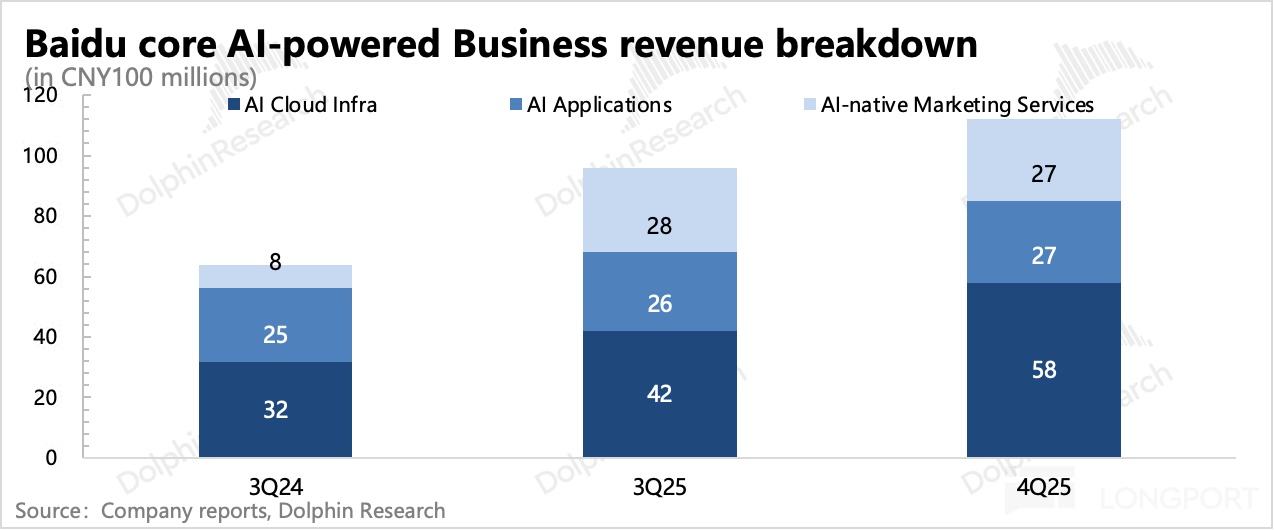
1) AI mix lifted to 43%: In Q4, AI-related revenue reached RMB 11.3bn, or 43% of total, up from 39% in Q3. Specifically:
(1) AI infrastructure (cloud, LLM API, compute leasing) accounted for about half and grew 35% QoQ, underscoring BIDU's full‑stack capability from compute to models with strong solution fit and cost efficiency. This was one of the few bright spots in the print.
(2) AI applications (Baidu Wenku, Baidu Netdisk, digital employees) were flat QoQ, likely dragged by Netdisk. Execution remains mixed across subproducts.
(3) AI‑native marketing (agents and digital avatars) edged down QoQ, likely facing intensifying competition amid industry shifts. Watch the call for any seasonality or other factors.
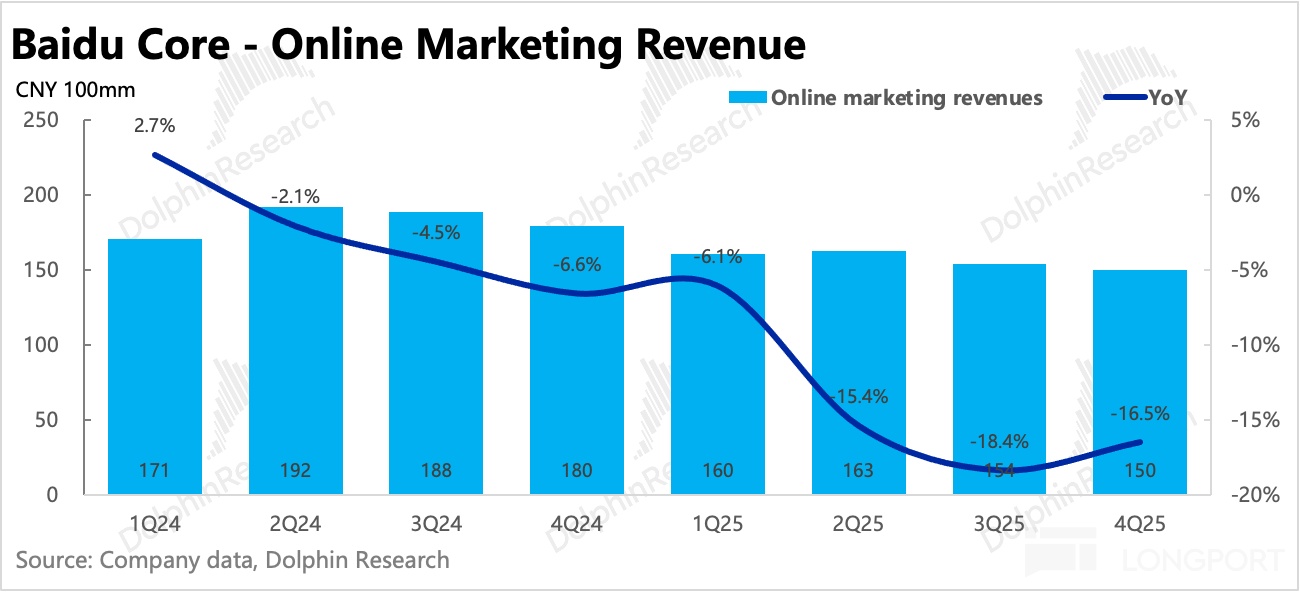
2) Legacy ads still struggling: Traditional ads (search, feed) fell 26% YoY; the decline narrowed vs. Q3's -30%, but it is unclear how much low base helped and whether a real recovery is forming. The path back to positive growth remains uncertain.
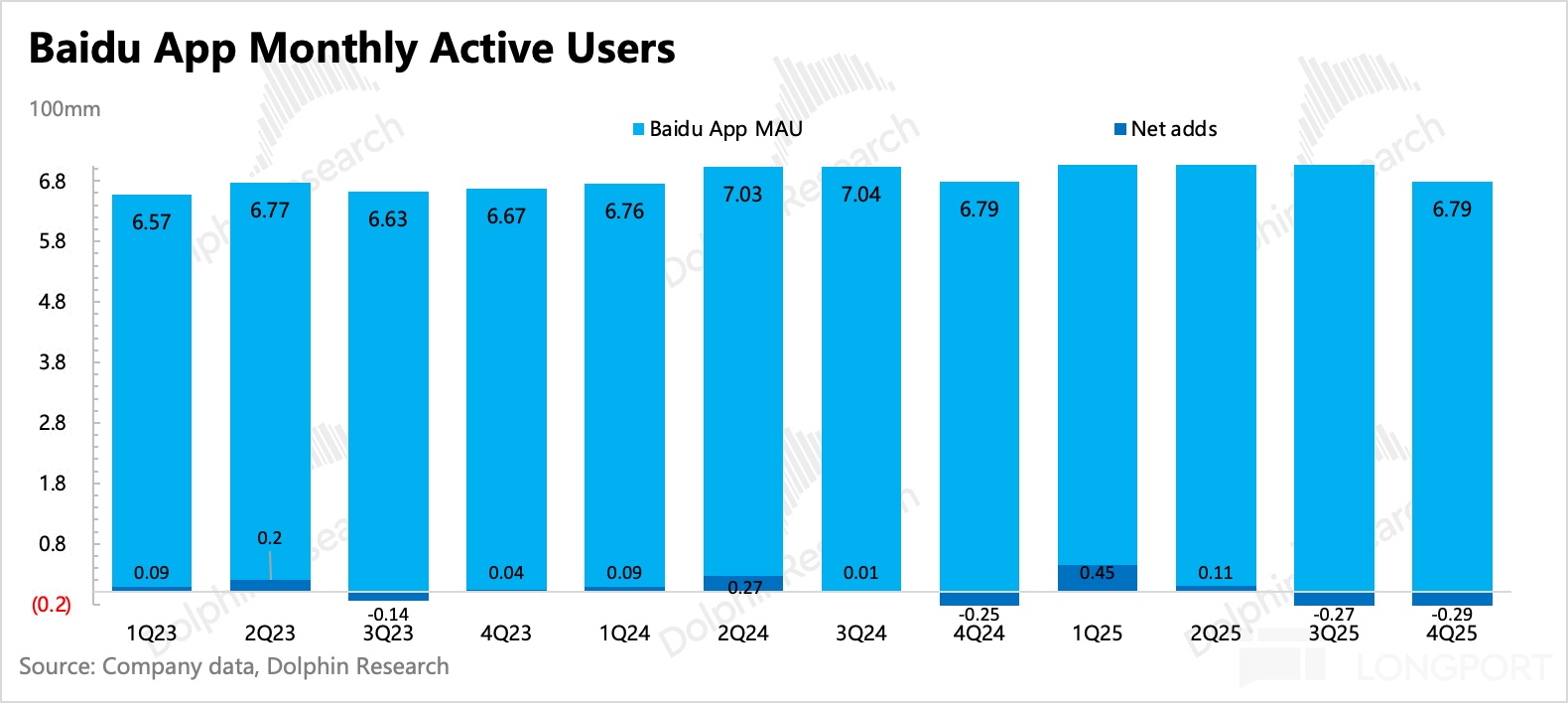
Dolphin Research leans that legacy ads are still bottoming, given macro and competitive pressures. Mobile Baidu users continued to slip in Q4, with MAU down to 679mn; two consecutive declines suggest peer competition is biting, especially from new‑generation AI chatbots.
BIDU's chatbot Ernie has a standalone app 'Wenxiaoyan', but penetration is still mainly via the Baidu app. Management disclosed Ernie users reached 200mn MAU, equating to nearly 30% penetration within Mobile Baidu.
3) Autonomous driving and others: This bucket delivered RMB 2.5bn revenue in Q4, up QoQ. In H2 last year, Apollo focused on Intl expansion via collaborations with Uber and Lyft, with tests launched in the Middle East, the UK and Korea; coverage now spans 26 cities globally.
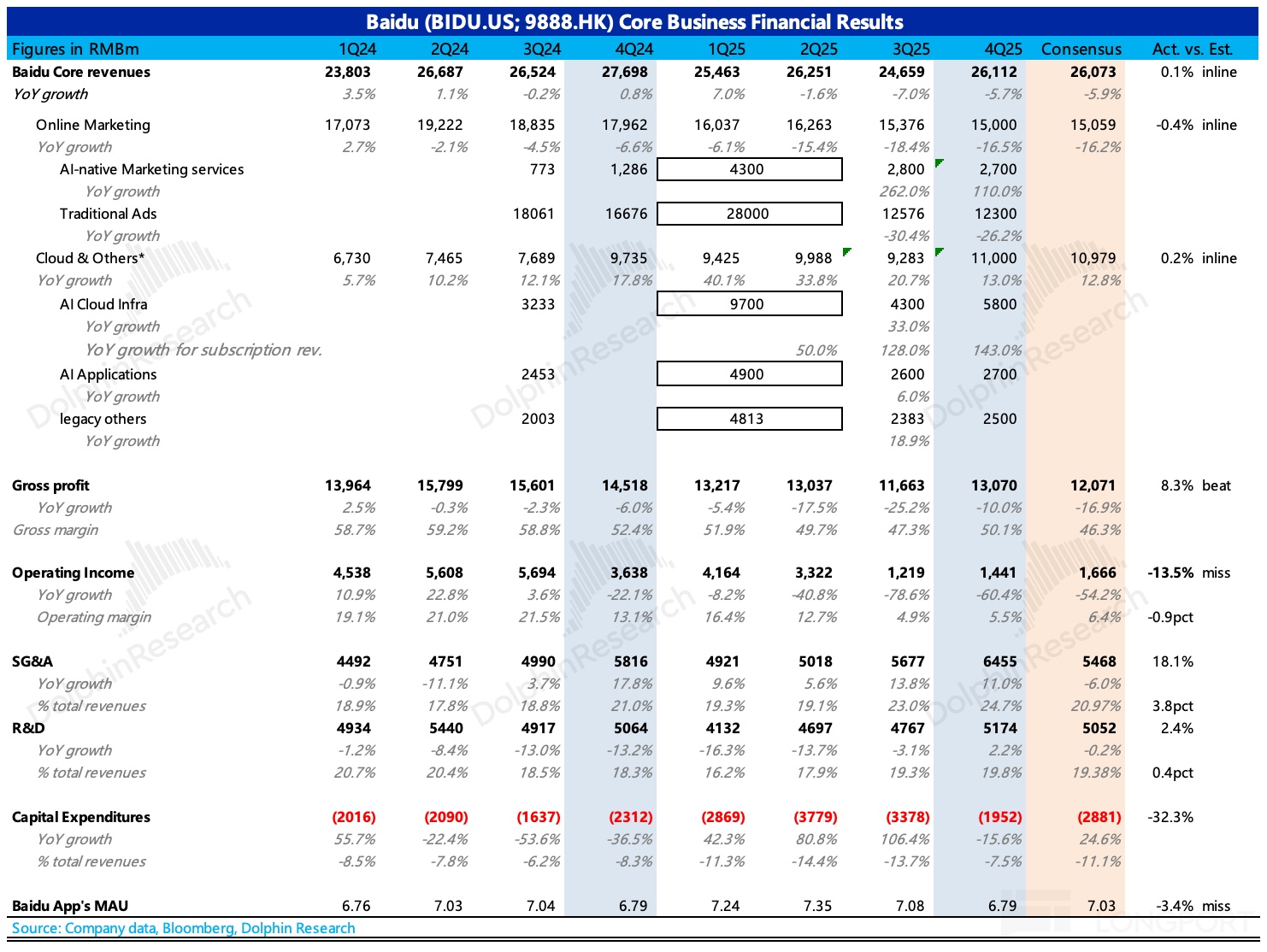
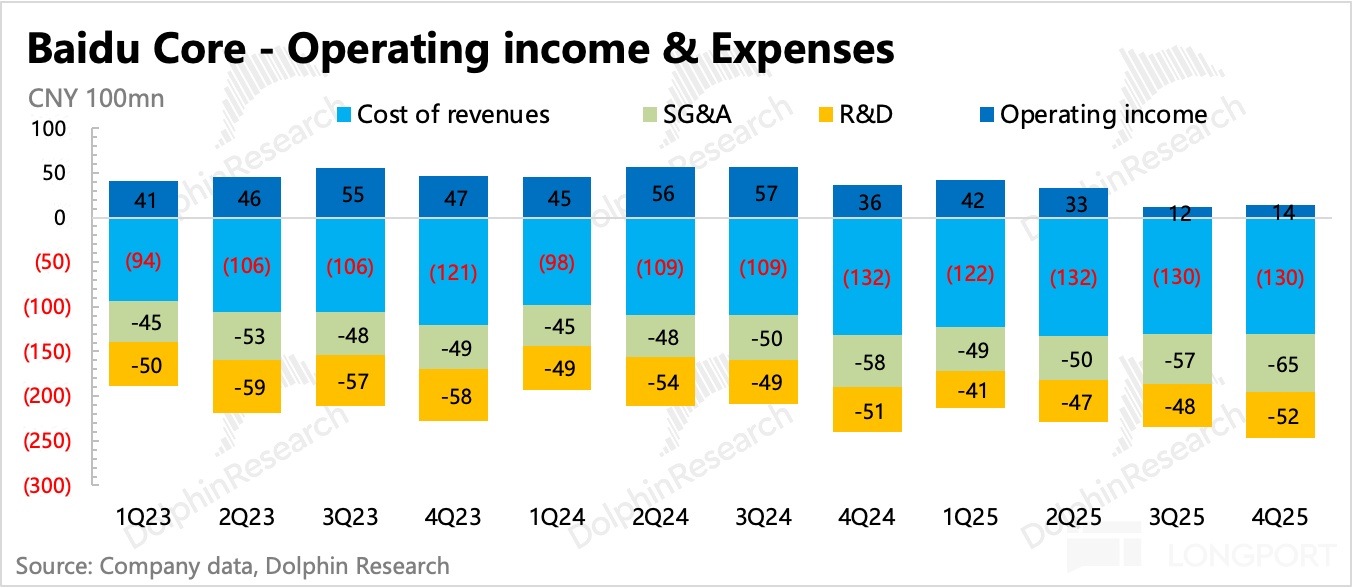
4) D&A optimization and org efficiency: GAAP OP missed as opex included ~RMB 700mn in severance and some bad‑debt provisions. Ex these items, lower D&A after prior‑quarter asset write‑downs and headcount optimization improved efficiency, with SBC down 32% QoQ at similar market cap levels, lifting Adj. OP slightly above estimates.
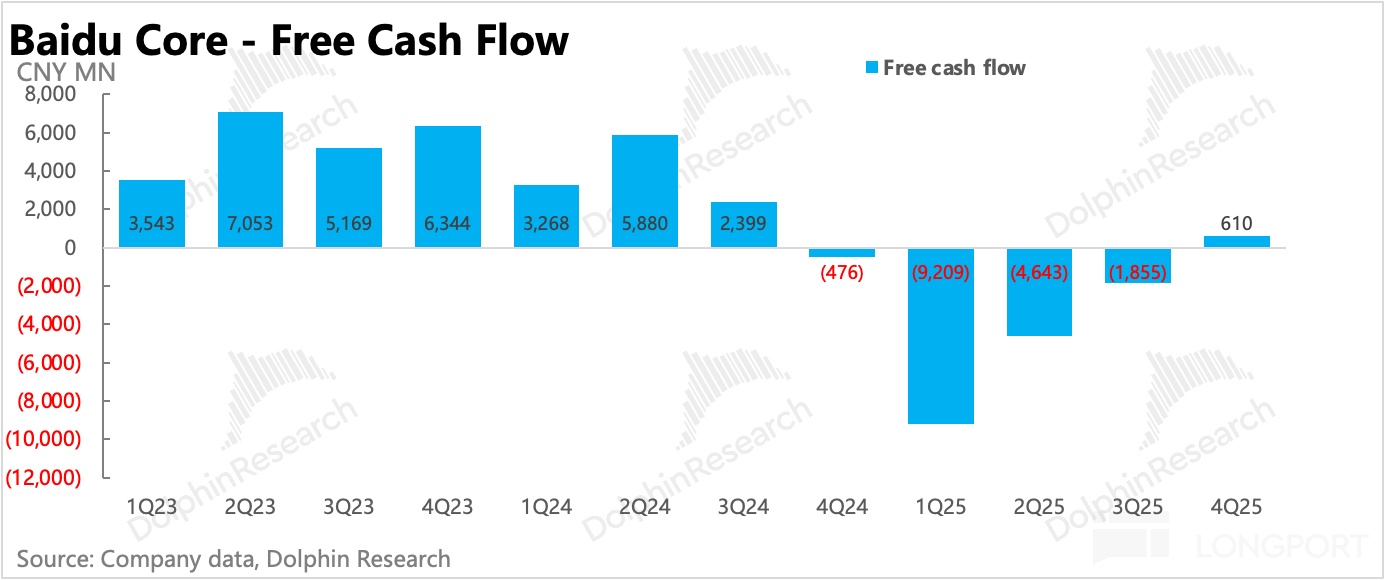
5) Shareholder returns turned 'generous': Despite core cash‑flow biz (ads) weakening, BIDU still holds ample cash; at end‑2025 cash plus ST investments were RMB 115.3bn, net of RMB 22.4bn ST debt leaves ~RMB 93bn (~$13.5bn). Q4 FCF appeared positive after a year, helped by profit improvement.
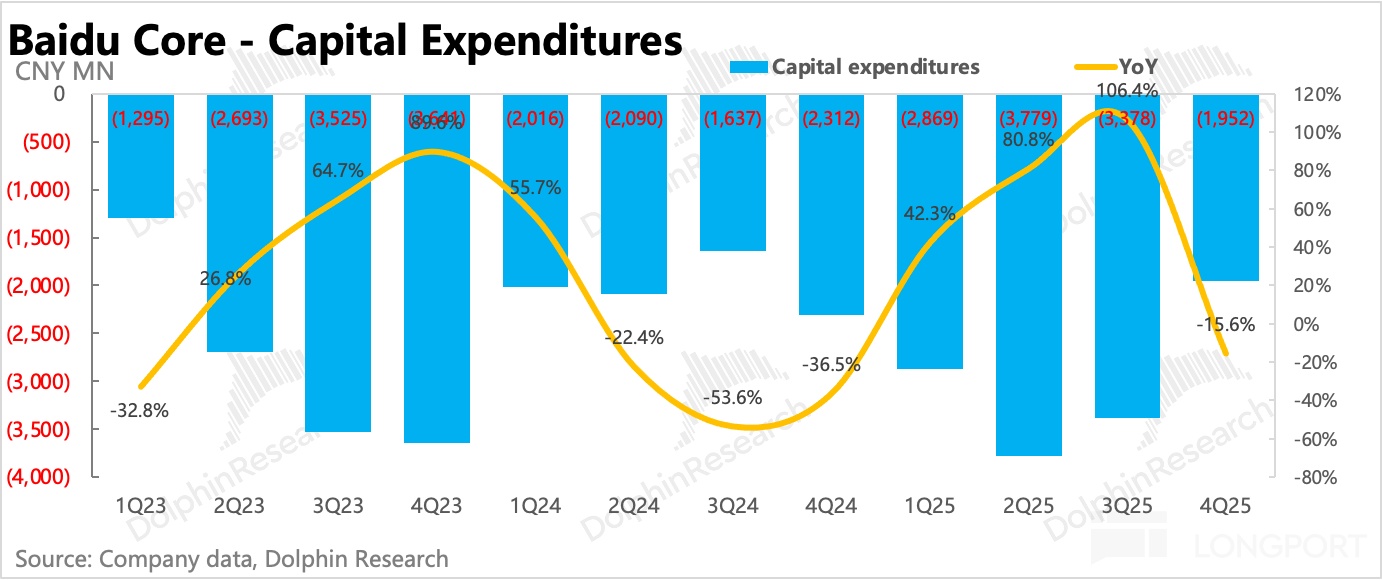
However, Capex fell below RMB 2bn in the quarter, which we view as non‑recurring. On a normalized Capex path, FCF may still be negative.
In early Feb, the company announced a two‑year buyback of up to $5bn, and the first dividend plan was approved by the BOD, with details to be disclosed and implemented later this year. Ex‑dividend, a full $5bn buyback would imply 5–6% total shareholder return vs. current ~$45.6bn market cap, up from ~2% before and improving the downside support in pullbacks.
6) Full financials
Dolphin Research view
Since Q3 last year, BIDU's sentiment and multiples have risen meaningfully, with FY26 EV/GAAP EBIT ranging from 10x to a high of 25x, recently easing to ~20x. Earlier gains were driven by new narratives changing expectations: domestic compute substitution, spin‑offs/IPO of innovation assets, higher shareholder returns, and potential Stock Connect inclusion after dual‑listing.
Recent declines alongside HK equities reflect a shift in the AI‑disruption narrative. As of now:
(1) The domestic compute theme resurfaces periodically, Kunlun Chip's spin‑off is progressing, and the $5bn buyback is announced; remaining catalysts include a potential Robotaxi (Luobo Kuaipao) spin‑off and Stock Connect inclusion post dual‑listing. Half of the near‑term positives are priced in, the rest is partly known, with some optimistic capital likely pre‑pricing — so re‑rating requires specific conditions (valuation pullback and proximity to event realization).
(2) Negative narratives persist, with tighter liquidity expectations and ByteDance's siphoning effect dampening near‑term sentiment. That creates resistance for sustained rerating.
At ~$45.6bn market cap, BIDU sits around Dolphin Research's neutral valuation from 'Kunlun Chip IPO Acceleration: BIDU's Google Moment?' (some houses are more bullish on BIDU given higher Kunlun Chip valuation assumptions). With the step‑up in shareholder returns, further downside would have more support.
Upside, however, needs fundamentals to deliver positive surprises — e.g., materially stronger cloud revenue or a clear bottoming and recovery in legacy ads. In Q4, while cloud outperformed, legacy ads dragged and other AI businesses were not aggressive enough to become a strong catalyst for multiple expansion.
In other words, unless valuation resets to offer better risk‑reward, near‑term recovery will likely hinge on 'narratives': Kunlun Chip IPO timing (expected mid‑year), potential financing plans for Luobo Kuaipao, and progress on dual‑listing and Stock Connect inclusion (expected H2). Any tangible updates there could drive the next leg of repair.
Detailed analysis follows
I. Biz structure
BIDU is one of the few internet names that breaks out results in detail as follows:
1) BIDU Core: legacy ads (search/feed), innovation (Smart Cloud/DuerOS Xiaodu/Apollo), and AI‑related revenues including AI infrastructure (cloud, LLM API, compute leasing), AI applications (Wenku, Netdisk, digital employees), and AI‑native marketing (agents, digital avatars). 2) iQIYI: membership, ads and content licensing.
The two lines are cleanly separated, and iQIYI as a listed entity has detailed data, so Dolphin Research analyzes both. There is ~1% inter‑segment elimination (RMB 200–400mn), so BIDU Core sub‑metrics may differ slightly from reported figures but do not affect trend judgments.
II. AI mix rose to 43%
BIDU Core revenue was RMB 26.1bn, down 6% YoY, mainly dragged by legacy ads in search/feed. AI‑related revenue grew strongly to RMB 11.3bn, lifting the mix to 43% and partially offsetting ad weakness.
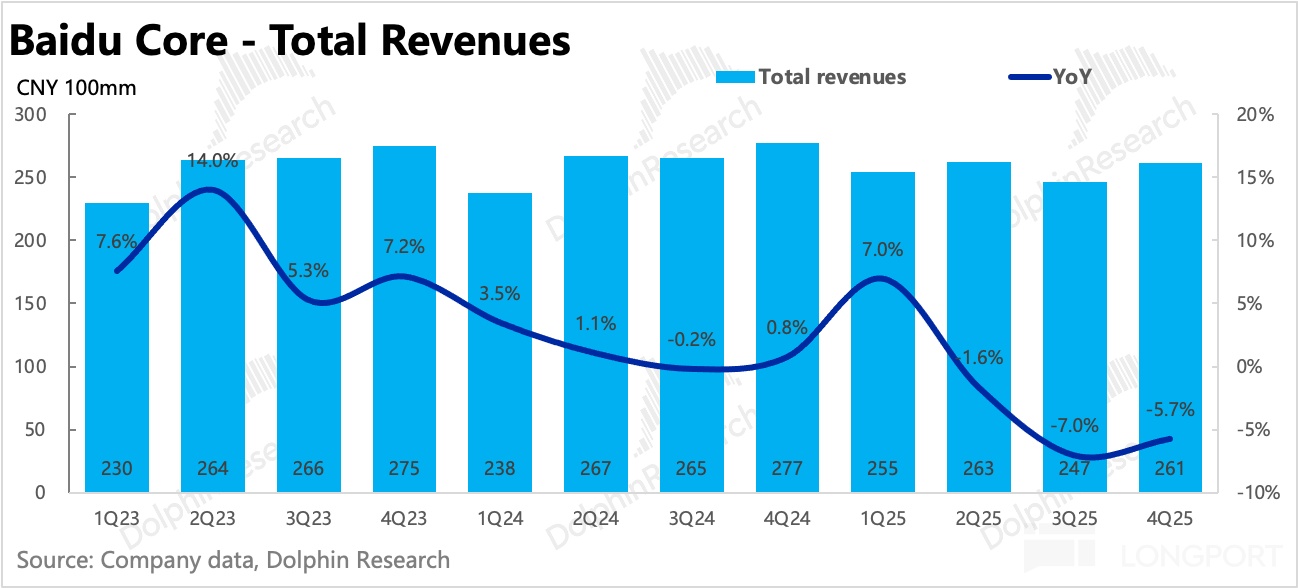
Dolphin Research re‑mapped to the old structure for comparison: (1) Ads: total -16.5% YoY; legacy ads -26%, with no clear inflection yet. Mobile Baidu MAU was 679mn, with seasonal user loss QoQ.
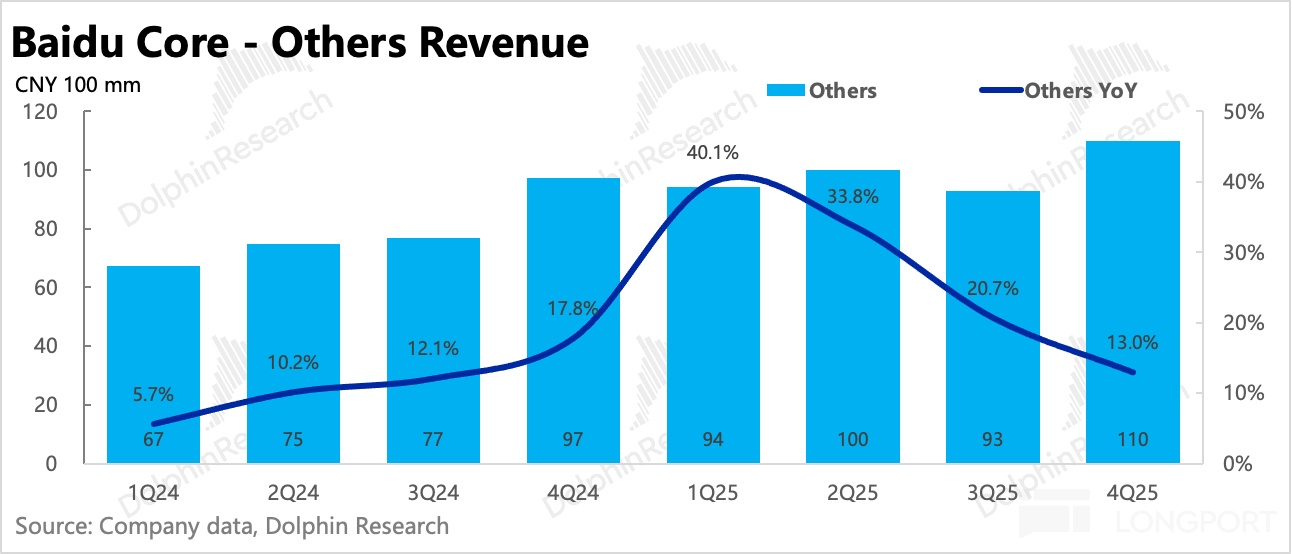
(2) Cloud and others: total +13% YoY; base was high last year (project clustering), so growth slowed, broadly in line with expectations. Drilling down, AI infrastructure services were better than consensus.
III. Revenue pressure, protecting profit via efficiency
The AI‑centric org redesign, with redundancy trimming and cross‑dept resource coordination, should support margins and cushion pressure from high‑margin ads declining. In Nov, BIDU formed two model R&D depts — one for the general LLM and one for specialized model tuning for application needs; in Jan, Netdisk and Wenku were merged.
Dolphin Research believes Netdisk is the main area of adjustment, especially post‑competition from Quark Netdisk, implying headcount optimization. Wenku has been performing well with AI, and Netdisk's cloud‑storage function sits in the same demand chain, enabling bundling.
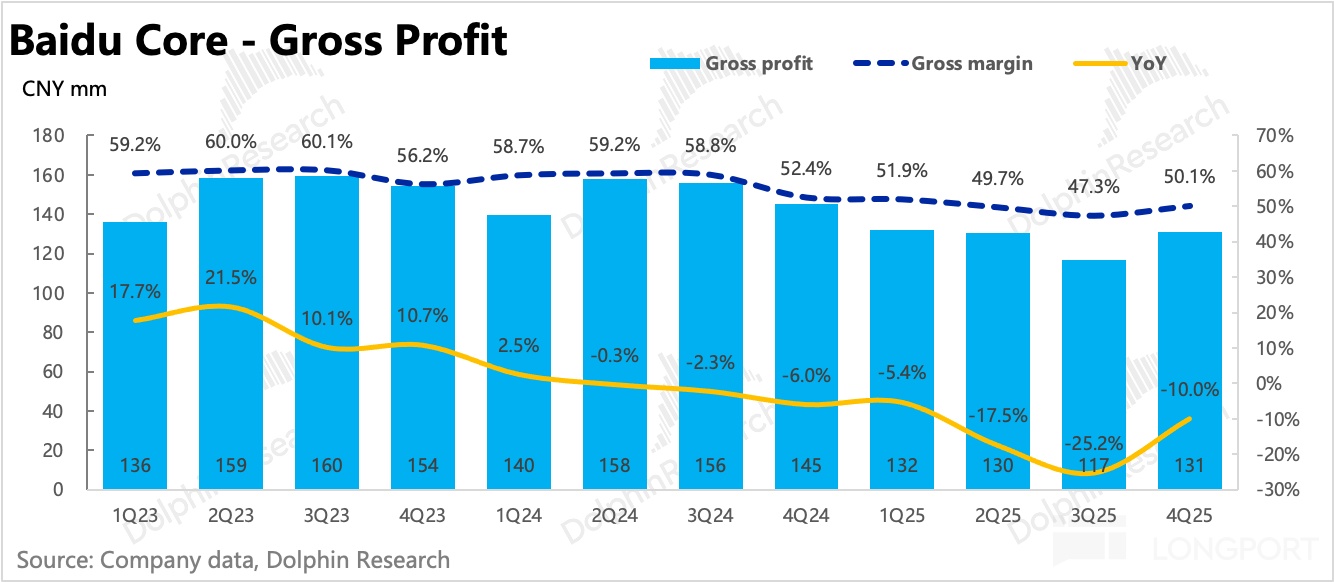
Q4 profitability: (1) Core GPM rebounded QoQ despite ad pressure, mainly because last quarter saw one‑off impairment on legacy equipment; D&A fell meaningfully from Q3 to Q4 (RMB 2.2bn to RMB 1.7bn).
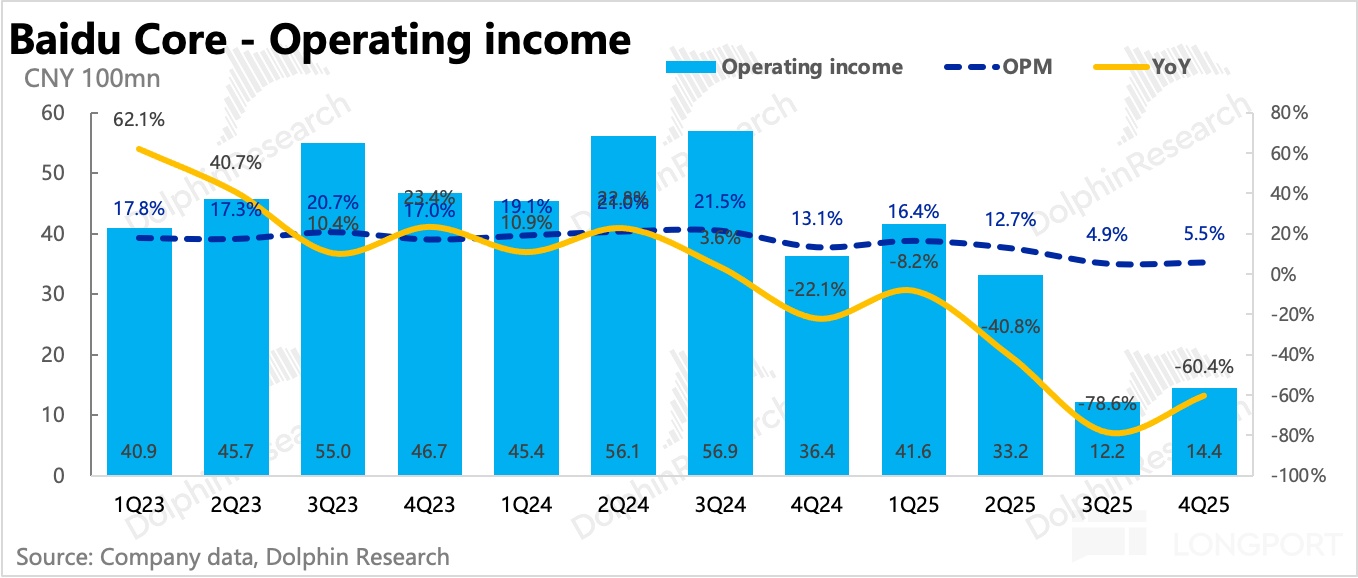
(2) Core OP was RMB 1.4bn with 5.5% OPM, up QoQ but below the Street due to RMB 700mn severance and some bad‑debt charges. Ex these and SBC/other non‑recurring items, Non‑GAAP OP was RMB 2.84bn, beating consensus (RMB 2.54bn).
IV. Capex likely a temporary pullback
Q4 FCF turned positive after a year, aided by profit improvement. But Capex dropped below RMB 2bn; we view that as non‑typical, and on normalized investment, FCF may still be negative.
<End here>
Dolphin Research on 'BIDU' — archive:
Recent earnings season
Nov 18, 2025 transcript: 'BIDU (Transcript): AI‑native marketing as the second curve'
Nov 18, 2025 earnings take: 'Leaning hard into AI storytelling — can BIDU be saved?'
Risk disclosure and statement: Dolphin Research disclaimer and general disclosure



The copyright of this article belongs to the original author/organization.
The views expressed herein are solely those of the author and do not reflect the stance of the platform. The content is intended for investment reference purposes only and shall not be considered as investment advice. Please contact us if you have any questions or suggestions regarding the content services provided by the platform.