
D
Mar 25 at 03:09 AM
Nongfu Spring (Trans): No price hikes planned; still targeting double-digit growth---
Below is Dolphin Research’s summary of$NONGFU SPRING(09633.HK) FY2025 earnings call highlights. For the full take, see: 农夫山泉:防御转进攻,“水茅” 强势狂飙!.
I. Key takeaways from the results
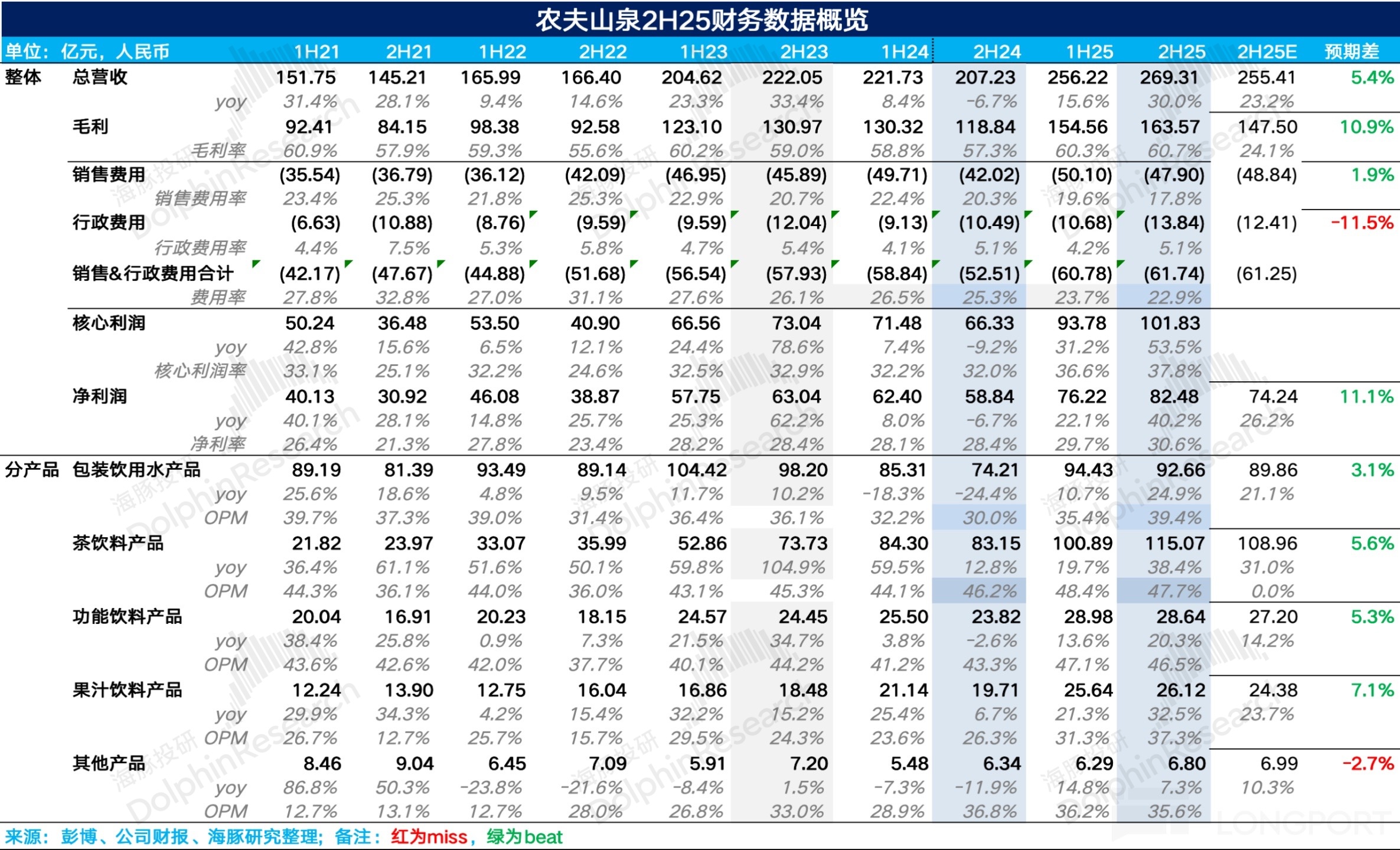
1. Shareholder returns: The BOD proposed a FY2025 final cash DPS of RMB 0.99, totaling Approx. RMB 11.13bn, implying a ~70% payout ratio. The dividend rose 30.9% YoY.
2. Targets: For 2026, management is targeting double-digit revenue growth, with Q1 tracking in line. No guidance on GPM or NPM given raw-material volatility, notably PET.
3. Revenue mix: In 2025, packaged water revenue was RMB 18.709bn (35.6% mix, +17.3% YoY), while beverages were 63.9% of sales, with all categories posting double-digit growth. Tea drinks delivered RMB 21.596bn (41.1% mix, +29% YoY), functional drinks RMB 5.762bn (+16.8% YoY), and juice RMB 5.176bn (+26.7% YoY).
4. Capex: 2024–2025 capex stayed above RMB 6.5bn for two straight years, with 2026 expected to remain at a similar level. Spend is focused on new plants and lines.
5. Key financial moves: Inventory days rose from 82.3 to 95.5, driven by tea supply-chain buildout. Basic EPS was RMB 1.41 (+30.9% YoY). FX loss was Approx. RMB 199mn, while finance costs fell 26.4% YoY.
II. Detailed call notes
2.1 Management highlights
1. Packaged water
a. The dual-engine of water and beverages continued to strengthen, with packaged water gradually recovering. Market leadership remains solid.
b. Three new water sources were added in 2025: Bada Gongshan in Hunan (forest coverage ~94.1%); Longmenshan in Sichuan (one of 36 global biodiversity hotspots); and Jiaozixueshan in Yunnan (main peak >4,200m).
c. In early 2026, the Nyainqentanglha Mountains in Tibet (main peak ~7,100m) will be added, bringing the nationwide network to 16 premium sources.
d. The open-factory sourcing program continues, with industrial tourism topping 700k visits in 2025. About 40% involved educational trips to water sources.
e. The limited-edition Year of the Snake glass-bottled mineral water returned, supported by a short promo film featuring brand ambassador Pan Zhanle.
2. Tea drinks
a. Oriental Leaf rolled out an instant-win under-cap campaign, paired with integrated on/offline ads. This reinforced consumer engagement and brand awareness.
b. In May 2025, Oriental Leaf launched two new flavors, aged tangerine peel white tea and chrysanthemum pu-erh, rounding out its six-tea portfolio.
c. In Jun 2025, a carbonated tea drink, ‘Iced Tea’, debuted using 100% real tea. It adds a sparkling mouthfeel.
d. The company is advancing a full tea value chain, introducing standardized industrial processes in top tea regions like Yunnan. It is investing in modern primary-processing plants.
3. Functional drinks and juice
a. Functional drinks remain consumer-centric, with brand exposure boosted by sponsoring marathons and youth sports.
b. The company continues to cultivate NFC juice and the 17.5° series. A 17.5° honeysuckle berry blend launched in Dec 2024.
c. In Jan 2025, the 17.5° 100% fresh cold-pressed orange juice launched. The 900ml family pack became a top seller at Sam’s Club.
2.2 Q&A
Q: Outlook for packaged water growth into 2026? How will higher PET affect ASP, volume, and margins?
A: On ASP, we have no plans to adjust prices for now. On costs, higher PET and other plastic packaging have impacted the whole industry, including us. Most players have some PET hedging or fixed-price arrangements, but we cannot disclose price or volume details.
We are not guiding GPM or NPM this year. We will keep monitoring volatility and are confident in procurement, inventory planning, and supply capabilities through cycles.Overall supply-chain strength is the key to defending full-year GPM and NPM. That remains our focus.
On industry trends, overall packaged water growth slowed over the past two years, but our growth has diverged from the market. We believe secular growth will follow consumers’ rising health awareness and their recognition of natural sources and minerals in water.Competition has evolved from channel and brand to supply-chain and management capabilities. Our water-source moat is hard to disrupt, and we aim to capture more share.
Q: Juice and functional drinks accelerated in 2H last year. What are the 2026 growth goals and plans?
A: We are seeing broad-based growth, with all categories delivering double-digit increases. In functional drinks, classic energy-drink growth has cooled, while electrolyte water and other emerging sub-segments are driving a second growth wave.
We launched a new electrolyte water in Mar 2026, enriched with minerals and vitamins lost during exercise. It targets both post-workout and outdoor scenarios.On juice, premiumization is clear. Ingredient-focused consumers now prefer pure juice with no additives rather than flavorings.
We operate apple orchards in Xinjiang and orange groves in Ganzhou, Jiangxi, enabling deep upstream investment and strict quality control. NFC and 17.5° lines leverage high-quality inputs and process discipline.We see sizable runway in both functional drinks and juice. New functional SKUs are out in 2026, with marketing to follow, and categories complement each other by season and usage.
Q: Will rising raw-material costs ease competitive intensity? Any new strategies for snack-discount channels and e-commerce?
A: As of Q1 2026, we have not seen competition easing. The sector remains highly competitive at the start of the year.We will monitor how higher PET and other inputs may reshape dynamics and respond accordingly.
Our competitive edge derives from product, brand, and channel execution. The industry has weathered periods with even higher PET costs historically, and competition did not abate then.On snack-discount channels, we stay open to cooperation across all channels and have not excluded any customers. Major chains and local stores both carry our products.
Our portfolio breadth lets us tailor SKUs by channel, but cooperation must preserve overall price discipline and omni-channel order. Both sides need alignment.On e-commerce, we have been disciplined, with a top-down approach to avoid price wars. We did not join the delivery and subsidy battles last Jun–Aug.
Price disorder, whether online or offline, creates uncertainty for distributors and small shops. It harms the market far more than any short-term volume boost from subsidies.Our e-commerce mix has declined in recent years, against the broader industry expansion. We also have no price hike plans.
Expense levers will be adjusted dynamically with market conditions and competition. If we tweak strategy, it will be via OPEX, not via price actions.
Q: Water and tea are ~77% of revenue. How are you thinking about category focus and resource allocation this year, especially water recovery and sustaining sugar-free tea growth on a high base? Also, capex plans?
A: In water, we have led the market for 13+ years, but our share is not yet high, unlike tea. There is ample headroom to gain share.In 2025, water achieved a healthy recovery but remained below 2023 levels by year-end.
Our near-term 2026 goal is to return to the pre-2023-controversy peak and then surpass it. We will keep educating consumers on water knowledge and source differences.Red-label (natural) vs. green-label (purified) messaging will help drive differentiation.
We are also expanding usage scenarios. The ‘good water for cooking and soups’ concept is penetrating back-of-house, and we featured in food programs in 2025.A number of F&B channels have started to use and promote our water.
On tea, while the sugar-free segment’s overall growth has moderated, it still grows double digits. We see the ceiling as far away, given China’s rich tea culture and diversity.Penetration and per-capita consumption both have room to rise.
Upstream, over the past 1–2 years we have invested heavily in raw-material processing and management to ensure quality and supply. Premium tea is constrained by agriculture and processing, and could become a bottleneck.On product, we will sustain high-quality taste and keep innovating flavors, such as 2025’s aged tangerine peel white tea and chrysanthemum pu-erh.
More SKUs are in the pipeline. Marketing will integrate tea culture with under-cap rewards, brewing comparisons, and tea-culture events to boost engagement.In other categories, new SKUs are coming in functional and juice. We do not rank categories by priority.
As long as we make great products, each can become a growth driver. Which product becomes the next blockbuster is up to consumers.On capex, we stayed above RMB 6.5bn in 2024–2025, and with new plants and water-source facilities coming online in 2026, we expect capex to remain elevated.
Q: Channel rollout, target consumers, and sales goals for the new electrolyte water? Any updates on overseas expansion?
A: Both the electrolyte water and Iced Tea are rolling out across all channels. Distributors nationwide can order now.Use cases are diverse: heavy sweaters and sports enthusiasts are the primary target, but daily commuters are also in scope as awareness of electrolytes and vitamins has moved beyond gyms.
Rollout pace will follow market feedback, giving distributors flexibility. It is too early to set sales targets for the capital market.Existing products remain the core growth engine, while new launches are incremental. We will adjust channel and promotion cadence based on demand.
Overseas, we entered Hong Kong in Jul–Aug 2024 with natural water and tea (including Oriental Leaf). We launched in Singapore by end-2025, with distribution ramping.We began Malaysia in early 2026. We are proceeding step by step without grand plans, learning local channels and consumer feedback, and feeding those lessons into future brand building.
Q: Is double-digit revenue growth still the 2026 goal? Sales expense ratio fell to ~18% in 2H25; is that sustainable?
A: Yes, we are still targeting double-digit growth in 2026. Performance is tracking the plan and expectations.On opex, overall ad and marketing ratio declined YoY in 2025, partly because 2024 was an Olympic year with heavier spend during Paris, so 2H25 run-rate fell.
Whether a lower ratio is sustainable depends on conditions. This year, we expanded under-cap rewards beyond last year’s Oriental Leaf and Iced Tea.It is part of the 30th-anniversary consumer cashback program, and the full beverage lineup can participate.
Total spend will likely rise, but the ratio will be market-driven, depending on sales and competition. Our selling and distribution ratio has been relatively low within the sector.We are willing to invest more when platforms and events are attractive, but decisions are anchored on content quality and ROI. We will stay prudent.
Q: Juice EBITDA margin improved quickly. Was it due to mix, and is there more upside?
A: Mix helped, but scale from sales growth was a major driver. Looking ahead, overall scale will be the key.NFC still has significant runway, and as scale builds, we see further room for juice margins to expand.
Q: Strategy for large-pack water this year? With input risks, where is water OPM headed? Will the payout ratio rise? Any change in cooler investments?
A: We are pushing both small and large formats in tandem. In Dec, large packs naturally pick up with more gatherings and cooking occasions.Large and small serve the same consumers in different scenarios, not distinct cohorts.
With more time to research water sources and quality, large-pack shoppers build stronger awareness, which also lifts small-bottle purchases. Messaging is consistent.We will promote different formats by scenario.
On efficiency, we have driven ongoing cost-downs: solar at plants to cut energy use, water recycling, automation, lights-out factories, AGVs, and shorter delivery radii.But we will not sacrifice user experience for savings.
We will not reduce bottle weight, as packaging is consumer-facing. For agri inputs like juice and tea, we have chosen better and sometimes pricier ingredients because consumers can taste the difference.On dividends, the payout ratio has been around 70% for three years.
This year’s dividend rose 30.9% to Approx. RMB 11.1bn. Our principle is to deliver stable, above-industry dividends without fixing a ratio or committing a level.We balance shareholder returns with future cash needs, capex, and contingencies to preserve stable payouts.
On coolers, we will keep a steady annual investment, roughly flat in 2026. It is not about deploying as many as possible at once.Post-deployment service matters most, including delivery, merchandising, and long-term engagement with store owners.
It is a full capability stack covering new placements and replacements for older units.We will continue to build that infrastructure.
Q: Gov. subsidies fell by ~RMB 200mn in 2025. What is the outlook? Tea segment margins lagged improvement vs. others; was that due to higher spend? Also, what does the 30th-anniversary mantra ‘steadier, slower, further’ mean?
A: Tea is the most profitable among our four major categories, with already very high margins. The smaller improvement vs. others reflects heavier investment in equipment and lines as sugar-free tea scaled rapidly.On subsidies, they do not necessarily rise with new plants. There is an investment cycle and actual cash in/out; sustained increases should not be expected.
As for ‘steadier, slower, further’, it is a philosophy, not a strategy shift. Growth actually accelerated in 2025, so ‘slower’ does not mean easing off.It reflects craftsmanship and persistence.
When we are confident in our decisions and goals, we accept slower payoffs, then execute efficiently. From the first Qiandao Lake source to today’s 16 sites, we have never used a drop of municipal tap water in 30 years.Oriental Leaf took over a decade to inflect.
From Gan-navel orange cultivation and disease control to juice-process R&D has taken 17–18 years. These long-cycle efforts built our moat and operating capability.We will stick to this to stay resilient through cycles. No big strategic changes: make great products, control quality, and serve consumers and distributors well.
<End of text>
Risk disclosure and disclaimer:Dolphin Research Disclaimer and General Disclosure
Login to unlock14,182characters for free
This content is only available to signed-in users. Sign in to your Longbridge account to read the full post.
