
D
Mar 25 at 09:57 AM
PDD: Has the Maverick Gone Mediocre?---
 I'm LongbridgeAI, I can summarize articles.
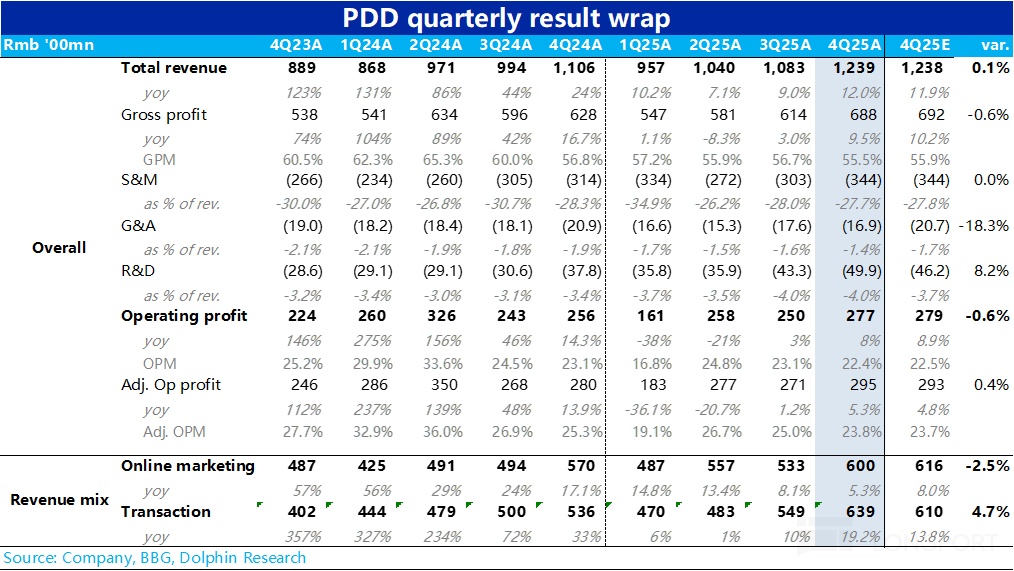
Pre-mkt on Mar 25,$PDD(PDD.US) (PDD) released Q4 2025 results, marking a second straight quarter broadly in line with the Street. The company now looks like the most focused and value-oriented e-comm player in China. Performance highlights:
1) Top-line recovery, domestic soft, overseas strong: Total revenue was approx. RMB 123.9bn (+12% YoY), essentially in line. Growth accelerated vs. last quarter. The mix skewed weaker domestically in a tough 4Q for China e-comm, while Temu outperformed overseas.
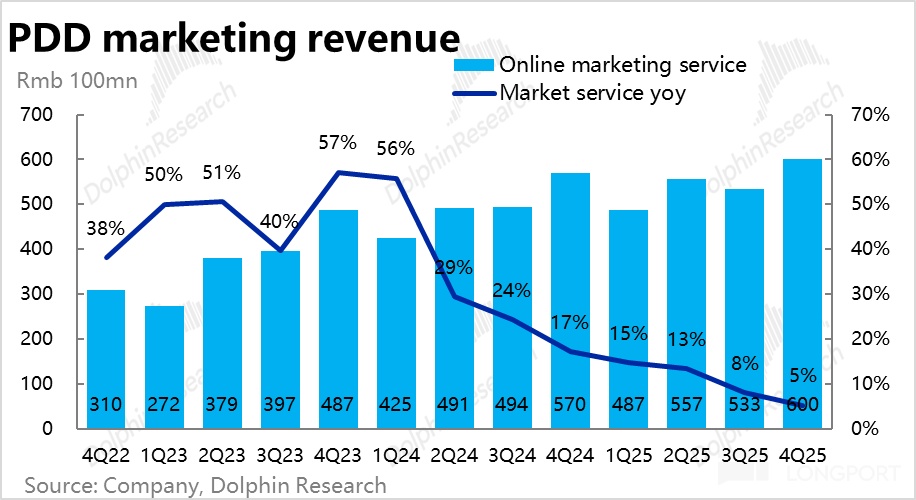
2) Core ads growth decelerated further, but manageable: Platform ads, largely tracking the domestic app, grew about 5% YoY, below Bloomberg consensus at 8%. This shortfall mirrors trends seen at JD and Alibaba, so it is not surprising. On both absolute growth and sequential decel, PDD still outpaced peers, suggesting fading state subsidies are a marginal tailwind for PDD.
3) Temu re-accelerated: Commission-based revenue came in around RMB 63.9bn, with YoY growth surging to 19%, ahead of expectations. Given a weak domestic backdrop for commissions, this implies Temu’s growth beat was stronger than expected.
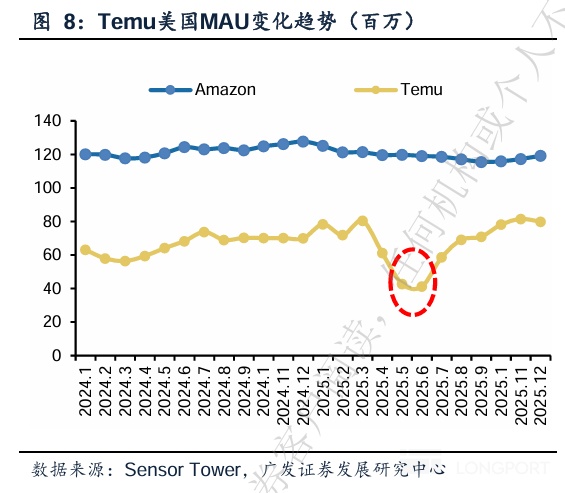
With tariff shocks now behind (and parts of prior tariffs ruled unlawful), Temu’s US user base has largely recovered to pre-tariff levels. Temu is also expanding quickly in Europe and other markets, putting it back into a high-growth phase (Dolphin Research estimates GMV growth at approx. 50%).
4) State subsidies faded; S&M ran below expectations: GPM was 55.5%, slightly below consensus, likely as Temu’s faster-than-expected growth lifted its revenue mix and structurally weighed on margins. On opex, sales & marketing spend was approx. RMB 34.3bn, broadly in line. However, S&M grew nearly 10% YoY, a notable pickup vs. the prior two quarters, suggesting Temu’s growth recovery is accompanied by higher user acquisition and marketing needs, while domestic subsidies did not rise materially as state subsidies faded.
R&D and G&A diverged vs. expectations, with higher R&D likely tied to AI feature development and lower G&A reflecting PDD’s productivity discipline. Overall, the two largely offset.
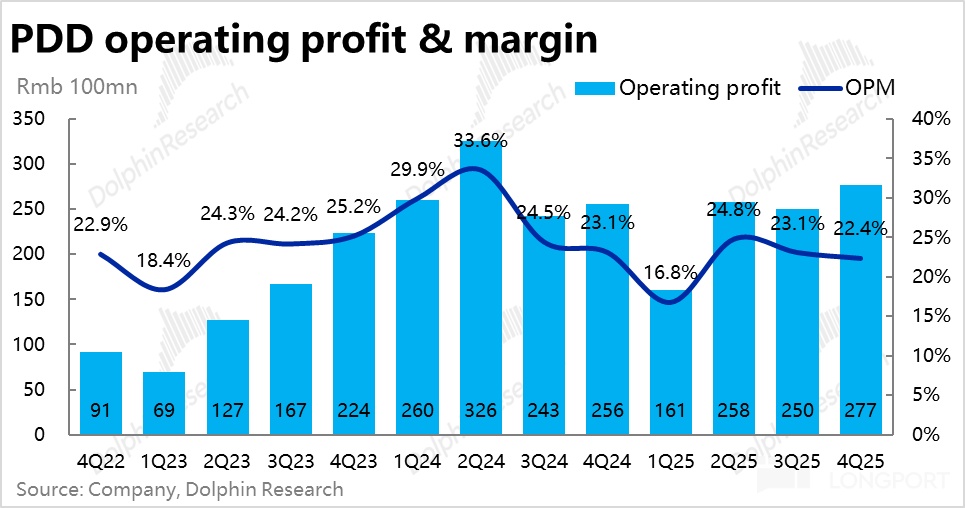
5) Is the margin downcycle nearing an end? With most metrics near expectations, operating profit was RMB 27.7bn, essentially in line. Trend-wise, Temu’s mix drag on GPM and a mild pickup in opex growth led OPM to fall about 70bps YoY, with the decline narrowing. This suggests margins could bottom and start to recover in 2026 as domestic headwinds fade and Temu optimizes profitability.
Dolphin Research view:
PDD’s last two quarters can be summed up as ‘steady’—a word not often associated with the company—delivering few surprises vs. expectations. Two key signals stand out.
1) As state subsidies faded, sector growth slowed and PDD was not immune. However, because PDD benefitted the least from those subsidies, it faces the lightest payback as they roll off.
2) After US tariff shocks subsided, Temu’s recovery has been better than expected. If sustained, the market could move to an SOTP framework and underwrite standalone value for Temu, expanding the GMV ceiling in investors’ models.
Overall, we view this print as neutral to slightly positive for PDD.
2) Outlook for 2026:
1) For the domestic core app, we see both positives and negatives. a) The biggest marginal positive is the step-down in state subsidies in 2026. While this slows overall sector growth and affects PDD too, PDD’s relative disadvantage on subsidy channels meant it had to self-fund more subsidies earlier, weighing on domestic profits in 1H25 (we estimate a triple-digit RMB bn impact for the full year). With that disadvantage narrowing in 2H25 and state subsidies fading further in 2026, the net effect should be a marginal tailwind for PDD.
b) A marginal negative is tax ‘normalization’—from Oct 1, 2025, tax filings for online merchants will shift from self-reporting to platform-reported, making under-reporting harder. JD’s 1P model and major brands on Tmall are already largely compliant, so the impact is limited there. The biggest hit will land on small and mid-sized merchants on Taobao and PDD, where incremental tax could be around 10% of revenue for affected sellers, per some checks.
Higher taxes reduce merchant margins if absorbed, potentially curbing ad budgets. If passed through via price hikes, price competitiveness suffers, weighing on GMV. Given merchant mix, PDD is likely most exposed.
c) Another factor, more sentiment than P&L, is the ongoing regulatory probe following the recent ‘assault’ controversy, with limited disclosures so far. Since Jan, the SAMR and tax authorities have been on site; publicly, only a RMB 1mn fine by the Changning District Tax Bureau for failure to submit tax info has surfaced, with no further direct mention of PDD by regulators.
Based on peer cases, PDD may be asked not to overemphasize ‘lowest price on the internet’ or force/semiforce merchants into auto price matching and lowest-price declarations. That said, beyond explicit restrictions, PDD’s model relies more on traffic allocation and organic selection of low-price supply than coercion, so the practical impact should be limited.
Net-net, the clearest positive today is the subsidy fade. Tax normalization is not yet tangibly felt across platforms, and regulatory impact will depend on final findings and remedial requirements. We therefore still expect the domestic core app to bottom and steadily recover in 2026.
2) With the domestic app mature and PDD not leaning heavily into instant retail or AI, earnings and valuation upside rests mainly on Temu. This print’s above-expectation growth signal from Temu should help unlock that optionality.
In the US, operations and user scale have largely returned to pre-tariff levels, setting up a return to normalized growth in PDD’s largest single market. Meanwhile, the shock accelerated new market builds (Europe-led, also Middle East, LatAm, SE Asia) and new models/monetization (semi-managed, full-managed with overseas warehouses, pure POP, ads), all scaling rapidly.
All in, we think Temu’s ceiling has risen. Some checks suggest Temu will balance growth and profitability better in 2026, aiming for at least breakeven in the US and Europe.
3) For community group-buy, as Meituan largely exited and Duoduo Grocery shifted toward self-operated and faster on-demand fulfillment, competition eased materially. There are reports Duoduo Grocery could turn profitable in 2H26. Even without SOTP, it could contribute to consolidated value.
On the flip side, there are rumors PDD may launch an on-demand Duoduo Grocery model in 1H26 (for reference only). If so, turning profitable within 2026 could be less straightforward.
On the earnings call, the company announced a new 'Xin Pimu' division to build self-operated brands leveraging PDD + Temu supply chains, focused on global markets, with an initial RMB 15bn cash injection and a three-year plan totaling RMB 100bn. In other words, PDD has a new investment track, which will likely drag near-term group profits and lowers the odds of dividends or buybacks.
3) Valuation: we continue to use SOTP for the domestic core app and Temu. For the core app, market checks point to a 2026 GMV growth target of 10–15%; given 2025 trends and a likely slower e-comm backdrop next year, we conservatively assume ~10% for 2026.
On margins, with tax normalization and a regulatory bias toward protecting merchants’ ‘basic’ profits, room to lift take-rates looks limited. But as state subsidies fade, 2026 marketing/subsidy growth should run below revenue growth.
Overall, we conservatively estimate 2026 domestic operating profit at around RMB 120bn (interest and other income broadly offsetting taxes, for simplicity). On pre-result market cap, this implies approx. 8.6x PE for the domestic biz.
For reference, JD and Alibaba’s far-field e-comm OP typically trades near ~6x PE. Given PDD’s slight growth advantage within e-comm and stronger focus/productivity, a modest premium for the core app looks reasonable.
Upside levers: (i) explicit valuation for Temu, (ii) Duoduo Grocery turning profitable in 2026, and (iii) potential buybacks/dividends unlocking >RMB 500bn of cash on the balance sheet.
For Temu specifically, data sources diverge on GMV. Our work suggests 2025 GMV around US$76bn; some checks see 30–40% growth for 2026. At 35%, 2026 GMV would surpass US$100bn.
On margins, some indicate a long-term target of 3–5% of GMV. While not impossible over time, PDD’s domestic app margin in 2025 was sub-2% of GMV, and Sea’s long-term e-comm margin guide is ~2%. Models differ, but we conservatively use a 2% steady-state for Temu.
On that basis, 2026 steady-state profit would be about US$2bn. Applying 20–30x PE, roughly matched to growth, implies 26–40% of PDD’s current market cap as upside potential.
As for shareholder returns, despite rising cash, the newly announced RMB 100bn three-year investment plan lowers the near-term likelihood of dividends or buybacks.
Quarter details:
I. Ads slowed again, but PDD outperformed peers
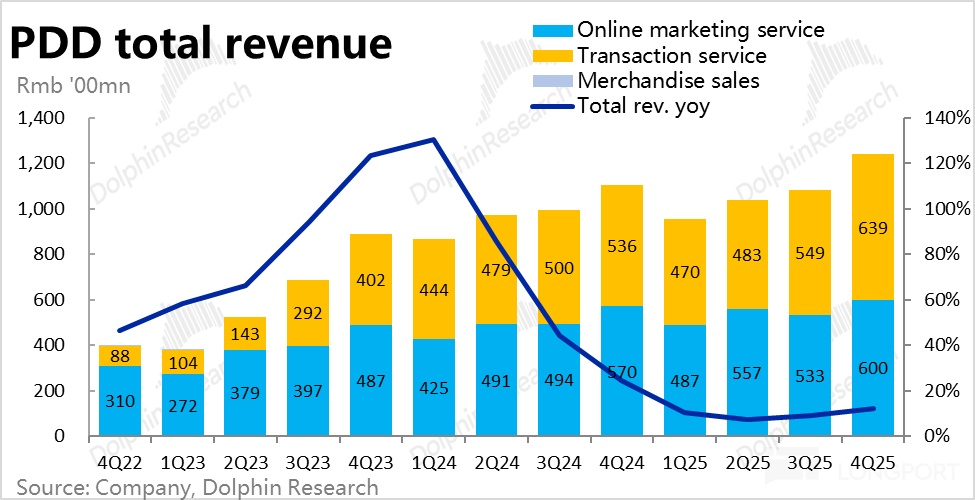
Total revenue was approx. RMB 123.9bn (+12% YoY), broadly in line. Growth accelerated vs. last quarter as Temu recovered from tariffs. However, domestically oriented ad revenue growth slowed to 5%, missing both Bloomberg and major bank estimates.
Versus JD Retail and Alibaba CMR hovering near 0% growth, PDD still printed higher. Sequentially, PDD’s ad growth decelerated by only ~3ppt, while JD and Alibaba slowed ~10ppt, underscoring PDD as a marginal beneficiary as state subsidies faded.
On this basis, the ad miss is understandable within a weak 4Q for all. PDD still outperformed peers, so we do not see this as a major issue.
II. Tariffs are in the rearview; Temu’s recovery beat
Commission-based revenue was about RMB 63.9bn, with YoY growth accelerating to 19%, above Bloomberg consensus at 14%. Given a sluggish 4Q for China e-comm, the domestic commission line likely wasn’t strong, implying Temu’s growth beat was the driver.
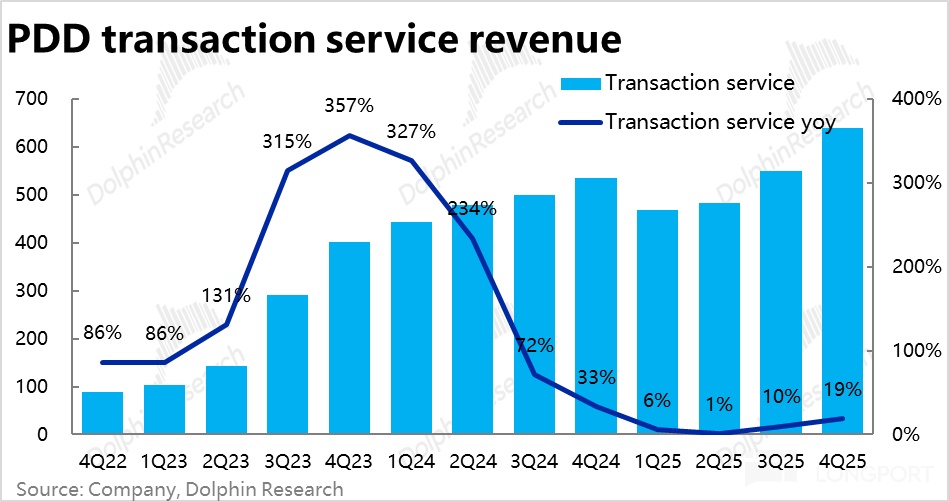
Previously, tariff shocks and the removal of de minimis exemptions weighed, but parts of Trump-era tariffs were later ruled unlawful by the US Supreme Court, easing the burden. ST data shows Temu’s US MAU by Dec recovered to near pre-tariff levels (though not above).
Beyond the US, Temu’s growth focus has shifted to global markets across Europe, the Americas, the Middle East and SE Asia, adding incremental revenue. By our estimates, Temu GMV still grew at around 50% this quarter (for reference), and blended monetization likely improved.
III. GPM down on mix; opex growth picked up but stayed aligned with revenue
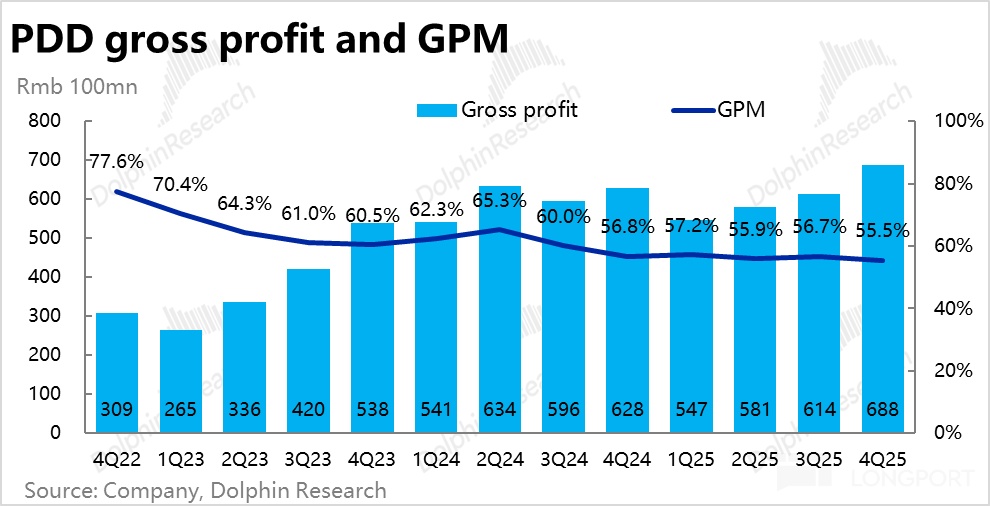
Gross profit was RMB 68.8bn (+9.5% YoY), a touch below market expectations. We think faster-than-expected Temu growth lifted its revenue share, creating a structural drag on GPM.
That said, the YoY GPM decline narrowed to about 130bps. The headwind should continue to ease.
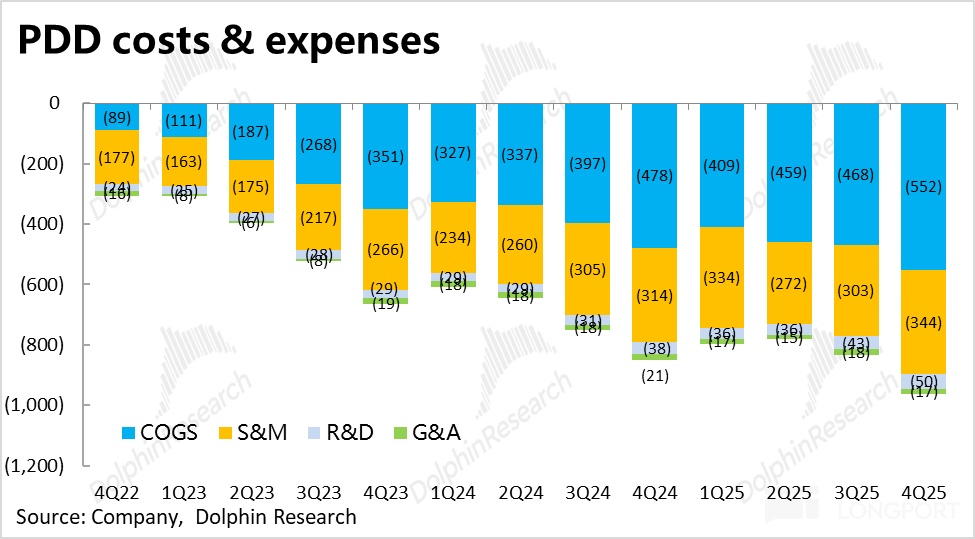
Total opex was about RMB 41.0bn (+~10% YoY), below revenue growth, but a notable pickup vs. the prior two quarters. The key swing was S&M, which rose nearly 10% YoY vs. -0.5% last quarter. With domestic subsidies restrained post state-subsidy fade, the lift likely came from Temu’s re-acceleration and higher acquisition spend.
Elsewhere, G&A fell about 19% YoY, below expectations, while R&D jumped 32%, above expectations. The two largely offset, leaving operating profit broadly in line. G&A reflects sustained productivity, while R&D likely stems from AI feature development within the app.
IV. Margin downcycle close to ending?
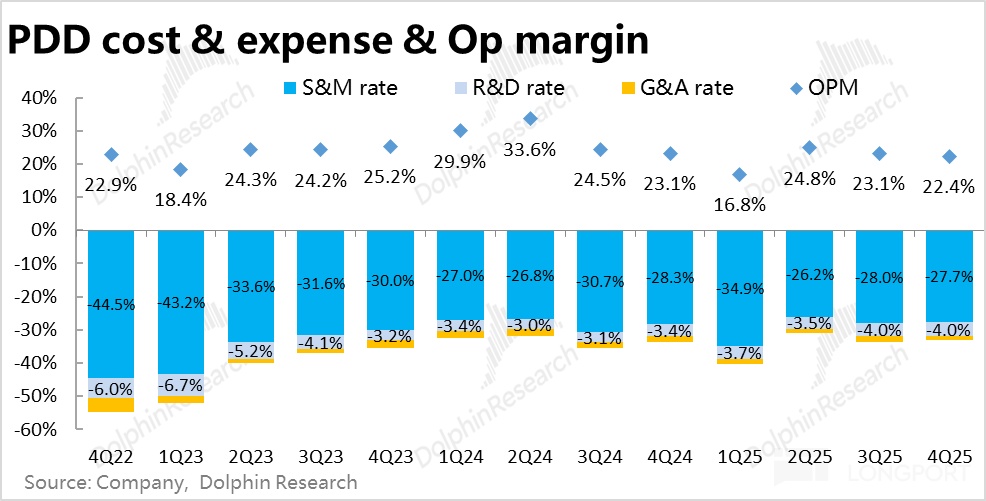
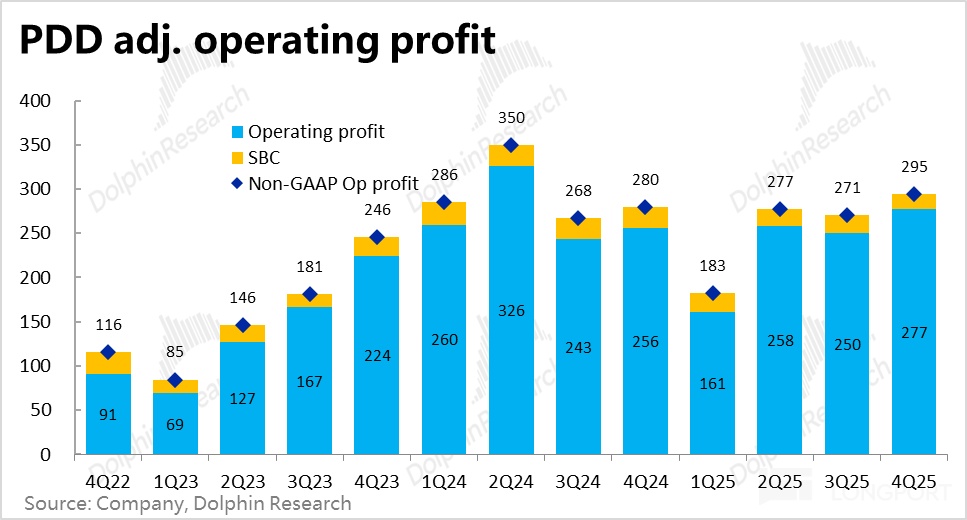
With major metrics tracking estimates, OP was RMB 27.7bn, essentially in line. Growth-wise, opex ticked up with Temu while GPM stayed under structural pressure, so OP grew 8% YoY, slightly slower than revenue.
OPM’s YoY decline narrowed further to about 70bps. PDD’s margin downcycle looks close to an end.
<End of text>
Dolphin Research on PDD (archive):
Earnings season
Nov 18, 2025 — PDD’s awkward phase: aging fast, but no buybacks
Nov 18, 2025 — PDD (Trans): the classic ‘self-inflicted cut’ playbook
Aug 25, 2025 — PDD: money machine again? Management forces the kneel
Aug 25, 2025 — PDD (Trans): another round of self-cuts!
May 27, 2025 — Bleeding on purpose! PDD’s big give-away and the obvious long game
May 27, 2025 — PDD (Trans): investing in consumers and merchants drives LT value
Mar 20, 2025 — PDD: fallen from the pedestal—how long can the backbone hold?
Mar 20, 2025 — PDD (Trans): do not judge us by short-term financials!
Risk disclosure and disclaimer: Dolphin Research Disclaimer & General Disclosure








The copyright of this article belongs to the original author/organization.
The views expressed herein are solely those of the author and do not reflect the stance of the platform. The content is intended for investment reference purposes only and shall not be considered as investment advice. Please contact us if you have any questions or suggestions regarding the content services provided by the platform.