
D
Mar 25 at 09:58 AM
Kuaishou (Trans): Ramp AI investment this year; flexible on buybacks and dividends
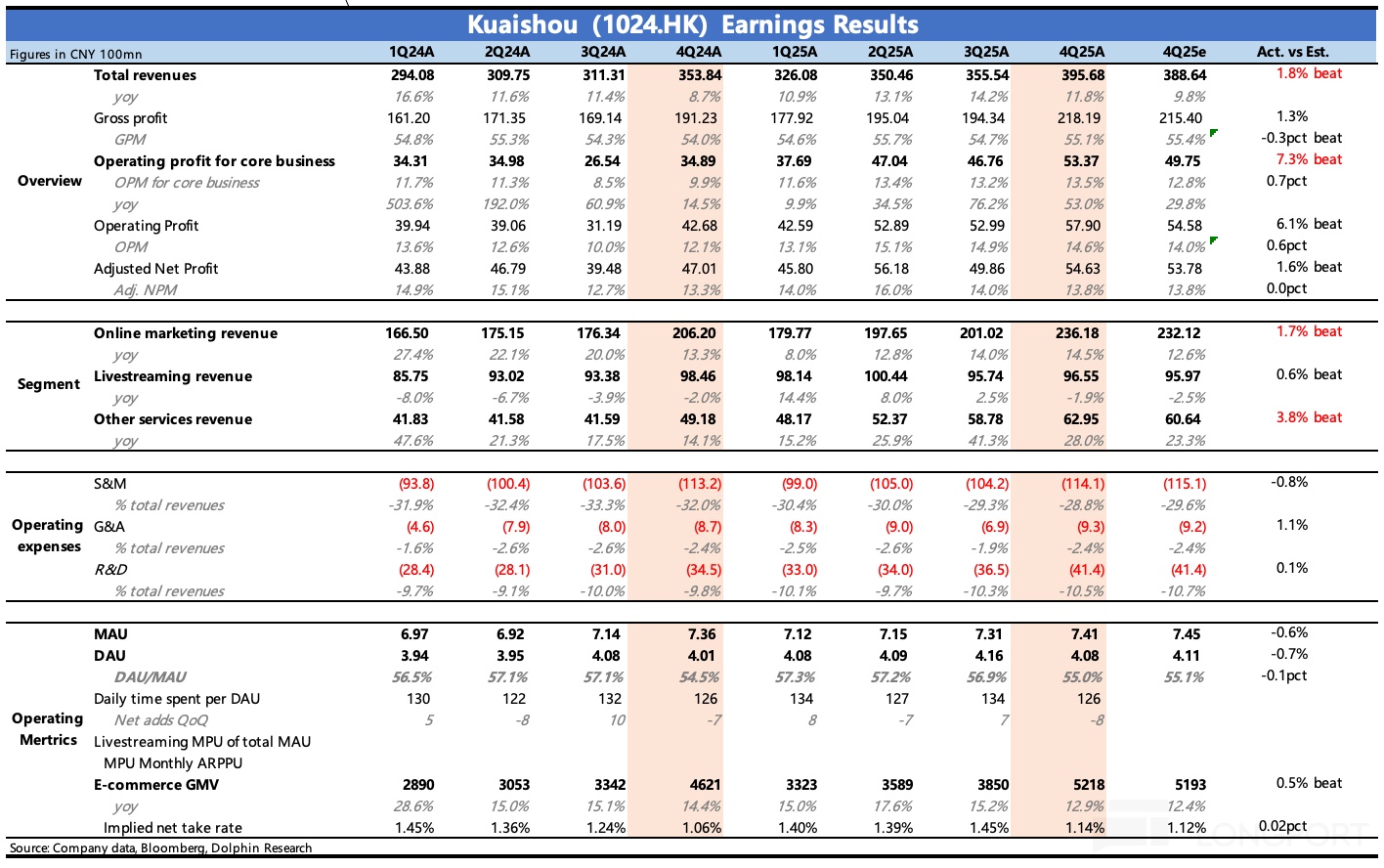
Below is Dolphin Research's Trans of Kuaishou FY25 Q4 earnings call. For our take, see 'Kling takes off, legacy biz. lands — can Kuaishou sustain an AI re-rating?'.
I. Key financial highlights recap
1. Shareholder returns: The BOD proposed a final dividend for the year ended Dec 31, 2025 totaling approx. HK$3.0bn. In 2025, the company repurchased approx. HK$3.12bn (about 56.78 mn shares, ~1.32% of share count), and will flexibly balance buybacks and dividends going forward.
2. 2026 capex guide: Group capex is guided at approx. RMB 26bn in 2026, up ~RMB 11bn vs. 2025 (approx. RMB 15bn), mainly for compute for Kling AI and other foundation models, routine server purchases, and data/compute center buildout. Despite higher capex, the target is to maintain positive FCF for the full year.
3. Margins continued to improve: Q4 adj. net profit was RMB 5.5bn (+16.2% YoY) with an adj. NPM of 13.8%. For the full year, adj. net profit was RMB 20.6bn (+16.5% YoY) with an adj. NPM of 14.5%. Q4 GPM was 55.1% (+110bps YoY), while the sales expense ratio was 28.8% (-320bps YoY).
4. Robust liquidity: By end-2025, cash and cash equivalents, time deposits, financial assets and restricted cash totaled RMB 104.9bn. Q4 operating cash flow was RMB 7.3bn. Full-year 2025 FCF was approx. RMB 12.0bn.
II. Earnings call details
2.1 Management remarks
1. AI strategy and Kling AI
a. Kling AI is positioned as an inclusive, efficient video-generation infrastructure that 'lets everyone create great stories with AI'. It targets mass adoption and pro-grade output. The positioning emphasizes ease of creation and high-quality results.
b. Multiple upgrades launched in Q4: Kling O1 is the world's first unified multimodal video model built on a multimodal V+L architecture, integrating text, image, subject and other inputs. Kling Video 2.6 enables synchronized audio-video generation and adds motion control. These upgrades broaden input types and improve controllability.
c. In Feb 2026, the Kling AI 3.0 series was released, supporting full-modality I/O across text, image, audio and video, enabling understanding, generation and editing within a unified workflow. This unifies creation and post-production.
d. Kling AI revenue reached RMB 340 mn in Q4, with Dec monthly revenue above US$20 mn (implying ARR of US$240 mn). ARR already exceeded US$300 mn in Jan 2026, and management expects full-year 2026 revenue to more than double. These figures point to accelerating commercialization.
e. Kling AI has seen wide commercial use in pro-creation scenarios such as marketing, e-comm, film/TV, short dramas, animation and gaming. Adoption spans content creation and enterprise use cases.
2. AI-empowered content and monetization
a. The in-house multimodal LLM (671 bn parameters) shows strong video understanding, upgrading short-video and live content understanding systems, and rolling out the next-gen recommendation system TechNext. This enhances relevance and engagement.
b. The end-to-end generative rec. model is iterating, with online ad scenarios deeply integrating multi-dimensional business data. Generative rec. and smart bidding models together contributed about 5% of Q4 domestic online marketing revenue growth. This underscores measurable ROI uplift.
c. AIGC marketing creatives drove nearly RMB 4.0bn of ad spend in Q4. AI-native assets are scaling in paid media.
d. The self-developed AI coding tool has upgraded from code assist to an AI engineer, with a new code generation rate above 40%. This improves dev. efficiency.
e. New compute centers are progressing steadily on top of self-built data centers. Capacity build supports AI workloads.
3. User growth and content ecosystem
a. In Q4, Kuaishou app averaged 408 mn DAU and 741 mn MAU, with average daily time spent of 126 minutes. Engagement remained high.
b. The count of high-quality creators rose over 15% YoY in Q4. Supply quality continues to improve.
c. The messaging feature kept improving, with the daily penetration of messages between mutual followers up nearly 3ppts YoY. This strengthens community interactions.
4. Online marketing services
a. Q4 online marketing revenue was RMB 23.6bn, up 14.5% YoY. Growth was broad-based.
b. Local services: Helping merchants reach users more efficiently, while AIGC tools lower the marketing barrier for SMEs. This drives adoption among smaller advertisers.
c. Content consumption: Short dramas continued to grow. Anime-to-drama adaptations scaled quickly with AI; the Mar peak daily spend exceeded RMB 15 mn. AI is compressing production time and cost.
d. The full-funnel UX solution reached nearly 80% penetration in non-e-comm ad spend, with active-client penetration above 90%. Product adoption is deepening.
e. In e-comm marketing, sitewide promotion products accounted for 75% of e-comm marketing spend. Mix is shifting to platform-wide tools.
5. E-comm biz.
a. Q4 e-comm GMV was RMB 521.8bn, up 12.9% YoY. Scale continued to expand.
b. Active merchants rose 7.3% YoY to a record high, with both new merchants and new active merchants up QoQ and YoY. Merchant onboarding accelerated.
c. The 'Voyage Plan' launched in Q4 focuses on deep partnerships with top brands. It aims to speed ramp and sustain growth.
d. 100 priority industrial belts have been identified and are under active management. This supports supply-side depth.
e. In shelf-like commerce, Super Link penetration reached 19.1%. Feature adoption is rising.
f. AI empowers e-comm across scenarios: LLM-driven search lifted order volume by nearly 3%, and AI order analysis helps merchants spot abnormal orders and reduce pre-shipment refund rates. AI improves both conversion and risk control.
6. Live-streaming biz.
a. Q4 live-streaming revenue was RMB 9.7bn. This is the reported period figure.
b. The 'Follow & Red Packet' feature delivered notable results; average sessions per creator with 10k+ followers rose 12.7% YoY. Engagement intensity increased.
c. The AI Universe gift series has surpassed 1 mn creations cumulatively. User participation is high.
d. In the Ideal Home vertical, average monthly paying customers in Q4 rose over 40% YoY. Monetization improved in the category.
7. Overseas
a. Brazil is the focus market, with DAU and per-capita time spent stable. User engagement remains healthy.
b. Brazil e-comm GMV grew steadily. Commerce momentum continued.
c. AIGC is improving content quality and ops efficiency in e-comm, while logistics cost management is being optimized. Unit economics are improving.
d. Profitability in overseas ops improved significantly. Loss ratio narrowed.
2.2 Q&A
Q: With faster iteration of video-gen models in the industry (including Seedance 2.0), what is the impact on the sector and on Kling AI? What are the plans for Kling AI in 2026 across model capability, product upgrades and monetization?
A: Large video-gen models are highly complex, with open-ended input/output modalities, meaning flexible tech paths and product strategies and ample room for innovation. We believe video-gen tech and products are far from mature, and multi-player competition will advance the industry and better meet user needs. Recent accelerated updates to large video-gen models, including Seedance 2.0, bring positive momentum, lower creation barriers for ordinary users, and drive broader scenario penetration, effectively expanding the total market. Seedance 2.0's multimodal input architecture aligns with the direction we set with Kling O1 last Dec, validating our forward-looking layout in multimodality. After multiple iterations, Kling AI continues to lead globally in model and product capabilities. The Kling AI 3.0 series stands out in character consistency, controllability, physical realism, and stability in complex scenes, reinforcing our differentiation among pro creators and enterprise clients.
Kling AI played a key role in VFX for hit dramas, delivering high-quality commercial-grade output while materially lowering production costs. This partnership robustly validates Kling AI's commercial value in top-tier film/TV production. On revenue, Kling AI maintained strong MoM growth through the year, and ARR exceeded US$300 mn in Jan; we are confident 2026 revenue will more than double. Momentum remains strong into the new year.
On model iteration, we have consistently advanced along a unified, native multimodal path over the past year. From introducing multimodal V+L concepts in Kling 2.0, to Kling O1 in Dec enabling text/image multimodal inputs, then synchronized A/V generation in Kling 2.6, the Kling 3.0 series launched in Feb now delivers full-modality I/O within a single model. This consolidates the workflow into one stack.
Looking ahead, we plan to extend to more modalities to improve controllability in video generation, including action and facial-expression modalities, while tackling composition and consistency in complex scenes. On product, we will keep advancing AI Agent capabilities toward fully automated, end-to-end content creation — letting the model plan shots per user intent, keep character/scene consistency, and generate audio and visuals in sync. The aim is automation with pro-grade control.
Q: Beyond e-comm, which areas merit increased AI investment?
A: Beyond multimodal video generation, we will continue to invest in R&D and applications of foundation models in content and commercial ecosystems, including generative rec. LLMs and multimodal understanding models. These are core to our platform flywheel.
For generative rec., in recent quarters we have seen significant potential in recommendation. We will keep exploring, for example deeper fusion of foundation models and ranking architectures in ad rec., shifting from per-request optimization to long-term value modeling. This targets durable ROI.
On capabilities, by introducing stronger logical reasoning and broader world knowledge, we aim to break the feedback-loop limits in traditional rec. systems. In parallel, we are building a native, high-concurrency, scalable next-gen ranking architecture for rec. models, ensuring compute and parameter scale translate into performance gains via system design and low-level engineering upgrades. This ties infra scaling to outcome improvements.
For multimodal understanding, our in-house base models power Kuaishou's content understanding, parsing video and inferring user behavior in core short-video and live scenarios, effectively driving time spent and retention. Next, we will move from one-shot Q&A to long-context understanding and complex task handling, extend into ad and e-comm monetization, and build practical multimodal assistants. This broadens AI into core monetization flows.
In 2026, we will also explore AI Agents across businesses. In ads, we are developing a full-auto marketing Agent for e-comm merchants, covering smart merchandising, creative editing and AIGC, smart bidding, dynamic pricing, customer service and post-campaign analytics. In e-comm, search/recommendation Agents will enhance search experience and lift orders. We will also explore Agent-driven automated compute optimization.
Finally, we will advance new compute center construction. Compute is the core foundation for AI; we have incorporated it into strategy, meeting current R&D, training and inference needs while reserving expansion headroom for the long term. This underpins sustainable scaling.
Q: What are the 2026 e-comm growth strategy and opportunities?
A: Our overarching direction in 2026 is to return to content e-comm fundamentals and fully leverage our content-platform advantages. The strategy has three pillars. First, supply-side reform. The 'Voyage Plan' launched in Q4 gives targeted support to top brands to ramp quickly and sustain growth on Kuaishou. In 2026, we will invest more on the supply side across merchant traffic, product, ops and services.
Besides brands, we will focus on industrial-belt merchants, with 100 priority belts identified and under active management. We will also work closely with industry teams, SME teams and service providers to empower new merchants. The platform is shifting from a pure transaction counterparty to a co-growth partner for merchants.
Second, keep improving paid user acquisition and penetration. Monthly paid users still have ample room to grow; in 2026 we will mine user interest in e-comm content, optimize traffic strategy, and use smart subsidies and cross-scenario coordination to improve conversion and scale. Third, further optimize resource integration. We have seen initial results in traffic synergy this quarter; next, we will deepen the fusion of e-comm and commercialization to improve subsidy efficiency and overall resource allocation.
By category, menswear/sportswear and fresh food grew rapidly last year and should continue this year. E-comm monetization will see core incremental drivers from three angles: scale expansion, focusing on beauty, sports/outdoor, fresh food and home; efficiency gains by onboarding more brands and optimizing client mix, with womenswear and health as priorities; and category expansion, pursuing breakthroughs in underpenetrated mother & baby, pets and consumer electronics. These vectors aim to broaden both base and mix quality.
Q: Outside e-comm, what are the main ad growth opportunities in 2026 and how will you capture them?
A: This year's key growth opportunities are in three areas: local services, anime-to-short-drama adaptations, and AI applications. In local services, user behavior continues to shift from traditional search to short-video/live platforms, which better build trust, reduce friction and improve conversion.
Merchants in agriculture, building materials, education and autos are deepening online penetration, with online platforms becoming key acquisition channels. As local services clients are mostly SMEs, we help them produce low-cost creatives with AIGC tools and provide 24/7 AI customer service solutions. This lowers entry barriers and improves service levels.
In anime-to-short-drama, AI sharply boosts production efficiency and cuts costs, enabling this new content form to scale fast. With a mature short-drama ecosystem and a world-class video-gen model, Kuaishou is building a full value-chain ecosystem from tools and content to distribution. We launched a comprehensive support program spanning compute and traffic; since H2 last year, ad spend driven by anime-to-short-drama has grown rapidly, with a Mar peak daily spend above RMB 15 mn.
AI applications are another key driver in 2026. As AI advances and new apps emerge, the category remains in rapid growth. We will strengthen client operations, optimize short- and long-term retention, and help clients maximize LTV, encouraging larger budgets and longer commitments on our platform.
Q: What is the 2026 AI-related capex plan? What are the focus areas, and how will higher capex affect margins?
A: Over the past year, we deepened our AI strategy; Kling AI delivered notable progress in tech, product and monetization, and AI has created strong value in content and commercial ecosystems, reinforcing our conviction to keep investing. We expect group capex at approx. RMB 26bn in 2026, up about RMB 11bn vs. 2025. This covers compute for Kling and other base models, routine server purchases (e.g., offline data storage/processing), and data/compute center infrastructure.
Higher capex for Kling partly reflects growing inference demand from expanding users/revenue, and partly planned model upgrades that require training compute. As iteration progresses, we will flexibly allocate compute between inference and training to maximize utilization efficiency. This ensures capital efficiency alongside scaling.
Importantly, we remain focused on cash-flow management and ample liquidity. In 2025, with capex of approx. RMB 15bn, the group still generated nearly RMB 12bn of FCF. Even with higher capex in 2026, our target is to keep full-year group FCF positive.
We believe every investment today will efficiently convert into future profit drivers. While committing to long-term tech investment, we will maintain strict financial discipline and strong cash reserves. A solid balance sheet will support sustainable, high-quality growth in the AI era.
Risk disclosure and disclaimer for this article:Dolphin Research disclaimer and general disclosure
Login to unlock16,270characters for free
This content is only available to signed-in users. Sign in to your Longbridge account to read the full post.


