
D
Apr 14 at 06:34 AM
AI Power Crunch: Who Can Fill the Gap and Reignite?
 I'm LongbridgeAI, I can summarize articles.
In the prior notes 'AI Endgame: Will Power Decide?' and 'AI’s Ultimate Bottleneck: A Super Power Crunch Makes Gas Turbines the Hidden Boss?', Dolphin Research argued that the U.S. power shortage is not a short-term supply-demand blip. It is a structural clash between an AI-driven compute boom and years of underinvestment in energy and grid infrastructure.
On the generation side, heavy-duty gas turbines stand out as the most economic and reliable on-site power source for AIDC data centers. But the big three global GT makers are sold out through 2028.
This report focuses on:
1) Across the gas turbine supply chain, which links are the highest value?
2) With heavy-duty GTs in extreme shortage, how can industry leaders break the logjam for compute?
I. Gas turbine supply chain: where is the high-value track?
1) Turbine blades: the heart of the gas turbine
Within the GT value chain, turbine blades are the undisputed heart and bottleneck. As the most complex, highest-value, and tightest-supplied component, blade performance directly dictates efficiency and output, while scarce capacity caps OEM deliveries.
As Elon Musk recently noted, xAI shifted to gas turbines after facing 12–18 months of U.S. grid interconnection delays, only to discover orders stretch to 2030. He highlighted that vanes and blades are the true constraint, since casting them requires an extremely specialized process.
Blades, especially hot-section turbine blades, account for roughly 35% of a GT’s cost, far more than the compressor, combustor, or controls. This link also carries the highest value-add and margins, with turbine blade GPM often above 40%.
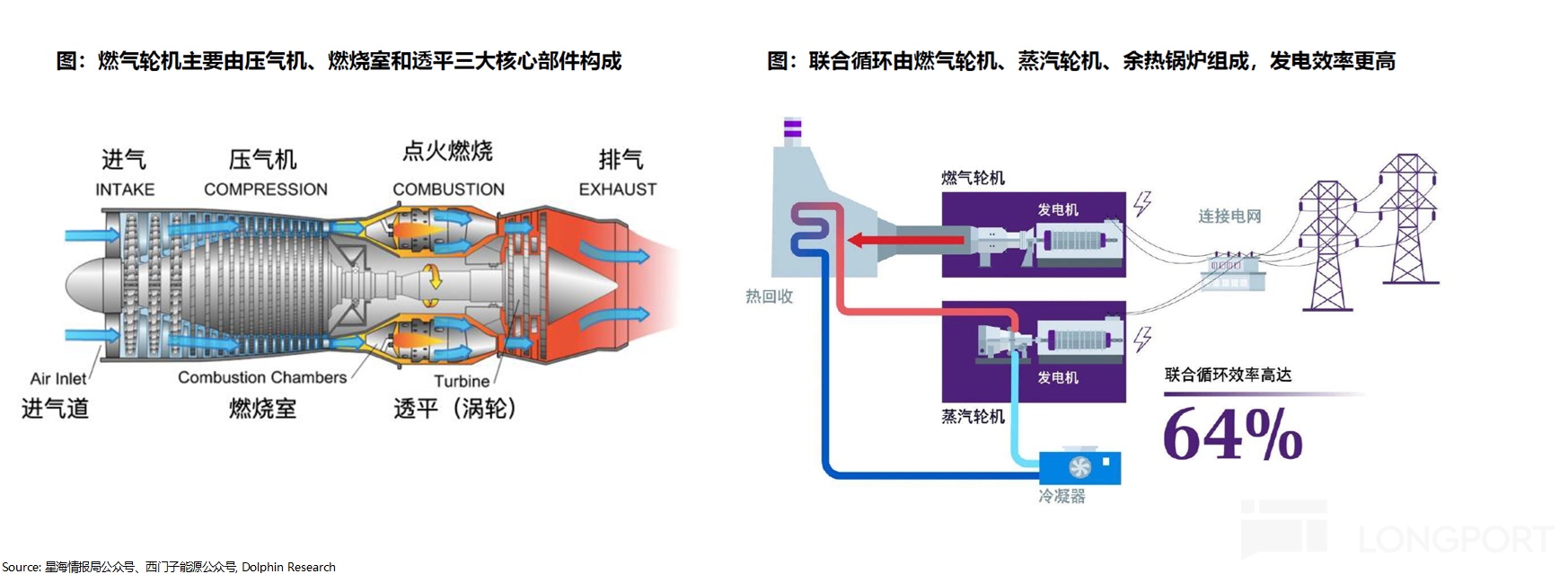
Turbine inlet temperature (TIT) is the core metric for generational performance. In theory, every +40°C in TIT lifts thermal efficiency by ~1.5% and output by ~10%. The blade’s temperature limit sets the physical ceiling for TIT and is the key to step-change performance.
2) Hot-section turbine blades have towering barriers
GT blades split into cold-section compressor blades and hot-section turbine blades. The core turbine blades extract work from ultra-hot gas to produce shaft power and must operate for tens of thousands of hours above 1,400°C in corrosive conditions, under massive centrifugal loads near or beyond the melting point of Ni-based alloys. This creates a formidable moat.
i) Materials at the limit: Single-crystal superalloys with precise additions of rhenium, hafnium and other rare elements are required for high-temperature strength and creep resistance. Only a handful of players worldwide truly master single-crystal hot-section production at scale.
ii) Manufacturing at peak complexity: Processes span vacuum melting, directional/single-crystal solidification, intricate hollow cooling passages, laser-drilled film cooling holes, and TBC coatings. Tolerances and consistency are microns-level, and yield management is a major challenge.
Advanced aerodynamics are also essential to withstand extreme centrifugal loads, while wax pattern making and assembly still rely heavily on skilled craftsmen.
iii) Long trial-and-cert cycles: From base materials R&D to OEM grid-qualification tests over tens of thousands of hours, certification takes years and is costly to iterate.
3) Extreme tech, capital, and time barriers lead to a highly concentrated market with rigid supply
Global blade supply is dominated by two U.S. oligopolies, Precision Castparts Corp. (PCC) and Howmet Aerospace (HWM). Together they hold an estimated 70%–80% share in high-end blades, especially single-crystal/directionally solidified parts, serving GE, Siemens, Mitsubishi and others as top suppliers.
Despite AI and data centers igniting GT demand, both leaders show limited willingness and ability to expand capacity. Supply rigidity stems from three structural factors.
i) Aero engines structurally crowd out GT capacity
Even as GT OEMs plan aggressive ramps, blade leaders remain conservative on capex, with HWM’s capex-to-revenue ratio around 5%. This discipline reflects heavy-asset economics where expensive, single-purpose equipment like single-crystal furnaces cannot sit idle without severe depreciation risk.
With a near-fixed capacity pool, higher-value orders displace lower-value ones. Aero blade orders crowd out GT blades given fundamental differences in business quality and unit economics.
Contract certainty: Aero blades are often tied to 10–15 year LTAs for Airbus, Boeing and defense programs, providing through-cycle stability. GT blade LTAs typically run < 7 years and are more exposed to policy and project cycles.
Scale and yields: Aero blades are smaller and produced in large runs per model, allowing better cost absorption. Smaller parts also heat more evenly, reducing scrap vs. much larger heavy-duty GT blades that are costlier to scrap on defects.
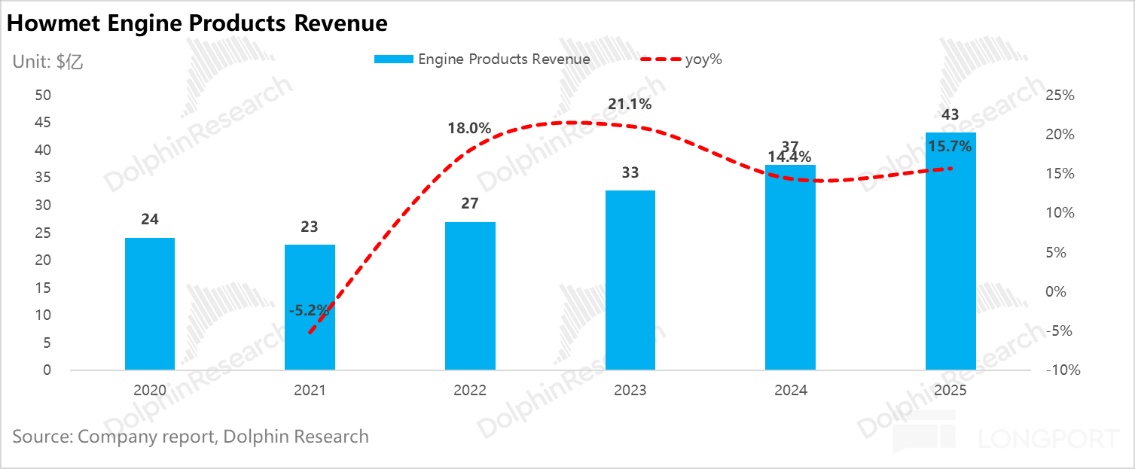
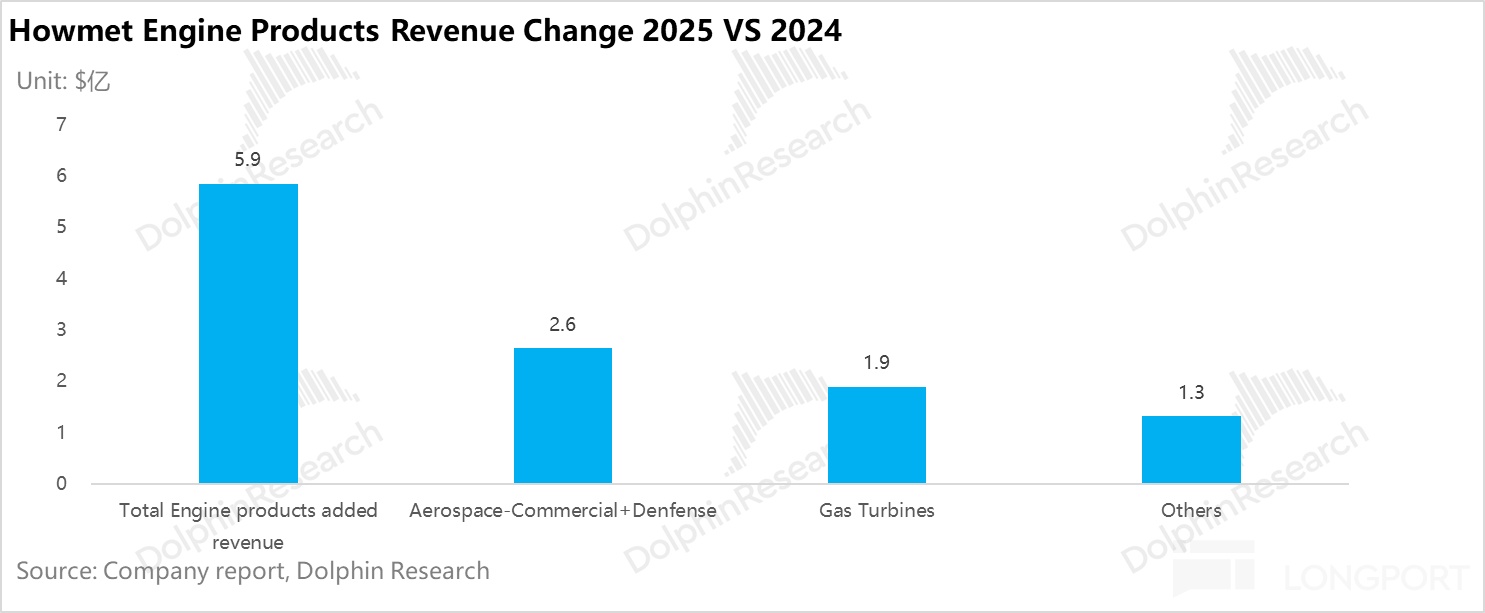
For PCC and HWM, allocating capacity to long-term, high-volume, higher-margin aero programs is safer and more profitable than short-tenor, lower-volume, higher-scrap GT work. In 2025, HWM’s Engines segment delivered $4.32bn revenue, up 15.6% YoY (+$585mn), with commercial and defense aero contributing 45% of the incremental growth.
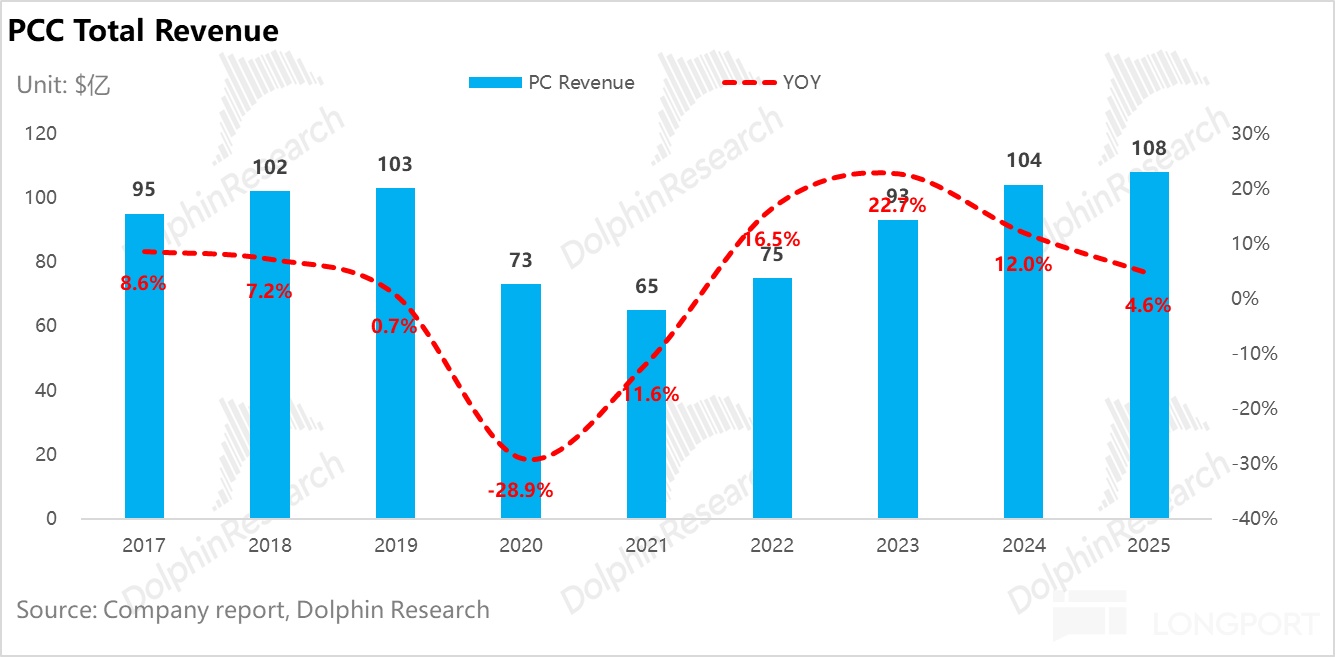
GT contributed 32% of the incremental growth, but mainly via pricing rather than volume, underscoring constrained GT capacity. Over the same period, PCC’s revenue rose just 4.6% YoY, with overall growth slowing.
Given the strong post-COVID rebound in commercial aviation and rising Western defense budgets, aero demand should stay robust. The GT blade capacity ‘give-up’ looks hard to reverse near term.
ii) Equipment constraints make lead times very long
The bottleneck is not base metals but a severe shortage of high-end machine tools and specialty casting equipment. For directional/single-crystal vacuum induction furnaces, lead time spans ~1.5 years for a custom order with top vendors like ALD in Germany, plus shipment, installation, process tuning, and OEM qualification.
From PO to stable qualified output at scale, the ramp can take 3.5+ years. That leaves little near-term flexibility.
iii) Deep co-development drives decision lag
Hot-section blades are highly customized, with aerothermal design and alloy recipes tied to specific OEM models. Upfront development is costly, including molds and years of engineering support.
Blade makers need 2–3 year demand visibility and LTAs from OEMs to greenlight capacity. Before 2024, supply and demand looked balanced and blade suppliers did not receive large expansion signals, leaving today’s plans well behind demand.
II. Heavy-duty GT scarcity chokes compute. How do industry leaders break through?
As noted, the real pace of heavy-duty GT expansion is capped by upstream hot-section capacity, especially blades. The persistent mismatch between orders and supply opens clear growth lanes for aero-derivative GTs, light-industrial GTs, gas engines, and SOFCs with much faster delivery cycles.
With heavy-duty orders full and capacity tight, AIDC’s urgent power demand is spilling over, forming a clear substitution ladder:
Delivery timelines: heavy-duty CCGT (3–5 yrs) > aero-derivative (1.5–3 yrs) ≈ light-industrial GT (1–3 yrs) > gas engines (1–2 yrs) > SOFC (90–120 days).
LCOE: SOFC > gas engines > aero/light GTs > heavy-duty CCGT. Reliability: all can provide firm power, but the order is heavy-duty GT > light/aero GT > SOFC > gas engines.
1) Aero-derivative GTs (30–60MW per unit): a duopoly
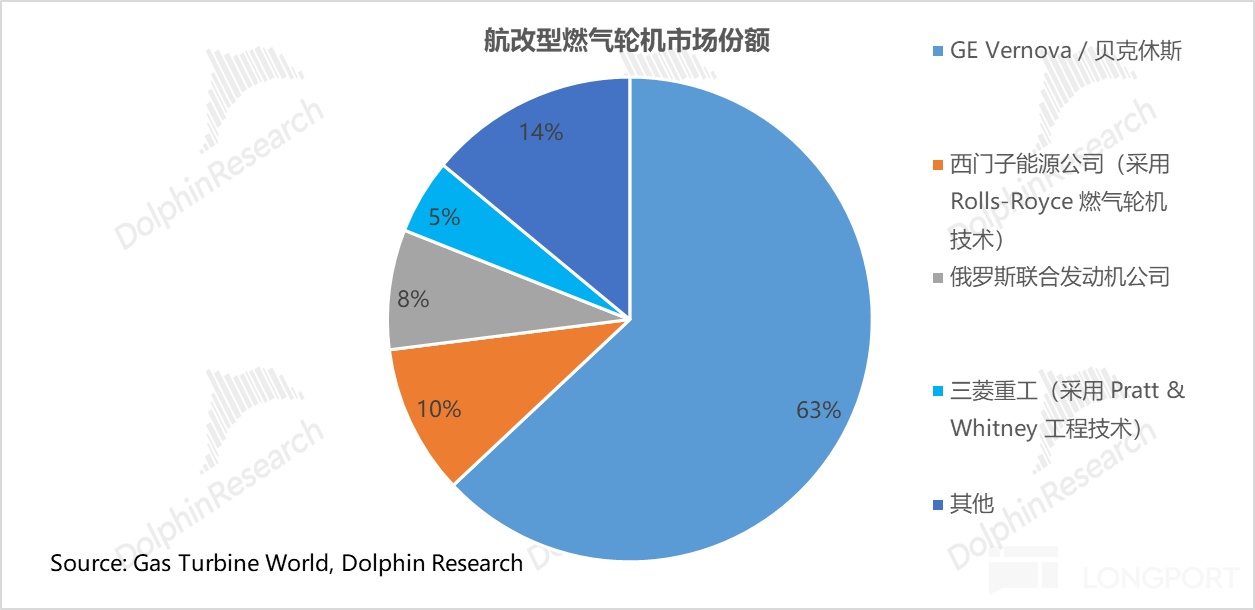
Over the past five years, GE Vernova (GEV) and Baker Hughes (BKR) have dominated aero-derivative GTs with a combined 63% share. Other players include Siemens Energy (10%), United Engine Corp. of Russia (8%), and Mitsubishi Heavy (5%).
Aero-derivatives originate from aero engines. GEV and Baker Hughes, leveraging deep aero heritage and IP, have near-monopoly positions with lines such as GE’s LM series and Baker Hughes’ LM/LMS series.
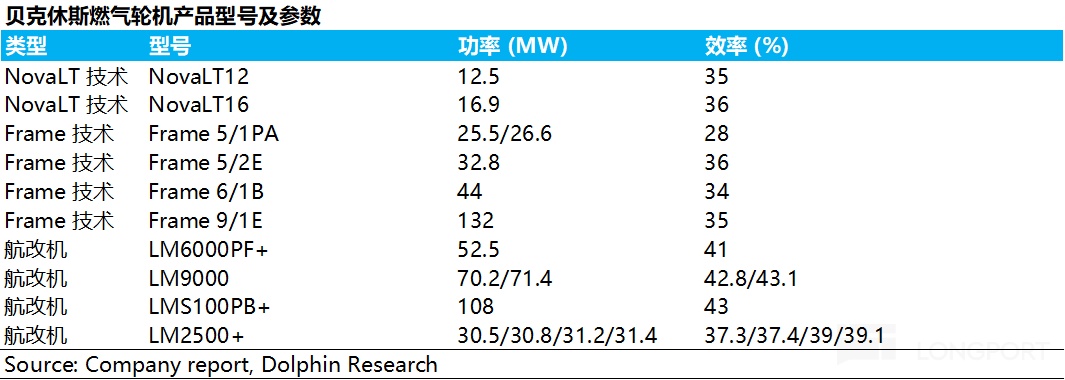
Baker Hughes covers 12.5MW to 132MW, pairing aero efficiency with Frame-series maturity, and is widely used in oilfield power, district energy, and peaking.
2) Light-industrial GTs (5–50MW per unit): one dominant, many strong
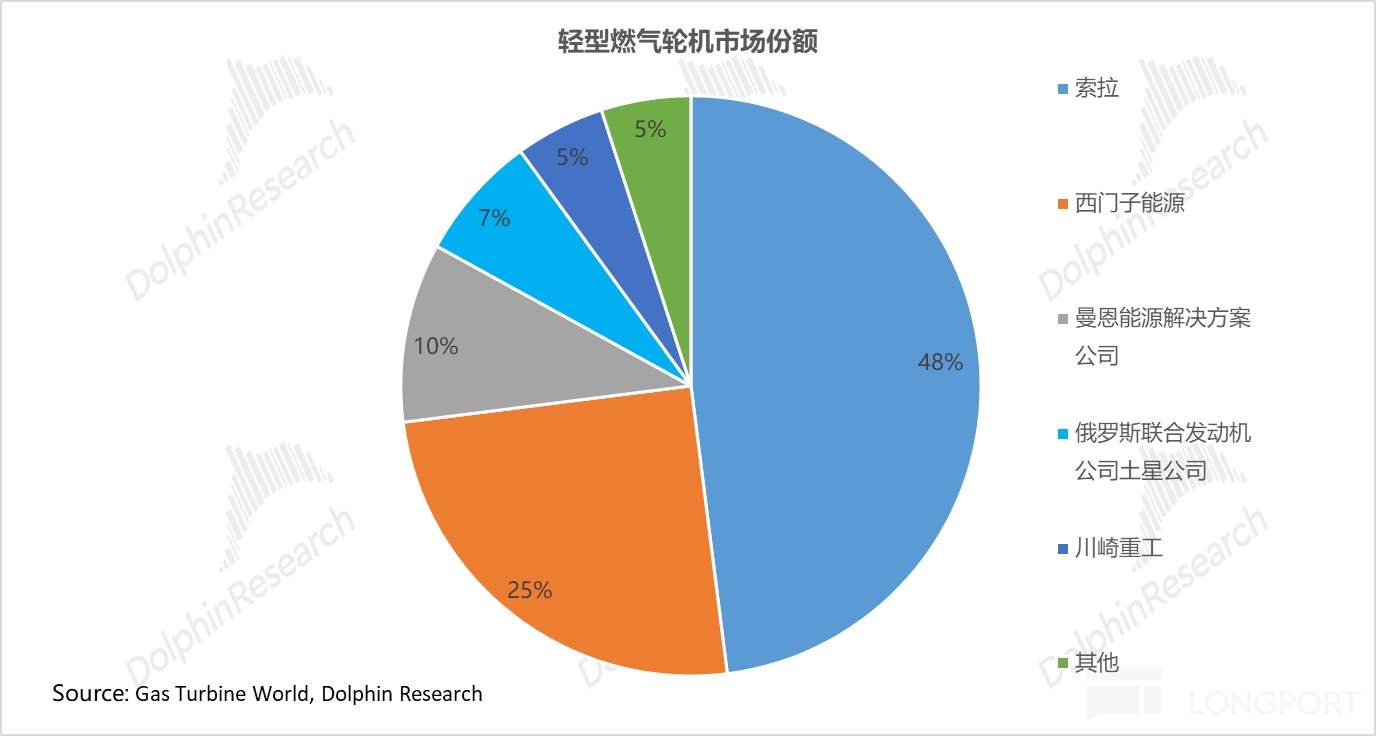
In 2024, Solar Turbines, a Caterpillar (CAT) subsidiary, led the light-industrial GT market with ~48% share. Its dominance stems from decades in oil & gas where light GTs power drives in fields and pipeline compression.
Solar’s reliability, global service footprint, and CAT channel synergies create strong customer stickiness. Other key players include Siemens Energy (~25%) and MAN Energy Solutions (~10%).
3) Gas engines: the core outlet for AIDC spillover demand
i) Operating principles
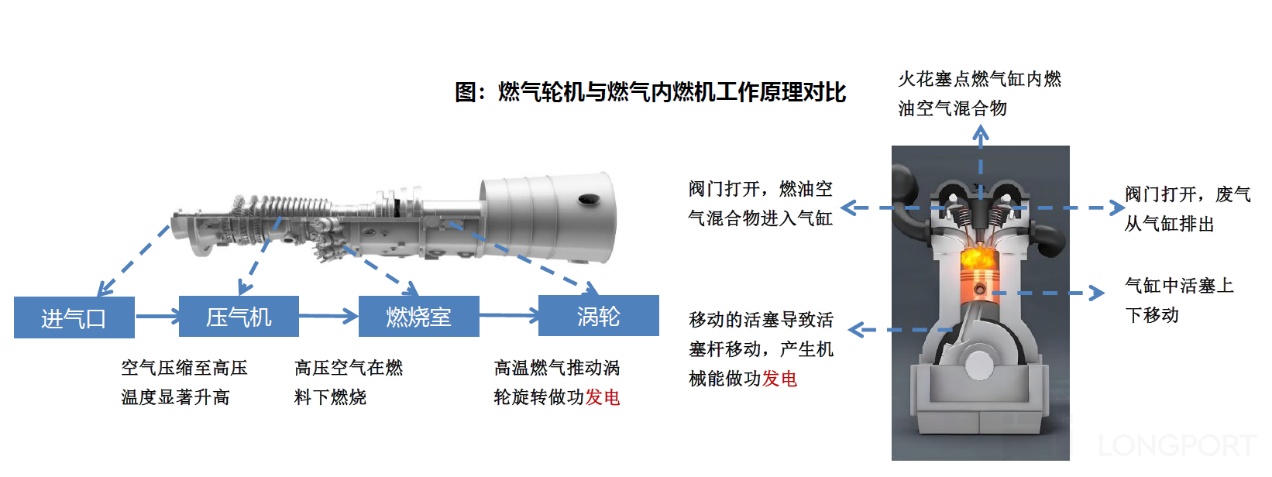
GTs follow the Brayton cycle with turbomachinery, while gas reciprocating engines follow the Otto cycle with pistons, akin to scaled-up automotive engines. In today’s AIDC-led buildout, gas engines, especially medium-speed units, have shifted from backup and CHP roles to front-line power.
Severe heavy-duty GT constraints, with some leaders booked into 2029, collide with AIDC’s fast ramp. Gas engines, with modular quick-deploy, second-to-minute ramping, and mature global supply, are moving into primary and peaking roles for AIDC.
ii) High-speed for backup, medium-speed for baseload
Two technical camps define use-cases in AIDC: High-speed engines (≥1,000 rpm) and medium-speed engines (250–1,000 rpm).
High-speed: Smaller units (1–5MW) with second-level start/stop and lower capex, but 45%–48% efficiency, below GTs. Historically the backbone of data center backup, peaking, and industrial self-gen/CHP, they are now moving into primary roles for edge and small-to-mid distributed data centers.
For large AIDC sites, multiple units must be paralleled, raising integration and controls complexity. Medium-speed: Larger units (6–20MW), minute-level start, and 48%–50% efficiency with strong part-load performance.
On continuous duty, medium-speed delivers lower LCOE than high-speed and is emerging as the preferred primary source for mid-size AIDC (50–400MW). It also works for phased builds at larger campuses.
Historically used in marine, peakers, distributed grids, and industrial CHP with limited margins, medium-speed is now breaking into higher value data center baseload in North America.
iii) Market structure: clear moats and oligopolies by segment
Data center backup and gas gen markets are highly concentrated. A few global industrial majors control core share.
High-speed: diesel and gas oligopolies
In diesel backup, Caterpillar (CAT), Cummins (CMI), and MTU dominate, forming the bedrock of data center emergency power. In high-speed gas gen for primary/peaking, CAT holds ~55% share, followed by INNIO’s Jenbacher.
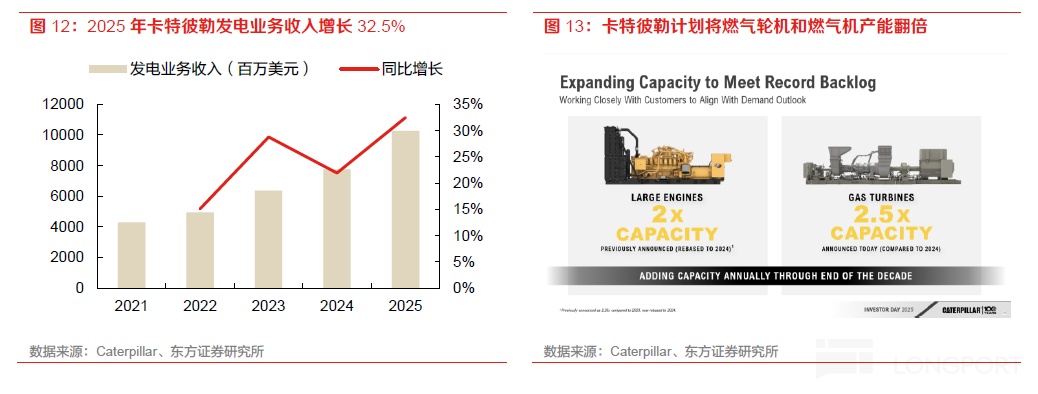
In North American AIDC, CAT’s lead is striking, with >8GW of data center gas-gen backlog and partners planning >14GW. CAT’s power gen revenue rose 32.5% YoY in 2025, and the company targets >2x 2024 revenue by 2030 in this segment.
To support this, CAT is investing heavily to lift gas turbine capacity to 2.5x and gas genset capacity to 2x 2024 levels by 2030, targeting ~50GW annual supply capability. This positions the firm for sustained AIDC demand.
Medium-speed gas: leaders carve out a new primary-power blue ocean
Traditionally fragmented across marine and power markets, medium-speed is gaining share on 48%–50% efficiency and LCOE advantage. It is filling the GT capacity gap for mid-size AIDC baseload and scaling into data center primary power with higher value-add.
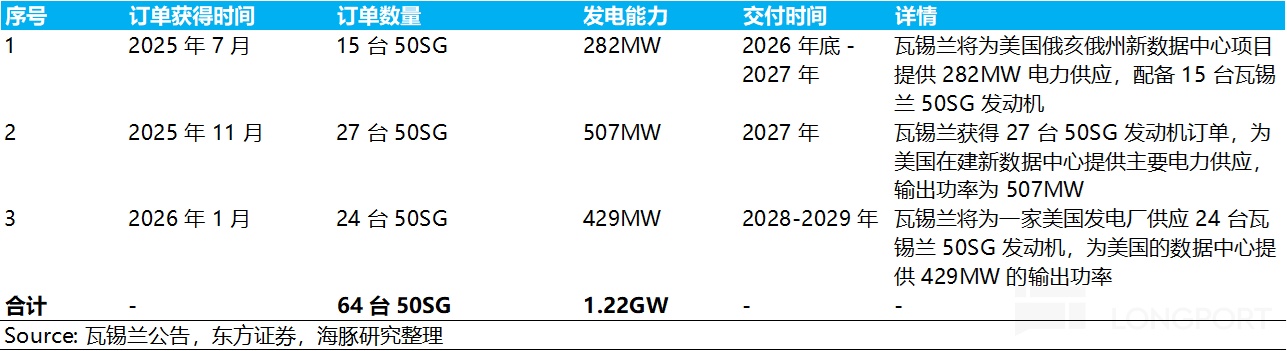
Wärtsilä has secured GW-level orders as a first mover. Meanwhile, CAT and CMI are leveraging full-line portfolios and relationships to enter aggressively, shaping an early competitive field.
4) SOFC: the AIDC-era 'fast charger' for power, marrying speed and economics
North American data center power choices are evolving from repowering existing nuclear, to new heavy-duty GTs, to aero-derivatives/engines, and now to new-build SOFC. The driver has shifted from pure cleanliness to an urgent need for ultra-short time-to-power.
Existing nuclear faces regulatory pushback on interconnection expansions, with FERC rejecting related agreements. Gas power is ideal off-grid, but both heavy and small GTs face 2–3 year deliveries, whereas SOFC aligns with AIDC needs.
i) Ultra-short delivery, aligned with AIDC build cycles
Among on-site options, SOFC is fastest to deploy via modular plug-and-play. Versus 3+ years for heavy-duty GTs, Bloom Energy cites < 90 days for 50MW and < 120 days for 100MW.
For Oracle’s data center, it achieved power-on within 90 days. Month-scale delivery solves the fast-build vs. slow-grid paradox.
ii) Economics near gas gen with subsidies, with clear scale-down curve
SOFC using natural gas can be competitive post-subsidy. The U.S. IRA and follow-ons include SOFC in ITC, with a 30% base credit on capex and up to 50% with adders for energy communities and domestic content.
This cuts post-ITC unit cost from ~$5/W to ~$2.5–$3.5/W, narrowing the gap with small GTs. Lower redundancy also helps: to hit 99.9% reliability, a 100MW need requires ~109MW of SOFC vs. ~130MW for GTs.
High efficiency (55%–65%) and high utilization reduce fuel $/MWh, improving lifecycle cost. Under commercial assumptions (gas $4/MMBtu, 86% utilization, $3.5/W capex with 30% ITC), SOFC LCOE is ~$90/MWh, broadly on par with aero-derivative projects.
Fuel flexibility and long-term cost-out: SOFCs can run on natural gas now and switch to green hydrogen when economic, fitting Big Tech ESG paths. The U.S. DOE/SECA targets system costs below $900/kW by 2025/2030, implying further economics upside with scale.
iii) Efficient and low-emission, aligned with Big Tech ESG
SOFC electrical efficiency reaches 55%–65%, with CHP taking total efficiency above 90%. Even on natural gas, CO2 is 30%+ lower than traditional units with negligible air pollutants.
Small footprint and quiet operation make SOFC an ideal next-gen data center power source. These features resonate with siting and ESG goals.

Technology and competition: balancing longevity and cost
i) Core principle: direct electrochemical conversion beyond Carnot
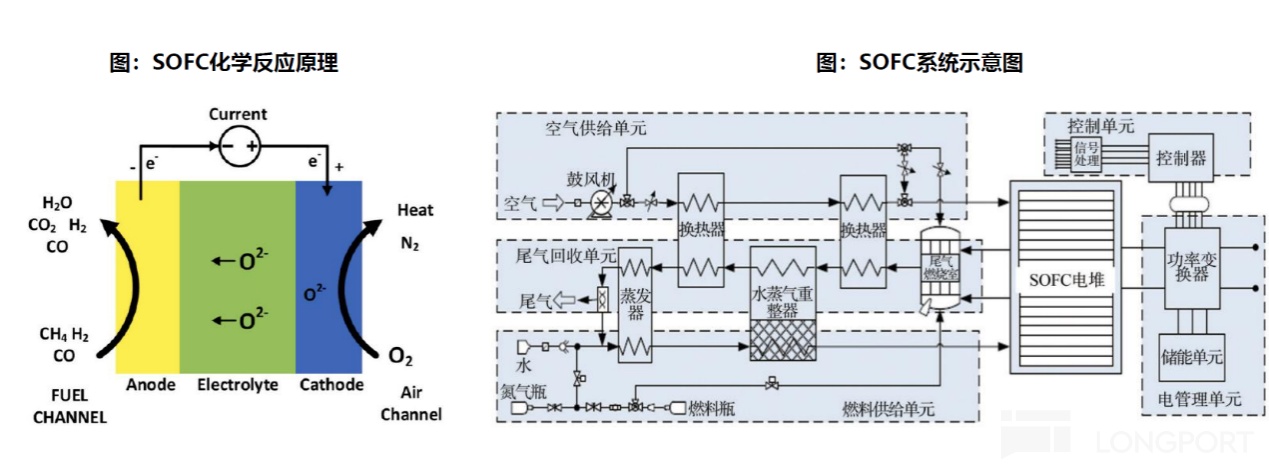
SOFCs directly convert chemical energy to electricity at 650–950°C as oxygen ions traverse a solid electrolyte and react at the anode with fuel like natural gas or hydrogen. This bypasses thermal-cycle limits.
System architecture: stacks plus balance-of-plant (BOP)
The system comprises a core reaction zone and surrounding support systems. The stack, built from hundreds or thousands of cells, determines power, efficiency, and lifetime.
BOP includes air preheat, fuel supply/reforming, tail-gas recovery, power electronics, and controls. Integration quality drives reliability and economics.
By support structure, SOFCs fall into electrolyte-supported (ESC), electrode-supported (ASC/CSC, mostly anode-supported), and metal-supported (MSC). Each seeks an optimal balance of strength, temperature, and resistance.
i) ESC: high-temp stability, mature first-gen
A thick electrolyte provides mechanical support with thin electrodes. Start-up is the slowest, but mechanical strength and structural stability are high and single-cell fabrication is straightforward.
The drawback is higher ohmic resistance from a thicker electrolyte, forcing very high operating temperatures of ~850–1,000°C and demanding high-temp BOP materials. Representative: Bloom Energy.
ii) ASC/CSC: lower temperature, performance focused second-gen
Thin-film electrolytes and thicker porous anodes as the support drop operating temperature to ~600–800°C, boosting power density and enabling cheaper metallic interconnects. Drawbacks include mass-transport limits from thick anodes and volume changes under redox cycling that can crack stacks.
Representatives: Delphi and FuelCell Energy for anode-supported, Siemens-Westinghouse for cathode-supported tubular designs. iii) MSC: metal-supported third-gen frontier
Replacing ceramic support with low-cost porous stainless steel drops operating temperature to ~500–600°C and greatly improves mechanical strength and thermal-shock resistance. Starts are faster and materials/cell costs are lower.
However, oxidation of metals at high temperature and thermal expansion mismatch with ceramics cause long-term degradation risks. The industry is working to overcome lifetime and degradation hurdles at scale.
Representatives: Ceres Power (SteelCell) and Weichai Power. These efforts define the commercialization frontier.
Market structure: one dominant, many strong
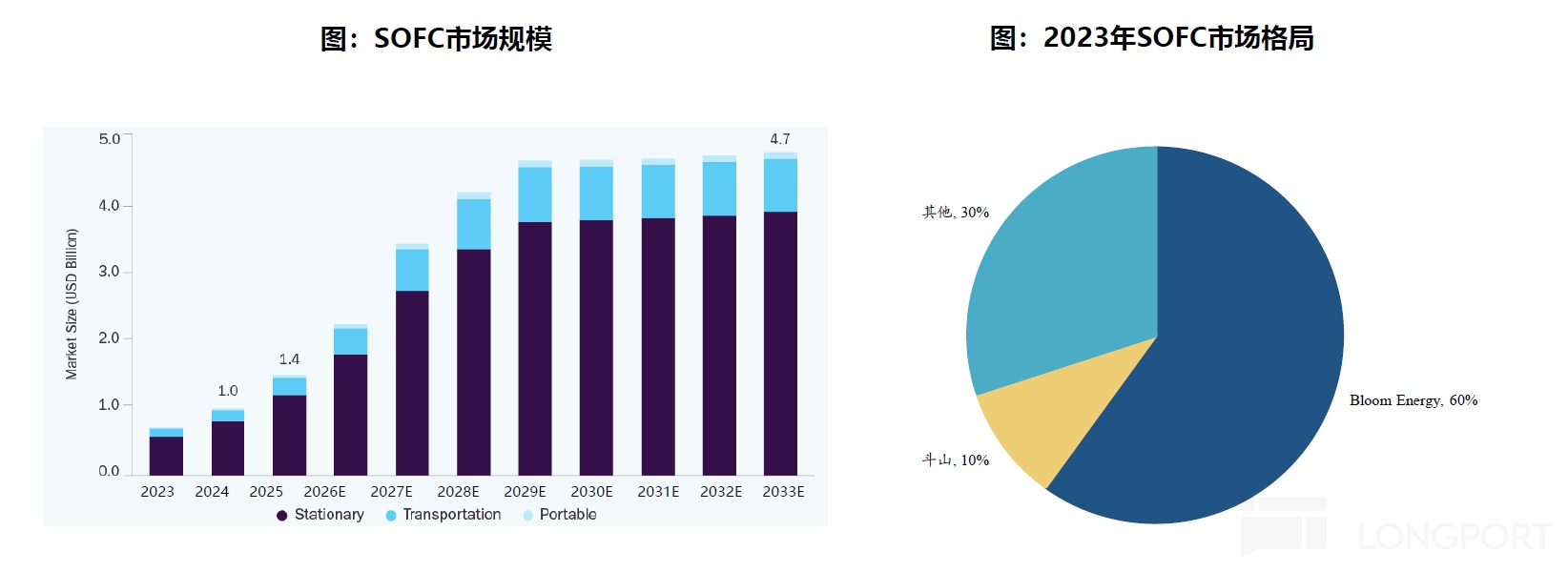
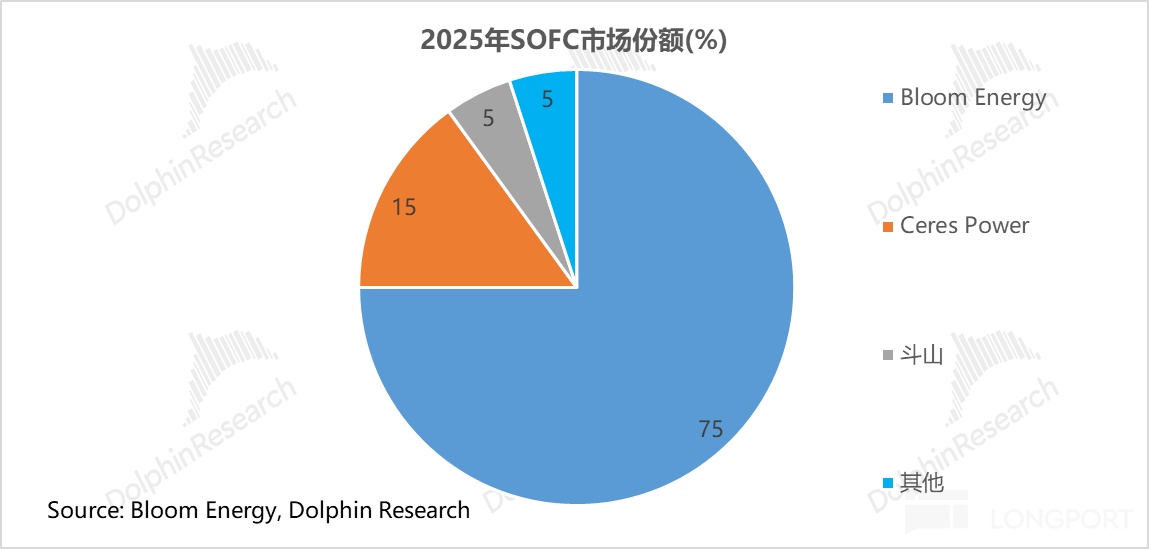
Still small, but on the eve of a breakout: The global SOFC market was about $1bn in 2024 per IDTechEx. With AIDC and other high-load use-cases surging, growth is set to accelerate.
In commercial/industrial SOFC stacks and systems, Bloom Energy (BE) dominates while others scale via technology licensing and partnerships. BE’s share is ~60%–80% based on deployments.
Its edge lies in mature tech and integration, volume manufacturing, faster delivery (90–120 days typical), and a deeply entrenched customer base. BE’s customers span the AI ecosystem from hyperscalers like Oracle and AWS to utilities like AEP (~1GW signed), new cloud players like CoreWeave, and infra capital such as Brookfield with a $5bn strategic tie-up.
BE’s current capacity is ~1GW, with plans to double to ~2GW by end-2026. This underpins delivery commitments.
Fast followers via licensing-led expansion: UK-based Ceres Power, with third-gen MSC tech, is building a global manufacturing network through an asset-light IP licensing model. It licenses SteelCell to large manufacturers rather than building its own large-scale plants.
Key partners include Doosan, which has a 50MW annual line and will start mass production in Jul 2025 with first shipments by year-end. Delta has announced a plant to start by end-2026, focusing on system integration.
Weichai Power, a ~20% strategic holder, has core stack manufacturing rights and is advancing Chinese capacity as a domestic leader. Other licensees include Denso in Japan and Thermax in India, accelerating regional commercialization.
Bloom Energy (BE): a triple transition in cost, backlog, and role
i) Cost down: tech iteration and scale drive volume
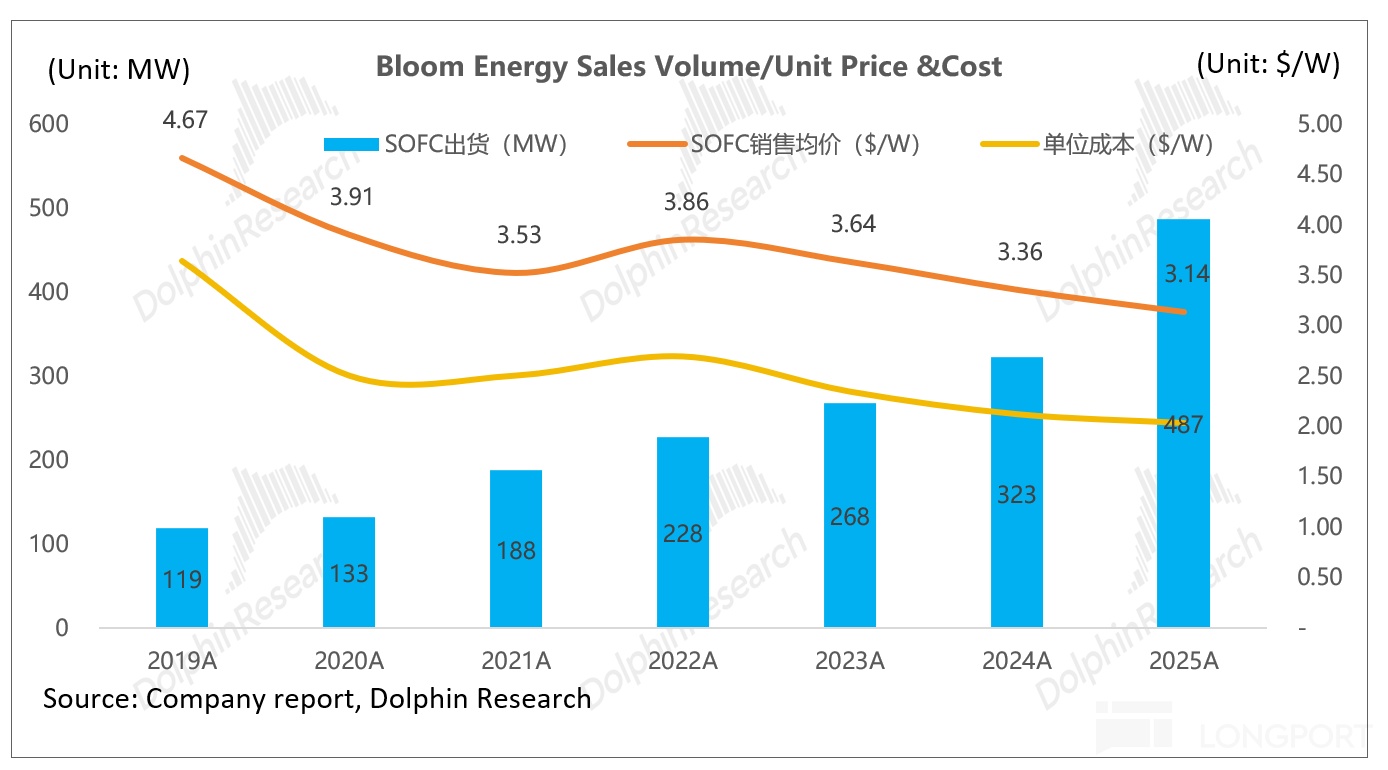
BE has steadily lowered hardware cost via tech improvements and scale. Unit system cost fell from ~$4.67/W in 2019 to ~$3.14/W in 2025, a ~6% CAGR decline, enabling expansion beyond high-tariff markets into lower-cost U.S. states.
ii) Orders surge: $20bn backlog at a record high, high visibility over 1–2 years
By end-2025, BE’s backlog reached ~$20bn. Product orders were ~$6bn (+140% YoY), implying ~2GW potential deployments.
Service orders were ~$14bn (+46% YoY), highlighting high-margin, long-duration cash flows under PPA models. Backlog fully covers 2026 capacity and partially locks 2027, supporting management’s outlook for >50% revenue growth and >32% non-GAAP GPM in 2026.
iii) Role shift: from policy-driven add-on to AIDC baseload
2024 marked a pivot. Before then, orders skewed smaller and policy/ESG-driven, such as Korea’s SK projects.
With the North American AIDC power crunch, BE is moving from off-grid alternative to a front-line, 24/7 baseload solution easing grid constraints. The order mix confirms this shift.
Geography: In 2024, 80%+ orders came from high-tariff states, driven by power price arbitrage. By 2026, 80%+ of backlog is in low-tariff states, showing site selection is migrating to where baseload can be added quickly and BE’s LCOE is competitive across regions.
Customer quality and stickiness: The roster now spans six hyperscalers and new cloud names vs. one a year ago, plus deep ties with utilities (AEP), infra capital (Brookfield), colos (Equinix), and hyperscalers (Oracle). Two-thirds of C&I orders are repeat buys, validating reliability under extreme loads.
Per recent environmental filings, an off-grid cluster in Texas could deploy ~1.5GW of BE systems. With 90–120 day plug-and-play, BE is entering the core supply chain of Meta and Google, leaving room for mega-orders ahead.
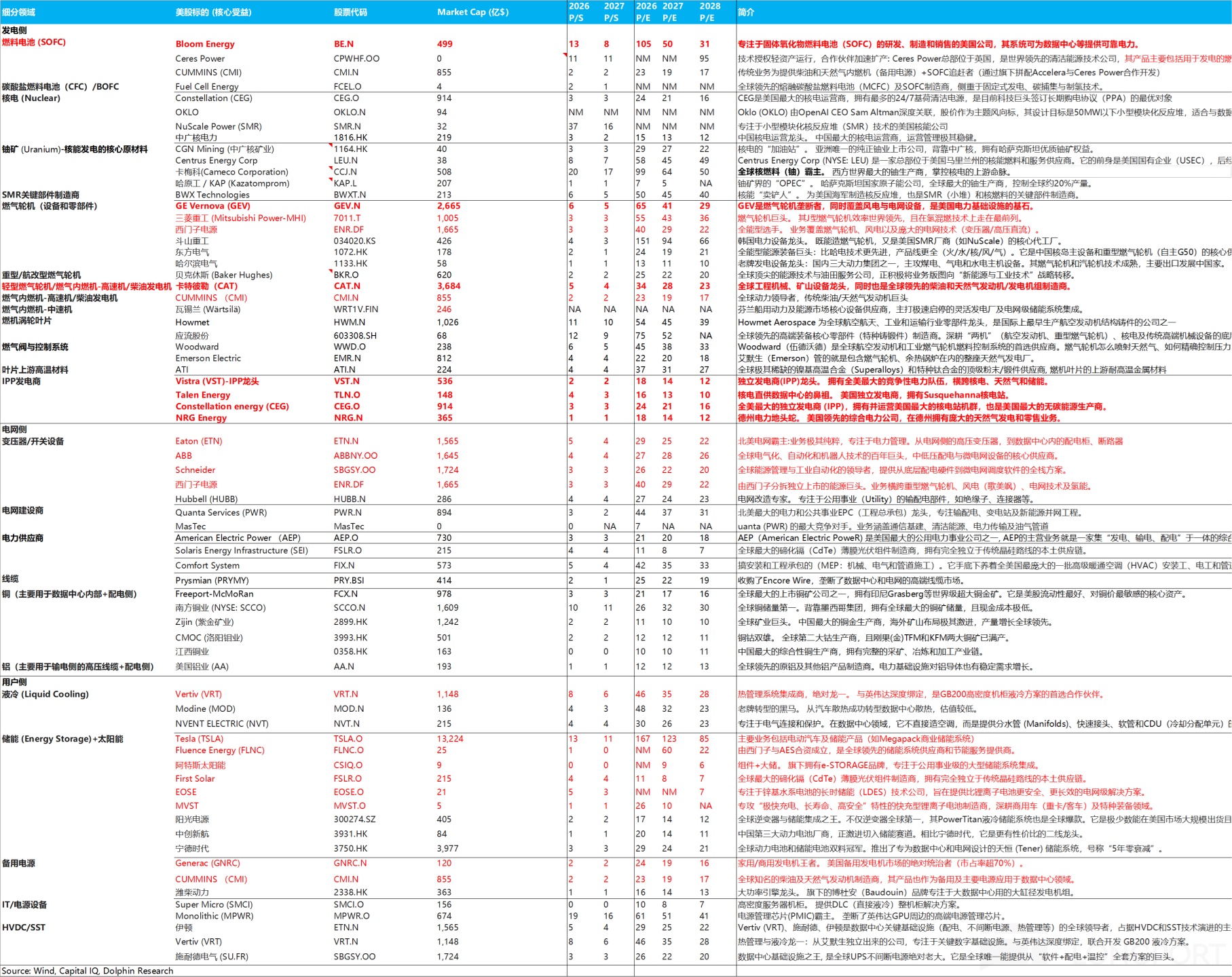
AIDC power: energy and equipment stock takeaways








The copyright of this article belongs to the original author/organization.
The views expressed herein are solely those of the author and do not reflect the stance of the platform. The content is intended for investment reference purposes only and shall not be considered as investment advice. Please contact us if you have any questions or suggestions regarding the content services provided by the platform.