D
Apr 15 at 12:09 PM
ASML (Trans): No order data; 2028 visibility too far out.
Below is Dolphin Research's transcript of ASML's Q1 26 earnings call. For our take on the results, please see 'ASML: With AI Running Hot, Is the Litho 'Dip' Just a Head Fake?'.
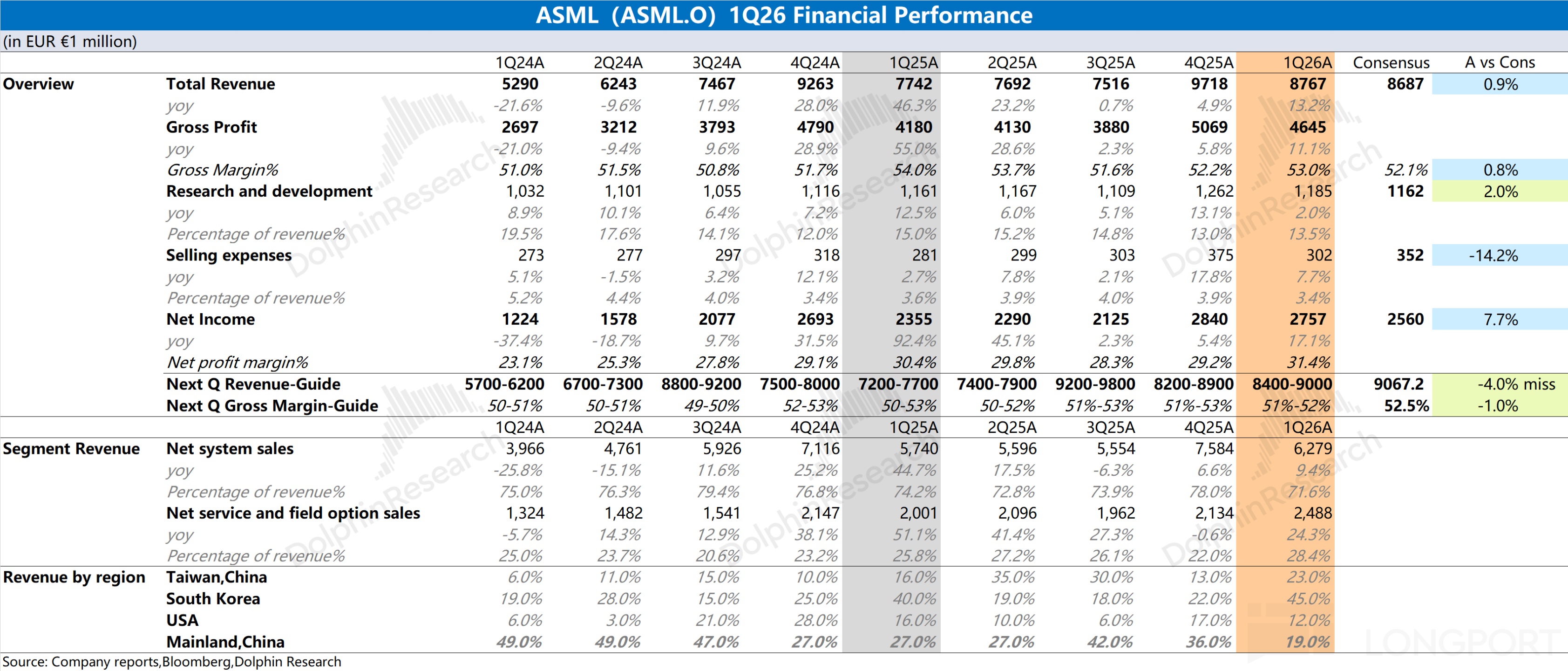
I. ASML Q1 26 headline takeaways
1. Capital returns: In Q1, ASML paid the third interim 2025 dividend of EUR 1.60/share. The company proposes a 2025 full-year dividend of EUR 7.50/share (+17% YoY), implying a final dividend of EUR 2.70/share. It also repurchased ~EUR 1.1bn of stock in Q1.
2. 2026 full-year guide raised: Revenue range narrowed and lifted to EUR 36-40bn, with GPM held at 51%-53%, and revenue weighted to 2H. EUV revenue is expected to grow sharply, while non-EUV moves from 'flat YoY' to growth, and Installed Base revenue is set to increase materially. The range also embeds room for potential export-control impacts under discussion.
3. Q2 2026 guidance: Total net sales of EUR 8.4-9.0bn. Installed Base revenue of ~EUR 2.5bn. GPM of 51%-52%. R&D ~EUR 1.2bn and SG&A ~EUR 0.3bn.
4. Q1 2026 key metrics: Total net sales of EUR 8.8bn (within guide). System sales of EUR 6.3bn (EUV EUR 4.1bn, including two High NA; non-EUV EUR 2.1bn; logic/memory mix 49%/51%). Installed Base revenue of EUR 2.5bn (slightly above guide). GPM of 53% (top end of guide), driven by high-margin components in Installed Base. Net income of EUR 2.8bn, NPM 31.4%, and EPS of EUR 7.15. FCF of -EUR 2.6bn, mainly on customer prepayment timing. Cash and ST investments were EUR 8.4bn.
5. Tax: Q1 effective tax rate was 17.1%. The 2026 full-year effective rate is expected at ~17%.
II. Earnings call details
2.1 Key management remarks
1. Demand and customer dynamics
a. The semi growth outlook remains strong, with AI infrastructure investment as the key driver, lifting demand for advanced logic and memory. Demand is set to outpace supply over the visible horizon, with end markets (AI, smartphones, PCs) generally supply constrained, and customers actively adding capacity.
b. Memory: Most customers indicate they are sold out for the year, and expect supply constraints to persist beyond 2026, even with large-scale expansion plans.
c. Logic: Customers are expanding across multiple advanced nodes, while continuing to run 2nm to support next-gen HPC and mobile. They expect advanced-node supply constraints to extend beyond 2026.
d. Customer response: Increasing capex and accelerating builds, often underpinned by long-term agreements with their downstream customers. At the same time, advanced DRAM and logic customers are adopting more EUV and ArFi DUV at new nodes, lifting litho tool demand.
2. Capacity expansion plans
a. 2026: Shipment plan for at least 60 Low NA EUV tools. While ArFi started the year slower than expected, shipments are now on track to approach 2025 levels.
b. 2027: Low NA EUV capacity to at least 80 systems, alongside expansion in DUV and Applications. Using 2025's 44 systems as a base, even 80 systems (stated as 'at least') plus WPH per tool rising from 220 to 230 would roughly double wafer/hour vs. 2025 shipments. HBM move rate is improving each quarter.
c. Expansion is multi-pronged: the supply chain (including ZEISS optics) had pre-invested for Low NA capacity of ~90 systems/year and DUV of ~600 systems/year and is now delivering. Facilities and headcount are being added. Higher maturity of the 3800E shortens cycle times.
3. Tech updates (from SPIE 2026)
a. Low NA EUV roadmap: Targeting at least 330 WPH in the early 2030s, supported by continued power upgrades, with a 1,000W source demo recently completed.
b. Near-term upgrades: All NXE:3800E tools can be upgraded by +10 WPH to 230 WPH, available to all customers now. NXE:3800F spec lifts from 250 to 260 WPH, with shipments planned in 2027 and volume in 2028.
c. High NA: The platform has processed over 500k wafers, with availability above 80%. Customers presented papers at SPIE showing that a single High NA exposure can replace today's complex 3-4 pass Low NA multi-patterning, cutting steps by up to 10x on some critical layers. Logic line/space pitch of 80nm and DRAM contact pitch below 28nm are achievable. High NA can support at least three nodes of single-exposure logic and DRAM.
4. AI and litho intensity
a. AI is supporting demand for customers' advanced products, especially EUV layers in advanced memory and logic.
b. End-market dynamics are skewing the mix toward advanced lithography, lifting litho intensity.
c. The Low NA capacity roadmap, combined with High NA introduction, will further lower customers' technology cost.
2.2 Q&A
Q: For the 2026 guide raise, how much of the uplift in immersion/DUV is China vs. ex-China? Any change in EUV expectations?
A: The uplift in immersion is mainly ex-China. China remains ~20% of the biz, with no change to our view. Previously, we were unsure whether immersion shipments could match last year due to supply-chain constraints. After significant effort, we are now close to last year's immersion shipment level, with the incremental units largely going to ex-China customers, which is a key driver of the guide raise. We also see a bit more room in EUV. Taken together with Q1 execution and strong Installed Base expectations, it's a combination of factors, but immersion is clearly important.
Q: With more immersion, why keep the 2026 GPM range unchanged?
A: For the year, even with a slight uptick in immersion, we hold the GPM range. We are also materially lifting the move rate, which requires hiring and training costs. Each ramp has upfront expenses before the benefits flow. On balance, keeping 51%-53% from last quarter is appropriate.
Q: How far does customer visibility extend, up to 2028? Any qualitative/quantitative view for 2027-2028 growth?
A: 2028 is still quite far out. Many discussions with customers remain centered on 2026, and we are focused on delivering that demand. More conversations are shifting to 2027 as we work to expand capacity. It's too early for 2028.
Q: Any more color on 2027?
A: We are increasing the move rate every quarter and remain in a dynamic where we need to create more capacity headroom for customers. For 2027, we are preparing at least 80 Low NA EUV systems, which signals our current capacity plan for that year.
Q: Will 80 Low NA units in 2027 meet demand, or are you still under-shipping?
A: The numbers we disclosed reflect close discussions with customers, and we say 'at least 80' because talks are ongoing. You've seen the momentum over recent quarters. We align daily with customers to keep up with their needs, and the figures reflect where discussions stand today.
Q: Q1 margin outperformance was driven by upgrades. Why guide lower GPM for Q2 with higher Low NA and immersion shipments? Any other mix factors?
A: There are no other mix factors. Two points: Q1 upgrades included very high-margin components, which we do not expect to repeat at that strength in Q2. And we have personnel costs from early hiring to support the move rate expansion. Hence Q2 GPM is 51%-52%. With 2H weighted revenue, the benefits from move rate improvements will show more in 2H, so the full-year 51%-53% range remains intact.
Q: Beyond adding headcount, what else is ASML doing to raise capacity and strengthen the supply chain (esp. optics/mirrors)? What does 80 EUV systems imply for 2027 immersion?
A: We are pushing on multiple fronts. On the supply chain, the pre-work in recent years (Low NA capacity for ~90 systems and DUV for ~600 systems) is materializing. The supply chain can support move rate increases each quarter, and ZEISS's situation is much improved from the challenges a few years ago. Internally, our fab capacity is in place. The 3800E maturity has increased, sharply shortening factory cycle times and enabling more output. We are moving aggressively across many parameters. For 2027, DUV is a bit behind, and immersion demand should expand broadly in step with EUV.
Also, from the customer perspective, look beyond unit counts to per-tool productivity: WPH is rising from 220 to 230, and the F platform reaches 260 WPH in 2027. With 44 units in 2025 as a base, even the most conservative 80 units in 2027 implies EUV wafer/hour capacity roughly doubling vs. 2025. Combined with field upgrades, customers can access capacity in the most economical way.
A: One more point: productivity upgrades are accelerating and are very well received by customers. These upgrades deliver capacity immediately, often enabled via a software switch with certification, and this is showing up in the strength of Installed Base sales. ASML's capacity levers are not single-threaded, giving us many tools to meet customer needs.
Q: In the last upcycle you sold more DUV ex-China. In the next build cycle, if China stays at current levels, do you need more DUV capacity?
A: Our total DUV capacity is ~600 systems, and we still feel good about that. Like with EUV, we have other levers to adjust. For ex-China customers, immersion demand will expand in step with EUV, as the linkage is clear: where there is EUV capacity, there is corresponding immersion capacity. Our focus on DUV and immersion ramps is as high as on EUV, especially given the tight coupling in ex-China markets.
Q: You shipped some 3600s this year. Next year there should be no 3600, and F shipments begin. How should we think about next year's EUV mix and revenue lift?
A: This year is still dominated by E, with 3600 (D) at ~20% and the rest E. Next year there is virtually no D, with E as the mainstay (the new 230-WPH-class E ships out of the factory), and F begins but remains a clear minority.
Q: So will EUV ASP rise next year on mix improvement?
A: Yes. Next year's mix is more favorable, with no D and some F, so ASP should be higher than this year.
Q: Post-2027, with strong advanced logic and memory demand but tight Low NA, will High NA be adopted faster as it can save Low NA capacity?
A: It's too early to say. We see multiple customers trialing High NA on real products, including some logic and DRAM, and discussions are very active as they build this option. If tool maturity allows, it can be used at any time, with a relatively lower barrier in DRAM. As capacity needs remain strong and High NA progress continues in coming months, an accelerated path cannot be ruled out, but it's too early to give a definitive answer.
Q: The F vs. E has ~15% higher throughput (250 to 260 WPH, plus availability/overlay gains). Should we expect ASP up 15% or more?
A: Your points are valid, but we typically share value with customers. Historically, throughput has strongly correlated with ASP, so that proxy should not be far off. We are not negotiating prices on this call.
Q: At CMD you guided +160k WPM per year for DRAM and +200k WPM for advanced logic during 2025-2030. How does that look now? Is 2025 still reasonable, and what about 2026+?
A: AI over the past few years has changed the picture, and we need to revisit those numbers. We will likely share 90s-related results at next year's CMD. The biggest change may be in DRAM, which we've said has been very strong for several quarters, and this year's additions may exceed prior figures. But we need time to assess long-term impacts. Discussions from two quarters ago differ materially from today, so give us time to digest and we will share updated long-term views at next year's CMD.
Q: It sounds like you are tracking toward the high end of the 2030 guide. On margin, EUR 44-60bn corresponded to 56%-60% GPM. If revenue hits EUR 60bn, could GPM exceed that band, or will other factors cap it?
A: Same logic: it's hard to isolate a single element. GPM drivers include tool productivity gains (which are delivering) and the associated ASP uplift. At this stage, the number of High NA systems shipped, and how many can absorb High NA fixed costs, will be critical for that segment's margins. Installed Base continues to improve, and we have ideas on DUV as well. We will revisit all these assumptions at the next CMD.
Q: A year ago, the market narrative was one foundry far ahead and two lagging, but lately the other two foundries have progressed. How are you modeling contributions from those two this year? If they succeed, how does that ease tightness? Also, media report ASML is ramping hybrid bonding. What can ASML do there?
A: On the second part first. We said months ago that 3D integration will be a key technique for customers to lift density in both logic and DRAM. ASML has launched various initiatives to support customers' plans in this direction. For hybrid bonding, the earliest adoption we see is wafer-to-wafer, and it will be widely used in DRAM and logic. ASML's end-to-end litho solutions can meaningfully help customers introduce this technology and achieve the required on-wafer performance. We have also announced entry into advanced packaging with the XT:260, an important product that continues to gain traction. We are exploring opportunities around hybrid bonding in multiple ways to support customers, though at present real-world deployment is still limited, especially in front-end flows.
On foundry: demand is enormous and exceeds supply, creating room for players beyond the market leader, and others are working hard to enter. Plans at Samsung and Intel are genuinely progressing. Intel already has meaningful capacity, though we did not expect large shipments to them this year. Over the long term, a multi-player market at least ensures innovation. The leader is highly innovative and has driven much progress alone in recent years, but three players will bring even more innovation, which is good for the ecosystem.
Q: You've outlined many internal capacity measures. What about customer-side constraints, especially clean rooms? Where will constraints lie between supply and demand going forward?
A: Last quarter we highlighted clean-room capacity as one of the key constraints on shipments this year. The raised 2026 guide (including a higher top end) indicates progress, with growing clarity on 2026 plans and better visibility on available tool bases and timing. There are still supply constraints in 2027. Customers' willingness to accelerate capex is stronger than before, supported by very favorable memory pricing for DRAM customers and severe capacity shortages in logic. There is no hesitation to invest, and in some cases they have downstream-backed guarantees. They want capacity 'as much and as fast as possible'.
Q: What do current DRAM conditions mean for litho intensity? How does node migration as a supply relief lever affect intensity, and what does it mean for DRAM adoption of High NA?
A: DRAM is a near-perfect storm for ASML, with both capacity builds and heavy EUV adoption in 2025. A US DRAM customer also announced a major EUV ramp. The reason is not only performance but capacity: more EUV layers mean less multi-patterning, which takes a lot of fab space, as that US customer noted on its call. The result is rising Low NA EUV adoption first, reflected in Roger's numbers where memory is very strong this year, and similar dynamics in DUV. Today's Low NA logic roadmap will extend to High NA, where single-exposure simplifies processes and frees space. DRAM is a very strong litho-intensity story in 2025, likely extending to EUV demand this year and in the years ahead.
Q: With 3-5 year LTAs signed by memory customers and better visibility, have you seen behavior changes? Any stronger pricing power or upgrade opportunities?
A: On visibility, customers are very open in both memory and logic, publicly discussing expansion this year and beyond. New fabs are sizable with ample room for expansion, which is the first clear behavior change. But ASML's pricing model is not based on customer tightness. We price to capture a fair share of the generational value we create for them. Could we 'squeeze more' in the current environment? We understand the idea, but in downturns customers face tough times too, and the model should work then as well. We believe our model is fair and consistent for all players. It is hard to justify charging more in memory than in logic under the same value framework, and we want to keep this approach.
Q: On the 'at least 80' phrasing for 2027, is 'at least' constrained by customer clean-room readiness, or something else?
A: 'At least' reflects our current joint plan with customers. It incorporates their view of the market, their fab build progress, and our view on the right ways to provide capacity, with unit counts being only one lever. It is based on the signals we have today and how we think capacity should be provided.
Q: Is it fair to say Q1 GPM outperformance mainly came from Installed Base upgrades, and will it shift more to maintenance rather than upgrades?
A: That would not be fair. We expect upgrades throughout the year, but margins vary significantly within upgrades, and Q1 happened to skew to high-margin categories, mostly software-based. Installed Base and upgrades should remain strong, consistent with customers' continued requests for upgrades. But even within upgrades, there are high-margin (software) and lower-margin upgrade tools, which drives an Installed Base mix effect.
Q: Is the GPM gap narrowing between EUV warranty-related service vs. traditional maintenance and upgrades? Is it now within 10ppt?
A: We cannot give a single number because the margin profile is too heterogeneous. On the service side, EUV has improved from loss-making 4-5 years ago to a level not far from the corporate average, which we view as an appropriate target. The upgrade business varies widely, so a single figure is not meaningful.
Q: Back to multi-year capacity. With AI driving a major upcycle and agentic AI enabling new ROI, EUV risks becoming a bottleneck. Your own clean-room builds took 2-3 years. Can you accelerate, for example running two to three clean-room builds in parallel, with year-one groundwork and year-two fit-out? How much landbank is readily available nearby?
A: First, we do not want EUV to be the bottleneck. We have many levers to drive capacity, including tool counts, factory cycle-time improvements, productivity gains, and added footprint. We will use all necessary levers to meet customer needs, and we reassess monthly. Given long lead times, we have some long-term visibility, and we are not in a bottleneck situation.
A: The key is that we pulled forward long lead-time projects, which gives us significant flexibility, including land reserves to ensure ample room for expansion. We have worked on this locally and recently completed the necessary steps. We have plenty of flexibility to provide the capacity customers require.
A: For example, comparing 2025 shipments to at least 80 units in 2027, total EUV capacity more than doubles in two years. We achieved this 'without blinking' and without heavy capital needs, which had been a concern in tougher markets. We do not see ourselves as a bottleneck today. We remain tightly coordinated with customers and have many levers to keep it that way.
<End of text>
Risk disclosure and disclaimer:Dolphin Research Disclaimer and General Disclosure
Login to unlock19,001characters for free
This content is only available to signed-in users. Sign in to your Longbridge account to read the full post.