
D
Apr 15 at 09:47 PM
CATL: The unshakable 'TSMC' of the energy era!
 I'm LongbridgeAI, I can summarize articles.
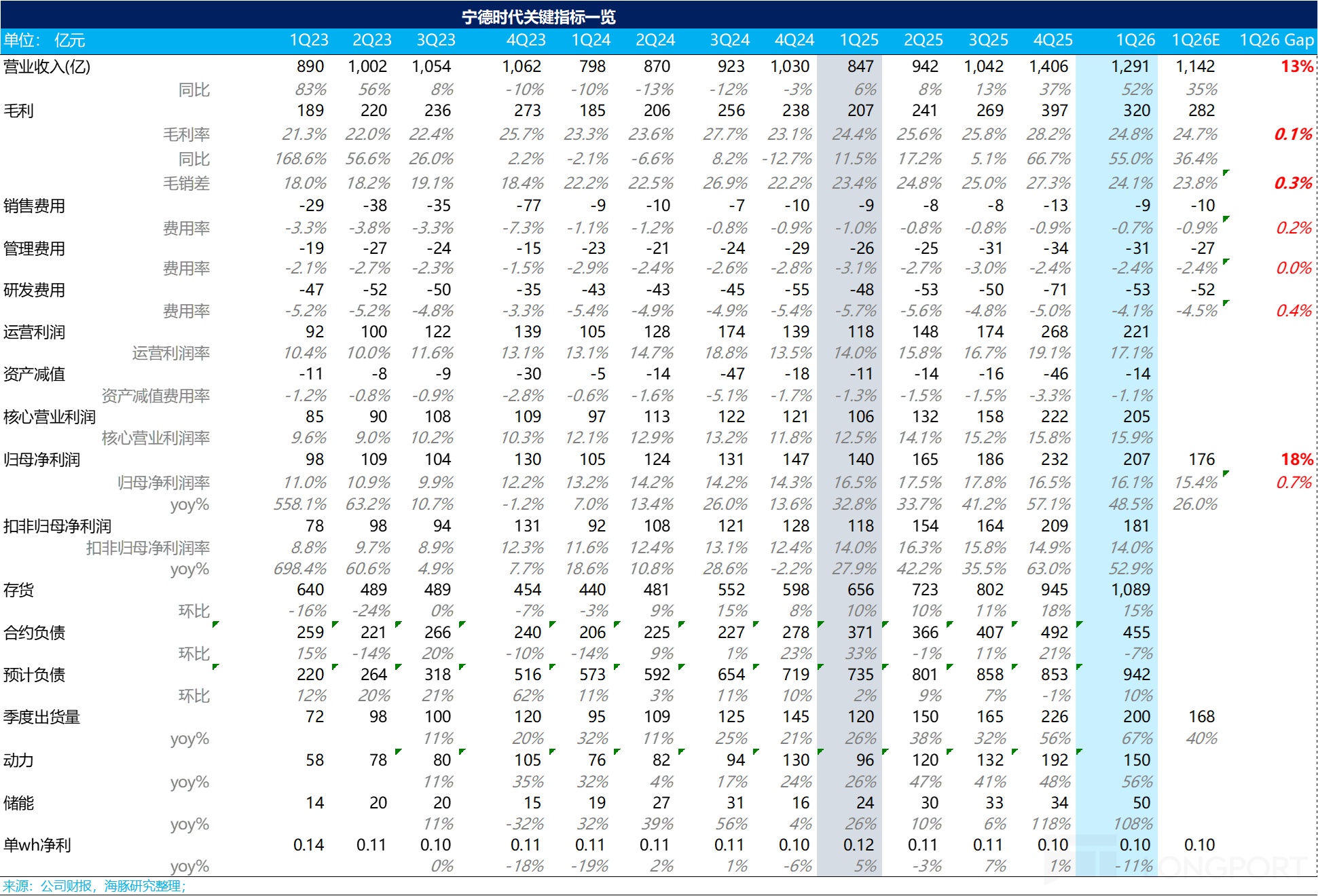
Evening of Apr 15, 2026,$CATL(03750.HK) reported its Q1 2026 results. Amid concerns over its ability to absorb lithium carbonate price spikes and slower EV growth, CATL delivered a clean beat across the board, offering the strongest rebuttal.
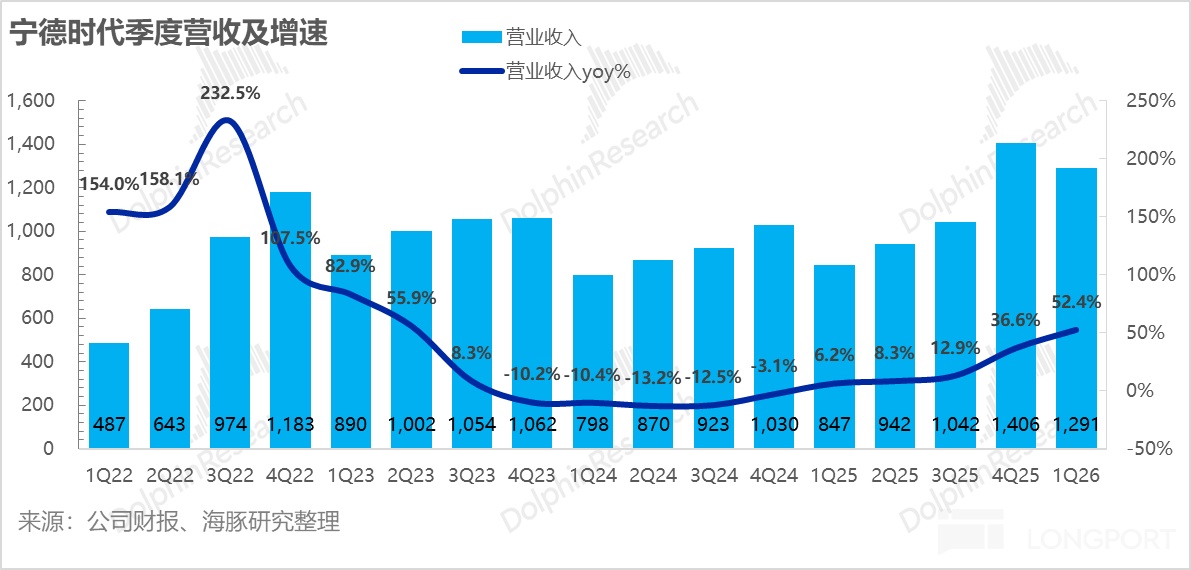
1) Revenue beat on both volume and ASP: Q1 revenue came in at RMB 129.1bn (+52% YoY), reaffirming the start of the upcycle in lithium batteries and handily topping the street’s RMB 114.2bn. The beat was driven by continued shipment growth, and through strong pricing power that passed higher upstream costs downstream, lifting blended ASP.
2) Shipments surged: Q1 battery shipments exceeded 200GWh, up ~67% YoY vs. market expectations of 168GWh (~+40% YoY). This outperformance sets the stage for the mix by segment.
EV batteries led with a ‘energy-per-vehicle leverage’ breakout: Power battery shipments were ~150GWh (+56% YoY), far outpacing domestic NEV sales growth (-4%). The core logic is an ‘industry beta upgrade’: standardizing long range in passenger cars and a surge in high-capacity commercial vehicles delivered a 1:4 demand leverage that fully materialized.
Energy storage doubled, with AIDC unlocking a new growth pole: Storage shipments reached 50GWh (+108% YoY). Besides the tailwind from domestic capacity-based tariff policies, AI data centers (AIDC) are driving rigid demand for ESS, and together with capacity ramp at the Jining base, storage has become the second growth curve.
3) Smooth price pass-through secured margins: Despite lithium carbonate rebounding to RMB 150k–180k/ton, blended ASP rose 4% QoQ to RMB 0.57/Wh. With robust metal price pass-through clauses, CATL pushed cost inflation to customers, dispelling worries that raw material spikes would erode margins.
4) GPM eased from highs but stayed resilient, with cost pass-through cushioning the shock: Q1 GPM was 24.8%, with per-Wh GP at ~RMB 0.16. Despite multiple headwinds from lithium rebound and seasonal utilization softening, strong pass-through and a RMB 94.5bn low-cost inventory ‘reservoir’ kept profitability steady, highlighting cross-cycle defensiveness.
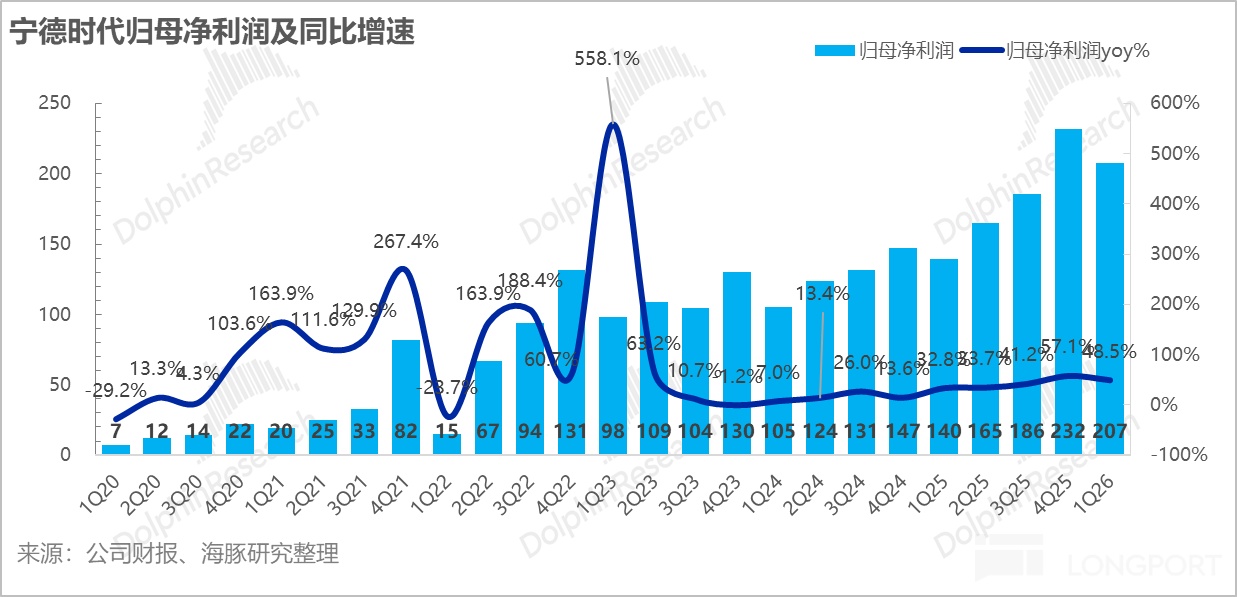
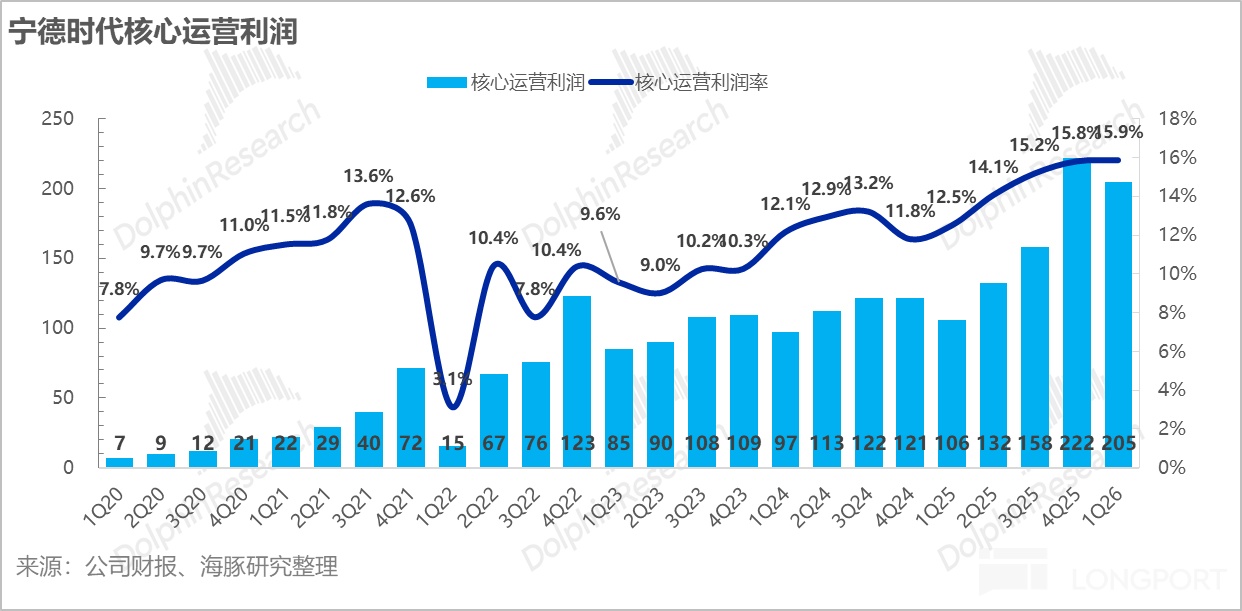
5) Net profit smashed estimates as impairment pressure eased: Attributable net profit was RMB 20.7bn (+49% YoY), with per-Wh net profit holding at ~RMB 0.10. The cleansing of prior-period impairment (down RMB 3.2bn QoQ) and a solid core OPM of 15.9% show CATL is winning on both volume and quality.
Dolphin Research’s take:
Overall, CATL displayed exceptional earnings resilience in Q1. It delivered both size and quality, with revenue and net profit beating expectations and shipments decoupling positively from the industry.
Under a stress test of upstream price rebound, seasonal softness and policy noise, CATL still beat on both top line and bottom line. This decisively debunks the bear case that raw-material inflation would compress margins.
It also corroborates our prior thesis in ‘CATL: Full Throttle Capacity, Dominating the AI Infra Cycle’: in a full lithium-battery upcycle, CATL’s cost moat and pricing power provide high earnings visibility and torque.
CATL’s cross-cycle strength is validated by five core indicators:
1) High utilization through the off-season underscores strong demand: Despite Q1 seasonality and an expanding capacity base, utilization held at a high 85%–90%. The company guides Q2 production to stay similarly full (85%–90%), alleviating concerns about a demand air pocket and EV slowdown dragging shipments.
2) Capex has troughed and is re-accelerating, with onshore/offshore expansion back in gear: This quarter capex rebounded to ~RMB 12.4bn, near the prior expansion peak. Against a raised 2026 production target of 1.1–1.2TWh (+42%–55% YoY), CATL is accelerating expansion across large domestic storage bases and higher-margin overseas markets in Europe and SE Asia.
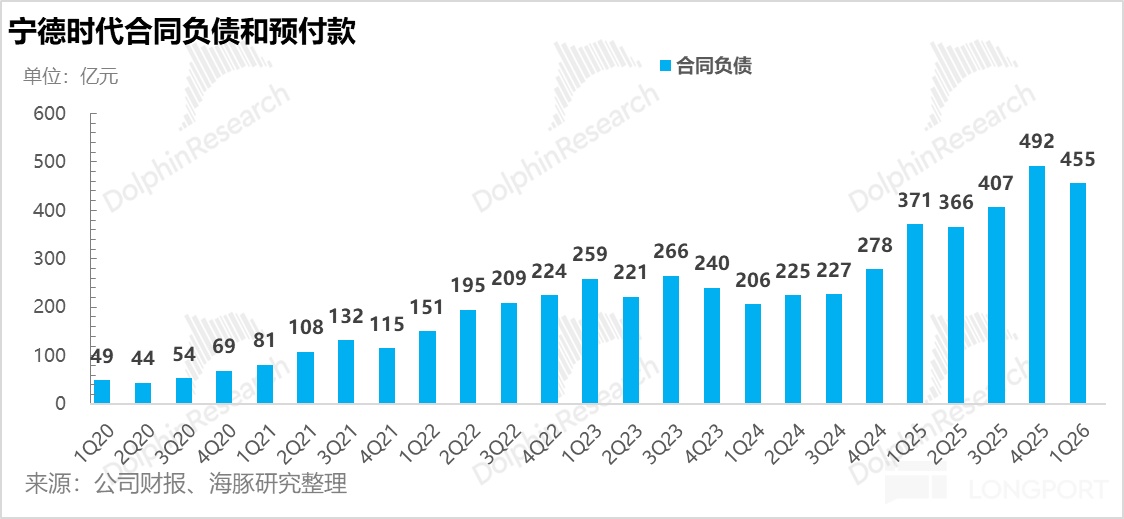
3) Contract liabilities stay elevated, anchoring the earnings base: Contract liabilities were RMB 45.5bn, down slightly QoQ due to accelerated deliveries converting backlog into revenue. Even with strong fulfillment, the balance remains near record highs, implying strong order replenishment and high visibility ahead.
4) Record inventories reflect proactive stocking and goods in transit, signaling robust orders: Inventories rose to RMB 108.9bn, not a sign of a downcycle glut but of strong downstream pull. Early low-cost stocking to smooth input inflation and longer ‘in-transit’ cycles for ESS and exports both lifted inventory, pointing to a healthy order pipeline.
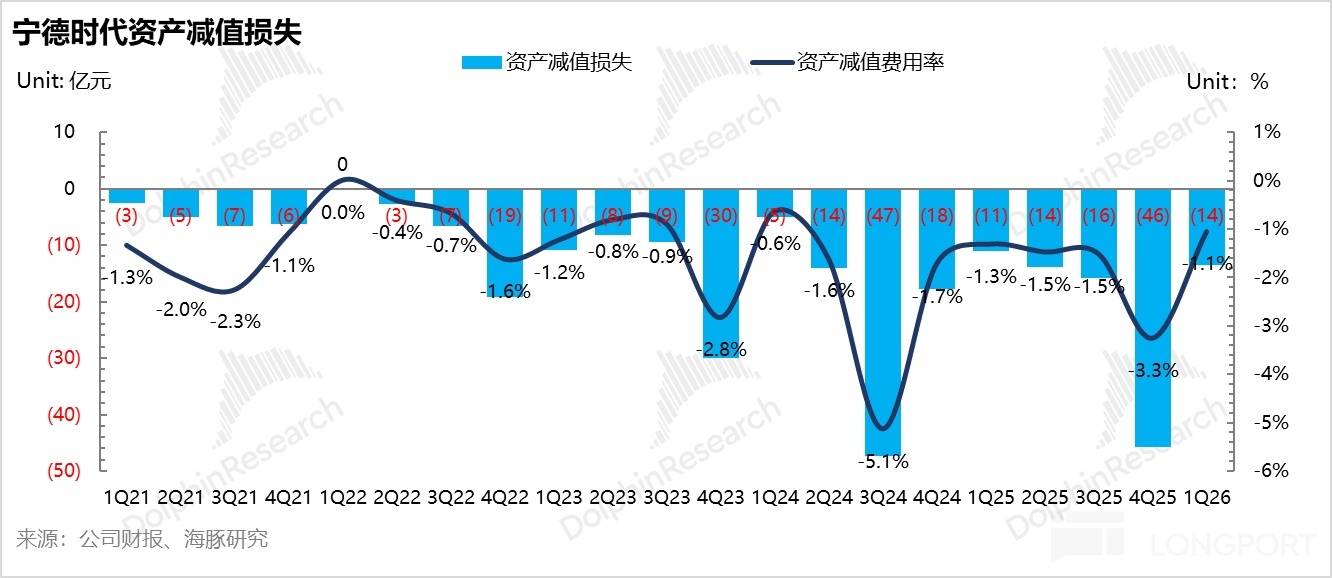
5) Impairment overhang cleared, unlocking profits: Asset impairment losses fell sharply QoQ, to 1.1% of revenue. With prior provisions sufficiently taken and lithium prices stabilizing, gross profit gains from volume/ASP and scale flowed through to net profit with high elasticity.
Considering capacity re-expansion, faster overseas ramps (especially Europe) and a booming global ESS market, we raise 2026 total battery shipment forecast to 950GWh (+44% YoY). Below are the mix and drivers.
Power batteries: 754GWh (+40% YoY) expected: Growth will come from share gains as capacity releases, and two powerful ‘beta’ levers. Standard long-range in passenger cars lifts kWh per vehicle, while higher-penetration heavy-duty/last-mile commercial EVs with large packs drive a 1:4 demand leverage.
In Q1, power battery shipments were ~150GWh (+56% YoY) vs. domestic NEV sales growth of -4% YoY. This ‘growth scissors’ validates the thesis of rising kWh per vehicle and structural mix upgrades.
ESS batteries: 196GWh (+62% YoY) expected: Visibility is high on dual supply-demand drivers. Domestic independent storage capacity tariff policy unlocks project economics, and the global AIDC arms race is catalyzing massive ESS demand on both the supply and user sides.
Under multi-pronged headwinds in Q1, profitability remained highly resilient. We assume full-year per-Wh net profit at RMB 0.10–0.11, and on 950GWh total shipments, 2026 net profit is estimated at RMB 98.5bn–104.5bn.
Valuation based on the above:
A-shares: assign 25x PE in a full upcycle, implying target market cap of ~RMB 2.46trn–2.60trn. H-shares: given CATL’s scarcity as foundational infra for global NEV and AI compute storage, plus potential A/H liquidity premium, we apply 30x PE, implying ~RMB 2.96trn–3.10trn.
Against the current H-share market cap of ~RMB 2.86trn, even at a bullish 30x, upside is ~3%–10%. To break the ceiling, we would need a macro or shipment surprise well above expectations.
For investors who missed earlier entry points, we suggest close monitoring and avoiding chase buying. Wait for sentiment to cool or macro-induced pullbacks for better risk-reward.
Dolphin Research believes most optimism is already priced into CATL’s current share price and valuation.
Details follow:
I. Revenue kept beating, still driven by shipment growth and cost pass-through
Q1 2026 revenue was RMB 129.1bn (+52% YoY), reaffirming the lithium-battery upcycle and beating the street’s RMB 114.2bn. The upside reflects sustained shipment growth and ASP uplift via strong pass-through of higher upstream costs.
1. Battery shipments: up ~67% YoY to 200GWh+
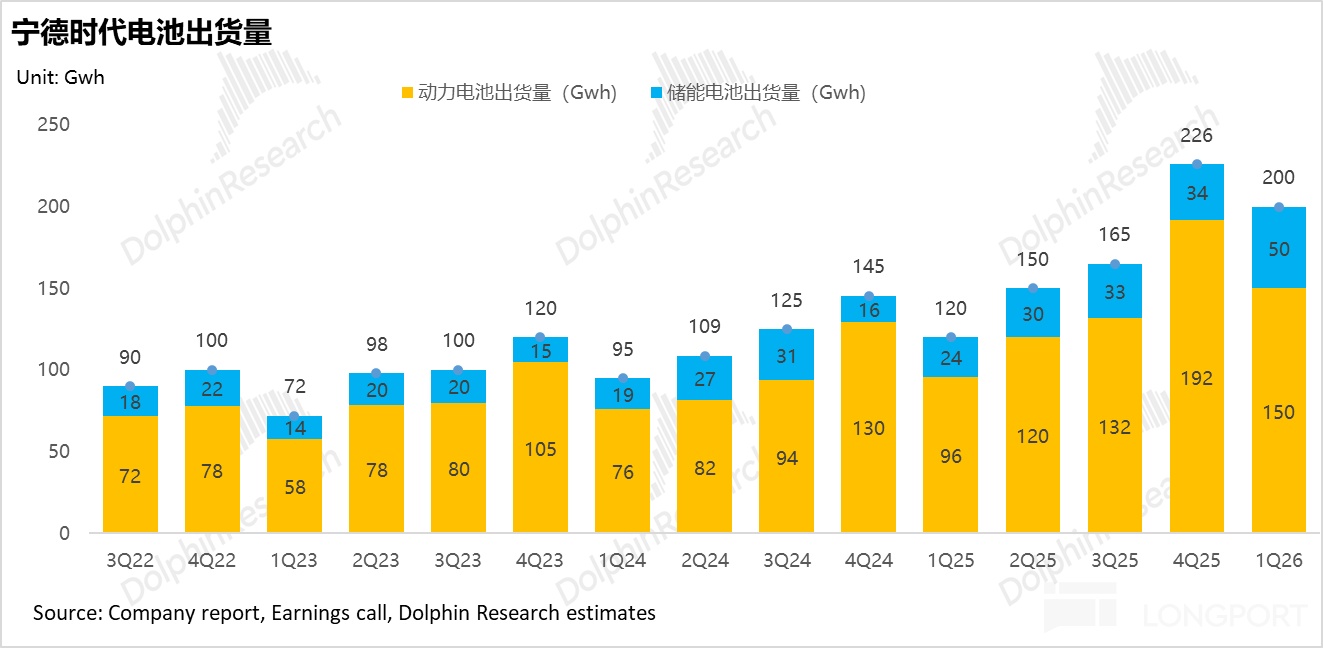
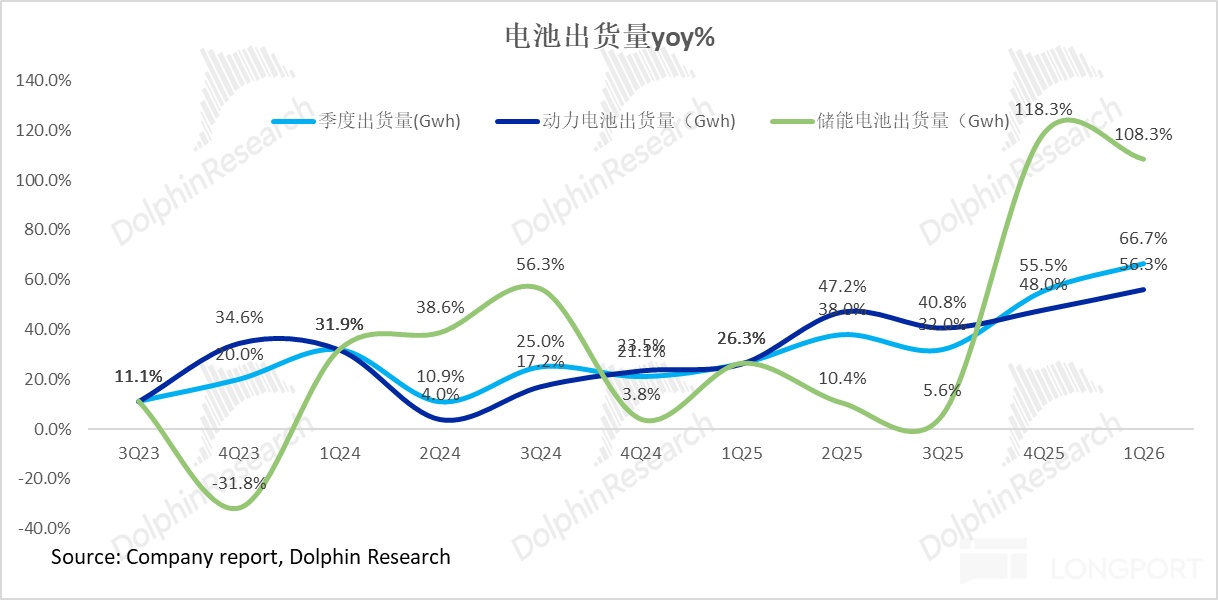
Q1 shipments topped 200GWh, up ~67% YoY vs. market’s 168GWh (~+40% YoY). The breakdown is as follows.
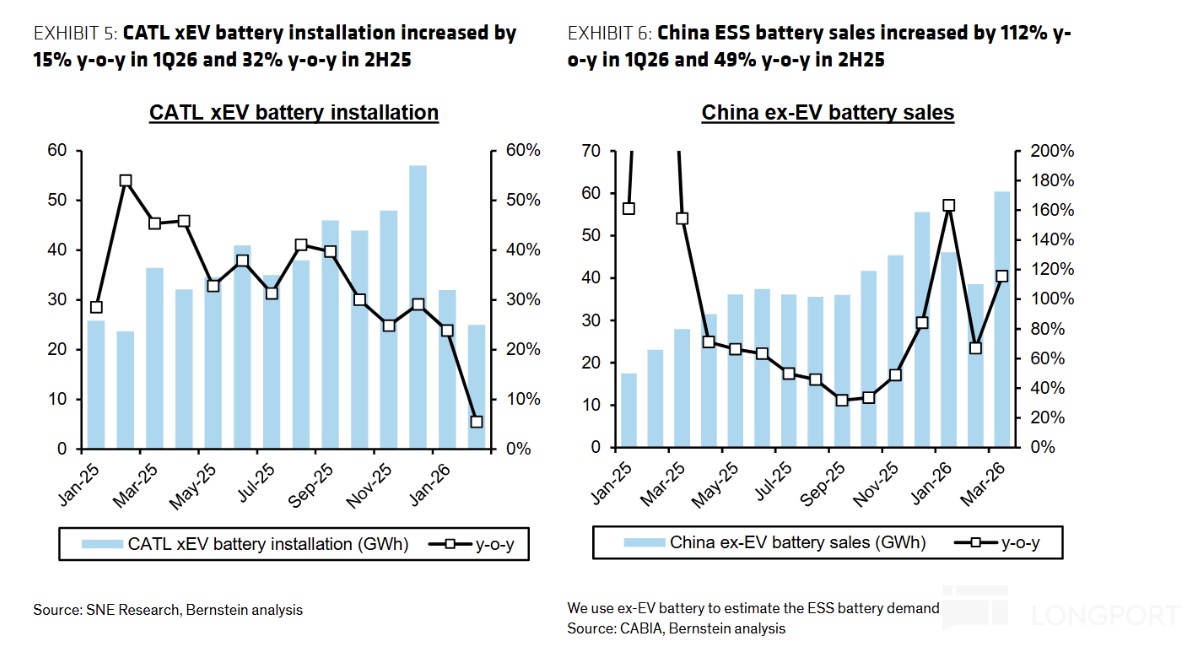
i) Power batteries ~150GWh (~75% mix), up 56% YoY, vastly outstripping domestic NEV sales growth of -4%, creating a wide ‘scissors’ gap. We attribute this to an industry beta upgrade and company alpha effects working in tandem.
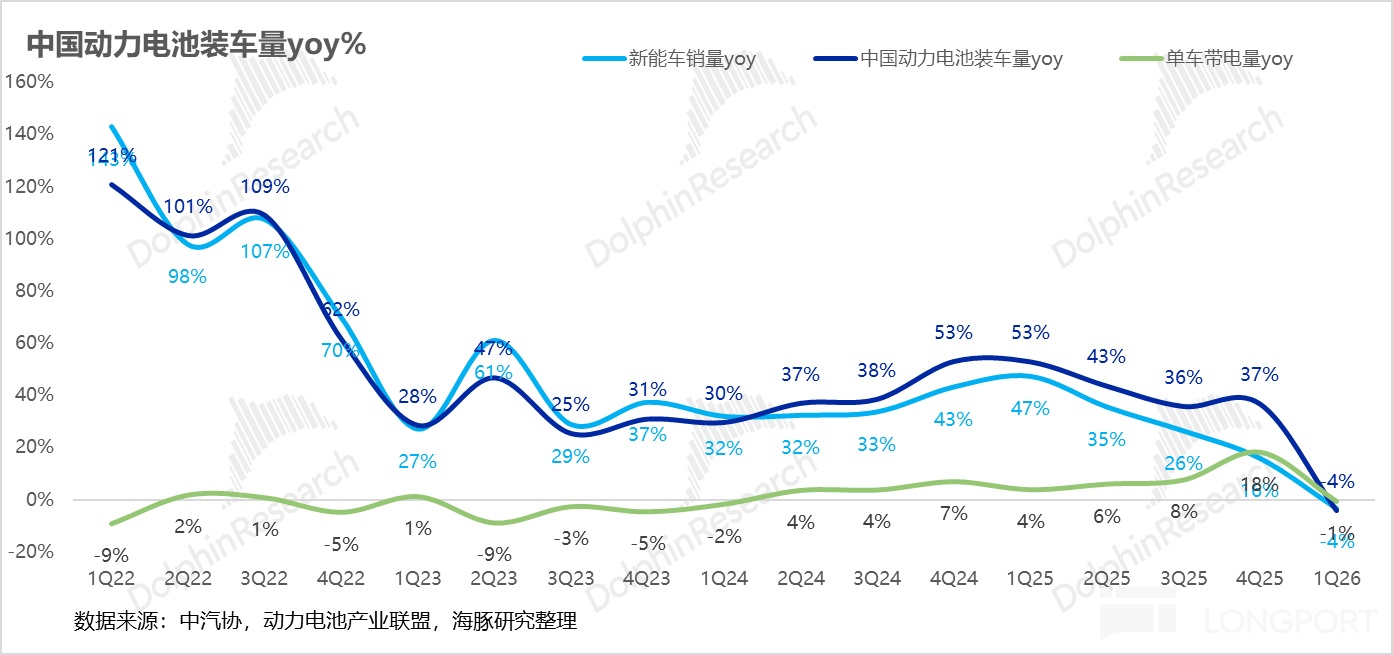
Industry beta: higher kWh per vehicle plus a high-capacity commercial-vehicle leverage:
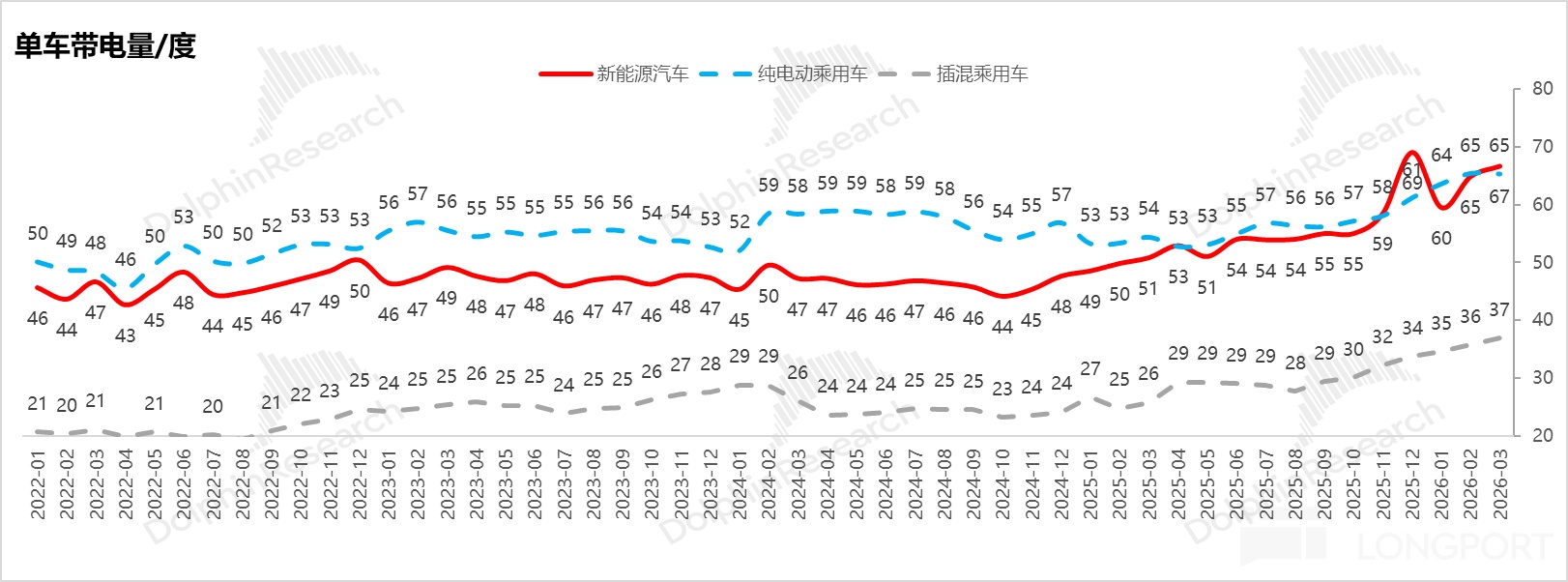
a. kWh per vehicle keeps rising: With BEV/PHEV mix stable, passenger-car battery capacity per vehicle continues to trend up. CABIA shows Q1 domestic NEV averaged 66.7kWh per vehicle (+34% YoY), with BEV at 65.3kWh (+21.4% YoY) and PHEV at 36.2kWh (+40.6% YoY).
Models with 600km+ range now account for 40%–50%, up from 10%–20% a year ago. This is driven by two forces.
BEVs’ big-battery arms race: To alleviate range anxiety and enhance premium competitiveness, automakers are standardizing larger packs. For example, Nio now sets 100kWh as the floor across its lineup, and Xiaomi SU7 mid/high trims carry 96kWh+ packs, shifting from optional to standard long range.
EREVs’ ‘electrification’ push: To improve daily pure-electric commuting, EREV pack sizes are migrating from ~40kWh to 60–80kWh (e.g., Leapmotor D19 at 80.3kWh and larger-pack Li Auto L-series trims). This lifts kWh demand per unit materially.
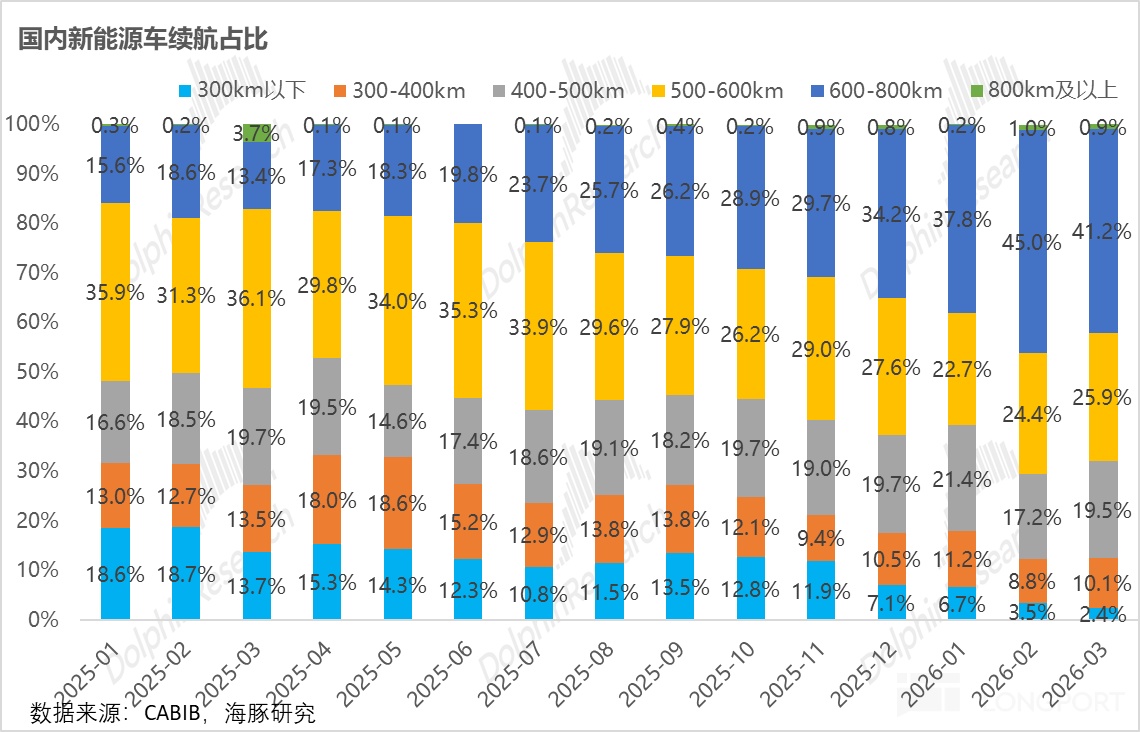
b. High-capacity commercial vehicles are gaining share, creating demand leverage
Penetration is rising, amplifying demand: Q1 domestic NEV commercial-vehicle sales were 184k (+23.6% YoY), far above total CV growth of 6%, with penetration climbing from ~4.5% in 2024 to ~7% in Q1 2026. TCO advantages from lower battery costs and road-access policies are catalyzing heavy trucks and light logistics.
A massive 1:4 leverage: Average BEV CV pack size has surged to ~200kWh (vs. 118kWh in Q1 2024), far above 60–70kWh for BEV passenger cars. Each incremental CV roughly equals the battery demand of 3–4 BEV passenger cars, and with CVs now about one-third of CATL’s power-battery sales, the pull-through is significant.
Company alpha: global share keeps rising
Domestic share gains are pressuring peers. Q1 domestic share rose 3.2ppts QoQ to 47.7%, and ex-BYD (largely self-supplied), third-party share climbed 1.8ppts QoQ to 57.3%.
Global capacity release and product strength are reinforcing leadership. Jan–Feb 2026 data show global usage share at 40.5% (+1.8ppt YoY), with overseas at 32.1% (+2.2ppt YoY).
As prior constraints ease and high-quality products like Shenxing and Qilin scale, global dominance is strengthening further. This underpins sustained alpha.
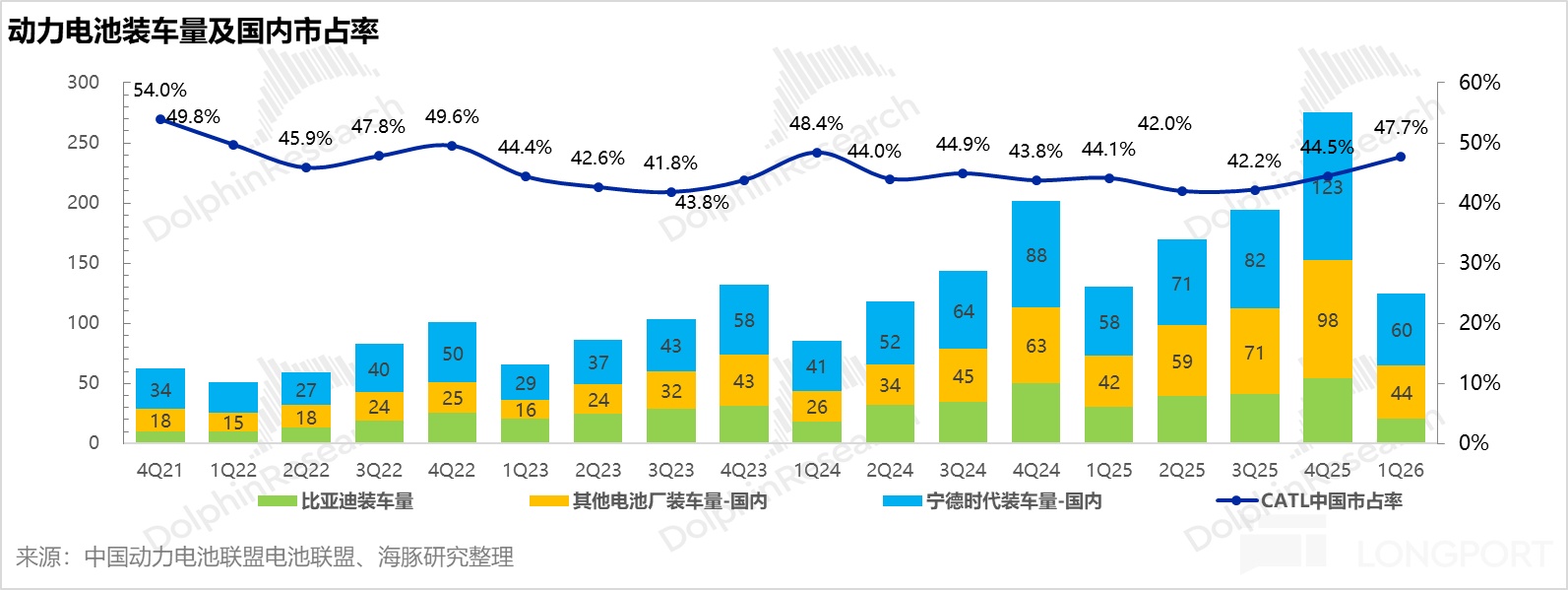
ii) ESS shipments 50GWh, +108% YoY on demand and capacity release
Q1 ESS shipments were ~50GWh (+108% YoY), in line with an industry in high gear (China ESS battery sales +112% YoY in Q1 2026). Demand is robust while the Jining base (planned >100GWh) began releasing capacity in Q1 2026 to relieve bottlenecks.
a. Domestic policy and market resonance establish the economics
Nationwide capacity-tariff adoption is a game changer. The ‘Document 114’ policy in early 2026 established a national-level capacity tariff for grid-side independent storage, benchmarked to coal power, enabling stable capacity revenue and lifting project IRR to ~8%–9%.
As the leader with long-life, low-degradation tech, CATL is a key beneficiary. Capacity release from the Jining base further supports deliveries and growth in shipments.
b. AIDC data centers emerge as a new ESS growth engine
AIDC creates new ESS demand from both the supply and user sides. On the supply side, storage raises the effective capacity factor of intermittent renewables like wind/solar and stabilizes the grid.
On the user side, ESS tackles volatile, synchronized AI loads by smoothing millisecond-level power pulses and safeguarding power. It also provides peak-shaving arbitrage and accelerates interconnection approvals, as ISOs such as PJM and ERCOT require large new loads to be grid-friendly.
Equipping ESS is becoming essential to expedite energization. This is particularly true in North America, where policy and grid constraints favor behind-the-meter solutions.
b. Battery ASPs: indexation highlights pricing power
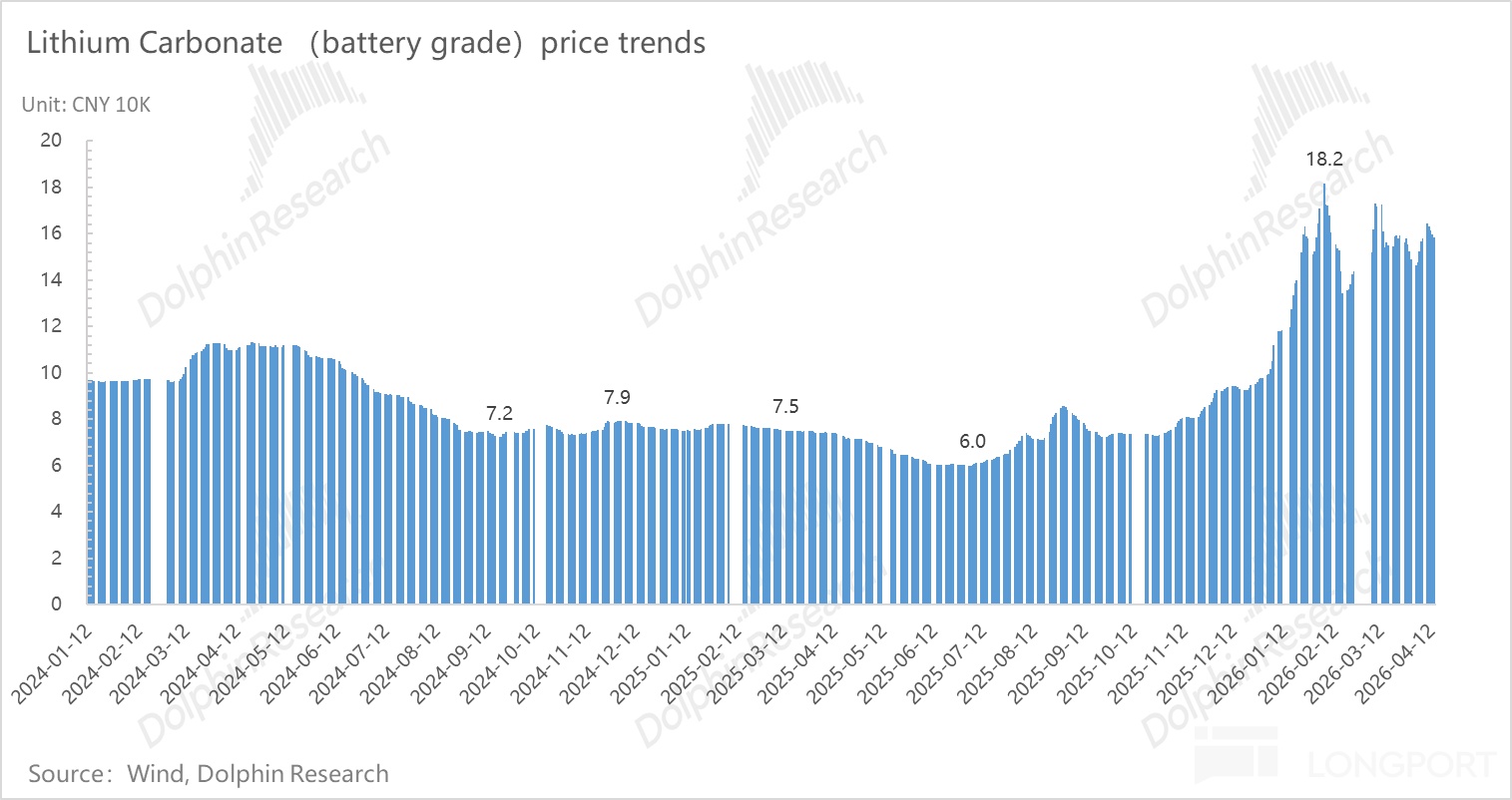
Blended ASP rose 4% QoQ to RMB 0.57/Wh in Q1, despite two headwinds: upstream costs jumped as lithium carbonate rebounded from RMB 80k–100k/ton in Q4 to RMB 150k–180k/ton in Q1. Mix also pressured ASP as lower-priced ESS rose ~5ppts QoQ to 25% of shipments.
Even with ‘cost up + mix down’, ASP still increased QoQ. This underscores strong chain-wide pricing power, as most orders include lithium and other metal indexation clauses that pass through raw-material swings and keep ASPs firm.
2. GPM compressed QoQ but profitability remained highly resilient
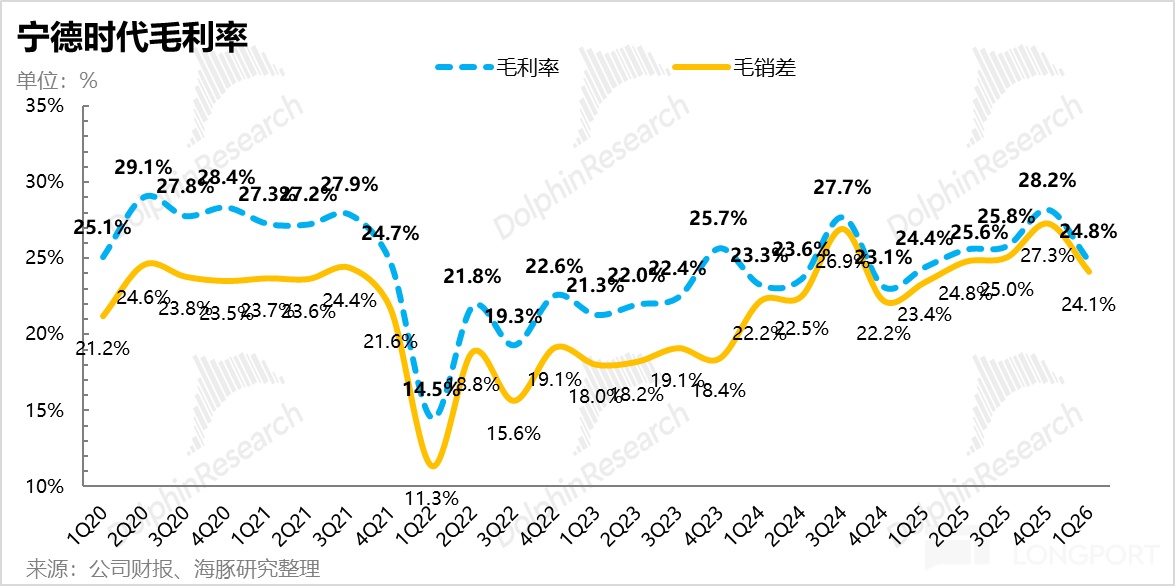
Q1 2026 GPM was 24.8%, with per-Wh GP down from RMB 0.18 in Q4 to ~RMB 0.16. While below the H2 2025 full-load peak (28.2% GPM), the result met expectations and showed steady resilience.
Multiple headwinds converged in Q1: lithium carbonate rebounded to RMB 150k–180k/ton and ESS mix rose, pressuring margin. Seasonality pulled utilization from 103% in H2 2025 to 85%–90%, raising unit D&A costs.
Policy also weighed, as export tax rebates faded. Yet margins held up thanks to CATL’s cycle-agnostic defenses and operational leverage.
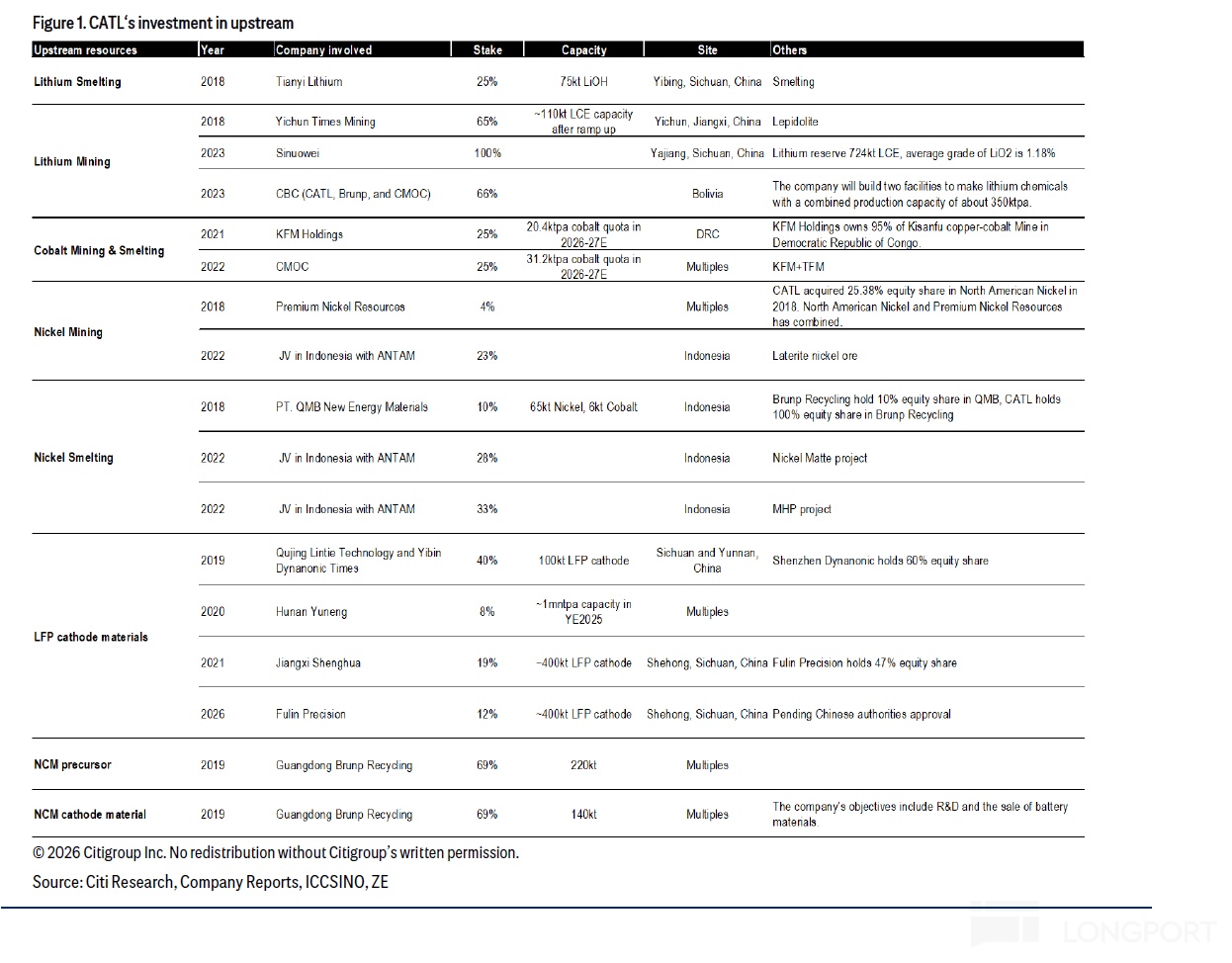
i) A ‘reservoir’ of low-cost inventory: Inventory at end-Q4 2025 was RMB 94.5bn (inventory/revenue at 67%). This buffer allowed consumption of lower-cost inputs in Q1 to smooth the impact of rising raw material prices.
ii) Strategic upstream hedges: Compared with the last lithium upcycle, CATL’s upstream portfolio is stronger, including ~25% in CMOC and the potential restart of its Jiangxi lithium mine (JXW) in 2026. These act as low-cost ‘shadow inventory’ against spot volatility.
iii) Scale economies and big-SKU strategy: Utilization of 85%–90% remains best-in-class even amid seasonality and expansion. Large-scale rollouts of products like Shenxing and Qilin sustain manufacturing scale benefits and cost-down momentum.
iv) Powerful cost pass-through: With metal indexation and strong bargaining power, CATL can pass most cost increases to customers. This mitigates both raw-material rebounds and expected policy changes such as tax adjustments.
II. Upcycle intact with strong end-demand
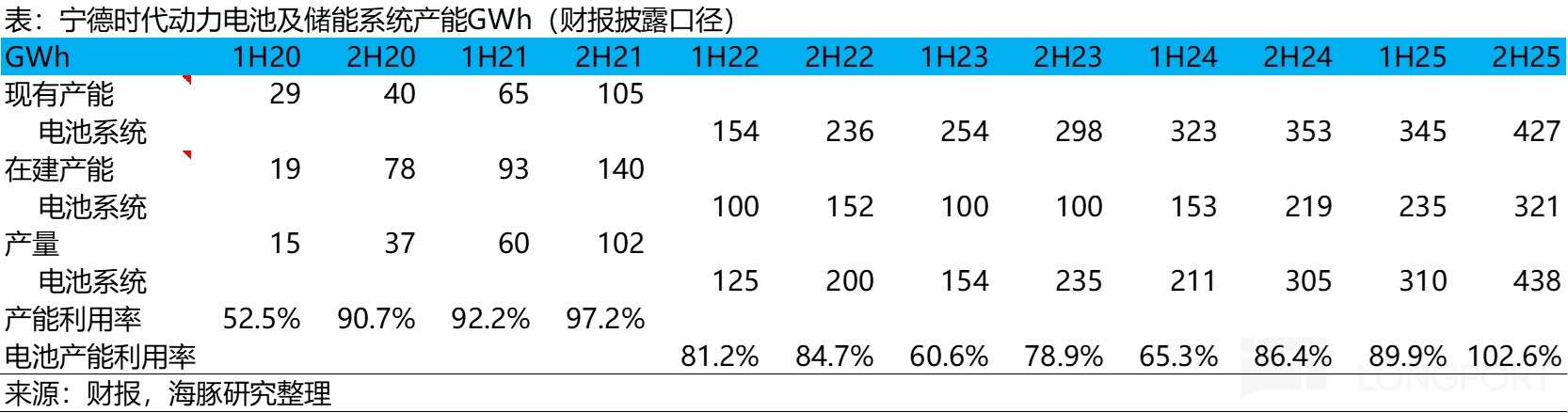
1) Utilization steady at 85%–90%, with full Q2 schedules
Utilization dipped from 103% in H2 2025 to 85%–90% in Q1 due to seasonality and a larger capacity base, yet remains top-tier. The company guides Q2 schedules to stay full, keeping utilization at 85%–90% and easing concerns about slower EV demand weighing on shipments.
2) Capex re-accelerates as global capacity expansion resumes
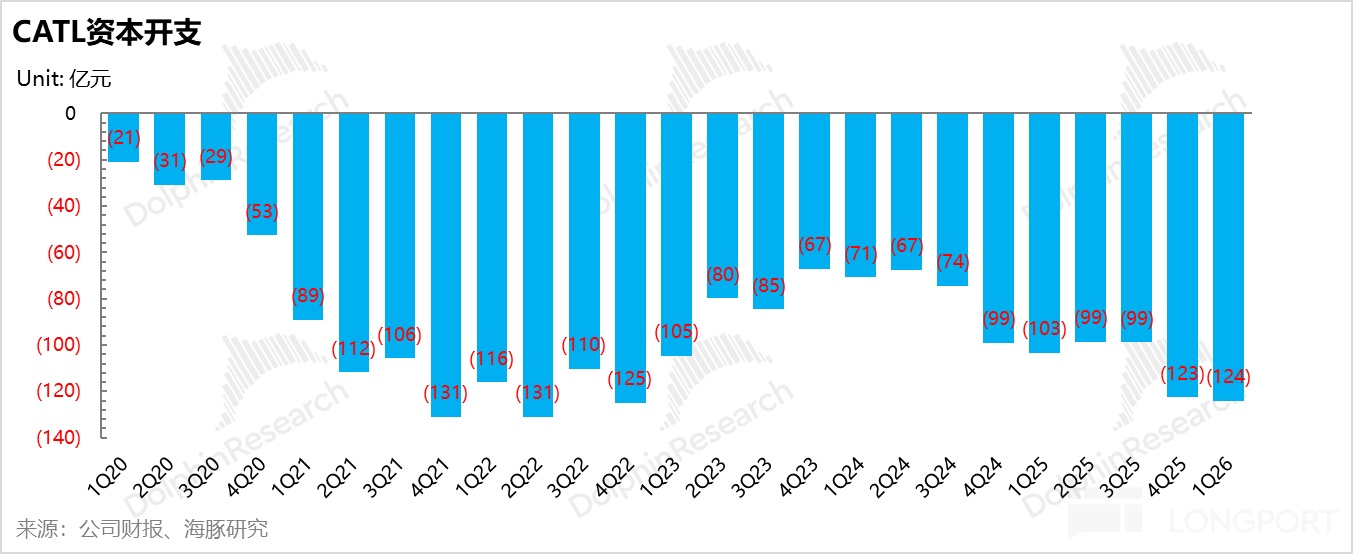
After peak investments in 2021–2022 and a downcycle from Q1 2022 (troughing near RMB 6.7bn in Q1 2023), capex has been rebuilding since Q1 2024. This quarter, capex climbed to ~RMB 12.4bn, near prior peaks and signaling a strong expansion phase.
CATL raised its 2026 production target to 1.1–1.2TWh, implying ~400GWh of additions versus ~772GWh in 2025 and +42%–55% YoY capacity growth. This underpins aggressive buildouts across regions.
Global capacity is ramping on multiple fronts:
Domestic expansion: Jining (Shandong), Zhaoqing (Ruiqing), Yichun (Jiangxi), Xiamen (Fujian), Qinghai and Ningde (Fujian) are all scaling. To absorb surging ESS orders, Jining’s >100GWh new capacity started phased release in Q1 2026.
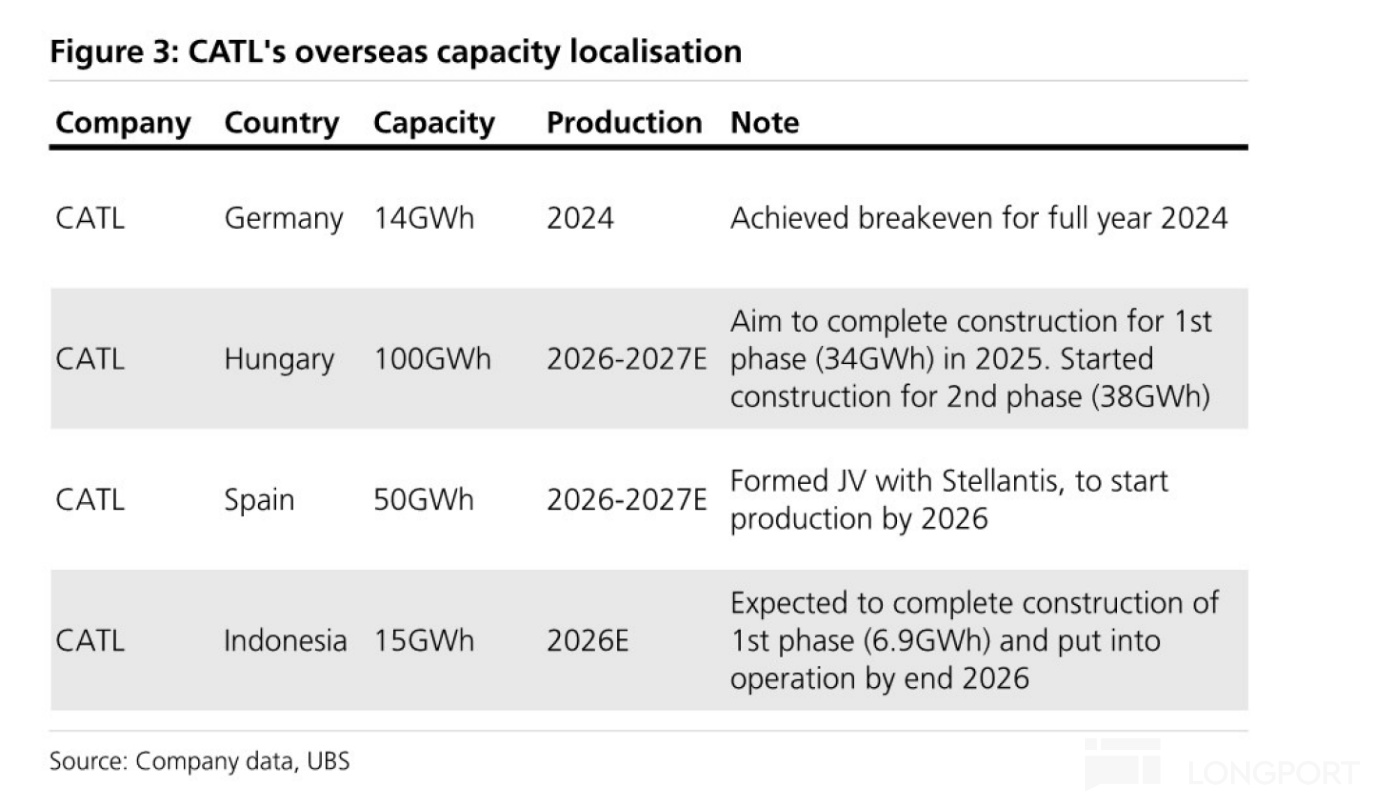
Overseas ramp: Europe is a key growth engine. The Germany plant (14GWh) has been online since 2024 and profitable, while Hungary (planned 100GWh) Phase 1 (34GWh) lines are in commissioning and expected by end-2025.
Spain (planned 60GWh) completed approvals and JV setup, with construction to start in 2026. In SE Asia, the Indonesia battery value-chain project is on track to start production in H1 2026.
Strong capacity release has already lifted global share in Q1 2026. It also secures supply for the next leg of demand release, particularly overseas, where a dense ramp cadence will anchor growth.
3) Inventories keep rising, indicating strong orders
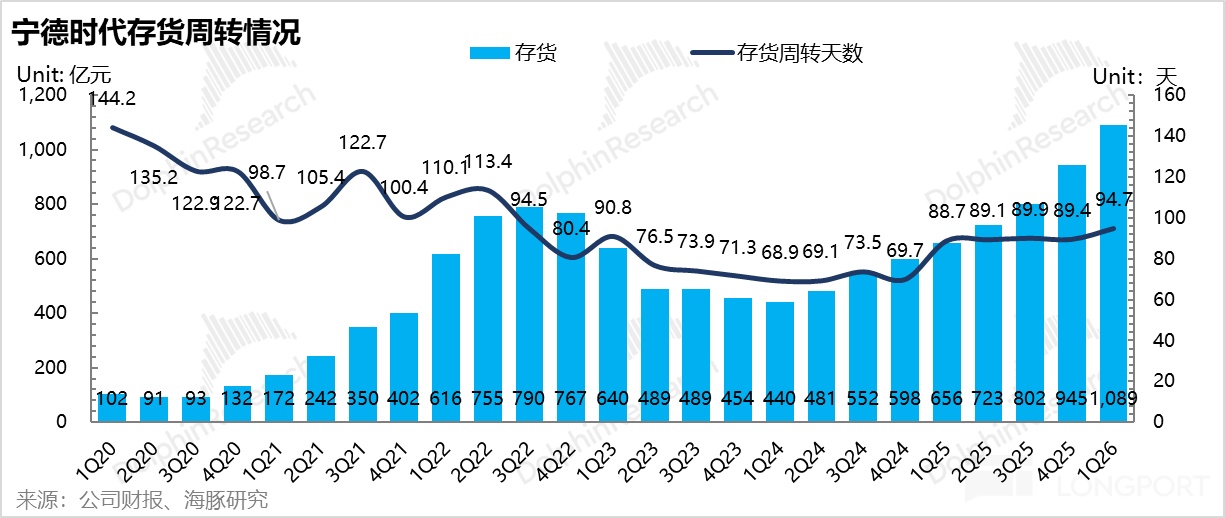
Inventories reached RMB 108.9bn at quarter-end, up ~RMB 14.4bn QoQ, a record high. Inventory/revenue rose from 67% to 84%, and days-on-hand lengthened to ~95 days, reflecting cycle and mix dynamics.
Unlike downcycle destocking, today’s high inventories reflect proactive stocking and in-transit goods. The strategy smooths cost volatility and supports future deliveries as demand remains firm.
i) Strategic raw-material reserves smooth cost risk: Leveraging strong cash flows, CATL increased reserves in raw materials and semi-finished goods as lithium rebounded. Pre-emptive low-cost stocking creates a buffer for the next 1–2 quarters.
ii) ‘Goods issued’ (shipped but not invoiced) are rising: With ESS moving from cells to systems, installation/commissioning extends delivery cycles and raises inventory duration. Longer overseas lanes to the Middle East and the Americas also lift in-transit inventory balances.
This implies strong downstream order momentum. As these in-transit items convert to revenue in coming quarters, earnings visibility will improve further.
4) Contract liabilities remain elevated
As a B2B business, CATL receives customer prepayments before delivery, making contract liabilities a proxy for orders. Q1 contract liabilities fell from RMB 49.2bn to RMB 45.5bn QoQ as backlog converted to revenue on strong deliveries.
Despite high-intensity fulfillment and 67% YoY shipment growth, the balance stayed at a historically high level. This indicates rapid replenishment and supports forward earnings certainty.
5) Asset impairments declined QoQ
Q1 asset impairment losses were ~RMB 1.4bn, down RMB 3.2bn from last quarter’s peak of RMB 4.6bn. As a share of revenue, impairments fell ~2ppts QoQ to just 1.1%, easing P&L pressure.
We see two drivers: ample prior provisioning and upstream stabilization. With sufficient write-downs on inventories and lithium-related assets and lithium rebounding in Q1, the risk of new large provisions is much reduced.
Impairment relief also unlocked net profit. This allowed gross profit gains from volume and ASP to flow through more cleanly.
Q1 attributable net profit was RMB 20.7bn (+49% YoY), beating the street’s RMB 17.6bn, while ex-non-recurring net profit reached RMB 16.4bn (+53% YoY). The beat was driven by shipment growth and effective pass-through that supported revenue and gross profit.
Tight control of R&D and opex, combined with a sharp QoQ drop in impairments, further released profits. Per-Wh net profit held at ~RMB 0.10, matching last quarter, proving that raw-material inflation did not erode profitability.
We focus on core OP (GPM minus opex and asset/credit impairments), which was RMB 20.5bn in Q1 (+94% YoY). The core OPM reached 15.9%, flat QoQ, underscoring sustained operational strength.
<End>
In-depth research:
Jul 5, 2026 ‘CATL: H-share Premium >20% — Time for a Re-Rating?’
Jan 23, 2026 ‘Through TSMC’s Lens: CATL and the Inescapable Cycle’
Earnings tracking:
Mar 10, 2026 First Take ‘CATL: Full Throttle Capacity, Dominating the AI Infra Cycle’
Jul 31, 2025 Trans ‘CATL (2Q25 Trans): Europe NEV Growth Sustains, Local Capacity Ramps’
Jul 31, 2025 Comment ‘CATL: Price Wars and the Involution Trap’
Apr 14, 2025 Trans ‘CATL (1Q25 Trans): Limited Tariff Impact, Working with Customers’
Apr 14, 2025 Comment ‘CATL: Tariff ‘Shock’, Navigating the Hit’
Mar 16, 2025 Trans ‘CATL (4Q24 Trans): Shenxing/Qilin to 60%–70% of Mix in 2025’
Mar 16, 2025 Comment ‘CATL: Another Leg Down — Is It Really That Bad?’
Risk disclosure and disclaimer: Dolphin Research Disclaimer and General Disclosure




The copyright of this article belongs to the original author/organization.
The views expressed herein are solely those of the author and do not reflect the stance of the platform. The content is intended for investment reference purposes only and shall not be considered as investment advice. Please contact us if you have any questions or suggestions regarding the content services provided by the platform.