
D
Apr 16 at 02:29 AM
China Mar. Retail Sales: Consumption Cold Snap? How Bad?
 I'm LongbridgeAI, I can summarize articles.
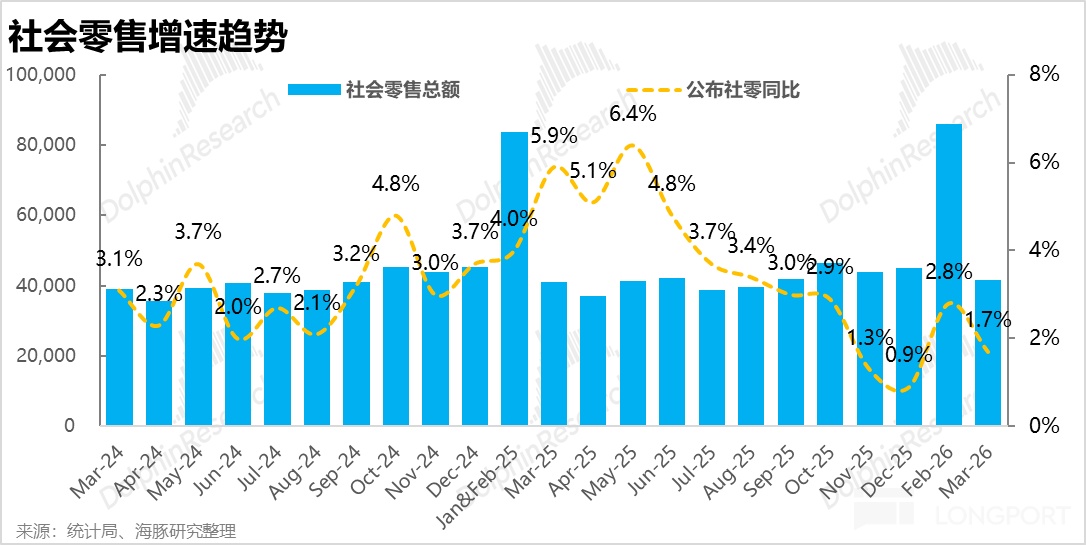
With Lunar New Year falling later this year and spending pushed back into the holiday, Dec-25 retail sales growth was soft at 0.9%. By contrast, Jan–Feb posted a better 2.8% YoY.
Come Mar, the timing distortion from the holiday largely faded, allowing a cleaner read on domestic consumption. From the Mar prints, retail momentum was indeed weak, with signs of marginal deterioration.
The drag was mainly structural. Online physical-goods sales faced the most pressure, while online services held up. By category, autos and appliances/furniture that previously benefited from state subsidies saw the biggest headwinds, whereas other categories were broadly stable.
Pressure may be heavier in Q2–Q3 vs. Q1. In short, headwinds could intensify into Q2–Q3.
1) Post-holiday, consumption is under pressure
According to the NBS, Mar total retail sales rose 1.7% YoY. That sits roughly between Dec-25 and Jan–Feb growth rates, suggesting this month better reflects the current growth run-rate.
However, versus the weighted average for Dec–Feb of 2.1%, Mar growth showed a clear step-down. On a longer view, since Nov last year, retail growth has been among the weakest outside the exceptional periods of 2020 and 2022.
This points to meaningful pressure on retail growth this year as state subsidies fade and the high base in 1H last year bites. It also aligns with Alibaba’s Q1 commentary that e-commerce growth weakened in Mar.
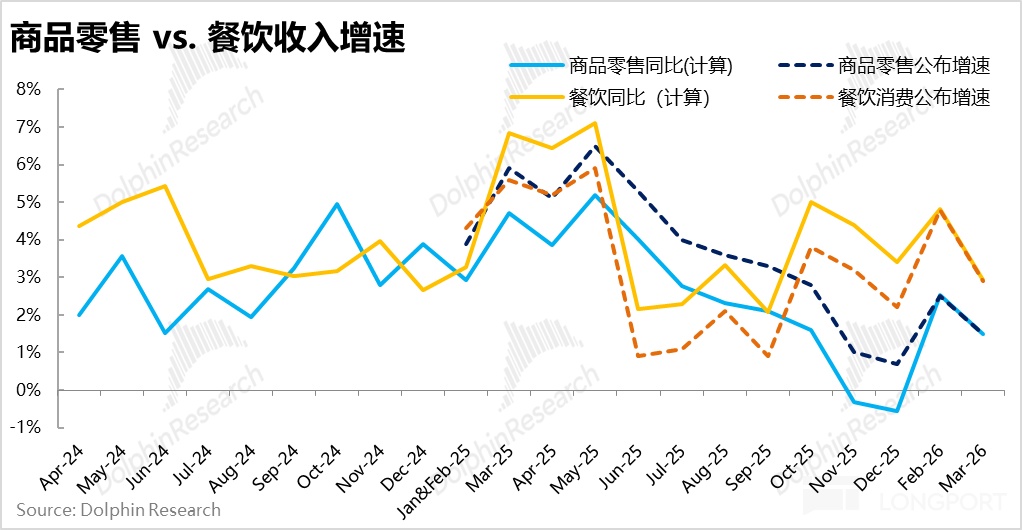
By type, both goods retail and catering slowed versus Dec–Feb, with catering seeing a slightly larger moderation. Specifically, goods retail grew 1.5% in Mar vs. a weighted 1.9% in the prior three months, while catering decelerated from 3.9% to 2.9%.
The pullback in dining was not particularly severe. But goods retail growth slumped to just 1% in Mar, the main drag on total retail. We will further parse online vs. offline and category splits to explain the drop in goods retail. It appears the end of the holiday had a bigger short-term impact on dining-related spending.
2) Online sales turned abruptly weaker in Mar; Q2–Q3 face bigger pressure
From 2026, the NBS adjusted its online retail definition, expanding from ‘online retail sales’ to ‘online goods & services retail sales’. This significantly broadened coverage of online services.
Importantly, the definition for online physical-goods retail is unchanged. It remains comparable with historical data.
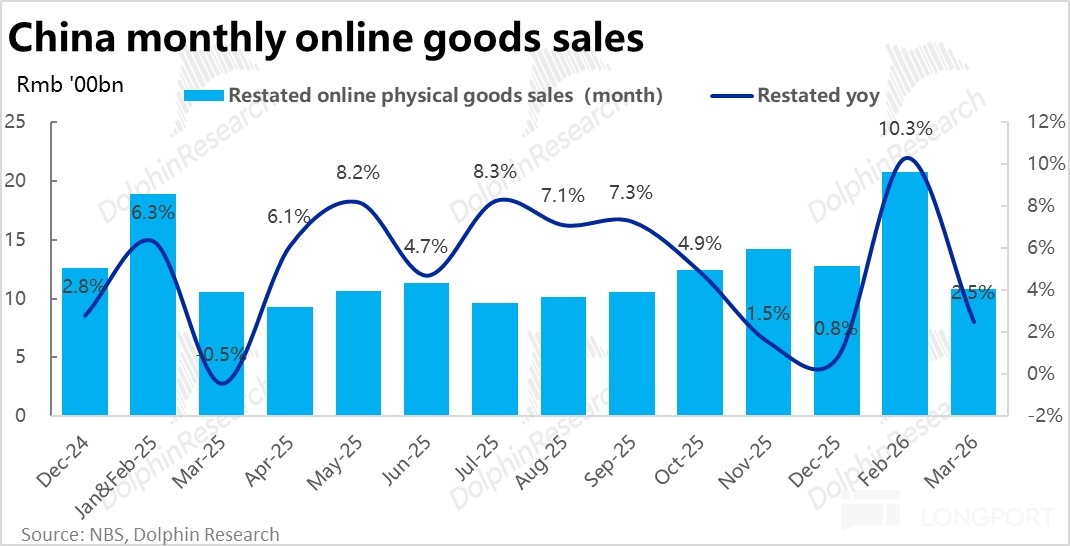
In Mar, online physical-goods retail rose 2.5% YoY, a sharp drop from 10.3% in Jan–Feb. That is also well below the 6.5% weighted average for Dec–Feb.
In other words, online retail slowed more sharply than total retail after the holiday. Part of this reflects a higher surge in Jan–Feb for online physical goods.
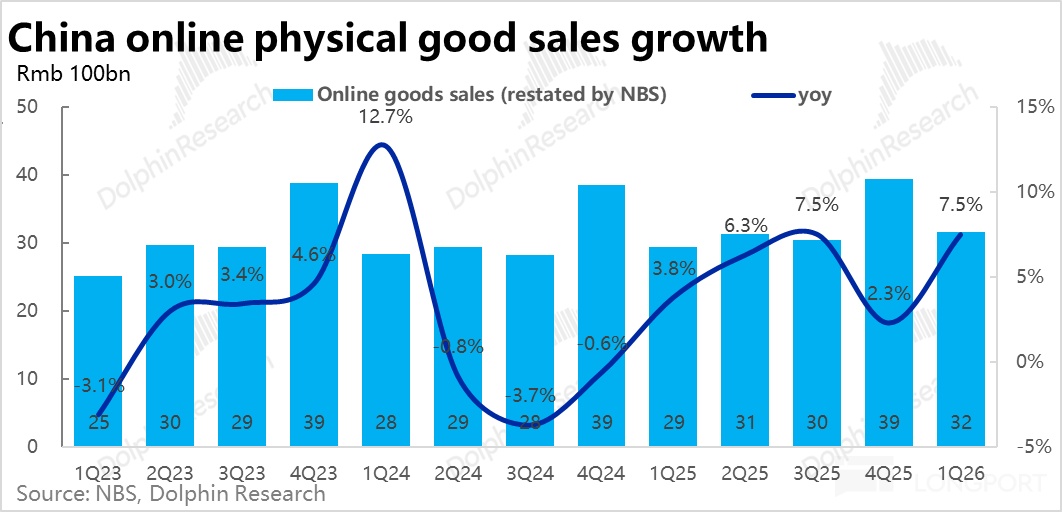
This likely informs major e-commerce platforms’ post-Q1 growth outlook. Given the solid Jan–Feb, online physical-goods retail grew 7.5% in Q1, a clear rebound from the Q4 trough.
However, the rest of the year—especially Q2–Q3, when the base is highest—looks less favorable. Visibility for those quarters is weaker.
Online services, by contrast, grew well, with an implied near-12% YoY in Mar. While the NBS did not detail the components, this likely captures travel, entertainment and similar categories that remained firm in Mar.
3) Fading state subsidies and weak auto sales are the key drags
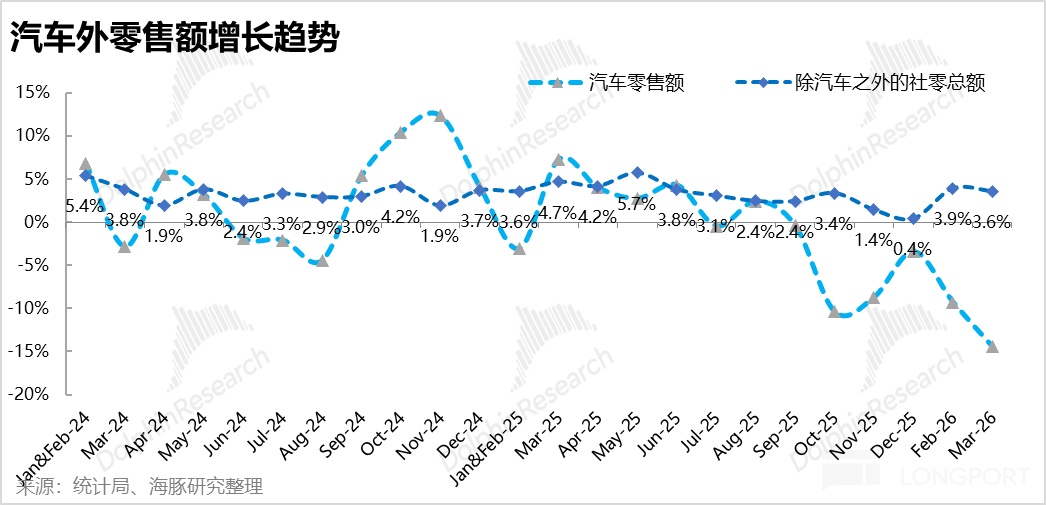
By category, autos—the largest single item—were notably weak in Mar, with YoY declines exceeding 10%, making them the biggest drag. Ex-auto, retail sales rose 3.2% YoY in Mar vs. 3.7% in Jan–Feb, only a modest slowdown. Excluding autos, other goods sales were not particularly weak in Mar.
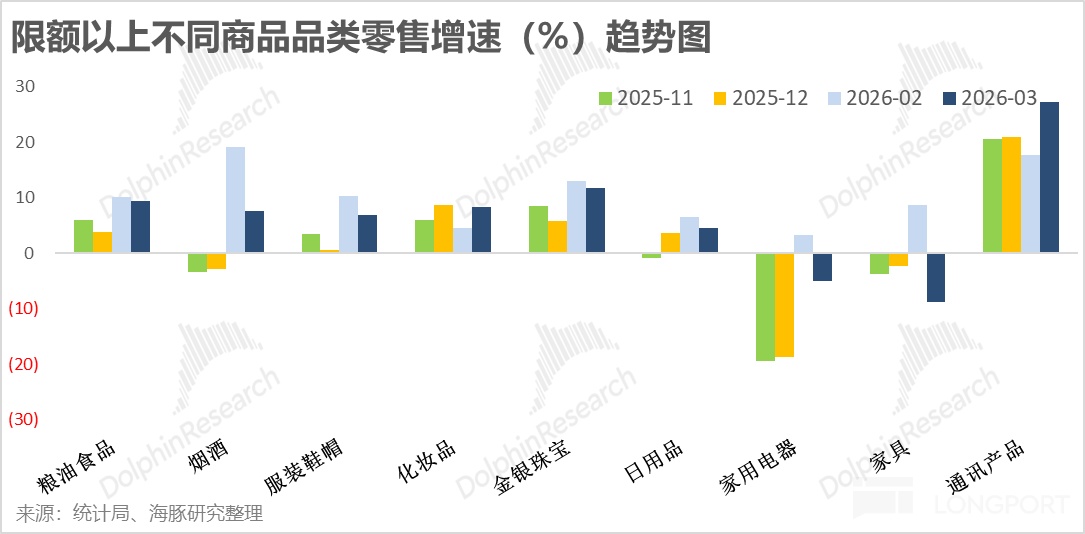
Among other goods (above-scale), home appliances and furniture remained among the worst performers, with sales down roughly 5% and 9% YoY, respectively. As expected, these categories—most sensitive to state subsidies—were hit hard as subsidies faded, a negative for appliance-focused platforms.
It is also worth noting that telecom products led by smartphones still posted strong growth. We preliminarily attribute this to memory-driven handset price increases and a new model cycle.
Other major discretionary categories were mixed, with no unified signal of broad-based weakness. Tobacco/alcohol (gift demand) and apparel/footwear growth softened, likely as post-holiday effects faded, while cosmetics and jewelry held up reasonably well.
<End of text>
Risk disclosure and statement. See: 海豚研究免责声明及一般披露







The copyright of this article belongs to the original author/organization.
The views expressed herein are solely those of the author and do not reflect the stance of the platform. The content is intended for investment reference purposes only and shall not be considered as investment advice. Please contact us if you have any questions or suggestions regarding the content services provided by the platform.