
D
Apr 30 at 02:33 AM
Dongpeng Beverage: Under fire on all fronts — can the energy-drink leader rebound?
 I'm LongbridgeAI, I can summarize articles.
On the evening of Apr 29 Beijing time, Eastroc Beverage (605499.SH) released its Q1 2026 results. While the core energy-drink franchise showed QoQ growth improvement, a sharp slowdown in electrolyte water (the 'second curve') left headline results slightly below market expectations. $EASTROC(09980.HK)
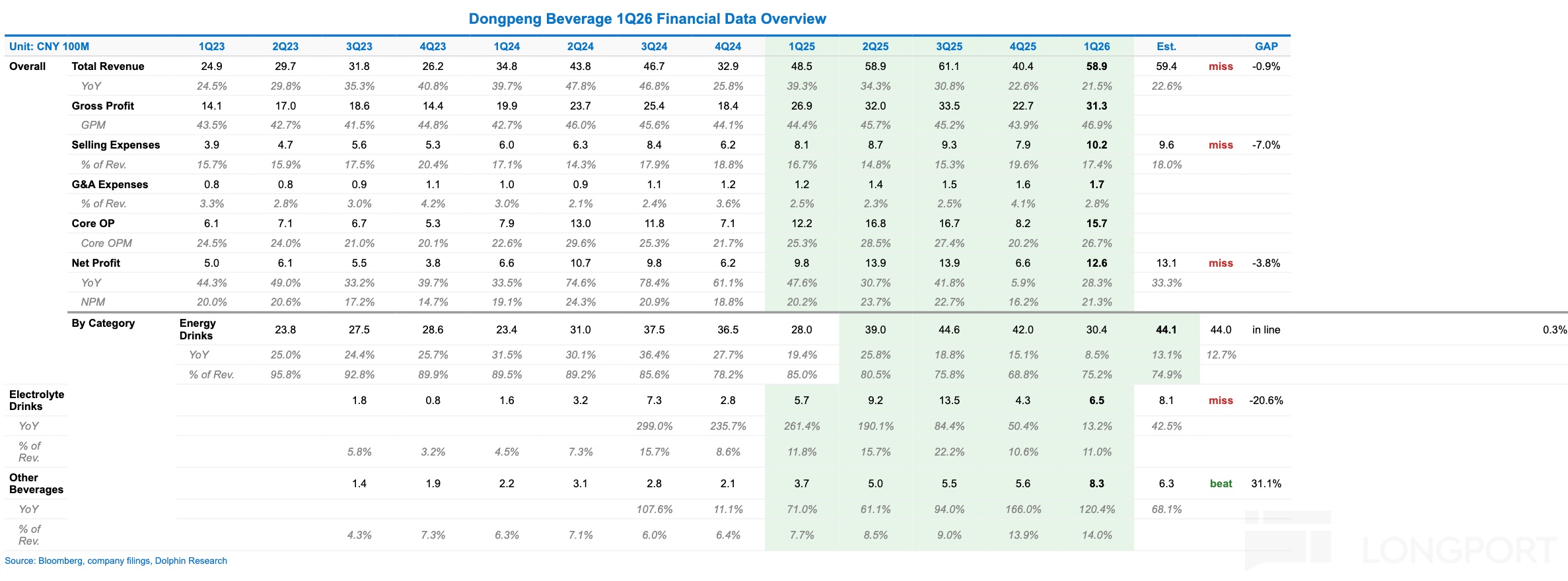
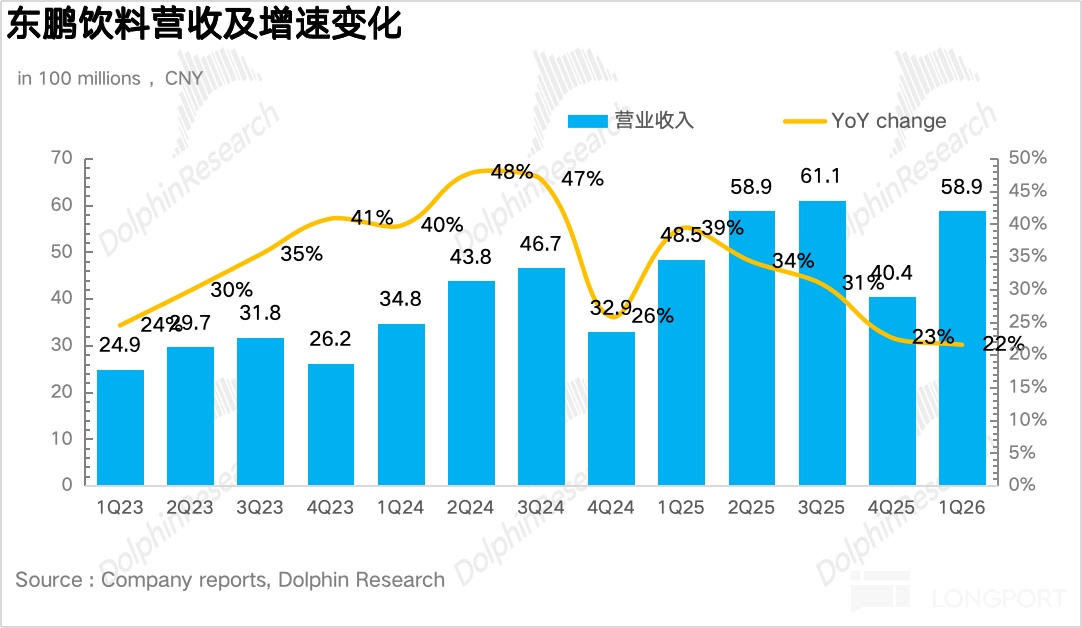
1) Slight miss vs. expectations. In Q1 2026, revenue reached RMB 5.89bn (+21.5% YoY), a touch below the Street. From a trend perspective, growth has remained on a deceleration path since Q1 2025, but the slope has eased notably.This suggests that after the 'pain period' tied to the organizational reshuffle in Q4 last year, the company's operating cadence is gradually normalizing.
2) Energy drinks saw QoQ improvement. By category, energy drinks delivered RMB 4.41bn in revenue (+13.1% YoY). Growth remains in a low-to-mid range but improved meaningfully vs. single-digit growth in Q4.Electrolyte drinks posted RMB 650mn (+13.2% YoY), with a marked deceleration. Beyond a tough base, we think intensifying competition also played a role as Nongfu Spring entered the segment using its master brand.The biggest highlight was 'other beverages' at RMB 830mn (+120.4% YoY), with mix rising from 7.7% to 14.0%. We attribute this largely to strong sell-through of 'Haidau Coconut' during the Chinese New Year holiday.
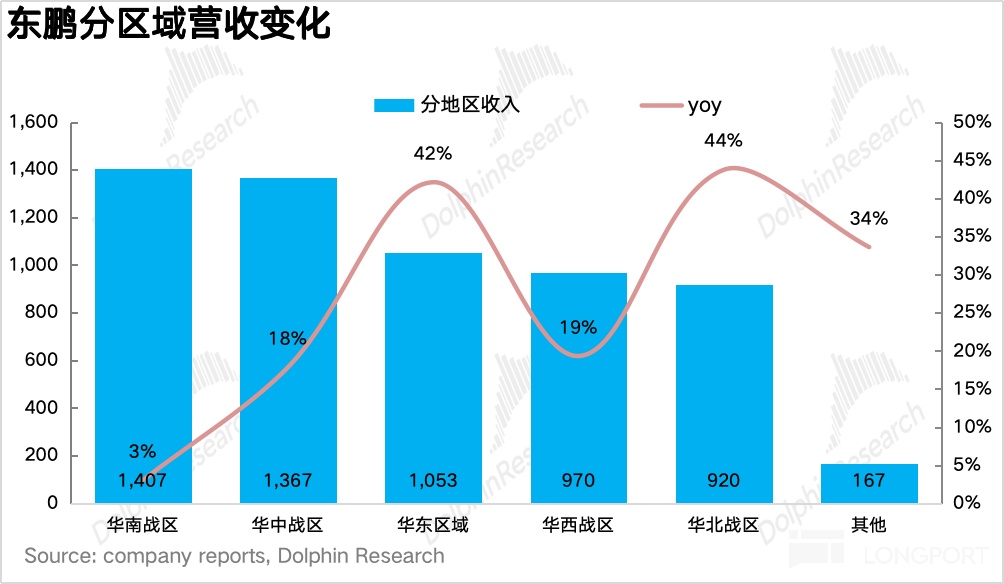
3) North China stood out. Across the five operating regions, performance divergence remained pronounced. With the Tianjin plant shortening delivery distances and strategy steadily shifting north, North China became the fastest-growing region, ranking No.1 among the five with +44% YoY.This region continues to benefit from capacity proximity and focus, driving outsized growth relative to others.
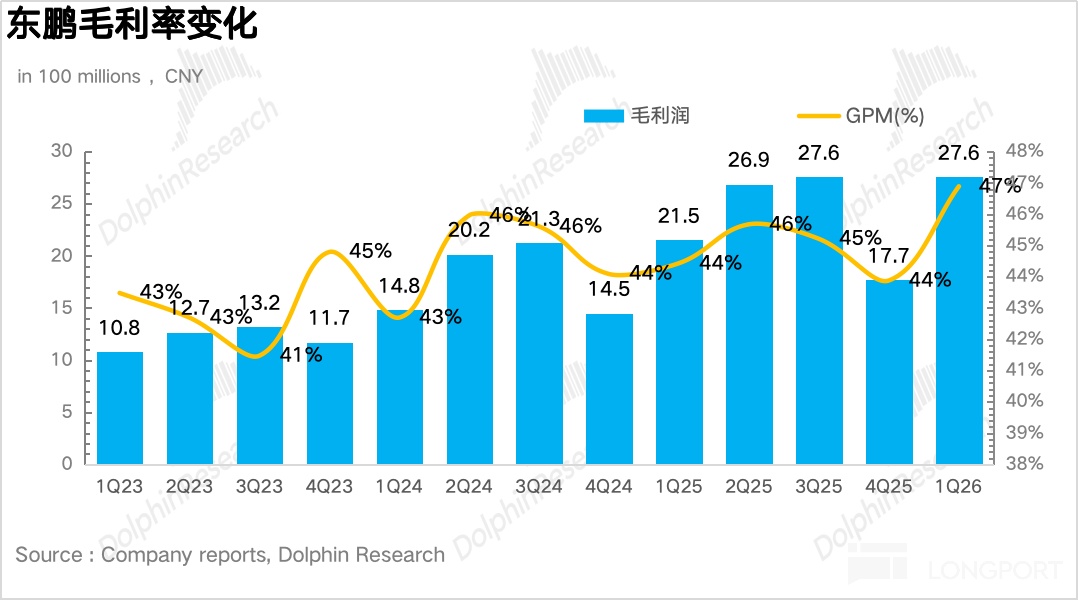
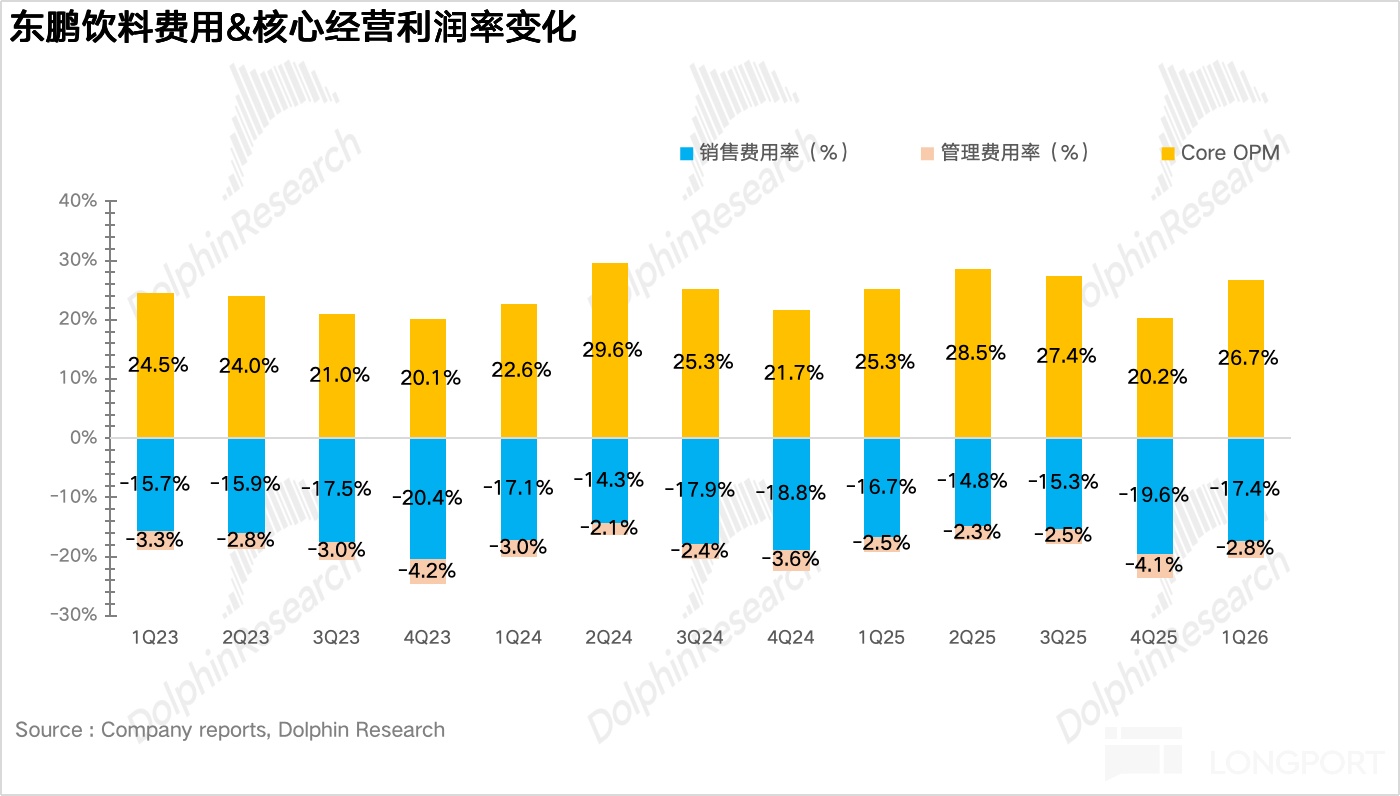
4) GPM expansion lifted profitability. Benefiting from lower PET and sugar prices, Q1 2026 GPM expanded by 240bps to 46.9%. On opex, increased marketing to back new launches, plus added layers and higher wages post the five-region reform, lifted the expense ratio.As a result, the core OPM improved by 140bps to 26.7%.
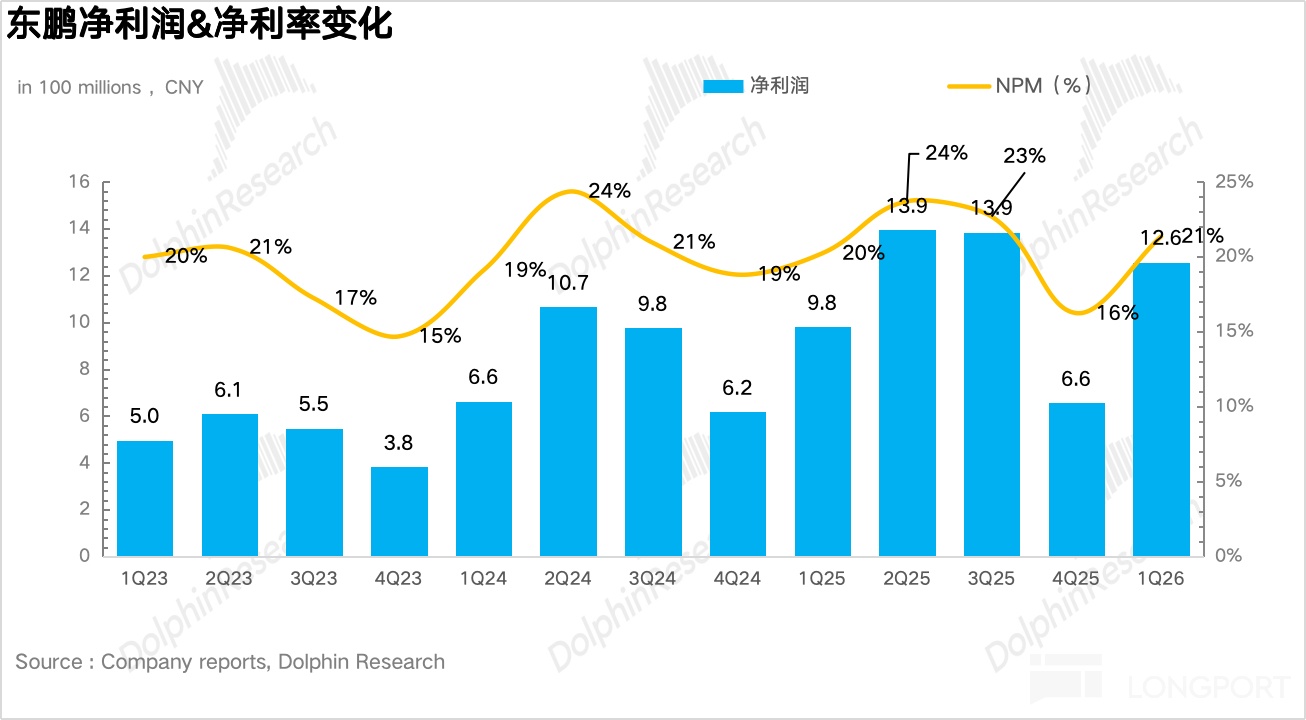
5) Financial metrics at a glance
Dolphin Research view:
On a stand-alone Q1 basis, revenue clearly re-accelerated vs. Q4 and profit showed greater elasticity. Market sentiment has recovered meaningfully from the post-annual-report pessimism around 'energy-drink stall.'
But on a longer view, the key question is not whether Q1 rebounded, but how the company can sustain an above-industry growth and valuation premium as energy drinks enter mid-to-late cycle, competition in 'Bushuaila' (electrolyte water) intensifies, and a third blockbuster has yet to emerge. The burden of proof now shifts to defending growth quality and consistency.
Causally, slower energy-drink growth is not just a topline issue; it cascades downstream. First, energy drinks were the high-margin, fast-turn, high-brand-equity anchor SKU, and slower growth increases mix dilution from 'Bushuaila' and other lower-margin new products.That, in turn, tempers the upward slope of overall profitability.
Second, the market awarded a higher multiple for a high-certainty story of one super SKU plus nationwide rollout. Once that story enters the back half, the valuation framework needs to shift.Investors will likely demand clearer evidence of multi-SKU scaling and cross-category execution.
As for 'Bushuaila,' the strongest growth engine in recent quarters, Q1 saw an abrupt deceleration. Stripping out the high base, its challenges are coming into view.Previously, competitors like Alien, Pocari Sweat, and Hezhiyan each had gaps. With Nongfu Spring entering in 2026 under its master brand, the nature of competition has clearly changed.
For Eastroc, the near-term pressure is not just price competition, but whether the early-mover advantage built on value-for-money and rapid distribution can be eroded by a deep-pocketed incumbent. Current data suggest this risk is materializing.Sustaining high growth will require defending shelf space, share of mind, and channel depth.
Finally, on the still-surging 'other beverages,' we see two main drivers: (1) 'Haidau Coconut' holiday surge: coconut drinks benefit from gifting and dining scenarios during CNY, and Eastroc's network enabled rapid placement and sell-through in Q1.This seasonal tailwind amplified category momentum.
(2) Ongoing channel reuse for 'Fruit Tea' and 'DaKa' coffee: these products leverage existing POS and cooler assets, keeping marginal costs very low. Scale-up benefits from the same route-to-market infrastructure.This cross-utilization accelerates trial and repeat at minimal incremental spend.
On valuation, the 25%+ pullback over the past six months has priced in a good portion of the 'step-down in growth.' To move from 'reasonable' to 'compelling,' we need peak-season validation on energy drinks and 'Bushuaila.'If Q2 energy-drink growth holds around ~15% and 'Bushuaila' returns to 30%+ in peak months, the current ~21x looks to offer a decent margin of safety. If competition keeps 'Bushuaila' subdued, we would stay more cautious at current levels.
Detailed read-through of the results:
I. Headline trends recovered QoQ but were slightly below expectations
Q1 2026 revenue was RMB 5.89bn (+21.5% YoY), a slight miss vs. consensus. Because CNY fell in mid-Feb 2026 vs. mid-Jan in 2025, some gift boxes, holiday stocking and sell-through shifted from Q4 2025 into Q1 2026.This makes Q4 look weaker and Q1 stronger. Taken together, it is more a timing redistribution than a true re-acceleration.
II. The 'second curve' electrolyte water slowed notably
By category, Q1 2026 energy drinks delivered RMB 4.41bn (+13.1% YoY). The bigger issue for Eastroc Special Drink is not formidable rivals but its own sheer size.In 2025, energy drinks reached a 51.6% volume share and 38.3% value share, cementing its No.1 position. The flip side is that incremental growth must increasingly come from deeper lower-tier penetration, finer-grained usage scenarios, and line extensions.
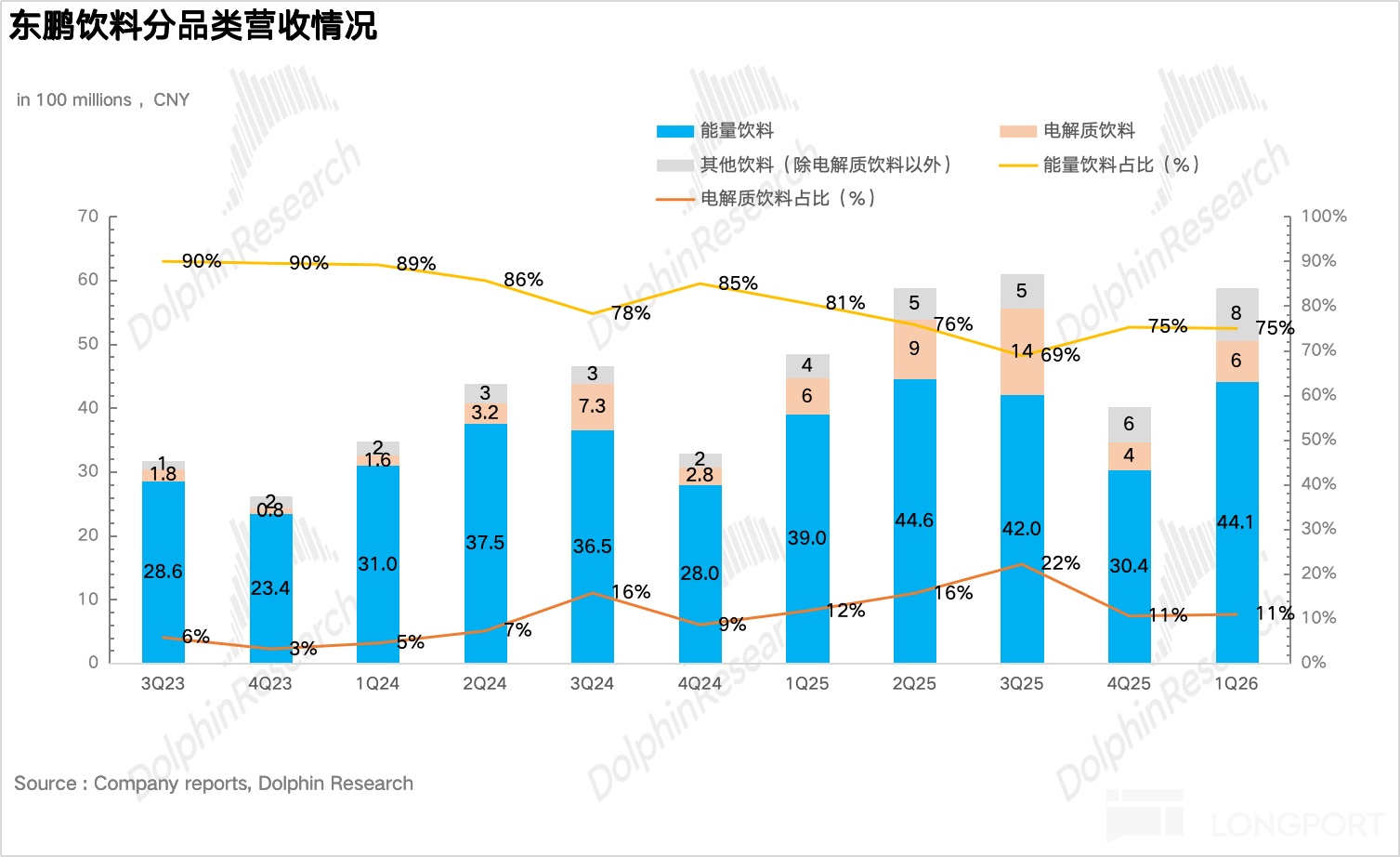
Turning to the 'second curve' that investors focus on, electrolyte water came in at RMB 650mn (+13.2% YoY). On competition, the key watch is Nongfu Spring launching an electrolyte line under its master brand, positioned around 'low sugar, low burden' and 'everyday hydration.'We view this as a pivotal signal.
While brands like Screaming, Alien, and Pocari Sweat have existed, the one with true national channel muscle and the ability to anchor 'water' in daily routines remains Nongfu. Its entry raises the bar structurally.We expect tougher fights for shelf, channel resources, and mindshare, making a high-growth slowdown in 'Bushuaila' the base case.
'Other beverages' delivered RMB 830mn (+120% YoY), accelerating QoQ and beating expectations. Momentum broadened beyond the core portfolio.This underscores traction in non-core SKUs.
Broadly, the importance of 'other beverages' is less about near-term profit and more about proving cross-category incubation capability. At this stage, it serves as a channel-efficiency tool and platform proof point rather than an independent valuation pillar.Whether Eastroc can build multiple RMB 300mn–500mn SKUs is feasible, but creating another RMB 3bn–5bn or even RMB 10bn blockbuster is far harder than 'Bushuaila.'
In H1 2026, the company will prioritize 'Fruit Tea' and Hong Kong-style milk tea. The latter's low-sugar positioning has received decent feedback.It should lift volumes in H2.
III. North China delivered standout growth
Across the five regions, divergence remained clear. With the Tianjin base shortening logistics radius and strategy tilting north, North China became the fastest growth region, ranking first with +44% YoY.Execution and capacity adjacency together drove outperformance.
Two watch points matter most: whether North China's high growth can persist through the year, and whether, after distributor optimization, mature markets can lift per-distributor output in tandem with new product sell-through. These variables will determine whether the five-region revamp is a short-term organizational move or the start of a sustained efficiency uplift.
- Profitability has recovered
Benefiting from lower PET and sugar prices, Q1 2026 GPM expanded by 240bps to 46.9%. On the expense side, increased marketing to support new products, plus expanded management layers and higher wages post the five-region reform, lifted the expense ratio.Net-net, the core OPM improved by 140bps to 26.7%.
Dolphin Research archive:
Deep dives:
Mar 31, 2026: 'Eastroc Beverage: Energy Drinks Stall, 'Bushuaila' Hard to Re-accelerate — Is the Hyper-growth Story Over?'
Sep 23, 2025: 'Eastroc Beverage: Overtaking Red Bull and Monster — How Did a Domestic 'Lifesaver' Become the Comeback King?'
Oct 10, 2025: 'Eastroc Beverage: After Energy Drinks, Where Is the Next RMB 10bn Playbook?'
Earnings takeaways:
Oct 24, 2025: 'Eastroc Beverage: Energy Drinks Slow — Can the Myth Hold?'
Risk disclosure and disclaimer: Dolphin Research Disclaimer & General Disclosure


The copyright of this article belongs to the original author/organization.
The views expressed herein are solely those of the author and do not reflect the stance of the platform. The content is intended for investment reference purposes only and shall not be considered as investment advice. Please contact us if you have any questions or suggestions regarding the content services provided by the platform.