
D
Apr 30 at 04:23 AM
Retail steadies, AI breakout: Is AMZN back in the top tier?
 I'm LongbridgeAI, I can summarize articles.
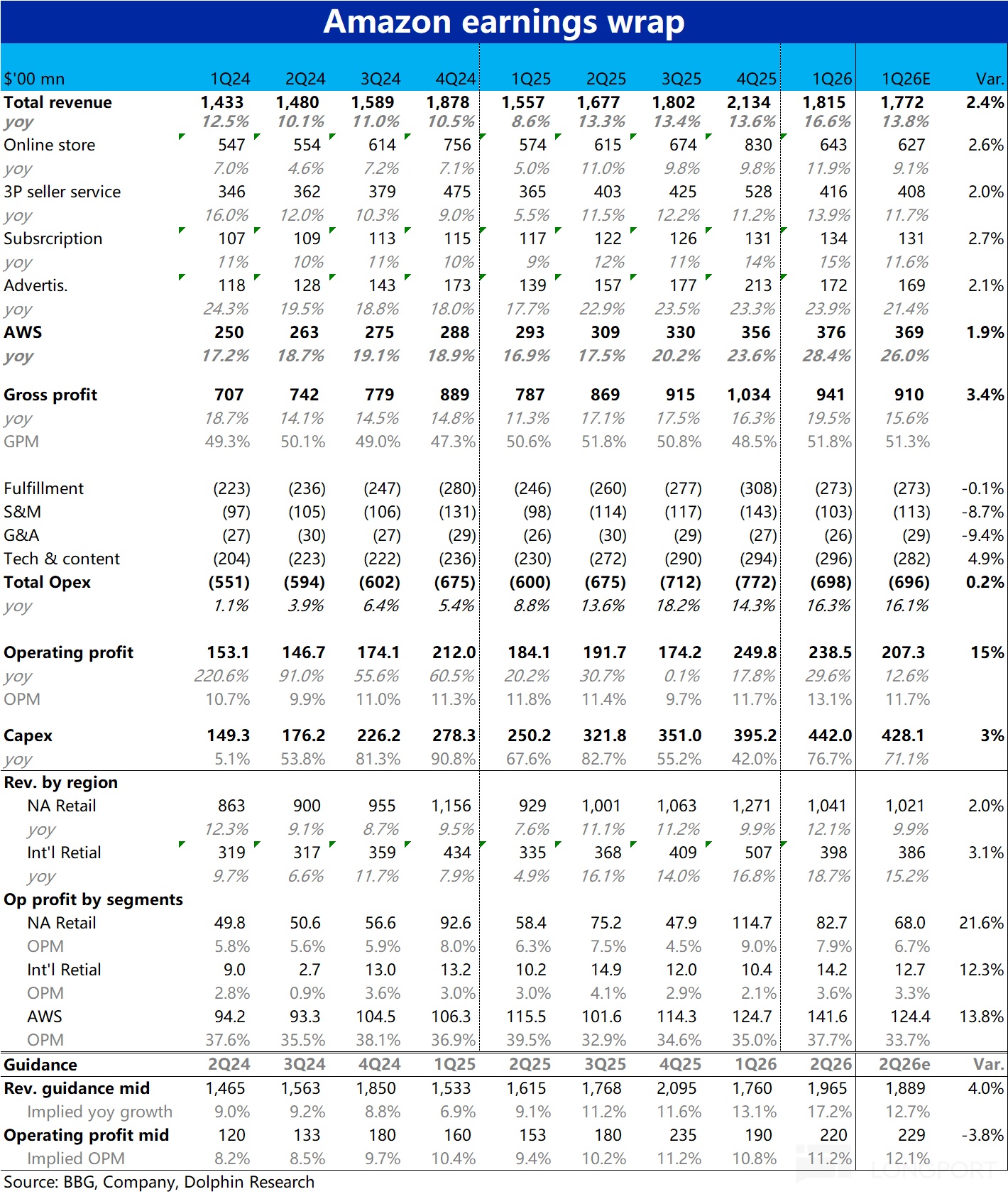
$Amazon(AMZN.US) released Q1 FY2026 results after the U.S. close on Apr 30 Beijing time. AWS accelerated sharply while broad retail stayed solid, with both revenue and profit beating Bloomberg consensus. However, with the stock up over 30% from recent lows in the past few weeks, the bar had already moved higher, leaving limited upside vs. raised expectations. Specifically:
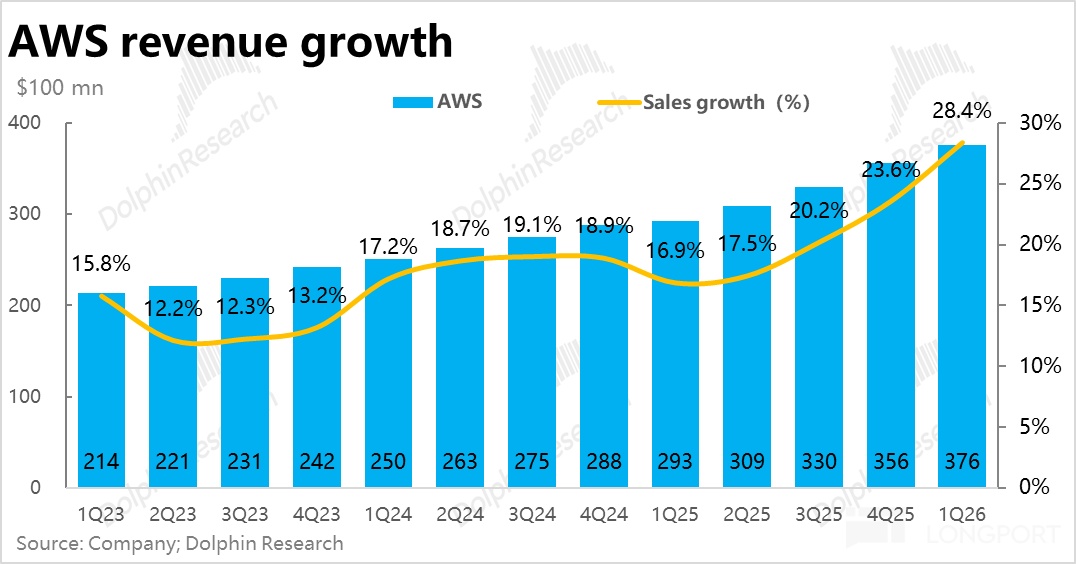
1) AWS re-accelerates, competitive standing improves: The key focus metric — AWS revenue rose 28% YoY to $37.6bn, a notable acceleration of 4ppt+ QoQ. That said, many brokers had lifted AWS growth expectations to 30%+ ahead of earnings, so the print fell short of the more bullish buy-side bar.
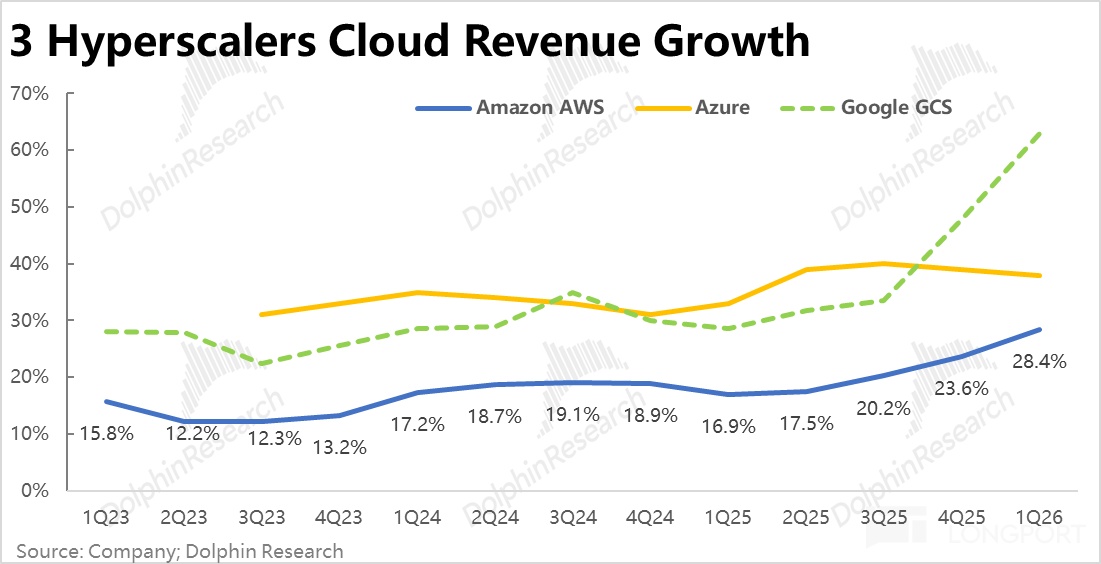
Still, AWS has sped up for three straight quarters, and recent large deals with OpenAI and Anthropic clearly signal AMZN’s improved position in the current AI wave.
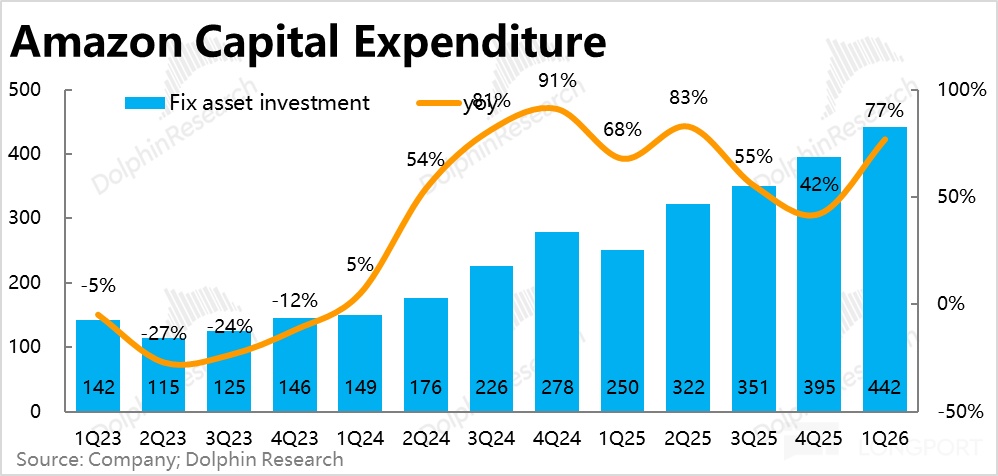
2) Capex hits another peak: Capex was $44.2bn this quarter, up another $4.7bn QoQ off a high base and above the Street ($42.8bn). Versus the other two hyperscalers, AMZN is the most aggressive on Capex today.
This has underpinned AWS’s sustained acceleration (more compute coming online). In addition, with newly signed mega-deals with OAI and Anthropic measured in the hundreds of billions of dollars, Capex and DC build-out could step up further.
3) More debt to support cash flow: Operating cash inflow was $26.6bn in the quarter, but after Capex FCF was a negative $17bn+, the first negative FCF print since the 2021–early 2023 Capex cycle. After raising nearly $15bn in debt last quarter, AMZN raised another $53bn this quarter.
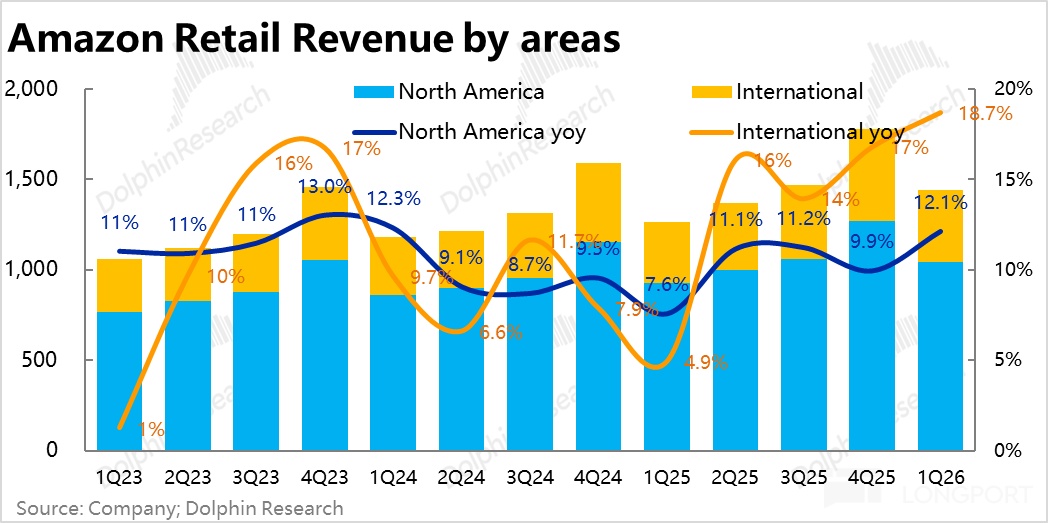
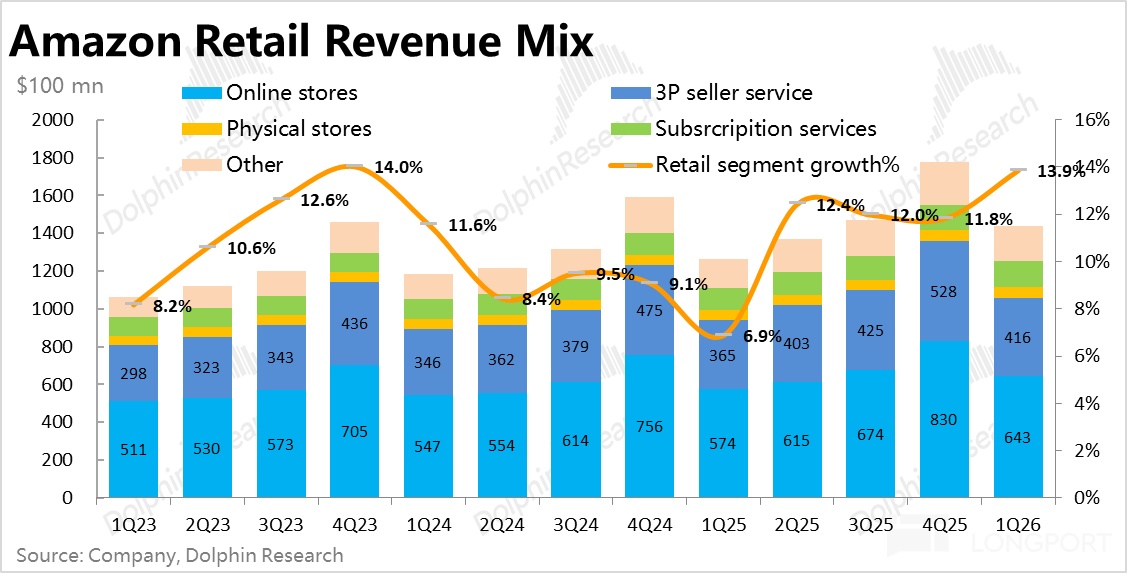
4) Retail steady with progress: Broad retail revenue was $143.9bn, +13.9% YoY, with growth accelerating by nearly 2ppt QoQ. Heading into the print, the market was cautious on retail amid Middle East tensions and higher oil, so retail outperformed expectations this quarter.
North America retail grew 12%, over 2ppt faster QoQ, with limited impact from the conflict. U.S. no-store retail growth in Jan–Feb (7.7%–8.6%) ran ahead of Q4 levels, supporting the sector backdrop. AMZN’s investments in logistics and near-field grocery/essentials likely contributed, with order volume up 15% to a post-Covid high.
Intl retail revenue grew 18.7%, but most of that was FX tailwinds. At constant FX, recent quarters have held around 10%–11% YoY growth with no real acceleration.
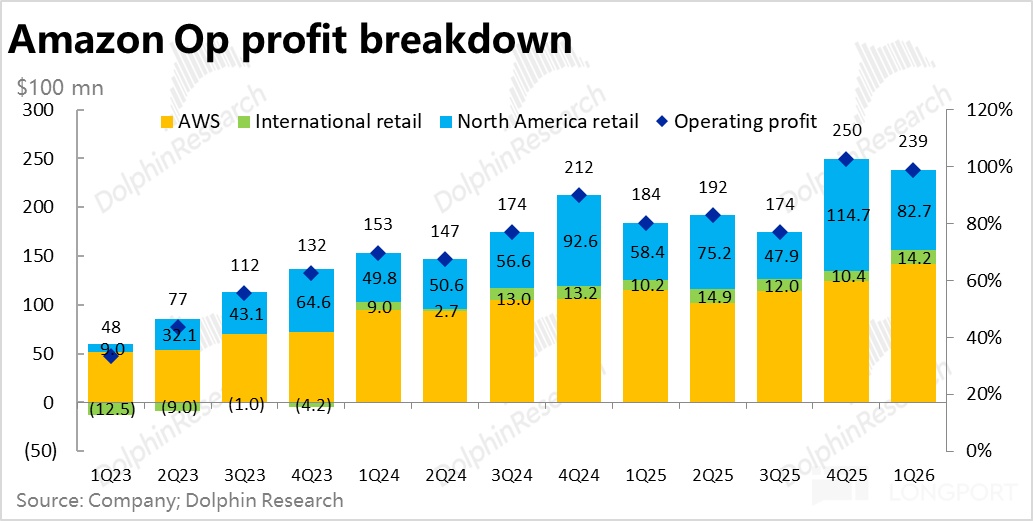
6) AWS and NA retail profits also strong: Operating profit was $23.9bn, above the $20.7bn consensus. Profit grew nearly 29% YoY, well ahead of revenue growth, and margin pressure feared from conflict and AI spend proved milder than expected, with margins still trending up.
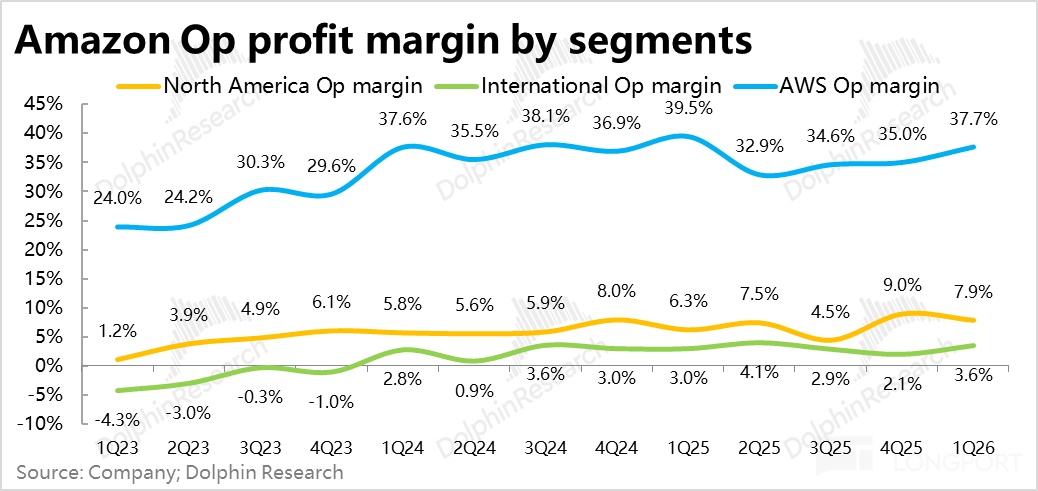
By segment, NA retail OPM reached 7.9%, materially above the 6.7% consensus and 6.3% a year ago. Intl retail also beat, but about $350mn of profit was FX tailwind; stripping that, Intl margin likely declined YoY.
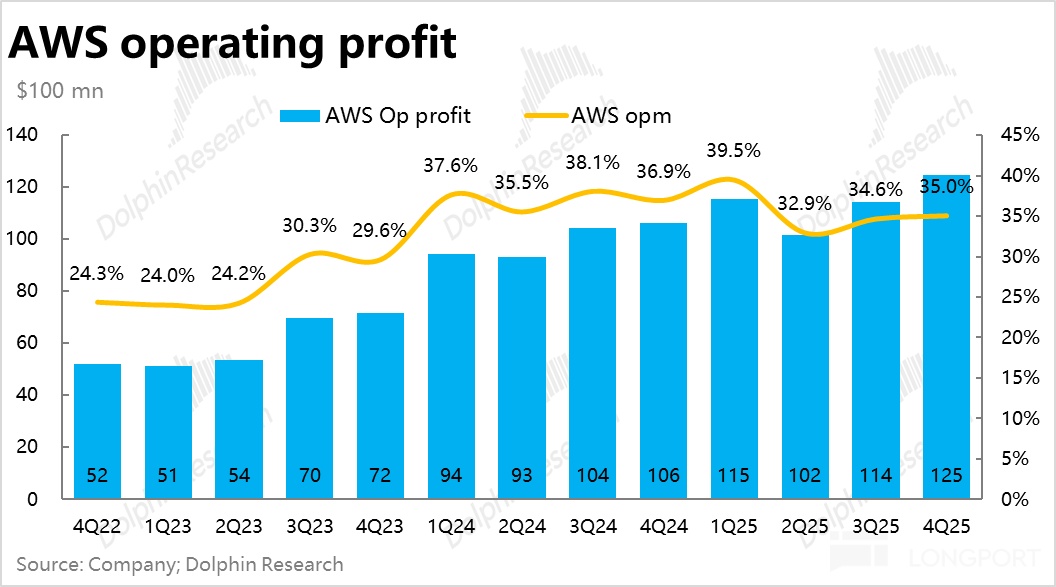
AWS OPM dipped on AI investment to 37.7% from 39.5%, but the drop was far smaller than feared, so AWS OP of ~$14.2bn beat the $12.4bn consensus.
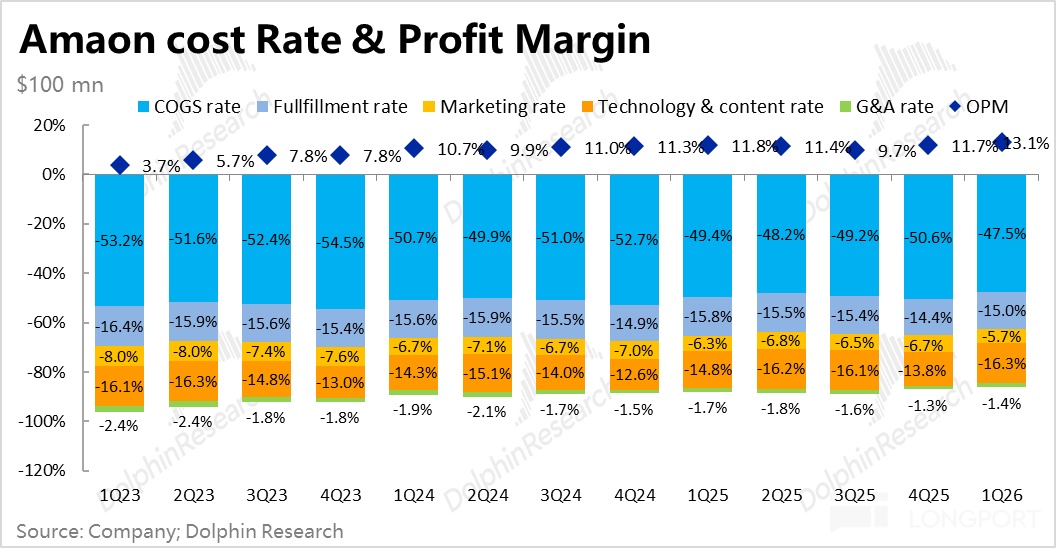
7) Beat driven mainly by GPM expansion: From a P&L angle, the profit beat came mainly from higher gross margin, not opex control. GPM was 51.8%, up 120bps YoY, similar to last quarter’s expansion.
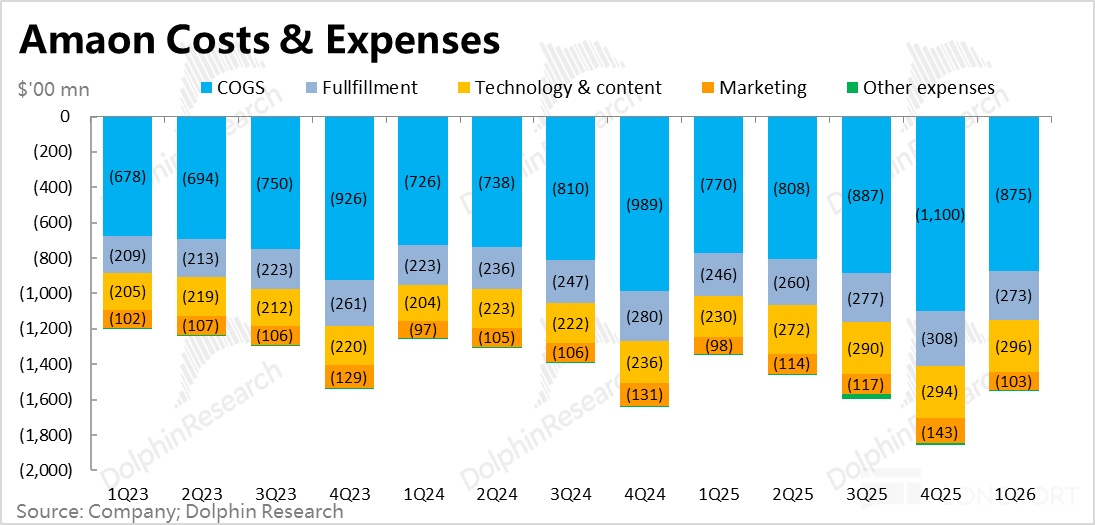
Total opex was $69.8bn, slightly above estimates and +16.3% YoY, roughly in line with revenue growth, implying limited leverage. The main driver was R&D up 29% YoY, likely tied to heavier AWS and AI-related investment.
Dolphin Research view:
1) Solid quarter: In short, AMZN delivered: a) AWS revenue accelerated and margins did not collapse as feared; b) broad retail, especially NA, showed resilient revenue and margin gains despite conflict; c) FCF turned negative amid rising Capex and frequent debt raises, but with AWS accelerating and landing mega-deals validating ROI, the market is unlikely to punish near term.
2) Guide implies further revenue acceleration, but more margin pressure: For next quarter, management guides revenue up 16%–19% YoY, i.e., another step-up vs. this quarter. One driver: Prime Day moves from Jul to Jun, aiding Q2 retail revenue (Wells Fargo estimates a ~$7bn tailwind, ~4ppt growth contribution).
On the other hand, based on the high end of revenue guidance and assuming retail up ~15%–16%, AWS growth implied at ~30%–35% YoY, continuing to accelerate. However, guided OP midpoint of $22bn is a bit light vs. the Street, implying an 11.2% OPM vs. 12.1% consensus and last year. That suggests conflict and Capex could weigh more on margins next quarter, though at the high end ($24bn) margins would be roughly in line with expectations.
3) AI competitive standing continues to rise: Taken with prior developments, AMZN’s most important shift is the marked improvement in its overall AI competitiveness, with quarters of progress culminating this quarter.
a) Deeper OpenAI partnership: Following last quarter’s $38bn 7-year OAI contract on AWS, the partnership deepened. OAI expanded its AWS commitment to $138bn over 7 years, or roughly $20bn per year of AWS revenue.
With MSFT’s exclusive sales rights for OAI APIs removed, AMZN can distribute OAI models and tools on AWS, with some features embedded into AWS services/products. OAI also committed that about 2GW of its new compute contracts will be built on Trainium.
b) Deeper Anthropic partnership: Similarly, AMZN and Anthropic signed new terms, including AMZN committing another $5bn investment with an option to add up to $20bn more. In return, Anthropic expanded its AWS compute contract to $100bn over 10 years and committed to an aggregate 5GW of Trainium capacity (current and future gens).
These two labs bring multi-pronged benefits: more compute contracts, stronger AI product capabilities, and an anchor user base and ecosystem for AMZN’s ASICs. In results, AWS acceleration is evident and RPO rose from $244bn to $364bn (reflects OAI orders; Anthropic’s $100bn not yet included).
c) In-house chips: Notably, chip sales are running at a $20bn annualized rate; including internal usage, the annual run-rate is ~$50bn, and Trainium committed orders total $225bn.
On this basis, AMZN’s ASIC business (GPU and CPU), including self-use, is approaching one-fifth of NVIDIA’s scale and could warrant standalone value. From a group competitiveness view, Trainium can save several tens of billions of Capex annually by reducing external chip reliance and add a few ppts of margin via higher energy efficiency, underscoring leadership in cloud and chips among the AI era’s three cores: models, cloud, and silicon.
3) On valuation and thesis, AMZN is at an inflection point as the narrative shifts, with AWS and chips likely to see a steady release of positives. Retail, being mature, should not drag and should remain steadily improving. Aside from potential near-term Capex over-investment pressuring margins, there are no obvious long-term flaws.
The key question: after a sharp rebound and higher expectations, is there still value at the current multiple? Assuming AWS revenue growth of 36% and 42% in 2026–27 and a conservative 31% OPM in 2027, and retail revenue at a 13% CAGR with a 7.6% blended OPM, 2027 after-tax OP would be near $110bn, implying ~25–26x. That is a neutral multiple for AMZN, so post-rally upside is less compelling, though continued execution can still drive returns.
Details below:
I. AWS: faster growth, solid profit, but expectations were high
The headline metric — AWS revenue up 28% YoY to $37.6bn (similar at constant FX), over 4ppt faster QoQ and nearly 11ppt faster vs. a year ago.
Even with acceleration, the print was not a clear beat, as many brokers had raised Q1 AWS growth to 30%+ and full-year 2026 to 35%+. As such, the most bullish investors may be slightly disappointed.
Given the largest scale among CSPs, elevated Capex, and newly signed $100bn+ deals with OAI and Anthropic, AWS growth is set to accelerate further; the question is whether it can clear the now-higher bar.
Beyond growth, AWS profit beat materially with a 37.3% OPM vs. 33.7% consensus. OP was nearly $14.2bn, +23% YoY, with no evident revenue-profit disconnect.
While AI mix did drive YoY margin compression of 180bps, the pressure was milder than broadly feared. Still, as Capex and AI revenue mix rise, a gradual OPM downtrend looks hard to avoid.
II. Capex keeps climbing
Capex was $44.2bn, up ~$4.7bn QoQ and above the already-elevated $42.8bn Street view. Among the three hyperscalers, AMZN was the only one with Capex above consensus and higher QoQ in 1Q vs. 4Q. For the year, management still holds a ~$200bn Capex budget.
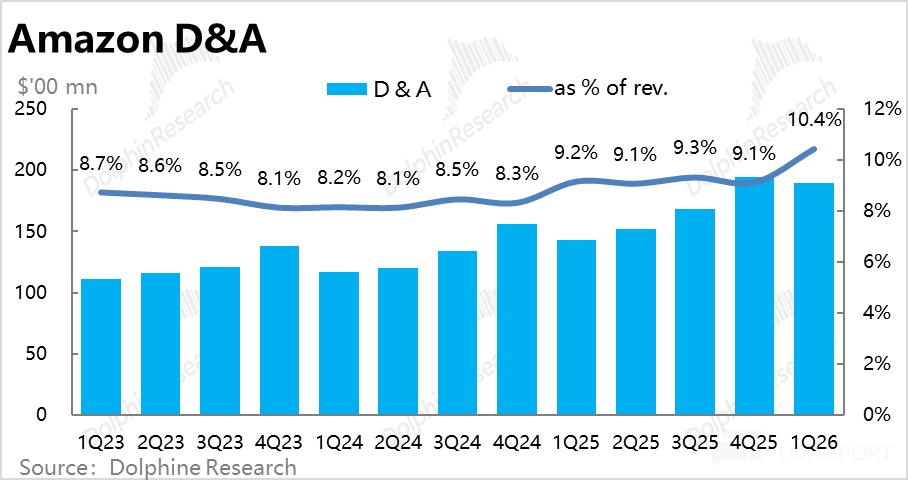
The aggressive pace helps explain AWS’s acceleration; likely tied to meeting OAI and Anthropic demand on schedule, necessitating faster DC build. Correspondingly, D&A as a % of revenue rose to 10.4% from a little over 9% last year. This may be one reason AWS margin held up this quarter, consistent with our view that D&A as a % of revenue could rise another 2–3ppt in 2026, implying mounting OPM pressure ahead.
III. Broad retail steady to better: NA true improvement, Intl mostly FX
Broad retail also improved, with $143.9bn revenue, +13.9% YoY, nearly 2ppt faster QoQ. Given conflict and higher oil, the market was cautious on retail, so this was the bigger surprise.
By region, NA retail grew 12%, over 2ppt faster QoQ. U.S. no-store retail rose 5%–7% YoY in Oct–Dec and 7.7%–8.6% in Jan–Feb, signaling sector-wide acceleration. AMZN’s investments in same-day logistics and near-field grocery/essentials also helped.
Meanwhile, Intl retail was up 18.7%, but largely FX-driven. At constant FX, recent quarters have held around 10%–11% YoY with no true acceleration.
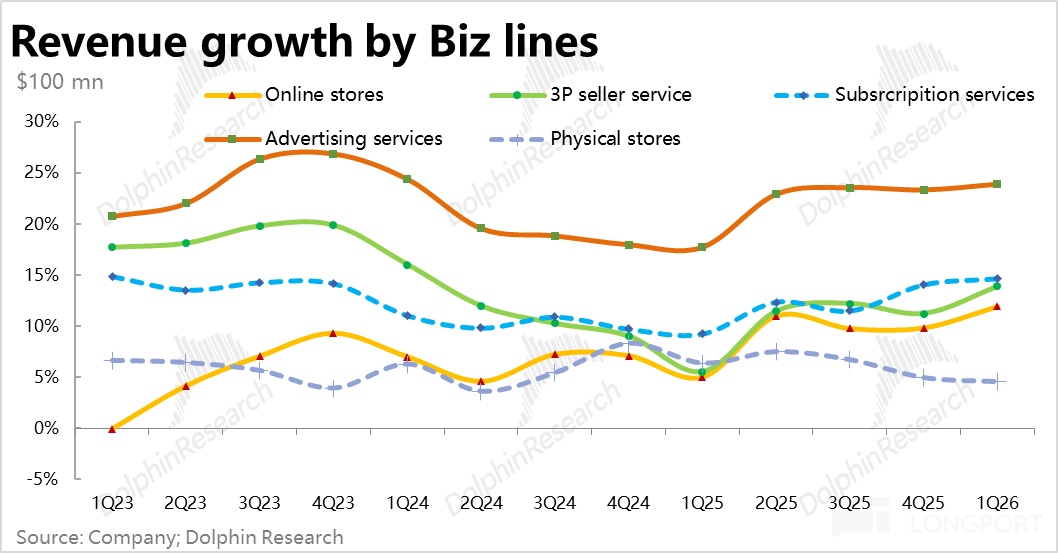
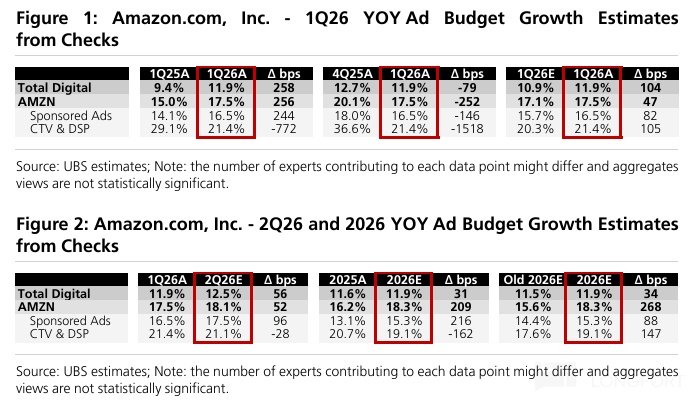
Across lines, growth was broadly steady to better, including: a) 1–2ppt sequential improvements in 1P retail and 3P seller services, while offline stores decelerated somewhat; b) ads remained strong at +22% YoY cc, flat vs. last quarter, with Prime Video and other media ads as key drivers. Recent surveys suggest AMZN ads will outgrow the market in 2026 (~18% vs. ~12%).
IV. Profit beat, driven by NA retail and AWS
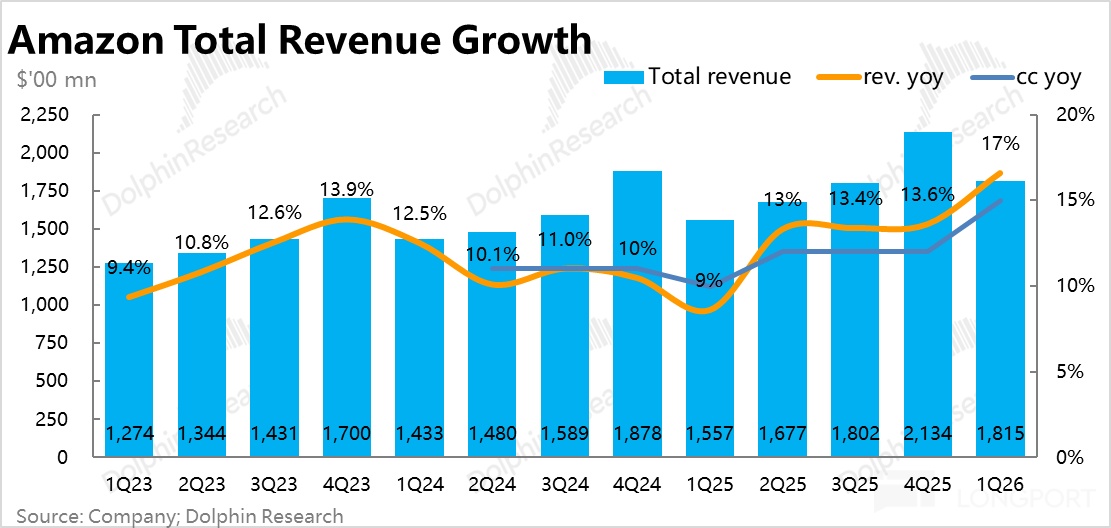
Total revenue was $181.5bn, +16.6% YoY, beating the $177.2bn consensus. Ex-FX, revenue grew ~15%, up 3ppt QoQ, mainly from AWS and with help from NA retail.
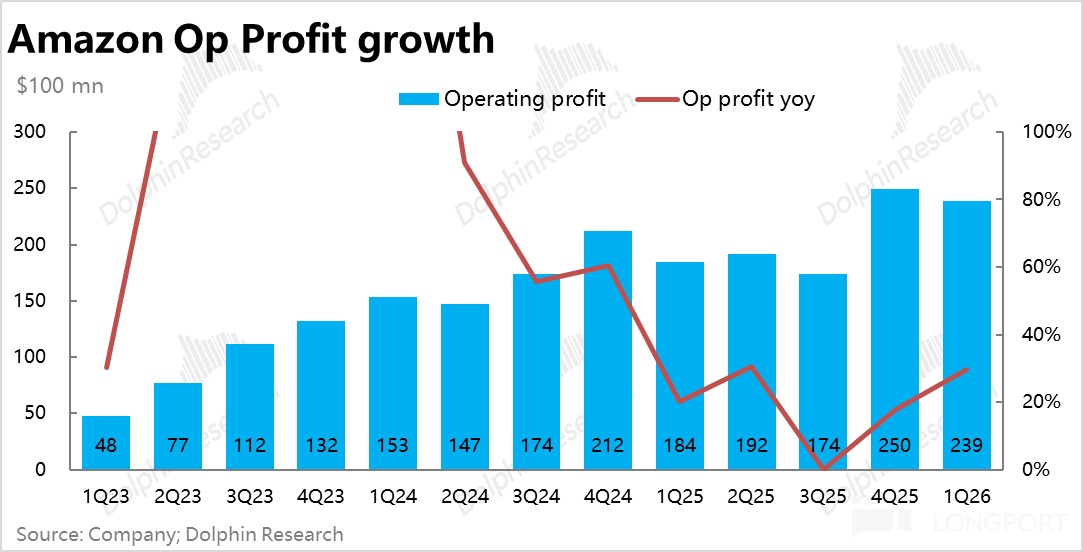
Operating profit was $23.9bn vs. $20.7bn consensus, up nearly 29% YoY and well ahead of revenue growth. Feared margin drag from conflict and AI spend has not materialized meaningfully, with margins still trending higher.
By segment: a) AWS margins fell 180bps YoY but less than feared; b) NA retail OPM was 7.9%, above 6.7% consensus and 6.3% last year; c) Intl retail OP was $1.42bn, above consensus, but ~$350mn was FX tailwind, implying a slight YoY margin decline ex-FX.
Net-net, the profit beat was mainly from NA retail and AWS.
V. GPM beat; R&D surged
The profit beat was mainly from GPM expansion rather than opex control. GPM was 51.8%, up 120bps YoY, similar to last quarter’s improvement.
Despite higher Capex and D&A weighing on AWS GPM, mix and efficiency gains in retail were more impactful. Total opex was $69.8bn, slightly above plan and +16.3% YoY, broadly in line with revenue, offering limited leverage.
The main swing factor was R&D up 29% YoY, with other opex well-contained. Given R&D includes AWS compensation, development costs, some equipment, and streaming content, this likely reflects heavier AWS and AI feature investment.
<End of text>
Dolphin Research past work on Amazon:
Earnings recaps
Oct 30, 2025 call ‘Amazon (Trans): compute capacity to double again by 2027’
Oct 30, 2025 recap ‘AWS inflects: has Amazon finally turned the corner?’
Aug 1, 2025 recap ‘AWS stalls, retail concerns: crouch before the jump?’
Aug 1, 2025 call Amazon (Trans): H2 Capex intensity to mirror Q2
May 2, 2025 call Amazon (Trans): AI compute still bottlenecked
May 2, 2025 recap ‘Heavy AI spend, tariff noise: back to a crouch?’
Feb 7, 2025 recap ‘Amazon: all-in cloud, margin release at risk again?’
Feb 7, 2025 call Amazon (Trans): GPU cloud depreciation nearing, DS a clear positive
Risk disclosure and disclaimer: Dolphin Research disclaimer and general disclosure


The copyright of this article belongs to the original author/organization.
The views expressed herein are solely those of the author and do not reflect the stance of the platform. The content is intended for investment reference purposes only and shall not be considered as investment advice. Please contact us if you have any questions or suggestions regarding the content services provided by the platform.