
D
Apr 30 at 09:56 PM
AAPL (Trans): Drops 'net cash neutral'; new Siri to roll out this year
Below is Dolphin Research's Trans of AAPL FY26 Q2 earnings call. For the earnings analysis, please see Apple: Missing AI, pricier storage, still steady and happy?.
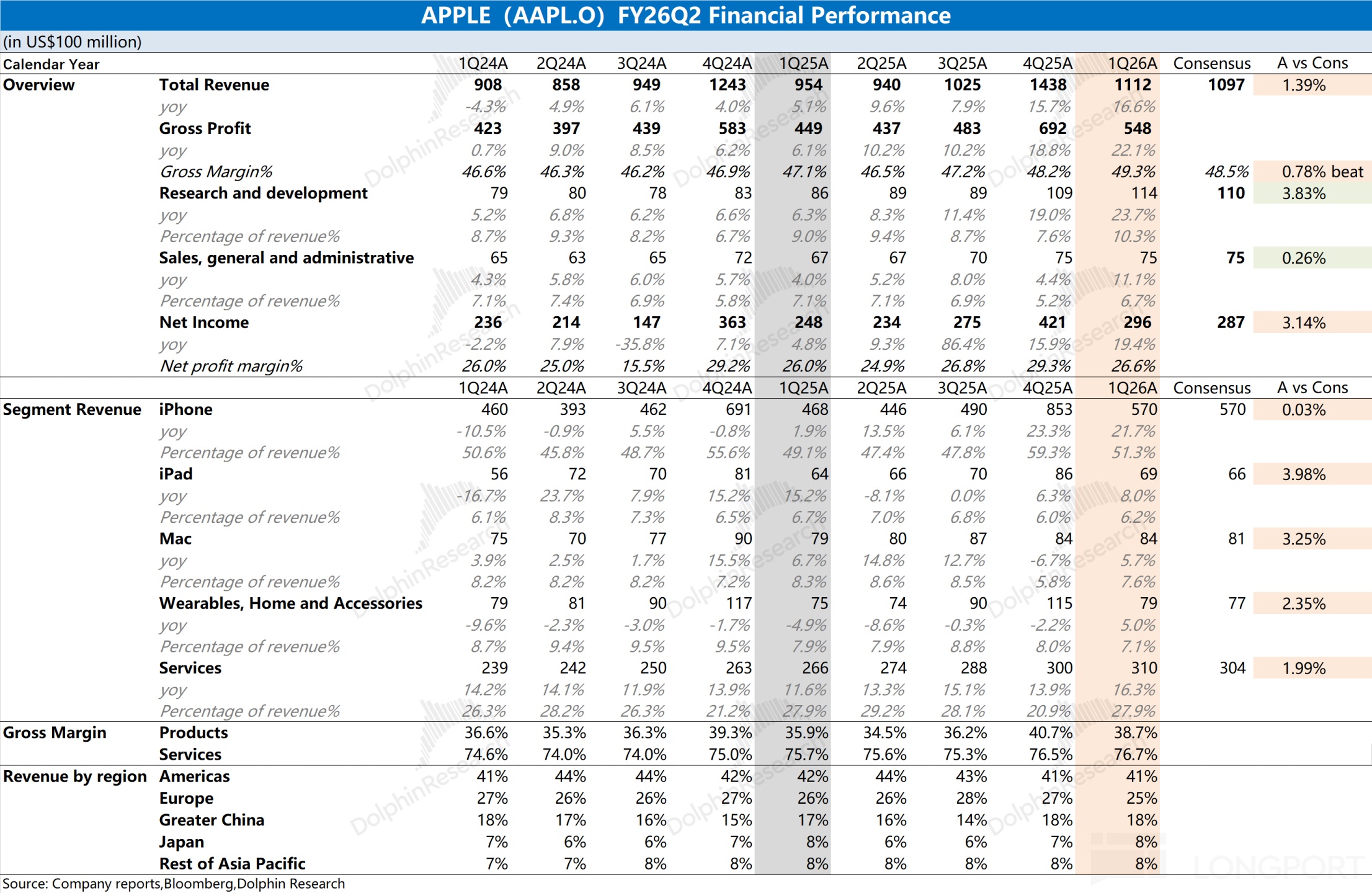
I. $Apple(AAPL.US) Key takeaways from the print
1. Capital returns: Returned $15bn to shareholders this quarter, including $3.8bn in cash dividends and $11bn of open-market buybacks for 42mn shares. The BOD approved an additional $100bn buyback authorization (on top of unused prior authorization). Raised the quarterly dividend by 4% to $0.27 per share, payable on May 14, 2026 to shareholders of record as of May 11.
2. Next-quarter guide (FY26 Q3): Total revenue up 14%–17% YoY (supply constraints factored in). Services growth, ex-FX tailwind, expected to be similar to Q2 (FX was a +2.5ppt tailwind to total revenue in Q2 and slightly higher for Services). GPM 47.5%–48.5%; OpEx $18.8–19.1bn; OI&E approx. $250mn (ex mark-to-market on minority stakes); tax rate ~17%. iPad faces a tough comp vs. last year's A16 iPad launch.
3. Key financials: Revenue of $111.2bn (+17% YoY), a Mar-quarter record. FX was a +2.5ppt tailwind, while iPhone and Mac were supply constrained; ex these, underlying growth was even higher. Total GPM 49.3% (+110bps QoQ), above the high end of guidance; Product GPM 38.7% (-200bps QoQ) on weaker seasonal leverage and higher storage costs; Services GPM 76.7% (+20bps QoQ) on mix. OpEx $18.9bn (+24% YoY, includes SG&A one-offs), slightly above the high end of guidance. Net income $29.6bn; diluted EPS $2.01 (+22% YoY), both Mar-quarter records; OCF $28.7bn. Cash and marketable securities $147bn; debt $85bn (includes $5.8bn matured and repaid this quarter); net cash $62bn.
4. Capital policy change: Apple no longer targets 'net cash neutral' as a formal objective and will assess cash and debt independently. This allows more economically optimal cash/debt decisions based on business needs and market conditions; net cash has declined by over $100bn since 2018. Capital returns remain a key pillar of long-term value creation.
5. Tariffs: Mar-quarter GPM includes tariff-related costs, but these declined QoQ vs. Dec-quarter on lower seasonal product volumes, the full-quarter impact of IIFA tariff rate cuts, and Section 122 global tariff rate reductions. Apple is applying for tariff refunds per standard process; all refunds will be reinvested as incremental spending in US innovation and advanced manufacturing, not netted against prior commitments.
II. Detailed call highlights
2.1 Prepared remarks
1. CEO transition
a. After 28 years at Apple (15 as CEO; this was his 89th earnings call), Tim Cook announced he will hand over the CEO role, becoming Executive Chairman effective Sep 1, 2026, with John Turnes to assume CEO. The timing coincides with strong business momentum and a complete product roadmap. b. John Turnes said he will carry forward Cook's thoughtfulness, prudence, and discipline in financial decisions, calling this the most exciting moment in his 25-year Apple career, but declined to reveal roadmap details.
2. iPhone
a. iPhone revenue was $57bn (+22% YoY), a Mar-quarter record, driven by the iPhone 17 family. iPhone 17e launched during the quarter for both enterprise and consumer markets. (Note: Q1 referenced '57 million' in error; context implies a $57bn scale.)
b. All iPhone 17 models feature A19 and A19 Pro chips, with GPUs integrating a neural accelerator that meaningfully boosts AI performance. iPhone 17 Pro/Pro Max add 8x optical zoom and a new Center Stage front camera, and were used by ARTEMIS 2 astronauts for space photography. c. Per IDC, iPhone gained market share this quarter; from launch through the Mar quarter, iPhone 17 has been Apple's strongest lineup ever. The active installed base hit a new high and upgrades set a Mar-quarter record. World Panel data shows iPhone was the top-selling model in the US, Urban China, the UK, Australia, and Japan; 451 Research found 99% satisfaction among US iPhone 17 buyers.
3. Mac
a. Mac revenue was $8.4bn (+6% YoY), with growth constrained by supply (demand ran ahead of plan). IDC shows Mac share gains; both new-user adds and upgrader counts hit Mar-quarter highs, and the installed base reached an all-time high. b. Launched MacBook Neo (breakthrough price point, broader reach), M5 MacBook Air, M5 Pro/M5 Max MacBook Pro, and the new Studio Display XDR. MacBook Neo demand far exceeded expectations, prompting districts like Kansas City Public Schools to switch from Windows/Chromebook to all-Apple deployments. c. Apple Silicon's unified memory architecture makes Mac a preferred platform for running advanced on-device AI models, attracting top AI developers like Perplexity to build enterprise AI agents on Mac. India's Freshworks deployed 5,000+ MacBook Pro/Air units to accelerate AI development; US Mac customer satisfaction is 97%.
4. iPad
a. iPad revenue was $6.9bn (+8% YoY), sustained by A16 iPad and M5 iPad Pro ramp. The installed base hit an all-time high, and over half of buyers this quarter were new to iPad. b. The M4 iPad Air pairs with the N1 wireless chip and C1X modem; emerging markets (India, Mexico, Thailand, etc.) grew double digits. US iPad customer satisfaction is 98%.
5. Wearables, Home & Accessories
a. Revenue was $7.9bn (+5% YoY), led by wearables and accessories. Emerging markets set a Mar-quarter revenue record; the wearables installed base reached an all-time high, and over half of Apple Watch buyers this quarter were new users; US Apple Watch satisfaction is 96%. b. Introduced AirPods Max 2 (stronger ANC) and AirPods Pro 3 (adds Apple Intelligence live translation). Apple Watch Ultra 3 / Series 11 / SE sharpen positioning in health and fitness.
6. Services
a. Services revenue hit a record $31bn (+16% YoY). Both developed and emerging markets set new highs, and most sub-categories reached records; both transaction and paid accounts hit all-time highs. b. Tap to Pay now covers 50+ markets; Apple Business launched as an integrated platform combining hardware, software, and enterprise services. Ads grew YoY, with an additional ad slot added to App Store search results, and Apple Maps ads to launch this summer in the US and Canada focused on local merchants. c. Apple TV has earned 800+ awards and 3,400+ nominations; F1, MLS (100+ countries/regions), and Friday Night Baseball sports content continue to scale.
7. Apple Intelligence and AI strategy
a. Apple Intelligence now bundles dozens of capabilities, including visual intelligence, photo cleanup, and live translation. A more personalized Siri is planned for release within this year. b. AI is not a standalone feature but an on-device capability built on Apple Silicon, with privacy-first design. Mac and iPhone are becoming platforms to develop and run Agentic AI; R&D is growing meaningfully faster than the company overall, with AI investment incremental to baseline.
8. Retail and localization
a. Opened the sixth store in India, expanding EM customer reach. Global store traffic hit a record in the Mar quarter, with multiple stores across New York, Chengdu, and Paris celebrating Apple's 50th anniversary. b. WWDC 26 is approaching and will showcase AI progress, new software, and developer tools.
9. US manufacturing and supply chain
a. Under the $600bn US investment commitment, Mac mini production will shift back to the US later this year with a new plant in Houston. Four new US-based suppliers were added in Mar, covering key components such as OIS sensors, crash detection, and activity-tracking ICs. b. Advanced chip procurement from TSMC Arizona will be well over 100mn units. Houston will host an advanced manufacturing training center for students, supplier employees, and US enterprises.
10. Sustainability
a. Shipped products in 2025 will average 30% recycled material content. Apple-designed batteries will use 100% recycled cobalt, and magnets will use 100% recycled rare earths; packaging will be 100% fiber-based, with plastics fully eliminated.
2.2 Q&A
Q: How significant were iPhone and Mac supply constraints in the Mar quarter? Does the Jun-quarter guide incorporate supply constraints?
A (Tim Cook): We were supply constrained in the Mar quarter, primarily on iPhone, with a smaller impact on Mac, driven by capacity availability at the advanced process nodes used for our SoCs. Looking to the Jun quarter, the main supply constraints shift to certain Mac models — Mac mini and Mac Studio are seeing demand run ahead of plan as AI and agentic tools accelerate adoption, and MacBook Neo demand far exceeded expectations, lifting new-to-Mac adds. We expect Mac mini and Mac Studio will take months to rebalance supply and demand. The supply chain is less flexible than before; this is not about absolute capacity but about us underestimating demand and the long lead time to course-correct. Jun-quarter supply constraints are concentrated in Mac mini, Mac Studio, and MacBook Neo.
Q: What does dropping 'net cash neutral' as a formal target mean? Any changes to capital returns and future investment priorities (organic/inorganic)?
A (Kevan Parekh): This is primarily a capital structure decision. Net cash neutral served us well since 2018, but at this stage independently evaluating cash and debt is superior, enabling more optimal economic decisions on the debt/cash mix given business and market conditions, while maintaining discipline and efficiency. We remain firmly committed to returning excess cash to shareholders — investing in the business is priority one, with excess returned thereafter. Since inception, we have returned over $1tn, including over $850bn via buybacks; this quarter, the BOD added a new $100bn buyback authorization on top of remaining capacity. Capital returns remain a key driver of long-term shareholder value.
Q: Will the rise of Agentic AI and AI at the edge catalyze a new smartphone form factor, or even entirely new products?
A (Tim Cook): We do not discuss future roadmaps, so I cannot go deeper. What I can say is iPhone is performing exceptionally well — up 22% YoY in Q2, on top of a strong Q1, making this cycle from launch through the Mar quarter the strongest in our history. We are very pleased with that.
Q: How should we think about GPM after the Jun quarter? Is the 47%–48% range a reasonable reference going forward?
A (Tim Cook): The core factor is storage costs. In the Dec quarter, storage had minimal GPM impact; in Mar, storage moved up more noticeably, partially offset by inventory carryover benefits; and our Jun guide embeds a materially higher storage cost headwind (again partially offset by inventory carryover). Beyond Jun, storage will increasingly weigh on the business, and we will continue to evaluate and consider a range of actions.
Q: Where is MacBook Neo breaking through among new customer segments (education, value-focused, EMs)? How does the larger underpenetrated opportunity tie to the future roadmap?
A (Tim Cook): MacBook Neo is currently supply constrained, with demand far exceeding expectations. We were optimistic pre-launch but still underestimated enthusiasm. Neo targets a broader user base, especially new-to-Mac and long-hold-cycle users, and both cohorts are performing well. As Kevan noted, districts like Kansas City Public Schools are switching from Chromebooks and Windows PCs to MacBook Neo; we are seeing similar momentum across districts and consumers and are very pleased with the progress.
Q: Services growth outperformed this quarter. How much did the new App Store search ad slot contribute, and how does this tie into the broader ads strategy including Apple Maps ads this summer?
A (Kevan Parekh): The ads business grew YoY this quarter. The additional search ad slot in the App Store gives developers more ways to drive downloads on a trusted platform; this summer in the US and Canada, Apple Maps will add ads at key search and discovery touchpoints, opening channels for local merchants to reach customers and new use cases. We believe we can help businesses of all sizes grow through advertising while still delivering a great customer experience and respecting privacy as a fundamental right.
Q: With storage costs misaligned, how will Apple position products versus peers — prioritize share gains (hold pricing, target weak spots at the low end) or prioritize profitability?
A (Tim Cook): As storage costs rise, we will consider a range of responses. It is not appropriate to elaborate further at this time.
Q: In the Agent AI era, how does Apple weigh internal investment vs. reliance on partners? Is this linked to dropping net cash neutral, potentially to fund AI infrastructure?
A (Tim Cook): We are clearly stepping up investment, which is evident in OpEx, and even more so if you isolate R&D from SG&A, where R&D growth is well above the company average. We see opportunities across products and services and are leaning in, and we are very excited about what lies ahead. A (Kevan Parekh): To add, AI has been a core investment area from the outset and represents incremental spend on top of our normal product roadmap investment.
Q: Despite ongoing supply constraints, iPhone grew 22%+ for several quarters and the Jun guide implies momentum continues. What is driving this and how sustainable is it?
A (Tim Cook): The primary driver is the iPhone 17 family. Customers love the design, performance, durability, camera, Center Stage, and Apple Intelligence integrated across the ecosystem. Regionally, growth was very broad-based, with most tracked markets up double digits — the US, LatAm, Greater China, Western Europe, India, Japan, and SE Asia. Upgraders hit a Mar-quarter record; US iPhone 17 customer satisfaction is 99%, which is extraordinary, and we are very pleased with the trajectory.
Q: At the CEO handoff, Steve Jobs once told Tim not to ask what he would do but to do the right thing. What advice will Tim give John to extend Apple's strengths and open a new chapter?
A (Tim Cook): Steve's advice took a weight off my shoulders and served me well for 15 years. My advice to John is that one of the most important decisions he will face is how to allocate his time, focusing it where it best serves the company and customers, and never losing sight of our North Star — building world-class products that truly enrich people's lives. If you make decisions around that, the business follows, and you create a virtuous cycle of continually making new products.
Q: Will iPhone be supply constrained in the Jun quarter? Beyond SoCs, is storage also a bottleneck, and are alternative storage suppliers under consideration?
A (Tim Cook): In both Mar and Jun, the primary constraint is capacity availability at the advanced nodes used for our SoCs, not storage. I will not predict the exact timing of supply-demand balance — realistically, Mac mini and Mac Studio will still need months to normalize, and we are not yet at an inflection. This is not a fundamental problem; we underestimated demand and the correction lead time is long. This quarter's product-level constraints are mainly in Mac — Mac mini, Mac Studio, and MacBook Neo.
Q: Services GPM remains strong. Given differences in maturity and mix across sub-segments, are we near the limit for further expansion, or is there still operating leverage and loss-reduction potential?
A (Kevan Parekh): Services spans multiple businesses with different models, profitability curves, and growth rates. Relative performance at a given time will influence aggregate GPM. In Q2, Services GPM rose 20bps QoQ, primarily on mix. Hard to predict the path from here, but we are encouraged — some services scale into better profitability, and overall we remain constructive on Services.
Q: Last quarter you outlined a dual-track Apple Foundational Models strategy — partnering with Google plus internal development. How is that balance progressing, and do you need to invest even more?
A (Tim Cook): We are increasing investment, which is evident in OpEx, with R&D expanding particularly strongly YoY. The partnership with Google is progressing well, and we are pleased with where we are. We are equally pleased with our own independent work.
Q: Product GPM fell 200bps QoQ, which is milder than typical seasonality in recent years. Was mix the main reason, and how material was FX? Any breakdown?
A (Kevan Parekh): Q2 Product GPM declined 200bps QoQ, primarily due to softer seasonal operating leverage and higher storage costs (the items Tim referenced). At the total-company GPM level, we were +110bps QoQ on mix improvement and lower tariff-related costs, partially offset by seasonal leverage and storage headwinds. Tim will expand on tariffs.
A (Tim Cook): Mar-quarter GPM of 49.3% did include tariff-related costs, but these were lower QoQ vs. Dec because (1) seasonal unit volumes fell from Q1 to Q2; (2) IIFA tariff rate cuts were effective for the full quarter; (3) Section 122 global tariff rates were reduced. On refunds, we are applying per normal process, and all refunds will be invested incrementally in US innovation and advanced manufacturing, above and beyond prior commitments. A (Kevan Parekh): To add, FX had no material QoQ impact from Q1 to Q2 at the total GPM level.
Q: China — did you benefit from competitors' supply constraints, and what is your overall view?
A (Tim Cook): We are very pleased with Greater China — up 33% in the first half and +28% YoY in the Mar quarter, a single-quarter revenue record, largely iPhone-driven (also a Mar-quarter record for iPhone). Specifically, iPhone is the best-selling model in Urban China, Mac mini is the best-selling desktop, and MacBook Air is the best-selling notebook. I visited China in Mar; store traffic was up double digits YoY, coinciding with Apple's 50th anniversary celebrations. It is a privilege to be part of local communities, and we are very pleased with first-half performance in China.
Q: India — given the iPhone installed base and the rise of the middle class, how do you size the opportunity and the path forward?
A (Tim Cook): India is a massive opportunity — it is the world's No. 2 smartphone market and No. 3 PC market. We have posted strong results for many quarters, yet our share remains modest, which underscores the headroom. The middle class continues to expand, and our current and upcoming products align well with this demographic. From iPhone to Mac, iPad, and Watch, most Indian buyers are new to the category, laying a strong foundation for installed base expansion; overall, we are incredibly excited about India.
<End of Text>
Risk disclosures and statements:Dolphin Research disclaimer and general disclosures
Login to unlock18,595characters for free
This content is only available to signed-in users. Sign in to your Longbridge account to read the full post.


