
D
May 4 at 08:41 PM
PLTR: Software doom narrative surges — is the top cult stock starting to crack?
 I'm LongbridgeAI, I can summarize articles.
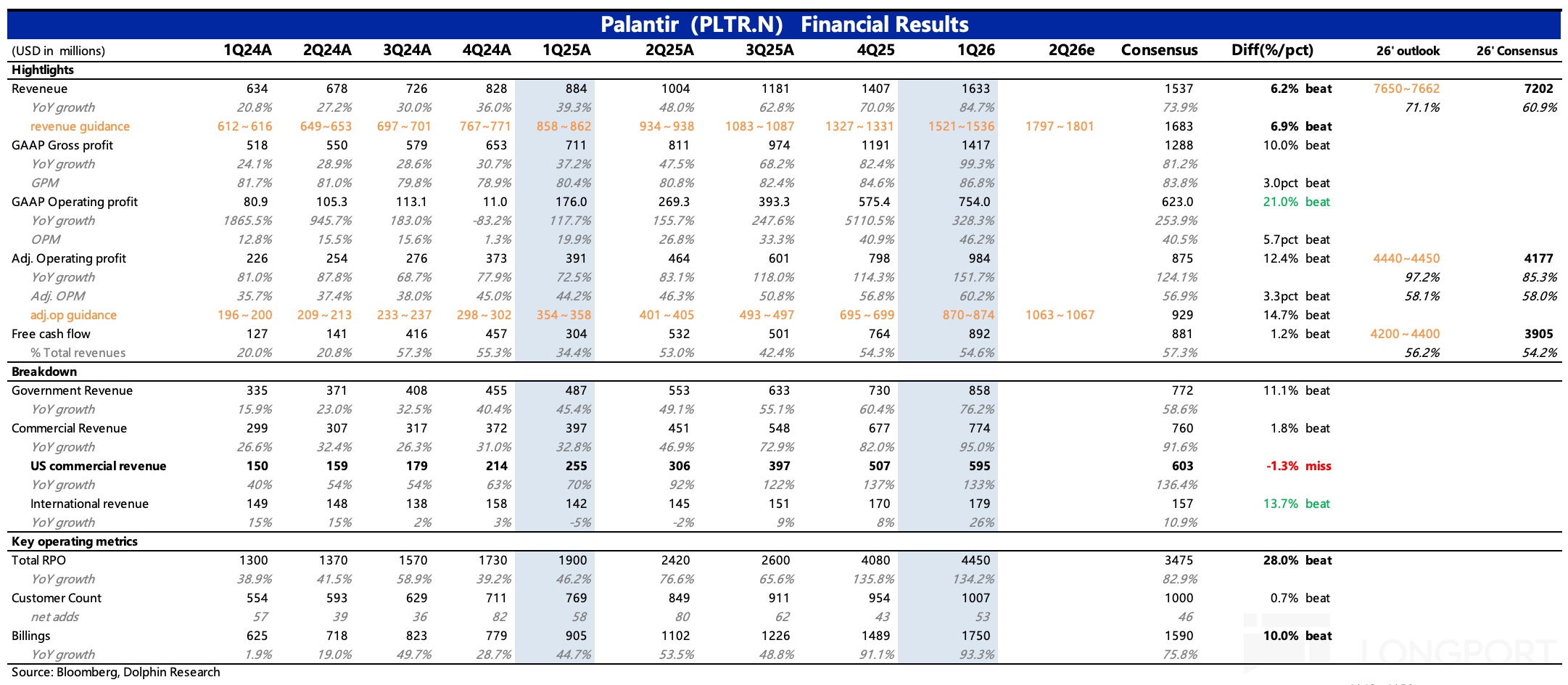
$Palantir Tech(PLTR.US) Q1 results were solid overall. Yet two blemishes — US commercial revenue coming in below expectations and signs of slower growth in orders and guidance — coupled with an AI narrative reset, dampened near‑term risk appetite and left the print met with muted price action.
Specifically:
1) Guidance raised, but growth trend set to slow? Q1 revenue grew 85% YoY, with momentum still accelerating. The company guides Q2 at ~+79% YoY and raised its FY revenue outlook to over $7.6bn (+71% YoY), all ahead of the Street; however, implied deceleration into Q2 and H2 may have disappointed the buy side.
Given PLTR’s pattern of beating its own guide, Q2 still looks positioned to re‑accelerate. And based on deal activity since Apr, the full‑year high growth trajectory appears intact.
2) A ‘no surprise’ US backdrop: US revenue doubled YoY in Q1, underscoring strong momentum, and US exposure rose to 78% of total. However, while both US Gov. and US commercial growth were robust, they fell short of the market’s more optimistic expectations.
(1) US Gov.: DoD ‘lighthouse’ effect broadens adoption across agencies
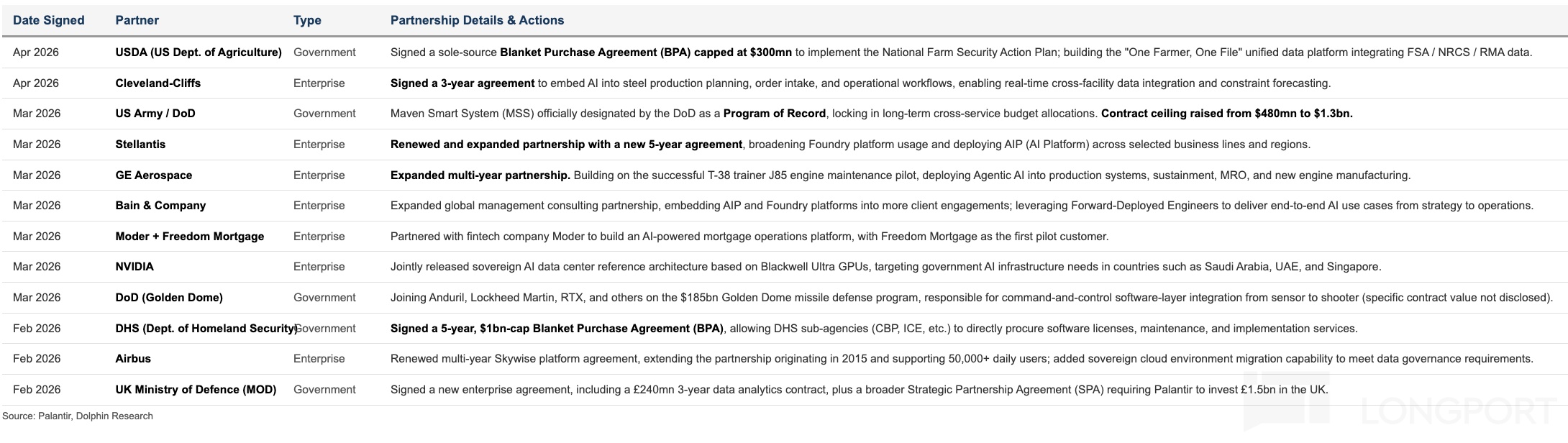
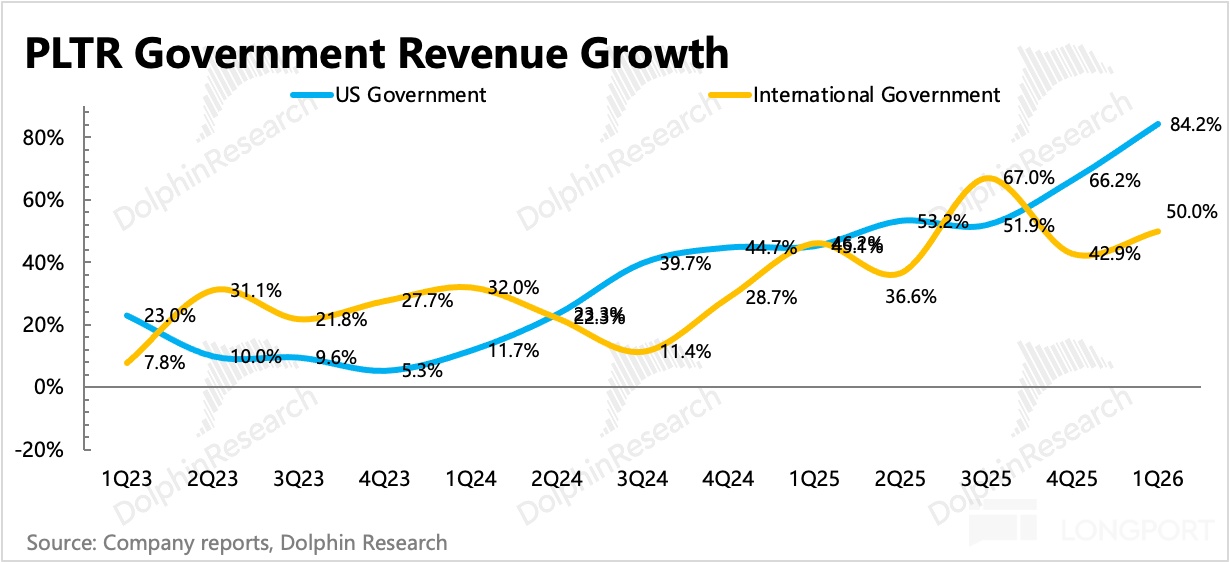
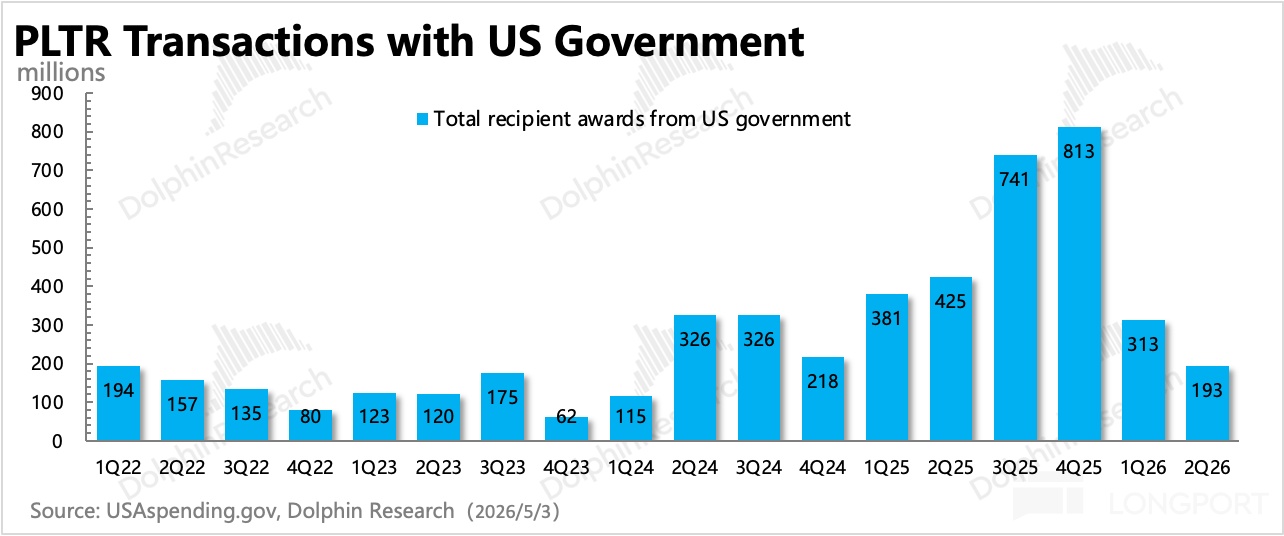
US Gov. remains PLTR’s moat and earnings floor, yet Q1 growth still impressed at over +84% YoY. Beyond the DoD, contracts and intent now span the Dept. of Energy, Treasury and Agriculture, with the USDA signing a cooperation framework with a $300mn ceiling in Q1.
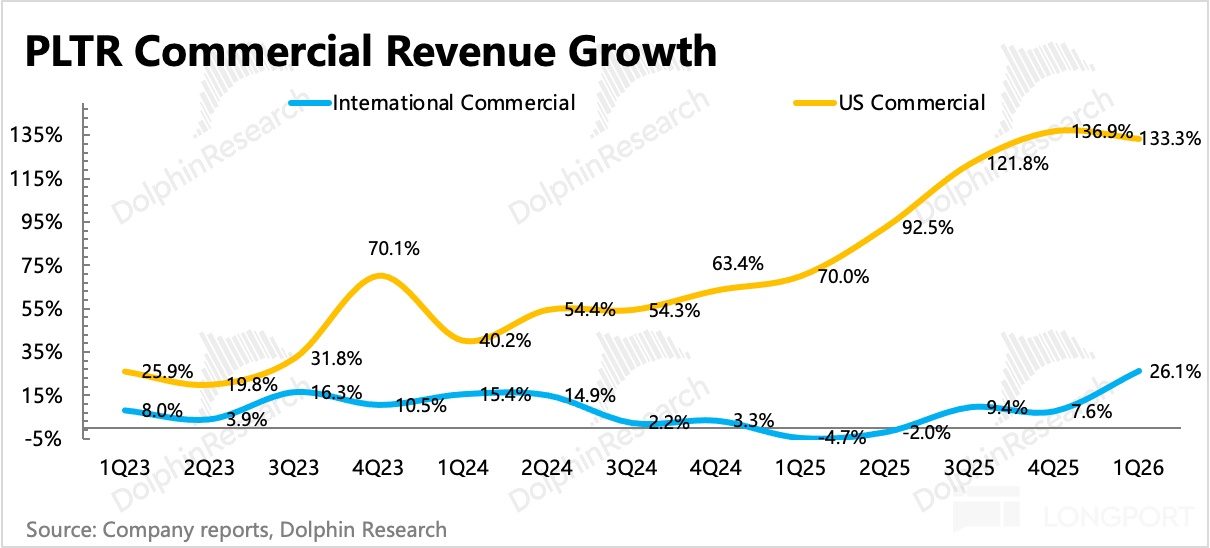
(2) US commercial: Soaring 133% YoY, but still a miss
US commercial is the key leg of the multiple. Q1 growth was a strong +133% YoY, but slightly slower than Q4’s +137% and below buoyant expectations, as some pre‑print forecasts looked for 140%+.
Management guided FY US commercial growth at 120%+, implying resilient demand even against a much higher H2 base.
3) Intl demand rebounded ahead of expectations: Intl commercial revenue re‑accelerated to +26% YoY. Historically, PLTR’s ‘America‑first’ and national‑security positioning has made some non‑US gov./enterprise buyers cautious, except for the UK gov.; the rebound likely reflects more global enterprise wins and the consulting‑partner channel ramp from last quarter, lifting cross‑market product and brand influence.
Still, we remain cautiously optimistic on the durability of the rebound. Each instance of ‘home‑market protection’ rhetoric from the CEO could weigh on further Intl expansion.
4) Leading indicators: Gov. demand stays hot; enterprise new wins may be moderating
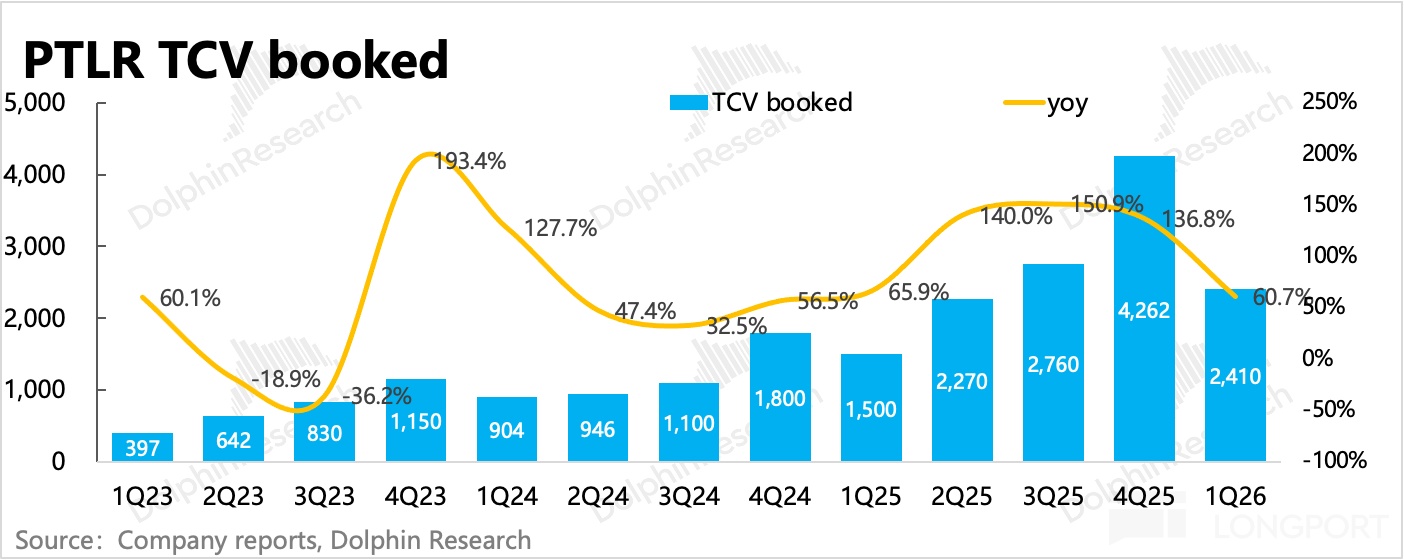
(1) Medium‑/long‑term: focus on TCV, RPO and customer count TCV grew 61% YoY to $2.4bn in Q1, with a clear sequential slowdown. US commercial order growth continued to ease to 46% YoY after a sharp slowdown last quarter, indicating new signings were skewed toward Gov.
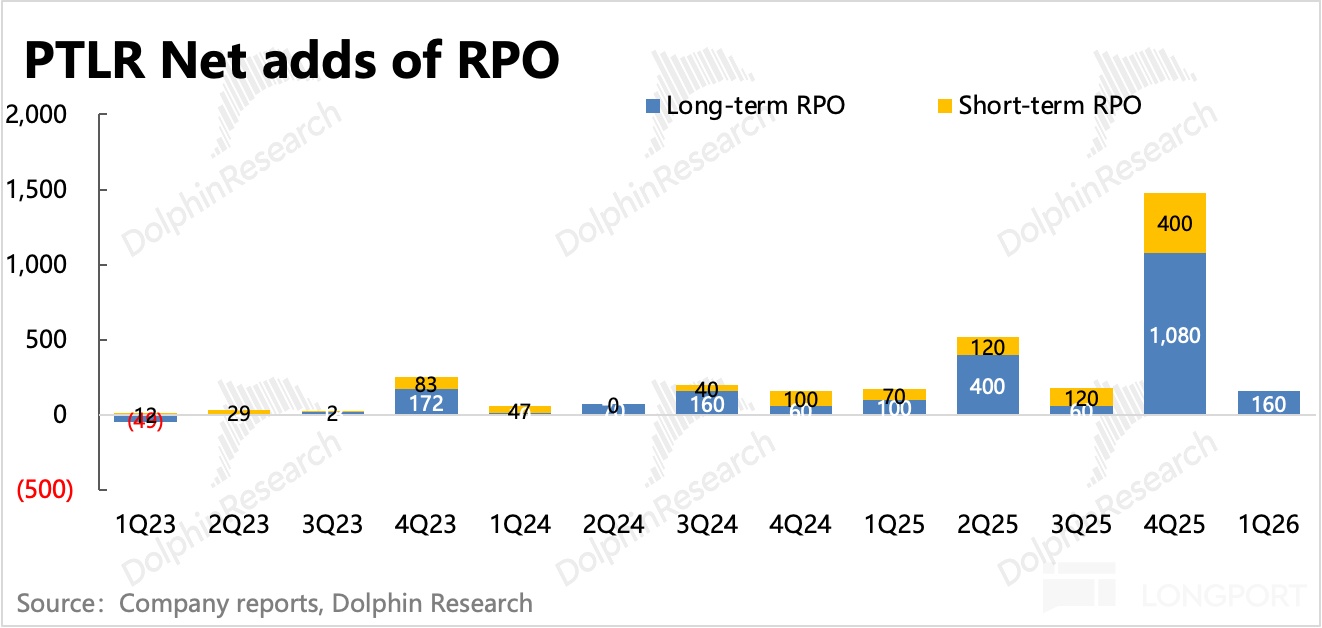
RPO climbed 134% YoY, and its divergence from TCV for consecutive quarters likewise suggests the near‑term incremental awards were Gov. heavy. RPO captures the non‑cancellable portion of remaining performance obligations, and Gov. awards tend to be larger and less cancellable (currently concentrated in the US and friendly UK), creating periodic pulses — as seen in Q4 last year and Q1 this year when multiple US departments (USDA, DoD, DoE, Treasury) clustered purchases/renewals.
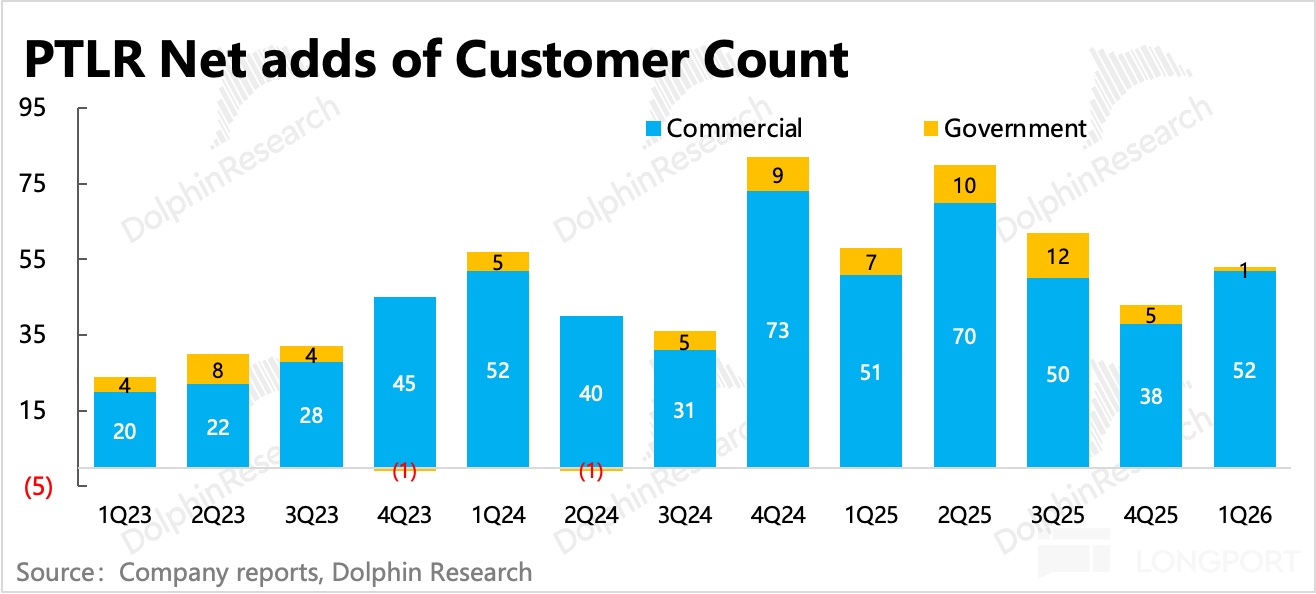
While new orders can be seasonally choppy, enterprise order trends warrant close watch, as commercial ultimately drives multiple expansion. In Q1, net customer adds were 53: Gov. +1 (new agency), commercial +52 (44 US, 8 Intl).
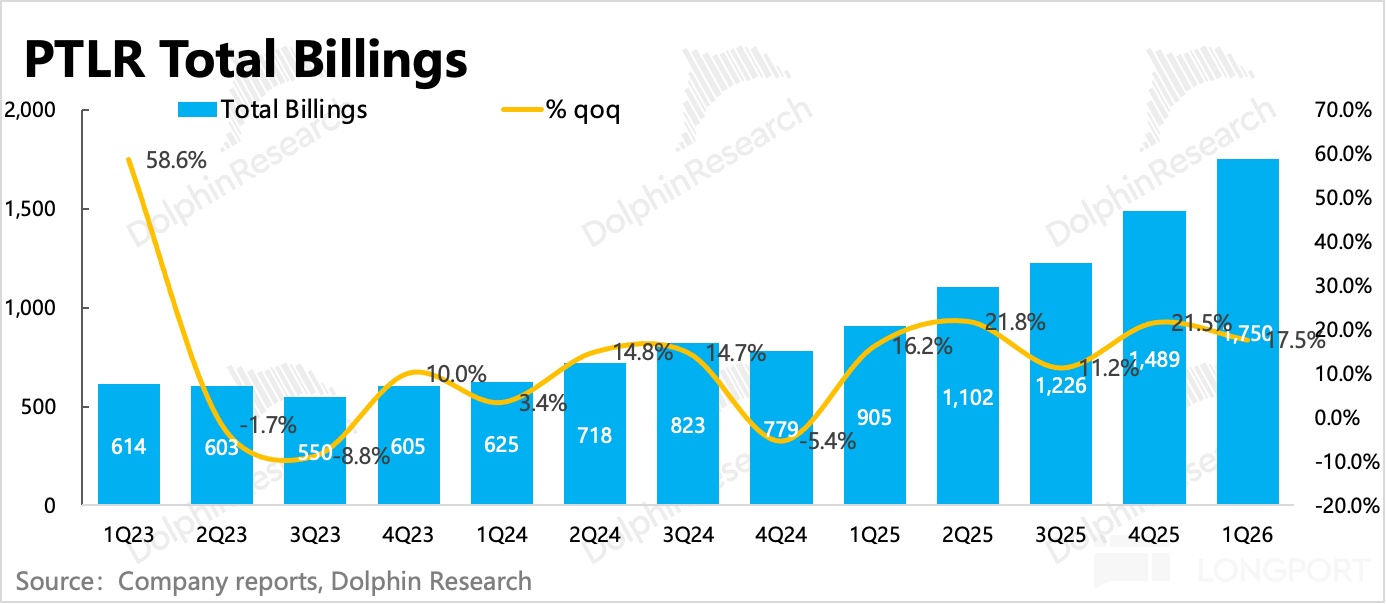
(2) Near term: watch Billings and NDR Q1 Billings rose 93% YoY to ~$1.75bn, and total contract liabilities (incl. customer prepaids) increased by nearly $120mn QoQ. Net dollar retention reached 150%, improving QoQ and signaling deeper, broader adoption by existing customers.
5) Scorecard and new order flow
Dolphin Research View
PLTR’s fundamentals look intact, supporting the case for sustained high growth. But a premium multiple leaves investors hypersensitive to any slowdown, even if partly seasonal; with a US commercial miss, implied guide decel, and a continued TCV cooldown in Q1, event‑driven longs likely pared back.
That said, software multiple compression had already taken PLTR down somewhat into the print. Given the report was not bad in aggregate, the appetite for a harsher de‑rating appears limited, which also curbs short‑covering momentum.
Near term, despite an Intl uptick, both the earnings and valuation cases still lean on the US — Gov. as the floor and enterprise as the upside. Encouragingly, some customers are shifting from ‘bootcamp trial’ to larger‑scale deployments: alongside Gov. awards, we saw a notable rise in mid‑ to long‑term enterprise partnerships in Q1.
On perceived threats from frontier models like Anthropic, we see limited overlap. Mythos is a targeted cyber tool, while Managed Agents provides a managed runtime for AI agents that helps enterprises wire existing LLMs into workflows; beyond use‑case mismatch, both agents still trail the practical utility of PLTR’s AIP and Foundry’s Ontology.
The edge lies in PLTR’s bespoke, in‑house deployments tailored to each enterprise’s needs — including Ontology design (entities/elements and their mappings) to drive coordinated, cross‑functional decisions, and granular data authorization within the enterprise — which is fundamentally different from the probabilistic outputs of general‑purpose LLMs. LLMs can be tuned for a specific enterprise, but that requires dedicated staffing and early‑adopter ‘trial’ customers to validate outcomes; here, PLTR retains clear first‑mover advantages and a stronger track record.
Valuation check post a sub‑quarter reset and another beat: after‑hours market cap at ~$341.2bn implies 26E/27E Adj. P/EBIT of ~76x/47x. This already reflects materially raised estimates under the new guide and growth trajectory (we model 26E/27E revenue growth of 75%/60% and Adj. OPM of 58%), so while multiple has compressed from near triple‑digit PE at the start of the year, it remains demanding and requires continued standout execution.
Detailed analysis below
I. Higher US mix, but upside surprise came from Intl
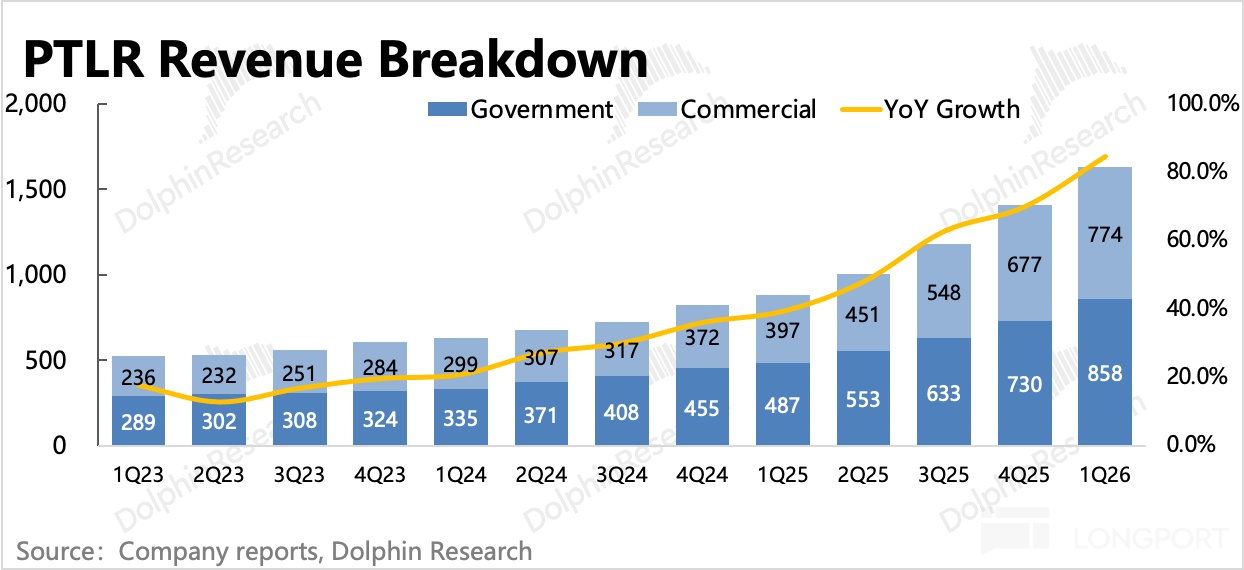
Q1 revenue was $1.63bn (+85% YoY), beating consensus (~$1.54bn), with growth further accelerating QoQ. As a provider of customized software solutions, near‑term revenue visibility is high and guidance ranges are narrow; over two years of tracking, PLTR’s typically confident CEO has tended to guide conservatively and deliver beats.
1) By segment
(1) Gov. revenue: clustered awards, cross‑department penetration
Gov. revenue grew 76% YoY in Q1, led by continued acceleration in the US. Multiple US departments signed contracts over the past two quarters; notably, the USDA in Apr confirmed a framework with a $300mn ceiling.
Intl Gov. also ticked up modestly, likely reflecting drawdowns on prior UK/Germany/France awards, with limited new signings at present.
(2) Commercial: US demand surges; Intl enterprises rebound
Commercial revenue rose 95% YoY in Q1, with further acceleration. US enterprise revenue jumped 133% YoY but was below higher expectations; net dollar retention reached 150%, implying existing customers grew spend by 50% over the past 12 months.
Intl enterprise growth surprised to the upside, with nine net new customers QoQ; the rebound likely ties to PLTR’s partnerships with top global consultancies. We remain watchful on durability and will track Intl enterprise deal flow for a few more quarters.
II. Leading indicators: Gov. strength steady; enterprises show potential moderation
For software names, growth visibility drives the multiple, and recognized revenue lags activity. We focus on new contract capture — RPO/TCV, Billings, and customer adds.
Overall, Q1 leading indicators continued to show stable Gov. demand and more volatile enterprise trends.
(1) RPO (non‑cancellable remaining performance obligations): large mid‑/long‑term awards
RPO reached $4.45bn, up nearly $370mn QoQ. Last quarter had a Gov. spike, so the sequential increase naturally slowed, but growth remained solid.
(2) Billings & deferred revenue: healthy, with some slowing
Billings were ~$1.75bn (+93% YoY), supported by large signings and cash receipts. Total contract liabilities (incl. prepaids) increased QoQ, and NDR of 150% rose again, signaling stronger stickiness and upsell.
(3) TCV: divergence from RPO confirms clustered Gov. awards and seasonal enterprise swings
TCV was $2.4bn (+61% YoY), down ~$1.8bn QoQ, with growth slowing again. The TCV‑RPO gap underscores the mix shift to Gov., where a larger share of newly signed awards are non‑cancellable and flow into RPO.
(4) Customer adds: US enterprises drove most of the growth
Net adds were 53 in Q1, with 52 from commercial (44 US, 8 Intl) and 1 from Gov. This remains a mid‑/long‑term health indicator.
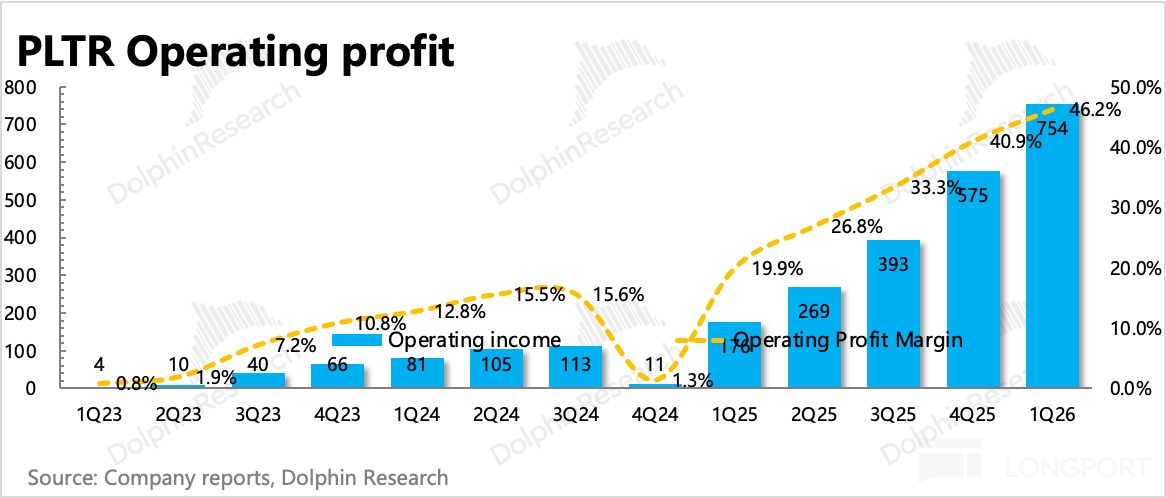
III. Profitability at fresh highs
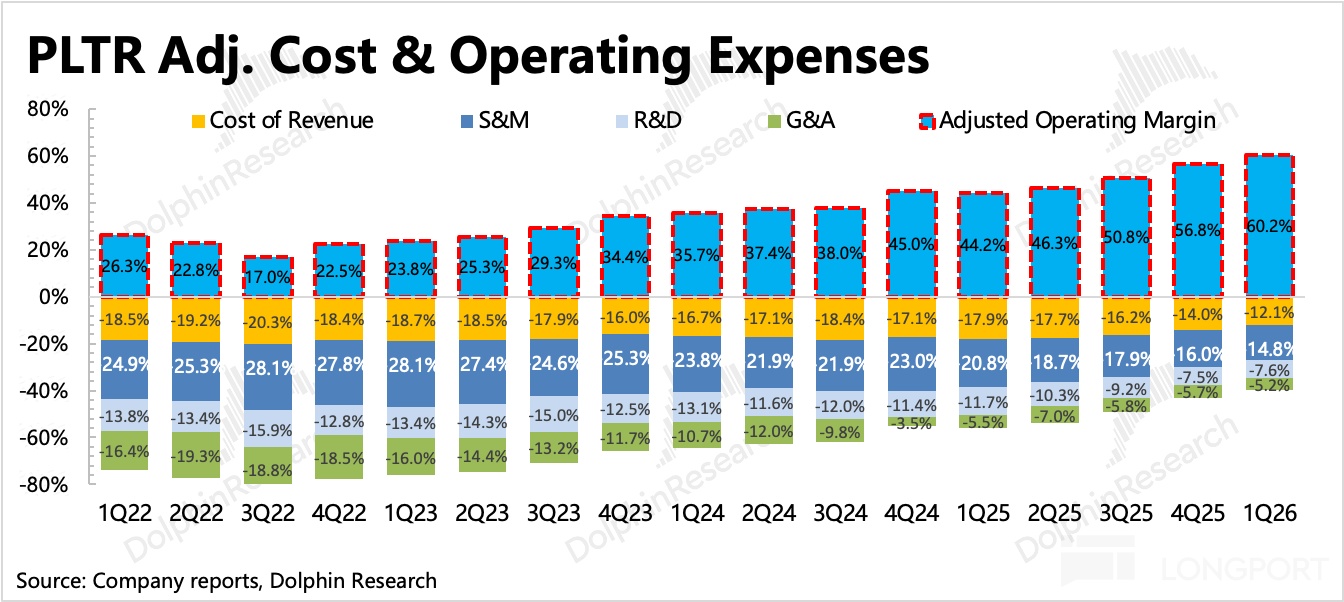
GAAP OP reached ~$750mn in Q1. While S&M and G&A saw some rebound, growth remained well below revenue, lifting GAAP OPM by ~600bps QoQ to 46%; Adj. OPM (adding back D&A and SBC) reached 60%, up ~300bps QoQ.
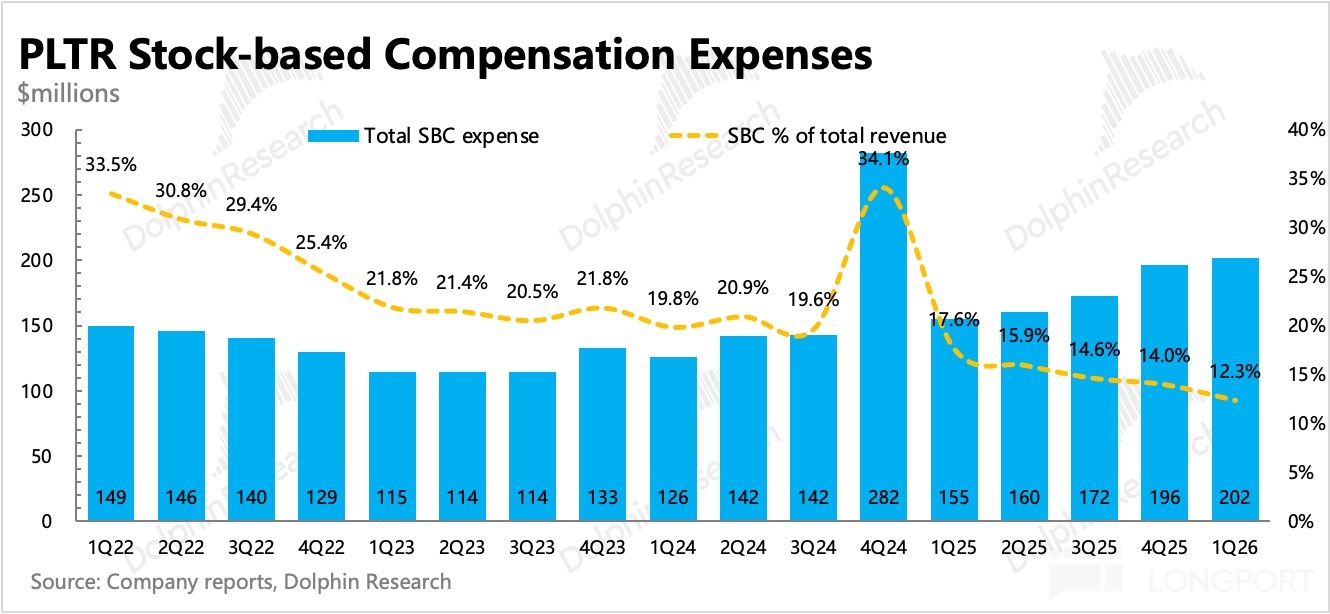
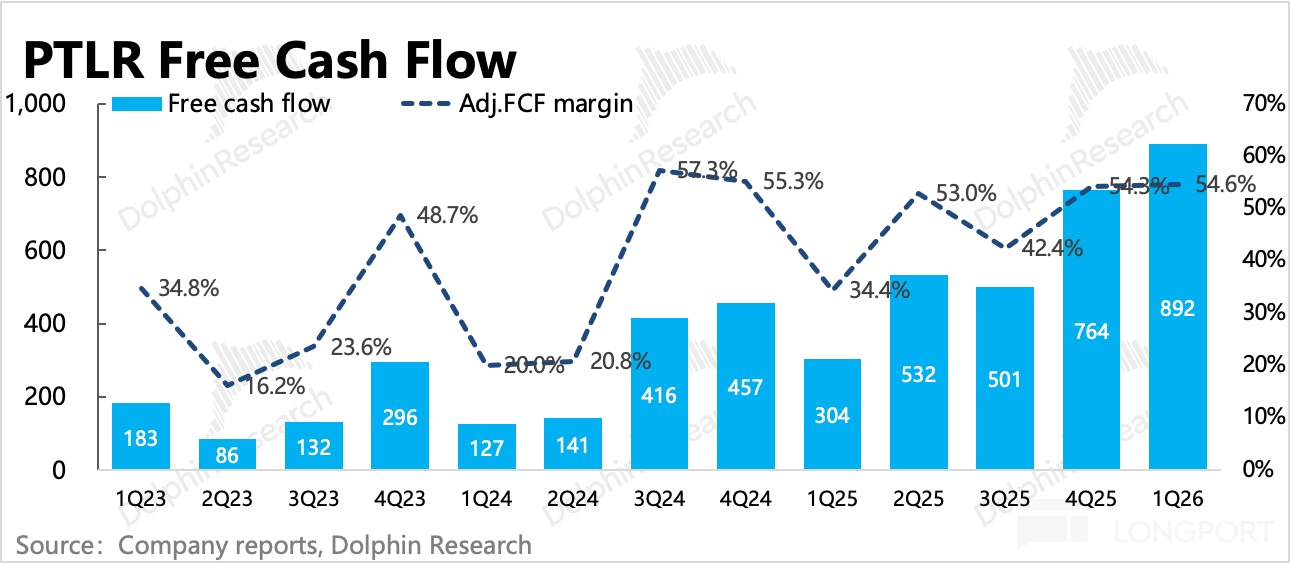
Cash flow can be seasonal given contract cash timing. With continued strong signings, Q1 FCF rose ~150% YoY; management guides FY FCF of $4.2–4.4bn, and cash plus ST investments stood at ~$8.0bn at quarter‑end.
<End>
Dolphin Research on ‘Palantir’ — archive:
Earnings calls/notes
Feb 3, 2026 call notes ‘Palantir (Trans): from ‘dispelling doubts’ to ‘demand acceleration’ in two years’
Feb 3, 2026 post‑earnings take ‘Palantir: another hard‑hitting print — can the AI apps leader retake its peak?’
Nov 3, 2025 call notes ‘Palantir (Trans): beyond single use‑cases toward systems‑level redesign’
Nov 3, 2025 post‑earnings take ‘Palantir: valuation too far ahead — payback time?’
Risk disclosure & disclaimer: Dolphin Research disclaimer and general disclosures


The copyright of this article belongs to the original author/organization.
The views expressed herein are solely those of the author and do not reflect the stance of the platform. The content is intended for investment reference purposes only and shall not be considered as investment advice. Please contact us if you have any questions or suggestions regarding the content services provided by the platform.