


How to hedge against downside risks amid a crazy rally?

"If the probability of an event occurring is very small, then once it does occur, the consequences are bound to be catastrophic."
Although this statement seems quite inappropriate in the recent market conditions, what I, Xuebajun, want to say is that unpleasant words always appear when the market is at its most exuberant. The sharp rises and falls in the US stock market over the past two years, while the turning points are difficult to predict, the magnitude of the decline after the turning point is surprisingly consistent. Especially during a continuous uptrend, the accumulated trading risk becomes greater and greater. It's hard for us to predict when a downturn will occur during an uptrend, but once it does, how should we hedge the risk in advance?
Rather than losing sleep at high prices, it's better to take the initiative. Today, Xuebajun will introduce several strategies to hedge against downside risk.
1. Protective Put (Protective Put Strategy)
While holding a stock, you also buy a put option. If the stock price falls, the stock position incurs a loss, but the put position generates a profit, thereby hedging the loss from the decline. For example, take the recently popular semiconductor sector.
Suppose an investor holds 100 shares of SOXL at $180. To hedge against downside risk, they can buy a put option with a strike price of $180. No matter how much the stock price falls, the time value profit from the put can perfectly hedge the loss of these 100 shares. However, note that buying this put has a cost. Assuming the put expires on May 15th, the latest market price is $835. That means we need to spend $835 to buy this put.
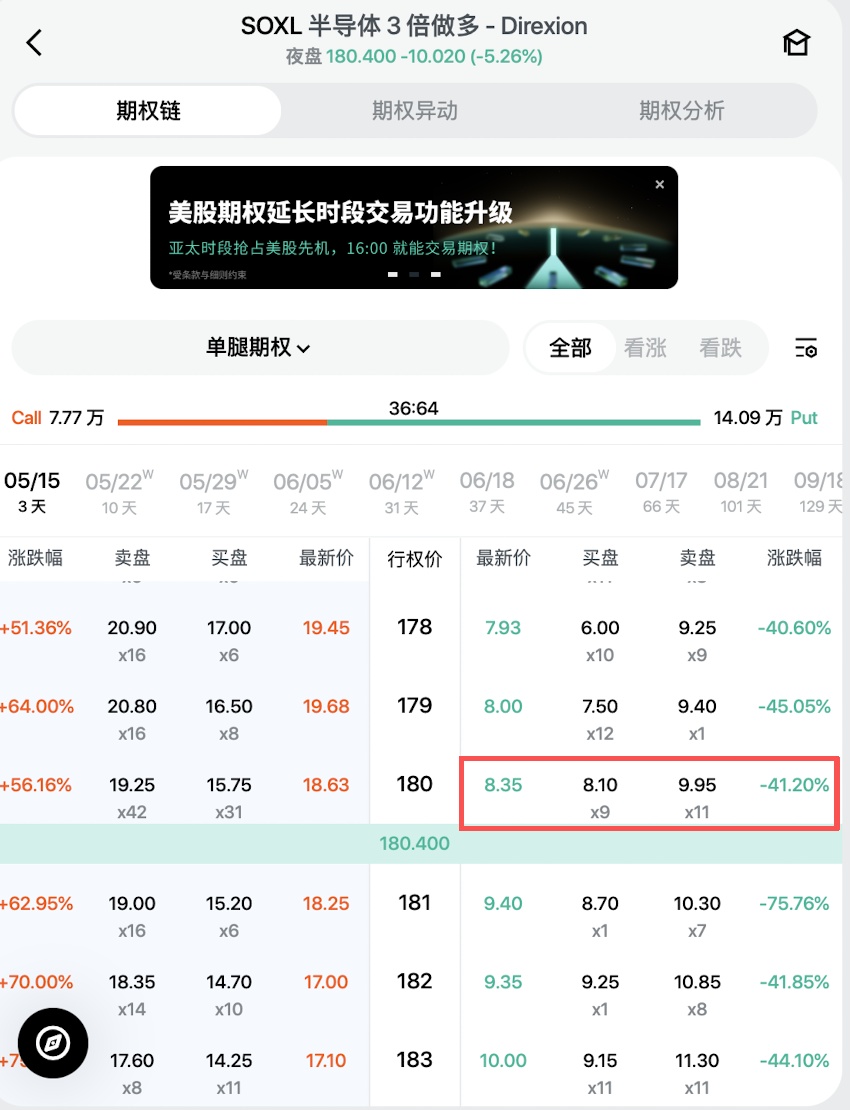
Therefore, the profit and loss curve of this combination is as follows: when the stock price is below $180, the put provides downside protection. No matter how low the stock price falls, our loss is always capped at $835. However, when the stock price rises, the profit from the stock can increasingly cover the premium paid. So, for the part above $180, the profit curve slopes upward.
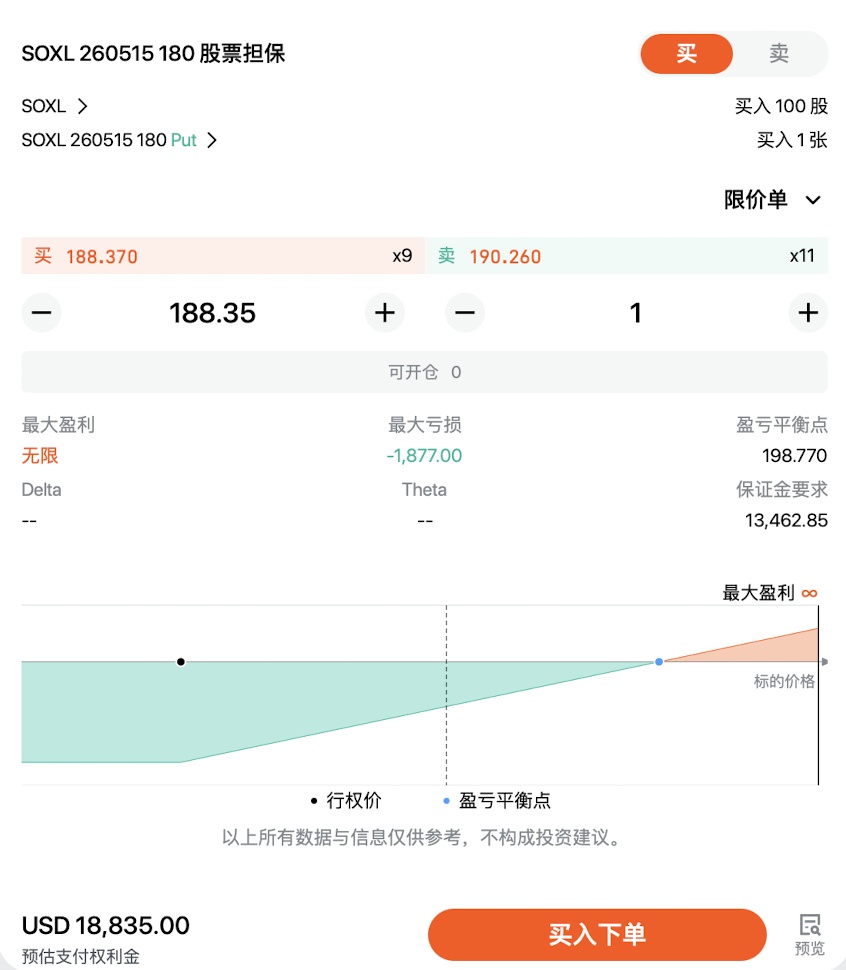
The biggest advantage of this strategy is that it's like buying insurance for the stock. The premium paid for the put is the insurance fee. The maximum loss for the entire portfolio is limited to the $835 premium.
However, many investors feel this downside protection method is too costly. Assuming the current stock price is $180, an $835 premium means the stock price needs to rise from $180 to $188.35 just to break even. In other words, for holding 100 shares, buying one put already creates a 6% sunk cost. Intuitively, the cost is indeed high. So, are there methods to relatively reduce hedging costs?
There really are. We can use another ultra-low-cost hedging strategy: the Vertical Put Spread.
2. Vertical Put Spread Strategy (Vertical Put Spread)
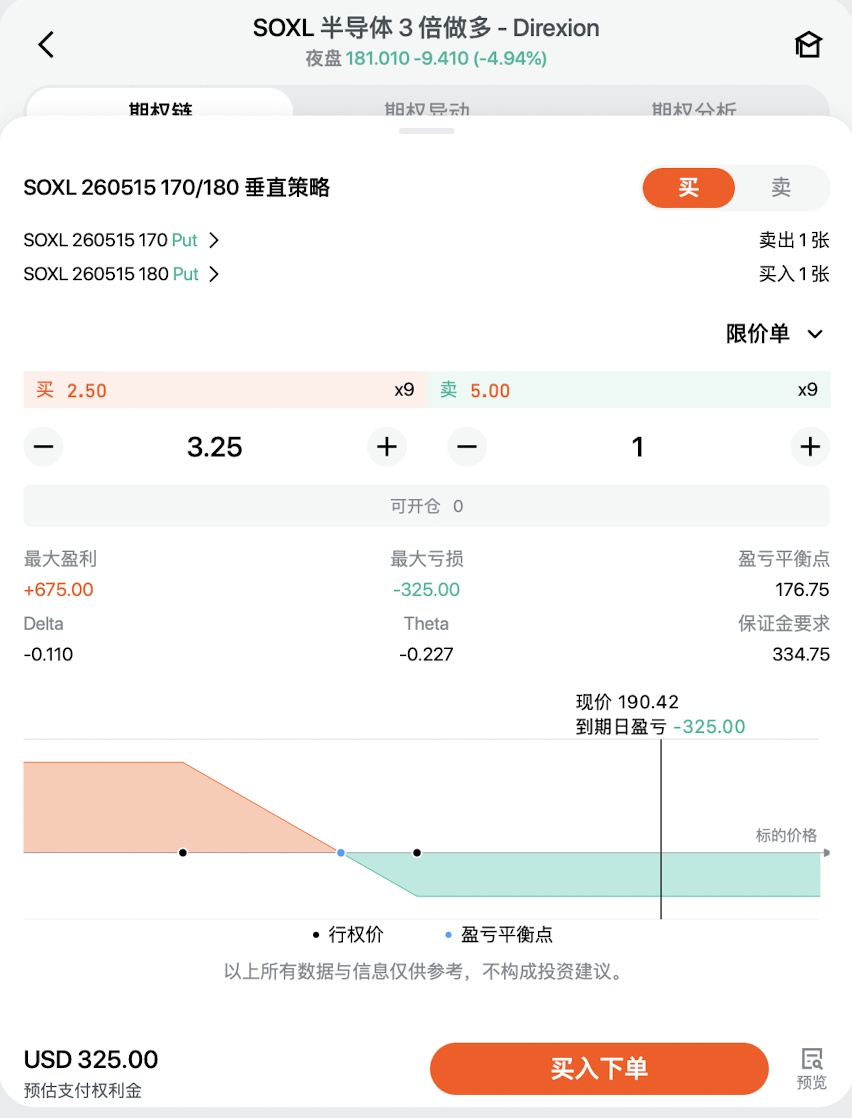
Again using SOXL as an example, while holding 100 shares, we can buy a put with a strike price of $180 and simultaneously sell a put with a strike price of $170. This reduces the premium paid to $325. If the stock price falls, as long as it doesn't break below $170, this combination can still completely hedge the loss from the decline. If the stock price rises, we only need it to rise to $183.25 to break even, far less than the cost of building a protective put directly at $180. Of course, compared to the former, the hedging space of this strategy is limited. Once the stock price falls below $170, the vertical spread cannot further hedge the loss from the stock price decline.
3. Going Long on the VIX Fear Index
Long-term experience proves that the correlation coefficient between the VIX index and US stock market movements is around -0.7 to -0.9. Especially when stock indices plummet, the negative correlation is even stronger. The biggest benefit of using the VIX index for hedging is that this negative correlation is not constant.
On about 20% of trading days, VIX and the stock index actually move in the same direction. Typically, the negative correlation is strongest in the early stages of a market crash (panic drives VIX higher), while it weakens during a slow-rising bull market. Furthermore, this correlation is asymmetric: the magnitude of VIX's rise when the stock market falls is far greater than its fall when the stock market rises.
Therefore, when constructing a hedging strategy, this strong negative correlation can be utilized. Secondly, because the performance difference between VIX and the stock index in extreme and flat market conditions is not completely symmetrical, it can also largely prevent the VIX from causing significant profit erosion for the entire portfolio if the stock price continues to rise.
In practice, products linked to the VIX index are mainly VIX ETF funds, such as UVIX (2x Long VIX Short-Term Futures ETF).
Let's assume a calculation using UVIX to hedge 100 shares of QQQ:
Same logic, but with 2x leverage:
QQQ falls 1% → VIX short-term futures rise about 3% → UVIX rises about 6% (2x leverage).
100 shares of QQQ ≈ $71,100 position, a 1% drop loses $711. UVIX rises 6%, at $5.45 per share, that's about a $0.33 increase per share. To hedge the $711 loss, we need 711 ÷ 0.33 ≈ 2,150 shares of UVIX, about $11,700, equivalent to 16.5% of the position.
However, if using UVIX to hedge, we need to note that
UVIX is essentially a futures ETF and is 2x leveraged, meaning using UVIX for hedging requires bearing both contango decay and volatility decay simultaneously.
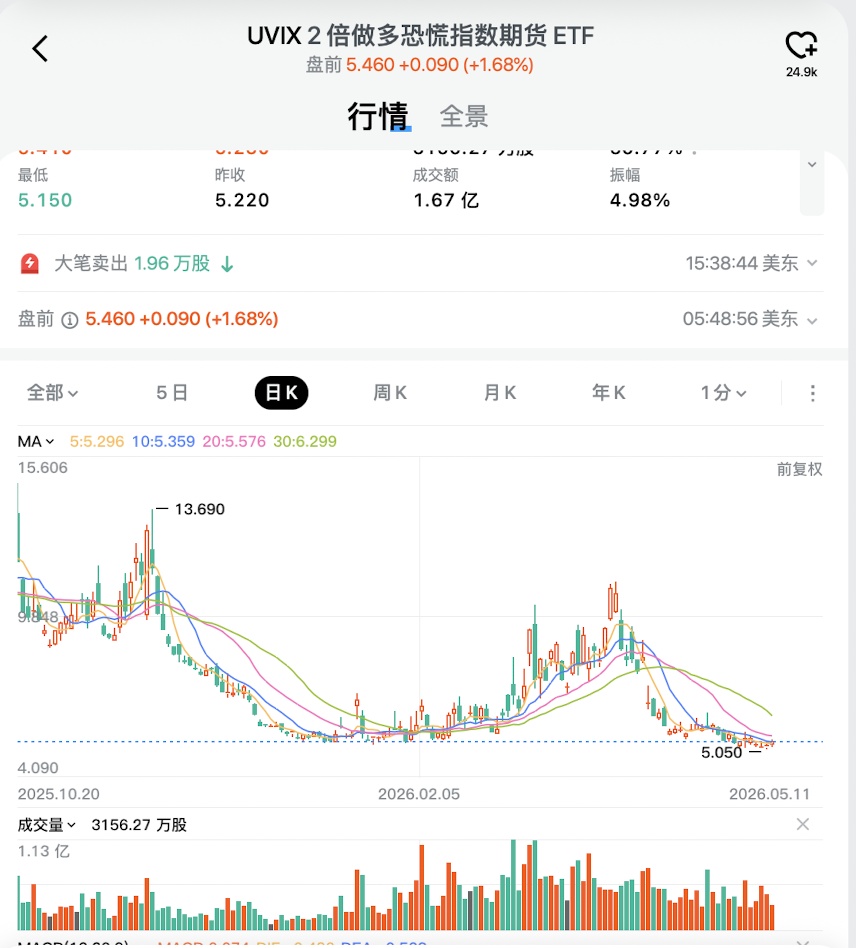
This point is very intuitive when looking at the price chart—from last October to now, grinding from near $13 down to around $5, losing nearly half in over half a year, while during this period, the VIX index's trend was actually a rising wave. This is purely structural decay eroding the principal.
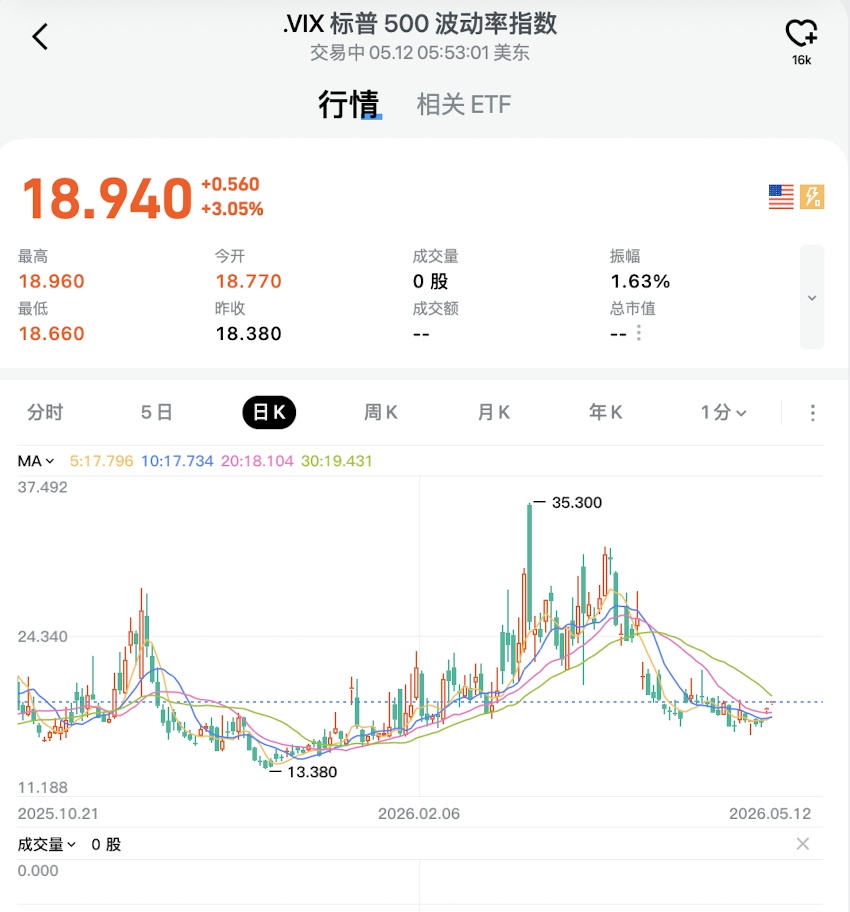
So the conclusion is: UVIX is suitable for short-term directional bets over a few days (like anticipating a short-term sharp drop), but not suitable as a long-term hedging tool for holdings. Its long-term decay rate will cause significant erosion while you wait for a black swan event.
Alright, that's all for today's sharing. Feel free to ask any questions in the comments section. Also, friends who are interested in options investment or want to learn more details are welcome to check out the latest Options Introduction and Trading Practical Course newly launched on Longbridge Academy.
The copyright of this article belongs to the original author/organization.
The views expressed herein are solely those of the author and do not reflect the stance of the platform. The content is intended for investment reference purposes only and shall not be considered as investment advice. Please contact us if you have any questions or suggestions regarding the content services provided by the platform.
