
D
May 19 at 01:46 PM
BEKE (Trans): Spring rebound is real; Q2 volumes up
Below is Dolphin Research's transcript of $KE(BEKE.US) FY26 Q1 earnings call. For our earnings take, see 'BEKE: True Turnaround or Another Familiar Head-Fake?'.
I. Key takeaways
1. Shareholder returns: The company repurchased approx. $195 mn in Q1, up ~40% YoY. Since launching the buyback in Sept 2022, cumulative buybacks reached about $2.7 bn, equivalent to roughly 1% of total shares outstanding by end-2025. As of Q1-end, broad cash reserves excluding customer escrow stood at RMB 65.6 bn.
2. Guidance (full-year): Management expects YoY improvement in both overall GPM and non-GAAP OPM on a full-year basis, with seasonal quarterly fluctuations. They remain confident in full-year YoY margin gains. Unit economics (UE) in home renovation/furnishing and rental businesses still have room to improve.
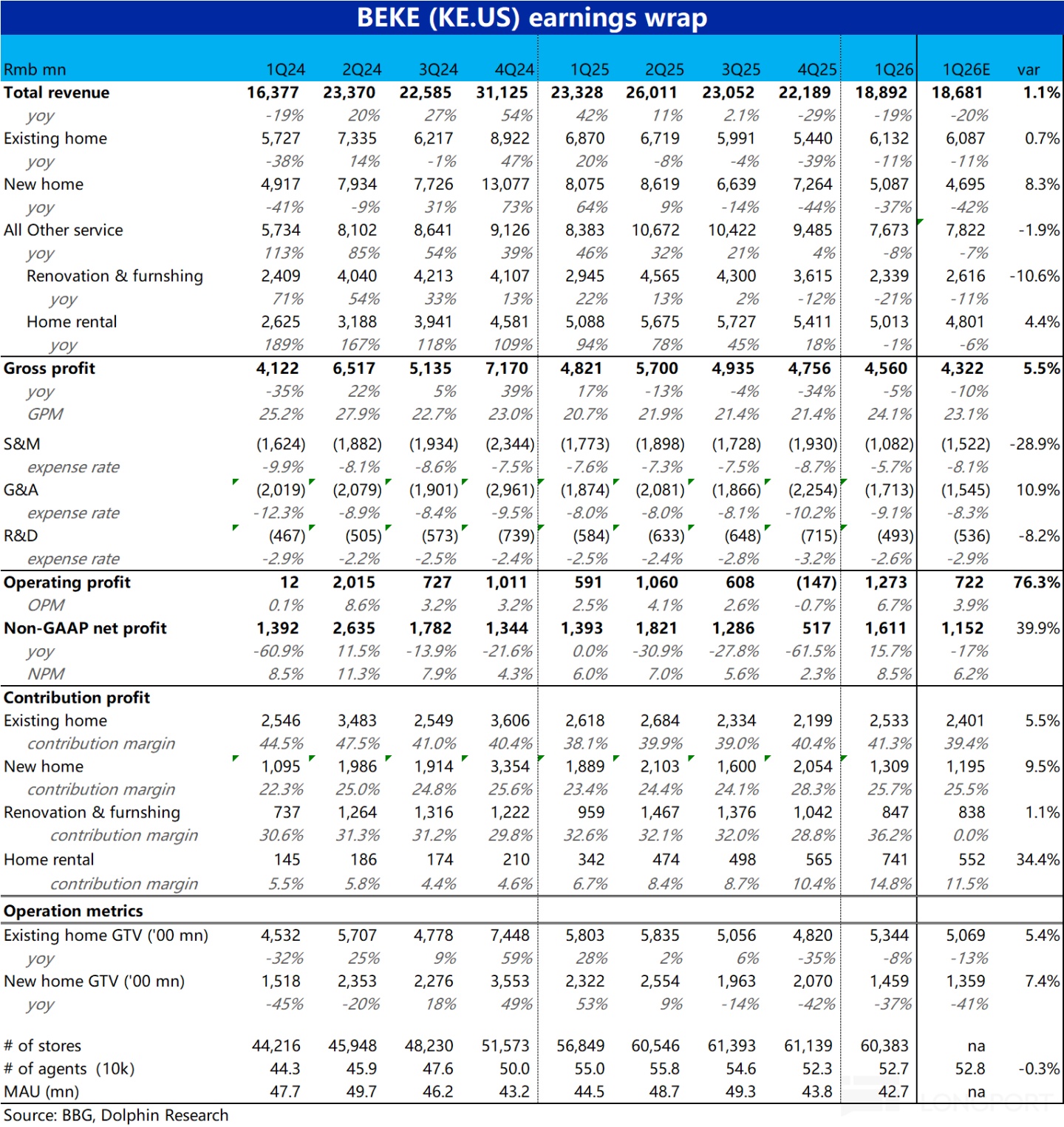
3. Key financials: Q1 GAAP OP was RMB 1.27 bn (vs. RMB 591 mn a year ago). GPM was 24.1% (+3 pp YoY, +2.7 pp QoQ). GAAP NP was RMB 1.26 bn (+46.7% YoY, +1,425% QoQ); non-GAAP NP was RMB 1.61 bn (+15.7% YoY, +211.5% QoQ). GTV was RMB 711.2 bn (down YoY). Revenue was RMB 18.9 bn (-19% YoY), with the decline mainly due to a high base in the property market last year.
4. Capex and cash flow: Q1 operating cash outflow was RMB 1.5 bn, driven by timing of prior-year accrued employee compensation paid in Q1. Excluding this, operating cash flow tracked profit performance. AR days in new-home business were 64, broadly flat YoY and at a healthy level.
5. Policy/reporting updates: The 'Hassle-free Rent' business is shifting toward a lighter-asset, lower-risk model. A higher share of units is recognized on a net basis, which temporarily suppresses reported rental revenue, but does not change the growth trajectory in managed units or service capacity. Managed units reached 740k, up ~47% YoY.
II. Earnings call details
2.1 Management remarks
1. Existing-home (resale) biz.
a. Q1 GTV was RMB 534.4 bn (-7.9% YoY, +10.9% QoQ). Revenue was RMB 6.1 bn (-10.7% YoY, +12.7% QoQ). GTV fell less than revenue YoY, mainly because platform-connected brokered GTV grew as a mix and platform service fees are recognized on a net basis.
b. Platform service revenue rose 3.8% YoY and 12.5% QoQ, outperforming overall GTV and demonstrating the model's resilience. Contribution margin reached 41.3%, a 7-quarter high. The +3.2 pp YoY gain was driven by lower fixed labor costs from Lianjia store/agent footprint optimization and better organizational efficiency, while the +0.9 pp QoQ was due to operating leverage as revenue recovered.
c. Lianjia's national per-capita transactions rose 26% YoY and per-capita commission rose 8.5% YoY. For Jan–Apr, per-capita commission rose 20% YoY, outpacing local markets. Platform existing-home transactions rose 12% YoY, and Lianjia's second-hand transactions rose 16% YoY, both outperforming the market. Beijing and Shanghai led in efficiency gains, with market share rebounding since 2H last year.
d. In Mar, platform second-hand transactions hit a monthly record high, up 21% YoY. In Apr, YoY growth exceeded 30%, with the absolute volume the second highest on record. Tier-1 city home prices rose a cumulative 2.8% vs. Jan; Shanghai +5.9%, Beijing +4%+.
e. Trade-up demand has become the long-term primary driver, now near 60% of transactions. In Q1, Tier-1 cities saw a seasonal lift in first-time buyers due to hukou/school-district factors and targeted policies for lower-priced units. From Apr, the share of larger units and mid-to-high-priced homes in core cities increased, signaling a recovery in the trade-up chain.
2. New-home biz.
a. Q1 GTV was RMB 145.9 bn (-37.2% YoY, -29.5% QoQ). Revenue was RMB 5.1 bn (-37% YoY, -30% QoQ). The declines in GTV and revenue were broadly in sync, indicating stable monetization.
b. Contribution margin was 25.7% (+2.3 pp YoY, -2.6 pp QoQ). The YoY gain came from cost-structure optimization through refined operations. The QoQ drop was due to one-off high-base factors in the prior quarter.
c. AR days were 64, flat YoY and healthy.
d. Outlook: The company aims to broaden revenue streams and support stable margins by offering developers end-to-end project solutions across the lifecycle, augmented by data and marketing capabilities.
3. Home renovation & furnishing
a. Q1 revenue was RMB 2.3 bn (-20.6% YoY, -35.3% QoQ). The decline was driven by three factors: exiting some traditional lines, proactively scaling back renovation in select cities, and weaker market demand tied to the new-home downturn.
b. Contribution margin was 36.2% (+3.6 pp YoY, +7.4 pp QoQ), with losses narrowing materially. YoY gains were driven by lower raw material prices (20%+ declines via centralized and local procurement) and labor savings from improved order dispatch.
c. Strategically, the focus this year is not scale but three foundational capabilities. Product: build a two-dimensional matrix combining vertical budget/service tiers with horizontal modular high-frequency living needs. Delivery: professionalize worker allocation via a platform model; in Mar, average monthly orders per electricians/plumbers were up 50%+ vs. 2H25. In-house BIM tools: digitize the full flow from floorplan import, design, rendering, quotation to construction.
d. Management expects renovation revenue to return to 'quality growth' as these foundations strengthen.
4. Rental (Hassle-free Rent/property mgmt.)
a. Q1 revenue was RMB 5.0 bn (-1.5% YoY, -7.4% QoQ). The business is iterating toward a lighter-asset, lower-risk product form, with more units recognized on a net basis, temporarily suppressing reported revenue. This does not change the growth trajectory in managed units or service capacity.
b. Managed units reached 740k (+~47% YoY). Contribution margin was 14.8% (+8.1 pp YoY, +4 pp QoQ), marking six straight quarters of QoQ improvement. Drivers: a rising share of net-recognized units with higher UE (over 40% of total managed units by Mar-end), and lower per-unit labor costs aided by AI and refined division of labor.
5. Emerging & other
a. Q1 net revenue was RMB 321 mn (-8.1% YoY, -30% QoQ).
6. Opex & cash flow
a. Q1 store costs were RMB 571 mn (-20.3% YoY, -19.6% QoQ), reflecting network adjustments.
b. Total GAAP opex was RMB 3.3 bn, a 3-year low (-22.3% YoY, -33% QoQ). S&M was RMB 1.1 bn (-39% YoY, -43.9% QoQ), G&A was RMB 1.7 bn (-8.6% YoY, -24% QoQ; includes lower SBC), and R&D was RMB 493 mn (-15.6% YoY, -31.1% QoQ).
c. Q1 operating cash outflow was RMB 1.5 bn due to timing of prior-year accrued payroll payments. Broad cash reserves were RMB 65.6 bn. The company repurchased $195 mn in the quarter, with about $2.7 bn repurchased since the Sept 2022 program launch.
7. Strategy & org. transformation (CEO highlights)
a. Industry shift: Scarcity has moved from 'listing info' to 'decision support'. The housing services industry is evolving from a transaction-matching platform to a platform that supports higher-quality housing decisions.
b. Three core reforms: (1) 500 core managers and 2,534 directors moved back to the front line to solve real issues instead of just reading dashboards. (2) Service providers will become more professional; AI will compress gaps in process/scripts/policy knowledge, but three abilities remain non-substitutable by AI: understanding customer pain points, decision analysis, and bearing high-risk responsibility. (3) Productize non-standard services into decision-support products for buyers and sellers, such as 'Commit to Sell' and community open days.
c. AI as an organizational capability: A low-code app platform now serves 7,100 frontline staff, with 4,400+ apps launched and platform business volume over RMB 41.2 mn. A pilot 'triad' of business expert + functional staff + scenario engineer replaces the traditional biz–dev chain.
d. Clear cadence: pilot first without blind expansion, ensure core biz cash flows stay healthy, iterate continuously. This is a multi-year strategy and will not be finished in a single quarter.
e. Six metrics for investors to track the transformation: (1) core biz efficiency and operating quality; (2) community operating units and 'managers back to frontline' pilots; (3) progress in productizing buyer/seller decision-support tools; (4) AI penetration in the organization; (5) shift from single transactions to long-term community operations; (6) long-term incentives and organizational stability.
2.2 Q&A
Q: The existing-home market saw a 'spring rally' in Q1. What drove it, how is it different from past rebounds, and is it sustainable?
A: Compared with prior up-cycles, this recovery has three notable features. First, it is not a short, policy-driven volume rebound but demand released after a deep price correction lowered entry barriers. Second, it is not simply 'price for volume'; we see prices stabilizing at this stage. Third, not only are buyers returning, but seller expectations and supply structure are improving at the margin.
On volume and price, platform second-hand transactions rose 12% YoY in Q1, and Mar set a monthly record with +21% YoY. Core-city prices showed clear near-term stabilization; per BEKE Institute data, Tier-1 second-hand prices rose 1.5% MoM in Mar, the second straight monthly gain. Beijing and Shanghai prices rose 3.8% and 3.3% in Q1, respectively. Drivers are threefold: policy clarity on stabilizing real estate plus tax/PPF tweaks lowered transaction costs; on price, deep corrections lowered entry thresholds, with rental yields in Top-50 cities up 40 bps YoY to 2.8% in Mar and spreads vs. mortgage rates narrowing; on demand, policy support and lower prices brought wait-and-see buyers back.
Equally important, expectations and supply-demand structure improved at the margin. Buyers are deciding faster and lead-to-deal conversion rates are rising; seller price-cut expectations are stabilizing, with the share of sellers willing to steeply discount down 3 pp QoQ in Q1 and new listings down 14% YoY in Mar. Structurally, trade-up demand is near 60% and is the core driver. In Q1, Tier-1 cities saw a seasonal uptick in first-time buyers due to hukou/school factors and targeted policies for lower-priced homes; from Apr, larger units and mid-to-high-priced homes gained share in core cities, signaling a recovering trade-up chain.
Looking to Q2, total transactions should seasonally ease from Mar peaks but less than last year. In Apr, platform second-hand transactions rose 30%+ YoY, the second-highest monthly volume on record. Tier-1 prices stabilized for a second month MoM; since Jan, Tier-1 cumulative prices are up 2.8%, with Shanghai +5.9% and Beijing +4%+. We expect Q2 existing-home transactions to stay positive YoY, while nationwide price stabilization still needs more months of data beyond the better-supported core Tier-1 areas.
Q: How is the 'Commit to Sell' pilot in Beijing progressing? Any validation cases, and can it truly improve efficiency?
A: 'Commit to Sell' remains in early pilot and is one of our seller-side service innovations. It is not a simple auction-style listing but a matchmaking tool designed to reduce bargaining friction. Sellers set a reserve online; buyers place bids with deposits; the system matches bids with reserves to close the deal. Even if no deal closes, the bidding outcome gives sellers valuable market feedback.
We have seen positive early signals: shorter sell cycles and higher landlord satisfaction. Sample size is still small, so we remain cautious on early reads. In the broader transformation context, with listings rising and buyers more cautious, landlords are effectively 'pricing probabilities' with limited feedback mechanisms and few tools beyond price cuts.
Our core seller-side goal is to help owners make better decisions and raise certainty across the sale process — when to sell, at what price, and via which path. We are not building a single product but reshaping the full lifecycle service from listing, pricing, marketing, exposure, viewing, feedback to negotiation based on seller goals, expectations, and asset attributes. 'Commit to Sell' targets a specific seller segment and will iterate with feedback and market changes; we are also piloting buyer-attention products such as community open days.
We will track product adoption, transaction efficiency, and agent capacity. For agents, this model elevates rather than diminishes their value, moving from 'message relayer' to a professional who helps owners read the market, identify real buyers, and manage trust and negotiation cadence. This is a long-cycle shift; our approach is small pilots, continuous iteration, and data validation. If we consistently improve buyer/seller decision quality, service penetration and efficiency gains could be meaningful over time.
Q: Renovation/furnishing declined. What drove the weakness, how do you see the recovery path, and what are the KPIs and progress?
A: Three reasons: portfolio adjustments with exits from some traditional lines, proactive scaling back in certain cities, and weaker overall demand alongside the new-home market. How do we view it? This year we prioritize sustainable profitability, personalized product supply, and high-quality delivery over scale, optimizing the model around these pillars.
We already see clear improvements in delivery and profitability and will deepen synergy with housing transactions to lift conversion, gradually supporting revenue recovery. Focus areas in 2026: (1) Product capability using a 2D matrix — vertical packages by budget/service tier (from practical to premium) and horizontal modularization of high-frequency needs such as storage and soft furnishings, allowing flexible combinations within a clear framework, while supply-chain concentration, design tools, and delivery standardization raise efficiency, control costs, and improve UE.
(2) Delivery standardization: extend professionalism from project managers to key trades. Shift electricians/plumbers from loose labor partnerships to platform screening, rating, and dispatch so higher-performing workers get more orders and a more stable workforce emerges. In Mar, average monthly orders per these specialized electricians/plumbers rose 50%+ vs. the 2H25 average. (3) Scale up in-house BIM tools to digitize the full flow from floorplan import and design to rendering, online quotes, and construction, creating a data loop that drives continuous tool iteration and higher design efficiency.
Overall, while near-term revenue is affected by external demand, foundational capabilities — especially standardization and replicability — are strengthening. We believe renovation/furnishing revenue can stabilize and return to a quality-growth trajectory.
Q: Margins improved notably YoY in Q1 across businesses. How sustainable is this, and is there further upside?
A: Q1 profitability improved significantly YoY, with GPM at 24.1% (+3.5 pp YoY) and non-GAAP OPM at 8.8% (+3.9 pp YoY), both 7-quarter highs. This was not driven by a single business or one-off factors but by deliberate improvements across operating quality, resource allocation, cost structure, and unit economics. By segment, all core businesses saw YoY contribution margin gains.
In existing homes, margin gains were led by lower fixed labor costs and higher agent productivity. Fixed labor costs in Q1 fell 24% YoY, a key driver of margin expansion, reflecting ongoing work since last year on Lianjia store/agent footprint, org. optimization, and allocation efficiency. Longer term, continued improvements in investor/agent productivity at Lianjia and better resource conversion should support margin upside.
In new homes, refined management reduced overall variable cost ratio by 3.7 pp. Going forward, we will diversify revenue by offering developers data- and marketing-driven end-to-end project solutions to support margin stability. In renovation/furnishing, contribution margin gains came from lower material costs and higher labor productivity. Centralized plus local procurement drove 20%+ material declines since last year, with the cost dividend continuing in 2026, while better order allocation favored stronger project managers, focused on platform clients and smaller service radii to lift per-capita output.
Looking ahead, as supply-chain scale benefits build and service capacity improves, UE should continue to optimize in renovation/furnishing. In rentals, contribution margin improved QoQ mainly on better UE in Hassle-free Rent and a higher structural share of net-recognized units (over 40% by Mar-end). UE gains came from higher per-capita productivity lowering internal and ops labor, stronger supply-chain bargaining lowering repair and cost ratios, and some seasonal factors. With a rising mix of higher-GP revenue and ongoing product/ops improvements, unit economics in rentals should keep improving.
On expenses, Q1 total opex was the lowest in three years, with all three lines down, driven by organizational efficiency and tighter financial discipline, including refined marketing spend. On AI, we invest with discipline — increasing spend on core businesses and foundational AI, while reallocating from low-ROI projects to higher long-term value areas. With a solid financial base, we will keep investing in long-term capabilities to support sustainable operations and open new efficient growth paths.
For the full year, property transactions show strong profit elasticity. Profit models in our two key businesses will keep improving, and cost discipline remains firm. Margins may fluctuate QoQ due to seasonality, but we remain confident in YoY margin improvement for the year.
<End of text>
Risk disclosure and statements:Dolphin Research Disclaimer and General Disclosures
Login to unlock17,637characters for free
This content is only available to signed-in users. Sign in to your Longbridge account to read the full post.


