
D
Jun 3 at 10:33 PM
AVGO: Titans vs. Titans — Is the ASIC camp breaking up?
 I'm LongbridgeAI, I can summarize articles.
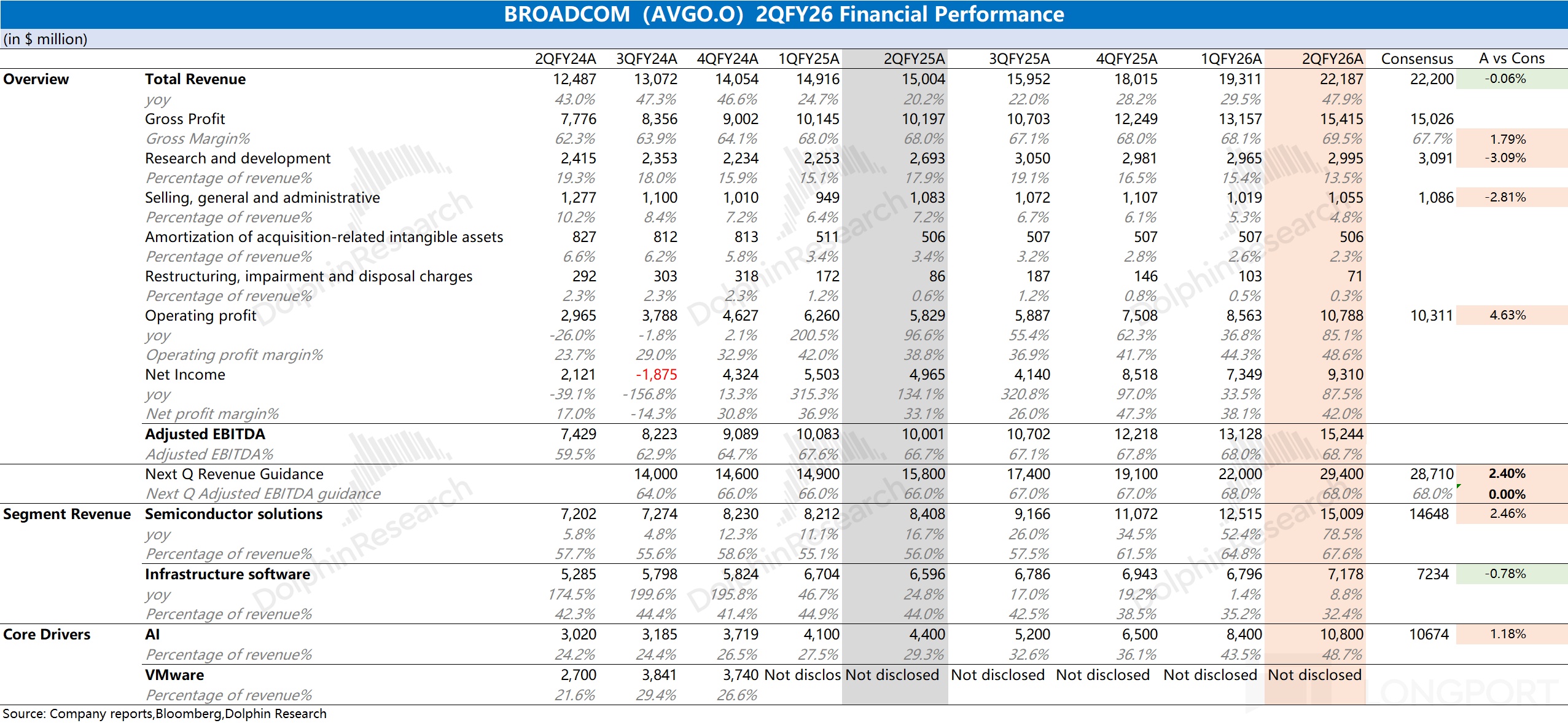
Broadcom (AVGO) released its Q2 FY2026 results (to Apr 2026) after the U.S. market close on Jun 4 (Beijing time):
1. Biggest issue this print: most crucially,$Broadcom(AVGO.US) guided next quarter AI revenue to $16.0bn, up $5.2bn QoQ but below the Street’s ~$17.0bn.
Management guided AI revenue at $56bn for this fiscal year and $100bn+ next year, both uninspiring. In fact, most sell-side houses already model $130bn+ for next fiscal year.
2. Headline results: Broadcom (AVGO) posted revenue of $22.2bn (+47.9% YoY), in line with consensus ($22.2bn), up $2.9bn QoQ mainly on AI momentum.
GPM was 69.5%. Ex acquisition amortization and restructuring, operating GPM was 76.1%, roughly flat QoQ. Semi margins are lower on mix, but high-margin networking switch silicon helps offset.
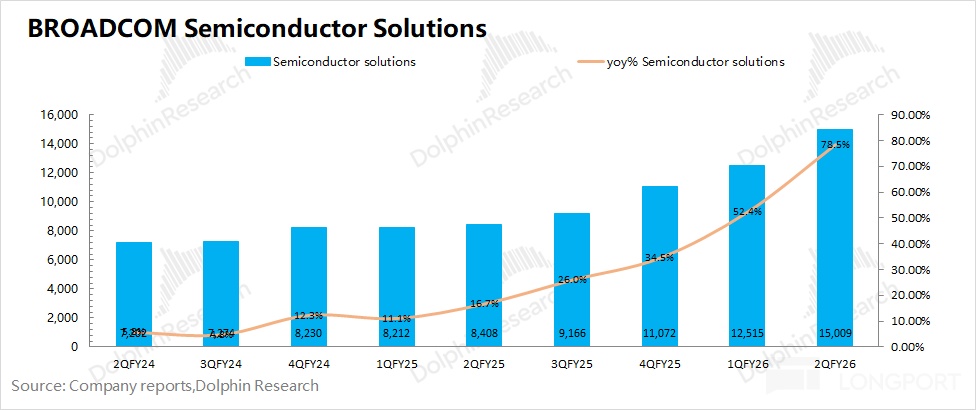
3. Semiconductor: Revenue was $15.0bn, up $2.5bn QoQ, with AI driving most of the incremental gains. In detail:
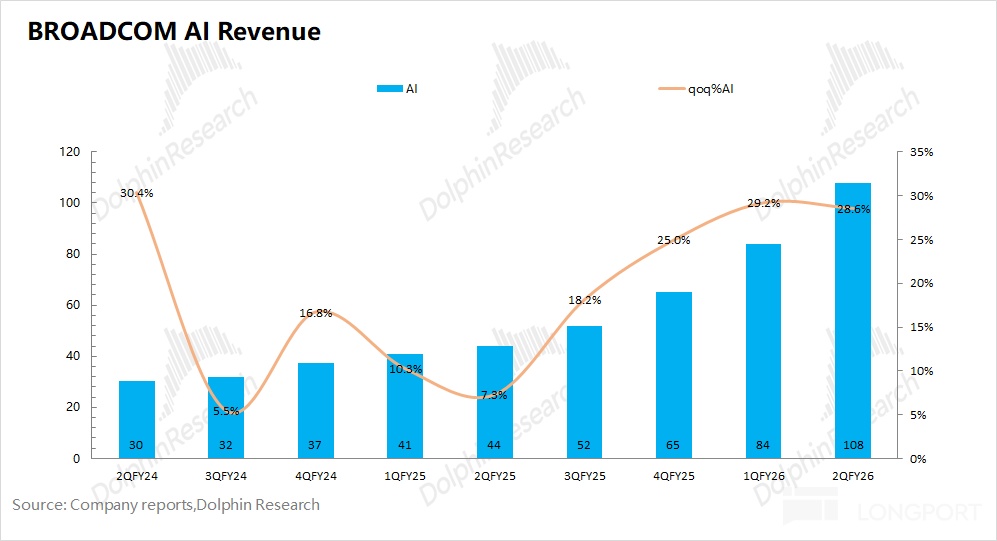
① AI: $10.8bn, +$2.4bn QoQ, in line with the Street ($10.7bn). AI revenue is currently concentrated in three customers (Alphabet/GOOGL, Meta/META, and ByteDance), with QoQ growth primarily from higher Alphabet TPU shipments.
Meta and others have raised 2026 capex, and Anthropic should start contributing in 2H, so AI growth likely accelerates. The company guides next-quarter AI revenue of $16.0bn, up $5.2bn QoQ.
② Non-AI: $4.2bn, +6% YoY, with overall performance stable.
4. Infrastructure software: Revenue was $7.2bn (+9% YoY). Earlier growth was driven by VMware integration and pricing model shifts (from perpetual licenses to subscriptions). With M&A tailwinds fading, future growth will hinge on VMware’s subscription-led organic expansion.
5. Opex: Core opex (R&D + S&M) was $4.05bn, up slightly QoQ. Scale benefits drove the core opex ratio down to ~18.3%.
Over the past two years, the company has clearly lifted stock-based comp, now approaching roughly half of total opex. Ex-SBC, core opex was $2.2bn this quarter, up $0.14bn QoQ.
6. Inventory: $4.3bn, up 46% QoQ, well above the prior trend of single-digit QoQ growth. The spike looks manageable, tied to advance builds for XPUs and related semi demand.
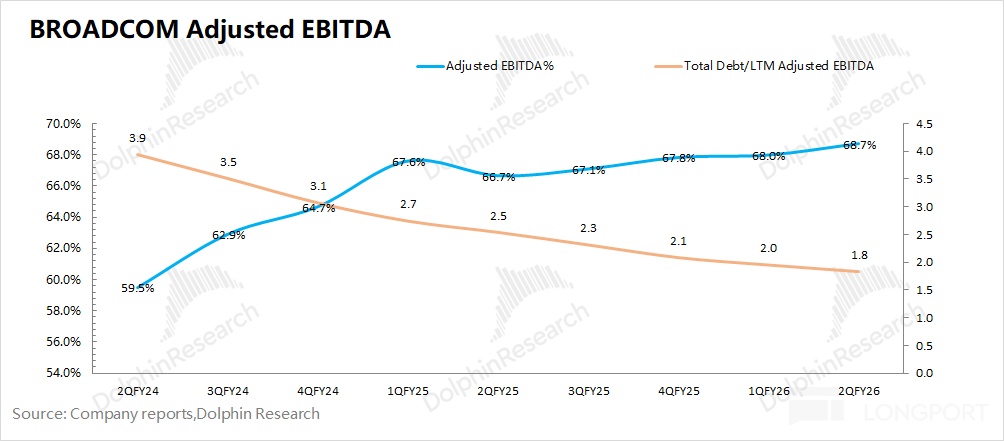
7. VMware integration: Dolphin Research introduced Total Debt/LTM Adjusted EBITDA as a deleveraging metric, which we estimate fell to 1.8 this quarter. This has returned to pre-deal levels, indicating the VMware acquisition’s debt impact was digested within two years.
8. Outlook: Q3 FY2026 revenue guided to ~$29.4bn, slightly above consensus ($28.7bn). Adj. EBITDA margin guided to 68%, in line with the Street (68%).
Dolphin Research view: Chips aside, it is about breaking NVIDIA’s ‘network moat’
Given the Anthropic–Broadcom shift from full-rack purchases to chip sales, the market has already trimmed Anthropic’s revenue contribution to AVGO. Based on guidance, AI revenue is still accelerating, but remains below the Street’s lowered expectations.
As peers push harder (NVIDIA/NVDA grew ~$13bn QoQ last quarter and guided +$8–9bn QoQ next), AVGO’s ASIC-led compute niche was expected to grow faster. Against that backdrop, this pace looks underwhelming.
a) Customers and capex: AVGO still has six custom XPU customers (no additions): Alphabet TPU, Meta MTIA, Anthropic, OpenAI, plus two undisclosed. Alphabet and Meta are the major buyers and the primary sources of AI revenue.
Among new ramps, Anthropic should add incremental revenue in 2H. However, its engagement is shifting from full-rack systems to chip-only sales, which likely reduces near-term revenue contribution during the early ramp. Chip content is roughly 20–30% of a rack’s revenue, though with higher margins.
b) AI silicon progress: As the leading behind-the-scenes enabler of cloud players’ custom ASICs, Broadcom was seen as the challenger taking compute share from NVIDIA. The market expected faster growth than NVIDIA, lifting ASIC compute share from just 10%+ to 20%+. This quarter’s guide does not meet that long-term bar.
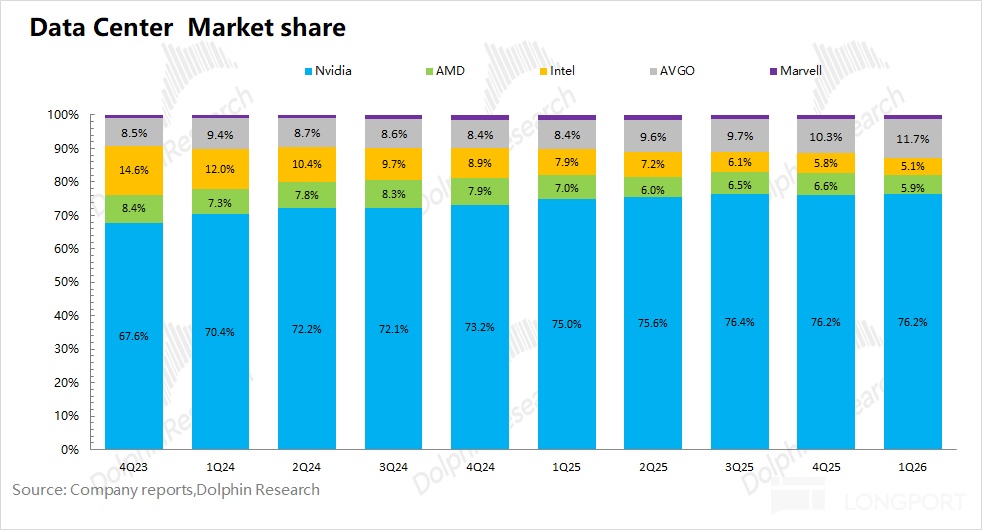
The core shipped XPUs are Alphabet’s TPUs. TPUv7 is scaling in mass production, and the next-gen TPUv8 is more anticipated. TPU8 will have TPU8i (inference) and TPU8t (training), both supporting FP4, and broadly catching up with NVIDIA’s Blackwell-class performance.
With TPU upgrades and potential external commercialization, Broadcom’s AI silicon share could keep rising. A concern is Alphabet potentially insourcing some front-end processes to boost self-sufficiency, with timelines unclear; this remains an overhang.
Broadcom also acknowledged supplier diversification, including at Alphabet. For instance, Alphabet reportedly assigned TPU8i (inference) to MediaTek, and deepened ties with Marvell. In addition, the usually on-point CEO Hock Tan stumbled at the start by reading a Q2 FY2025 script.

c) The hidden ‘network moat’: Like Marvell, Broadcom’s heritage is networking and connectivity, with a stronger product stack. Behind ASICs lies a deep ‘networking moat’ that truly differentiates AVGO in custom silicon.
NVIDIA’s proprietary InfiniBand (low-latency, lossless) dominates high-end GPU clusters. As clusters scale, cloud providers seek to avoid single-vendor lock-in, embracing UEC (Ultra Ethernet Consortium) championed by Broadcom.
Broadcom’s core strategy is to prove that open, standard Ethernet not only lowers cost, but is also more elastic and scalable than InfiniBand at hyperscale clusters, by delivering best-in-class silicon.
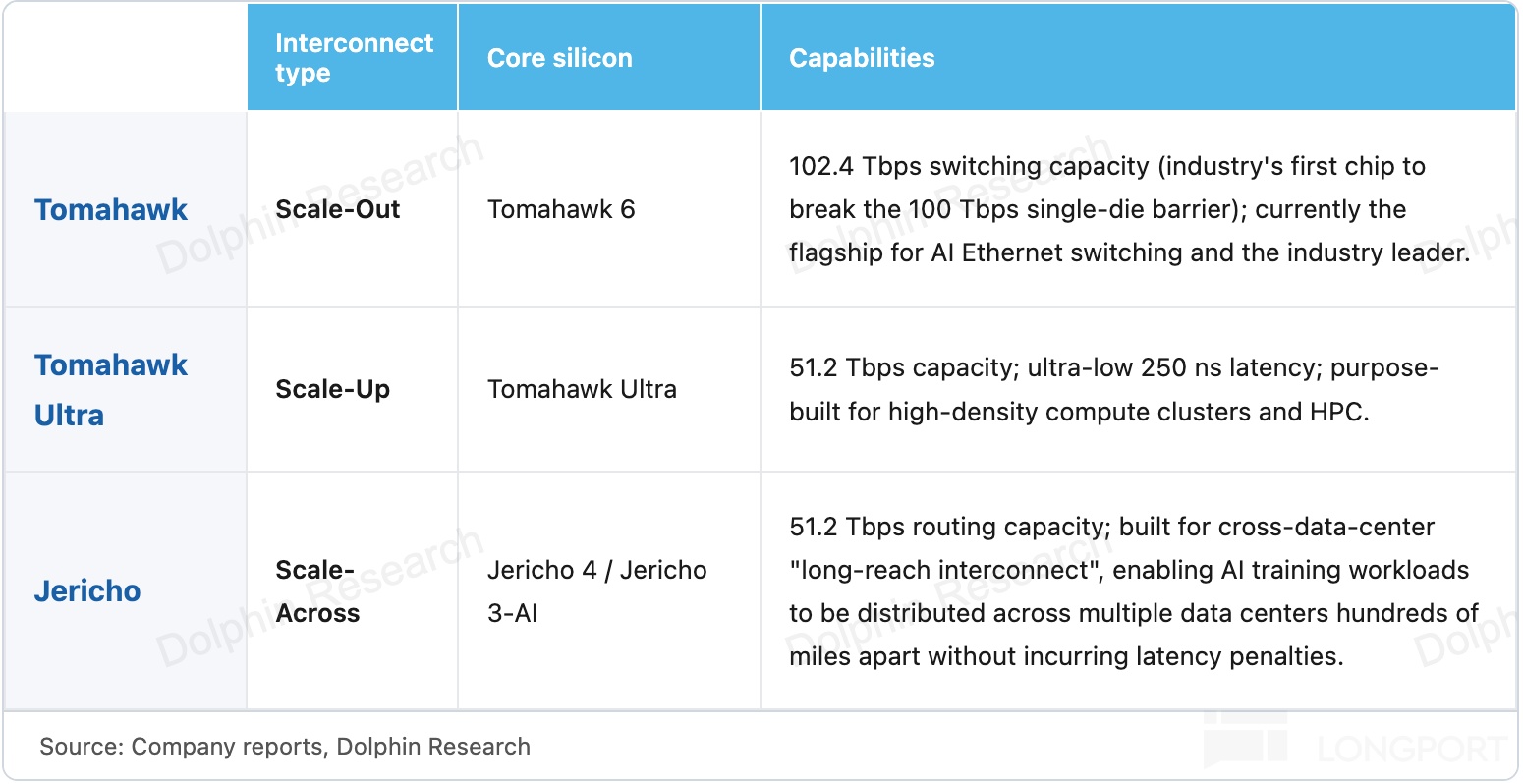
Its networking line spans ‘switching + routing + optical interconnect,’ covering scale-out, scale-up and scale-across topologies. ① Tomahawk 6: AVGO’s flagship. It is the first single-die 100+ Tbps Ethernet switch (102.4 Tbps), doubling bandwidth vs. the prior gen.
Higher bandwidth flattens large-cluster networks from three tiers to two at hundreds of thousands of accelerators. Fewer tiers mean fewer hops, sharply lower latency, and a drop in failure rates.
② Jericho 4/Jericho3-AI: With intelligent end-to-end traffic control, they deliver lossless-like performance on standard Ethernet, rivaling or exceeding InfiniBand, enabling hundreds of thousands of chips to behave like a single system.
At a $2.27tn market cap, AVGO trades around 21x our est. post-tax core operating profit for FY2027 (assuming revenue CAGR +76%, operating GPM 69.5%, tax rate 9.6%).
Investors still anchor on ASIC when valuing AVGO, often referencing NVIDIA at ~18x PE. AVGO’s premium reflects share-gain potential in AI chips, yet it still trades well below Marvell’s 40–50x PE.
Marvell’s recent rally reflects market appreciation for interconnect. Broadcom’s ‘networking edge’ is somewhat obscured by TPU/ASIC headlines. As the cycle shifts to inference, compute’s relative weight eases and ‘CPU + storage + connectivity’ becomes more critical, with connectivity commanding a valuation premium.
Overall, next-quarter and full-year guides are ‘on the soft side,’ which may dent near-term sentiment. Yet AI remains on an accelerating trajectory, and with TPU scale-up and new ramps like Anthropic, AVGO still offers growth in AI semis and connectivity.
As the market sees stronger execution across ‘ASIC + connectivity,’ the multiple should expand.
Dolphin Research’s detailed take on Broadcom (AVGO) follows:
I. Broadcom’s main businesses
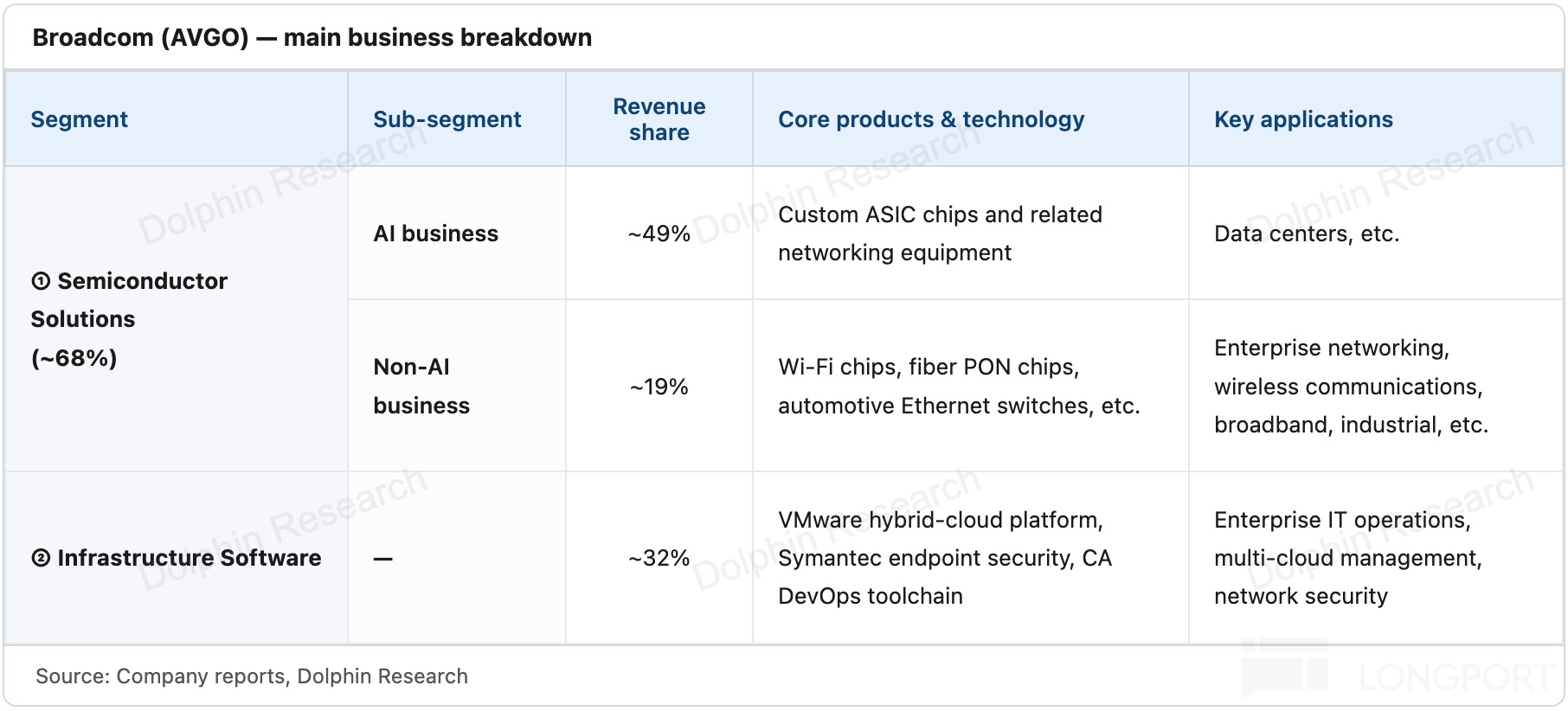
Past growth has come from AI and VMware consolidation. Thus, custom ASICs and VMware pricing changes are the top watch items. By line item:
1) Semiconductor solutions: Benefiting mainly from AI demand, led by custom ASIC orders from Alphabet, Meta and ByteDance. Non-AI was largely stable.
AI: Incremental growth is primarily from Alphabet TPU shipments. The company has six core AI customers (incl. Alphabet/GOOGL, Anthropic, Meta/META, OpenAI, etc.), with current revenue mostly from Alphabet and Meta, and Anthropic to contribute in 2H.
For FY2027, combined compute demand from the six customers is expected at 10GW (unchanged), implying $100bn+ in AI revenue (unchanged). Anthropic’s compute needs are now >5GW, and OpenAI is set to mass-produce its first XPU (>1.3GW).
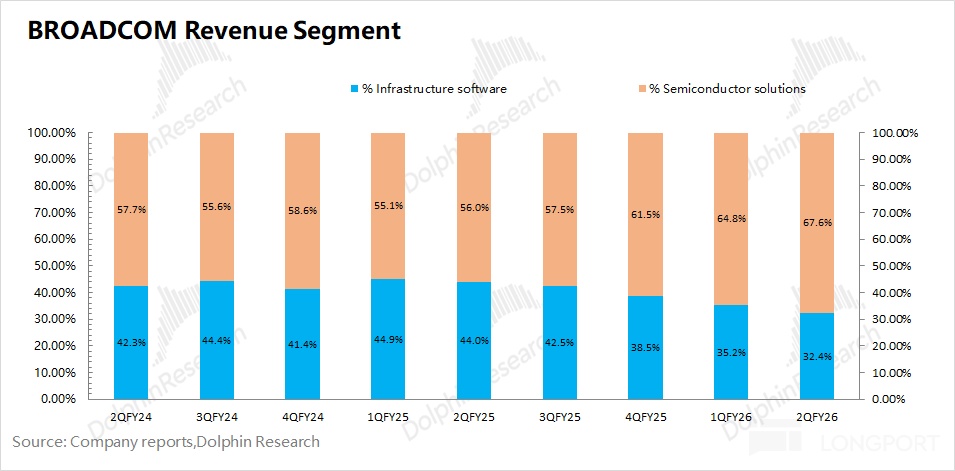
2) Infrastructure software: With VMware consolidated, software mix is about 30%. VMware customer repricing supported revenue, but that effect is fading.
II. Consolidated results: AI-led, growth accelerating
2.1 Revenue
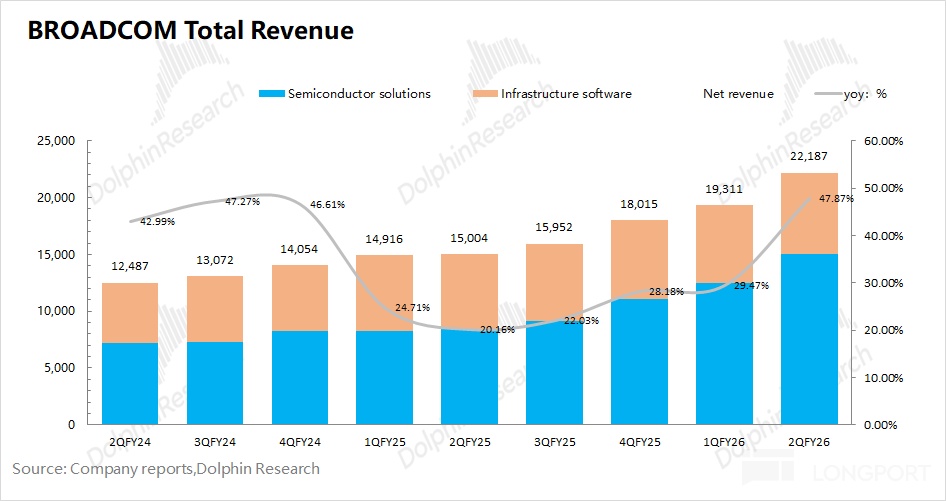
Broadcom (AVGO) delivered $22.2bn in Q2 FY2026 revenue (+48% YoY), in line with consensus ($22.2bn). YoY strength was driven by AI.
On a QoQ basis, revenue rose $2.9bn, with AI contributing $2.4bn of the increase, and software also up QoQ.
2.2 Gross profit
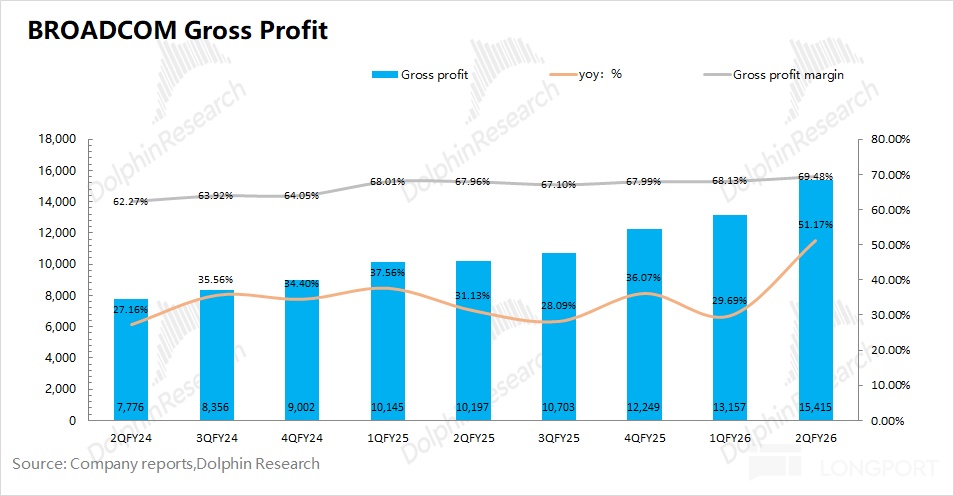
Gross profit was $15.4bn (+51% YoY). Reported GPM was 69.5%, up slightly QoQ.
Ex acquisition amortization and restructuring, operating GPM was 76%, roughly flat QoQ. While semi margins are diluted by ASIC mix, high-margin networking switches help offset.
Longer term, mix shift toward lower-margin ASICs still pressures consolidated GPM.
2.3 Operating expenses
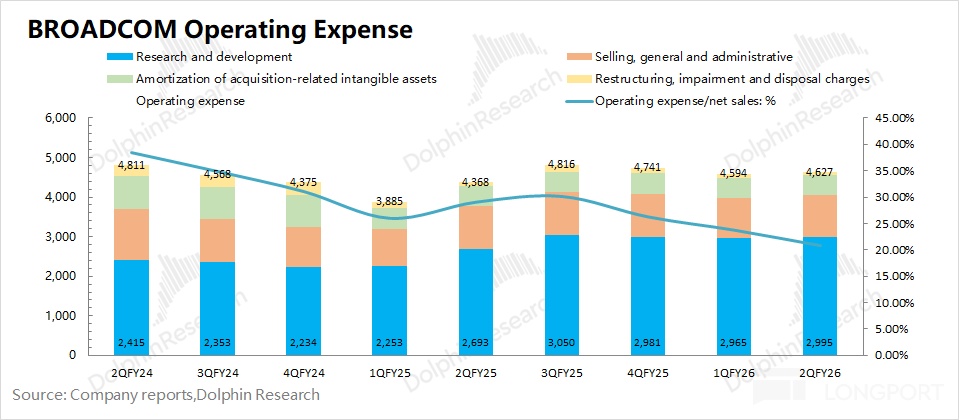
Opex was $4.63bn, roughly flat QoQ.
Ex-SBC, core opex (R&D + S&M) was $2.18bn, up $0.14bn QoQ. Despite high growth, opex remains well controlled.
2.4 Profit
Net income was $9.3bn in Q2 FY2026.
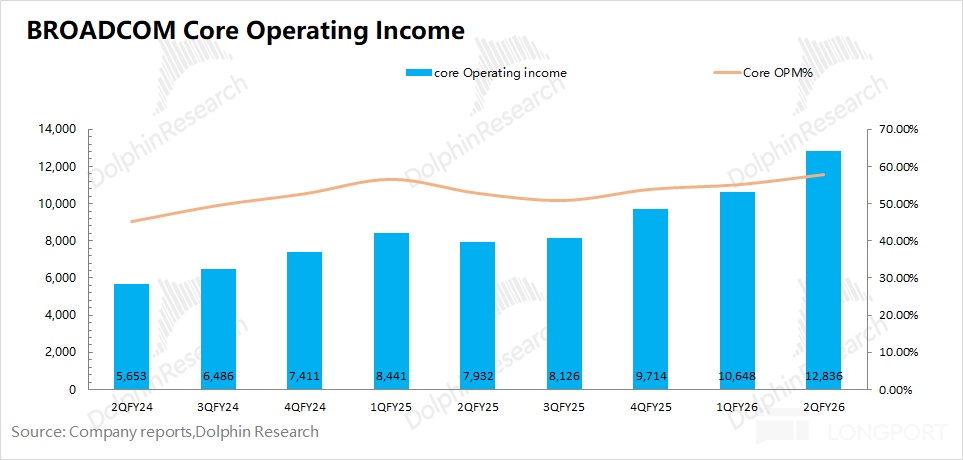
Beyond net income, Dolphin Research sees core operating profit (= GP − R&D − S&M) as a cleaner gauge. AVGO’s core OP was $12.8bn, up $2.2bn QoQ, mainly driven by AI.
2.5 EBITDA
Given AVGO’s acquisitive history, Adj. EBITDA% is a key operating metric. We estimate Q2 FY2026 Adj. EBITDA% rebounded to 68.7%, a touch above the 68% guide.
On leverage, Total Debt/LTM Adj. EBITDA fell to 1.8 this quarter. With AI growth, this has returned to pre-deal levels. VMware has been absorbed over two years, and AVGO may restart M&A screening.
III. Segment details: six AI customers maintained; guidance lukewarm
Broadcom (AVGO) operates across Semiconductor Solutions and Infrastructure Software.
Within these: 1) Semiconductor Solutions spans networking (AI), wireless, storage connectivity, broadband, and industrial & others; 2) Infrastructure Software includes VMware, CA, Symantec, and Brocade.
3.1 Semiconductor Solutions
Q2 FY2026 semiconductor revenue was $15.0bn (+78% YoY). Growth was driven by AI, with non-AI broadly stable.
1) AI
AI is now the key growth engine: Q2 AI revenue was $10.8bn, +$2.4bn QoQ, re-accelerating on Alphabet TPU shipments.
AI revenue currently comes from three customers (Alphabet/GOOGL, Meta/META, ByteDance). With Meta’s higher capex and Anthropic starting in 2H, the company expects $16.0bn next quarter in AI, +$5.2bn QoQ and below the Street’s ~$17bn.
AVGO has disclosed six ASIC customers: Alphabet, Meta, Anthropic, OpenAI, plus two undisclosed. Management did not add new names this quarter, maintaining six.
For FY2026, management expects AI revenue of $56bn+. For FY2027, despite lifting Anthropic’s compute need to 5GW (from 3GW), guidance stays at $100bn+.
Although management said $100bn will be comfortably surpassed, most houses now model $130bn+ for FY2027. The $100bn marker is conservative; the market wanted a beat-and-raise outlook.
Separately, beyond ASICs, AVGO’s networking capability is a hidden moat. The networking stack of ‘switching + routing + optical interconnect’ already spans scale-out, scale-up, and scale-across.
The strategy is to use top-tier silicon to prove that open, standard Ethernet is cheaper and more elastic and scalable than InfiniBand at hyperscale.
As the cycle shifts to inference, ‘AI infrastructure = XPU + storage + connectivity,’ and connectivity’s importance rises. While the market fixates on TPU/ASIC shipments, networking strength could also lift the multiple.
2) Non-AI
Non-AI semiconductor revenue was $4.2bn this quarter, +6% YoY.
Non-AI includes enterprise storage, broadband, wireless, and industrial & others. Broadband, server storage, and enterprise networking grew YoY and offset seasonal wireless softness. The company expects non-AI semi revenue of ~$4.5bn next quarter (+12% YoY).
3.2 Infrastructure software
Infrastructure software revenue was $7.2bn (+9% YoY). With VMware integration effects fading, focus shifts to organic performance.
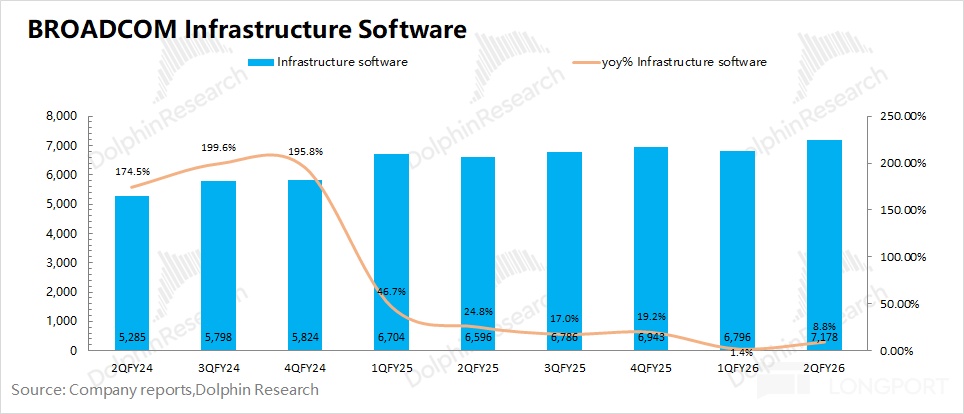
Software now breaks into VMware and the legacy CA & Symantec & Brocade portfolio. As legacy software holds around $2bn per quarter, VMware remains the main swing factor.
Dolphin Research believes VMware’s contribution is best viewed through ‘financial digestion’ and ‘perpetual-to-subscription’ transition. Based on segment trends, VMware likely did about $5bn this quarter.
Against the $8.9bn company revenue guide for next quarter, VMware and software should re-accelerate with higher subscription mix. With leverage down to 1.8, VMware has been absorbed, AVGO no longer breaks out VMware, and AI remains the top focus.
Back catalogue on Broadcom (AVGO) from Dolphin Research:
Earnings:
Mar 5, 2026 call Trans: Broadcom AVGO (Trans): FY2027 AI revenue to top $100bn; XPU partnerships are sustainable
Mar 5, 2026 earnings First Take: Broadcom AVGO: AI full throttle, a sleeker rival to NVIDIA?
Dec 12, 2025 call Trans: Broadcom AVGO (Trans): Anthropic adds $10bn+; $73bn order book is a floor
Dec 12, 2025 earnings First Take: Broadcom: Calling out NVIDIA, but did the vanguard blink?
Sep 5, 2025 call Trans: Broadcom (Trans): AI revenue growth to top 60% next fiscal year
Sep 5, 2025 earnings First Take: NVIDIA, AMD quiet? Broadcom seizes the AI flag
Jun 6, 2025 call Trans: Broadcom (Trans): AI revenue to sustain 60% growth into 2026
Jun 6, 2025 earnings First Take: Broadcom: ASIC growth ‘misfires’—speed bump or opening for a trillion-dollar ASIC story?
Mar 7, 2025 call Trans: Broadcom (Trans): ASIC customers add 2 to become ‘3+4’; no M&A for now
Mar 7, 2025 earnings First Take: Marvell stumbles, NVIDIA on pause? Broadcom holds the line
Risk disclosure and statements: Dolphin Research disclaimer and general disclosure








The copyright of this article belongs to the original author/organization.
The views expressed herein are solely those of the author and do not reflect the stance of the platform. The content is intended for investment reference purposes only and shall not be considered as investment advice. Please contact us if you have any questions or suggestions regarding the content services provided by the platform.