

Analysis Report on the Collaborative Development and Key Bottleneck Breakthrough Paths of Hotel Furniture and Home Textile Industry Chains 2026

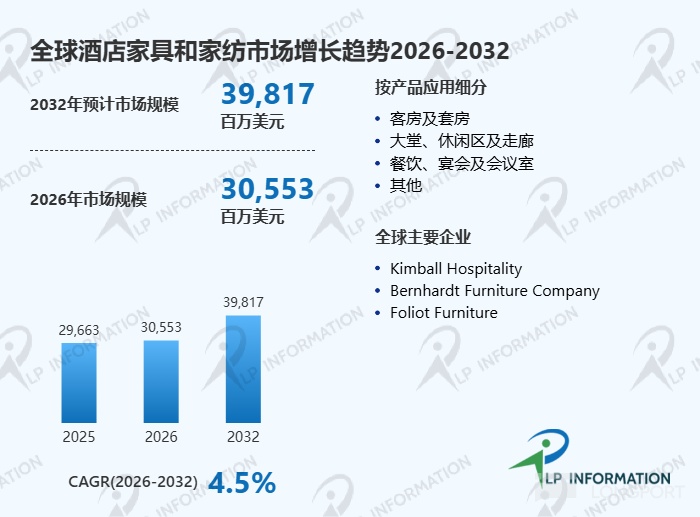
According to the latest research data from LP Information, the global hotel furniture and home textile market size in 2025 is approximately $29.663 billion, and is expected to grow to $39.817 billion by 2032, with a compound annual growth rate (CAGR) of about 4.5% from 2026 to 2032. Against the backdrop of global tourism recovery, hotel industry expansion, and the resonance of existing property renovation cycles, this market is gradually shifting from a "scale expansion-driven" phase to a structural growth stage driven by "operational efficiency and brand experience."
I. Industry Chain Structure: An Integrated System from Material Supply to Project Delivery
The hotel furniture and home textile industry belongs to a typical project-customized consumer goods supply chain, characterized by a long chain and complex coordination.
The upstream segment mainly includes wood and wood-based panels, metal structural components, foam and spring systems, leather and decorative fabrics, textile fibers, flame-retardant materials, coatings, and adhesives. The performance of raw materials directly determines product durability, flame-retardant ratings, and environmental standards.
The midstream consists of hotel furniture manufacturers and home textile producers, responsible for design refinement, standardized production, and project support capabilities. This segment emphasizes batch consistency and project delivery capabilities, and must meet the design specifications and functional standards of different hotel brands.
The downstream segment includes hotel investors and management groups, encompassing chain hotels, resort hotels, boutique hotels, and serviced apartment operators, as well as general contractors, interior design firms, and soft furnishing integrators.
The core characteristic of the entire industry chain is the trinity of: design-driven + project delivery + long-cycle replacement.
II. Market Size and Growth Drivers: Dual Engines of Tourism Recovery and Existing Property Renovation
According to the latest data from LP Information, global demand for hotel furniture and home textiles primarily stems from three major sources:
- Ongoing new hotel construction projects (especially in the Asia-Pacific and Middle East regions)
- Periodic renovation of existing hotels (typically on an 8–12 year renewal cycle)
- Standardized procurement driven by brand upgrades and soft brand expansion
In recent years, global hotel investment has gradually expanded from the luxury high-end market to mid-to-high-end and select-service hotels, significantly increasing the demand for standardized furniture and home textiles.
Simultaneously, the recovery of international tourism has boosted hotel occupancy rates, leading to significantly increased focus from hotel operators on furniture durability and low maintenance costs, thereby further supporting medium- to long-term demand growth.
III. Competitive Landscape: International Brands Dominate the High-End, Local Companies Strengthen Engineering Capabilities
The current global market exhibits a clear three-tier structure: "International Brands + Regional Manufacturers + Engineering Integrators."
In the high-end market, companies like Kimball Hospitality, Bernhardt Furniture Company, Pedrali S.p.A., and Poltrona Frau S.p.A. leverage design capabilities and brand premium to secure core project shares.
In the engineering and large-scale supply segment, companies such as Foliot Furniture and MityLite rely on cost advantages and rapid delivery capabilities to deeply participate in the construction of North American chain hotel systems.
In the home textile sector, companies like Standard Textile, Welspun Living Limited, and Indo Count Industries Limited hold significant positions by leveraging large-scale manufacturing and global supply chain systems.
Overall, market concentration is higher in the high-end segment, while competition is more fragmented in the mid-range and engineering markets.
IV. Product Structure and Application Scenarios: Evolving from Single-Item Sales to Space Solutions
According to the latest data from LP Information, the hotel furniture and home textile product system mainly includes:
Furniture Systems
Guest room beds, sofas, tables and chairs, cabinets, and public space furniture.
Home Textile Systems
Bedding sets, curtains, carpets, towels, and soft furnishings.
Application structures are primarily concentrated in:
- Guest rooms and suites (core revenue source)
- Lobbies and public spaces (core area for brand display)
- Dining and banquet spaces
- Meeting and business function spaces
The industry is upgrading from "single-item procurement" to "integrated space solutions."
V. Industry Barriers: Engineering Capabilities and Compliance Systems Become Core Thresholds
Industry entry barriers are mainly reflected in:
- High requirements for project-level delivery capabilities (multiple concurrent projects + global delivery)
- Complex international certification systems (flame retardancy, environmental protection, durability, etc.)
- Strong requirements for supply chain and logistics systems
- High requirements for customized design capabilities
These factors collectively constitute the industry's long-term competitive barriers.
VI. Driving Factors and Constraints
Main Driving Factors
- Global tourism recovery
- Chain hotel expansion
- Urban renewal and hotel renovation cycles
- Growth in mid-to-high-end hotel demand
- Green and healthy consumption trends
Main Constraining Factors
- Fluctuations in raw material prices
- Unstable international logistics costs
- Long project payment cycles
- High complexity of customized production
VII. Policy and Sustainability Trends
The EU's ESPR 2025–2030 framework has listed furniture as a key product category for regulation, pushing the industry towards:
- Repairable design
- Use of circular materials
- Lifecycle management
- Carbon footprint transparency
The U.S. Environmental Protection Agency (EPA) has also strengthened controls on formaldehyde and VOC emissions, making environmentally friendly materials a core procurement indicator.
VIII. Future Development Directions
The industry will exhibit the following trends in the future:
- Deepening of modular and standardized design
- Popularization of green and low-carbon materials
- Application of digital design and BIM collaboration
- Servitization and full-cycle management models
- Strengthening of regionalized global supply chain layouts
- Continuous expansion of the existing property renovation market
According to the latest research data from LP Information, the global hotel furniture and home textile market is currently in a phase of stable growth parallel with structural upgrading. Future competition will no longer be limited to price and design but will comprehensively shift towards:
Comprehensive competition based on design capability + project delivery capability + sustainability capability + global supply chain integration capability.
The copyright of this article belongs to the original author/organization.
The views expressed herein are solely those of the author and do not reflect the stance of the platform. The content is intended for investment reference purposes only and shall not be considered as investment advice. Please contact us if you have any questions or suggestions regarding the content services provided by the platform.
