

ATFX: Bank of Canada decision imminent, expected to hold at 2.25%

At 21:45 today, the Bank of Canada will announce its interest rate decision, with the mainstream expectation being that it will keep the benchmark interest rate unchanged at 2.25%. At 22:30, Bank of Canada Governor Macklem and Senior Deputy Governor Rogers will hold a monetary policy press conference, with a focus on their stance regarding inflation data and the future interest rate path.
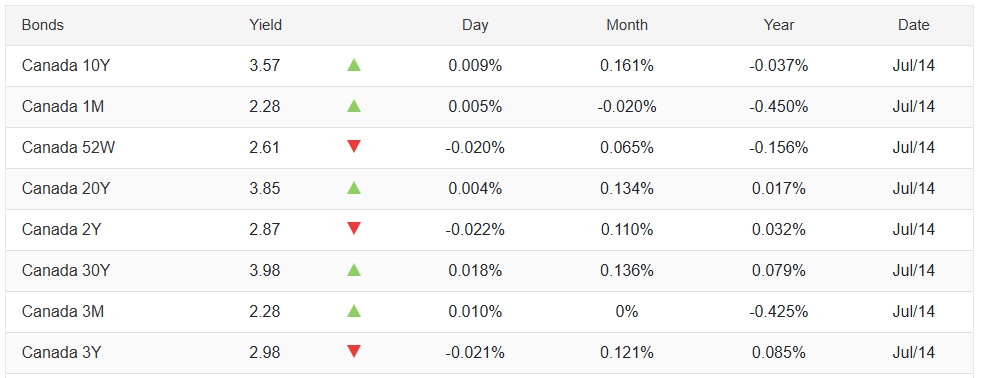
Figure 1, Summary of Canadian Treasury Bond Yields Across Maturities - ATFX
Whether the Bank of Canada adjusts interest rates can be analyzed on one hand through inflation and unemployment data, and on the other hand through the performance of Canadian Treasury bond yields. As can be seen from the chart above, the yield on one-month Canadian bonds is 2.28%, which is the same as the three-month bond yield. This means it's highly likely the Bank of Canada will not take any action to raise or lower interest rates within the next three months. The one-year Canadian Treasury bond yield is 2.61%, an increase of 33 basis points compared to the one-month yield of 2.28%. The Bank of Canada typically adjusts interest rates in increments of 25 basis points. The one-year yield exceeding the one-month yield by 33 basis points suggests there is motivation for the Bank of Canada to raise interest rates from a medium- to long-term perspective.
Figure 2, Overlay of Canadian Unemployment Rate and Core Inflation Rate - ATFX
Canada's latest unemployment rate is 6.5%, lower than the previous reading of 6.6% but higher than the 5% warning level. Canada's latest core CPI year-on-year rate is 2.2%, higher than the previous 2.1%, and within the moderate inflation standard range of 2% to 3%. The Bank of Canada's primary mandate is to maintain full employment and price stability. Although the unemployment rate is relatively high, it is stable, and inflation data remains within a reasonable range. In the absence of external shocks, the Bank of Canada clearly has no need to adjust monetary policy.
Variables and risk points stem from Middle East geopolitical issues. After the US and Iran signed a memorandum of understanding on June 17th, Iran conducted a drone attack on ships passing through the Strait of Hormuz on June 25th, leading to a US counterattack and increasing tensions in the Middle East. As of now, both Iran and the US have announced renewed blockades of the Strait of Hormuz, once again posing a problem for oil from the Persian Gulf region to reach consumer countries smoothly.
If Canada's inflation rate continues to rise due to high international oil prices, the Bank of Canada may have motivation to raise interest rates. However, Canada's core inflation rate in May was only 2.2%, lacking the high inflation risk seen in the US. Therefore, Canadian inflation is not expected to be significantly affected by rising international oil prices. This may lead the Bank of Canada to maintain monetary policy stability for a relatively long period, with the direction of the USDCAD exchange rate relying more on changes related to the US Dollar Index and the Federal Reserve.
ATFX Risk Warning, Disclaimer, Special Notice: The market carries risks, investment requires caution. The above content represents only the analyst's personal views and does not constitute any operational advice. Please do not treat this report as the sole reference. At different times, the analyst's views may change, and updated content will not be notified separately.
The copyright of this article belongs to the original author/organization.
The views expressed herein are solely those of the author and do not reflect the stance of the platform. The content is intended for investment reference purposes only and shall not be considered as investment advice. Please contact us if you have any questions or suggestions regarding the content services provided by the platform.
