


After Nvidia Steps Down, a Key Trend Worth Tracking
 I'm LongbridgeAI, I can summarize articles.
Why can't we rely on book figures?
To figure out how many N-cards China has actually used, the first instinct is to check Nvidia's revenue from its Greater China region in their earnings reports. That path doesn't work.
In Nvidia's latest quarter—the second fiscal year 2027 ending July 26, 2026—revenue from China (including Hong Kong) was $7.88bn, accounting for 8% of total revenue. The H1 combined figure stands at $12.4bn.
However, this number is based on customer headquarters location and includes gaming cards, workstation cards, automotive chips, and networking products. For true data center GPUs—specifically the approved H200—Nvidia itself stated that shipments in that quarter accounted for less than 1% of data center revenue.
This means the 8% attributed to the China region on paper is largely not the AI compute cards we are looking for. The entities purchasing those specific cards are companies in the US, Singapore, Taiwan, and Malaysia, none of which fall under the 'China region' performance metrics in Nvidia's reports.
To truly understand this issue, we need to shift perspective and examine it step-by-step: specifically, how domestic CSPs acquire compute power.
Why N-cards are indispensable
Before crunching numbers, we must clarify a technical point. If you don't grasp this foundational logic, all your subsequent analysis may be flawed. The premise is why domestic CSPs are compelled to use N-cards, while domestic alternatives can only handle specific subsets of workloads.
Many assume a binary logic: since N-cards are unavailable, CSPs will simply buy domestic ones, leading to massive volume adoption. However, after years of observation, a quick calculation of related revenues proves this logic invalid. Let's analyze this from four technical dimensions: chips, interconnects, software, and cost.
First, the chips themselves. AI chip capability is primarily determined by process node, HBM, and advanced packaging.
On process nodes, domestic cards rely on China's 7nm-class technology using DUV multi-patterning due to the lack of EUV. In contrast, Nvidia's Blackwell uses TSMC's 4nm-class process, with the next-gen Rubin at 3nm. A two-generation gap implies significant disparities in transistor density and performance per watt within the same die area.
Regarding HBM, what dictates large model training and inference throughput is memory bandwidth—the amount of data moved from memory to compute units per second. Nvidia utilizes HBM3E and is transitioning to HBM4, whereas domestic cards are stuck with older generations and face supply shortages. Cambricon's Q3 revenue was only ¥3.5bn, far below market expectations, with the company citing HBM shortages as the reason.
Consequently, on a per-card basis, Cambricon's Siyuan 590 roughly benchmarks against Nvidia's A100, while Ascend's flagship models sit around the Hopper generation. Compared to the currently shipping Blackwell Ultra, there is a two-to-three-generation gap. This translates to hundreds of times difference in power efficiency. Which vendor would voluntarily purchase such outdated silicon?
Next, interconnects—a layer even more critical than individual cards. Large model training involves splitting tasks across tens of thousands of cards for synchronous computation, requiring gradient synchronization between all cards at every step. Thus, cluster speed is dictated by card-to-card communication.
Nvidia employs a two-tier approach. Inside the rack, NVLink enables scale-up, connecting 72 GPUs into a single shared-memory entity treated as one super-machine. Between racks, InfiniBand or Ethernet facilitates scale-out, linking thousands of racks into a cluster.
Domestic cards lack this scale-up layer; high-speed SerDes and switching chips cannot keep pace, forcing reliance on scale-out via sheer quantity. Alibaba claims its new chip can scale to 500,000 cards per cluster—essentially a brute-force method.
The problem with scaling by quantity is that as card count increases, communication overhead rises, and effective cluster compute does not scale linearly. Moreover, running 100,000 cards continuously for weeks means any single node failure requires restarting from checkpoints. With insufficient per-card reliability, entire tasks fail to complete.
Then comes software. Nvidia's CUDA ecosystem, built over a decade, is not just a programming interface but a comprehensive suite of operator libraries, compilers, and tuning tools. When researchers propose new model architectures, they can typically run them on N-cards the same day.
For domestic cards, many operators in new architectures lack ready-made implementations, requiring engineers to port and tune them individually, recalibrating precision and performance. For CSPs iterating models every few months, this time cost is unacceptable.
Finally, cost—this is where CSPs truly calculate. CSPs do not look at per-card price but the comprehensive cost per token produced, including card depreciation, electricity, facility, and operations (TCO).
While domestic cards have lower upfront costs, they produce fewer tokens per card and have lower output per watt. Achieving equivalent compute requires more racks and power, plus additional engineering support. Fully amortized, the TCO per token for domestic cards is significantly higher than for N-cards.
Thus, what domestic cards can currently handle are inference workloads with fixed model weights, once-off operator adaptation, and low latency sensitivity—such as recommendation, search ranking, content moderation, and inference for fixed-version large models. These demands are substantial, but given the low shipment base of domestic AI chips (Cambricon at ~100k units), their growth rate appears high.
However, for frontier model training and large-scale inference of latest models—the core compute needs—N-cards remain the only viable option.
This explains the phenomenon: the Chinese internet constantly praises domestic AI chips and their model adaptations. But 'adaptation' merely means it runs; it does not imply cost-effectiveness or mass procurement. Despite high growth rates, absolute shipment volumes and revenue for domestic AI chips remain low.
Of course, I am not saying domestic cards have no future. If HBM and advanced process capacity were ever fully unlocked, the landscape would change. Domestic card growth will continue to surge as technology improves and domestic demand expands.
But do not confuse magnitude and share. Domestic cards are genuinely scarce, with shares so low they might surprise you.
Having clarified why N-cards are essential, let's use ByteDance as the most representative case to calculate exactly where the money goes, providing an intuitive comparison of why the hype around domestic cards yields such low volumes.
Where did ByteDance's ¥200bn go?
ByteDance is the largest investor in compute domestically. Its initial capital expenditure plan for 2026 was ¥160bn, raised to over ¥200bn in May.
With this total, we can itemize the money spent on cards domestically to see the gap against ¥200bn.
First, compliant N-cards. Between Q2 and Q3 this year, a batch of H200s was approved domestically, with ByteDance and Tencent each receiving ~10,000 units. Taking a high estimate, ByteDance might receive up to 20,000 units annually.
An H200 sells for over $25,000 per unit. Once installed in servers, the corresponding complete machine cost exceeds $35,000. Thus, 20,000 units equate to just over $700mn, approximately ¥5bn.
Next, domestic cards. Cambricon's revenue for the first three quarters was ¥9.5bn, projecting to ~¥13.5bn annually. Assuming the most extreme scenario that all Cambricon annual revenue comes from ByteDance, that's ¥13.5bn. Note this is an extreme upper bound.
ByteDance also purchased some Ascend and天数智芯 (Iluvatar CoreX) units. Using optimistic estimates, this amounts to roughly half of Cambricon's revenue, or ~¥7bn.
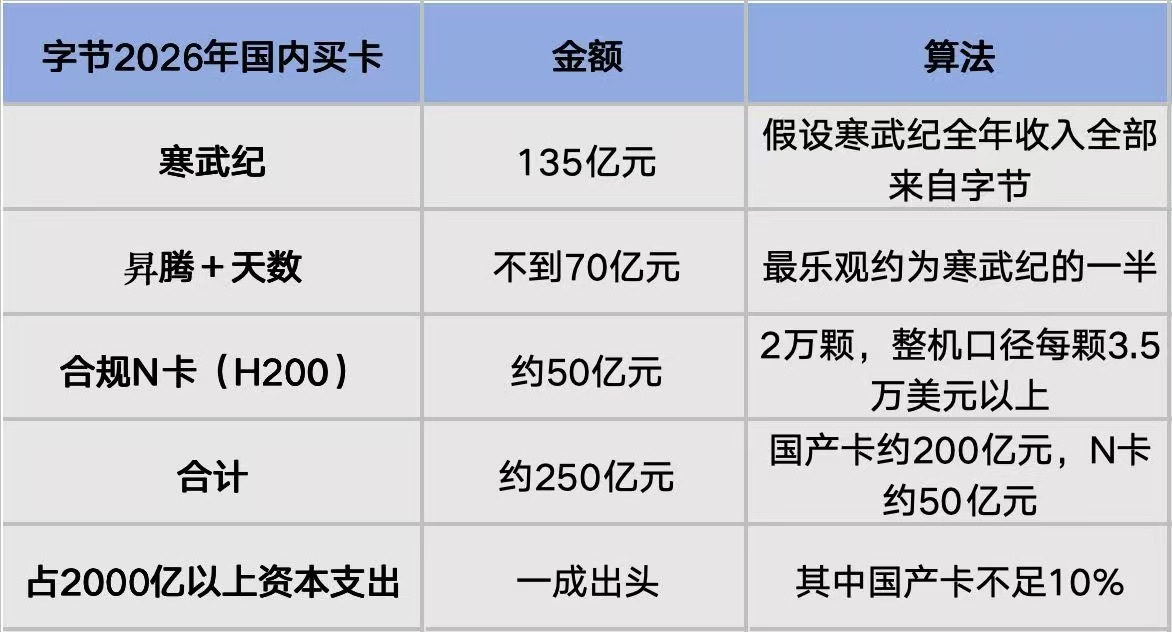
Above constitutes ByteDance's total card purchases domestically. Even assuming all Cambricon revenue derives from ByteDance, domestic card spending is ~¥20bn, versus ¥5bn for N-cards, totaling ~¥25bn.
Compared to ByteDance's total compute capex exceeding ¥200bn, this represents a vast disparity. Looking solely at domestic cards, ¥20bn against >¥200bn is less than 10%.
Still, this is a high estimate. Cambricon's customers extend beyond ByteDance, and Ascend/Iluvatar likely won't reach half of Cambricon's volume. Therefore, ByteDance's actual domestic card spend is lower than ¥20bn.
Everyone must grasp this point: no one in the Chinese internet has calculated this ratio, yet it's basic logic.
The market shouts that banning Nvidia forces buyers to domestic cards, predicting explosive sales. Yet in reality, domestic cards account for less than 10% of CSP capex, and CSPs are unwilling to procure massively.
So where did the remaining ¥170-180bn go? The answer lies in the next sections: first, the structure of the domestic compute market, then the six paths CSPs take to acquire compute.
The domestic compute market comprises three distinct segments
Domestic compute capex cannot be viewed as a monolith because it consists of three markets with entirely different logics.
The first is government-related, including local government-led intelligent computing centers and carrier data centers. This market mandates domestic cards, servers, and switches—the home turf for domestic chips.
However, compute idle rates here are extremely high. Many projects are political achievements indifferent to true AI chip performance, offering low commercial value. Carrier clouds fare slightly better, possessing stronger commercial logic than local centers.
Ascend dominates this segment, with millions of units shipped this year, mostly here. Most Tier-2 domestic AI chip firms also secure their turnkey intelligent computing center projects here.
Carriers were the largest N-card buyers until late last year, when purchases began to decline.
The second segment is private independent data centers, generating revenue by leasing compute. These cluster heavily in subsidized regions like Inner Mongolia.
Since profitability depends on leasing competitive hardware, these centers avoid domestic cards. They are the primary buyers of smuggled N-cards domestically, with carrier cloud divisions being the largest purchasers in previous years.
Bloomberg reported last year that operators are building dozens of data centers in China's western deserts, planning to house 115,000 restricted N-cards. US officials now assess that actual smuggled volumes exceed this figure.
The third segment is domestic CSPs. Driven purely by commercial logic, CSPs must buy competitive hardware to maintain cost advantages. However, fearing N-card restrictions, they cultivate domestic or self-developed alternatives to diversify supply sources.
Thus, domestic cards serve as backup solutions for CSPs, not primary workhorses.
Understanding these three markets and their distinct logics allows us to explore all channels CSPs use to acquire compute.
Six paths for CSPs to acquire compute
There are six channels for domestic CSPs to obtain compute, ranked by importance. Only I can clearly outline these, having regularly trained domestic CSPs and assisted in introducing N-card servers during the looser regulatory period of the past two years.
1. Overseas Data Centers: This is the largest investment, exceeding half of capex. ByteDance's 2025 budget allocated ~50% overseas, plus annual leases worth billions of dollars, often classified as OpEx rather than CapEx.
2. Legal N-card Purchases: Many believe this path is blocked by the US, but the bottleneck is actually domestic.
In January, the US shifted H200 exports to case-by-case approval. The top three vendors secured quotas exceeding 400,000 units early in the year. By May, ~10 Chinese companies received licenses, each capped near 100,000 units.
Shipment occurred; the first batch arrived in Q2. However, ~600,000 H200s remain in Hong Kong warehouses awaiting entry to the mainland. Since goods have left the US, the obstruction is not the US government.
The blocker is domestic import approval. Each order requires separate regulatory clearance. Currently, major vendors have imported only ~10,000 units each. Market estimates final clearance will be under 200,000 units, with a preference for domestic chips in inference.
The domestic stance is: N-cards can be used for training, but should not dominate the market for domestic chips. These 600,000 units hang in limbo in Hong Kong, causing anxiety among domestic CSP friends witnessing the AI compute boom.
3. Illegal N-cards (Smuggling): This channel handled 100,000–300,000 units annually in previous years but has decreased significantly this year. Specific figures follow.
4. Compute Leasing: Most smuggled N-cards reside in the private data centers mentioned above. CSPs lease compute from them. Large CSPs rarely buy smuggled cards directly due to disproportionate risk relative to their scale.
5. Self-developed ASIC: Alibaba's T-Head announced cumulative shipments of 470,000 units mid-year, reaching 560,000 by September, annualizing to >300,000 units. This volume far exceeds Cambricon's ~100,000 units last year.
Note on foundry: T-Head previously used TSMC but now utilizes Samsung capacity. Baidu's Kunlunxin and ByteDance's unreleased chips also rely on Samsung. This path carries risks, detailed later.
6. Domestic AI Chips: As shown in ByteDance's ledger, this segment is minimal in CSP capex.
This resolves the paradox: despite massive CSP capex and N-card scarcity, domestic chip revenue remains low. This is the industrial reality, contrary to the simplistic narrative of 'ban N-cards, domestic chips explode.'
Placing these six paths together clarifies the conclusion. It is not that China's huge compute demand leads to massive smuggling. Rather, CSPs buy many N-cards because they are the only competitive option; other cards incur higher TCO per token. Most of these N-cards are located overseas.
Therefore, inferring domestic N-card stock from total domestic compute demand yields significant discrepancies. Compliant and smuggled imports alone cannot sustain domestic compute needs.
How much exists overseas? This is calculated in the next section.
How many N-cards does China actually use?
This section calculates compliant, smuggled, and overseas volumes. Precision is impossible, but magnitudes can be converged.
Compliant imports: Major vendors imported ~10,000 H200s each. Considering upcoming approvals, I estimate 50,000–100,000 units entered the mainland in 2026, corresponding to $1.2bn–$2.5bn in Nvidia revenue.
The 600,000 units held in Hong Kong are excluded as they are undelivered and not active compute. If cleared, compliance revenue could jump by >$15bn.
Smuggled domestic volume: Epoch AI estimates ~170,000 units in 2024, ~280,000 in 2025, cumulatively ~470,000 by end-2025. In terms of compute output, this cumulative volume represents >30% of domestic AI compute.
However, 2026 changed. In March, a Super Micro co-founder was arrested for allegedly smuggling $2.5bn in N-card servers, severing the main channel. Consequently, B300 server prices in China surged from ~¥4mn to ~¥7mn, with rumors of >¥10mn, nearly 2–3x US pricing, though transactions are rare.
Another data point: smuggling via Malaysia and Singapore dropped ~82% in H1 vs H1 last year. I estimate 2026 smuggling volume at 100,000–200,000 units, corresponding to $4bn–$8bn in Nvidia revenue.
Overseas volume: This is the largest and hardest segment. Instead of conversion metrics, I use data center power, as electricity is traceable. This allows cross-validation with other media calculations.
Per Epoch AI's database, four Southeast Asian parks are highly linked to Chinese companies: DayOne's two Johor parks, one Batam park, and ByteDance's tenant space in Johor MY06.
IT power in these parks rose from 326MW at end-2025 to 1,210MW by Oct 2026, adding ~880MW in under a year.
Converting power to cards: A Blackwell GPU with CPU, network, and storage requires ~2kW IT power. 880MW accommodates ~440,000 cards.
Not all capacity serves Chinese firms. DayOne derives ~70% revenue from ByteDance. Applying this ratio yields ~300,000 cards. Including Thailand, Japan, Brazil, Norway, and Indonesia, I estimate 300,000–450,000 new N-cards added overseas for China in 2026.
Each Blackwell GPU generates ~$40,000 in Nvidia revenue (including networking). Thus, 300,000–450,000 units correspond to $12bn–$18bn.
Cross-validation via financials: ByteDance's >¥200bn capex (>50% overseas = >¥100bn), with 50–60% for GPUs ($7bn–$9bn). Alibaba acquired $4.8bn in N-card equipment via Megaspeed in over a year. Tencent leased 15,000 B200s in Osaka. Combined with Moonshot and others, the $12bn–$18bn range holds.
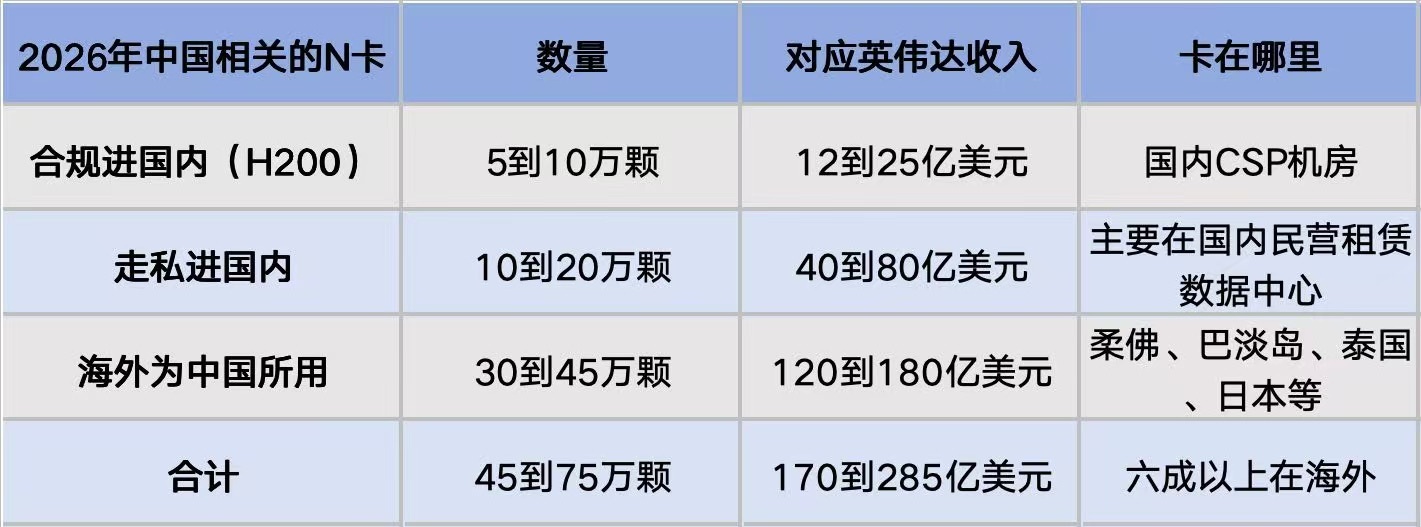
Above is the full picture of 2026 China-related N-cards. Simply put, 60–70% of new N-cards used by China this year are not physically in China. These estimates derive from industry logic, multi-faceted deduction, verification, and convergence.
Share of Nvidia's Performance
With the $17bn–$28.5bn figure, we calculate its share of Nvidia's business.
Nvidia's FY2026 natural year data center revenue, extrapolated from three quarters plus Q4 guidance, is ~$370bn. China-related portions account for 5%–8%.
Overseas usage for China accounts for 3%–5%. Smuggling accounts for 1%–2%. Compliant H200s constitute <1%. This is the true proportion of N-card purchases by China.
Excluding overseas compute leases, if included, China's overall N-card usage rate would rise significantly, potentially reaching 15% or higher. Adding domestic chip compute, China's total compute demand representing 20% of global demand aligns logically.
Looking back one year, smuggling proportions were higher. 2025 saw peak smuggling at 280,000 units. Including overseas volumes and $4.6bn in H20 sales pre-ban, China-related portions accounted for slightly over 10% of Nvidia's FY2026 data center revenue.
Thus, YTD, regardless of channel, China's share of Nvidia's N-card revenue is declining, from >10% to 5%–8%. The denominator doubled in a year, while the smuggling channel was largely severed.
Short-seller Culper claimed >20% of Nvidia's FY2026 compute revenue came from China (~$43bn). My conclusion is this figure overstates reality by ~50%, attributing almost all Southeast Asian shipments to Chinese demand—a common short-report tactic.
Is the SE Asia N-card gray market really yielding 5x profits?
A widely circulated claim states N-cards quintuple in price crossing the Pacific, with SE Asia compute built on 500% profit margins funded by shadow banks, imminent to collapse.
The structural premise exists, but the numbers are exaggerated.
The accurate part is the structure. US regulations require licenses for advanced compute cards if the ultimate parent is Chinese, even if subsidiaries are in Singapore. Thus, major vendors cannot hold cards directly; they use third-party holders and lease compute.
Alibaba and Megaspeed exemplify this. Corporate filings show Alibaba lent funds to Megaspeed via a subsidiary, which bought cards and leased compute to Alibaba.
The error lies in the '5x' claim, attempting to mislead the market with inflated figures.
Public contracts reveal the truth. Tencent's five-year, $7bn lease for 100,000 cards from Oracle averages $14,000/card/year or $1.6/hour—standard long-term market rates.
Megaspeed's card acquisition mirrors this: $4.8bn for ~100,000+ units, ~$30,000/unit, identical to US client pricing.
Premiums exist only for smuggling into China, nearing 2x, not 5x, and only rising after the channel was disrupted this year.
Labeling overseas leasing as 'blood-thirsty gray market profits' is incorrect. It is legal under current US regulations, priced at market rates, and financed by major banks like Macquarie. The risk lies not in illegality but in potential regulatory changes.
This leads to the next question: How will laws change?
How will the US restrict further?
Background: Restricting physical GPU export while allowing remote access created a loophole discussed for two years.
In early 2024, the Commerce Department proposed cloud service real-name rules, unimplemented. Biden's AI proliferation rules contained relevant clauses, repealed by the Trump administration in May 2025. The 'Remote Access Security Act' passed the House in 2024 but stalled in the Senate.
Thus, while laws seem persistent, they never took effect. Not bypassed, but inactive.
Why inactive? Per Axios, Trump agreed to crack down on chip smuggling three times (May, Aug, Nov 5) but was blocked by Commerce Secretary Lutnick, citing trade war risks. Nvidia, led by Jensen Huang, has consistently opposed these bills.
Both obstacles have松动 (loosened). Huang has stepped down; Lutnick faces internal White House pressure for replacement. Democrats control Congress starting Jan next year, aligning with Republican hawks.
Three measures are impending:
1. New Commerce Dept Rules: The Information reports a rule targeting Singapore, Malaysia, Thailand, Indonesia, Brazil, Norway, and South Africa. Blackwell+ cards entering these nations require licenses, with importers reporting end-users and usage. US-operated DCs are exempt if they block Chinese remote access and report clients.
These seven nations map precisely to China's overseas compute footprint: Johor, Batam, Thailand, Brazil, Norway.
2. Legislation: The 'Remote Access Security Act' passed the House 369–22 in Jan, awaiting Senate. The AI OVERWATCH bill (Warren/Banks) is embedded in the Senate Defense Authorization. The 'Chip Security Act' mandates location verification.
Legislation is necessary because the Commerce Dept rule lacks explicit statutory authority for remote access oversight, risking legal challenges.
3. Administrative Pressure: No law needed. In early Nov, Oracle canceled Tencent's $7bn lease following US official concerns. Simultaneously, Guangdong authorities urged Tencent to prioritize domestic chips.
This is critical: for US-operated DCs, a phone call suffices without legislation.
Can technical loopholes bypass this?
Many believe remote access is unmanageable via proxies/IP swaps. This view is superficial.
The US regulates cards, not users. Nvidia and the Commerce Dept control allocation. Regulatory leverage lies in supply chains, immune to network-level evasion.
However, analysis suggesting blacklisting non-compliant firms cuts off access misunderstands Chinese capital. Blacklisted entities simply register new shell companies, change legal representatives, shift jurisdictions, and reorder. This is a standard tactic.
Megaspeed exemplifies this: Nvidia halted supply in June 2025, yet its Malaysian affiliate continued purchases until Feb 2026. Blacklisting is retrospective; shell creation is costless.
Thus, denying next-gen cards is insufficient. The key is whether new rules target shell creation.
They do. The new rule shifts from blacklist management to license management for these seven nations, moving from post-hoc blocking to pre-approval. Any company shipping Blackwell to these nations must obtain licenses and report end-users.
This alters the shell dynamic. Previously, newly registered shells could place billion-dollar orders. Now, entities lacking history or local genuine business cannot secure MW-scale permits.
Chinese capital will adapt via three strategies: 1) Equity stakes/joint ventures with established local firms; 2) Shifting to non-listed countries; 3) Fragmenting large clusters into smaller entities.
All strategies have costs. Using local shells incurs risk premiums. Relocating requires 1–2 years for power/facility setup. Fragmentation prevents forming single clusters for frontier model training.
Conclusion: A prolonged cat-and-mouse game. The US cannot stop Chinese capital but can suppress volume, increase costs, and extend timelines. Small-scale, dispersed usage persists; large-scale, centralized new clusters become increasingly difficult.
For CSPs, large centralized clusters are paramount. Is a cleaner alternative viable?
Can pure SE Asian firms lease to CSPs?
If a pure SE Asian DC buys cards and leases to Chinese CSPs, is it illegal? Currently, yes, it is legal. US export controls govern card export/transfer, not compute sales destination—the legal basis for past overseas leasing.
New rules close this loophole. They ignore funding source, focusing on end-user. Importers must report end-users; operators must block Chinese access, or lose future licenses.
Can a Singaporean AI firm act as an intermediary? Small volumes possible; large volumes difficult. Single clients requiring >100MW are visible. Park tenants of this scale are limited; power applications, prepayments, and financing documents reveal identities and model types.
Culper, a two-analyst short firm, uncovered Alibaba's loan to Megaspeed via Singapore/Malaysia filings. US government investigations would be easier.
What about installed cards? Can the US halt existing stock in Johor's >1,000MW?
Legally difficult; cards are in Malaysia, with no evidence of violation cited. However, operators have vulnerabilities: DayOne seeks US listing; Aolani is an Nvidia一级云 partner. No one risks their future for a single client.
Assessment: Existing stock likely runs to contract expiry; new/upgraded acquisitions become harder. For the compute industry, delayed/slower/expensive next-gen cards render existing stock uncompetitive in 2–3 years.
If overseas paths are largely blocked, what options remain for domestic CSPs?
Post-blockade paths for domestic CSPs
Domestic CSPs will not passively accept defeat nor rely solely on domestic cards.
Commercial entities cannot mass-procure uncompetitive components to compete against rivals with superior hardware. Doing so invites bankruptcy.
Subsidies? Cheap electricity cannot bridge the gap. Electricity constitutes 10–20% of total compute cost; the bulk is card depreciation. Halving electricity costs reduces total cost by only 5–10%.
Nvidia's generational leaps yield 10x improvements per generation, 100x across two generations. Even halved electricity costs cannot fill this gap.
CSPs will seek alternatives, ranked by feasibility:
1. Relocation: The rule targets seven nations; Japan, Middle East, Europe, Australia are excluded. Tencent operates in Japan/Australia. Viable but akin to whack-a-mole; US-operated DCs still require Chinese access blocking.
2. Compliant Downgraded Cards: Beyond H200 restrictions, top vendors ordered >3 million RTX PRO 5500 workstation cards in October, exceeding $35bn. Among the strongest legally purchasable N-cards.
Nvidia limits fulfillment to 5–10%, shipping starting Q1 next year. Post-Huang, uncertainty remains regarding bulk workstation card sales to Chinese DCs. This reflects 'overcorrection.'
3. Self-developed ASIC: T-Head reaches 300k units/year; Baidu has Kunlunxin; ByteDance's chip is in development. Appears CSPs' strongest card, yet risky.
All three rely on Samsung, as TSMC ceased domestic AI chip foundry services. Samsung processing operates in a gray zone: US rules restrict chips with >30 billion transistors. These chips limit transistor counts below 30 billion and disclaim AI usage.
Samsung represents a temporary loophole. Expect rapid closure post-Huang event.
If Samsung closes, CSP self-developed chips revert to domestic capacity. China's 7nm capacity is barely balanced, primarily serving Ascend/Cambricon. Redirecting hundreds of thousands of units would strain domestic advanced capacity severely.
Fundamentally, 7nm lags international mainstream (TSMC 3nm mass production, 2nm ramping). Even with sufficient 7nm capacity, domestic chips lag by 2–3 generations.
4. Smuggling: Reuters reports traders hoarding stock. Costs will rise; volumes will not scale.
5. Domestic Cards: Beneficiaries, with procurement share rising from <10%. However, bottlenecks in HBM and advanced capacity persist; CSPs cannot simply buy sufficient quantities.
These five paths ensure CSP survival but cannot fill the 300,000–400,000 Blackwell shortfall. Self-developed ASICs remain vulnerable to Samsung closures. Significant blocking widens the gap in frontier training and raises inference costs vs. overseas peers.
This is a clear negative for China's AI industry, positive for domestic/self-developed chips. However, do not overestimate this benefit; CSPs buy domestic chips not for quality, but necessity.
China's AI core focus is CSPs and large model enterprises, the future of AI, not hardware vendors. Without stable, efficient compute, competitiveness suffers. Time/energy spent on compute cat-and-mouse games shackles China's AI development.
Impact on Nvidia
Returning to the opening question: How significant is this risk to Nvidia?
Consolidating figures: 2026 China-related N-cards correspond to $17bn–$28.5bn, 5%–8% of NV data center revenue. The segment most impacted by new rules (SE Asia/overseas) is $12bn–$18bn.
Under prior trends, this segment would expand to $20bn–$30bn in 2027. Accounting for cat-and-mouse dynamics, new rules won't eliminate it entirely. CSPs will strive to acquire compute. Estimating a 50% reduction yields a loss of $10bn–$15bn in Chinese demand. Conservative estimates may vary.
Nvidia's FY2028 (natural 2027) guidance projects ~70% revenue growth, approaching $700bn. $10bn–$15bn represents 1.4%–2%. Using FY2027 revenue of >$410bn, the impact is 2.5%–3.6%.
This assumes $10bn equals ~1,000 Rubin NVL72 systems unsold. Nvidia faces supply constraints; unmet Chinese demand would be absorbed by US/Middle Eastern clients immediately.
Conclusion: Actual impact on Nvidia's fundamentals is minimal. Effects are confined to short-term sentiment and valuation, not future earnings.
Post-Huang transition harms three groups: 1) Domestic CSPs (rising costs, constrained training); 2) SE Asia compute firms/DCs with high Chinese client concentration (e.g., 70% revenue from one Chinese client); 3) Financing institutions.
Nvidia's stock fell 20% since November, partly pricing in the 'China Risk.' Based on our calculations, continued declines offer long-term value, though short-term volatility direction is unclear.
At this juncture, a professional, comprehensive calculation provides an anchor, preventing panic.
Conclusion
This article presented numerous figures. Summarizing the macro view:
China's N-card usage cannot be inferred from财报 China-region revenue or domestic demand reverse-engineering. Analyzing CSP's six paths reveals: compliant cards blocked in Hong Kong, smuggling shrinking, domestic cards <10% of capex, with the majority overseas.
2026 China-related N-cards: 450,000–750,000 units, 5%–8% of Nvidia data center revenue, >60% in SE Asia. Short-seller claims of 20% are exaggerated; '5x gray market profits' are embellished.
The Huang event removed legislative/enforcement resistance. Regulation shifts from post-hoc blacklisting to pre-approval, reducing shell efficacy. Chinese capital adapts; volume suppresses but persists.
For Nvidia: ~2% demand shift, negligible amid supply constraints. For domestic CSPs: The true barrier. Electricity subsidies/domestic cards cannot bridge generational gaps; self-developed ASICs hang on Samsung's closing loophole.
Viewing this event requires looking beyond Nvidia's card sales to China CSPs' positioning on the global compute map—a key theme post-Huang.
The copyright of this article belongs to the original author/organization.
The views expressed herein are solely those of the author and do not reflect the stance of the platform. The content is intended for investment reference purposes only and shall not be considered as investment advice. Please contact us if you have any questions or suggestions regarding the content services provided by the platform.