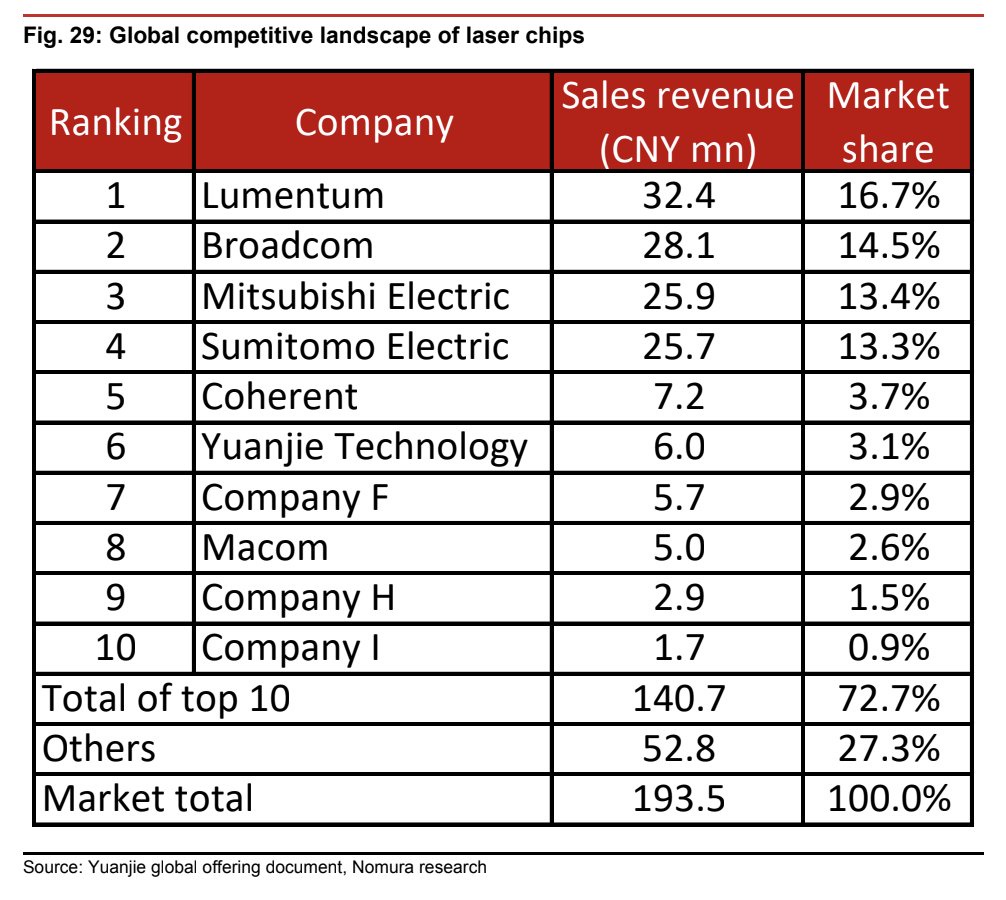
Lumentum leads in market share of laser chips
$Lumentum(LITE.US) $Broadcom(AVGO.US) $Coherent Corp.(COHR.US) $Macom Tech(MTSI.US)

Roundhill AVGO WeeklyPay ETF
AVGW39.4300.15% ( +0.060 )
Share your thoughts
Write something you'd like to share with our community...
- E
Nomura: Optical
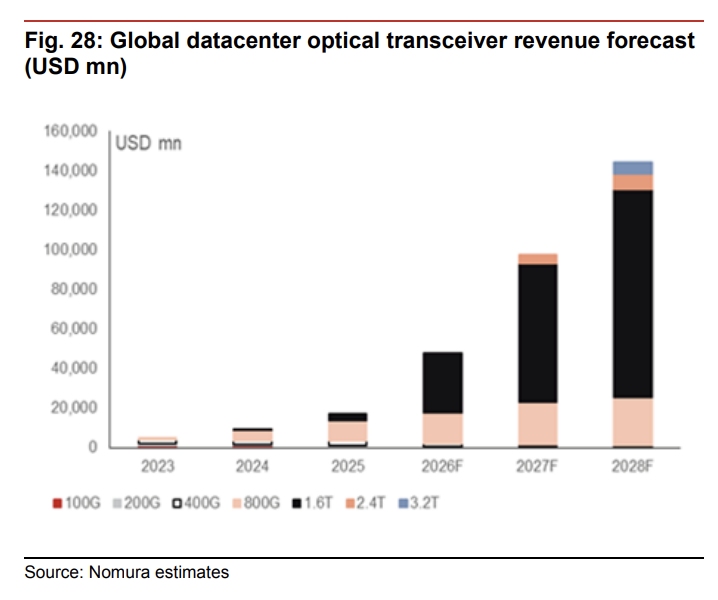
Market Overview & Growth Projections> Revenue Expansion: The global datacenter optical transceiver market is projected to reach USD 47.7bn in 2026F and surge to USD 144.2bn by 2028F, representing a rapid CAGR of 74% from 2026 to 2028F.> Primary Growth Catalyst: Market expansion is primarily driven by robust, buoyant demand coming from large language model (LLM) training and inference workloads.High-End Transceiver Shipment ForecastsHigh-end speeds (800G and 1.6T) are experiencing stronger momentum due to accelerated technology upgrades within AI networking segments:> 800G Transceivers: Projected shipments stand at 33.8mn units in 2026F, scaling to 55.0mn units in 2027F, and 78.0mn units in 2028F.> 1.6T Transceivers: Projected shipments stand at 26.1mn units in 2026F, increasing to 71.5mn units in 2027F, and reaching 126.0mn units by 2028F.> Next-Generation Speeds (2.4T / 3.2T): Initial shipments are expected to commence in 2027F and 2028F, ultimately reaching volumes of 5mn units and 2mn units respectively by 2028F.Architectural Evolution & Supply Chain Dynamics> Co-Packaged Roadmap: As the industry migrates toward co-packaged optics, deliveries of NPO (Near-Package Optics) and CPO (Co-Packaged Optics) products are expected to start rolling out between 2027F and 2028F, serving as fresh demand multipliers for high-power optical lasers.> Supply Chain Constraints: Unprecedented demand cycles continue to pressure optical chip suppliers' fulfillment capabilities, giving IDM players like Yuanjie a competitive edge in a supply-constrained market environment.$Coherent Corp.(COHR.US) $Lumentum(LITE.US) $Applied Optoelectronics(AAOI.US) $Macom Tech(MTSI.US) $Broadcom(AVGO.US)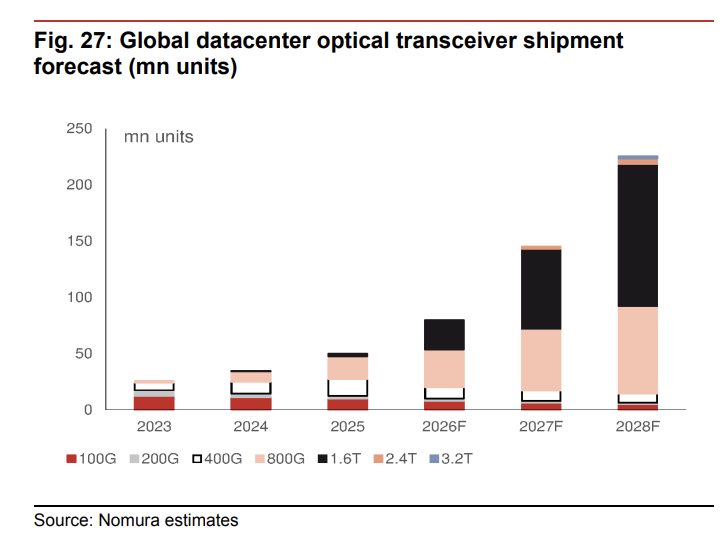
- C

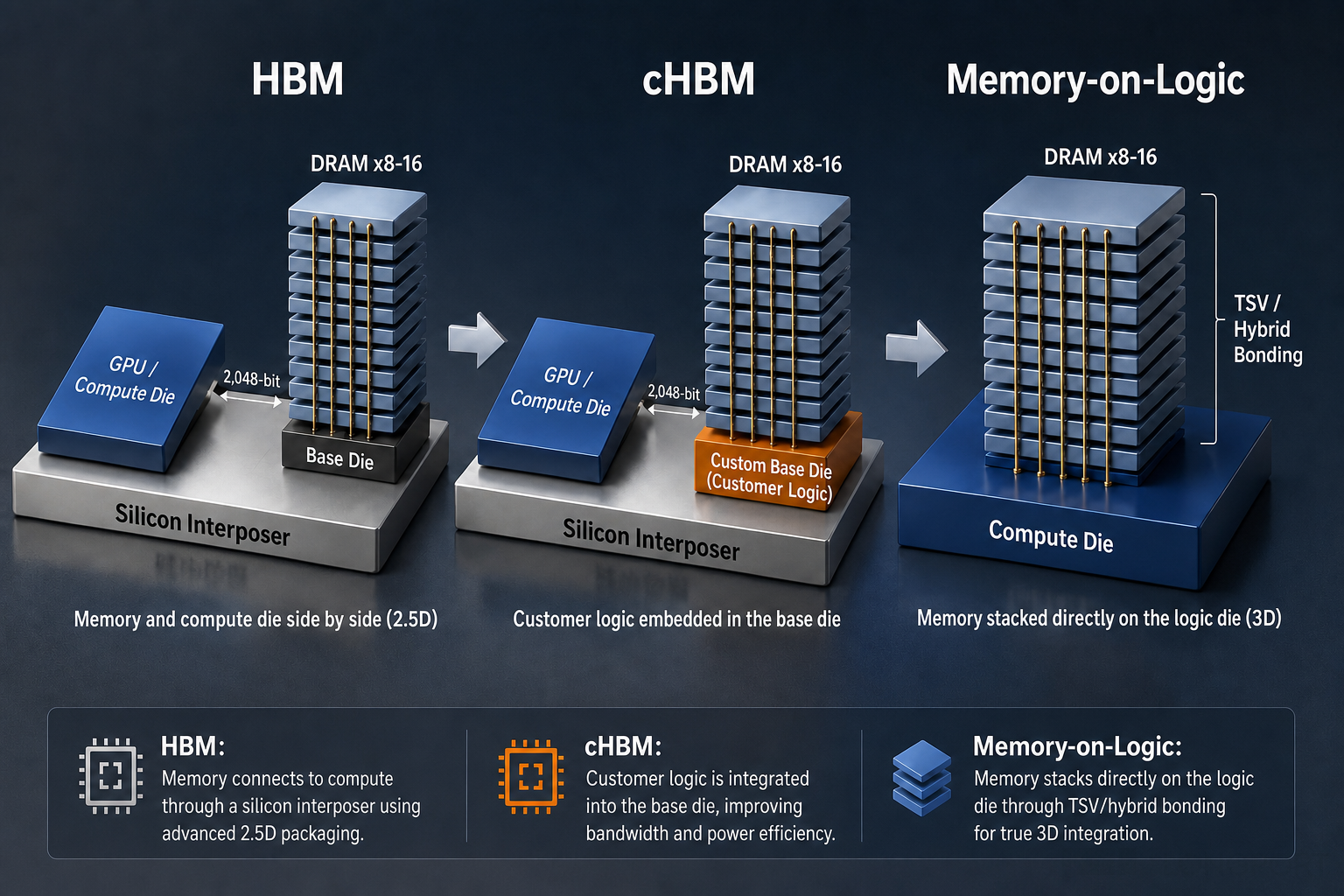
SK hynix: After Standard HBM Expansion, Is Customization the Next Act?
HBM is evolving from a standardized memory product into a customer-specific, tightly integrated component. From HBM4 process shifts to custom HBM and memory-on-logic, this transition could reshape the memory industry’s cyclicality and valuation.
- H
📢 𝗝𝗨𝗦𝗧 𝗜𝗡: Samsung Posts Record Q2 Operating Profit as AI Memory Demand Stays Strong - $Micron Tech(MU.US) $Sandisk(SNDK.US) $Western Digital(WDC.US) $SK Hynix(SKHY.US) $Seagate Tech(STX.US)
👉 𝗞𝗲𝘆 𝗛𝗶𝗴𝗵𝗹𝗶𝗴𝗵𝘁𝘀:➤ 𝗦𝗮𝗺𝘀𝘂𝗻𝗴 reported record 𝗤𝟮 𝗼𝗽𝗲𝗿𝗮𝘁𝗶𝗻𝗴 𝗽𝗿𝗼𝗳𝗶𝘁 of ₩𝟴𝟵.𝟰 𝘁𝗿𝗶𝗹𝗹𝗶𝗼𝗻.➤ Operating profit exceeded analyst estimates of ₩𝟴𝟴.𝟭𝟯 𝘁𝗿𝗶𝗹𝗹𝗶𝗼𝗻.➤ Revenue reached ₩𝟭𝟳𝟭 𝘁𝗿𝗶𝗹𝗹𝗶𝗼𝗻, versus ₩𝟭𝟳𝟮.𝟲𝟱 𝘁𝗿𝗶𝗹𝗹𝗶𝗼𝗻 expected.➤ Operating profit surged 𝟭,𝟴𝟭𝟯.𝟴% year over year.➤ Revenue increased 𝟭𝟯𝟬% from a year earlier.➤ Operating profit climbed 𝟱𝟲.𝟯𝟳% from the previous quarter.➤ Revenue rose 𝟮𝟴.𝟭𝟭% quarter over quarter.➤ Strong 𝗔𝗜 𝗺𝗲𝗺𝗼𝗿𝘆 demand continued to drive chip business growth.➤ Samsung recently expanded its strategic partnership with 𝗕𝗿𝗼𝗮𝗱𝗰𝗼𝗺.👉 𝗪𝗵𝘆 𝗧𝗵𝗶𝘀 𝗠𝗮𝘁𝘁𝗲𝗿𝘀:➤ Reinforces that 𝗔𝗜 memory demand remains a major semiconductor growth driver.➤ Positive results support the investment outlook for 𝗔𝗜 chip suppliers.➤ Highlights Samsung's competitive position against 𝗦𝗞 𝗛𝘆𝗻𝗶𝘅 in AI memory.➤ Strong profitability may support continued investment in memory and foundry expansion. - H
📊 𝐈𝐍𝐕𝐄𝐒𝐓𝐎𝐑 𝐍𝐎𝐓𝐄: Bernstein Reaffirms Bullish View on Memory Chipmakers After Major AI Partnerships - $NVIDIA(NVDA.US) $SK Hynix(SKHY.US) $Micron Tech(MU.US) $Sandisk(SNDK.US) $Western Digital(WDC.US) $Seagate Tech(STX.US)
👉 𝗞𝗲𝘆 𝗛𝗶𝗴𝗵𝗹𝗶𝗴𝗵𝘁𝘀:➤ 𝗕𝗲𝗿𝗻𝘀𝘁𝗲𝗶𝗻 reiterates a bullish outlook on 𝗺𝗲𝗺𝗼𝗿𝘆 𝗰𝗵𝗶𝗽𝗺𝗮𝗸𝗲𝗿𝘀.➤ 𝗦𝗞 𝗛𝘆𝗻𝗶𝘅 and 𝗡𝗩𝗜𝗗𝗜𝗔 announced a partnership worth over $𝟱𝟬𝟬 𝗯𝗶𝗹𝗹𝗶𝗼𝗻.➤ 𝗦𝗮𝗺𝘀𝘂𝗻𝗴 and 𝗕𝗿𝗼𝗮𝗱𝗰𝗼𝗺 signed a $𝟮𝟬𝟬 𝗯𝗶𝗹𝗹𝗶𝗼𝗻 memory and foundry agreement.➤ SK Group is pursuing an additional $𝟮𝟱𝟬 𝗯𝗶𝗹𝗹𝗶𝗼𝗻 in memory partnerships.➤ Bernstein says AI leaders are securing long-term 𝗛𝗕𝗠 memory supply.➤ Analysts expect around $𝟭.𝟯 𝘁𝗿𝗶𝗹𝗹𝗶𝗼𝗻 in annual memory revenue for 2027 and 2028.➤ Bernstein says recent memory sector weakness presents a 𝗴𝗼𝗼𝗱 𝗲𝗻𝘁𝗿𝘆 𝗽𝗼𝗶𝗻𝘁.➤ Bernstein rates 𝗦𝗮𝗺𝘀𝘂𝗻𝗴, 𝗦𝗞 𝗵𝘆𝗻𝗶𝘅, and 𝗠𝗶𝗰𝗿𝗼𝗻 𝗢𝘂𝘁𝗽𝗲𝗿𝗳𝗼𝗿𝗺.➤ Analysts expect minimal impact on 𝗧𝗦𝗠𝗖 from the announced agreements.👉 𝗪𝗵𝘆 𝗧𝗵𝗶𝘀 𝗠𝗮𝘁𝘁𝗲𝗿𝘀:➤ Reinforces 𝗛𝗕𝗠 as the key bottleneck in AI infrastructure expansion.➤ Long-term supply deals improve visibility for memory makers' future revenue.➤ Securing memory supply supports AI growth plans at 𝗡𝗩𝗜𝗗𝗜𝗔 and 𝗕𝗿𝗼𝗮𝗱𝗰𝗼𝗺.➤ Positive outlook could strengthen investor sentiment toward AI memory stocks.👉 𝗘𝘅𝗽𝗲𝗿𝘁 𝗦𝘁𝗮𝘁𝗲𝗺𝗲𝗻𝘁:𝗠𝗮𝗿𝗸 𝗟𝗶, Bernstein Analyst:"We believe the announced amounts are more for memory and indicate the need for NVIDIA & Broadcom to secure memory supply." - S
Just some TLDR news:
- $CXMT IPO tomorrow if you like Chinese memory. - Samsung Electronics reportedly struggling to secure large FC-BGA substrates. Ibiden (4062) reportedly requested LTA guarantees, Samsung Electro-Mechanics sought prepayments. - Samsung + $Broadcom(AVGO.US) sign memory + foundry AI framework through 2030, expected to exceed $200b- $SOI expects FY2027 silicon photonics revenue to double compared to the previous year, surpassing Morgan Stanley's 60% growth projection. Photonics thesis go brrr. - SK Group + $NVIDIA(NVDA.US) sign $500B+ partnership to build out AI DCs and HBM4 memory. - SKC Absolics glass core delay to 2027 from reports. Targeting final reliability testing EOY, mass production next year. So if you're curious, this does push back some ramps from $LPK and others (hence drop on ER). - $Qualcomm(QCOM.US) price hikes by double digits for smartphone processors, due to upstream supplier hike pricing.- $Meta Platforms(META.US) expected to issue $12B in project-level/SPV financing for El Paso, Texas AI DC expansion - Naver announced a $10 billion investment from $NVIDIA(NVDA.US) and Brookfield to construct a 1GW-scale AI Factory. Near term plan is 200MW by 2028. (Nvidia $1B investment, Brookfield nonbinding $9B)- 64GB DDR5 server modules rises 146% versus end-June contract pricing- $Intel(INTC.US) brought forward 14A process mass production by a year, risk production H2 2027 and volume production in 2028, vs. 2029 HVM expectations. - Samsung Electro-Mechanics wins $200m MLCC order (existing bottleneck). - $AMD(AMD.US) (the Bandana bottleneck), announces Helios is in full production with shipments Q3 2026. Including an up to 2GW MI455X GPU deployment with Anthropic and a 6GW infrastructure rollout with OpenAI. Gave new >50% CAGR TAM to $220B by 2030 from $26b in 2025 for CPU market. Rolls out optical interconnects for Mi500 in 2027. From channel checks, AMD is heading down to the CPO route (seems likely to use Ayar). - $Oracle(ORCL.US) wins $7B Department of War enterprise software contract- JX metal doubles semi target capacity at its KR subsidary with a 4B yen investment, with operations to begin H2 2027, amid surging demand from major customers Samsung Electronics and SK Hynix- Tungsten hexafluoride spot prices surged 2.1-2.5x Y/Y following Japan's Kanto Denka and Chuo Gas announcing permanent production halts. Fluorinated liquid supply faces a vacuum as 3M plans to exit PFAS production. - From the four optical chipmaker earnings, Yuanjie/Eoptolink/TFC Optical/Dongshan Precision: no major order cuts, 1.6T shipments expected to accelerate into 2027. Optical chip suppliers expected to capture outsized margins from shortages. - Unitree Robotics Targets 30,000 Humanoid Robot Production Capacity by 2026. Read through on humanoid TAM scaling like $Churchill Capital XI(CCXI.US) and others. - Energy storage lithium batteries orders increase first half orders by 2,900% apparently in China. Not as familiar with EVE Energy and other battery makers. - E
BOCOM International: Zhongji Innolight
AI Infrastructure & Market Forecasts> Role of Communication Networks: Zhongji Innolight is positioned to benefit as a leading global manufacturer of optical modules due to the rising importance of communication networks in AI infrastructure.> Chip Market Forecast: The global AI communication network chip market size is forecasted at USD 107.5bn (2026E) and USD 154.9bn (2027E), driven by upstream giants NVIDIA and Broadcom.Optical Modules in AI Data Centers> GPU-to-Transceiver Ratio: Based on NVIDIA Blackwell Ultra NVL72 systems, 1 GPU corresponds to ~6.1 transceiver modules.> Shipment Estimates: High-bandwidth (>=400G) optical module shipments in data centers are expected to reach 81.1m units (2026E) and 146.7m units (2027E).1.6T Optical Modules: Expected to reach 28.4m units (2026E) and 76.3m units (2027E), serving as the primary driver for Zhongji Innolight's earnings growth.Technology Position & Market Share> Technology Timeline: CPO may scale up in 2H27 or later, while NPO could begin volume ramp in 2026 as the primary interface technology form.> Global Ranking: According to Frost & Sullivan, Zhongji Innolight's data communication optical module market share was 23.1% in 2025, ranking first globally.$Applied Optoelectronics(AAOI.US) $NVIDIA(NVDA.US) $Broadcom(AVGO.US) $Marvell Tech(MRVL.US) - D

$Broadcom(AVGO.US)
Google’s earnings a few hours ago enforce the narrative that capex yields positive ROI.
I believe there is another year left before capex will slow down. Get in before it is too late!
#Trade Showcase: Trade, Show and Earn Rewards!
- D
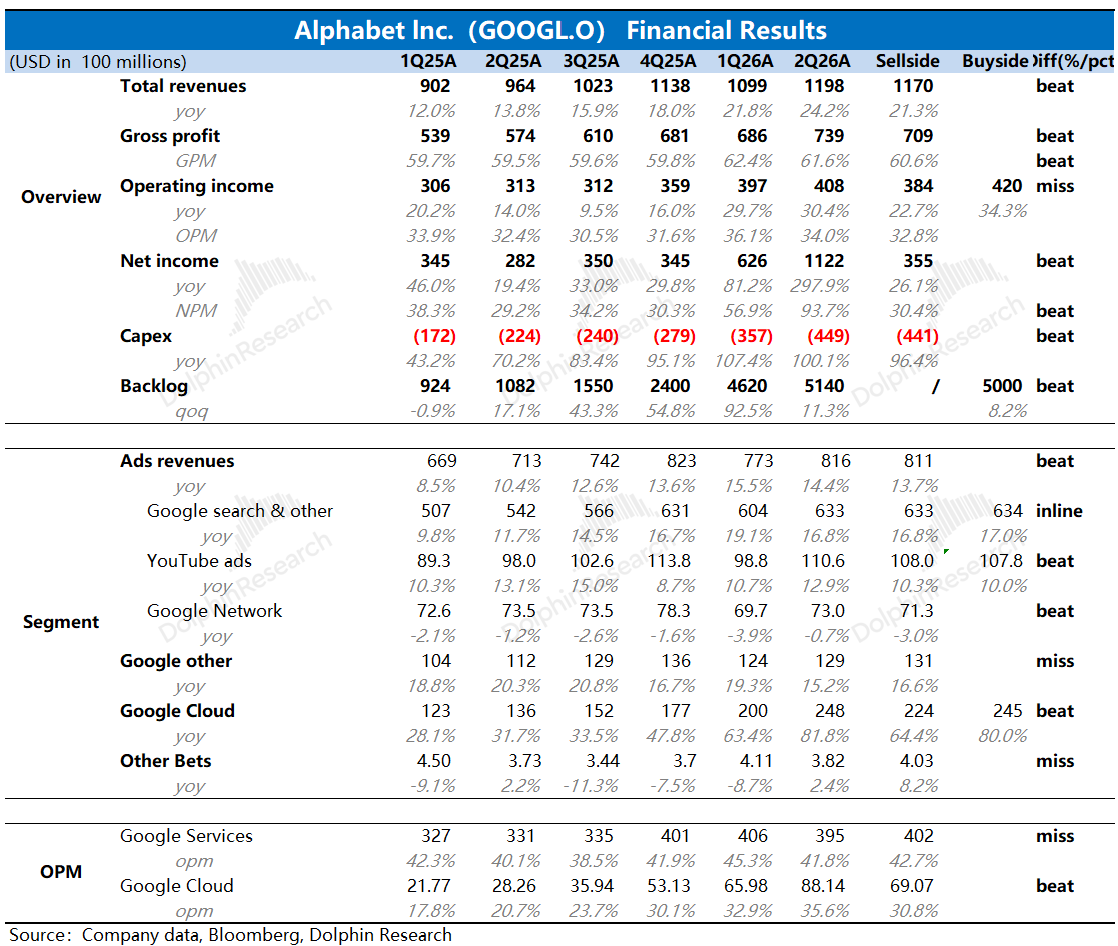
GOOGL 2Q26 First Take: As a top-tier global AI buyer, Alphabet’s earnings are a focal point for the entire tech supply chain. Key metrics include Capex, Cloud growth, and cash flow trends:
(1) Capex hit $44.9bn, doubling YoY. Management raised FY26 Capex guidance from $180-190bn to $195-205bn (+ $10bn net) and expects a significant increase in 2027. This aligns with buy-side expectations of a $5-10bn hike due to rising storage costs.
(2) Google Cloud grew 82%, slightly beating the buy-side’s 75-80% estimate. Note that this includes TPU hardware sales, though revenue recognition details (Gross vs. Net of Broadcom’s share) remain undisclosed. Backlog reached $514bn, meeting the $500bn investor threshold.
(3) Core Ads slightly beat estimates. Search remained robust as expected, while YouTube Ads showed a modest recovery.
(4) Group OP slightly missed. Free Cash Flow (FCF) turned negative (-$5.8bn) amid aggressive spending. EPS surged 294%, primarily driven by valuation gains from investments in SpaceX and Anthropic, making it a distorted metric for core fundamentals.
Overall, the results favor the supply chain 'bull case.' Management remains highly aggressive on AI investment due to strong demand. This offsets the market’s high Capex expectations, offering supply chain investors a temporary sigh of relief.
Conversely, aggressive spending pressures short-term fundamentals, especially during this 'weak conviction' phase where Gemini iterations face hurdles and growth bases rise. Despite impressive Cloud revenue and backlog growth, the unexpected negative FCF and Capex guidance suggest cash flow pressure will persist.
Of the $80bn+ financing announced earlier this year, $49.6bn has been executed, with the remaining $40bn in follow-on offerings starting in Q3. Assuming FY27 OCF of $250bn, plus current cash and short-term investments of $2400bn and the $40bn from future offerings, a total liquidity of $540bn could support the aggressive buy-side Capex forecast of $350bn for 2027.
The remaining ~$200bn can cover ad-hoc investments and maturing long-term debt. However, managing this cash exposure remains challenging. We cannot rule out the possibility of additional financing beyond current plans. $Alphabet(GOOGL.US) $Alphabet - C(GOOG.US)
- K
aapl just tagging along with the market today, +1% and nothing new. the broadcom chip deal was two weeks ago already, not fresh news. while everyone chases memory and AI, apple is the sleepy one lah. still my anchor but not adding here, no catalyst
- D
It is difficult to tell if this recovery in chip stocks is a dead cat bounce. My gut feeling says no as the AI infrasture demand is real but the market is moved by smart money and what we can do is size our positions according to our risk appetite and set stop losses.
☕️ [Task Coins Giveaway] Daily Market Talk — Chips Explode, Tesla & Google Tonight
Memory stocks went vertical (MU +12%, SNDK +14%) on UBS's buy call, while Nvidia declared Vera Rubin in full production. Next up: Tesla and Alphabet report tonight, the first real test of whether AI capex is turning into cash.
- L

memory stocks still got room to up as previous week drop.
just try buy on dip or hold it if already brought.
☕️ [Task Coins Giveaway] Daily Market Talk — Chips Explode, Tesla & Google Tonight
Memory stocks went vertical (MU +12%, SNDK +14%) on UBS's buy call, while Nvidia declared Vera Rubin in full production. Next up: Tesla and Alphabet report tonight, the first real test of whether AI capex is turning into cash.
- M
apple locked in that 30 billion broadcom chip supply through 2031 including custom AI silicon, and the stock still dipped 2%. people keep forgetting apple is quietly one of the biggest AI supply chain plays. not adding but very happy to hold
- E
Yole Group: CPO Supply Chain
PIC designNvidia $NVIDIA(NVDA.US) Broadcom $Broadcom(AVGO.US) Marvell $Marvell Tech(MRVL.US) LightmatterCelestial AIAyar LabsEnosemiASIC & xPUs designNvidia $NVIDIA(NVDA.US) Broadcom $Broadcom(AVGO.US)Marvell $Marvell Tech(MRVL.US) Intel $Intel(INTC.US) AMD $AMD(AMD.US) MediaTek $2454.TWLaserLumentum $Lumentum(LITE.US) Broadcom $Broadcom(AVGO.US) Coherent $Coherent Corp.(COHR.US) Sivers Semiconductors $SIVERS SEMICONDUCTORS AB(SIVEF.US) Scintil PhotonicsScape PhotonicsQuintiquentFoundriesTSMC $Taiwan Semiconductor(TSM.US) SilTerra - subsidiary of Dagang NeXchange $4456.KlNSTICIMECLetiITRIGlobalFoundries $GlobalFoundries(GFS.US) SOI wafer & Epi-waferSoitec $SOI.PA Shin-Etsu Chemical $4063.TLandMark Optoelectronics $3081.TWO IQE $IQE.L Shanghai Simgui Technology - subsidiary of NationalSilicon Industry Group $688126.SSSumitomo Electric $5802.TVPEC $2455.TWAXT $AXT(AXTI.US) Packaging / Assembling / TestingASE Holdings $Advanced Semiconductor Engineering(ASX.US) Foxconn $2317.TWFabrinet $Fabrinet(FN.US) SPIL - subsidiary of ASE Holdings $Advanced Semiconductor Engineering(ASX.US) ShunSin Technology $6451.TW Amkor Technology $Amkor Tech(AMKR.US)Jabil $Jabil(JBL.US)JCET $600584.SS Teradyne $Teradyne(TER.US)FormFactor $Formfactor(FORM.US) EIC, Retimers, SerDes, PHYMarvell Technology $Marvell Tech(MRVL.US) Credo Technology $Credo Tech(CRDO.US)MACOM Technology $Macom Tech(MTSI.US) Semtech $Semtech(SMTC.US) Alphawave Semi - part of Qualcomm $Qualcomm(QCOM.US) Astera Labs $ALLAB System / EquipmentNvidia $NVIDIA(NVDA.US) Micas NetworksRuijie Networks $301165.SZ Cisco Systems $Cisco(CSCO.US) Inventec $2356.TW Dell Technologies $Dell Tech(DELL.US) Hewlett Packard Enterprise $Hewlett Packard Enterprise(HPE.US) Wistron $3231.TW Wiwynn $6669.TW Connectors & FibersMolexSamtecCorning $Corning(GLW.US) Yangtze Optical Fibre and Cable (YOFC) $6869.HK US ConecTE Connectivity $TE Connectivity(TEL.US) Sumitomo Electric $5802.THengtong Optic-Electric $600487.SSLuxshare ICT $002475.SZEnd customersAWS $Amazon(AMZN.US) Microsoft Azure $Microsoft(MSFT.US) Meta $Meta Platforms(META.US) Tesla $Tesla(TSLA.US) Tencent $Tencent(TCEHY.US) ByteDanceOpenAIxAINon-exhaustive list.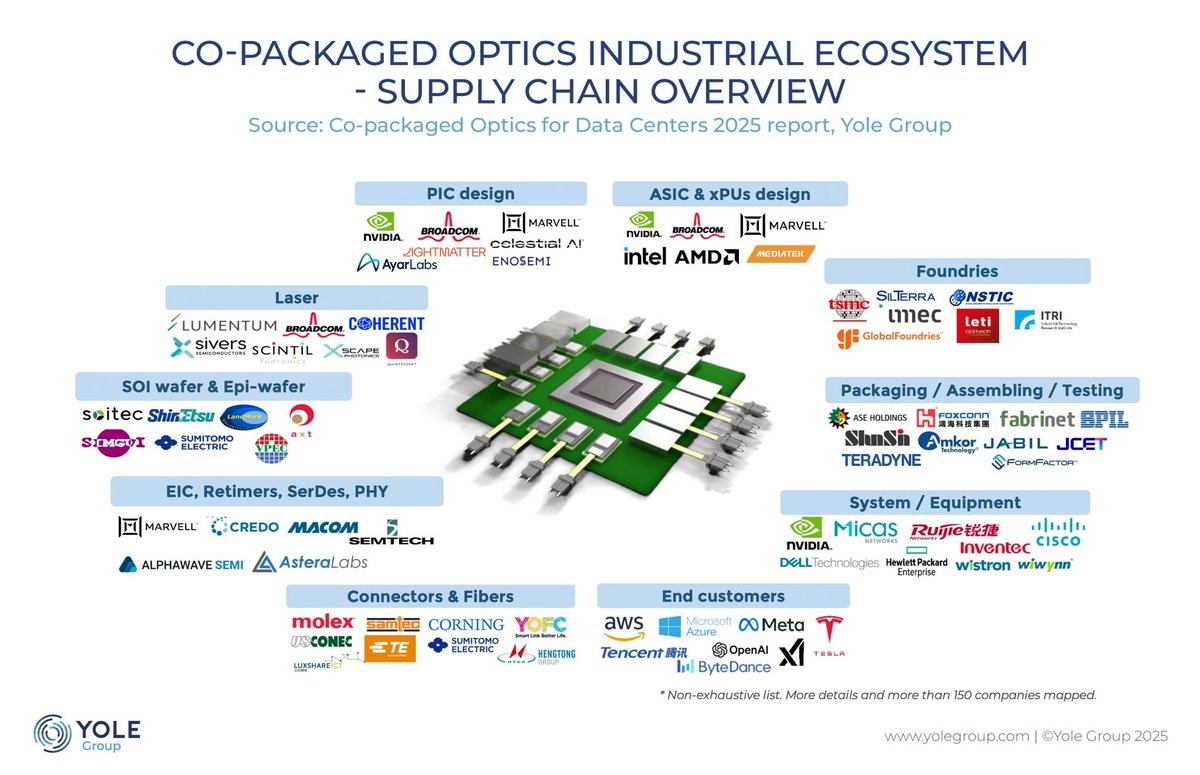
- H
Morgan Stanley: 'Selloff of US memory stocks creates a compelling entry point'. - $Micron Tech(MU.US) $Sandisk(SNDK.US) $Seagate Tech(STX.US) $SK Hynix(SKHY.US) $Western Digital(WDC.US) $NVIDIA(NVDA.US) $Broadcom(AVGO.US)
"This remains an unusual memory cycle, as data center strength is the only cause – which means that as we saw in April there are mixed signals elsewhere that may be a false flag. Memory isn't the best risk reward in our coverage – which we think is NVDA/AVGO – but it's catching up fast. Memory stocks are crowded, and with the unusual nature of this cycle periods of drawdowns seem inevitable – but we are buyers on that weakness. In a cycle entirely driven by data center, there are going to be mixed signals in consumer, PC, smartphone markets, which impact spot market and inventory levels at various points; we believe that some of the anecdotes dragging the stocks down in recent days have been about those parts of the market. But we spent last week talking to several of our purchasing contacts in the data center space, and the intensity of the shortages in that part of the business show no signs of abating. We see prices up at least 25% on a like-for-like basis from 2q to 3q, above our estimates and above 3rd-party estimates. As importantly, the longerterm concerns that the memory shortage will intensify in 2027 and again in 2028 are still as strong as ever. There isn't enough memory vs. AI requirements, and we just don't see that changing...we think that the selloff in the stocks has created a strong entry point. We think that the best value in the market comes from the compute names, notably NVDA and AVGO, but memory is catching up quickly given this deceleration, and we think this should provide a good entry point for the stocks." - H


$NVIDIA(NVDA.US)
It’s time to look at Nvidia for the week. Last week, she was holding right above the 200D MA precariously. However, she held that support and started turning up towards the end of the week as higher beta keeps getting sold.
When you look at similar big cap profiles in tech such as AMD, AVGO and TSM, AVGO is the closest whereas AMD is pretty strong followed closely by TSM who are both well clear of their 200D MA.
Now look at what is considered the defensive play for tech - Apple. She has been rallying ahead in the meantime.
Now digest all that and look at the big picture. It is actually telling you a story. Earnings are coming up and funds usually de risk into them especially when they are well green on their positions. And some funds are tech oriented so they must stay within the tech world. Guess where they park their money while waiting? They need huge mega caps which are less volatile and won’t move that much with that much capital. The names doing well in the tech mega cap space are the chosen ones. Apple is the clear beneficiary being a tech stalwart yet not a hyperscaler.
If earnings shows that AI is doing well and hyperscalers are not cutting back while starting to monetise AI and forward guidance confirms, I am expecting high beta AI beneficiaries which have sold off to rally hard surprising many retails who are now bearish.
@Captain's Treasure
- E
Mizuho Securities: Optics
Market Trends & Technologies> Optical Circuit Switches (OCS): OCS is gaining traction among hyperscalers, with Google (GOOGL) leading adoption in its Jupiter Network and other hyperscalers like Amazon (AMZN) and Microsoft (MSFT) exploring its use. Lumentum (LITE) and Huber+Suhner (HUBN) are identified as key partners in this space. > Co-Packaged Optics (CPO) vs. Near-Packaged Optics (NPO): While interest in CPO continues to grow (with potential deliveries in 2028/29E), industry focus is shifting toward NPO in the near-term because it is easier to deploy and requires less co-integration than CPO, despite being less power-efficient. > Silicon Photonics (SiPho) & InP: The supply chain for SiPho remains constrained, with demand potentially outpacing foundry capacities at GFS and TSEM. A transition to 6-inch wafers is underway to help alleviate supply tightness by providing ~130% higher wafer area. > Micro-LED (uLED) Potential: uLED/ALC is emerging as a potential disruptor for networking, offering 20-30m reach at approximately 1/5th the cost of optical pluggables, with no InP supply constraints. Credo (CRDO) is noted as a key player in this space, targeting deliveries starting in 2027-28E. Company-Specific Updates (Lumentum & Credo)Lumentum (LITE):> Growth Drivers: Lumentum management noted that the "best is yet to come" as several major growth drivers—optical scale-up, optical scale-out, and optical circuit switches (OCS)—are just beginning to ramp up and are not yet fully reflected in their numbers.> 1.6T Transition: The company is seeing a significant tailwind from the transition to 1.6T transceivers, led by NVIDIA and Google, with 200-gig EMLs providing roughly double the average selling price (ASP) of previous generations.> Scale-Out Business: The partnership with NVIDIA for high-powered lasers in CPO switch platforms is a major focus, with expected incremental revenue of $50 million to $100 million in the fourth quarter of fiscal 2026 alone.Credo Technology (CRDO):> Market Outperformance: Credo has significantly outperformed larger rivals like NVIDIA and Broadcom in share price gains during 2026, largely due to its specialized role in high-speed, energy-efficient connectivity.> Optical Portfolio: Following its acquisition of DustPhotonics, Credo has strengthened its silicon photonics capabilities. The company expects its optical connectivity business to generate over $600 million in revenue in fiscal 2027, supported by a 1.6T networking transition.$Lumentum(LITE.US) $Credo Tech(CRDO.US) $Broadcom(AVGO.US) $NVIDIA(NVDA.US) $STMicroelectronics NV(STM.US) $Alphabet(GOOGL.US) $Meta Platforms(META.US) $Tower Semicon(TSEM.US) $Marvell Tech(MRVL.US) $Taiwan Semiconductor(TSM.US) $Microsoft(MSFT.US) $Amazon(AMZN.US)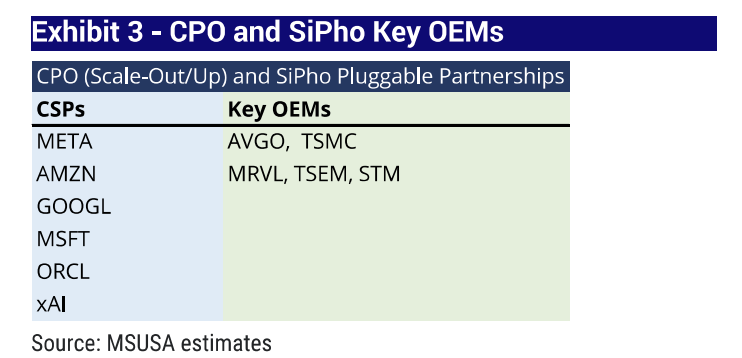
- E
Morgan Stanley: Optical vs Copper
How do you think about the optical scale up opportunity in 2027, 2028, 2029, etc, and how does that relates to the Nvidia ecosystem and roadmap?A: We believe a small scale out adoption next year, with small volumes accounting for 10-15% penetration with scale out. We do think there are some low adoption with CPO until Feynman in 2029. Small, single digit adoption of CPO in 2028 and really scaling in 2029.You took your TAM to $73B, 4x from a year ago, talk about the drivers of that and how that compares to consensus and buy side out there?A: Driven by CapEx data points being 2x we were expecting last year, that is one vector of growth. The other is the cluster sizes being discussed are the biggest rivers of scale up network . We have gone from 8 to 72, then from a couple 100s to 1000s in the next couple generations. This acts as a multiplier to scale up multiplier.Talk about the exposure among Lumentum, Coherent, and Corning. Are there nuances between who is more exposed, less exposed?A: For CPO within scale out, it is generally positive for Lumentum. Doesn't necessarily changed a whole lot for Corning. With Coherent, they have to balance it out with transceiver business they have. For Lumentum it is the most positive because of the one customer they have on the transceiver side being google and they are not going to be adopting CPO. For CPO within scale up, it is opportunity for all 3. This is where copper gets replaced with fiber and lit up by lasers and optical engines made by Coherent an Lumentum. In terms of overall exposure, Lumentum has a bigger catalyst because of larger AI/DC revenue. It would be incremental for both Coherent and lumentum. Lumentum #1, Coherent or Corning #2.Tell me about the Corning Glass Bridge announcement that got the stock excited?A: This is not a new announcement. It was a paper they released in 2025 and a presentation they did that refocused the market on this technology. It is already part of the $10B photonics target the company discussed couple of months ago.In terms of catalyst for optical space, OCP (Open Compute Project) coming in October has gone popular. What are you expecting to hear from this?A: We think this will be a catalyst because it provides more exposure into hyperscaler behavior. OCP will give us a chance to see hyperscalers roadmap, it will focus on CPO, NPO adoption and the vendors involved.Copper is still the story for 2026 and 2027. We have seen this continued enthusiasm for ASICs. How is copper well positioned for this dynamic? Who are the well positioned beneficiaries?A: Copper life can be extended with use of retimers and better SerDes. Copper has a lot of runway before switching to optics. We will likely see a hybrid environment before going to 100% optics. A large debate in scale up is what fabric and protocol will become dominant other than NVLINK as we get into new XPUs and alternatives to Nvidia GPUs ramping. A big debate here is between UALink and ethernet. Ethernet is dependent on Broadcom's new ASICs ramping in 2H2027 into 2028, we think Broadcom will have opportunity to bundle XPU solutions with networking portfolio and are very well positioned in ethernet. On UALink, this is high optionality for Marvell and Astera Labs. Astera has the scale up switch for Trainium 3, this is a PCIe based solution. We think customers will want to move to UA Link eventually.You consider Keysight as an agnostic winner in R&D, regardless of the copper vs optical timeline. Explain your thesis and why do you see it pulling ahead?A: Keysight really ways in multiple ways when it comes to AI. First, it benefits from different types of architectures being discussed which all need to be tested with their equipment in labs. Second, when you move to higher speeds (400g laser vs 200g), it requires more complicated testing. Third, when architectures change frequently, like every 2 years, that boosts their business. The variety of architectures being tested matters.$Astera Labs(ALAB.US) $NVIDIA(NVDA.US) $Broadcom(AVGO.US) $Marvell Tech(MRVL.US) $Credo Tech(CRDO.US) $Semtech(SMTC.US) $Amphenol(APH.US) $Keysight Tech(KEYS.US) $Coherent Corp.(COHR.US) $Lumentum(LITE.US) $Corning(GLW.US) $Alphabet(GOOGL.US) - @
BREAKING: Broadcom is diversifying away from long-time foundry partner TSMC. Lego will be the new manufacturing partner for Broadcom's flagship hyperscaler ASIC products in 2028. Broadcom President of Semiconductor Solutions, Charlie Kawwas, has already showed off package samples at RAISE Summit in Paris last week. With TSMC supply constrained, customers are alternative sources of chip supply from unexpected places. One of the major differentiators Lego brings is industry leading defect repair, "plug and play" chiplet interoperability, as well as built in self-alignment technology for 3D stacking. Mattel and Hasbro were also under consideration, but Lego's proven track record won out in the end. We have ordered multiple Millennium Falcon Sets set to our Portland teardown lab for competitive teardown analysis.
- S
TSMC Beat Big and Raised Its Outlook. The Stock Barely Moved and the Sector Crashed. Here Is Why.
This is the most counterintuitive tape of the week. TSMC reported a blowout Q2, revenue of 40.2 billion dollars up 33.7%, gross margin at 67.7%, and it raised its full-year outlook. That is about as c...