

🐱💖 BLINKFANS K-POP MARKET TALK: ALIBABA (BABA) — IS CHINA TOO OVERSOLD? 🇨🇳📉🛍️
 I'm LongbridgeAI, I can summarize articles.
💕 1. OMG BLINKS! WHY AM I WATCHING ALIBABA?
Hey BLINKS! 🐱💗 Today, I want to talk about Alibaba (BABA), one of China’s biggest technology and e-commerce companies. When investors hear about tariffs, trade wars, weak consumer spending and geopolitical tensions, Chinese stocks can become extremely unpopular. But sometimes, when everyone is rushing to sell, I start asking myself a different question: Has the market become too pessimistic about China’s future?
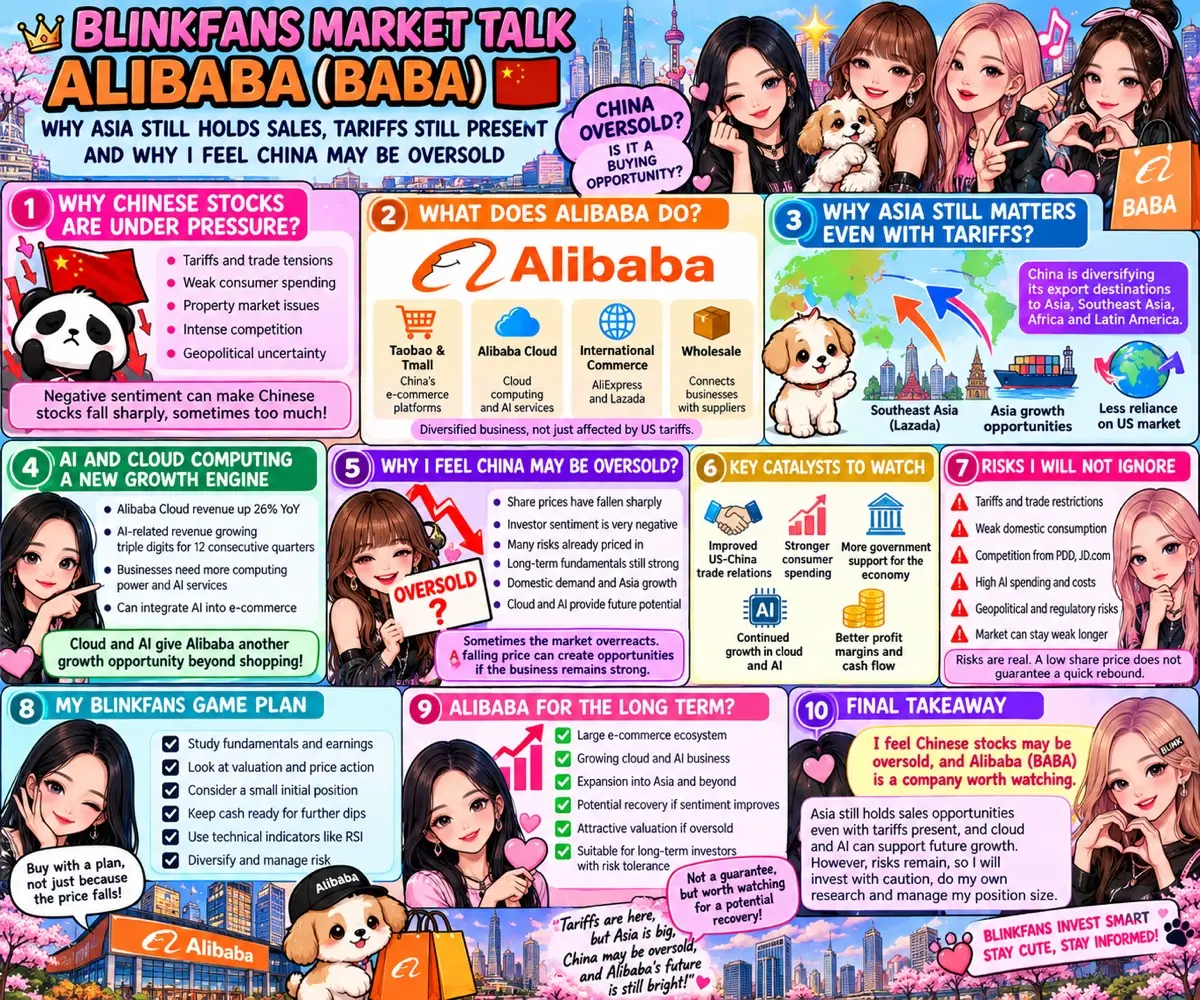
I feel Chinese stocks may be oversold, and Alibaba is one company worth putting on my watchlist. However, I am not saying that every dip is automatically a buying opportunity. A cheap stock can become cheaper if its business deteriorates. What interests me is whether the market is pricing in too much bad news while overlooking Alibaba’s long-term business potential.
🎤 My market mood today? When everyone is singing a sad breakup song about China, I want to check whether the fundamentals are really broken before I join the crowd!
📉 2. WHY ARE CHINESE STOCKS UNDER PRESSURE?
BLINKS, let’s understand the bigger picture first! China’s economy faces several challenges, including cautious consumers, pressure in the property market, intense competition between businesses and uncertainty surrounding international trade.
Tariffs can make Chinese products more expensive for American buyers. When that happens, importers may reduce orders, consumers may switch to other suppliers, and Chinese exporters may have to absorb some of the additional costs to remain competitive.
This uncertainty can affect investor confidence even before the full financial impact appears in company earnings. Investors may sell first because they fear that future profits will be lower.
China’s economic recovery also remains uneven. Reuters reported on October 15, 2026, that economists expected third-quarter growth to improve modestly, while weak consumer demand, sluggish private investment and property-market problems continued to weigh on the outlook. Source: Reuters
But here is the important distinction: a challenging economy does not automatically mean every Chinese company is a bad investment.
Some companies have stronger balance sheets, more diversified revenue streams and better opportunities to adapt. My job as an investor is to distinguish those businesses from companies whose growth story is genuinely deteriorating.
🛍️ 3. WHAT EXACTLY DOES ALIBABA DO?
Think of Alibaba as more than just a Chinese shopping website!
Its ecosystem includes Taobao and Tmall, which connect consumers with merchants; Alibaba Cloud, which provides computing and technology services; and international commerce businesses such as AliExpress and Lazada.
It also operates wholesale platforms that connect businesses with suppliers.
Why does this matter? Because Alibaba earns money from several different activities. Its performance is not determined by American tariffs alone.
For example, a shopper in China buying a household product through Taobao is participating in domestic commerce. A business using Alibaba Cloud is paying for technology infrastructure. A customer ordering from an international marketplace creates another type of commercial activity.
These revenue streams have different drivers and different risks.
That diversification is one reason I am interested in Alibaba. Even when cross-border trade becomes more difficult, domestic commerce and cloud computing can still offer growth opportunities.
However, diversification does not eliminate risk. If Chinese consumers spend less, domestic e-commerce can suffer. If businesses reduce technology spending, cloud growth could slow too.
🌏 4. WHY ASIA MATTERS WHEN TARIFFS ARE STILL PRESENT
This is one of the most important parts of my investment thesis! 💗
When people discuss tariffs, they often focus heavily on trade between China and the United States. But Asia is a much larger and more diverse economic region than one bilateral trading relationship.
Southeast Asia, for example, has consumers and businesses with different income levels, shopping habits and technology needs. E-commerce continues to provide ways for merchants to reach customers across borders.
Alibaba’s international businesses, including Lazada in Southeast Asia and AliExpress in other markets, give the group opportunities to reach customers beyond mainland China.
China has also been diversifying its export destinations. Reuters reported in January 2026 that Chinese exporters had increasingly shifted their focus toward Southeast Asia, Africa and Latin America amid persistent US trade tensions. Source: Reuters
For Alibaba, this creates an important question: can its international commerce ecosystem continue to attract merchants and customers outside the United States?
If it can, the company’s future is not determined solely by American demand.
But let’s be realistic, BLINKS! 🌸 Asia is not a magic shield against tariffs. Some Asian markets may impose their own trade rules, and products sold through international marketplaces can still face shipping costs, customs duties and local competition.
Lazada also faces competition from other e-commerce platforms. Alibaba must continue investing in logistics, promotions, customer service and merchant relationships to remain competitive.
My view is that Asia provides diversification and potential growth opportunities, not a guarantee that sales will always remain strong.
💻 5. THE AI AND CLOUD COMPUTING STORY
Now let’s talk about something that makes Alibaba more interesting than a traditional online retailer: artificial intelligence!
Alibaba Cloud provides computing infrastructure and AI-related services that businesses need to develop and operate digital products. As companies build AI applications, they may need more computing power, storage and cloud services.
That creates a potential growth opportunity for Alibaba.
According to Alibaba’s August 20, 2026, quarterly results announcement, total group revenue grew 9% year over year. Cloud revenue increased 26% year over year, while AI-related product revenue continued to record triple-digit growth for the twelfth consecutive quarter. Source: Alibaba Group
These figures are important because they show that Alibaba’s investment story extends beyond shopping.
AI adoption could create demand for cloud infrastructure even when consumer spending is uneven. It also gives Alibaba opportunities to integrate AI into its own e-commerce platforms, helping merchants improve operations and consumers discover products.
However, AI is not free money! Companies must spend heavily on computing infrastructure, research and development. If investment rises faster than revenue or margins, shareholders may not immediately benefit.
I want to see whether Alibaba can turn its AI spending into sustainable revenue and profits rather than simply announce exciting new technology.
💰 6. IS BABA CHEAP ENOUGH TO BUY?
This is where I become careful, BLINKS! 💕📊
A share price falling sharply can make a stock look attractive, but I need to understand what I am paying for.
I would examine Alibaba’s revenue growth, operating profit, free cash flow, cash position, valuation and spending commitments. I would also compare its valuation with its expected earnings growth and other technology companies.
If the market expects a major decline in earnings, a low price-to-earnings ratio may be justified. If earnings remain resilient while the share price falls because of fear, the valuation could become more attractive.
That is the difference between buying a falling stock and buying a business at a reasonable price.
I would also look at the international commerce division’s profitability. Expanding sales is useful, but generating sustainable profits matters too.
My approach would be to build a watchlist and consider a small initial position if the valuation and risk-reward ratio make sense. I would keep cash available in case the stock falls further.
I would not use borrowed money or invest everything just because I believe China is oversold.
📈 7. WHAT COULD MAKE CHINESE STOCKS REBOUND?
There are several possible catalysts I would watch.
First, any improvement in US-China trade relations could reduce uncertainty and encourage investors to reconsider Chinese assets.
Second, stronger Chinese consumer spending could improve expectations for e-commerce and other domestic businesses.
Third, additional government measures supporting consumption, private investment or the property market could improve confidence if they translate into real economic activity.
Fourth, continued growth in Alibaba Cloud and AI-related services could help demonstrate that the company has new engines of growth beyond traditional online shopping.
Finally, better profit margins and cash generation could encourage investors to assign a higher valuation to Alibaba.
But catalysts can disappoint. Markets may already have priced in good news, policy measures may take time to work, and trade tensions can return unexpectedly.
I would look for confirmation in earnings and company guidance rather than buy solely on rumours.
⚠️ 8. THE RISKS I WILL NOT IGNORE
BLINKS, we need to talk about the risks too! 💗
Tariffs and trade restrictions: These can hurt cross-border commerce, raise costs and make international expansion more difficult.
Weak domestic consumption: If Chinese households remain cautious, merchants may compete aggressively for customers, putting pressure on profitability.
Competition: Alibaba competes with other powerful platforms, including PDD and JD.com. Discounts and subsidies can attract shoppers but reduce margins.
AI spending: Cloud computing offers growth potential, but substantial capital expenditure can pressure near-term cash flow.
Geopolitical and regulatory risks: Chinese equities can experience valuation swings because of policy changes, international tensions and investor concerns about the structure of overseas-listed shares.
Market timing: Even if China is oversold, the market can remain weak for longer than I expect.
That is why I would separate my long-term thesis from my short-term trading decision. A business can be attractive over several years while its share price remains volatile over the next few weeks.
🎤 9. MY BLINKFANS INVESTMENT GAME PLAN
My strategy is simple: I want to buy businesses when the potential reward justifies the risk, not simply because their share prices have fallen.
For Alibaba, I would watch price action, trading volume and support levels alongside earnings, cloud growth, international commerce performance and management guidance.
If the stock stabilises after a sell-off and begins forming higher lows, that could suggest buyers are returning. If it continues making lower lows while earnings expectations deteriorate, I would be more cautious.
Technical indicators such as RSI can help identify when selling pressure has become intense, but an oversold reading is not a guarantee of an immediate rebound.
I would also avoid putting all my money into one Chinese stock. Diversification across sectors and markets can help manage the risks associated with geopolitics and economic uncertainty.
🐱💖 10. FINAL VERDICT: IS CHINA OVERSOLD?
My personal view is that Chinese stocks deserve a closer look when negative sentiment becomes extreme, and Alibaba is a company I would watch for a potential recovery.
The reason is that Alibaba combines domestic e-commerce, international commerce, cloud computing and AI-related opportunities. Its future depends on more than just US-China trade.
Asia offers opportunities for regional expansion, while AI and cloud computing could provide additional sources of growth. At the same time, tariffs, weak consumer confidence and competition remain real challenges.
I am not claiming that Alibaba has reached its bottom. I want to see whether the business can keep growing, whether its investments can generate returns and whether the share price offers a sensible entry point.
For me, the biggest question is not whether everyone is bullish on China. It is whether the price already reflects too much pessimism relative to the company’s future earning power.
💗🎶 BLINKFANS MARKET RAP!
🎤 Tariffs are here, but the world is wide,Alibaba’s looking for growth on the Asian side! Cloud and AI, e-commerce in play,But I check the earnings before I buy the dip today!
📉 If China falls, I don’t panic and chase,I study the business, the value and price! Oversold could mean opportunity in sight,But risk management keeps my portfolio right! 🐱💰
My takeaway: I feel Chinese stocks may be oversold, but I want confirmation from fundamentals and price action. Alibaba is on my watchlist for a possible long-term opportunity, not a guaranteed rebound. Always do your own research and invest according to your risk tolerance. 💖📊
I do buy using etf to diversify
$Krne Csi China Internet(KWEB.US)


The copyright of this article belongs to the original author/organization.
The views expressed herein are solely those of the author and do not reflect the stance of the platform. The content is intended for investment reference purposes only and shall not be considered as investment advice. Please contact us if you have any questions or suggestions regarding the content services provided by the platform.