

[Mou Weekly] Premiums are paper-thin, discounts are real (Week 43 of 2026 | Issue No. 293)
 I'm LongbridgeAI, I can summarize articles.
Last week, the Nasdaq 100 fell 0.8%, marking its second consecutive weekly decline. SpaceX rose 7.8% on Wednesday before dropping 9.1% on Thursday; Tesla's earnings beat expectations, yet the stock still fell 3.1%. The daily ups and downs of these two companies this week had nothing to do with their own fundamentals.
Figure 1: Over the past five trading days, both stocks were dragged along by the same news (Closing price on Oct 16 = 100)
What dictated their price action was a single answer during SpaceX's earnings call on October 20. When asked about the merger, Musk stated that both companies' boards had formed special committees; as an interested party, he could not participate in the discussions, but "I think it's a good idea." He followed up by clarifying that treating the merger as a done deal was overstated, given that Tesla requires approval from more than half of all outstanding shares—a "relatively high threshold."
Wall Street ignored the second half of his statement. Reuters' headline read: The merger is a matter of time, not if. The only remaining disagreement is how much premium Tesla shareholders should receive, ranging from zero to 35%.
This question is flawed. The merger involves a share swap; the premium isn't cash, it's SpaceX stock. Tesla shareholders aren't being acquired; they are being swapped into a new currency. The real question is what that new ticket is worth.
What kind of ticket are they getting?
First, look at the price. SpaceX listed on June 12 this year, closing at $201.8 on its third day, then dropped to $108.4 by July 31, before recovering to $147.5 last Friday. In four months, it fell 46% then rallied 36%. Once the exchange ratio is locked in on signing day, the path between signing and settlement falls entirely on Tesla shareholders.If a 30% premium is secured on signing day, a mere 23% drop in SpaceX's stock would wipe out that premium entirely.
Figure 2: SpaceX's listing price trajectory and two unlock dates
Next, consider the volume. At listing, only 4.3% of SpaceX shares were in circulation. On October 22, approx. 1.3 billion shares unlocked, valuing the company near $1.9 trillion at that day's price, though SPCX dropped 9.1% that day. On December 8, the 180-day primary lock-up expires, releasing all remaining restricted shares. Paying the premium with a ticket undergoing massive supply expansion is line one of the consideration terms.
Then, assess quality. Q3 was SpaceX's first profitable quarter since listing, with revenue of $14.6bn and net income of $4.4bn. Breaking that down, ~$1.6bn of the $4.4bn came from non-operating items: interest income, $1.03bn in other income ($560mn from related parties), plus a tax benefit. Cumulative losses for the first three quarters remain at $410mn. Capex in Q3 hit $19.6bn, exceeding revenue by $5bn; free cash flow for the first nine months was estimated at -$35bn by media. As noted previously, SpaceX's long-term debt rating is BBB, carrying an 8% to 8.5% interest cost.
Finally, check cash. Tesla held $45.4bn in cash and short-term investments at the end of Q3, generated $1.5bn in positive free cash flow in Q3, and cut its full-year capex guidance from $25bn to $20bn. That $45.4bn is enough for SpaceX to spend for over two quarters at Q3's burn rate. Ross Gerber, who holds both stocks, put it bluntly: Any premium dilutes SpaceX shareholders because their bill is rising.
Figure 3: Consideration statement—what Tesla gives vs. what it gets back
Swapping a company with net cash on hand for stock in a company spending more each quarter than it earns. That is the entirety of the consideration terms.
The 30% premium buys the final veto vote
Based on last Friday's market caps, without a premium, Tesla shareholders would get just over 40% equity post-merger; with a 30% premium, it approaches 50%. Musk holds ~20% of Tesla and ~48% of SpaceX, controlling over 80% of voting rights via super-voting shares. Barclays, REX, and Dialectic each calculated Musk's post-merger equity at ~37%, with voting power between 56% and 58%. At SpaceX's listing, public shareholder voting power totaled just 0.8%.
Placing these two numbers side-by-side makes clear what the premium buys. Today, public shareholders hold 80% of Tesla's equity; for compensation plans, the Texas relocation, or any major decision, Musk must beg for votes. Post-merger, with dual-class structure, Musk's voting majority ensures there will be no further votes.The premium truly buys not Tesla's cars or robots, but the final veto vote held by Tesla shareholders.
The price is determined by voting arithmetic. The rule is majority of outstanding shares; abstentions count as against; brokers cannot vote on behalf of clients. Compare this to the June 2024 compensation vote, Tesla's most aggressive mobilization ever, featuring company lotteries and CEO calls. Result: 2.31bn shares voted, 72% of outstanding; 335mn unvotable by brokers; independent shareholders voted 1.35bn for, 529mn against. Including Musk's brothers' ~400mn shares, 'for' votes represented ~55% of total outstanding. The threshold was 50%. After that vote, Tesla remained Tesla. After this vote, Tesla ceases to exist.
One detail warrants closer inspection. On October 19, Tesla launched a "Voluntary Retail Voting Plan" in its annual meeting proxy materials: retail investors can pre-authorize future shareholder meetings to vote per board recommendations; they can opt out of M&A or not. On October 20, Musk announced the "special committee." First paving the voting path, then announcing the bridge to cross.
Ryan Zurrer of Dialectic hit the nail on the head: "The biggest obstacle is the conflict between Tesla shareholders' votes and Musk's own incentives."
Cartoon: Premiums are paper, discounts are real
The calendar is in S&P's hands
The Nasdaq 100 isn't the issue; both are already included, so the merger creates no new passive buying. The issue is the S&P 500: Tesla is in, SpaceX is not. Before its June listing, S&P explicitly refused to change rules for it: 12 months listed, GAAP profitable in the most recent quarter and cumulative last four quarters, float >=10%. By these rules, SpaceX wouldn't qualify until June 2027 at the earliest. It hasn't passed the four-quarter cumulative test either: Q1 loss $4.3bn, Q2 loss $540mn, Q3 profit $4.4bn; Q4 needs another $440mn profit to turn positive.
JP Morgan offered a view last week: If it's a share-swap merger, the index committee has grounds for an exception, letting SpaceX replace Tesla, creating passive buying equal to ~10% of post-merger float. The inverse also holds: If settlement occurs before qualification and the committee grants no exception, Tesla gets removed from the S&P 500, forcing passive selling from tracking funds. Same mechanism, opposite direction.
Tesla experienced this mechanism firsthand. On Nov 16, 2020, S&P announced Tesla's inclusion; the stock surged 12% that day, and index funds bought $51bn per rules. Two years later, that purchase cost index funds ~$24bn. What passive buying lifted then, the same capital can now drag down.
Thus, the merger's biggest variable isn't the premium, it's the timeline. The market is pricing based on S&P's calendar. Predictions for the "formal merger announcement": 19% by end of 2026, 30% by end of Jan 2027, 35% by end of Feb, 59% by end of Jun, 66% by end of 2027. The steepest step crosses exactly over June 2027. Another platform requiring "signed definitive agreement" is stricter: 65% before 2028.
Figure 4: Market prediction ladder and three key dates
There's also an antitrust thread: Former DOJ officials have raised concerns that post-merger access conditions for Starlink to other automakers could constitute vertical foreclosure. Brushed aside in one sentence, but it's another variable on the timeline.
Tesla's K-line changed hands starting last week
Combining the above three sections, Tesla's stock price from last week onwards is a ternary equation: Merger probability × Swap value; plus (1 - merger probability) × Independent Tesla. Three variables, none controlled by Tesla itself.
Last week's tape was the first evidence. Tuesday night Musk said "good idea," Tesla rose 3.4% Wednesday. Wednesday night Tesla's own earnings beat EPS estimates, FCF turned positive, no new merger news on the call, yet Thursday saw a 3.1% drop. The market used two days to tell you which message matters more.
Sell-side analysts split into two camps. Needham's Chris Pierce argues that at Tesla's current valuation, the merger offers little upside; rumors instead mask Tesla's organic upside. RBC, conversely, baked the 20-30% premium directly into its target price. Same stock: one says premium is upside, the other says premium is a ceiling.
What an independent Tesla looks like was clarified by last week's earnings: Revenue $28bn, flat YoY; GAAP net income $790mn, down 43% YoY; Q3 deliveries 487k units, down 2% YoY; stock down 14% YTD. Without the merger, these are the numbers walking their own path.
Friends holding Tesla and selling Calls, you need to clarify one thing this week: Merger rumors inflated option premiums, but the gap on merger announcement day is exactly what Sell Calls miss. Who gets the premium? Not the Call sellers. Highlighting risk doesn't mean bearish on Tesla; the pit dug by rumors could be a buying opportunity, but know before boarding that the currency of this ticket has changed. Specific position management is on the website's member page.
[Next Week Outlook]
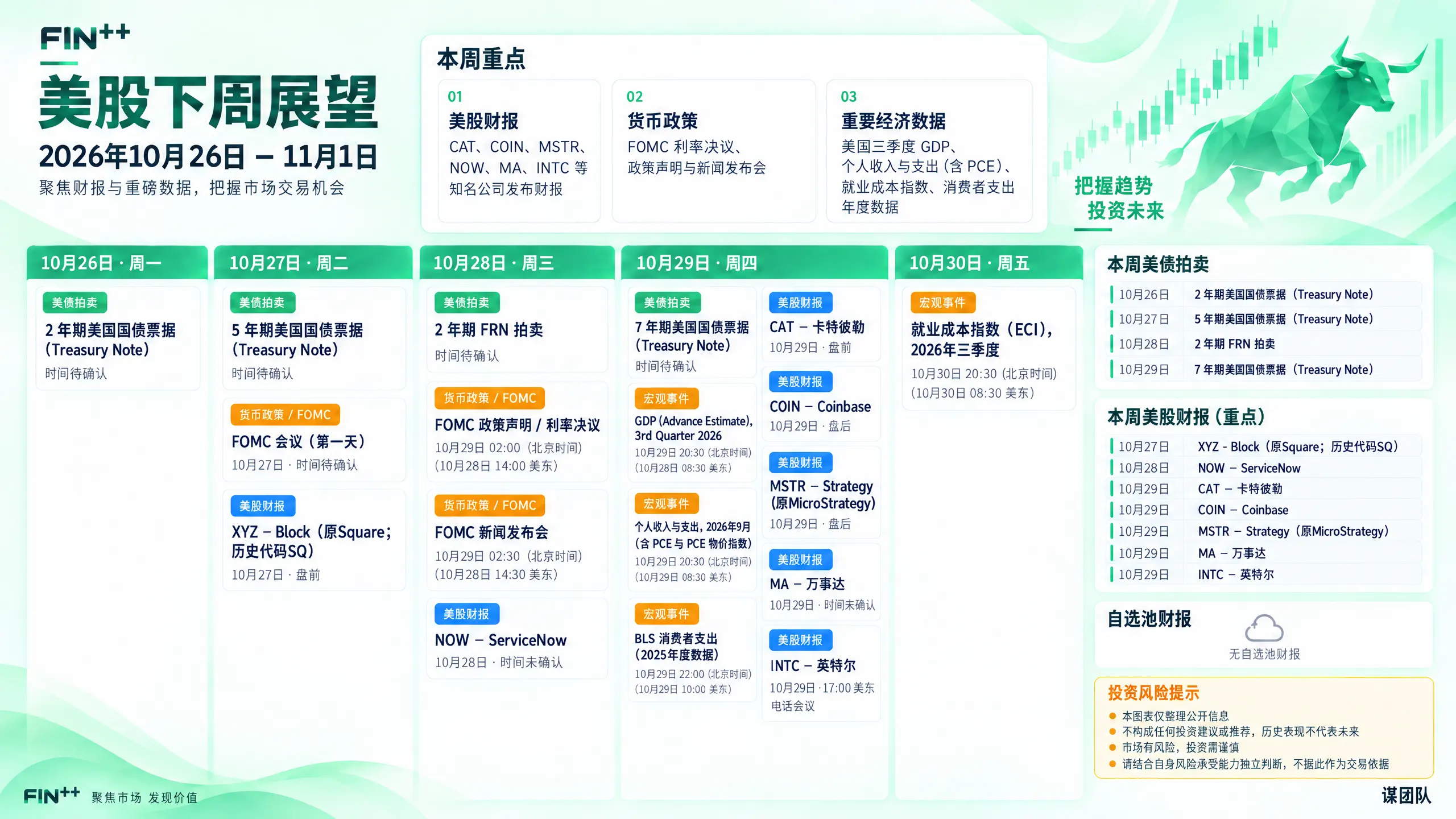
This week sees earnings colliding with rate decisions. Last week, Nasdaq 100 fell two weeks straight, narrowing from 5.5% to 0.8%; the knife on the AI chain dulled but wasn't sheathed.
This week's table: Wednesday rate decision, the first meeting after September hikes; market prices in a hold, watching for inflation wording changes in the statement. Wednesday after-hours: Microsoft, Google, ServiceNow report simultaneously. Thursday after-hours: Amazon. Watch if capex guidance accelerates further and where that money comes from. Within MAAI constituents, Vertiv reports Wednesday pre-market, ServiceNow Wednesday after-hours.
In short: Three cloud giants report AI revenue; one rate decision sets the price of money.
On positioning: Merger rumors lifted implied volatility for both Tesla and SpaceX; don't chase pre-event. At the index level, post-two-week-drop earnings week, position sizing matters more than direction. See website for specifics.
Premiums are paper, discounts are real. Before signing, ask: Who is printing this ticket, and when can it be sold?
(Views expressed are personal and do not constitute investment advice.)
The copyright of this article belongs to the original author/organization.
The views expressed herein are solely those of the author and do not reflect the stance of the platform. The content is intended for investment reference purposes only and shall not be considered as investment advice. Please contact us if you have any questions or suggestions regarding the content services provided by the platform.
Author's posts
View more[Weekly Strategy Report] Is a stock market crash coming? (Week 47, 2026 | Issue No. 297)
Last week, the Nasdaq fell 10.02%, marking its worst week since March 2020. The S&P 500 dropped for seven consecutive days, falling 8.61% for the week and retreating 11.6% from its Oct 6 high, entering a correction. On Friday alone, the Nasdaq fell 5.28%, the Philadelphia Semiconductor Index plunged 10.73%, and the VIX closed at 35.89. Within a month, the Nasdaq has seen a second single-day drop of over 5%. Let's settle some accounts first: in last week's weekly report three weeks ago, my call was 'another buy-the-dip opportunity,' and I outlined five conditions under which that view would be wrong. Two of those conditions have now materialized, meaning my judgment was incorrect. Reviewing them one by one...
3 likes[Mou Weekly] What if Jensen Huang comes back? What if he doesn't? (Week 46, 2026 | Issue No. 296)
NVIDIA fell 12.75% last week, marking its sixth consecutive weekly decline and the longest losing streak since 2012. In the same week, AMD rose 18.9%, Broadcom gained 18.2%, the Philadelphia Semiconductor Index surged 9.4%, and the S&P 500 climbed 2.6%. The market hasn't abandoned AI; it's dumping 'the only one.' On Thursday, Jensen Huang stepped down as President, CEO, and Director, with CFO Colette Kress taking over on an interim basis. This week, everyone has been asking the same question: Can he make a comeback? While this question deserves a serious answer, for position sizing, it's more critical to walk through both scenarios. Figure 1: Same week...
14 likes · 3 replies[Mou Weekly] Lightning Strikes During Storms: What to Do After a Plunge (Week 45, 2026 | Issue #295)
Last Thursday, the S&P 500 fell 4.35%, its worst day since the tariff war began in April 2025; the Philadelphia Semiconductor Index dropped 12%, marking its worst performance since March 2020, while the Nasdaq entered a correction phase. Friday saw a one-day rebound, but for the full week, the S&P 500 fell 2.7%, the Nasdaq 100 dropped 4.9%, and the SOX plunged 13%. My own account took a 16.53% hit on Thursday, the largest single-day loss since the pandemic. After such a crash, what should you do? First, let's discuss why you shouldn't make decisions on the night of a plunge, and then, if you must act, which leg to move first. Let's reconcile last week's ledger: I wrote five signals for admitting mistakes last week, and two appeared...
3 likes · 2 replies