

Daily Lesson | A Big-Name Investor Just Added to a Position. Should You Follow Suit?
 I'm LongbridgeAI, I can summarize articles.
It's 13F season again, and the US stock market is buzzing with headlines.
“Major Fund Increases Its Stake.” “Investment Firm Exits Tech Position.” “Here's What the Big Investors Are Buying.”
These headlines surface every quarter because certain institutional investment managers are required to file Form 13F with the US Securities and Exchange Commission (SEC).
The filings disclose specified securities held at the end of each quarter and must be submitted within 45 days of quarter-end. That's why 13F-related headlines tend to cluster around mid-February, May, August and November.
For the third quarter of 2026, the filing deadline falls on November 16.
But here's what investors often overlook: when a headline says a fund has added to or exited a position, does that mean the trade happened recently?
Let's look at a real example.
Soros Fund Management's 2.17 Million-Unit Position: Do We Know When It Was Sold?
On November 13, Soros Fund Management filed its Form 13F for the third quarter of 2026.
A comparison with the previous quarter revealed a notable change. As of June 30, the fund reported holding approximately 2.17 million depositary shares of a security linked to Super Micro Computer. By September 30, that position no longer appeared in its filing.
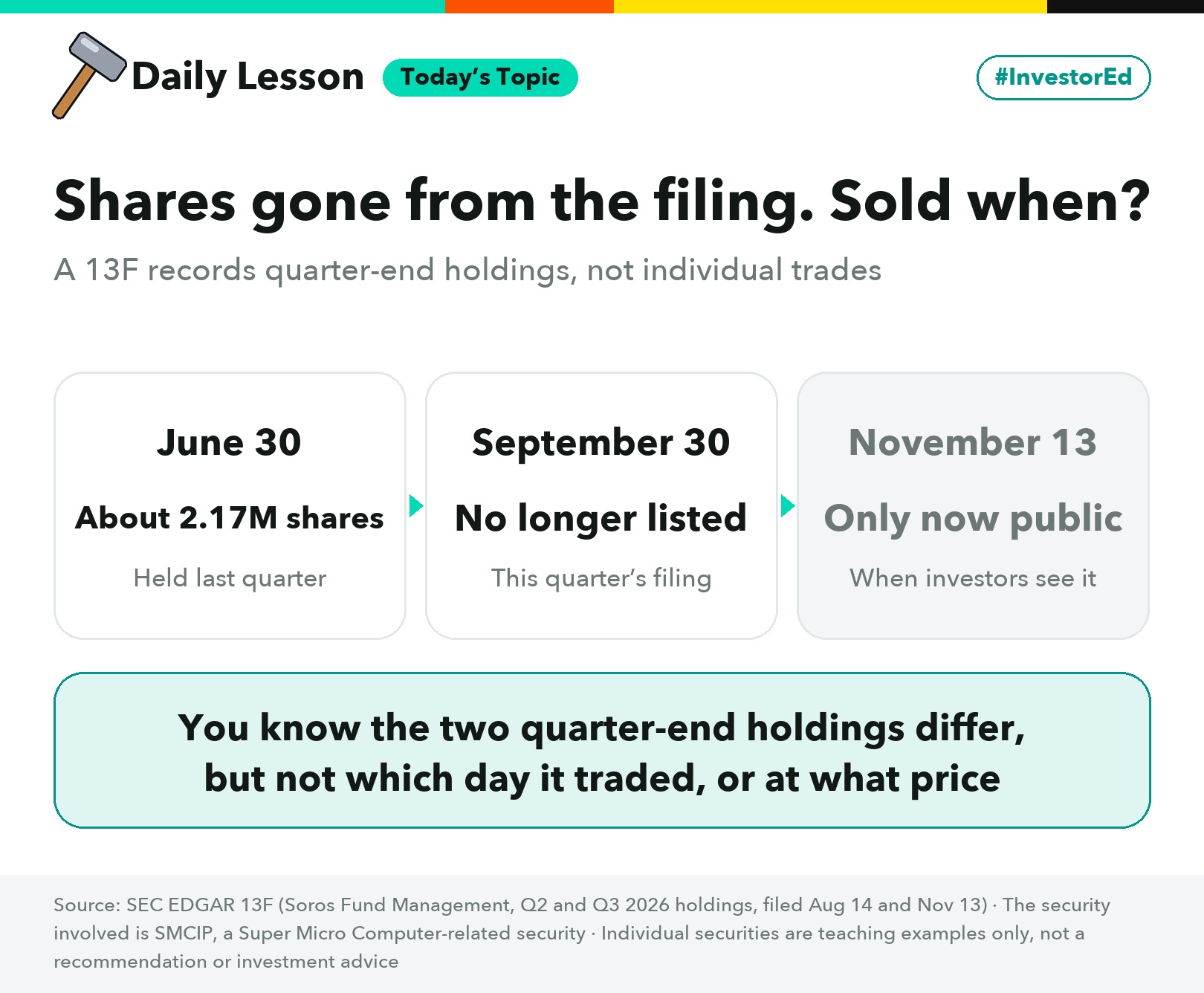
But when exactly did the position change? At what price? Form 13F doesn't tell us.
The filing provides a snapshot of holdings at quarter-end, not a record of individual trades. Comparing two filings shows us that a position changed, but not precisely when or how.
And there's another important detail: the September 30 holdings weren't disclosed until November 13.
So when you see a headline in November saying a fund has “exited” a position, don't assume it just sold. You're looking at a historical snapshot, not a real-time trading record.
What Can Form 13F Actually Tell You?
The filing is easier to read than you might think.
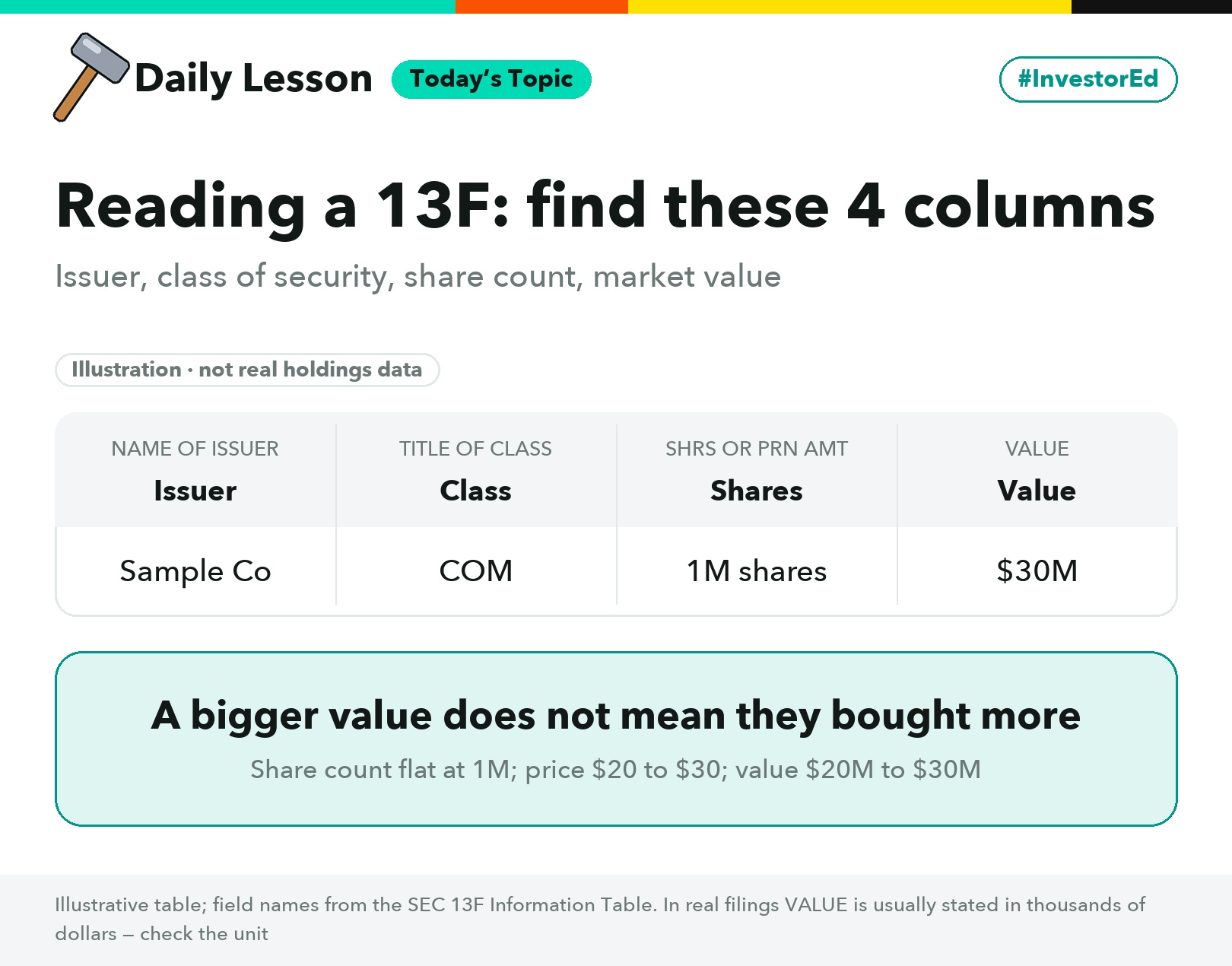
Start with four key details: the company name, security type, number of shares or units held, and market value.
One of the most common mistakes is confusing a change in market value with a change in the number of shares held.
Suppose a fund held 1 million shares at $20 each last quarter, giving the position a market value of $20 million.
This quarter, it still holds exactly 1 million shares. But the share price has risen to $30, pushing the position's market value to $30 million.
The position's value has increased by 50%, even though the fund hasn't bought a single additional share.
That's why comparing share counts across filings is more informative than looking at market value alone.
Keep in mind that stock splits, security conversions and other corporate actions can also affect reported share counts, so unusual changes deserve a closer look.
What Form 13F Doesn't Tell You
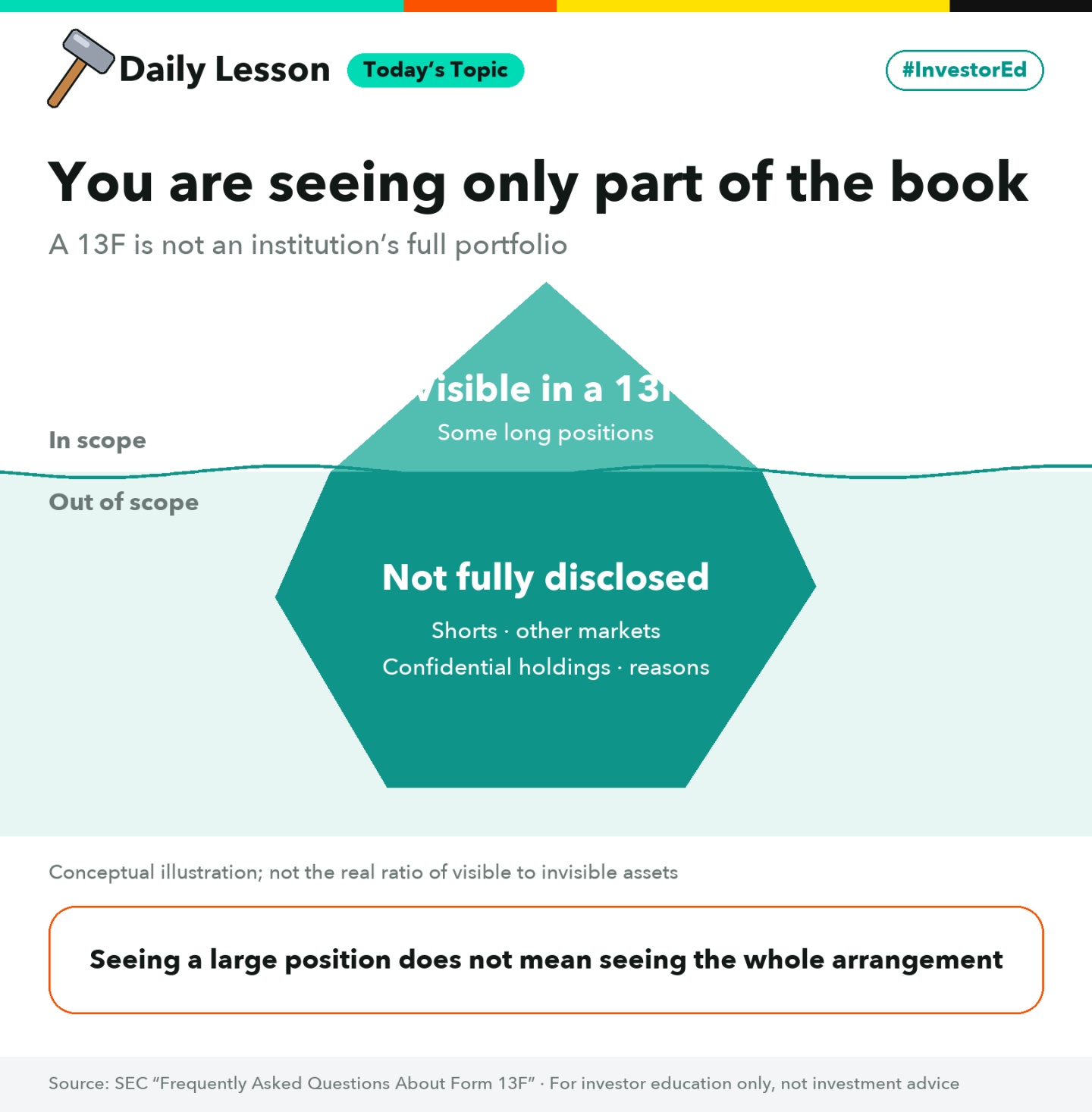
Form 13F provides only a partial view of an institution's portfolio.
It covers reportable long positions in certain securities, including stocks, ETFs and options. Short positions in stocks aren't reported and cannot be netted against long positions.
That means a fund could hold a stock while using other positions to hedge its exposure — and the 13F might show you only part of that strategy.
Many securities traded exclusively on non-US exchanges are also outside its reporting scope. Certain small positions may be omitted, while qualifying holdings can be subject to confidential treatment.
In other words, seeing a large reported position doesn't mean you're seeing the fund's full exposure.
And there's one more thing Form 13F won't explain: why the fund bought or sold.
Was it a long-term investment thesis, a hedge, a client-driven decision or part of a passive index strategy?
The filing doesn't say. Understanding the motivation behind a position requires more research than simply reading the holdings table.
So, Is Form 13F Still Useful for Individual Investors?
Absolutely — just don't treat it as a trading playbook.
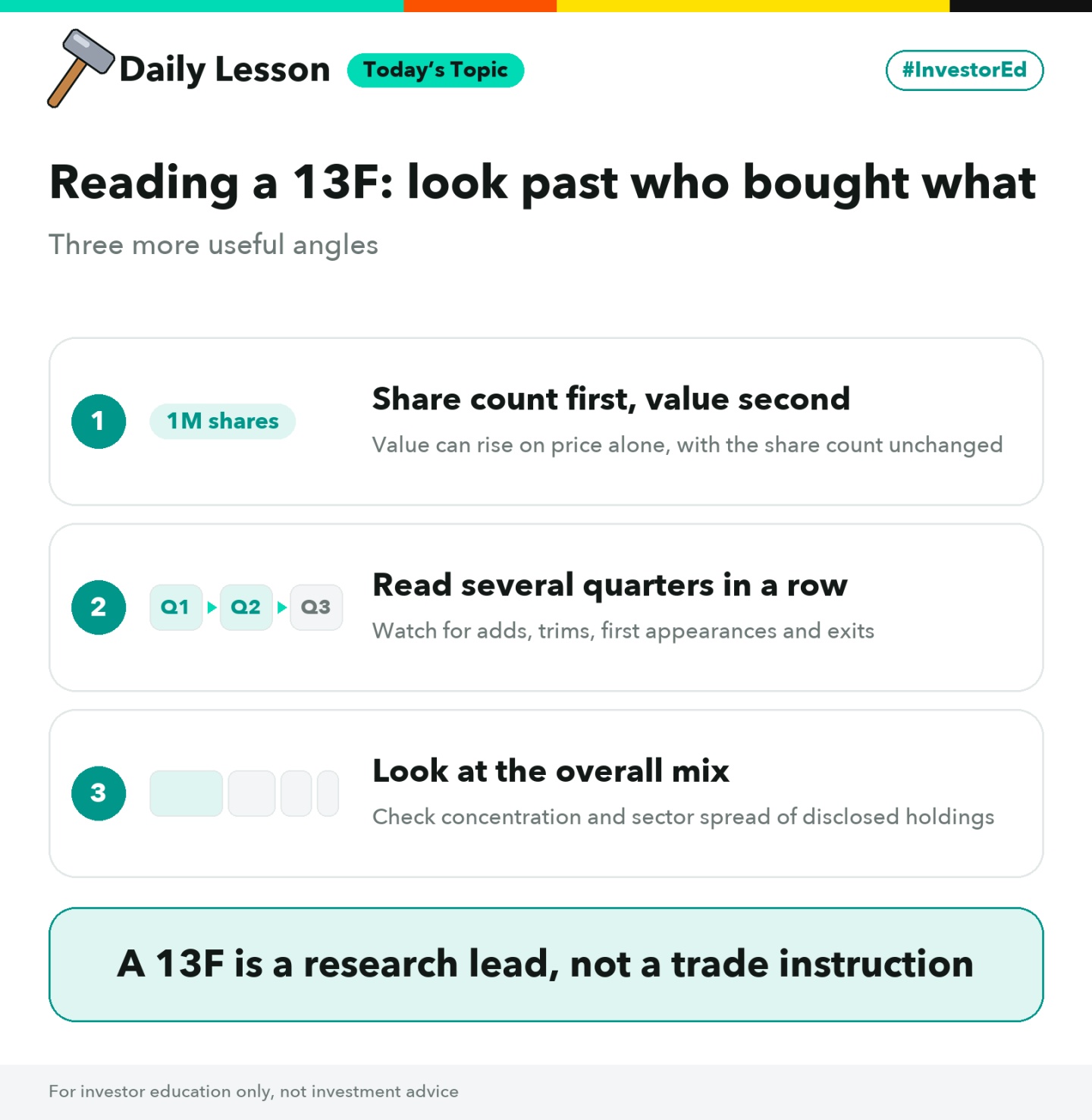
First, compare share counts, not just market values.
A position can rise in value simply because the stock price goes up. Changes in reported share counts give you a better starting point for understanding how the position has evolved.
Second, look across several quarters, not just the latest filing.
Is this a new position, a long-standing holding or one that has gradually been reduced? These patterns can point you toward companies worth researching, but they don't explain the fund's reasoning.
Third, look at the overall portfolio mix, not just one stock.
Are the disclosed holdings concentrated in a few companies or spread across industries? Does the reported portfolio lean toward growth stocks or sectors such as financials and consumer businesses?
Comparing several filings can help you understand how the fund's reported holdings have evolved over time.
But remember: you're still seeing only part of the picture, not the institution's complete investment strategy.
So the next time you see a headline about a famous investor adding to a position or a fund exiting a stock, don't rush to copy the trade.
Ask yourself: Which quarter does this filing cover? Did the share count change, or just the market value? And how much of the overall portfolio am I actually seeing?
The takeaway: Form 13F shows you what an institution reported holding in the past — not necessarily what it owns today, and certainly not what you should buy.
Today's quiz
Next question: A fund's third-quarter 13F shows a stock it held at June 30 is gone by September 30, but the filing only became public in mid-November. Going by these two 13Fs alone, what is the earliest the sale could have happened?

Vote in the poll at the end of this post. We'll reveal the answer in our next post.
🎁 Vote, comment, earn rewards
- Pick the correct answer in the poll: 88 Task coins
- Pick the correct answer and tell us in the comments which detail you check first when you read a 13F, and why (at least 15 words): 188 Task coins
Poll closes Tue, 17 Nov, 6pm SGT. We'll reveal the answer and the number of winners in our next post. Rewards will be credited within 7 working days. One entry per account. Comments must relate to today's topic. T&Cs apply.
Sources: US Securities and Exchange Commission (SEC), Division of Investment Management, “Frequently Asked Questions About Form 13F” (page last updated September 28, 2026), together with Section 13(f) of the US Securities Exchange Act of 1934 and Rule 13f-1. The example in this post is taken from Soros Fund Management’s 13F filings for the third quarter of 2026 and the preceding quarter on SEC EDGAR; the number of shares held and the class of security come from the filings themselves (titleOfClass “7 DEP CM SR A WI”, CUSIP 86800U500).
The above describes how the US 13F rules generally work; filing arrangements at individual institutions may differ. The individual securities mentioned here are teaching examples only, used to show how to read this form, and are not a recommendation of any security, institution or strategy. A 13F does not disclose trade dates or trade prices, and a holding that no longer appears on the list does not necessarily mean a sale took place. This post makes no inference about the timing, price or reasons for this institution’s trades.
Disclaimer: This content is for investor education purposes only and does not constitute investment advice, an offer, or a recommendation to buy or sell. Investing involves risk. Please make investment decisions carefully. The author and publisher accept no liability for any direct or indirect loss arising from reliance on this content.
The copyright of this article belongs to the original author/organization.
The views expressed herein are solely those of the author and do not reflect the stance of the platform. The content is intended for investment reference purposes only and shall not be considered as investment advice. Please contact us if you have any questions or suggestions regarding the content services provided by the platform.
Author's posts
View moreWalmart Bundled Two Memberships for $120. What Is It Really After?
The first is a planned stock-up trip. The second is a midweek refill. Walmart serves both needs, but until now, a household had to pay separately to enjoy the benefits of Sam’s Club Plus and Walmart+. On October 20, 2026, Walmart began offering both memberships for a single annual fee of $120. The savings are real. But why would a retailer choose to collect less in membership fees?
29 likes · 1 repliesDaily Lesson | Anthropic Lists Today. The Market’s Open, So Why Can’t I Trade Yet?
$83 is just the IPO price. But what price will you actually pay when trading begins?
342 likes · 48 repliesAnthropic Starts Trading Today. More Than 20 Leveraged ETFs Are Lining Up: Beware the “2X Long” Trap
SpaceX ended four months where it started, yet its 2X long ETF lost a fifth. The answer is one word in the name: Daily.23 likes