

2024 Week 14 Weekly Report

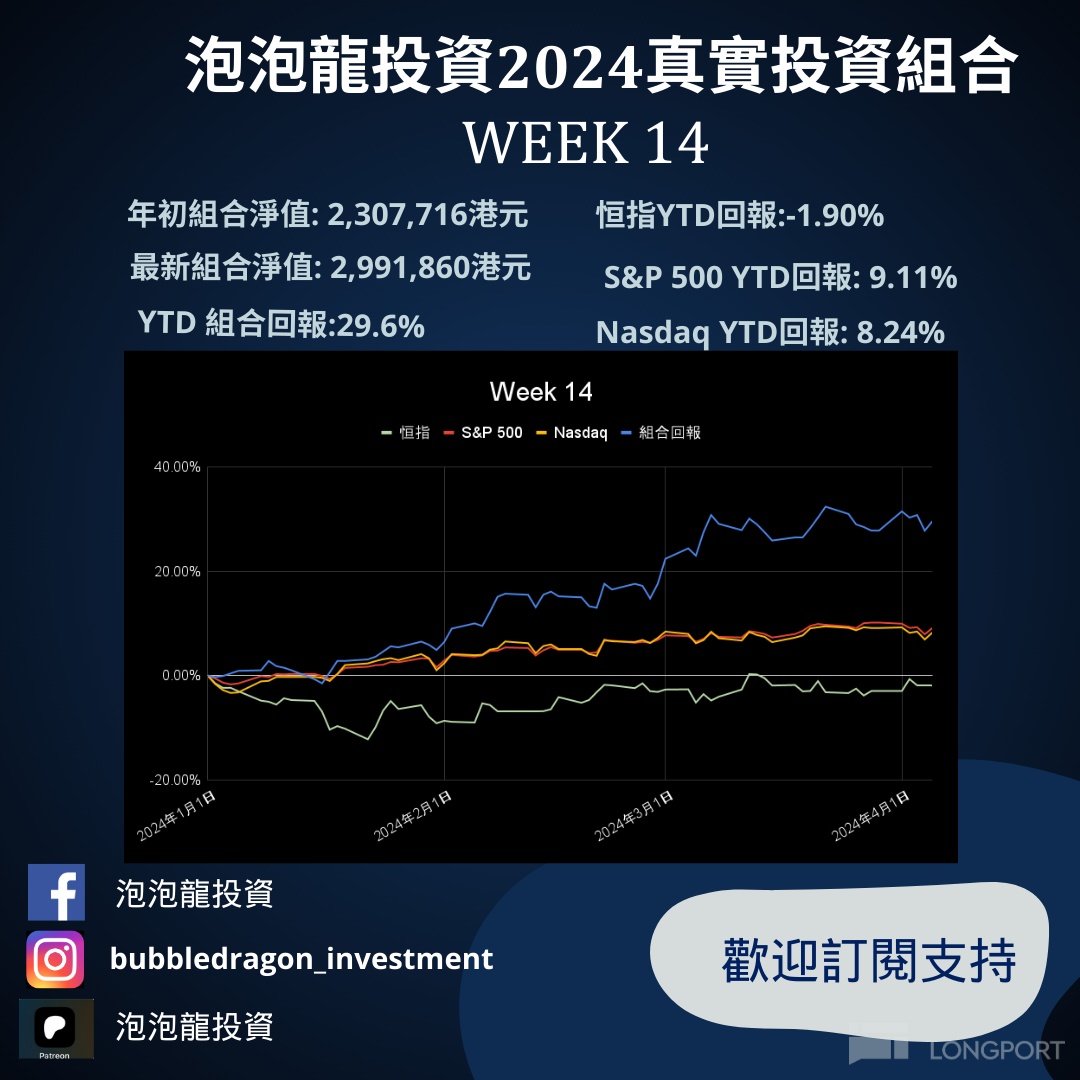
Portfolio NAV at the beginning of the year: HKD 2,307,716
Latest portfolio NAV: HKD 2,991,860
YTD return: 29.6%
Hang Seng Index YTD return: -1.90%
S&P 500 YTD return: 9.11%
Nasdaq YTD return: 8.24%
Portfolio
The overall portfolio return increased by about 2% compared to last week, which is a small gain. There wasn't much actual increase in the holdings this week, but maintaining a return around 30% is something to be grateful for.
Currently, the portfolio's YTD return is 29.6%, which is quite fortunate, outperforming the S&P 500 by about 20.5% and the Hang Seng Index by over 31%. In terms of market selection, it seems to be the right choice for now.
It's a bit unfortunate that the portfolio didn't benefit from the rise in oil and uranium stocks this time. Relatively speaking, I missed the moment when oil prices broke through and oil stocks surged, so by the time I noticed, the risk-reward ratio didn't seem attractive enough, and I didn't deliberately participate further.
A detailed review of the portfolio holdings is shared in the Patreon member area:
Hong Kong Stock Market
- As mentioned before, the Hong Kong market is relatively strong. Recently, while Japan and the U.S. markets have been adjusting, Hong Kong stocks remain quite "resilient." The core reason is that they've fallen enough, and valuations are already very low.
- I've also been redeploying some funds into Hong Kong stocks, and I believe global investors are doing something similar.
- In reality, the allocation amount doesn't need to be large—say, 5% is enough. But if global investors all take similar actions, the effect can be quite significant.
- I believe this situation will play out gradually over the next few years, so Hong Kong stocks won't skyrocket overnight but will strengthen step by step.
- However, for the market to truly enter a major uptrend, it still needs fundamental support. Being cheap alone has never been a reason for a big rally.
- Take Tencent (700) as an example. The recent strength in its stock price is partly due to decent earnings, but the key is the daily HKD 1 billion buybacks, which are substantial. With such buyback scale, the stock price is unlikely to weaken. But whether it can surge depends on whether the company's profits can continue to rise.
- I don't see any clear path for that. Domestically, Tencent seems to have limited room for growth. Internationally, it's starting from scratch and doesn't seem to have any particular advantage or competitiveness.
- For a former king like Tencent to see its stock price return to HKD 500 or above, some "Big Change" is needed.
- Tencent is a microcosm of Hong Kong stocks and Chinese companies. So, the day I sense some "obvious transformation," I believe it will be the time for global investors to aggressively buy Hong Kong stocks. At that point, I won't hesitate to go all-in on Hong Kong stocks again.
U.S./Japan Stock Market
- Recently, both the Japanese and U.S. markets have entered a correction phase. The core reason is the "Higher for Longer" interest rate environment. U.S. data continues to be very strong, which is truly impressive.
- In reality, different industries in the U.S. are experiencing polar opposites. Many companies are struggling and begging the Fed to cut rates ASAP, while large corporations are thriving, completely unfazed by the high-rate environment.
- This is the competitiveness of these companies, which is why the market gives them high valuations. In such a high-rate environment, these giants can still achieve year-on-year profit growth, further reinforcing their perceived competitiveness and justifying even higher valuations.
- Interestingly, whether in economic data or the stock market, these giants dominate, so the data doesn't reflect the pain of small and medium-sized enterprises (SMEs). But this is the law of the jungle—big fish eat small fish, survival of the fittest, natural selection.
- At this point, it's highly likely there will be only two rate cuts this year. I've always thought 2-3 cuts this year would be the most reasonable. After all, the pain of SMEs can't be completely ignored; they need some relief.
- Moreover, while CPI is slightly above expectations, it's not to an exaggerated extent that would reverse the rate-cutting trend—it just prolongs the process.
- So, in terms of investment strategy, it's not enough to just buy stocks that benefit from rate cuts. It's better to focus on fundamentals, industry trends, and company-specific developments, as this isn't the kind of liquidity-driven bull market we saw in 2020.
- This kind of bull market is called a "structural bull market," where certain industries develop rapidly, and some companies are destined to be star stocks. This is the healthiest type of bull market—more sustainable and analyzable, with less emotional influence.
- Finally, let's talk about the star stock Tesla. Friday night was another rollercoaster. First, the stock plunged on rumors that the company was abandoning its low-cost car project. Then Elon Musk clarified it was fake news, and the stock rebounded. Later, after hours, Elon dropped a bombshell, announcing that Robotaxi would launch on 8/8, sending the stock soaring.
- I've always emphasized that I won't invest in companies on the decline. Undeniably, Tesla is far from a bad company and has many growth avenues. But if we noticed China's price war and Tesla's declining car sales last year, wouldn't it have been better to exit then?
- You can have long-term faith in Tesla but still wait for a lower price to buy back in—the two aren't mutually exclusive. For example, I was very bearish on Tesla around $250 because car sales were clearly declining, and margins were shrinking.
- You could have sold then. Now, at around $160, you could re-enter as a long-term investor. This way, your cost basis would be about $90 lower, and if the stock rises back to $250, you'd already be up over 50%!
- Long-term investors, who understand the company better, should theoretically be able to avoid such a steep decline.
- As investors, sometimes it pays to be a little flexible—after all, the profits you make are your own, and you're the one who benefits.
The above is personal opinion and does not constitute investment advice.
The copyright of this article belongs to the original author/organization.
The views expressed herein are solely those of the author and do not reflect the stance of the platform. The content is intended for investment reference purposes only and shall not be considered as investment advice. Please contact us if you have any questions or suggestions regarding the content services provided by the platform.
