

Financial Mom Weekly Summary 137: What Should Investment and Trading Be Loyal To
 I'm LongbridgeAI, I can summarize articles.
" Your actions should align with the written plan."

The three major Hong Kong stock indices all rose. At the close, the $Hang Seng Index HSI.HK$ gained 0.80%, the Tech Index rose 1.42% to stand above 4,000 points, and the China Enterprises Index increased by 0.64%.
While recently studying how the wave trading strategy of Shanghai Twelve Young Masters achieves trend-following,
one key point discovered was clarifying what your investment trades should remain loyal to.
From a personal perspective, for trend-following investment strategies like wave trading, you should remain loyal to your strategy and expectations before entering the market,
and after entering, discard your expectations and remain loyal to the trend (the path of least resistance in the market) and the plan;
the trend will tell you which plan to choose and execute.
As for value investing strategies, before investing, you should remain loyal to value judgment and margin of safety; after investing, remain loyal to value judgment and the plan;
similarly, the periodic release of fundamental-related information will affect your value judgment of the company, thereby telling you which plan to execute.
For example, the plan might be to sell if fundamentals change, hold/exit if uncertain, hold if unchanged, increase holdings if undervalued and improving (if funds allow), or continue holding if funds are tight.
Regularly tracking fundamental information is to ensure you remain loyal to your value judgment of the held company based on the latest information;
but most so-called value investors either don’t track at all or, like Cai Ma, engage in self-deceptive tracking without remaining loyal to the post-tracking value judgment and related plans.
In short, your actions should align with the written plan.
Experts prioritize consistent plan execution to validate their ideas, believing that loyalty to the strategy will eventually be rewarded by the market for their patience and discipline;
naive investors prioritize chasing profits/succumbing to human weaknesses, neglecting what they should remain loyal to, and thus are constantly schooled by the market.
01—Live Trading Statistics and Fund Flow Tracking
This week's live trading: None
This week's live trading statistics:
Last week’s live trading saw $Muyuan Foods sz002714$ rise8.41%, Changchun High-Tech rise4.36%, $Focus Media sz002027$ rise1.85%, $Tencent Holdings hk00700$ rise1.81%, and Lead Intelligent drop1.3%,
Starting from November 2023, the live trading profit statistics table will be disclosed at the end of each month or the week with live trading. No statistics this week due to no trading.
This week's fund flow tracking:
The purpose of tracking weekly fund flows is to allow ordinary investors to assess whether the fundamentals of individual stocks/industries have begun to improve from a fund flow perspective, identifying turning points in probability for favorable bets.
Because institutional funds only continue to flow in significantly when they genuinely see improvements in company/industry operations and gain confidence; otherwise, rallies driven solely by company buybacks will be short-lived.
Note: When tracking weekly fund flows, pay attention to whether the company has recently announced buybacks/executive purchases and the amounts, preferably tracking after weekly oversold conditions and around earnings reports.
Perfect case:
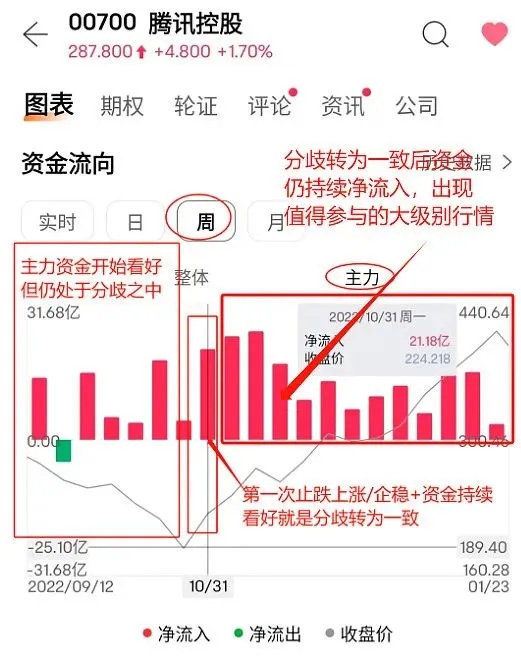
The weekly fund flow chart of Tencent’s previous oversold rebound, which doubled in the short term. Even during adjustments, institutional funds never saw net outflows, making it the best example of fund flow and price coordination. Placed here for reference.
This week’s live trading has no weekly oversold stocks, but there’s Focus Media, which reported earnings last week, and Tencent, which will report next week. Briefly track these companies’ weekly fund flows:
1. Focus Media
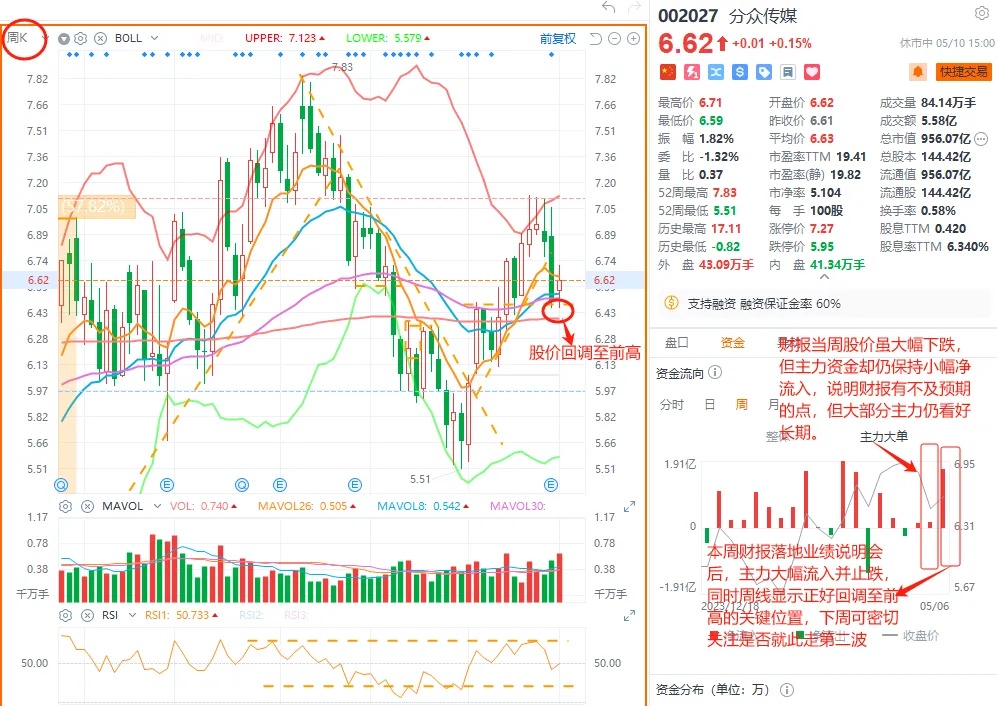
From the screenshot, after the earnings report, Focus Media corrected to a key resistance level at the previous weekly high. This week, institutional funds flowed in significantly, halting the decline.
This likely indicates more institutions have shifted from disagreement to consensus on the earnings shortcomings, agreeing the impact is minor,
Next week, watch closely for a potential second wave.
2. Tencent Holdings
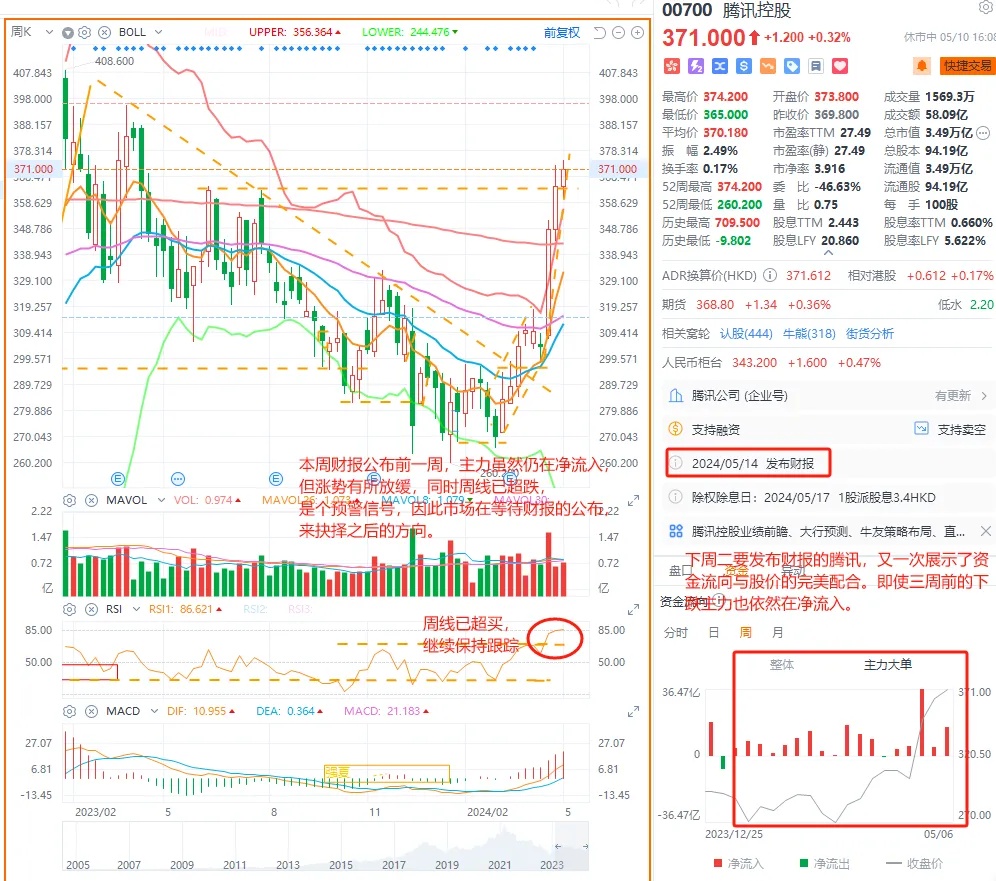
Tencent, reporting earnings next week, remains in a weekly uptrend. Institutional funds continued net inflows this week, but it’s overbought—suitable for holding but not chasing. Track further after next week’s earnings.
02—Live Trading Stock Fundamental Tracking
I. Focus Media: Investor Relations Report Explains Q1 Operating Cash Flow Decline, Alleviating Market Concerns
Previously mentioned, listed companies’ investor relations reports are a good way to understand how they’re improving operations.
This report, following the earnings call’s institutional research, reveals why institutional funds started flowing back in this week.
After reading, Cai Ma believes the main reason is the market’s divergent view on [the company’s Q1 operating cash flow decline] was reasonably addressed:
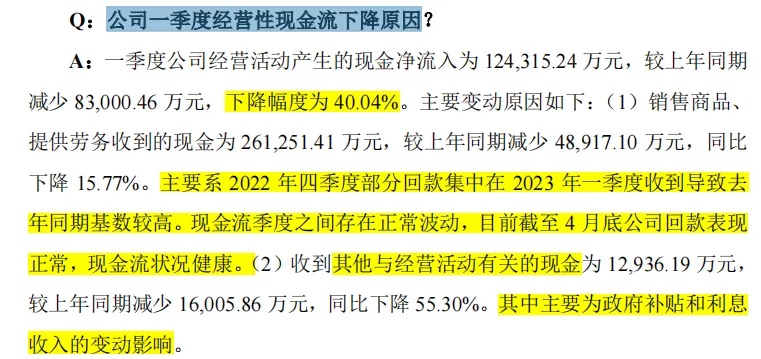
Regarding the significant 15.77% YoY drop in cash received from sales and services, the company explained:
Mainly due to some Q4 2022 payments being received in Q1 2023, creating a high base effect. Cash flow fluctuates normally between quarters. As of April, collections are normal, and cash flow is healthy.
Is this explanation plausible?
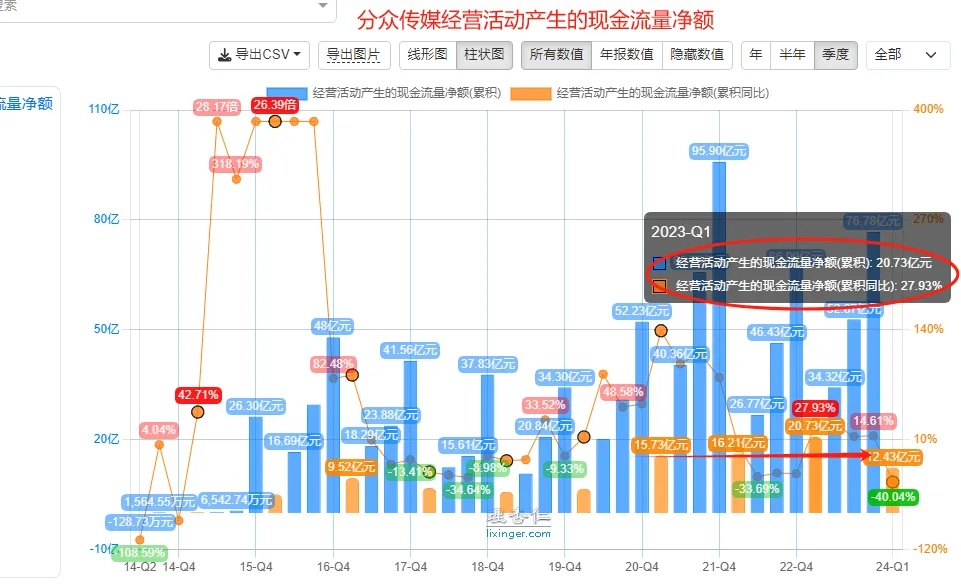
Comparing the company’s historical operating cash flow net amounts, Q1 2023 collections were indeed much higher than the same periods in previous years, creating a high base. The explanation holds.
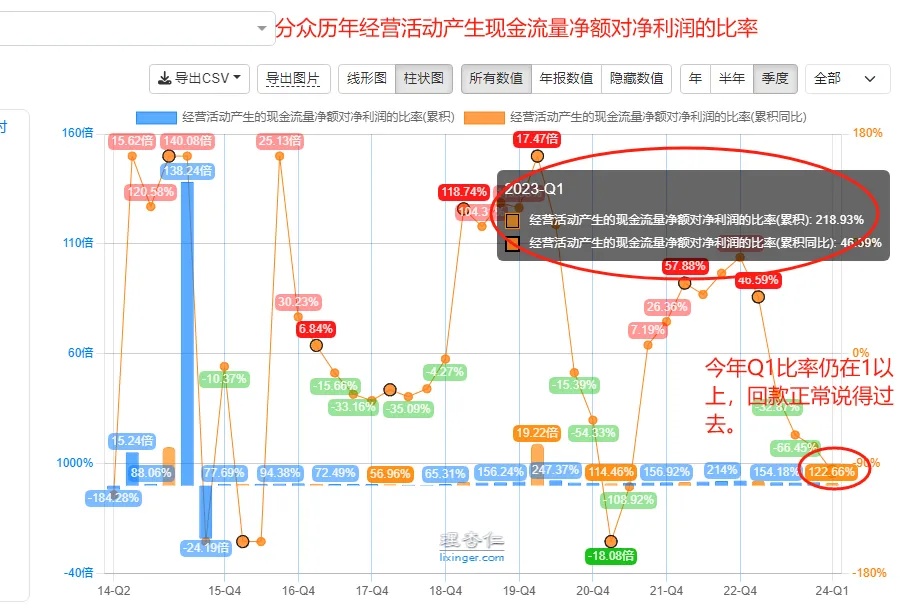
This is also evident from the operating cash flow-to-net profit ratio. In Q1 2023, this ratio was very high at 218.93%. This Q1, it remains above 1, supporting the claim of normal collections.
This also explains why Focus Media’s ratio has declined for four consecutive quarters. As long as it stays above 1, it’s indeed normal quarterly cash flow volatility—higher collections in one quarter naturally lead to lower collections in the next if total receivables are stable.
Thus, the company’s explanation is plausible, alleviating market concerns and prompting renewed institutional inflows.
For other details on operational improvements, download and read the report.
II. Muyuan Foods: Steady Operations in April, Lower Breeding Costs, Ample Credit Lines, Low New Loan Costs
This week, Muyuan also released an investor relations report. Key points:
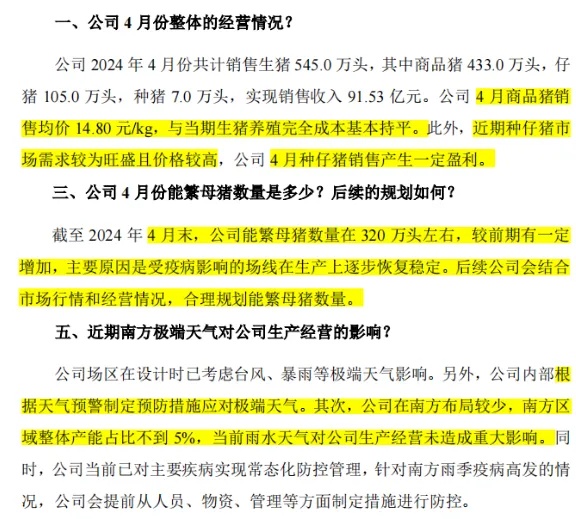
1. Operations: April hog prices roughly matched costs; breeding pig sales generated some profit. Sows inventory rose slightly, with adjustments as needed. Extreme weather impact was minimal due to low exposure and controls.
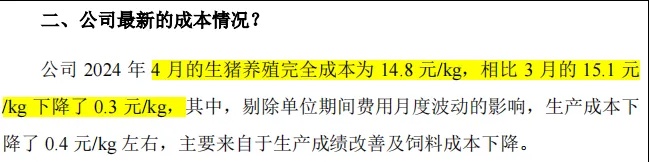
2. Cost reduction: April’s hog breeding costs dropped by 0.3 yuan/kg vs. March.
3. Financing & debt: Ample credit lines; low new loan costs.
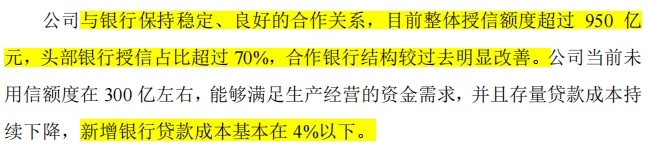
Notably, Muyuan’s unused credit lines total ~30B yuan, with new loan costs mostly below 4%.
Envy-inducing! It brings to mind Charlie Munger’s words:
We’re like hedgehogs with one trick: find float costing less than 3%, then invest in businesses yielding 13%.
This applies to corporate operations too, though sub-3% float is rare domestically; sub-4% is already good.
However, even low-cost loans should fund high-return primary/secondary businesses, not reckless diversification.
Overall, Muyuan remains steady. Continued tracking.
Hope this helps. Until next time.
Disclaimer: This article shares Cai Ma’s trading system philosophy and investment logic, not advice. Any mentioned stocks are not recommendations. Markets are risky—invest prudently!
The copyright of this article belongs to the original author/organization.
The views expressed herein are solely those of the author and do not reflect the stance of the platform. The content is intended for investment reference purposes only and shall not be considered as investment advice. Please contact us if you have any questions or suggestions regarding the content services provided by the platform.