

From the analysis of two factors, what kind of opportunity are you looking for in the market?
 I'm LongbridgeAI, I can summarize articles.
" Before screening assets/market trends, you should be very clear about what you are looking for."

Today, the main Hong Kong stock indices generally showed a high-open-low-close trend. The three major indices rose slightly at the opening but continued to decline throughout the day, with losses widening in the afternoon. The $Hang Seng Tech Index HSTECH.HK$ once fell by 2.2% and finally closed down 1.78%, while the $Hang Seng Index HSI.HK$ and the China Enterprises Index fell by 0.59% and 0.68%, respectively.
Large-cap tech stocks continued to decline in the afternoon, dragging down the market. $Meituan-W HK03690$ opened high but closed low after earnings, falling over 2%.
Recently, an investment friend interested in swing and trend trading reached out to learn and grow together.
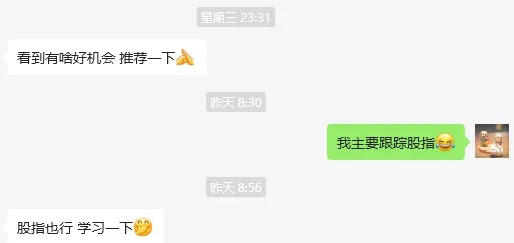
On Wednesday night, they suddenly messaged me: "Seen any good opportunities? Recommend something."
Since researching swing strategies, I’ve become increasingly reluctant to disclose my ongoing trades or spotted opportunities outside of long-term positions.
I’ve also stopped caring about what influencers buy or sell, focusing only on tracking swing opportunities in assets I’m familiar with.
Because I’ve come to realize that what’s honey for one investor may be poison for another,
the opportunities and responses required for different investment styles are entirely different.
I also believe in the saying: "Those who know don’t speak; those who speak don’t know."
So, when faced with requests for stock codes, I politely decline.
After explaining that I mainly track indices, my friend said: "Indices are fine too—let’s learn together."
At that point, I realized their intention wasn’t just to get a code,
but to practice identifying strong-trend entry points using the "Shanghai Twelve" swing strategy we’d recently studied.
01—A Recent Swing Opportunity
So, I shared a few opportunities I’d spotted in assets I track that fit the "Shanghai Twelve" swing strategy.
We then discussed the clarity of entry signals,
and both agreed that the clearest signal appeared in $VanEck Vectors Digital Transformation ETF DAPP$,
which I started tracking post-Bitcoin halving out of curiosity (historically, halvings led to big rallies—I wondered how this one would play out).
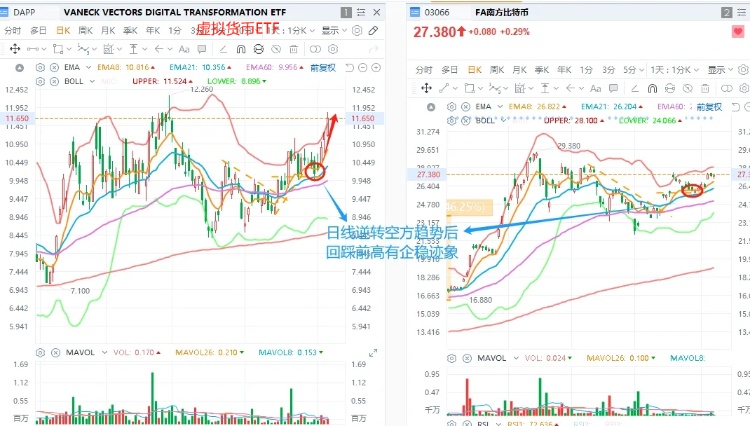
The chart shows that after the crypto ETF reversed its bearish trend two weeks ago (breaking the downtrend line and previous high), it stabilized near the prior high,
presenting a 1-3 day swing entry opportunity under the strong-trend strategy.
Under my earlier swing strategy, I’d enter near the prior high and hold for up to three days.
But the new "Shanghai Twelve" strategy requires riding the trend until it breaks the rising trendline formed by the three-day low.
Through our discussions, we realized we’re looking for different opportunities.
He prefers fundamental stock-picking, entering when strong signals appear and holding until the trend ends—a long-term trend trader.
I focus on swing opportunities in a few familiar assets, adjusting holding periods based on trend strength—a swing trader.
This reaffirms that market opportunities can be honey for one but poison for another.
So, before screening assets/market trends, you should be very clear about what you’re looking for.
02—Two Factors: What Kind of Opportunity Are You Seeking?
Two factors can clarify what opportunities you’re after.
Expected asset volatility and trading frequency reveal the type of opportunity you seek.
High expected volatility + low frequency → long-term trend/value opportunities.
Medium volatility + medium frequency → mid-term/swing opportunities.
Low volatility + high frequency → short-term/day-trading opportunities.
Expected volatility depends on market/asset traits, your risk tolerance, and your ability to judge trends/value growth.
Trading frequency depends on market/asset traits, your trading preferences, and opportunity frequency.
Thus, understanding your investment needs, capital nature, and personality is as crucial as understanding the market—if not more.
As trading legend Larry Hite put it:
"To me, this is a Zen-like industry—your most useful tool is yourself."
Of course, what you seek and what you can find aren’t always the same. True opportunities arise when they align.
And no matter the opportunity, always size positions according to your risk controls and tolerance.
Hope this helps—see you next time.
Disclaimer: This article shares my trading philosophy and logic, not investment advice. Any stocks mentioned are not recommendations. Markets are risky—invest wisely!


The copyright of this article belongs to the original author/organization.
The views expressed herein are solely those of the author and do not reflect the stance of the platform. The content is intended for investment reference purposes only and shall not be considered as investment advice. Please contact us if you have any questions or suggestions regarding the content services provided by the platform.