

 Likes Received
Oracle (ORCL) Q4 earnings report and valuation analysis


1. Current Performance and Stock Rating
On the morning of June 12 (Beijing Time), Oracle Corporation released its Q4 fiscal report. $Oracle(ORCL.US)
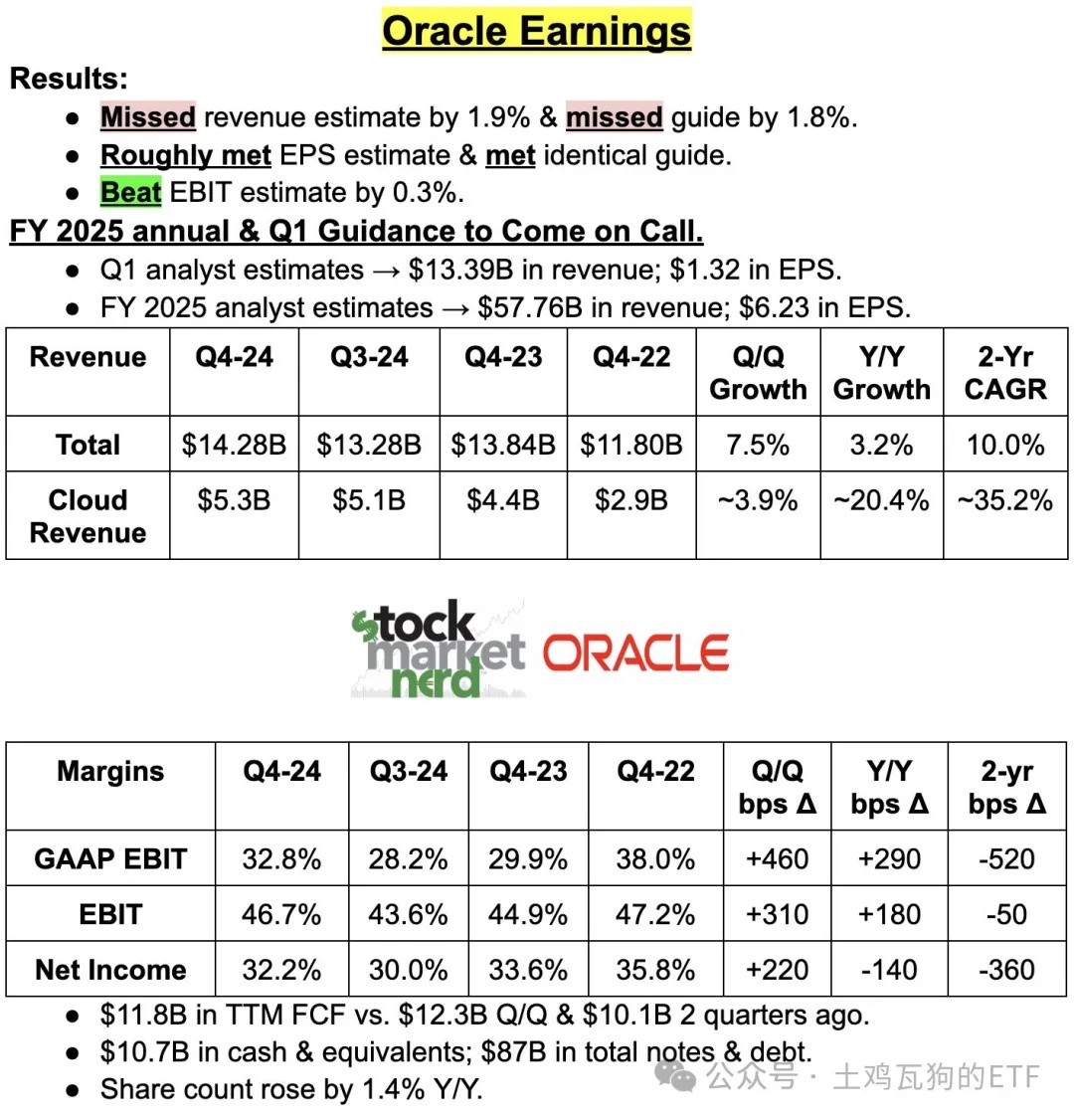
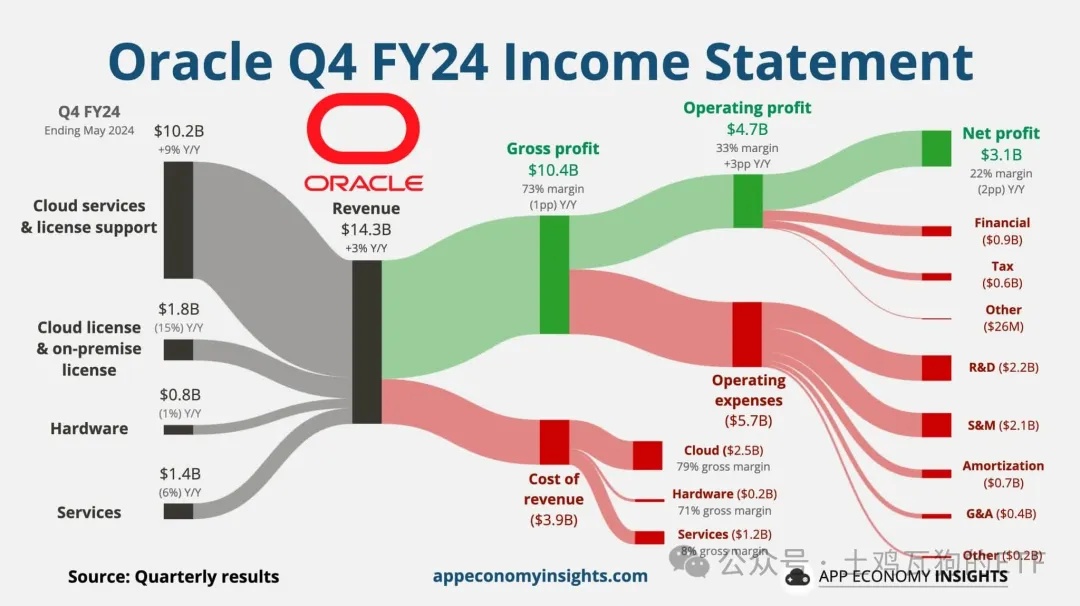
1. Revenue was $14.3 billion, up 3.3% YoY, slightly below the expected $14.6 billion.
2. Net profit was $3.14 billion, or $1.11 per share, down from $3.32 billion and $1.19 per share in the same period last year. However, adjusted EPS was $1.63, close to the analyst expectation of $1.65.
3. Cloud-related revenue performed well, with IaaS revenue up 42% YoY and SaaS revenue up 10% YoY. The majority of total revenue came from cloud revenue, reaching $5.3 billion, up 20% YoY. Cloud business growth and AI-related contracts were the biggest drivers of performance, exceeding analyst expectations. The collaboration with MSFT and the cloud interconnect plan with Google Cloud also indicate future growth.
4. Total remaining performance obligations (RPO) were $98 billion, with AI-related contracts growing by 44%, including $12.5 billion in contracts with OpenAI and others.
5. The CEO stated that increased AI demand, particularly contracts with OpenAI, drove RPO growth. The CTO noted that the cloud collaboration with Microsoft has expanded significantly, with 11 of the 23 OCI data centers under construction now operational.
2. Oracle's Long-Term Strategy and Goals
Guidance: The company expects double-digit revenue growth for fiscal 2025, above market analyst expectations, reflecting Oracle's confidence in demand for its AI cloud services. This positive outlook drove the stock price up 9% in after-hours trading.
Oracle is one of the oldest software companies in the market, with a business covering all layers of the tech stack. Earlier, the company set its fiscal 2026 financial targets, including $65 billion in revenue, a 45% non-GAAP operating margin, and double-digit annual EPS growth.
I am constructive on Oracle's ability to achieve its $65 billion revenue target, primarily due to:
1) Market share growth in the Infrastructure-as-a-Service (IaaS) segment;
2) Strong execution in strategic back-office applications;
3) The long-term opportunity to convert database support customers to autonomous databases. However, I remain cautious about Oracle's ability to transition its maintenance customers to cloud-native products.
3. Oracle Analysis Under an Investment Framework
The company has a deep tech stack and a large customer base in a sizable total addressable market (TAM), with innovative strategies and scale advantages in autonomous databases and ERP.
However, continued market share loss in databases, customer diversification beyond Oracle, and limited exposure in new application areas are its weaknesses. Nonetheless, I believe Oracle will continue to gain share in the IaaS market.
4. Valuation and Key Risks
I have raised my 12-month price target for Oracle from $120 to $150. Of course, strong AI momentum could bring additional valuation premiums. This target price is based on a balanced weighting of discounted cash flow (DCF), forward P/E for the next four to eight quarters, and enterprise value to free cash flow (EV/FCF).
Key upside risks include: 1) A reversal in database market share loss, 2) Above-expectation share growth in IaaS, 3) Positive cost-cutting from the Cerner acquisition, 4) Reacceleration of Cerner's business, 5) Outperformance of autonomous databases, 6) Acceleration in generative AI workloads.
Downside risks include: 1) Accelerated database market share loss, 2) Slow integration of Cerner's business, 3) Limited appeal of IaaS despite heavy capex, 4) Higher-than-expected capex burden to sustain IaaS revenue growth, 5) Limited share buyback pace.
The copyright of this article belongs to the original author/organization.
The views expressed herein are solely those of the author and do not reflect the stance of the platform. The content is intended for investment reference purposes only and shall not be considered as investment advice. Please contact us if you have any questions or suggestions regarding the content services provided by the platform.
