
2024 Week 52 Weekly Report
 I'm LongbridgeAI, I can summarize articles.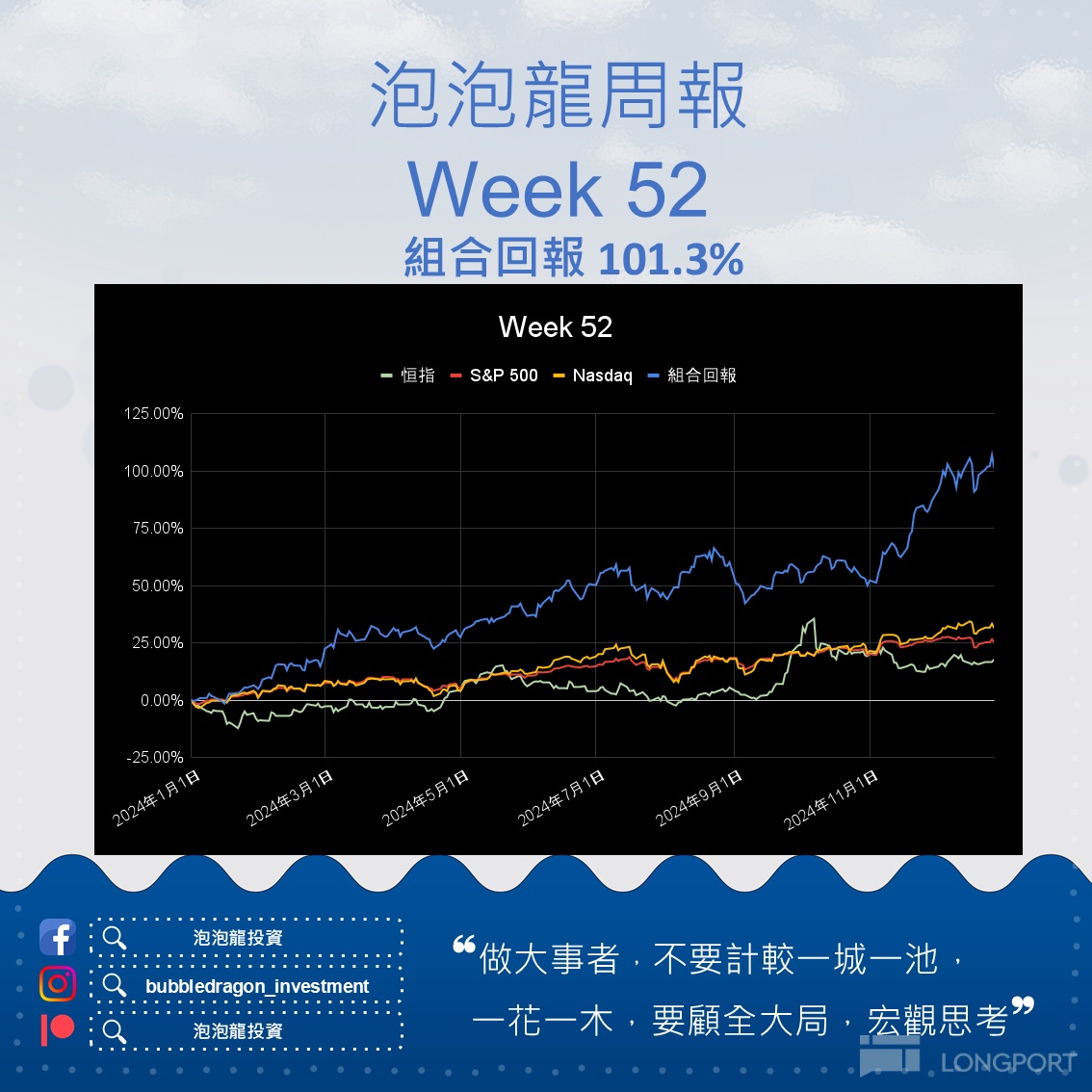
Portfolio NAV at the beginning of the year: HKD 2,307,716
Latest portfolio NAV: HKD 4,642,076
YTD return: 101.2%
Hang Seng Index YTD return: 17.85%
S&P 500 YTD return: 25.18%
Nasdaq YTD return: 31.38%
Closing bell! The last week of 2024 has ended! Both Hong Kong and U.S. stock markets saw index gains this year, so theoretically everyone's wealth should have grown—and I believe the growth shouldn't be lower than the index returns. If you lost money or underperformed the indices this year, it's crucial to identify the issues and make improvements. After all, investing isn't a timed race; it's more like your life, a lifelong journey.
Portfolio
The portfolio's final YTD return is 101.2%, barely exceeding 100%, which is still a decent result. This performance is neither the best nor the worst—especially given the abundance of high-flying U.S. stocks this year. Just look at the recent quantum computing stocks, many of which surged several-fold, riding a massive bullish wave. So, while the 101% return reflects my skills and effort, it also benefited from the overall market euphoria.
Key points: The portfolio barely used leverage, and trading activity was generally low—sometimes no trades for a whole week. The goal is to make it easy for others to learn and replicate, allowing them to grow wealth through investing while working.
Market Outlook
Let's briefly discuss Hong Kong stocks. As I've repeatedly emphasized, the Hong Kong market is about "stock-picking, not market-timing." While there's no major rally, many individual stocks offer solid investment/speculation opportunities, with some quietly trending upward. Since November and December's policy disappointments, a major Hong Kong market rally seems unlikely, given renewed skepticism about economic recovery and lackluster data.
However, both A-shares and Hong Kong stocks have standout performers, indicating lingering capital interest that keeps the market somewhat lively. This week's spotlight was on #Xiaomi, whose shares nearly hit all-time highs amid news of its AI chip investments. Another was #SMIC, which has been climbing steadily with strong momentum.
There are many similar cases in Hong Kong stocks, so investors should focus on a few high-conviction picks rather than diversifying too much. While concentration raises risk, excessive diversification would only drag down returns in this lukewarm market.
As for U.S. stocks, recent volatility has been extreme. After a clear "Santa Rally" earlier, Friday saw a sharp sell-off. Though dip-buying emerged later, the overall trend is starting to raise doubts. U.S. stocks have soared this year, especially thematic plays—some seemingly without a ceiling. But is this rational? Quantum stocks rising 10x in two months—are applications really taking off? Do we even understand quantum computing? I don't. Are these gains justified? Food for thought.
The biggest challenge in U.S. stocks now is sky-high valuations, especially in recent months. Take #PLTR: its PS is in the dozens and PE in the hundreds. While growing, the company isn't small anymore, with annual profit growth around ~50%. At this pace, it might take 5-10 years for PE to drop below 50x—unless growth accelerates dramatically, which seems unlikely to me.
Thus, buying or holding high-valuation U.S. stocks carries significant risk. Yet, I can't rule out further all-time highs. That's why I call U.S. stocks high-risk now. I've consistently argued for a 10-20% index correction to reset the uptrend more sustainably.
Follow me on FB, IG, or Patreon. Thanks!
Disclaimer: I am not licensed by the Hong Kong SFC. Content is personal sharing only, not investment advice or solicitation.
$SoFi Tech(SOFI.US) $Tesla(TSLA.US) $NVIDIA(NVDA.US) $XIAOMI-W(01810.HK) $SMIC(00981.HK) $MEITUAN(03690.HK) $Strategy(MSTR.US)
The copyright of this article belongs to the original author/organization.
The views expressed herein are solely those of the author and do not reflect the stance of the platform. The content is intended for investment reference purposes only and shall not be considered as investment advice. Please contact us if you have any questions or suggestions regarding the content services provided by the platform.