

 Rate Of Return
Tesla 2024 Q4 earnings report interpretation - stock price support still relies on pie-in-the-sky AI promises

Previously, $Tesla(TSLA.US) released its Q4 2024 earnings report. Judging solely by the numbers, most of the results fell short of expectations. However, since the delivery figures were already known, the gap wasn’t significant. Moreover, Tesla's revenue still primarily relies on car sales, but this segment’s impact on the EV market valuation is diminishing.
There’s not much to say about Tesla’s earnings report—it’s largely similar to previous quarters. With no new car models for years, growth in the EV business has essentially stalled. The main potential now lies in AI, FSD, and other new ventures. This quarter’s report shows the EV business remains at rock bottom, while AI is gearing up for a major breakthrough.
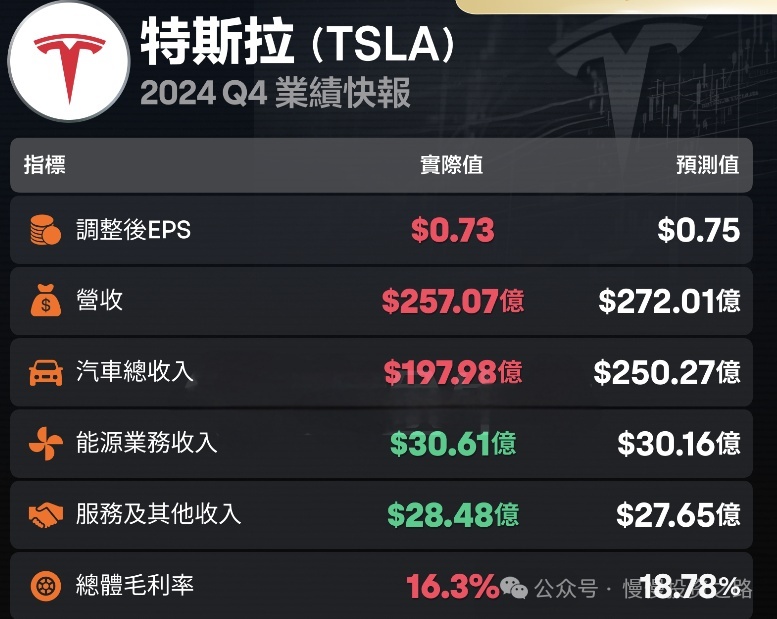
Overview of Tesla’s earnings report
I’ve been tracking Tesla’s earnings for a long time and have written extensively about them, from when the stock was at $100 to $300. My views haven’t changed much: Tesla’s diversified business means $100 was the historical bottom, $150 was undervalued, and anything above $150 reflects premiums for FSD, AI, and other new ventures—valuations that are hard to pin down accurately, leaving much to imagination. Personally, I bought Tesla three times at $125 and $150, selling around $200. While I missed gains above $200, holding at the bottom gave me peace of mind. Interested readers can check my earlier articles:
Tesla Q3 2024 Earnings Breakdown—EVs Poised for a Rebound
Tesla Q1 2024 Earnings Breakdown—Buy the Dip, Sell the Rally
Tesla Q4 2023 Earnings Breakdown—EV Growth Myth Shattered, Revaluation Needed
Is It Time to Bottom-Fish Tesla After the Plunge?

Tesla’s Alpha Play—Q4 Earnings Preview
Tesla Q4 2022 Earnings Breakdown—The Answer Is Clear
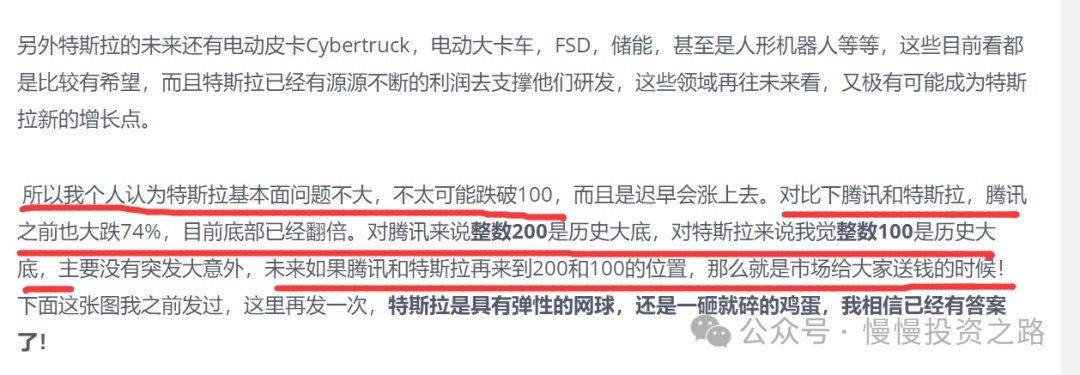
One of these articles was honored as the top 精华 article by a brokerage platform last year:

Let’s dive into Tesla’s earnings data for reference.
I. Overall Earnings Snapshot
1. Revenue
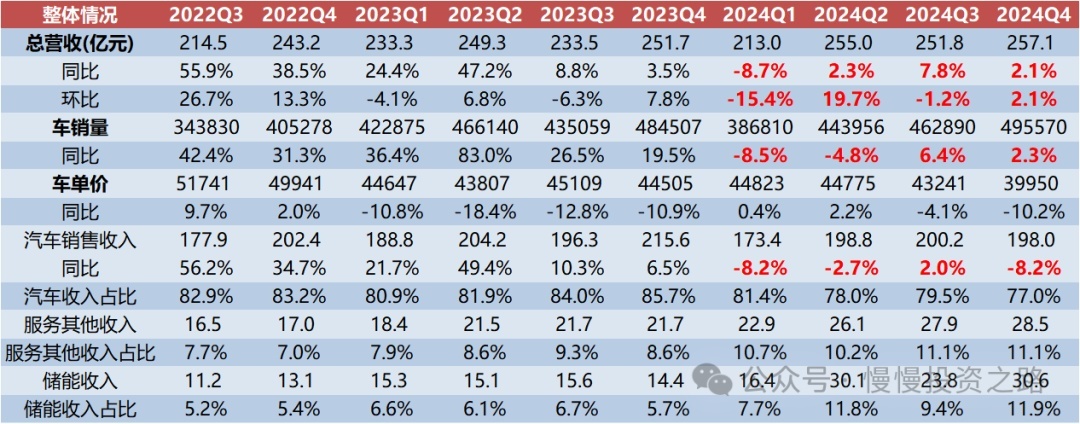
Tesla’s Q4 revenue hit $25.71B, up 2.1% YoY. Breaking it down, growth was mainly driven by energy storage, while core auto revenue slid 8.2%—the third drop in four quarters. This aligns with trends in China, where Tesla, without new models, struggles against local rivals. The Model Y remains its lifeline, as the Model 3 is now outsold by Xiaomi’s SU7.
Energy storage doubled YoY but only accounts for 11.9% of revenue. AI-related businesses are still in investment mode, with no near-term contributions. New models like Cybertruck are delayed or low-volume, and robotaxis are pushed to 2026. Yet Musk reiterated on the call: EV sales may grow 25%-30% in 2025. Take that with a grain of salt.
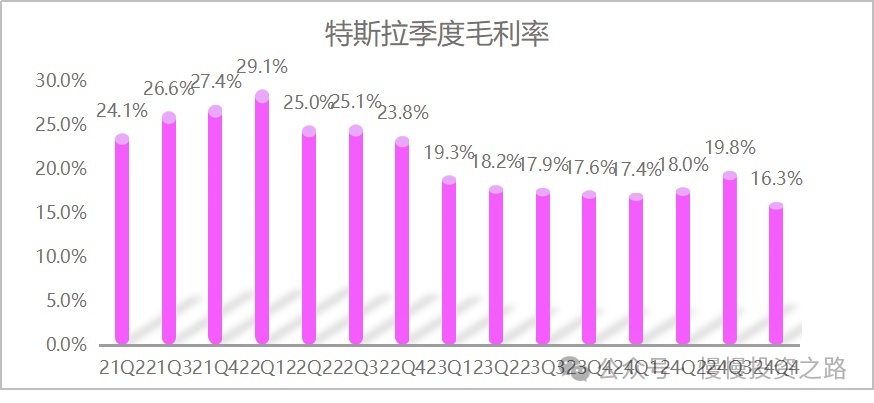
2. Gross Margin
Q4 gross margin was 16.3%, down YoY and QoQ, including ~$700M from carbon credits.
3. Net Profit
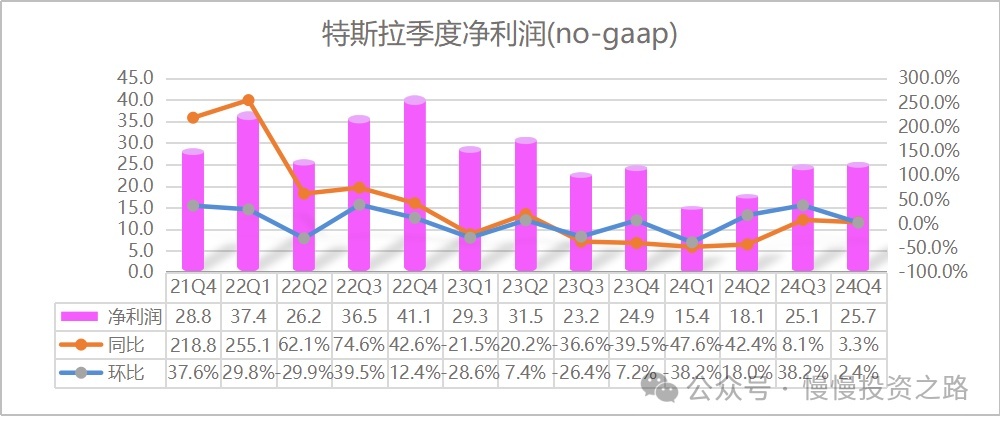
Non-GAAP net profit reached $2.57B, up 3.3% YoY, marking two straight quarters of growth after four declines. Still, this pace is sluggish for U.S. stocks—Tesla needs an EV rebound and breakthroughs in FSD/AI.
4. Expenses
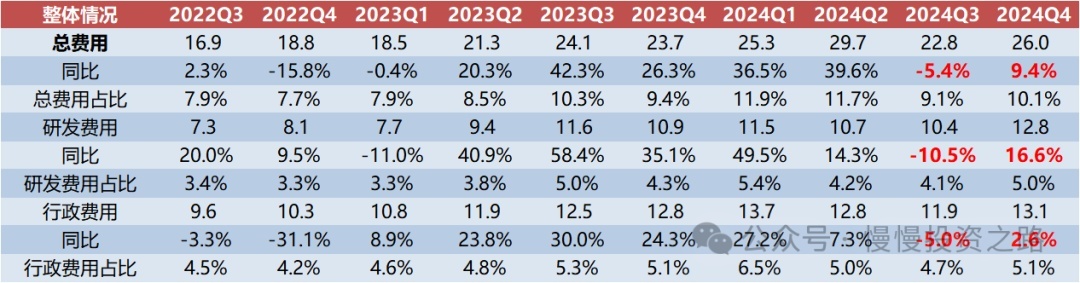
Total expenses rose 9.4% YoY to $2.6B, fueled by AI investments. Check out Tesla’s factory/server room pics in the report—impressive but costly.
II. Earnings Call Highlights
Tesla’s earnings data often take a backseat to Musk’s commentary, especially on AI ambitions. This quarter focused on FSD and Optimus—key future growth drivers.
1. New Models:
Launching several products in 2025, including a budget model by mid-year.
2. FSD:
- V13 showed major improvements; V14 will leap further. Unsupervised FSD launches in Austin in June, expanding to other U.S. regions by year-end.
- Thousands of Fremont factory cars already park autonomously. AI capex totals ~$5B; 2025 spending may flatline.
- Interest from automakers in licensing FSD, but U.S. rollout takes priority.
- China training hurdles: Data can’t leave China, and U.S. bans local training. Workaround: Simulators with Chinese road rules.
3. Optimus (Humanoid Robot):
- Cortex training cluster built in Texas; needs 10x more compute than cars.
- Thousands of Optimus bots doing dull/dangerous factory tasks by year-end. Aims for 100M units annually long-term.
- Version 2 due next year, with external sales possible by late 2025.
- "Prototypes are easy, mass production is hard." Tesla’s real-world AI and scaling edge set it apart.
- Optimus could generate $10T+ revenue; long-term, it’s Tesla’s crown jewel.
III. Closing Thoughts
Tesla’s EV business is past its hypergrowth phase—2024 saw negative growth, lagging Chinese rivals. But Tesla’s strategy diverges: no new models for years, redirecting resources to AI/robotics. As Musk puts it, Tesla is an AI company, not an automaker.
Monthly deliveries pre-report make EV results predictable. Traditional auto valuations (e.g., Toyota, BYD, Li Auto) suggest Tesla’s EV biz might justify ~$240B at 30x PE (assuming $8B profit). The remaining ~$1T valuation? That’s for FSD, Robotaxi, Optimus, and energy storage.
FSD adoption is nascent; Robotaxi tech likely surpasses Baidu’s. Optimus is long-term. For now, $150/share reflects EVs + energy + pre-breakthrough FSD. Beyond that, it’s AI speculation.
Disclaimer: Personal views only, not investment advice! Original content—likes/shares appreciated!
The copyright of this article belongs to the original author/organization.
The views expressed herein are solely those of the author and do not reflect the stance of the platform. The content is intended for investment reference purposes only and shall not be considered as investment advice. Please contact us if you have any questions or suggestions regarding the content services provided by the platform.
