

 Rate Of Return
The truly useful review in investment trading

“ Truly useful review is about thinking how to deal with the unknown at the present moment, rather than fantasizing about perfectly catching a trend that has already passed.”

Today, the Hong Kong stock market closed higher across the board. The Hang Seng Index rose 0.51%, the HSCEI rose 0.10%, the Hang Seng Tech Index rose 1.35%, and the Red Chip Index rose 0.39%.
Recently, under the influence of tariff disputes, the movement of Hong Kong and A-share indices gives the impression that the market doesn’t know which direction to take, so it’s just oscillating slightly.
With the upcoming May Day holiday, increased uncertainty has made market funds more cautious. The overall performance of the indices has been lackluster. With the long holiday ahead, why not learn something useful?
Most people in investment trading conduct reviews, but few do reviews that genuinely help them improve.
Recently, from the weekly reports of Shanghai Twelve Young Masters, I learned what a truly beneficial review for traders looks like. Today, I’ll document it to reinforce my understanding.
01—Truly Useful Review
Twelve Young Masters said, "Most traders engage in hindsight reviews when facing the market: from a god’s perspective, they think about how they should have acted in such a market. They fantasize about where they should have entered and exited in such a big trend, and how much they could have made. This is the purpose of most people’s reviews.
But what is a truly useful review? It’s about facing the present and asking, ‘What should I do next?’ That’s what a review is.
If you’re reviewing historical charts, you should cover up all the subsequent K-lines. You can’t review by looking at what has already fully played out—that’s nonsense, and you’ll never improve that way. You need to cover up all the subsequent K-lines and review them one by one. After each line appears, you must remember that everything afterward is unknown. At that point, you should consider how you would think and what plans you should make."
In other words: Truly useful review is about thinking how to deal with the unknown at the present moment, rather than fantasizing about perfectly catching a trend that has already passed.
Futures trading software has review training features that can help train this kind of truly useful review.
Stock trading software can also be used to cover up subsequent K-lines and review them one by one, as Twelve Young Masters suggested.
When you have time in the future, practice this kind of truly useful review more often.
02—Weekly Market Review and Analysis
Next, let’s routinely analyze the three main indices we’re tracking: A50, the Hang Seng Index, and the Hang Seng Tech Index:
1. FTSE China A50 Index
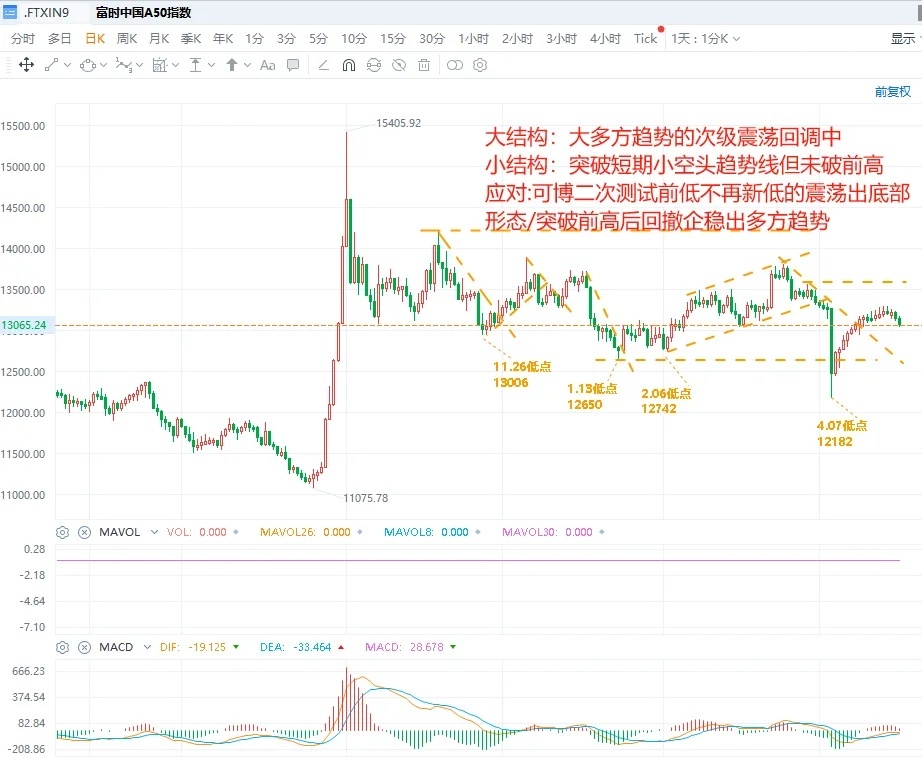
From the screenshot, it’s clear that the A50’s daily chart remains in a wide-range consolidation pullback within a broader uptrend.
On a smaller scale, there was a short-term breakout above a minor downtrend line, but the price started retreating below the previous high.
For swing traders, the plan is: After breaking the bearish medium-speed trendline, you can bet on a consolidation forming a bottom pattern (e.g., W-bottom/head-and-shoulders/triple bottom) without new lows, or a trend reversal after breaking the previous high and stabilizing on a pullback.
2. Hang Seng Index
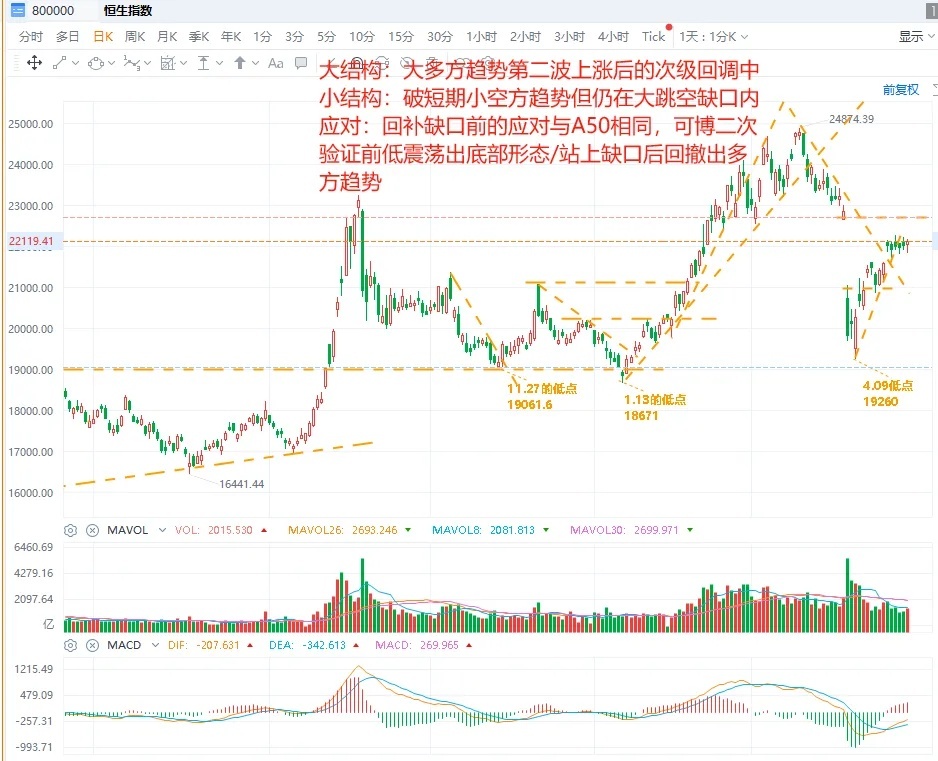
From the screenshot, the Hang Seng Index’s broader structure remains in a secondary pullback after the second wave of a major uptrend, as long as the January 13 low isn’t broken.
On a smaller scale: Last week’s analysis suggested that if the April 7 gap’s lowest point is treated as the previous high, a bullish trendline could be drawn. However, this trendline is too steep and would require strong bullish momentum to sustain—conditions that are clearly absent now.
This means the ideal trendline for participating in a pullback to bet on trend continuation should neither be too steep (requiring too much fuel and bullish momentum) nor too flat (indicating a weak trend).
Generally, a trendline slope of 45-60° is optimal, as it’s likely to continue without major news or overbought conditions.
For swing traders, the current plan is: After breaking the bearish medium-speed trendline, you can bet on a consolidation forming a bottom pattern (e.g., W-bottom/head-and-shoulders/triple bottom) without new lows, or a trend reversal after stabilizing above the gap, or a new bullish trend forming within the gap.
3. The Hang Seng Tech Index’s movement is similar to the Hang Seng Index but weaker in the short term. The strategy is the same as for the Hang Seng Index.
Note: The above is purely my personal analysis as a swing trader. It may not be accurate or comprehensive, so please refer to it rationally.
I hope my sharing is helpful to you. See you in the next article.
Special Disclaimer: This article only shares Wealth Mom’s trading system philosophy and investment logic. It does not constitute any investment advice. If any stocks are mentioned, they are not recommendations. The stock market is risky, so invest cautiously and refer to this rationally!
The copyright of this article belongs to the original author/organization.
The views expressed herein are solely those of the author and do not reflect the stance of the platform. The content is intended for investment reference purposes only and shall not be considered as investment advice. Please contact us if you have any questions or suggestions regarding the content services provided by the platform.
